Introduction
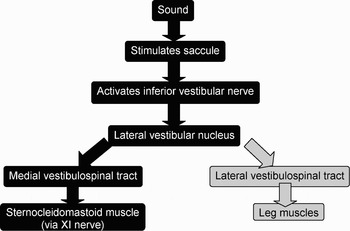
The sacculo-collic reflex is a short latency, otolith-mediated myogenic response elicited by application of a sound stimulus and measured with sternocleidomastoid electromyography. It has been suggestedReference Colebatch, Halmagyi and Skuse1–Reference Kushiro and Zakir5 that the saccule is stimulated by movement of the stapes footplate in response to a sound impulse, and the neck muscles are subsequently stimulated via the inferior division of the vestibular nerve, the lateral vestibular nucleus in the brainstem and the medial vestibulospinal tract. Although the response has predominantly been recorded in the sternocleidomastoid muscle, similar responses can be recorded in the lower limbs, where the impulse is thought to pass via the lateral vestibulospinal tract (see Figure 1).Reference Li, Houlden and Tomlinson6
The proposed sacculo-collic pathway.

Vestibular evoked myogenic responses were first demonstrated by Bickford et al. in 1964.Reference Bickford, Jacobson and Cody7 These authors differentiated short-latency (13 ms), repetitive responses from the startle reflex, which has a longer latency (50 ms) and a long refractory period. Voluntary muscle activity was also ruled out as it has a much longer latency (approx 100 ms). In 1971, Townsend and CodyReference Townsend and Cody8 suggested localisation of the response to the saccule, on the basis that the response was preserved in patients with chemically ablated semicircular canals but was absent in those with advanced Ménière's disease and following cochleosacculotomy. Localisation of the sacculo-collic response to the vestibular nerve was proposed by Colebatch et al. (1994)Reference Colebatch, Halmagyi and Skuse1 and by Halmagyi and Colebatch (1995).Reference Halmagyi and Colebatch9 These studies demonstrated loss of the response following selective vestibular nerve section, and loss or prolonged latency of the response in patients with vestibular neuritis. Proposed localisation of the response to the inferior portion of the vestibular nerve is based on the observation that patients with vestibular schwannoma have an absent or abnormal sacculo-collic response on the affected side,Reference Murofushi, Matsuzaki and Mizuno10 with the majority (84.8 per cent) of acoustic neuromas arising from the inferior portion of the nerve.Reference Komatsuzaki and Tsunoda11
The primary function of the saccule in humans is the detection of linear acceleration. The sensitivity of the human saccule to acoustic stimulation is thought to be an evolutionary remnant.Reference McCue and Guinan12, Reference Todd, Cody and Banks13 More primitive animals, such as fish, respond to environmental sound despite having no cochlea, through the stimulation of a saccular pressure wave by sound stimuli.Reference Popper, Platt and Saidal14 Amphibians and reptiles have no cochlea but possess a more complex saccular structure than fish, which enables them to respond to different sounds. Mammals have been widely demonstrated to have vestibular systems with balance as their primary function but which are also sound-responsive. The mammalian inner ear has developed a highly specialised structure for sound sensitivity – the cochlea – but the mammalian vestibular system remains sensitive to environmental sound. This evolutionary remnant is a potentially valuable tool for assessment of the human vestibular system and its nervous supply.
If the proposed sacculo-collic pathway is correct, one would expect an absent response in patients with stapes fixation when an air-conducted sound stimulus is applied via calibrated headphones. Following successful stapes surgery and closure of the air–bone gap, one might expect the sacculo-collic response to be restored, since sound stimuli are being successfully transmitted to the vestibule by the stapes piston prosthesis. However, the reduction of the effective area of the footplate might prevent this from happening. Considering that the saccule and utricle lie within the vestibule deep to the stapes footplate, insertion of a piston into the vestibule during surgery could traumatise these structures, either directly or as a result of hydraulic effects. The saccule is probably more at risk as it lies in the direct line of insertion during surgery. On this basis, an abnormal result might be expected in patients who have had successful closure of their air–bone gap but who have sustained iatrogenic saccular damage.
Most patients who undergo stapes surgery report a transient disturbance of balance, and a small minority experience chronic balance disturbance following surgery. An understanding of the nature of the vestibular disturbance following stapes surgery, and in particular the site of the lesion, may help to reduce the likelihood of damage by informing modifications in technique.
The aim of this study was to confirm the proposed sacculo-collic pathway, and to determine the effect of successful stapes surgery on the sacculo-collic response. This was done by analysing the response of patients who had undergone successful stapes surgery, patients with otosclerosis and controls.
Materials and methods
Fifty patients (70 ears following successful stapes surgery; 26 otosclerotic ears and four normal ears) and 40 controls underwent sacculo-collic testing. All stapes surgery patients were at least six months post-operative, having had successful closure of their otosclerotic air–bone gap.
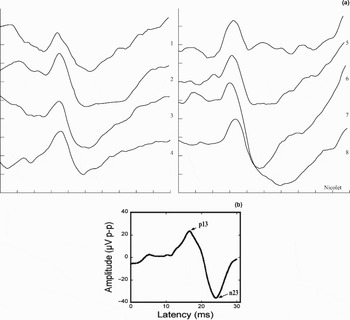
Each ear was presented with monaural repetitions of 100 × 90 dB clicks, via calibrated headphones, at 200 ms intervals. The sternocleidomastoid muscles were tensed during the sound stimuli, and evoked myogenic potentials in these muscles were recorded with surface electromyography electrodes. The evoked myogenic potentials were averaged and recorded. This was repeated a minimum of four times on each ear to ensure reproducibility (see Figure 2).
The normal sacculo-collic response. (a) The reproducible myogenic response to sound; (b) Diagrammatic representation.

In order to qualify as a normal sacculo-collic response, the recorded myogenic waves had to be reproducible, and to demonstrate specific myogenic potentials at 13 and 23 ms.
The amplitudes of the evoked myogenic responses were not analysed. The latency of the responses was measured and was normal (13 and 23 ms) in every ear with a positive response. The results were thereafter recorded in a simplified manner, as either normal or absent.
Results
The results of the sacculo-collic tests are shown in Table I. All of the control ears produced a normal sacculo-collic response, as did all of the patients' normal (non-otosclerotic) ears.
Sacculo-collic responses in ears with otosclerosis and previous stapes surgery, and controls

All of the otosclerotic ears had an absent sacculo-collic response (as would be expected), since, when elicited by air-conducted sound, the sacculo-collic response requires a mobile ossicular chain in order to transmit a pressure wave to the saccule when a sound stimulus is applied.
Of the 70 ears which had undergone stapes surgery, 65 had an absent sacculo-collic response and five had an intact response. On further analysis, these cases appeared to be divided according to the timing and nature of the stapes surgery.
The 65 ears with absent sacculo-collic responses had all undergone surgery (i.e. successful stapedotomy) between 1985 and 2005. Conversely, the five ears with normal sacculo-collic responses had all undergone surgery between 1979 and 1985, i.e. prior to the introduction of micro-drills.
Discussion
The results of this study support the proposed mechanism and pathway for the sacculo-collic response. They also correlate with physiological and evolutionary theories regarding the otolith organs. Significantly, localisation of the sacculo-collic reflex to the vestibular nerve is demonstrated by this study. If the sacculo-collic response had been mediated by sound transmission, all patients who had had closure of their air–bone gap following successful stapes surgery would be expected to have a response.
The results of the patients who had undergone successful stapes surgery are divided into two discrete groups: those having undergone stapedectomy, with an intact sacculo-collic response; and those having undergone stapedotomy, with an absent sacculo-collic response despite having had their conductive hearing loss reversed. There are several possible explanations for this.
In the 65 ears which had undergone successful stapedotomy, all with an absent sacculo-collic response, one might wonder whether saccular damage had been sustained during piston insertion at the time of surgery, especially as the response was preserved in those ears which had undergone successful stapes surgery at a time when larger fenestra were standard practice. If the sacculo-collic response correlated with balance symptoms following stapes surgery, this could be an entirely feasible explanation.
However, of the 65 stapedotomy patients with an absent sacculo-collic response, only 27 (41.5 per cent) reported post-operative balance symptoms. Of these, 19 patients (29 per cent of total) reported balance symptoms lasting less than 48 hours which completely resolved, and eight patients (12 per cent of total) reported balance symptoms which lasted up to four weeks and then completely resolved. One patient in this group reported longstanding balance symptoms before surgery, which remained unchanged following her successful stapes surgery. However, of the five patients undergoing successful stapedectomy and having an intact sacculo-collic response, all reported post-operative balance symptoms which lasted between one and 12 months.
According to these findings, an absent sacculo-collic response following successful stapes surgery appears not to correlate with balance symptoms. Whilst the absence of a sacculo-collic response might be due to iatrogenic saccular damage during stapes piston prosthesis insertion, the absence of longstanding balance symptoms in these patients suggests that, if this is the case, patients are able to compensate for their loss of saccular function within a matter of weeks. The higher incidence of balance symptoms in those undergoing surgery prior to 1985 suggests that factors other than saccular damage contribute to balance symptoms following stapes surgery. The most important of these is perilymph leakage, which is minimised with the use of a vein graft and/or a smaller fenestration.
Another explanation for these results is that, whilst a stapes piston prosthesis is effective for transmitting sound to the inner ear and thus restoring hearing, it is ineffective in transmitting a sufficient pressure wave to the saccule to elicit a normal sacculo-collic response. This hypothesis could be tested by repeating the sacculo-collic test on the same patient groups, using bone-conducted sound stimuli. Welgampola et al. Reference Welgampola, Rosengren, Halmagyi and Colebatch15 have demonstrated that sacculo-collic responses can be elicited by bone conduction in subjects with conductive hearing loss and no evidence of vestibular pathology.
• This study supports current evidence that the sacculo-collic response is triggered by a pressure wave within the vestibule, and that the myogenic response to sound is mediated via the vestibular nerve
• Following successful small fenestra stapedotomy, the sacculo-collic response is absent
• The sacculo-collic test has potential value as a clinical tool in diagnosing lesions of the saccule and inferior vestibular nerve, but in patients having undergone stapes surgery it has no clear correlation with balance symptoms
• The effect of stapes surgery on the saccule could further be investigated by using bone-conducted sound stimuli to assess post-operative saccular function
There was one unexpected result in a control case, in which the sacculo-collic response was unilaterally absent on repeated testing. However, the control admitted to having a ‘blocked’ ear, and pure tone audiometry revealed a conductive hearing loss on the affected side. This ear was therefore excluded from the control group, giving a total of 79 control ears from 40 control patients.
Conclusion
This study supports current evidence that the sacculo-collic response is triggered by a pressure wave within the vestibule, and that the myogenic response to sound is mediated via the vestibular nerve.
Following successful small fenestra stapedotomy, the sacculo-collic response was demonstrably absent.
The sacculo-collic test has potential value as a clinical tool in diagnosing lesions of the saccule and inferior vestibular nerve. However, in patients who have undergone stapes surgery, it has no clear correlation with balance symptoms.
The effect of stapes surgery on the saccule could be further investigated by using bone-conducted sound stimuli to assess post-operative saccular function.