Implications
In this study, the administration of creatine pyruvate (Cr-Pyr, a new compound, which contains pure pyruvic acid molecularly bound to pure pharmaceutical grade creatine at a concentration ratio of 40 : 60) was compared with the administration of Pyr or Cr alone for its effect on lipid and protein metabolism in broilers. The insights gained from this study will provide a better understanding of the mechanisms involved in the Cr-Pyr effect on broiler chickens. Further clarity will help the industry to avoid obesity-related problems during production and explore new ways to improve muscle growth in broilers.
Introduction
Production of broiler chickens containing excess body fat is a problem in the poultry industry. Several factors, such as nutrients and genetics, contribute to the tendency for broilers to accumulate excess body fat (Mallard and Douaire, Reference Mallard and Douaire1988). Therefore, improving carcass composition by the inclusion of targeted feed additives has become a primary focus of nutrition research. Pyruvate (Pyr) is a three-carbon compound that serves as the gateway compound between the glycolytic pathway and the Krebs cycle. Under aerobic conditions, Pyr is shuttled into the mitochondria, where it is converted into acetyl coenzyme A by the Pyr dehydrogenase complex. Several previous studies have indicated that calcium and/or sodium Pyr supplementation enhances weight and fat loss and improves exercise capacity, primarily in overweight individuals (Stanko et al., Reference Stanko, Robertson, Galbreath, Reilly, Greenawalt and Goss1990 and Reference Stanko, Tietze and Arch1992). Hence, Pyr has recently become a popular weight-loss supplement and a proposed ergogenic aid.
Along with excessive fat deposition, poor meat quality attracts increasing consumer concern, and protein synthesis is an important factor in the determination of meat quality and growth in broilers. Creatine (Cr, methyl guanidine acetic acid) represents one of the most important nitrogen containing compounds in protein and energy metabolism (Navratil et al., Reference Navratil, Kohlikova, Petr, Heyrovsky, Pelclova, Pristoupilova, Pristoupil and Senholdova2009). It is an organic compound that is directly involved in the muscle energy buffering system. Cr supplementation has been reported to increase muscle Cr and phosphorylcreatine contents by 5% to 30% (Harris et al., Reference Harris, Soderlund and Hultman1992). In addition, Cr loading has been widely studied, due to its potential ergogenic effect in sports performance. For example, Cr supplementation in humans has been reported to elevate muscle total Cr content (Harris et al., Reference Harris, Soderlund and Hultman1992; Hultman et al., Reference Hultman, Soderlund, Timmons, Cederblad and Greenhaff1996) and increase muscle mass (Vandenberghe et al., Reference Vandenberghe, Goris, Van-Hecke, Van-Leemputte, Vangerven and Hespel1997). Young et al. (Reference Young, Bertram, Theil, Petersen, Poulsen, Rasmussen, Malmendal, Nielsen, Vestergaard and Oksbjerg2007) observed that protein synthesis increased in primary myotubes when exposed to Cr monohydrate, whereas protein degradation was unaffected.
Although Pyr and Cr play important roles in lipid and protein metabolism, their intake is not without potential problems. Pyruvic acid is most commonly bound to calcium or sodium. High-sodium intake causes fluid retention, and excessive calcium intake can lead to calcium deposits in muscle and promote the formation of kidney and gallstones. Cr most commonly exists in the monohydrate form, but it can also be bound to either citrate or phosphate. The monohydrate or crystalline water portion of the product causes measurable fluid retention, which some find undesirable.
Creatine pyruvate (Cr-Pyr) is a new compound, which contains pure pyruvic acid molecularly bound to pure pharmaceutical grade Cr at a concentration ratio of 40 : 60. Pyr is formed in the body as a byproduct of normal carbohydrate and protein metabolism. Thus, pyruvic acid can be bound to Cr to enhance the use of both compounds (Cr-Pyr). A large body of research exists on the effects of Pyr (Stanko et al., Reference Stanko, Tietze and Arch1992; Brenner et al., Reference Brenner, Walberg and Sebolt2000; Pauline et al., Reference Pauline, Maria, Mike, Rodney, Patty, Almada and Richard2005) and Cr in rats, pigs and humans (Willoughby and Rosene, Reference Willoughby and Rosene2003; Rosenvold et al., Reference Rosenvold, Bertram and Young2007; Young et al., Reference Young, Bertram, Theil, Petersen, Poulsen, Rasmussen, Malmendal, Nielsen, Vestergaard and Oksbjerg2007), but little is known about the effect of the combined compound Cr-Pyr, especially in animals.
Our previous study (Chen et al., unpublished results) indicated that supplementation with 5% Cr-Pyr improves both lipid and protein metabolism through the regulation of various metabolic indicators, although not adversely affecting growth performance in broiler chickens. Therefore, this inclusion level was used to determine the dose of Pyr (2%) and Cr (3%), according to the concentration ratio of 40 : 60. In this study, the administration of Cr-Pyr was compared with the administration of Pyr or Cr alone for its effect on lipid and protein metabolism in broilers.
Material and methods
Animals and housing
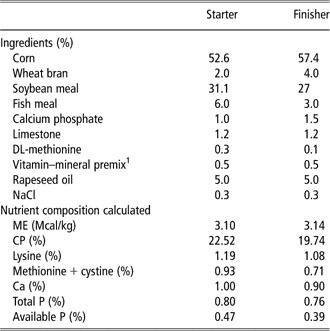
A total of 400 1-day-old male broiler chickens (Arbor Acres), obtained from Jiangsu Wuxi chicken breeding company (Wuxi, China), were weighted and allocated to four treatment groups, each of which included four replicates of 25 birds. The birds were offered the same basal diet from 1 to 42 days (starter phase = 1 to 21 days; finisher phase = 22 to 42 days). Dietary nutrient levels were based on NRC (National Research Council, 1994) recommended nutrient requirements for broiler chickens (Table 1; Yang et al., Reference Yang, Chen, Hong, Liu and Liu200). The animal care and use protocol was approved by the Institutional Animal Care and Use Committee of Nanjing Agricultural University.
Ingredient composition and nutrient content of diets

ME = metabolizable energy.
Nutrient level of the diets was based on National Research Council recommendations.
1Vitamin–mineral premix supplied the following per kilogram of diet: vitamin A, 1500 IU; vitamin D3, 200 IU; vitamin E, 10 mg; vitamin K3, 0.5 mg; thiamine, 1.8 mg; riboflavin, 3.6 mg; D-pantothenic acid, 10 mg; folic acid, 0.55 mg; pyridoxine, 3.5 mg; niacin, 35 mg; cobalamin, 0.01 mg; biotin, 0.15 mg; Fe, 80 mg; Cu, 8 mg; Mn, 60 mg; Zn, 40 mg; I, 0.35 mg; and Se, 0.15 mg.
Treatment and diets
During the finisher phase, the four groups were an unsupplemented control, 2% Pyr, 5% Cr-Pyr or 3% Cr (Nanjing Qiaokang Biotechnology Corporation, China). The chicks were housed in lighted coops, water was continuously provided and constant lighting was maintained. The temperature was set at 32°C for the first 5 days and then gradually reduced according to normal management practices, until a temperature of 22°C was achieved. The broilers were floor-reared under natural lighting during the finisher phase, and the chickens were weighed at 1, 21 and 42 days of age to determine average daily gain (ADG). Everyday, feed consumption per replicate was recorded, the uneaten feed was discarded and fresh feed was replenished. Average daily feed intake (ADFI) and the feed conversion ratio were then determined. At the end of the experiment, birds were randomly selected, deprived of feed for 12 h, weighed and killed. The abdominal fat pad, pectoral and leg muscles were subsequently removed and weighed.
Measurement of metabolic parameters
Liver and muscle were collected and snap-frozen in liquid nitrogen. Frozen tissues were stored at −70°C before analysis. Blood samples were allowed to clot at 4°C and centrifuged at 3000 × g for 10 min before harvesting the serum, and the serum samples were then stored at −20°C until assayed. The aforementioned blood samples were used to detect triglyceride (TG), high-density lipoprotein cholesterol (HDL-C), low-density lipoprotein cholesterol (LDL-C), non-esterified fatty acid (NEFA), uric acid (UA) and creatinine (CR), using commercial kits (Nanjing Jiancheng Biotechnology Institution, China). Liver TG content was determined on homogenized liver samples using a mixture of chloroform and methanol (2 : 1, v/v), according to the method of Folch et al. (Reference Folch, Lee and Slane-Stanley1957). Approximately 100 mg of liver was homogenized on ice with 1 ml of physiological saline. An aliquot of these homogenates was used to determine glutamic-pyruvic transaminase (GPT) and glutamic-oxaloacetic transaminase (GOT) using commercial kits that were bought from the Nanjing Jiancheng Bioengineering Institute.
Real-time quantitative reverse transcriptase PCR
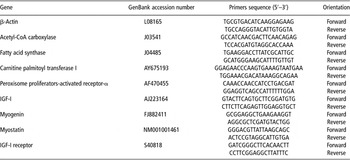
Total RNA was extracted from liver and muscle samples using TRIZOL reagent (Takara, Japan) according to the manufacturer's protocol. Reverse transcription was performed using the method of Zhao et al. (Reference Zhao, Ma, Zou and Chen2007). An aliquot of complementary DNA sample was mixed with 25 μl SYBR_Green PCR Master Mix (Takara, Japan) in the presence of 10 pmol of each forward and reverse primers for β-actin (used as an internal control; GenBank accession no. L08165), acetyl-CoA carboxylase (ACC, GenBank accession no. J03541), fatty acid synthase (FAS, GenBank accession no. J04485), peroxisome proliferators-activated receptor-α (PPAR-α, GenBank accession no. AF470455), carnitine palmitoyl transferase I (CPT-I, GenBank accession no. AY675193), insulin-like growth factor 1 (IGF-I, GenBank accession no. AJ223164), IGF-I receptor (IGF-IR, GenBank accession no. S40818), myogenin (GenBank accession no. FJ882411) and myostatin (GenBank accession no. NM001001461) mRNA (Table 2), and then it was subjected to PCR under standard conditions (45 cycles). All samples were analyzed in duplicate using the ABI Prism 7300 Sequence Detection System (Applied Biosystems, Stockholm, Sweden) and programmed to conduct one cycle (95°C for 1 min) and 45 cycles (95°C for 20 s, 64°C for 30 s and 72°C for 30 s). Fold change was calculated using the 2−ΔΔct method.
Oligonucleotide PCR primers

IGF-I = insulin-like growth factor I.
The primers for the β-actin, ACC and CPT-I were designed and synthesized by Takara Biotechnology Co. Ltd (Dalian, China). Repeated experiments confirmed that β-actin was stable and reliable as an internal reference for the real-time PCR, and it was widely used in some published articles (Zhao et al., Reference Zhao, Ma, Zou and Chen2007; Hu et al., Reference Hu, Ni, Ren, Dai and Zhao2008; Chen et al., Reference Chen, Tang, Zhang, Ma and Zou2010). The other primers used (FAS, PPAR-α) were determined according to the published guidelines (Zhao et al., Reference Zhao, Ma, Zou and Chen2007; Collin et al., Reference Collin, Swennen, Skiba, Buyse, Chartrin, Le Bihan-Duval, Crochef, Duclos, Joubert, Decuypere and Tesseraud2009) or designed by Primes Premier 5 (IGF-I, IGF-IR, myogenin and myostatin).
Statistical analysis
The experimental data were expressed as the mean ± s.e., and differences were considered significant when P < 0.05, as tested by Multiple Comparisons of variance (one-way ANOVA, to compare interactions among Control, Cr, Pyr and the Cr-Pyr), using the Statistical Packages for Social Science 16.0 and Excel 2003 in Microsoft. Replicate was considered as the experimental unit for the entire index determined.
Results
Growth performance
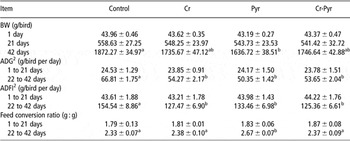
No differences in body weight (BW) or feed conversion efficiency were observed in male broilers following Cr-Pyr or Cr administration from 22 to 42 days (P > 0.05). ADG and ADFI for the three groups were significantly lower (P < 0.05) than in the control group, whereas BW was lower and the feed conversion ratio was higher in the Pyr group (P < 0.01). There were no significant differences among the three groups (P > 0.05; Table 3).
Effect of Cr, Pyr and Cr-Pyr on growth performance of male broilers from 22 to 42 days of ageFootnote 1

Cr = creatine; Pyr = pyruvate; Cr-Pyr = creatine-pyruvate; ADG = average daily gain; ADFI = average daily feed intake.
1 Data in each group represent mean values of four replicates, one replicate indicating the average of 25 chickens in one cage.
a,b Values indicate the results of significance testing for difference between treatments. Unshared letters indicate significant difference among treatment groups P < 0.05, while shared letters indicate no significant difference.
Carcass composition
As a portion of total BW, the abdominal fat in the three experimental groups tended to be lower than in the control group (0.05 < P < 0.1). A marked increase in leg muscle mass was noted in the Cr-Pyr group (P < 0.05). There were no significant differences among the three groups (P > 0.05; Table 4).
Effect of Cr, Pyr and Cr-Pyr on carcass composition of male broilersFootnote 1

Cr = creatine; Pyr = pyruvate; Cr-Pyr = creatine-pyruvate.
1 Values are means ± s.e.m. Each treated group represents 12 chickens at the age of 42 days (12 chickens per treatment are representative of 3 birds per replicate).
a,b Values indicate the results of significance testing for difference between treatments. Unshared letters indicate significant difference among treatment groups P < 0.05, while shared letters indicate no significant difference.
Lipid metabolism
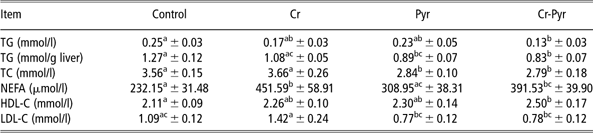
Supplementation with Cr had little effect on lipid metabolism (P > 0.05). The hepatic TG content and the serum total cholesterol (TC) concentration were lower (P < 0.01) in the Cr-Pyr and Pyr groups. Furthermore, the serum TG content was depressed and the blood NEFA and HDL-C contents were elevated in the Cr-Pyr group (P < 0.05). Compared with Cr, the Cr-Pyr and Pyr caused a marked decrease in the hepatic TG, serum TC and LDL-C concentration (P < 0.05; Table 5).
Effect of Cr, Pyr and Cr-Pyr on lipid metabolic parameters in serum and liver of broilersFootnote 1
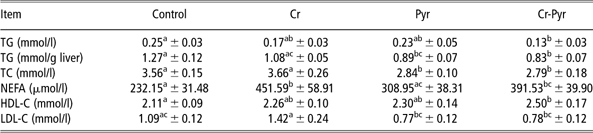
Cr = creatine; Pyr = pyruvate; Cr-Pyr = creatine pyruvate; TG = triglyceride; TC = total cholesterol; NEFA = non-esterified fatty acid; HDL-C = high-density lipoprotein cholesterol; LDL-C = low-density lipoprotein cholesterol.
1 Values are means ± s.e.m. Each treated group represents 12 chickens at the age of 42 days (12 chickens per treatment are representative of three birds per replicate).
a,b,c Values indicate the results of significance testing for difference between treatments. Unshared letters indicate significant difference among treatment groups P < 0.05, while shared letters indicate no significant difference.
Protein metabolism
The serum UA content was lower (P < 0.05) in the Cr-Pyr and Cr group, and a marked decrease (P < 0.05) in liver GOT activity for each of the three treatment groups was evident. However, Cr-Pyr treatment had no effect (P > 0.05) on serum CR and GPT activity in the livers of male broilers, as compared with the control animals (Table 6).
Effect of Cr, Pyr and Cr-Pyr on protein metabolic parameters in serum and muscle of broilersFootnote 1

Cr = creatine; Pyr = pyruvate; Cr-Pyr = creatine pyruvate; UA = uric acid; CR = creatinine; GPT = glutamic-pyruvic transaminase; GOT = glutamic- oxaloacetic transaminase.
1 Values are means ± s.e.m. Each treated group represents 12 chickens at the age of 42 days (12 chickens per treatment are representative of 3 birds per replicate).
a,b,c,d Values indicate the results of significance testing for difference between treatments. Unshared letters indicate significant difference among treatment groups P < 0.05, while shared letters indicate no significant difference.
Hepatic lipid metabolic gene expression
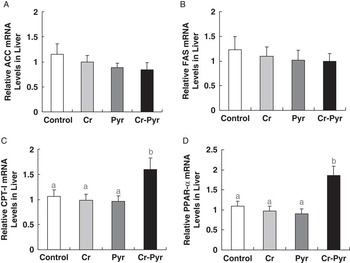
No significant differences were observed in hepatic lipid metabolic gene expression in the Pyr and Cr groups (P > 0.05). As shown in Figure 1c and d, CPT-I (P < 0.05) and PPAR-α (P < 0.01) gene expression were markedly elevated in the Cr-Pyr group than in the control group, also than in the Pyr and Cr groups (P < 0.05).
Effect of creatine (Cr), pyruvate (Pyr) and creatine pyruvate (Cr-Pyr) on (A) ACC, (B) FAS, (C) CPT-I and (D) PPAR-α gene expression in the liver of broilers. Values are means ± s.e., n = 12 (12 chickens per treatment are representative of three birds per replicate). In the figure a and b indicate the results of significance testing for difference between treatments. Unshared letters indicate significant difference among treatment groups (P < 0.05), whereas shared letters indicate no significant difference.

Muscle protein metabolic gene expression
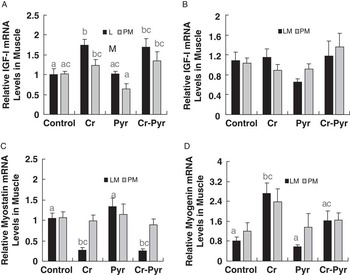
As shown in Figure 2, no treatment had any affect on protein gene expression in the pectoral muscle of broilers (P > 0.05). In leg muscle, IGF-I (P < 0.05) gene expression was increased in birds treated with Cr-Pyr and Cr (Figure 2a), whereas IGF-IR mRNA abundance (Figure 2b) was unaffected in the Cr-Pyr group (P > 0.05). Furthermore, myostatin gene expression was depressed (P < 0.01) in the Cr-Pyr and Cr groups (Figure 2c), whereas myogenin expression was elevated in the Cr group (P < 0.01; Figure 2d). The comparison of three groups indicated that IGF-I (leg muscle) and myogenin gene expression was significantly higher in the Cr group than in the Pyr group (P < 0.05); compared with the Pyr group, the Cr-Pyr and Cr groups were significantly changed IGF-I (pectoral muscle) and myostatin gene expression (P < 0.05).
Effect of creatine (Cr), pyruvate (Pyr) and creatine pyruvate (Cr-Pyr) on (A) IGF-I, (B) IGF-I receptor, (C) myostatin and (D) myogenin gene expression in the muscle (include leg muscle (LM) and pectoral muscle (PM)) of broilers. Values are means ± s.e., n = 12 (12 chickens per treatment are representative of four birds per replicate). In the figure a, b and c indicate the results of significance testing for difference between treatments. Unshared letters indicate significant difference among treatment groups (P < 0.05), whereas shared letters indicate no significant difference.

Discussion
Pyr markedly decreased BW, ADG, ADFI and increased feed conversion in broilers. The same growth performance criteria were not affected in the Cr-Pyr and Cr supplemented groups throughout the duration of the trial Johnstone et al. (Reference Johnstone, Klasing, Calvert and Hannah1989) found that supplementation of pyruvate/dihydroxyacetone (1 : 1; Pyr/D) to the diet significantly decreased the BW of Single Comb White Leghorn pullets. Cortez et al. (Reference Cortez, Torgan, Brozinick, Miller and Ivy1991), and Ivy et al. (Reference Ivy, Cortez, Chandler, Byrne and Miller1994) also showed that Pyr fed for 3 to 5 weeks to rats results in decreased BW. Although Cr and Cr-Pyr reduced ADG and ADFI, BW was not affected in the Cr and Cr-Pyr broilers throughout the length of the trial. With the reduced abdominal fat and increased leg muscle as a proportion of total carcass, we presumed that Cr and Cr-Pyr reduced the fat deposition, meanwhile, increased in muscle mass, so the BW was not changed.
The hepatic TG content and the serum TC concentration were both depressed by addition of 5% Cr-Pyr or 2% Pyr to the diet. This observation concurs with the findings of Goheen et al. (Reference Goheen, Pearson, Larkin and Rao1981), who reported that Pyr, D and/or riboflavin consumption could decrease the liver TG content. We also observed an increase in serum HDL-C content in the Cr-Pyr treatment group, which was consistent with the results reported by several other groups in which Pyr was found to promote fat loss and regulate cholesterol levels, presumably by increasing the concentration of plasma HDL (good) cholesterol (Stanko and Adibi, Reference Stanko and Adibi1986; Olson et al., Reference Olson, Schneeman and Freedland1991). Serum NEFA concentration is an important indicator of fat metabolism. In this experiment, an increase in serum NEFA in the Cr-Pyr group was observed, reflective of the increased hydrolysis of TG to glycerol and free fatty acids (Xu et al., Reference Xu, Wang, Mao, Zhan and Hu2003).
Another interesting observation was that expression of PPAR-α increased in the Cr-Pyr group, and that this was accompanied by increased expression of CPT-I. PPAR-α is a member of the nuclear hormone receptor family of transcription factors. It is expressed in the liver, heart, skeletal muscle and brown adipose tissue where it regulates genes that control mitochondrial and peroxisomal fatty acid oxidation (Schoonjans et al., Reference Schoonjans, Staels and Auwerx1996). Cr-Pyr administration resulted in increased PPAR-α expression in liver, which induced transcriptional upregulation of fatty acid transport proteins that facilitate fatty acid entry into cells and the activity of enzymes involved in the β-oxidation of fatty acids, resulting in decreased fatty acid synthesis (Schoonjans et al., Reference Schoonjans, Staels and Auwerx1996). CPT-I catalyzes the formation of long-chain acyl-carnitine from activated fatty acids and free carnitine, thus committing fatty acids to subsequent oxidation (Xu et al., Reference Xu, Wang, Mao, Zhan and Hu2003). Owing to its inhibition by malonyl-coenzyme (CoA), CPT-I controls the rate of β-oxidation and regulates the deposition or oxidation of fatty acids (McGarry et al., Reference McGarry, Takabayashi and Foster1978; Zammit, Reference Zammit1999). Rocchi and Auwerx (Reference Rocchi and Auwerx2000) showed that PPAR-α can increase the rate of fatty acid β-oxidation by increasing the expression of several PPAR-α target genes, such as CPT-I and acetyl-CoA carboxylase oxidase. These results suggest that Cr-Pyr increases the expression of CPT-I and PPAR-α in the liver and produces a higher rate of fatty acid β-oxidation, thus decreasing the accumulation of fat in broilers. Meanwhile, we found that adding 3% Cr had no effect on lipid metabolism in broilers.
The low level of serum urea nitrogen indicates a higher nitrogen utilization rate (Malmolf, Reference Malmolf1988). In our experiment, the content of serum UA fell in the presence of Cr-Pyr and Cr. This finding suggests that Cr-Pyr and Cr increased the nitrogen utilization rate and, presumably, the rate of protein synthesis. GPT and GOT activity reflect body protein synthesis and catabolism. Decreased GOT activity was evident in all the three treatment groups, which suggested that the rate of protein catabolism was higher in the control group. These results showed that 5% Cr-Pyr and 3% Cr had a profound influence on protein metabolism in broiler chickens.
IGF-I is known to stimulate proliferation, differentiation (Florini et al., Reference Florini, Ewton and Coolican1996; Oksbjerg et al., Reference Oksbjerg, Gondret and Vestergaard2004 and Reference Oksbjerg, Nissen and Vestergaard2006) and protein synthesis in muscle cells (Hembree et al., Reference Hembree, Hathaway and Dayton1991). Stimulation of muscle growth may be mediated by increased plasma IGF-I, which originates primarily from the liver or is produced locally in the muscle tissues (Louis et al., Reference Louis, Van-Beneden, Dehoux, Thissen and Francaux2004; Deldicque et al., Reference Deldicque, Louis, Theisen, Nielens, Dehoux, Thissen, Rennie and Francaux2005). In this study, the expression of IGF-I gene was significantly increased in leg muscle in both the Cr-Pyr and Cr groups, and this was accompanied by increased relative leg muscle weight. The previous studies indicated that Cr may increase differentiation and protein synthesis in ovine myogenic satellite cells (Vierck, et al., Reference Vierck, Icenoggle, Bucci and Dodson2003) and primary myotubes from chick embryos (Ingwall et al., Reference Ingwall, Weiner, Morales, Davis and Stockdale1974). In addition, several human studies have shown that Cr increases muscle protein (Balsom et al., Reference Balsom, Soderlund, Sjodin and Ekblom1995; Willoughby and Rosene, Reference Willoughby and Rosene2001; Deldicque et al., Reference Deldicque, Louis, Theisen, Nielens, Dehoux, Thissen, Rennie and Francaux2005). Therefore, it is important to note that 5% Cr-Pyr and 3% Cr may increase muscle protein synthesis in broiler chickens.
Besides IGF-I, muscle myostatin and myogenin genes were also measured. Myostatin belongs to the transforming growth factor-β super family, and it is expressed specifically in developing and mature skeletal muscle. It appears to act as a negative regulator of muscle development (Sonstegard et al., Reference Sonstegard, Rohrer and Smith1998). Myogenin is one of the most important genes concerned with muscle fiber formation, and its expression level is related to muscle growth (Grounds et al., Reference Grounds, Garrett, Lai, Wright and Beilharz1992; Koishi et al., Reference Koishi, Zhang, McLennan and Harris1995). Results obtained herein indicate that the expression level for the myostatin gene decreased in leg muscle after Cr-Pyr or Cr administration. Concomitantly, increased expression of myogenin gene was found in leg muscle, especially in the Cr group. This may be reflective of increased muscle growth potential.
The comparison of Cr, Pyr and Cr-Pyr treatment indicated that Cr-Pyr and Pyr had more obvious effect on lipid metabolism than Cr; but Cr-Pyr and Cr played an active role in protein metabolism. Compared with Pyr and Cr, the novel compound Cr-Pyr exhibited a bifunctional effect on lipid and protein metabolism in broilers.
In conclusion, the administration of 5% Cr-Pyr was accompanied by significant elevated levels of lipolysis in the liver and increased muscle protein synthesis. The insights gained from this study will provide a better understanding of the mechanisms involved in the Cr-Pyr effect on broiler chickens. Further clarity will help the industry to avoid obesity-related problems during production and explore new ways to improve muscle growth in broilers.
Acknowledgments
This study was supported by the National Natural Science Foundation of China (Grant no. 30600439). The authors are grateful to Dr William W. Riley for critical reading of the manuscript.