Introduction
Post-traumatic stress disorder (PTSD) can develop after a traumatic stressor and it affects approximately 5.7% of the general population in the USA (Kessler et al. Reference Kessler, Demler, Frank, Olfson, Pincus, Walters, Wang, Kenneth and Zaslavsky2005) and 1.1–2.9% in Europe (Wittchen et al. Reference Wittchen, Jacobi, Rehm, Gustavsson, Svensson, Jönsson, Olesen, Allgulander, Alonso and Faravelli2011). Intrusive symptoms are a core feature of PTSD comprising, inter alia, recurrent, involuntary and intrusive distressing traumatic memories (American Psychiatric Association, 2013).
Rodent and human studies provide cumulative evidence for the involvement of the noradrenergic system in PTSD neurobiology (Krystal & Neumeister, Reference Krystal and Neumeister2009; Bailey et al. Reference Bailey, Cordell, Sobin and Neumeister2013). For example, female adult PTSD patients who have been sexually abused during childhood show increased 24-h urinary norepinephrine (NE) compared with women who experienced childhood sexual abuse without PTSD diagnosis and non-abused controls (Lemieux & Coe, Reference Lemieux and Coe1995). Furthermore, female and male war refugee PTSD patients show increased salivary α-amylase (sAA) activity, an indicator of increased noradrenergic activation (Van Stegeren et al. Reference Van Stegeren, Rohleder, Everaerd and Wolf2006), after awakening compared with healthy controls, and sAA secretion is positively associated with reported PTSD symptoms (Thoma et al. Reference Thoma, Joksimovic, Kirschbaum, Wolf and Rohleder2012). In addition, pharmacological interventions with the α1 adrenergic antagonist prazosin, which blocks noradrenergic activation, have been shown to reduce trauma-related nightmares compared with placebo in women with PTSD (Taylor et al. Reference Taylor, Lowe, Thompson, McFall, Peskind, Kanter, Allison, Williams, Martin and Raskind2006).
However, little is known about the neurobiological influences on the formation of intrusions after traumatic stress. The noradrenergic system could be involved, as indicated by studies in which a relationship between increased NE and intrusive memories has been found (Southwick et al. Reference Southwick, Bremner, Rasmusson, Morgan, Arnsten and Charney1999). For example, in a study conducted by Southwick et al. (Reference Southwick, Krystal, Morgan, Johnson, Nagy, Nicolaou, Heninger and Charney1993), PTSD patients were administered a single dose of yohimbine, an α 2 selective antagonist that enhances noradrenergic activation, and placebo, each on a separate test day in a double-blind, randomized balanced order. Of the patients, 40% reported flashbacks in the yohimbine condition, while only 5% reported flashbacks in the placebo condition during the test day. Furthermore, in male and female PTSD patients, it has been found that the interaction of increased sAA activity and increased salivary cortisol levels during the consolidation of emotionally negative images predicts an increase in intrusive memories (Nicholson et al. Reference Nicholson, Bryant and Felmingham2014).
Sex-specific biological stress mechanisms involved in memory consolidation (Andreano & Cahill, Reference Andreano and Cahill2009) might be responsible for the inconsistent sex differences in intrusive memories in men and women (Felmingham et al. Reference Felmingham, Tran, Fong and Bryant2012; Bryant et al. Reference Bryant, McGrath and Felmingham2013). For example, women who underwent a cold pressor test before seeing emotionally negative images recalled more negative images after 2 days compared with men (Felmingham et al. Reference Felmingham, Tran, Fong and Bryant2012). Cortisol levels after the cold pressor test predicted the number of recalled negative images in women, and neutral images in men (Felmingham et al. Reference Felmingham, Tran, Fong and Bryant2012). In contrast, the interaction of increased sAA activity and increased salivary cortisol levels during the consolidation of emotionally negative images predicts an increase in intrusive memories in men but not in women (Bryant et al. Reference Bryant, McGrath and Felmingham2013).
The lack of suitable experimental designs to examine the neurobiology of the formation of intrusive memories has so far limited the number of studies. Recently, trauma film paradigms have been shown to induce short-lasting intrusive memories in healthy individuals (e.g. Holmes & Bourne, Reference Holmes and Bourne2008). The only study that has, so far, examined associations among salivary cortisol, sAA, and intrusion formation within the trauma film paradigm found a positive correlation between post-film salivary cortisol levels and the frequency of intrusions, however, only in individuals with increased sAA activity (Chou et al. Reference Chou, La Marca, Steptoe and Brewin2014).
In contrast to the scarce evidence regarding the influence of the noradrenergic stress system on intrusion formation, there are a large number of studies investigating the influence of the noradrenergic system on other aspects of memory and emotional learning in humans (Van Stegeren, Reference Van Stegeren2008; Roozendaal & McGaugh, Reference Roozendaal and McGaugh2011; Schwabe et al. Reference Schwabe, Joëls, Roozendaal, Wolf and Oitzl2012). The administration of adrenergic receptor blockers (e.g. propranolol) leads to impaired memory performance for emotional events and stimuli in humans, while pharmacological noradrenergic activation (e.g. yohimbine) during encoding and consolidation enhances memory for emotional stimuli in the majority of studies (Chamberlain & Robbins, Reference Chamberlain and Robbins2013). A positive association between sAA, assessed shortly after the presentation of emotionally arousing pictures, and memory of these pictures 1 week later has been found in healthy participants (Segal & Cahill, Reference Segal and Cahill2009).
In addition to the catecholaminergic system, the hypothalamus–pituitary–adrenal (HPA) axis releases cortisol when it is activated, and has an impact on the formation of emotional memory during encoding and consolidation in healthy individuals (Schwabe et al. Reference Schwabe, Joëls, Roozendaal, Wolf and Oitzl2012; Finsterwald & Alberini, Reference Finsterwald and Alberini2014). For instance, elevated cortisol levels during encoding and consolidation after administration of hydrocortisone improve memory performance for emotionally arousing pictures compared with neutral pictures (Kuhlmann & Wolf, Reference Kuhlmann and Wolf2006). Therefore, cortisol levels during trauma might be relevant in the formation of intrusions.
The aim of the current study was to examine the potential influence of noradrenergic activity during traumatic stress (trauma film) in healthy women on the consecutive development of intrusive memories in an experimental design. We hypothesized that noradrenergic activation would lead to an increased number of intrusive memories of the trauma film, more vivid intrusions, and more distressing intrusions of the trauma film compared with placebo and inhibited noradrenergic activity. In addition, it was hypothesized that lower noradrenergic activity would lead to a decreased number of intrusions, decreased vividness and decreased distress of intrusions compared with placebo.
Method
Participants
A total of 118 healthy university students were recruited via official university email lists or public postings. As the rape victim in the trauma film is female, the sample was restricted to women to increase homogeneity of our sample. Furthermore, pilot runs with the trauma film including male and female participants had shown that men did not identify themselves with the victim but rather with a male witness. Exclusion criteria included former or present Diagnostic and Statistical Manual of Mental Disorders, 4th edition (DSM-IV) Axis I disorders (assessed by the Structured Clinical Interview for DSM-IV Axis I Disorders; German version of First et al. Reference First, Spitzer, Gibbon and Williams1995), physical illnesses, any medication intake (except oral contraceptive), history of sexual abuse or rape, and pregnancy or lactation period. The HCG ULTRA pregnancy test was implemented to exclude pregnancy. All women were between 18 and 44 years old (see Table 1) and spoke German on a native level. Out of the 118 participants, four women were excluded: two participants withdrew from the study after having watched the film for several minutes, one participant was excluded due to fatigue during the session after taking clonidine, and one participant was excluded due to missing diary data. This resulted in the final sample size of n = 114. All participants received financial remuneration (35€).
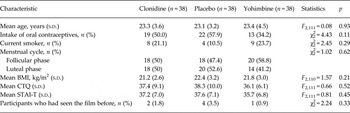
Sample characteristics

s.d., Standard deviation; BMI, body mass index; CTQ, Childhood Trauma Questionnaire; STAI-T, trait scale of the Trait Anxiety Inventory.
Procedure
The randomized, double-blind, placebo-controlled study was conducted at the Department of Psychiatry and Psychotherapy, Campus Benjamin Franklin, Charité – Universitätsmedizin Berlin, and was approved by the local ethics committee. Participants were asked to refrain from smoking, physical exercise, eating, consuming caffeine, and drinking alcohol or other beverages (except for water) at least 1 h prior to the assessment. Written informed consent was obtained at least 24 h before the assessment. Each participant was tested on a separate day.
Experimental phase
Participants were randomly assigned to either clonidine (0.15 mg), inhibiting noradrenergic activity, placebo, or yohimbine (10 mg), stimulating noradrenergic activity. The pills for both drugs as well as the placebo looked identical, hence ensuring that the experimenter was also blind to the experimental condition.
Administration was conducted 60 min before the trauma film, since peak plasma levels of oral clonidine occur after 60–90 min with an elimination half-life of about 6 to 12 h (Reid, Reference Reid1981) and oral yohimbine peaks in plasma after 45–60 min with an elimination half-life of about 0.60 (s.d. = 0.25) h (Owen et al. Reference Owen, Nakatsu, Fenemore, Condra, Surridge and Morales1987). Potential effects of the medication and the trauma film on salivary cortisol levels, sAA activity and blood pressure were measured at seven time points during the study. To do so, saliva was collected and blood pressure was measured by an automatic device (BoSo Medicus Uno; Bosch + Sohn, Germany) at baseline, after medication intake, and five times after the trauma film. The Childhood Trauma Questionnaire (CTQ; German version of Bernstein & Fink, Reference Bernstein and Fink1998) was utilized to control for differences in experienced childhood events, as childhood trauma has been shown to be associated with noradrenergic responses to stress (Otte et al. Reference Otte, Neylan, Pole, Metzler, Best, Henn-Haase, Yehuda and Marmar2005) and with an increased risk of PTSD after trauma in adulthood (Breslau et al. Reference Breslau, Chilcoat, Kessler and Davis1999). Since PTSD is positively related to pre-trauma trait anxiety (McNally et al. Reference McNally, Hatch, Cedillos, Luethcke, Baker, Peterson and Litz2011), the trait scale of the State-Trait Anxiety Inventory (German version of Spielberger & Gorsuch, Reference Spielberger and Gorsuch1983) was applied. After the assessment, participants completed the intrusion diary for the next 4 days. Participants were instructed to not talk to other potential participants about the content of the study.
Follow-up session
After 7 days, the diary was returned and The Impact of Event Questionnaire (German version of Horowitz et al. Reference Horowitz, Wilner and Alvarez1979) was applied to evaluate PTSD-related symptoms: intrusion, avoidance and hyperarousal. In order to not inform participants about the trauma film before the experimental phase, they were asked at the end of the study if they had seen the film ‘Irréversible’ before. After 4 weeks the participants were contacted and The Impact of Event Questionnaire was conducted again via phone. At the end of the study a debriefing was provided via phone and in written form.
Trauma film and intrusion diary
The trauma film paradigm was adopted, using a film scene which is particularly suitable for evoking short-lasting intrusions in healthy participants and which has been used in previous studies (Weidmann et al. Reference Weidmann, Conradi, Gröger, Fehm and Fydrich2009). The scene from the film ‘Irréversible’ (directed by Gaspar Noé, 2002) was shown to all participants, depicting a scene (14 min, 40 s) in which a woman is raped by a man. The film was shown on a 2 × 2.5 m screen. The sound was played through headphones. The female researcher was present while the participant watched the film.
A pencil-and-paper diary (Holmes et al. Reference Holmes, Brewin and Hennessy2004; Weidmann et al. Reference Weidmann, Conradi, Gröger, Fehm and Fydrich2009) was used to record intrusions throughout the following 4 days. Participants were instructed to ‘record any spontaneously occurring memory from the trauma film’ instantaneously after occurrence. The difference between image- and thought-based memories was explained to the participant. According to Holmes et al. (Reference Holmes, Brewin and Hennessy2004), memories in the diary were specified by spontaneity of appearance, frequency, modality (image, thought based, or both), content, vividness and the degree of distress. Vividness and degree of distress of every single intrusion were rated from 0 (‘not at all’) to 5 (‘a lot’) and evaluated by summing up daily ratings. A text message was sent at 21.00 hours daily to remind participants to transfer inscriptions from their pencil-and-paper diary to an identical online diary to assure participation. When participants turned in the diary, the researcher went through every single memory with them and rated whether the respective memory was intrusive or not. Only memories which occurred spontaneously and included imagery with vividness and degree of distress >0 were considered intrusive and included in the analyses (Ehlers et al. Reference Ehlers, Hackmann and Michael2004; Arntz et al. Reference Arntz, de Groot and Kindt2005). The researchers were trained how to rate the intrusions following a protocol. Further, they were instructed to contact the principal investigator (who was also blind to group membership) in case of uncertainty how to rate the intrusions. This was only the case twice at the beginning of the study. The inter-rater reliability of this approach proved to be excellent in a study with a similar intrusion assessment (intraclass correlation = 0.997; Hagenaars & Arntz, Reference Hagenaars and Arntz2012).
Salivary assessment
Saliva samples were collected in order to determine salivary free cortisol and sAA (Salivettes®, blue cap; Sarstedt). To ensure homogeneous saliva collection from all salivary glands, participants were instructed to move the cotton swab in their mouth in a circular pattern for 1 min without actively chewing on it (Nater & Rohleder, Reference Nater and Rohleder2009). Samples were subsequently stored at −20°C before biochemical analyses were performed in the Neurobiology Laboratory of the Department of Psychiatry, Charité – Universitätsmedizin Berlin. Salivary cortisol was analysed using a commercially available TR-FRET-based, in-house adopted immunoassay (Cisbio International), which was performed in principle according to the manufacturer's instructions (see online Supplementary material for details). Inter- and intra-assay coefficients of variation were below 12%. sAA activity was determined using a modified protocol (see online Supplementary material for details) of a previously published direct α-amylase assay (Lorentz et al. Reference Lorentz, Gütschow and Renner1999). Inter- and intra-assay coefficients of variation were both lower than 10% for sAA activity.
Statistical analysis
Statistical analyses were performed using SPSS version 22.0 (USA). Statistical significance refers to a p value <0.05. Differences between treatment groups in demographic baseline variables and in the conducted questionnaires during the study were tested by univariate analysis of variance (ANOVA) for continuous data and Pearson's χ2 test for categorical data. For total cortisol, the area under the curve (AUC) was calculated (Pruessner et al. Reference Pruessner, Kirschbaum, Meinlschmid and Hellhammer2003). Pearson's correlation analyses were performed to analyse a possible association between salivary cortisol (AUC), cortisol peak value (peak – baseline), number of intrusions, vividness of intrusions, and degree of distress evoked by intrusions.
Three sets of repeated-measures mixed-design ANOVA were used to test the effects of treatment (between-subjects factor) and time (within-subjects variable with seven levels) on salivary cortisol levels, sAA and blood pressure. Furthermore, ANOVA was conducted to examine the effects of treatment (between-subjects factor) and time (within-subjects variable with four levels) on number of intrusions, vividness, and degree of distress as dependent variables. For repeated-measures ANOVA, η p 2 was used as effect size. In all ANOVAs, homogeneity of variance was assessed by Levene's statistic and sphericity was examined with Mauchly's test. Since the assumption of sphericity was never met, Greenhouse–Geisser-corrected p values are reported. For post-hoc comparisons, a Bonferroni correction for multiple comparisons was performed.
An a priori power analysis revealed that a sample size of 105 yields high power (0.95) to detect a small effect size (η p 2 = 0.03) at p < 0.05 in a three-group design using repeated-measures ANOVAs (G*Power 3.1; Faul et al. Reference Faul, Erdfelder, Lang and Buchner2007). To take drop-outs into account, sample size was set to 118 participants.
Results
Participant characteristics
The three groups did not differ in any of the demographic variables or possible confounders (see Table 1).
sAA and blood pressure
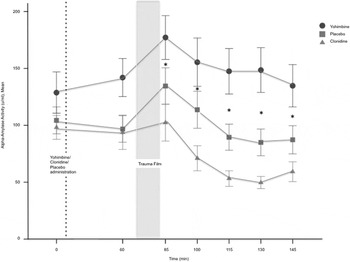
sAA activity throughout the assessment is displayed in Fig. 1. There was a significant effect of time (F 3.98,421.71 = 13.57, p < 0.01, η p 2 = 0.11) as well as a significant effect of treatment (F 2,106 = 7.41, p < 0.01, η p 2 = 0.12). Furthermore, a significant time x treatment interaction (F 7.96,421.71 = 3.14, p < 0.01, η p 2 = 0.06) was revealed. Groups did not differ at baseline (p > 0.05). Post-hoc tests revealed that yohimbine led to higher sAA activity compared with placebo and clonidine (p < 0.05).
Salivary α-amylase activity at baseline and before and after the trauma film for the clonidine, placebo and yohimbine groups. Values are means, with standard errors represented by vertical bars. * Significant differences between the yohimbine and placebo groups, and the yohimbine and clonidine groups (p < 0.05).

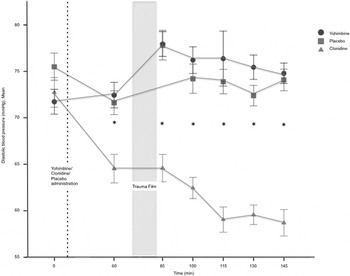
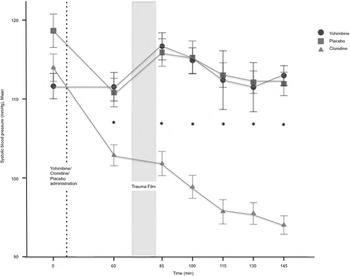
Diastolic blood pressure and systolic blood pressure are displayed in Figs 2 and 3. There was a significant effect of time and treatment for diastolic (F 3.91,430.57 = 10.65, p < 0.01, η p 2 = 0.09, F 2,110 = 33.36, p < 0.01, η p 2 = 0.38) and systolic (F 4.13,454.52 = 16.43, p < 0.01, η p 2 = 0.13, F 2,110 = 28.42, p < 0.01, η p 2 = 0.34) blood pressure. The interaction effect of time x treatment was significant for diastolic (F 7.83,430.57 = 11.16, p < 0.01, η p 2 = 0.17) and systolic blood pressure (F 8.26,454.52 = 8.35, p < 0.01, η p 2 = 0.13), indicating that clonidine decreased diastolic (p < 0.01) and systolic (p < 0.01) blood pressure compared with yohimbine and placebo.
Diastolic blood pressure at baseline and before and after the trauma film for the clonidine, placebo and yohimbine groups. Values are means, with standard errors represented by vertical bars. * Significant differences between the clonidine and yohimbine groups, and the clonidine and placebo groups (p < 0.01).

Systolic blood pressure at baseline and before and after the trauma film for the clonidine, placebo and yohimbine groups. Values are means, with standard errors represented by vertical bars. * Significant differences between the clonidine and yohimbine groups, and the clonidine and placebo groups (p < 0.01).

Salivary cortisol
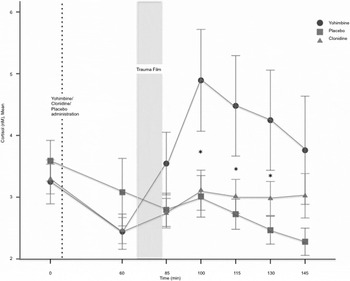
Salivary cortisol levels for the three experimental groups are displayed in Fig. 4. While there was no treatment effect (F 2,107 = 2.00, p = 0.15), the effect of time was significant (F 2.00,214.29 = 3.52, p < 0.01, η p 2 = 0.03). Furthermore, the time x treatment interaction was significant (F 4.01,214.29 = 3.37, p = 0.01, η p 2 = 0.06). Post-hoc tests revealed no difference in salivary cortisol levels between the three groups at baseline (p > 0.05). Furthermore, post-hoc tests revealed higher salivary cortisol levels in the yohimbine group compared with the placebo group (p < 0.05) and also compared with the clonidine group on a trend level (p < 0.1).
Salivary cortisol levels at baseline and before and after the trauma film for the clonidine, placebo and yohimbine groups. Values are means, with standard errors represented by vertical bars. * Significant differences between the yohimbine and placebo groups (p < 0.05), and difference on a trend level (p < 0.1) between the yohimbine and clonidine groups.

Intrusions
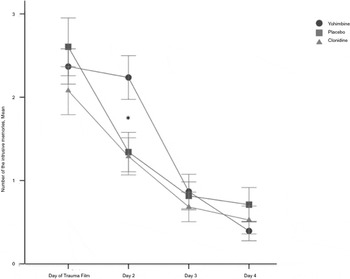
As expected, the number of intrusions declined over time (F 2.47,273.81 = 65.24, p < 0.01, η p 2 = 0.38). While there was no significant effect of treatment (F 2,111 = 1.00, p = 0.37), a significant time x treatment interaction was observed (F 4.93,3.0 = 2.97, p = 0.01, η p 2 = 0.05), indicating a delayed decrease in the number of intrusive memories in the yohimbine group compared with the clonidine and placebo groups. The interaction is displayed in Fig. 5. Post-hoc tests revealed that participants in the yohimbine group reported more intrusive memories of the trauma film on the first day after the trauma film than participants in the clonidine (p = 0.02) and placebo (p = 0.03) groups.
Number of the intrusive memories for the yohimbine, placebo and clonidine groups over 4 days, starting on the day when the trauma film was shown to the participants. Values are means, with standard errors represented by vertical bars. * Significant differences between the yohimbine and placebo groups, and the yohimbine and clonidine groups (p < 0.05).

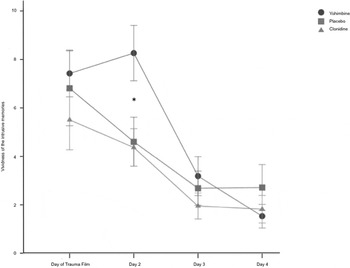
As expected, the vividness of intrusive memories also declined over time (F 2.38,264.55 = 32.32, p < 0.01, η p 2 = 0.23). While there was no significant effect of treatment (F 2,111 = 1.34, p = 0.27), the time x treatment interaction was significant (F 4.77,264.55 = 2.55, p = 0.03, η p 2 = 0.04), indicating a delayed decrease in the vividness of intrusive memories in the yohimbine group compared with the clonidine and placebo groups. The interaction is displayed in Fig. 6. Again, on the first day after the trauma film the reported vividness of the intrusions in the yohimbine group was significantly higher than in the placebo (p = 0.03) and clonidine (p = 0.02) groups.
Vividness of the intrusive memories for the yohimbine, placebo and clonidine groups over 4 days, starting on the day when the trauma film was shown to the participants. Values are means, with standard errors represented by vertical bars. * Significant differences between the yohimbine and placebo groups, and the yohimbine and clonidine groups (p < 0.05).

Yohimbine, clonidine and placebo did not affect the degree of distress that participants experienced through the intrusive memories (no effect of treatment, F 2,111 = 1.17, p = 0.31 and no treatment x time interaction, F 4.76,264.40 = 1.73, p = 0.11). However, there was a significant effect of time (F 2.39,264.40 = 59.84, p < 0.01, η p 2 = 0.36), indicating a decline of distress over the course of 4 days.
Including sAA activity and cortisol levels (‘AUCs’), childhood trauma (CTQ; German version of Bernstein & Fink, Reference Bernstein and Fink1998), or intake of oral contraceptives separately as covariates in the general linear model did not modify the significance of the interaction effect (time × treatment) for the number of intrusions and vividness. Further, the number of intrusions, the vividness of intrusions, and the degree of distress evoked by the intrusions were not associated with the cortisol response (AUC and peak value; all r values <0.1, all p values >0.05).
The Impact of Event Questionnaire
The Impact of Event Questionnaire (German version of Horowitz et al. Reference Horowitz, Wilner and Alvarez1979) did not show any differences in PTSD-related symptoms between the yohimbine, clonidine, and placebo groups 1 week (F 2,108 = 0.25, p = 0.78) and 4 weeks after the assessment (F 2,107 = 0.32, p = 0.72).
Discussion
We examined the influence of the noradrenergic system on encoding and consolidation of potentially intrusive memories after a trauma film paradigm in healthy women. Prior to the trauma film, participants received either yohimbine to stimulate noradrenergic activity, or clonidine to inhibit noradrenergic activity, or placebo. Intrusions occurring throughout the following 4 days were recorded.
After yohimbine the number of intrusive memories as well as their vividness showed a delayed decrease compared with clonidine and placebo over the 4 days following the trauma film. These findings might be relevant for future studies because it has been shown that intrusions during the days and weeks after a trauma predict a PTSD diagnosis later on (Shalev et al. Reference Shalev, Peri, Canetti and Schreiber1996; Ehlers, Reference Ehlers2010).
Our results extend recent findings of a study by Bryant et al. (Reference Bryant, McGrath and Felmingham2013), which showed that healthy participants reported more unintentional memories of depicted negative images after being stressed during consolidation compared with non-stressed participants. In this study, an interaction of increased salivary cortisol levels and sAA activity during consolidation predicted more unintentional memories in men but not in women (Bryant et al. Reference Bryant, McGrath and Felmingham2013). So far, a single study has examined the influence of sAA and salivary cortisol during encoding and consolidation on subsequent intrusions within the trauma film paradigm but without manipulating glucocorticoid and noradrenaline signalling (Chou et al. Reference Chou, La Marca, Steptoe and Brewin2014). However, in this study, sAA activity during encoding and consolidation did not predict the vividness of subsequent intrusions in men and women. Also, peri-film sAA activity was not associated with the number of intrusions. However, a positive correlation between post-film salivary cortisol levels and the number of intrusions was found in individuals with increased sAA activity (Chou et al. Reference Chou, La Marca, Steptoe and Brewin2014).
A strong increase in salivary cortisol levels 15 min after the end of the trauma film in the yohimbine condition was found. Contradictory findings exist on the influence of yohimbine administration on salivary cortisol levels in healthy controls. Some findings indicate enhanced salivary cortisol levels after yohimbine administration (Sommer et al. Reference Sommer, Braumann, Althoff, Backhaus, Kordon, Junghanns, Ehrenthal, Bartmann, Hohagen and Broocks2011) and others indicate no effect of yohimbine on salivary cortisol levels in controls (Gurguis et al. Reference Gurguis, Vitton and Uhde1997). In our study, noradrenergic activation after yohimbine during the trauma film might have served as a facilitator of the cortisol response to stress. This, again, might have resulted in the delayed decline of intrusions and their vividness in the yohimbine condition. This mechanism would be in line with findings suggesting that glucocorticoids enhance memory consolidation of emotional stimuli when noradrenergic activity during encoding is increased (Roozendaal et al. Reference Roozendaal, Okuda, De Quervain and McGaugh2006). For example, it has been shown that memory for emotional images 1 week after encoding is enhanced by hydrocortisone administration in participants with increased noradrenergic activity at the time of encoding, while this is not the case for participants with hydrocortisone administration but without noradrenergic increase and participants in the placebo condition (Segal et al. Reference Segal, Simon, McFarlin, Alkire, Desai and Cahill2014).
So far, there are no other experimental studies examining the effects of manipulating the noradrenergic system during encoding and consolidation of stressful or traumatic events on intrusions. However, our findings seem to be in line with data on stress and emotional memory in rodents and humans. Our results are compatible with data from animal studies suggesting enhanced fear memory after noradrenergic activation during consolidation (Dębiec et al. Reference Dębiec, Bush and LeDoux2011; Gazarini et al. Reference Gazarini, Stern, Carobrez and Bertoglio2013). Furthermore, the consolidation of emotional events in healthy participants seems to be enhanced by stress (Smeets et al. Reference Smeets, Otgaar, Candel and Wolf2008; Segal & Cahill, Reference Segal and Cahill2009).
No differences in the number of intrusions and their vividness between the clonidine and placebo groups were found. Therefore, noradrenergic inhibition via the α 2 receptor during trauma does not seem to influence consecutive intrusions, at least in healthy young women and in response to a relatively mild experimental stressor. Several studies examining emotional memories in humans after β-adrenergic blockade during encoding have reported reduced memory performance for emotional material (Strange et al. Reference Strange, Hurlemann and Dolan2003; Van Stegeren, Reference Van Stegeren2008). Furthermore, healthy participants show impaired memory in a word list paradigm after administration of a single dose of clonidine during consolidation compared with placebo (Kuffel et al. Reference Kuffel, Eikelmann, Terfehr, Mau, Kuehl, Otte, Loewe, Spitzer and Wingenfeld2014). In line with these results, a single dose of yohimbine during consolidation after a word list paradigm improves memory performance compared with placebo (Wingenfeld et al. Reference Wingenfeld, Kuffel, Uhlmann, Terfehr, Schreiner, Kuehl, Otte, Loewe and Spitzer2013). A mechanism underlying the fact that intrusions did not differ between the clonidine and placebo groups could be the activity of the HPA axis, which did not differ with respect to saliva cortisol between both groups. Furthermore, a floor effect might be responsible for the failure to find an effect of clonidine.
There are some limitations to this study. The sample was restricted to women and female sex hormones may make an impact on intrusive memories (Cheung et al. Reference Cheung, Chervonsky, Felmingham and Bryant2013). Therefore, the results might not be applicable to men. Also, participants taking oral contraceptives were not excluded and the cycle phase was not matched. We did, however, control for both. The lack of effect of clonidine on intrusion formation might be related to the relatively small dosage; however, clonidine decreased diastolic and systolic blood pressure compared with yohimbine and placebo, and sedation of the participants at a higher dosage has to be considered. Previous studies have shown that a dosage of 0.15 mg is sufficient to impair memory consolidation in healthy controls (Kuffel et al. Reference Kuffel, Eikelmann, Terfehr, Mau, Kuehl, Otte, Loewe, Spitzer and Wingenfeld2014). Additionally, a higher dosage (0.3 mg) compared with a lower dosage (0.15 mg) has been shown to have the same effect on the formation of memory in healthy controls (Tiplady et al. Reference Tiplady, Bowness, Stien and Drummond2005). Further, due to the elimination half-life of clonidine and yohimbine, clonidine effects were present during encoding and most of consolidation, whereas yohimbine effects were only present during encoding and early consolidation. Furthermore, in our study design the duration of action of clonidine and yohimbine made it impossible to distinguish between noradrenergic effects during encoding or consolidation of the trauma film on the development of intrusions. This distinction might be especially important regarding future medical treatment interventions, which could more easily be administered during consolidation after the trauma, than during encoding of the traumatic event. Additionally, the decrease of vividness and number of intrusions in the yohimbine group was only of small effect size. The influence of the noradrenergic system on consecutive intrusions after real trauma and clinical significance needs to be elucidated. Furthermore, the self-report of intrusive memories might be inaccurate if the participants fail to recognize the intrusions or do not report them (Takarangi et al. Reference Takarangi, Strange and Lindsay2014). However, participants’ compliance was increased by the daily transfer of recorded intrusions from the paper to the online diary and the reminder per text message.
Future research should focus on investigating the effect of the noradrenergic system and the HPA axis on the formation of intrusions separately by respectively blocking one of the systems. Furthermore, the influence of the noradrenergic system on consecutive intrusions should be evaluated in men and with other trauma film paradigms. In summary, a delayed decrease in intrusive memories as well as a delayed decrease in their vividness after yohimbine administration compared with clonidine and placebo was found. These results suggest an influence of noradrenergic activation on intrusion formation. These findings contribute to a better understanding of the neurobiological formation of intrusive memories in healthy individuals without history of trauma exposure. The findings suggest potential mechanisms for animal and human models of PTSD.
Supplementary material
For supplementary material accompanying this paper visit http://dx.doi.org/10.1017/S0033291716001379
Acknowledgements
We are grateful for the initial assistance of Dr Anke Weidmann. Further, we are grateful for the assistance of Anna Schmied and Linda Bruch. F.R. was supported by the Elsa-Neumann-Scholarship.
Declaration of Interest
None.