

Introduction
Recent evidence indicates that mental health is a primary cause of disability in Britain. Estimates from the World Health Organisation indicate that mental health problems account for over a third of the burden of illness in Western Europe (WHO, 2004) and the UK Department for Work and Pensions estimates that approximately 40 per cent of those claiming incapacity benefits do so because of mental health related illnesses. At any one time, 16 per cent of the British population suffers from mental illnesses such as depression and anxiety disorders (Mental Health Policy Group, 2006), and contrary to anecdotal evidence there appears to be a socio-economic gradient in the prevalence of mental illness such as anxiety disorders and depression, with people with low educational attainment, low income and living in a deprived neighbourhood being more likely to suffer from these mental health problems than the general population (see Yu and Williams, Reference Yu, Williams, Aneshensel and Phelan1999; Lorant et al., Reference Lorant, Deliège, Eaton, Robert, Philippot and Ansseau2003a and Muntaner et al., Reference Muntaner, Eaton, Miech and O'Campo2004 for reviews on the different association between socio-economic status and various mental health conditions).Footnote 1
To make matters worse, only about a quarter of mental health sufferers usually receives appropriate treatment (Institute of Medicine, 1994; Mental Health Policy Group, 2006), and socially excluded groups are less likely to be treated than the general population and often receive a different type of care (Lorant et al., Reference Lorant, Kampfl, Seghers, Deliège, Closon and Ansseau2003b).
Recent research has highlighted how social capital, defined as the level of trust, networking cooperation and reciprocity that connects individuals with society (Paldam, Reference Paldam2000), is positively associated with good social outcomes, ranging from reduced crime to economic growth, from effective democratic institutions to improved health status. Empirical studies based both on British and non-British data suggest that social capital is positively associated with mental health (Kawachi and Berkman, Reference Kawachi and Berkman2001; McKenzie et al., Reference McKenzie, Whiteley and Weich2002; Henderson and Whiteford, Reference Henderson and Whiteford2003; De Silva et al., Reference De Silva, McKenzie, Harpham and Huttly2005; Almedom, Reference Almedom2005). While it is widely acknowledged that social factors such as income inequality, segregation and social capital are important correlates of individual health, it is less clear whether the importance of social environment differs in different groups of the population and whether social capital can mitigate the adverse consequences of disadvantage (Szreter and Woolcock, Reference Szreter and Woolcock2004). It is also far from clear to what extent observed associational patterns between social capital and mental health stem from underlying causal relationships. In the paper we tackle the first of the two gaps in the literature and examine to what extent social capital represents a protective factor from negative socio-economic circumstances with respect to mental health. By using longitudinal data, we limit problems associated with the endogeneity of social capital measures.
In Britain social class and deprivation are inversely correlated with both social capital and well-being indicators (Hall, Reference Hall1999; Szreter and Woolcock, Reference Szreter and Woolcock2004; Li et al., Reference Li, Savage and Pickles2003). Britain also has one of the densest networks of community involvement in the world (Hall, Reference Hall1999; Kendall and Knapp, Reference Kendall and Knapp1996). However, great inequalities exist in the extent to which different groups of the population are integrated in society as well as the quality of their lives. People with disadvantaged backgrounds have lower rates of participation in their communities than the general population and worse health (both physical and mental). Moreover, the existing social gradient is expanding with disadvantaged individuals faring worse than the general population on indicators of both social capital and health (Szreter and Woolcock, Reference Szreter and Woolcock2004).
Social capital might improve mental health through a number of pathways: by providing psychosocial support, by giving individuals a sense of purpose and by improving the information individuals can rely on to tackle mental distress by fostering the adoption of healthy behaviours (Scheffler et al., Reference Scheffler, Brown and Rice2007). Two non-mutually exclusive mechanisms are described as the main effect model and the stress-buffering model (Cohen and Willis, Reference Cohen and Willis1985). According to the main effects model social capital improves well-being generally, while the stress-buffering model posits that social capital has only an effect on the well-being of individuals in stressful circumstances. We examine main effects and stress-buffering by comparing the relationship between social capital indicators in individuals who are at a high risk of developing mental distress in adulthood and individuals who have not been exposed to the stressful circumstances that characterise the high-risk group. We also employ three different indicators of social capital – membership in groups and associations, voting and social support – to capture different aspects of civic and social engagement that might be related with mental health status.
There is broad evidence that individuals exposed to severe adversity during the early years are at an increased risk of developing negative outcomes later in life (Duncan and Brooks-Gunn, Reference Duncan and Brooks-Gunn1997; Hobcraft, Reference Hobcraft1998; Burgess et al., Reference Burgess, Propper and Rigg2004). However, early events do not determine children's life chances. Positive experiences over the life course may offset the negative effects of exposure to risk, contributing to more favourable outcomes (Yaqub, Reference Yaqub2002). In the literature, individuals who display these characteristics – positive adaptation despite experiences of significant adversity – are defined as resilient (Luthar and Cicchetti, Reference Luthar, Suniya, Cicchetti and Becker2000).
In this study we are interested in examining whether social capital fosters resilience among individuals at high risk of mental distress. We use the Rutter Malaise Inventory to assess mental distress in young adults, aged 34. We consider the risks associated with poor mental well-being taking a life cycle approach, and in doing so we consider sources of disadvantage in both childhood and adulthood.
Data and methods
The 1970 British Cohort Study (BCS70) contains information on all individuals who were born in Great Britain between 5 and 11 April 1970. Cohort members were surveyed shortly after birth, and then again at regular intervals. We use data from birth for ages five, ten, 30 and 34.
A common drawback of longitudinal data is sample attrition. The first sweep of data collection gathered information about 17,287 cohort members, but in the 2004 survey only 9,665 cohort members were successfully interviewed, i.e. 56 per cent of the initial sample size. In general, lost cases tend to have more disadvantaged backgrounds than those who are successfully interviewed. However, 54 per cent of the cohort members that we classified as being at high risk were interviewed in the first and last surveys, a figure that is comparable for the low-risk group, so selection bias is unlikely to play a major role here. Furthermore, findings from attrition analyses have suggested that, even when attrition rates are relatively high (up to 50 per cent), biases in coefficient estimates are not as large as might be expected (Fitzgerald et al., Reference Fitzgerald, Gottschalk and Moffitt1998; Alderman et al., Reference Alderman, Behrman, Kohler, Maluccio and Watkins2001). When fitting our models we took into account attrition by (i) using bootstrapped standard errors to obtain reliable standard errors and (ii) considering missing information using the maximum likelihood method (Muthén and Muthén, Reference Muthén and Muthén1998−2005).
Study population
We concentrate our analysis on a group of individuals who suffered severe disadvantage in childhood (from birth up to age ten). Since children who have been in care are at a particular risk of suffering poor mental health (Cheung and Buchanan, Reference Cheung and Buchanan1997), anyone who has been in care before the age of ten is part of our high-risk group. Consistent with the idea that high risk is associated with multiple disadvantage, defined as the combined effect of disadvantage over time and in different domains (Sameroff et al., Reference Sameroff, Seifer, Baldwin and Baldwin1993), we identify as being at a high risk of suffering mental distress in adulthood those cohort members who satisfy the following criteria: (1) the cohort member's mother suffered poor mental health when the cohort member was either five or ten (defined in terms of malaise score of 7 or higher on the self-completed 24 items, Rutter Malaise inventory scale) and (2) the cohort member's father was either (i) unemployed in at least two out of the three survey waves during early childhood (birth, ages five and ten) or (ii) was in an unskilled manual occupation or absent in at least two out of the three same periods (birth, ages five and ten). Our at-risk group (n = 5,065) is comprised of 1,635 individuals who have been in care and 3,430 individuals who satisfy the condition of poor maternal mental health and material deprivation.
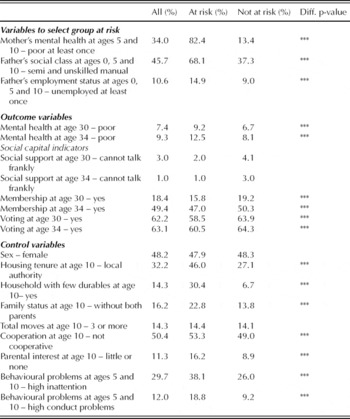
While in the complete sample 9.3 per cent of cohort members report high levels of malaise at age 34, 12.5 per cent of cohort members in the high-risk group reported high levels of malaise. Table 1 highlights differences in socio-economic characteristics and mental distress as measured by the malaise score of cohort members in the high-risk group and the low-risk group and indicates that differences between the two groups are indeed highly significant.
Distribution of key variables by risk status

Notes: Statistical significance: *p < 0.05; **p < 0.01; ***p < 0.001.
Sample size
When fitting our models, the software excluded cases with missing data on control variables, leading to a final working sample of 5,335 individuals, of whom 1,270 (24 per cent) were classified as at high risk.
Malaise at 34
In 2004, cohort members were asked to complete nine items from the Rutter scale of behaviour disorder (Rutter, Reference Rutter, Anthony and Koupernik1970). High malaise scores indicate a tendency towards depression and are associated with anxiety and poor mental health (Schoon, Reference Schoon2006). Rodgers et al. (Reference Rodgers, Pickles, Power, Collishaw and Maughan1999) show that the Malaise index has acceptable levels of internal consistency and internal validity. We construct a dichotomous variable taking value 0 if the respondent reports less than four symptoms of psychological distress and 1 if the respondent reports four or more symptoms.
Social capital measures
We measure social capital in childhood through a variable that measures the number of times cohort members moved home by the age of ten, since families who are more mobile are less likely to develop and maintain strong ties within their community. The second indicator of social capital in childhood is based on teachers’ reports on whether the cohort member at age ten was cooperative with peers, which indicates the ability and willingness of children to interact constructively with others.
We include three indicators of social capital in adulthood – satisfaction with social support, membership in groups and associations and voting in general elections – to capture different aspects of social and civic engagement which might contribute to mental health outcomes. The variable indicating membership takes value 0 if respondents are not members and 1 if they are members of one of a list of groups and associations.Footnote 2 We include a variable aimed at eliciting the quality of social support networks cohort members can rely on. Unlike previous studies examining the correlates of mental distress using the 1958 British birth cohort (Power et al., Reference Power, Stanfeld, Matthews, Manor and Hope2002) we were unable to develop a detailed index of social support as indicated by Matthews et al. (Reference Matthews, Stanfeld and Power1999a). The social support question block in BCS only asks cohort members whether they have anyone they feel can give them support and advice if needed (virtually all cohort members have someone) and then asks respondents whether they are satisfied with the support received. Our social support indicator takes value 0 if cohort members are not satisfied with current social support and 1 if they are. We include voting through an indicator of whether the respondent voted in the last general elections before the survey wave – 1997 for age 30 and 2001 for age 34.
Controls
We control for a number of socio-demographic and economic characteristics that may be associated with a higher prevalence of poor mental health outcomes at age 34. These include the sex of the cohort member because of evidence that females in general suffer higher levels of malaise (WHO, 1997; Kessler, Reference Kessler2003) and might be especially at risk when coming from deprived backgrounds (Matthews et al., Reference Matthews, Manor and Power1999b); and partnership status because individuals without a partner are more likely to suffer from depression than those living with a partner (Simon, Reference Simon2002). They also include family factors, socio-economic circumstances in childhood and adulthood and behavioural adjustment during childhood.
Family factors
We assess maternal and paternal interest in the education of the cohort member at age ten through teachers’ reports of whether at least one parent showed poor interest. This variable captures the quality of family functioning and the extent to which the family is a source of support, and stimulation for the cohort member. We introduce a variable for family structure indicating whether the family of the cohort member experienced a divorce, separation or death before the child reached the age of ten because of evidence that children who experience family break-ups are at an increased risk of suffering from behavioural and mental problems (Quinton and Rutter, Reference Quinton and Rutter1988).
Socio-economic disadvantage
We include two indicators of socio-economic disadvantage: information on housing tenure (at ages ten, 30 and 34), and absence of household durables (at age ten). The second indicator aims at eliciting material deprivation. Cohort members whose household lacked two or more out of a total of four itemsFootnote 3 when they were ten are considered to have suffered material deprivation.
Behavioural adjustment during childhood
We construct measures of the cohort member's behaviour during childhood using information collected from the cohort member's parent at ages five and ten. We group six items into two behavioural measures: conduct problems and inattention/hyperactivity. We construct the first measure using parental reports on the extent to which their child: (a) frequently fights with other children, (b) often destroys own or others belongings and (c) is often disobedient. Similarly, we construct the variable measuring inattention/hyperactivity using reports that the child: (a) is squirmy or fidgety, (b) cannot settle down to anything and (c) is very restless. Each attribute was rated by the mother using a scale from 0 to 2. We add the scores of all items to obtain a total sum for each behavioural measurement. We classify the total sum into three categories: low, medium and high.Footnote 4 Finally, we combine conduct problems and inattention/hyperactivity into a construct labelled externalising problems using factor analysis. The measurement model revealed that the items considered reliably form a latent construct. The standardised loadings were strong and significant, with values of 0.86 and 0.50 (p <0.001).
Conceptual model
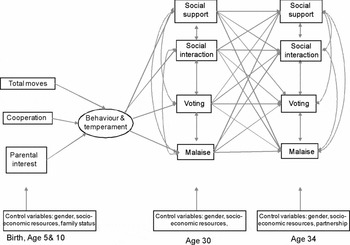
Figure 1 illustrates our hypotheses on the relationships between variables. Following the literature, we assume that social capital in childhood is associated with behavioural adjustment in childhood, which in turn is associated with mental health and social capital in adulthood. We also hypothesise that mental health at age 30 is related with subsequent mental well-being and social capital (measured by malaise, social support, membership and voting at age 34). We assume that cohort members who are distressed are those who are less likely to be satisfied with their level of social support, are less likely to join groups and associations and vote and therefore we account for a possible correlation between malaise at age 34 and social capital at age 34 in our model (see double arrows in Figure 1).
Conceptual model of the relationship between social integration and malaise

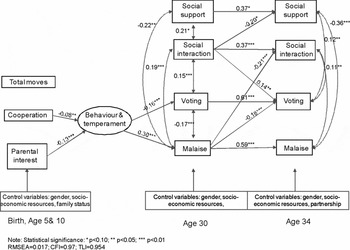
Estimated pathways between social capital and malaise – high-risk group

We estimated our model by risk status to examine the two main theories in the literature on how social capital is associated with well-being (the main effects model and the stress-buffering model).
Figure 1 describes structural relationships between variables. It is a recursive model that contains social capital and mental distress variables in two BCS adulthood waves (ages 30 and 34) and represents the best fitting model relative to a group of alternative models that we tested and that are consistent with the theory on the relationship between social capital and mental health. The inclusion of lagged variables allows us to examine individual-level stability of both social capital and mental distress. Although we cannot test for whether the relationship between social capital and mental distress is causal, by introducing lagged variables we can examine whether someone who experiences mental distress at age 30 is less likely to have high levels of social capital at age 34 and whether individuals with high levels of social capital at age 30 are less likely to suffer mental distress at age 34.
Results
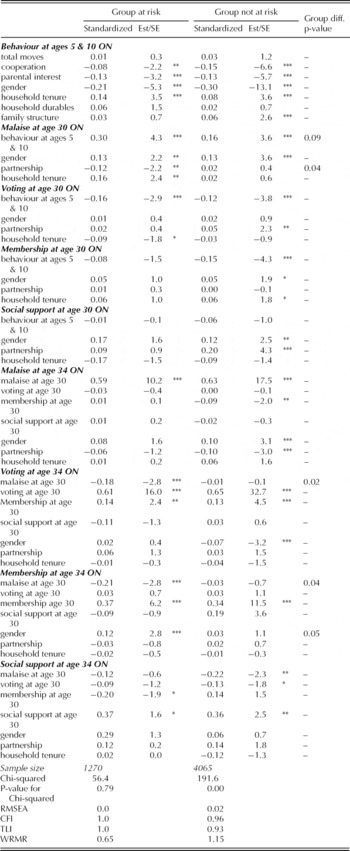
Our main aim is to examine whether social capital protects from the risk of suffering high levels of mental distress in adulthood that is associated with disadvantaged circumstances in childhood. We assess the validity of the main effects model and of the stress-buffering model by predicting the probability that individuals in each of the high-risk group and the low-risk group will suffer mental distress at age 34 and by testing whether the relationship between social integration and mental distress is different in the two groups. Our models perform well.Footnote 5 The last column in Table 2 reports results of a chi-square difference test between the high-risk group and the low-risk group and can be used to examine whether the difference in estimated coefficients for the two groups are statistically significant.Footnote 6 We use the test to assess whether social capital is significantly associated with a reduction in mental distress in both groups (main effects model) or only in the high-risk group (stress-buffering model) and whether there are other differences between the two groups in factors associated with high levels of malaise.
Estimated pathways between social capital indicators and malaise by risk status

Notes: Statistical significance: *p < 0.10; **p < 0.05; ***p < 0.01. This model controls for the concurrent associations between malaise and the social capital indicators (membership, voting and social support) specified at ages 30 and 34.
We observe a strong and significant relationship between malaise at ages 30 and 34 in both the high-risk group and the low-risk group (0.59 and 0.63 standard deviation units, SD hereafter), confirming the hypothesis that past episodes of mental distress are highly predictive of current mental health states. We also observe strong correlations between our social capital measures at age 30 and the corresponding measures at age 34, again in both the high-risk group and the low-risk group.
A few differences on the other hand emerge when examining correlations between social capital and malaise in the two adulthood waves in the two groups. Among individuals in the low-risk group, having been a member of a group or association in the past is associated with a reduced likelihood of current mental distress: the direct associations between membership at age 30 and malaise at age 34 is modest in size (–0.09 SD) but statistically significant even when considering indirect pathways (correlations between membership at age 30 and malaise at age 30, the association between membership at age 30 and membership at age 34 and the paths between malaise at age 30 and membership and malaise at age 34). Membership in groups and associations on the other hand does not appear to be significantly correlated with reduced mental distress among high-risk individuals.
Findings reported in Table 2 highlight how some forms of social capital, namely membership in groups and associations, play a protective role among low-risk individuals. They also indicate that past episodes of mental distress reduce engagement and participation mainly among high-risk individuals: malaise at age 30 is negatively correlated with voting and membership in groups and organisations at age 34 among individuals in the high-risk group and with satisfaction with social support among individuals in the low-risk group. Since we control for the correlation between malaise at age 30 and social capital indicators at age 30 in our model as well as for a wide selection of socio-economic controls, such correlations are strongly suggestive of causal relationships. Overall our findings appear to suggest that low-risk individuals benefit from the networks acquired through membership in groups and associations, while those individuals who are at a highest risk of developing mental distress do not lower their risk by joining voluntary organisations.
Despite a 20-year time lag, the association between measures of behavioural problems (age ten) and malaise (age 30) is statistically significant and moderate in size (0.30 SD for high-risk individuals and 0.16 for low-risk individuals). Cohort members who have experienced behavioural problems in childhood are more likely than others to suffer from mental distress at age 30 and a history of behavioural problems appears to be particularly problematic for individuals in the high-risk group (between group difference significant at the 10 per cent level). Important correlates of behavioural problems are family interest in the education of the child, an indicator of a more general climate of encouragement that children can expect from their families, and housing tenure. Results in Table 2 also indicate that the association between cooperation with peers – one of the social capital indicators in childhood – and behavioural adjustment in childhood is, although statistically significant, of minor size (–0.08 SD), while the association between number of household moves and behavioural problems is not significant with no differences across risk groups.
While the use of a cohort study like BCS presents numerous advantages that we exploit in our research, it also inevitably poses some limits. First and foremost we are restricted to examining the relationship between social capital and mental health among individuals who were born at a particular point in time and therefore our estimates might not apply to individuals living in other contexts and conditions. Another limit of our study stems from our reliance on a self-reported measure of mental distress rather than clinical assessments. At the same time our measures of social capital, most notably social support, are fairly generic and cannot be used to infer the mechanisms through which social capital might influence mental health. Finally, as highlighted in the introduction and data sections, our results should be interpreted with some caution as they show associations rather than underlying causal relationships. While the use of many childhood controls and two waves of adulthood data should limit the problems of individual heterogeneity, self-selection and reverse causality in the estimation of the association between social capital and mental distress, there is no guarantee that our results indicate underlying causal effects.
Discussion and policy implications
The study examines whether the previously documented relationship between social capital and mental health is present among a group of individuals particularly at risk of developing mental distress in adulthood. We also assess the validity of two hypotheses presented in the literature on the pathways through which social capital might reduce the prevalence of mental distress – the main effects and the stress buffering models – by examining whether the relationship between social capital and mental distress is similar, weaker or stronger in high-risk individuals than in individuals with a lower risk of poor mental health outcomes.
Our results are consistent with the literature showing a long-term effect of childhood adversity on mental health (see for example Lundberg, Reference Lundberg1991; Power et al., Reference Power, Stanfeld, Matthews, Manor and Hope2002; Miech et al., Reference Miech, Caspi, Moffitt, Wright and Silva1999). Individuals who suffered from stressful circumstances in childhood, such as being put into care, having a mother who suffered from mental distress for prolonged periods and living in material deprivation, are significantly more likely than individuals with less disadvantaged backgrounds to suffer mental distress as adults. They are also less likely to have high levels of social capital as measured by membership in groups and associations, voting and perceive a lack of adequate social support. The main contribution of the study is that it examines the relationship between social capital and mental health using a life cycle approach to consider the pathways leading to mental distress in adulthood.
Our main finding is that while membership in groups and associations appears to have a protective role with respect to mental distress among individuals with a low risk of suffering poor mental in adulthood, no such role can be observed among high-risk individuals. We do not observe similar relationships between our other two indicators of social capital – political participation and satisfaction with social support – and malaise. Our findings indicate that when individuals in the high-risk group suffer from poor mental health, they lower their participation in their community through reduced voting and membership in groups and associations. Past episodes of mental distress in the low-risk group reduce their satisfaction with social support.
Our findings indicate, consistently with the literature, that childhood circumstances are particularly important correlates of mental well-being in adulthood: children with externalising problems are significantly more likely to suffer high levels of malaise as adults than children with low levels of hyperactivity and conduct problems (see Rutter et al., Reference Rutter, Kim-Cohen and Maughan2006 for a review). While behavioural problems are a major determinant of mental distress generally, they appear to be crucial factors involved in the progression to mental distress among individuals with a high risk of suffering from poor mental health. Children who grow up in families that are involved and supportive and who do not face material deprivation in childhood are at a much lower risk of suffering from behavioural problems and, as a result, are at lower risk of mental distress in adulthood.
The results indicate that social capital is not correlated with a reduced incidence of mental distress among individuals who are at a high risk of suffering poor mental health and that policies aimed at improving the integration of individuals within their community and society at large are unlikely to narrow the gap in mental well-being that currently exists between disadvantaged groups and the rest of society. The use of scarce resources in community empowerment initiatives or in the alleviation of structural factors such as poverty and material deprivation represents a highly sensitive political and philosophical dilemma (see Baum, Reference Baum1999; Lynch et al., Reference Lynch, Muntaner and Davey Smith2000; Szreter and Woolcock, Reference Szreter and Woolcock2004; Bridgen, Reference Bridgen2006). Our study suggests that while membership in groups and associations might have positive spillover effects in other areas and plays a protective role among low-risk individuals, it is unlikely to improve mental health outcomes of disadvantaged groups.
Even if we assumed that estimated relationships were indicative of underlying causal relationships, our research suggests that policies aimed at increasing social capital would not be able to reduce the gap in mental health outcomes between individuals from disadvantaged backgrounds and the rest of the population. The findings indicate that policies directed at improving the social and economic circumstances of children offer the best hope to reduce mental distress and improve the lives of disadvantaged individuals.
Acknowledgements
The authors would like to thank Ludovica F. Gambaro for her patience and hard work in compiling the database used in this analysis.