Immigration is a crucial issue in contemporary American politics, where rapid demographic change and native backlash are influencing voting behavior and partisan loyalties (Abrajano and Hajnal Reference Abrajano and Hajnal2015; Hajnal and Rivera Reference Hajnal and Rivera2014). Immigration has been a salient issue in recent elections: strong Latino support helped Barack Obama win re-election in 2012, while an anti-immigrant campaign helped Donald Trump win the Republican nomination and presidency in 2016.Footnote 1 Immigration also shapes attitudes toward government spending (Garand, Xu and Davis Reference Garand, Xu and Davis2017; Hussey and Person-Merkowitz Reference Hussey and Pearson-Merkowitz2013), influences the size and generosity of the welfare state (Alesina and Glaeser Reference Alesina and Glaeser2004; Crepaz Reference Crepaz2008; Hawes and McCrea Reference Hawes and McCrea2018; Hero and Preuhs Reference Hero and Preuhs2007; Xu Reference Xu2017; Ybarra, Sanchez and Sanchez Reference Ybarra, Sanchez and Sanchez2016) and has implications for American national identity (Huntington Reference Huntington2004; Schildkraut Reference Schildkraut2011).
Despite being a nation of immigrants, the American mass public expresses considerable heterogeneity regarding support for immigration. Given immigration's political relevance, it is important to understand the sources of this heterogeneity. Previous research has emphasized cultural factors such as ethnocentrism, a predisposition to divide the world into ‘us versus them’ (Kinder and Kam Reference Kinder and Kam2009); national identity, which is associated with a desire to preserve traditional culture and values (Branton et al. Reference Branton2011; Sides and Citrin Reference Sides and Citrin2007; Sniderman, Hagendoorn and Prior Reference Sniderman, Hagendoorn and Prior2004); and feelings toward certain groups, such as Latinos (Brader, Valentino and Suhay Reference Brader, Valentino and Suhay2008; Hartman, Newman and Bell Reference Hartman, Newman and Bell2014; Lu and Nicholson-Crotty Reference Lu and Nicholson-Crotty2010; Valentino, Brader and Jardina Reference Valentino, Brader and Jardina2013), non-English speakers (Hainmueller and Hopkins Reference Hainmueller and Hopkins2015; Hopkins Reference Hopkins2015; Newman, Hartman and Taber Reference Newman, Hartman and Taber2012), or low- and high-skilled migrants (Hainmueller and Hiscox Reference Hainmueller and Hiscox2010; Newman and Malhotra Reference Newman and Malhotra2019; Valentino et al. Reference Valentino2019). Prior studies have also emphasized economics (Burns and Gimpel Reference Burns and Gimpel2000; Citrin et al. Reference Citrin1997; Dancygier and Donnelly Reference Dancygier and Donnelly2012; Gerber, Huber and Biggers Reference Gerber2017; Malhotra, Margalit and Mo Reference Malhotra, Margalit and Hyunjung Mo2013; Pardos-Prado and Xena Reference Pardos-Prado and Xena2018), and have found that concerns about the national economy – and, to a lesser degree, one's personal economic well-being – shape public attitudes toward immigration.Footnote 2
I argue that evaluations of government also shape public opinion on immigration. When people trust government, the actor most responsible for managing immigration policy, they should be more willing to give it the latitude to enact and implement pro-immigration policies. When people distrust government, however, they should be less willing to support a larger role for government in formulating immigration policy, as they are less likely to trust its ability to manage this policy effectively. Past research has, to my knowledge, overlooked the role of political trust, meaning that our understanding of mass immigration attitudes is largely limited to cultural and economic explanations.
I show, using cross-sectional data from the American National Election Studies (ANES), that politically trustful individuals, both Democrats and Republicans, are more likely than their politically distrustful counterparts to support increased immigration and policies that provide a path to citizenship to the more than 11 million undocumented immigrants living in the United States.Footnote 3 This relationship holds across election years, during both Democratic and Republican administrations, and under varying economic conditions. I buttress these cross-sectional analyses with panel data from the ANES and General Social Survey (GSS), demonstrating that political trust influences support for immigration, rather than the reverse. To assuage concerns about endogeneity, I also conducted a survey experiment using Amazon's Mechanical Turk (MTurk), providing causal evidence to demonstrate that political trust increases support for pro-immigration policies.
These findings make a novel contribution to our understanding of public opinion toward immigration, underscore the political relevance of trust in government, and suggest that people's thinking about immigration, a large-scale policy that involves a prominent role for government, is not solely influenced by economics nor social group evaluations, but also by their perceptions of government's trustworthiness. These findings suggest that a more politically trustful mass public will be more amenable toward immigration reform that provides a path to citizenship for the 11 million undocumented immigrants currently living in the United States and will be less likely to support policies that restrict the number and types of immigrants who are permitted to enter the country. Furthermore, any efforts to reform the US immigration system, a priority of recent administrations, both Democratic and Republican, will depend heavily on public support. In short, understanding US public opinion toward immigration policy matters for understanding contemporary American politics.
Why Political Trust Matters for Immigration Attitudes
Political trust is important for democratic governments to function effectively. It is needed in order to marshal public support to overcome collective action problems and solve societal problems (Easton Reference Easton1965; Hetherington Reference Hetherington1998). Low political trust can depress redistributive spending (Hetherington Reference Hetherington2005), reduce law compliance and make citizens less willing to pay taxes (Fairbrother Reference Fairbrother2019; Scholz and Lubell Reference Scholz and Lubell1998). I argue that political trust also plays an important role in shaping mass support for immigration.
When policies offer benefits to some people but not others, political trust, an evaluation of the government as a whole, is ‘activated’ and serves as a decision rule for whether people will support that policy (Rudolph Reference Rudolph, Zmerli and van der Meer2017). Hetherington and Globetti (Reference Hetherington and Globetti2002) illustrate this in a study of attitudes toward race-targeted policies. Political trust was found to affect whites' preferences, people who would not directly benefit from the policy, but made no difference for blacks, who would be direct beneficiaries of the policy.
When people do not receive direct benefits from a policy, be they material or ideological, but are asked to pay costs, for example, whites being asked to support race-targeted spending (Hetherington and Globetti Reference Hetherington and Globetti2002), liberals being asked to support Social Security privatization (Rudolph and Popp Reference Rudolph and Popp2009) or conservatives being asked to support increased redistributive spending (Rudolph and Evans Reference Rudolph and Evans2005), political trust is ‘activated’, and helps people overcome their skepticism and give government ‘the benefit of the doubt’. As Hetherington and Husser (Reference Hetherington and Husser2012, 313) state, ‘when paying costs rather than receiving benefits, people must trust the government to think its programs will produce societal benefits and not waste resources’. Immigration is one such policy that should ‘activate’ political trust. Increased immigration comes with risks, be they real or perceived, to the native population, but few direct, tangible benefits. Although increased immigration can potentially contribute to economic growth, I argue that few Americans perceive a direct benefit from immigration such as a biweekly check, improved infrastructure, or a deduction on their tax returns.
Indeed, recent surveys show that many Americans have negative perceptions of immigrants. Data from the 2016 ANES show that Americans give illegal immigrants a mean feeling thermometer rating of just 41.5 (compared to 68.1 for Hispanics, 68.4 for blacks and 54.5 for Muslims). Data from an Associated Press/National Opinion Research Center (AP/NORC) survey conducted in February 2017 show that only 23 per cent of respondents believed that legal immigrants were not at risk of committing acts of political or religious violence, 19 per cent of respondents believed there was no risk that welfare and safety nets would be burdened, and only 25 per cent believed that legal immigrants pose no threat to native workers' employment prospects. Large majorities of Americans believe that illegal immigrants are just as likely (60 per cent) or more likely (20 per cent) than the native population to commit crimes, according to a February 2017 CBS News poll. An April 2016 Public Religion Research Institute/Brookings survey shows that 54 per cent of respondents believe that illegal immigrants hurt the economy by driving down wages, while a majority of people believe that illegal immigrants taking jobs that would otherwise be filled by Americans is very (25 per cent) or somewhat (29 per cent) responsible for the country's current economic problems, according to a September 2015 Public Religion Research Institute (PRRI) survey.Footnote 4 In short, survey data show that many (though certainly not all) Americans view immigration as posing at least some risk to the native population, by straining social services, committing crimes, or threatening natives' job prospects. Importantly, these threats need not be real but merely be perceived to be real by the native population (Hopkins, Sides, and Citrin Reference Hopkins, Sides and Citrin2019).
Prior studies conducted in the United States (Haynes, Merolla and Ramakrishnan Reference Haynes, Merolla and Ramakrishnan2016) and Europe (Boomgaarden and Vliegenthart Reference Boomgaarden and Vliegenthart2009; Fitzgerald, Curtis and Corliss Reference Fitzgerald, Curtis and Corliss2012), have shown that the media and political elites can play an important role in shaping perceptions of immigrants. Media coverage of immigration in the United States tends to link immigrants to crime, abuse of social services, unwillingness to assimilate, and illegal entry into the country (Abrajano, Hajnal and Hassell Reference Abrajano, Hajnal and Hassell2017; Chavez Reference Chavez2013; Farris and Mohamed Reference Farris and Mohamed2018; Valentino, Brader and Jardina Reference Valentino, Brader and Jardina2013). These perceptions can also be shaped by elite rhetoric such as Donald Trump's 2016 campaign (Newman, Shah and Collingwood Reference Newman, Shah and Collingwood2018). As such, when thinking about immigration, many Americans are likely to invoke a generally negative picture.
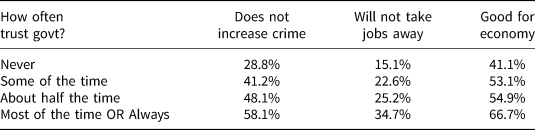
Allowing additional immigrants to enter the country is accompanied by perceived threats, but very few direct, tangible benefits for the native population.Footnote 5 As such, political trust should be ‘activated’ and play an important role in shaping people's attitudes toward immigration. Table 1 displays data from the 2016 ANES, which provides evidence in support of this argument. The results show that more politically trustful individuals are less likely to perceive threats from immigration. Americans with higher levels of trust are more likely to state that immigrants do not increase crime rates, believe they will not threaten natives' job prospects and state that immigration is beneficial to the economy, rather than a burden.
Political trust and perceptions of immigration's consequences in 2016

Source: 2016 ANES.
When people believe that government officials are corrupt, look out for the interests of the few rather than the public at large, and that government programs are ineffective and wasteful, they should be less likely to trust the government to manage and implement large-scale policies such as immigration. Increased immigration means a larger role for the federal government. The national government determines who can come into the country, how long they can stay, to what benefits they are entitled, and whether certain immigrants pose a security threat to the population. The government is also then responsible for keeping track of immigrants, and providing them and their children with social services, all while continuing to provide services and protection to the native population.Footnote 6 If people do not trust this actor to effectively manage immigration policy, then they should be less willing to support pro-immigration policies that entail a larger role for the national government.
Hypothesis People with higher levels of political trust should have higher levels of support for pro-immigration policies.
Data and Methods – Observational Analyses
To test this hypothesis, I primarily make use of the 2016 ANES, which includes a rich battery of immigration-related questions. I also replicate my results using data from the 2012 ANES and the Cumulative American National Election Study (CANES) from 1992–2008, employing a smaller, but similar set of immigration policy questions. This shows that my findings are not solely the result of the heightened salience of immigration in the 2016 election.Footnote 7 I also use data from the 1994–1996 and 2000–2002–2004 ANES panel studies, as well as the 2012–2014 GSS panel study, showing that political trust temporally precedes and drives support for immigration, rather than the reverse.
Dependent Variable – Support for Immigration
I use principal components factor analysis and data from the 2016 ANES to construct a measure of pro-immigration policy support. I use five questions that ask about: (1) US government policy toward unauthorized immigrants living in the country, (2) maintaining birthright citizenship, which grants citizenship to immigrant children born in the United States, (3) if children brought to the United States illegally who have lived here for at least 10 years and graduated from high school should be allowed to stay in the country, (4) building a wall on the US/Mexico border, and (5) preferred immigration levels. All of these variables are coded so that higher values indicate a pro-immigration position.Footnote 8
Although these questions ask about different aspects of immigration policy (that is, levels versus a path to citizenship), each question loads onto a single factor (eigenvalue = 2.69, variance explained = 53.7 per cent). This suggests that they are all tapping into a latent concept reflecting support for accommodating, rather than restrictive immigration policy.Footnote 9
Independent Variable – Political Trust
Consistent with Marc Hetherington (Reference Hetherington2005, 9), I view political trust as ‘a running tally of how people think the government is doing at a given point in time’. This is related to, but also more stable than, and conceptually distinct from, the approval ratings of specific actors such as the president or Congress (Citrin and Luks Reference Citrin, Luks, Hibbing and Theiss-Morse2001). This conceptualization of political trust encompasses people's view of the government as a whole, and is more reflective of diffuse, rather than specific support (Citrin and Stoker Reference Citrin and Stoker2018; Easton Reference Easton1975; Hetherington Reference Hetherington1998). It does not, however, refer to implicit system support, that is, support for the American system of democracy and ‘bedrock institutions’ of government (Intawan and Nicholson Reference Intawan and Nicholson2018). Rather, political trust captures ‘how positively citizens perceive government's performance relative to their expectations’ (Hetherington Reference Hetherington2005, 10).Footnote 10
I measure political trust by using four questions, following past research (Hetherington Reference Hetherington1998; Hetherington Reference Hetherington2005; Hetherington and Rudolph Reference Hetherington and Rudolph2008; Hetherington and Rudolph Reference Hetherington and Rudolph2015). These questions ask: (1) how often people trust government to do the right thing, (2) whether government looks out for all people or a few big interests, (3) how much tax money people think government wastes, and (4) how many people in government are corrupt. Each question is coded so that higher values indicate higher levels of trust. I use principal component factor analysis to construct a factor score from these four questions (eigenvalue = 2.04, variance explained = 51 per cent).Footnote 11
Control Variables
I include the following demographics: age (in years), education (high school or less as the reference category, some college, or a college degree), gender (female), household income (six categories), race (white, non-Hispanic vs. not), marital status, home ownership and whether both of the respondent's parents were born in the United States. These socio-demographic variables, particularly income and education, can help to reduce the possibility that political trust is actually capturing life satisfaction, cosmopolitanism or social trust (Newton and Zmerli Reference Newton and Zmerli2011; Uslaner Reference Uslaner2002); this could make people more supportive of immigration because they tend to see the world as a better place, and tend to be less likely to live in the same neighborhood as and/or compete with immigrants for jobs. I also control for survey mode (Internet vs. in person), as people may be more willing to express socially undesirable opinions in the more anonymous online setting (Abrajano and Alvarez Reference Abrajano and Alvarez2019).
I take partisanship (coded in the Republican direction), and ideology (coded in the conservative direction, with ‘haven't thought much about it’ coded as ‘moderate’ to avoid dropping cases) into account, expecting that strong Republicans and stronger conservative identifiers will be less likely to support pro-immigration policies.Footnote 12 I also control for retrospective national economic evaluations, as well as perceptions of one's personal financial situation over the past year (both coded in the direction of having gotten ‘better’). Consistent with past research, which has found a strong link between evaluations of the national economy, but a weak link with one's personal financial situation (Burns and Gimpel Reference Burns and Gimpel2000; Citrin et al. Reference Citrin1997; but see Gerber et al. Reference Gerber2017), I expect that positive retrospective evaluations of the national economy, more so than one's personal financial situation, will be associated with higher support for immigration.
When Americans think about immigration, they tend to have Hispanics in mind (Abrajano and Hajnal Reference Abrajano and Hajnal2015; Brader, Valentino and Suhay Reference Brader, Valentino and Suhay2008; Pérez Reference Pérez2010), but evaluations of other groups could also shape attitudes toward immigration. For example, it is possible that people are thinking about Asians (the fastest growing immigrant population, according to the US Census Bureau) or Muslims, a group for whom immigration has been particularly salient in the news media and in the 2016 campaign. I therefore include feeling thermometer ratings for the following groups: Hispanics, blacks, Asians, Muslims and whites. I expect people who feel more warmly toward these non-white groups will be more supportive of immigration, while people who feel more warmly toward whites will be less supportive (Jardina Reference Jardina2019; Valentino, Brader, and Jardina Reference Valentino, Brader and Jardina2013).Footnote 13
I include two core values – egalitarianism and moral traditionalism.Footnote 14 I expect that more egalitarian individuals, who are likely to favor broad-based equality of opportunity and outcomes for all groups, should exhibit more pro-immigration attitudes (Kinder and Kam Reference Kinder and Kam2009; Pantoja Reference Pantoja2006), while people who score higher in moral traditionalism, and thus favor maintaining traditional cultural norms, will be less supportive of immigration (Branton et al. Reference Branton2011). I also include a measure of authoritarianism, using four questions that ask about child-rearing preferences (Feldman and Stenner Reference Feldman and Stenner1997). Consistent with past research (Craig and Richeson Reference Craig and Richeson2014; Johnston, Newman and Velez Reference Johnston, Newman and Velez2015; Velez and Lavine Reference Velez and Lavine2017), I expect that more authoritarian individuals, who express a greater desire for order and conformity, will be more supportive of restrictive immigration policies.Footnote 15 I also include state fixed effects, which take any state-level factors that may influence immigration attitudes, such as the unemployment rate, proximity to the US/Mexico border, and the size of and/or changes in the foreign born population, into account.
Political Trust and Support for Immigration
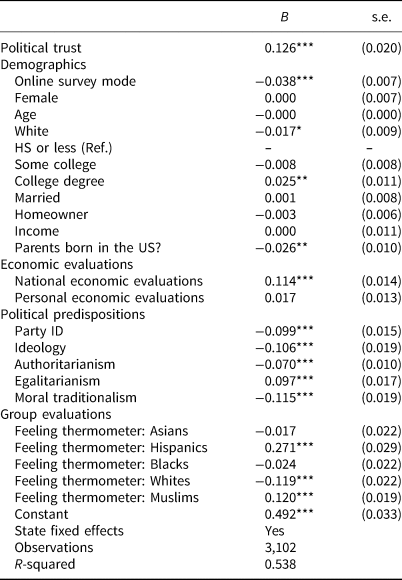
Analysis of the 2016 ANES, displayed in Table 2, demonstrates a strong relationship between political trust and support for policies that expand, rather than restrict, immigration and provide a path to citizenship for undocumented immigrants.Footnote 16 A shift in political trust from its minimum to its maximum value (from 0 to 1), holding all of the other control variables constant, increases support for pro-immigration policies by approximately 0.13, from 0.51 to 0.64.Footnote 17 This is substantively significant, given that the dependent variable ranges from 0 to 1.
Political trust and support for immigration in 2016

Note: Dependent variable is pro-immigration factor score, ranges from 0 to 1. OLS coefficients with robust standard errors clustered by state in parentheses. *** p < 0.01, ** p < 0.05, * p < 0.1 (two-tailed)
Source: 2016 ANES.
The control variables influence immigration support as expected, suggesting that the model is appropriately specified. Republicans and conservatives, people who score higher in moral traditionalism and authoritarianism, lower in egalitarianism, and those who view the state of the national economy more pessimistically are less supportive of immigration. People who feel warmer toward Hispanics and Muslims, two prominent minority groups, are more supportive of immigration, while those who feel more warmly toward whites are less supportive of pro-immigration policies. The results in Table 2 do not discount the role of partisanship, ideology, core political values, economic evaluations, or feelings toward racial/ethnic groups, but they do show that political trust matters as well.
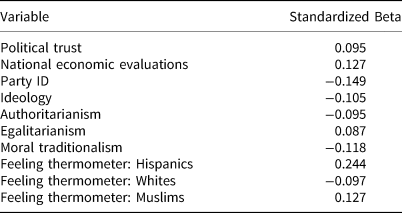
Table 3 compares the substantive influence of political trust with ten other variables. The standardized Beta coefficient shows the influence of a one standard deviation increase in each variable (all range from 0 to 1) on support for immigration (the same factor score employed in Table 2, ranging from 0 to 1). As expected, feelings toward Hispanics have the strongest influence: a one standard deviation increase in the Hispanic feeling thermometer rating leads to a 0.24 standard deviation increase in support for immigration. For reference, a one-standard-deviation increase in political trust is associated with an approximately 0.10 standard deviation increase in support for immigration. Although not the strongest in terms of magnitude, political trust compares favorably with other variables that have been shown to meaningfully shape public attitudes toward immigration: sociotropic economic evaluations, symbolic predispositions (partisanship and ideology), personality traits (authoritarianism), core political values (egalitarianism and moral traditionalism), and racial/ethnic group evaluations (feeling thermometer ratings of Hispanics, whites, and Muslims).
The relative magnitude of the political trust effect in 2016

Note: Based on the OLS model in Table 2.
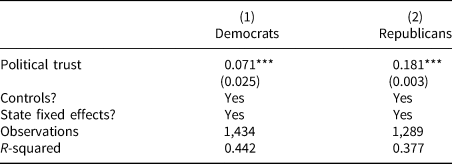
In Table 4, I also consider heterogeneity in the relationship between political trust and support for immigration. Extant research suggests that political trust helps people to support policies that do not provide them with material (Hetherington and Globetti Reference Hetherington and Globetti2002) or ideological (Rudolph and Evans Reference Rudolph and Evans2005) benefits. Recent work has shown a clear divide between Democrats and Republicans on the issue of immigration: people who hold anti-immigration attitudes increasingly support the Republican Party, which has, over time, taken more restrictive positions on the issue (Abrajano and Hajnal Reference Abrajano and Hajnal2015). Democratic Party identifiers tend to be more supportive of pro-immigration policies than their Republican Party counterparts.Footnote 18 As such, trust in government should matter more for Republicans, for whom supporting pro-immigration policies is a ‘heavier lift’ than for Democrats, who tend to already be supportive of such policies.Footnote 19
Political trust and support for immigration by partisanship in 2016

Note: Dependent variables are pro-immigration factor scores, ranging from 0 to 1. OLS coefficients with robust standard errors clustered by state in parentheses. *** p < 0.01, ** p < 0.05, * p < 0.1 (two-tailed)
Source: 2016 ANES.
To assess this, I split the 2016 ANES data into self-identified Democrats (strong, weak, and independent leaners) and self-identified Republicans (strong, weak, and independent leaners). I exclude pure independents. I then regress the pro-immigration factor score on political trust, and the same set of controls in Table 2.Footnote 20 As shown in Table 4, political trust significantly bolsters support for pro-immigration policies among both Democrats and Republicans. The relationship is stronger for Republicans: a shift in political trust from its minimum to maximum leads to a 0.18 increase, from 0.37 to 0.55, compared to a 0.07 increase from 0.65 to 0.72 for Democrats.
Robustness of Findings
I use additional cross-sectional, panel, and experimental data to bolster the results from the 2016 ANES. Cross-sectional data from the 2012 ANES and the 1992–2008 Cumulative ANES (CANES), show that the relationship between political trust and immigration holds in years when immigration was less politically salient. Panel data from the 1994–1996 ANES, 2000–2002–2004 ANES and the 2012–2014 GSS demonstrate that the direction of causality flows from trust to immigration support, assuaging concerns about reverse causality. Finally, I use an MTurk survey experiment, in which political trust is primed through the use of a fictitious op-ed article. In this experiment, respondents were randomly assigned to read an op-ed from The Economist in which government is either portrayed as untrustworthy and corrupt, or as trustworthy and non-corrupt. People in the positive trust condition were significantly more likely than those in the negative trust condition to support pro-immigration policies. This brings causal evidence to bear, supplementing the observational analyses of the ANES.
Additional Election Years
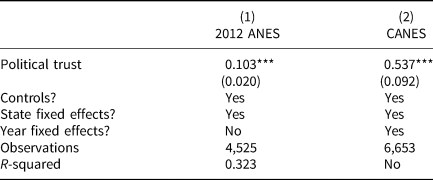
In Table 5, I replicate results in the 2012 ANES, using a smaller, but similar set of immigration questions as in 2016. I also use a question asking about preferred immigration levels from the CANES from 1992–2008. For the 2012 ANES, I use principal component factor analysis to construct a factor score of pro-immigration policy support (eigenvalue = 1.66, variance explained = 55.5 per cent). This is based on three questions asking about: (1) citizenship for certain unauthorized immigrants living in the United States, specifically those who came to the United States as children and graduated high school, (2) what the US government should do about unauthorized immigrants currently living in the United States and (3) preferred immigration levels. For the CANES, a more general dataset, I only use a question that asks about preferred immigration levels.
Political trust and support for immigration in additional years

Note: Model 1 (2012 ANES) dependent variable is pro-immigration factor score, ranging 0 to 1. Model 2 (CANES) dependent variable is preferred immigration levels, ranging 1 to 5. CANES years for Model 2 = 1992, 1994, 1996, 2004, 2008. OLS (Model 1) and ordered probit (Model 2) coefficients with robust standard errors clustered by state in parentheses. *** p < 0.01, ** p < 0.05, * p < 0.1 (two-tailed)
The results in Table 5 show that in both 2012 (Model 1) and over time from 1992 through 2008 (Model 2), political trust exerted a substantively significant influence on immigration policy preferences, making people more supportive of a path to citizenship for undocumented/unauthorized immigrants, and more likely to support increased immigration levels. The fact that the results are similar in different election years, under both Democratic and Republican administrations, and varying economic conditions, should increase external validity and underscore the robustness of the main results, based on analyses of the 2016 ANES.Footnote 21
Political Trust Precedes Immigration Policy Preferences
Past research strongly suggests that political trust is theoretically and causally antecedent to policy preferences. Hetherington (Reference Hetherington2005, 66–68) makes a compelling argument that political trust precedes policy preferences, arguing that trust serves as a decision rule for whether people accept or reject government policies, particularly those that do not confer direct, widely shared benefits. Indeed, previous studies show that trust influences people's attitudes on racial policies (Hetherington and Globetti Reference Hetherington and Globetti2002), government spending (Hetherington and Rudolph Reference Hetherington and Rudolph2015; Rudolph and Evans Reference Rudolph and Evans2005) and foreign policy (Hetherington and Husser Reference Hetherington and Husser2012), rather than policy preferences driving trust. However, recent work focusing on Europe shows that concerns about immigration's societal impact can, by undermining a sense of national identity and connection to governing elites, negatively influence people's trust in political institutions (Citrin, Levy, and Wright Reference Citrin, Levy and Wright2014; McLaren Reference McLaren2011; McLaren Reference McLaren2012).Footnote 22
These panel data suggest that concerns about immigration can depress political trust, particularly among people who are concerned about how government is handling immigration policy. McLaren's findings differ from those of this article, however. McLaren's article looks at the influence of concern over immigration on political trust, while my article looks at the relationship between political trust and support for accommodating, pro-immigration policies. These articles need not conflict with each other, however. It is possible for the conclusions of both articles to be valid and complement each other. Concern over immigration, and how government is handling the policy, can indeed influence political trust (see also Newman and Johnson Reference Newman and Johnson2012; Rocha, Knoll and Wrinkle Reference Rocha, Knoll and Wrinkle2015), but it is also possible for political trust to influence public support for pro-immigration policies. Both sets of findings enhance our understanding of the trust–immigration relationship.
While I do not discount the possibility that concerns about how government is handling immigration can influence political trust, it seems unlikely that attitudes toward specific policies such as birthright citizenship, immigration levels, or providing citizenship to certain undocumented immigrants, would drive trust in government, given the generally low levels of political sophistication in the American mass public, and the general instability of people's policy preferences (Converse Reference Converse and Apter1964; Delli Carpini and Keeter Reference Delli Carpini and Keeter1997; Zaller Reference Zaller1992). Rather, political trust should serve as a rule (Hetherington Reference Hetherington2005; Rudolph Reference Rudolph, Zmerli and van der Meer2017) for deciding whether to support an expanded role for government in the policy domain of immigration.
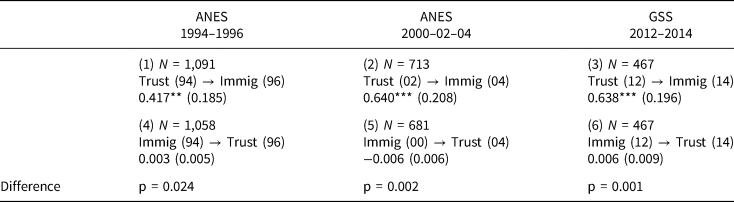
To demonstrate that the direction of causality flows primarily from trust to immigration support, I employ panel data from the 1994–1996 and 2000–2002–2004 ANES panel studies, as well as the 2012–2014 GSS panel study, estimating a series of simple cross-lagged models in Table 6.Footnote 23 The results presented here show that political trust drives immigration policy preferences, rather than the reverse.Footnote 24 In each cross-lagged model, the coefficient for political trust is significant, while the coefficient for preferred immigration levels is non-significant.Footnote 25
Cross-lagged models of political trust and preferred immigration levels

Note: Political trust is a factor score, ranging from 0 to 1. Preferred immigration levels range from 1 to 5. Each model contains a lagged dependent variable; these are omitted here to save space. Models 1, 2 and 3 included a measure of lagged immigration support (measured in 1994, 2000 and 2012, respectively). Models 4, 5 and 6 include a measure of lagged political trust (measured in 1994, 2002 and 2012, respectively). Difference in coefficients are for political trust in 1994, 2002 and 2012 (Models 1, 2 and 3, respectively) and immigration support in 1994, 2000 and 2012 (Models 4, 5 and 6, respectively). Ordered probit (Models 1, 2 and 3) and OLS coefficients (Models 4, 5 and 6) coefficients with robust standard errors in parentheses. *** p < 0.01, ** p < 0.05, * p < 0.1 (two-tailed)
Experimental Evidence
To guard against endogeneity concerns and bolster claims of a causal relationship between political trust and support for immigration, I conducted a survey experiment using Amazon's MTurk. In this experiment, I had subjects read a fictitious op-ed article that portrays government as either trustworthy or untrustworthy. After reading this article, respondents are then asked about their attitudes on a series of immigration policy questions. This survey experiment is meant to supplement the observational analyses of the ANES, and to provide causal evidence of a relationship between political trust and support for immigration. The experiment was conducted in October 2018. After removing respondents with IP addresses identified as ‘spam’ by Amazon, people who did not have a US address (based on longitude and latitude coordinates) and people who took the survey multiple times, I was left with 1,028 observations (517 in the positive treatment group and 511 in the negative treatment group), down from 1,618.Footnote 26 Although MTurk survey takers are not perfectly representative of the general population (they tend to be younger, better educated and more liberal/Democratic), they are not drastically different, and are more representative than a student or convenience sample (Berinsky, Huber and Lenz Reference Berinsky, Huber and Lenz2012). Furthermore, this experiment is simply meant to supplement observational analyses of the ANES, a gold standard of representative national public opinion surveys.Footnote 27 See Appendix D for greater detail regarding this survey experiment.Footnote 28
There were two treatment groups. One received a ‘negative’ trust treatment, while another received a ‘positive’ treatment. This design is based on Faulkner, Martin and Peyton (Reference Faulkner, Martin and Peyton2015), who found that a similar op-ed affected the political trust levels of a student sample in Australia. Each group read a fictitious op-ed article from The Economist.Footnote 29 The positive treatment group read a version in which a former government bureaucrat portrayed politicians as trustworthy and government as effective and non-corrupt. The negative treatment group read a version in which the same bureaucrat portrayed politicians as untrustworthy and government as ineffective and corrupt.Footnote 30 After viewing one of these two articles, respondents were asked a series of questions about their trust in government, including a question asking ‘how much they personally trust the federal government’ with ‘0’ indicating no trust at all, and ‘10’ indicating complete trust.” I rescaled responses to this question to range between 0 and 1. People who were assigned to read the positively framed op-ed article reported significantly higher levels of political trust compared to those who read the negatively framed op-ed article (positive mean = 0.425; negative mean = 0.370; p = 0.000).
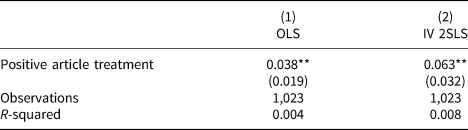
After reading the article and being asked to rate their trust in the federal government, I asked respondents three immigration-related questions. These three questions ask about: preferred immigration levels, a border wall with Mexico, and a path to citizenship for undocumented/unauthorized immigrants currently living in the United States.Footnote 31 All three questions load strongly onto a single factor (eigenvalue = 2.13, variance explained = 70.9 per cent). I rescale this factor score (serving here as the dependent variable) to range between 0 and 1. In Column 1 of Table 7, I regress this pro-immigration factor score on positive treatment assignment, showing that higher levels of (experimentally induced) political trust increase support for immigration by approximately 0.04 (on a 0 to 1 scale).
Positive portrayals of government increase support for immigration

Note: Dependent variables are pro-immigration factor scores, ranging from 0 to 1. Source is MTurk survey experiment. OLS coefficients with robust standard errors in parentheses. *** p < 0.01, ** p < 0.05, * p < 0.1 (two-tailed)
The results in Column 1 of Table 7 show a significant treatment effect (of assignment to read the positive op-ed article). However, this may underestimate the true causal effect, as it included people who failed to pay close attention to the tone/frame of the article. After respondents read the article, I asked them two recall questions. These questions asked if the op-ed characterized the United States as a corrupt or non-corrupt nation and if the author had characterized the federal government as trustworthy or untrustworthy. People who incorrectly answered one or both of these questions, or said they were ‘not sure’ to one or more, were coded as having not closely read/paid attention to the article. Although most respondents correctly answered both questions, a non-trivial portion (29.6 per cent) did not. This can pose a problem as is suggests that these individuals did not receive the ‘full treatment’, that is, reading and correctly recalling the frame of the op-ed article. This problem of ‘intent to treat’ (Angrist and Pischke Reference Angrist and Pischke2015, 119–120) can understate the causal effect.
To overcome this problem, I use an instrumental variables approach. To accurately capture the effect of reading the positively framed op-ed article, I use random assignment (whether an individual was assigned into the positive or negative group) to instrument for having been positively treated, that is, having closely read and correctly recalled the positively framed op-ed article.Footnote 32 In Column 2 of Table 7, I use an instrumental variables two-stage least squares regression (IV 2SLS), using random assignment (to the positive rather than negative frame) as an instrument for actual receipt of the positive treatment (closely reading and correctly recalling the article). The results from this analysis show a slightly larger treatment effect (0.06 vs. 0.04). Overall, these experimental data and analyses should help to assuage concerns about endogeneity resulting from omitted variable bias and bolster the validity of the results based on cross-sectional analyses of the ANES.
Political Implications
Overall, the totality of evidence, which examines multiple election years and employs cross-sectional, panel and experimental designs, shows that political trust exerts a substantively significant influence on American public support for immigration. Immigration attitudes are not shaped solely by feelings toward immigrant groups, economics, partisanship, ideology, core values or personality. Trust in government, the actor most responsible for managing large-scale policies such as immigration, matters as well. I have shown that people who are more politically trustful are less likely to support restrictive immigration policies, and are more likely to afford government the leeway and flexibility to enact, implement and manage pro-immigration policies, confident that it will be done in a manner that protects the native population from threats, be they real or perceived, stemming from immigration.
Americans' political trust is quite low today, although it has fluctuated over time due to factors such as economic growth, presidential and congressional approval, social capital, and partisan polarization, as well as whether foreign or domestic affairs occupy national attention (Chanley, Rahn and Rudolph Reference Chanley, Rudolph and Rahn2000; Hetherington and Rudolph Reference Hetherington and Rudolph2008; Hetherington and Rudolph Reference Hetherington and Rudolph2015; Keele Reference Keele2007). This has implications for immigration support in the mass public, and also for the prospects of long-term, comprehensive immigration reform, which multiple Congresses, and presidents of both parties, have attempted unsuccessfully several times since the passage of the Immigration Reform and Control Act in 1986.
Following the defeat of the US Senate's immigration reform bill in 2013, Florida senator Marco Rubio, the bill's chief Republican author, stated that his biggest lesson from the immigration reform effort was ‘that there now exists an incredible level of mistrust on anything massive that the government does’.Footnote 33 Indeed, data from a 2015 Pew Research Center poll showed that only 28 per cent of Americans believed the federal government was actually doing a good job at managing immigration policy.Footnote 34 It seems likely that future immigration reform efforts will be influenced by media and elite framing – that is, whether policies are portrayed as ‘amnesty’ or a ‘path to citizenship’ (Merolla, Ramakrishnan and Haynes Reference Merolla, Ramakrishnan and Haynes2013). Public opinion can also vary depending on whether the immigrant population is portrayed as entering the country legally or illegally (Wright, Levy and Citrin Reference Wright, Levy and Citrin2016), or assimilating into American culture or not (Ostfeld Reference Ostfeld2017), but also, I argue, by charges that government cannot be trusted to handle increased immigration levels, and ensure that the native population is protected from perceived criminal, economic, and/or cultural threats stemming from immigration.
Though an American immigration consensus does exist, one that prefers high-skilled immigrants over low skilled (Hainmueller and Hopkins Reference Hainmueller and Hopkins2015), any large-scale efforts to reform the US immigration system are likely to be vulnerable to attacks on government's ability to effectively handle the issue of immigration, a charge that will likely resonate with a distrustful mass public.Footnote 35 Americans' trust in the federal government is currently at an historical nadir, something that does not bode well for immigration reform. Rather, policies that restrict immigration, and candidates who espouse them, will likely find support among the American mass public. Higher levels of political trust would bolster overall support for pro-immigration policies, particularly among Republicans, whose support will be crucial to any future immigration reform efforts.
Future research could examine whether the relationship between political trust and immigration attitudes varies depending upon the group under consideration, that is, if it matters more for non-white groups, given that many Americans are more likely to view these groups negatively and perceive a greater threat to the native population. Future work could also examine whether political trust conditions the relationship between changes in the immigrant population in one's local area and people's attitudes toward immigration (Hopkins Reference Hopkins2010; Newman Reference Newman2013) – that is, if politically trustful individuals are less likely to perceive a threat from demographic changes in their communities. Future research would also benefit from moving beyond attitudes, for example to examine whether US states or countries in Europe that have more trusting citizens pursue less punitive and less restrictive immigration policies.
Past work, both in Europe (McLaren Reference McLaren2011; McLaren Reference McLaren2012) and in the United States (Newman and Johnson Reference Newman and Johnson2012) has found that concern about immigration can lower political trust and reduce elected officials’ approval ratings. Rocha, Knoll and Wrinkle (Reference Rocha, Knoll and Wrinkle2015) found that effective immigration enforcement in Texas bolstered whites' trust in government, but depressed Latinos' trust. These authors argue that the nature of immigration enforcement can have a policy feedback, by ‘redistributing political trust’, depending on the groups that are affected. Citrin, Levy and Wright (Reference Citrin, Levy and Wright2014) found that European countries' adoption of multicultural policies strengthened the connection between citizens' dissatisfaction with immigration and their political support (evaluations of the government of the day and the larger political system). This similarly suggests that immigration policies can have a ‘feedback’ effect, influencing the public's political trust.
These past works, along with the results presented in this article, which showed that low political trust can depress support for immigration, suggest that there may be an interesting dynamic relationship between political trust and immigration, in that low trust makes it harder for government to effectively manage and assimilate the immigrant population, which in turn reduces political trust. If the political system is unable to effectively manage immigration policy, it seems likely that people will lose confidence in that system, which can undermine government's ability to marshal public support to take on a larger role in dealing with immigration. This can create a vicious cycle (Easton Reference Easton1965), whereby poor performance undermines trust in the political system, which in turn leads to poor performance. Examining a possible dynamic relationship is beyond the scope of this article but could be an interesting path for future research. Although this article examined the United States, immigration is highly salient in European politics as well, since Europe is dealing with dual crises of low citizen trust and an influx of immigration (Dancygier and Laitin Reference Dancygier and Laitin2014). The findings here can potentially have implications for established democracies in general.
Overall, these findings demonstrate a strong link between political trust and immigration attitudes. When people are considering their support for immigration, they do not simply follow the cues of co-partisan elites (Nicholson Reference Nicholson2012; Zaller Reference Zaller1992), nor do they solely base their decisions on symbolic considerations (Sears et al. Reference Sears1980), and group evaluations (Converse Reference Converse and Apter1964; Kinder and Kalmoe Reference Kinder and Kalmoe2017). People also take evaluations of government, the actor most responsible for enacting, implementing, and managing public policies, into account.
Supplementary material
Data replication sets are available at https://doi.org/10.7910/DVN/YOABB5 and online appendices are available at https://doi.org/10.1017/10.1017/S0007123419000668.
Acknowledgements
I would like to thank Brad Gomez and Teresa Cornacchione for their helpful comments and willingness to read over multiple drafts. I would also like to thank the editor and anonymous reviewers for their helpful suggestions.