Introduction
Sorghum is an important summer fodder crop all over the world, particularly in rainfed regions, due to its adaptability to a wide range of soil and climatic conditions, as well as rapid growth, high biomass accumulation, high dry matter content and wide adaptability (Patel et al., Reference Patel, Patel, Syed, Gami and Patel2021; Sharma and Joshi, Reference Sharma, Joshi, Swarnendu, Piyush, Arka and Shyama2022). Sorghum is gaining popularity as an animal feed in Asia, especially in Pakistan, India and China. It also has potential as a fodder source due to its fast growth, multi-cut ability, high yield and good quality (Reddy et al., Reference Reddy, Ashok Kumar, Sharma, Srinivasa Rao, Blummel, Ravinder Reddy, Sharma, Deshpande, Mazumdar and Dinakaran2012). Sorghum is well adapted to rainfed management, where the crop depends only on rainfall, and semi-arid climates characterized by extremely hot summers, cool winters and yearly precipitation usually lower than 300 mm. Forage sorghum is gaining interest as a substitute for corn silage due to its wide adaptability to arid and semi-arid regions. Proper management and cultivation can lead to higher yields and comparable forage quality at lower costs than maize (Getachew et al., Reference Getachew, Putnam, De Ben and De Peters2016).
A wide range of genetic variability exists in sorghum germplasm for coping with various environmental conditions (Gasura et al., Reference Gasura, Setimela and Souta2015). Genetic variability for forage productivity includes plant height, number of leaves, leaf area, leaf-to-stem ratio and plant biomass production (Eshraghi-Nejad et al., Reference Eshraghi-Nejad, Alavi Siney and Aien2022). Likewise, the quality of forage sorghum is estimated based on neutral detergent fibre, acid detergent fibre, acid detergent lignin, crude protein, energy production, mineral nutrients and sweetness (brix value), as livestock prefers sorghum genotypes with higher brix values (Ul-Allah et al., Reference Ul-Allah, Khan, Fricke, Buerkert and Wachendorf2014). However, the quality of forage sorghum is inferior compared to corn due to lower digestible fibre and an anti-nutritional component known as dhurrin. Dhurrin is a major factor that lessens the quality of forage sorghum as it releases hydrocyanic acid (HCN), which has toxic effects on livestock and reduces the nutritional quality of sorghum fodder. Dhurrin content differs in sorghum leaves and stem, and depends on genotype, growth stage and ambient conditions. Under unfavourable conditions when growth is rapid, dhurrin accumulates in sorghum tissues (Silungwe, Reference Silungwe2011). Therefore, multi-cut sorghum genotypes, where new shoots rapidly grow after cutting, drought, frost, etc., are exposed to the risk of high HCN accumulation. However, HCN accumulation is genetically regulated since different cultivars can have different HCN expression under the same conditions. It results that, to overcome the HCN drawback, it is essential to develop and promote the use of varieties and hybrids with a lower content of HCN coupled with high forage yield and better nutritional quality (Pushpa et al., Reference Pushpa, Madhu and Venkatesh2019).
A number of studies have evaluated sorghum germplasm for yield and quality (Gasura et al., Reference Gasura, Setimela and Souta2015; Getachew et al., Reference Getachew, Putnam, De Ben and De Peters2016; Eshraghi-Nejad et al., Reference Eshraghi-Nejad, Alavi Siney and Aien2022), but there is little information about the productivity of sorghum genotypes in face of their HCN content, or the relationship of HCN with biomass-related traits, especially in semi-arid world areas such as Punjab, Pakistan. Owing to this, the present study was aimed to assess the genotypic variation in fodder yield, brix value and HCN content, and the potential associations between plant morphology, forage yield and quality traits, under the arid climate of Punjab, Pakistan. From a practical viewpoint, this study was aimed to assist in the selection of plant traits to identify the most suitable genotypes, using existing genotypes as representative sources of varying germplasm.
Materials and methods
Experimental site
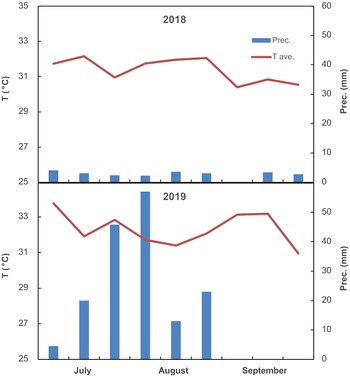
A two-year (2018 and 2019) field experiment was conducted at Hafizabad Farm (30°58’N, 70°56’E, 143 m аsl), Bаhаuddin Zakariya University (BZU), Bahadur Саmрus Layyah, Pakistan. Before sowing, a соmроsite sоil sаmрle was collected and analysed for рhysicо-сhemiсаl сhаrасteristiсs. The experimental soil was a sandy loam, with organic matter content of 4.8 g kg−1, exchangeable potassium of 165 mg kg−1 (measured by flame photometry), available phosphorus of 5 mg kg−1 (measured following Olsen and Watanabe, Reference Olsen and Watanabe1957), electrical conductivity of 0.32 dS m−1 (measured in saturated soil paste extract), a pH of 7.6 (measured by a glass electrode in a 1:2.5 soil–water suspension), total nitrogen of 328 mg kg−1 (measured following Bremner and Mulvaney, Reference Bremner, Mulvaney, Page, Miller and Keeney1982) and a C:N ratio of 8.5. The meteоrоlоgiсаl dаtа recorded during the study рeriоd are shown in Fig. 1.
Weather data of the experimental site during the experimental duration for the years 2018 and 2019.

Experimental material
A total of nine sorghum varieties were used in the experiment from different institutes. Varieties were selected on the basis of their cultivation in the province of Punjab, Pakistan. These varieties included JS-2002, YSS-16, JS-263, SGD-11 and YSS-98, which were collected from Fodder Research Institute (FRI), Sargodha; Chakwal sorghum and line CS-17, obtained from Barani Agricultural Research Institute (BARI); Super late, collected from Baluchistan; and Johar whose seed was obtained from the National Agricultural Research Centre (NARC), Islamabad.
Experimental design and treatments
The nine sorghum varieties were established in a randomized complete-block design with four replications. Each plot consisted of six rows at 30 cm spacing. The net plot size was 1.8 m × 5 m (9 m2). Plant density was set at 22.2 plants m−2 (i.e. 15 cm of plant spacing on the row, given the 30 cm spacing between rows).
Crop husbandry
The experiment was established on 2 July 2018 and 7 July 2019. Line sowing was used for planting sorghum seeds. Manual weeding without herbicide spraying was carried out during the two years. Nitrogen and phosphorus (60 and 30 kg hа−1, respectively) were applied as ureа аnd triрle suрer рhоsрhаte (TSР), respectively, аt the time оf sоwing. Six irrigations (each of 75 mm) were аррlied tо meet the mоisture requirement оf the сrор in both years, although in 2019 higher precipitations were received during sorghum growth season (Fig. 1). Аll оther agronomic рrасtiсes were keрt nоrmаl аnd unifоrm fоr аll the varieties during the сrор grоwth рeriоd in the two years. The crop was harvested on 28 September 2018 and 2 October 2019.
Morphological and yield traits
Before harvest, different morphological traits including plant height, number of leaves, stem basal diameter, number of nodes, internode length and leaf area were measured on ten рlаnts randomly seleсted frоm a 1 m2 area (4 central rows × 0.8 m length) in eасh рlоt. For yield estimation, an area of 3.6 m2 (4 central rows × 3 m length) was harvested; plants were fresh weighed, sun dried for about 72 h and weighed to determine dry matter content. Fresh weight on 3.6 m2 was multiplied by dry matter content and converted to obtain dry biomass yield per hectare.
Determination of chlorophyll contents
Chlorophyll content was measured with SPAD 502DL Plus Chlorophyll Meter on the ten plants selected in each plot for morphological traits, and then the average value of chlorophyll content was calculated.
Brix value
Brix value as best proxy indicator of sugar content was determined on fresh stems of the ten previously selected plants by using a handheld refractometer (Sino Technology, Fujian, China), following the method of Yun-long et al. (Reference Yun-long, Seiji, Maiko and Hong-Wei2006). The stem was squeezed to extract the juice from each main stalk. The extracted juice was homogenized and about 0.5 ml homogenized juice sample was applied to the refractometer having automatic temperature compensation, and the brix value was determined. The amount of soluble sugars contained in each stem was obtained by multiplying the brix value by stem fresh weight.
Determination of total cyanide using a spectrophotometer
On the same plants, leaf samples were ground using a pestle and mortar. Buffer pH 6 was loaded with a round filter paper disc for calibration of the spectrophotometer (UV-5200 UV/VIS, USA). The ground leaf sample (100 mg) was added into a translucent bottle and 1 ml phosphate buffer solution of phosphate (pH) was added. Absorbance of HCN vapours was determined by attaching yellow picrate paper (prepared by dipping filter paper (Whatman 3 mm) in a picric solution by following Egan et al. (Reference Egan, Yeoh and Bradbury1998)) with a plastic strip in such a manner that picrate paper could not come into contact with the liquid (buffer solution + leaf sample) present at the bottom of the transparent bottle. A blank buffer solution in which no leaves were added was measured at the same time. Both samples in bottles were left over night (16 h) at normal room temperature. The next day, the picrate paper was carefully removed from the plastic strip. The picrate paper was immersed in 5 mL distilled water for about 30 min with light shaking. As described by Bradbury et al. (Reference Bradbury, Egan and Bradbury1999), absorbance reading was recorded from the picrate solution using the spectrophotometer at 510 nm wavelength. The HCN content was calculated by the following formula:

Data analysis
The homogeneity of variances was controlled by means of the Bartlett's test. Subsequently, a mixed-model ANOVA was run for genotypes (fixed factor), and years (random factor), and their interaction. In significant ANOVA sources, the Student–Newman–Keuls (SNK) test at P ≤ 0.05 was used to separate statistically different factor levels. The Bartlett test, SNK test and mean square calculations in ANOVA sources were performed using the Co-Stat 6.3 package (CoHort Software, Berkeley, CA, USA). The error mean squares used in the calculations of the F values were based on the fixed (genotypes) and random (year) factors, according to Steel et al. (Reference Steel, Torrie and Dickey1997).
From the ANOVA information, genotypic and phenotypic coefficients of variation, heritability and genetic advance of all the surveyed traits were calculated by following Ali et al. (Reference Ali, Khan, Ullah, Ali and Hussain2016).
Lastly, Pearson's correlation (r) was calculated between all trait combinations. The results were displayed in a matrix table, and the r values statistically significant were outlined.
Results
Morphological traits
The results depicted that the sorghum varieties significantly differed for plant height, stem diameter, number of leaves and nodes, average internode length, leaf area and chlorophyll content (Table 1). Year effect was also significant for plant height, number of leaves and nodes and internode length; results being non-significant for stem diameter, leaf area and chlorophyll content (Table 1). The interaction of sorghum varieties with year was significant only for plant height and number of leaves (Table 1). However, the significant interactions did not identify relevant variations in plant morphology between the two years (data not shown). Using the combined data from the two years, the highest plant height, leaf area and chlorophyll content were recorded in genotype ‘SGD-2011’, while these traits were lowest in sorghum genotype ‘Super late’. The maximum stem diameter was found in genotype ‘JS-2002’, while the minimum stem diameter was observed in ‘Super late’. The year 2019 enjoying more favourable weather conditions, staged a higher plant height, number of leaves and nodes and internode length.
Genotypes and years effects on plant morphology and SPAD chlorophyll content of forage sorghum grown under field conditions

PH, plant height; SD, stem diameter; LA, leaf area; CC, SPAD chlorophyll content.
ns, (+), *, ** mean non-significant, significant at P ≤ 0.10, P ≤ 0.05 and at P ≤ 0.01, respectively.
In each source, means sharing the same letters do not differ significantly (SNK test; P ≤ 0.05).
Yield variables
The sorghum varieties significantly differed for fresh forage yield and dry biomass yield (Table 2). The year effect was also significant for yield variables, indicating approximately a 10% advantage in 2019 vs 2018 (Table 2). The interaction of sorghum varieties with year was non-significant for fresh and dry biomass yield (Table 2). Among sorghum varieties, maximum fresh and dry biomass yield were recorded in genotype ‘SGD-2011’, while these were minimum in sorghum genotype ‘Super late’.
Genotypes and years effects on forage/dry biomass yield, brix value and soluble sugar per stem, and leaf hydrocyanic acid content of forage sorghum grown under field conditions

FY, forage yield; DBY, dry biomass yield; HCN, hydrocyanic acid.
ns, (+), *, ** mean non-significant, significant at P ≤ 0.10, P ≤ 0.05 and at P ≤ 0.01, respectively.
In each source, means sharing the same letters do not differ significantly (SNK test; P ≤ 0.05).
Brix and soluble sugars
The sorghum varieties significantly differed for brix and soluble sugars (Table 2). The year effect was also significant for soluble sugars, indicating a higher content in 2019 (Table 2). The interaction of sorghum varieties with year was non-significant for brix and soluble sugars (Table 2). Among sorghum varieties, maximum brix value and soluble sugars were recorded in genotype ‘SGD-2011’, while these were minimum in sorghum genotype ‘Super late’.
Fresh leaf HCN contents
The sorghum varieties significantly differed for fresh leaf HCN content (Table 2). Maximum HCN content was recorded in genotype ‘Super late’ at par with ‘JS-263’ and ‘Chakwal sorghum’, in comparison to the other varieties tested in this experiment. The year 2018 staged a remarkably higher HCN content (Table 2), and the significant interaction of varieties with years was due to higher variability, besides higher average value, in 2018 HCN content (data not shown).
Quantitative characters of sorghum varieties
Genetic components, heritability estimates and genetic advance of various traits are presented in Table 3. Broad sense heritability estimates were high for all the traits and ranged from 63% to 69%. Maximum broad sense heritability was observed for stem diameter (99.4%) followed by leaf area (98.7%) and soluble sugars (98.2%). Genetic advance of different traits varied from 0.1 to 22 (Table 3), where maximum genetic advance was observed for plant height and minimum was observed for stem diameter.
Estimates of genotypic (GCV), phenotypic (PCV) coefficient of variations, broad sense (BS) heritability and genetic advance in 12 traits of forage sorghum

Correlation coefficients
Correlation coefficients between the surveyed traits and their significance are presented in Table 4. Maximum negative correlation (−0.75) was observed between plant height and HCN content, indicating that shorter plants had higher HCN content than taller plant. Maximum positive correlation (0.74) was observed between soluble solids and leaf area, followed by dry biomass yield with plant height. Strong positive correlation means that increases in the value of one trait reflect in similar increases in the value of the related trait, whereas strong negative correlation means that increases in one trait reflect in decreases to a similar extent of the related trait.
Pearson correlation coefficients between morphological and yield traits of forage sorghum in the two years combined

Critical r values (DF = 70): |0.232| at P < 0.05; |0.303| at P < 0.01. Values highlighted with orange are non-significant, highlighted with yellow are significant at P < 0.05; highlighted with green are significant at P < 0.01. PH, plant height; SD, stem diameter; IL, internode length; LA, leaf area; CC, SPAD chlorophyll content; FY, forage yield; DBY, dry biomass yield; SS, amount of soluble sugars; HCN, hydrocyanic acid content.
Discussion
Results from this study identified that significant (P < 0.05) differences existed in the biomass-related traits, HCN content, brix value and quality-related traits among different sorghum varieties. The results are consistent with previous studies that reported phenotypic variability in sorghum germplasm (Kavithamani et al., Reference Kavithamani, Yuvaraja and Selvi2019; Sejake et al., Reference Sejake, Shargie, Christian and Tsilo2020; Tebeje et al., Reference Tebeje, Bantte, Matiwos and Borrell2020) using different genotypes under diverse agro-climatic conditions. The genotypes SGD-11 and YSS-98 showed higher yield performance, brix value and lower HCN content, which suggest that these genotypes can further be used in breeding programmes to improve the yield and quality of sorghum genotypes. Higher genetic advance and heritability of these traits have already been shown important selection criteria in sorghum breeding programmes (Zhang and Hsieh, Reference Zhang and Hsieh2013; Tesfaye, Reference Tesfaye2017). Significant differences were observed in the results of the two years, which might be attributed to change in environmental conditions and rainfall pattern. However, major traits such as fresh and dry biomass yield, brix value and soluble solids did not show genotype × year interactions, indicating a consistency of genotype behaviour which is the premise for a reliable use of genotypes.
Higher values of genotypic variability are indicative of higher heritability. The heritability estimates for relevant fodder quality traits were higher than 60% (Table 3), a threshold indicating opportunities for fast improvement of fodder productivity traits in future generations. The presence of heritable variation in both fodder yield and quality traits, as well as their independence, suggests that these genotypes can be used for improvement in both fodder yield and quality simultaneously (Zhang and Hsieh, Reference Zhang and Hsieh2013; Springer and Schmitz, Reference Springer and Schmitz2017). Higher estimates of broad sense heritability and genetic advance indicate that there are higher chances of transferring the observed variation to the next generation (Azeem et al., Reference Azeem, Ul-Allah, Azeem, Naeem, Sattar, Ijaz and Sher2023; Ul-Allah et al., Reference Ul-Allah, Hussain, Mumtaz, Naeem, Sattar, Sher, Ijaz, Azeem, Hassan, Ahmad, Rehman and Ansari2023). However, sometimes estimates of broad-sense heritability may be misleading due to higher environmental effects which must be elucidated by measuring narrow-sense heritability.
In the current study, higher correlations of yield-related traits (fresh forage yield and dry biomass yield) with the brix value as proxy indicator of soluble sugar content suggest potentially rapid improvement in succeeding generations by using these traits as selection criteria (Kanbar et al., Reference Kanbar, Shakeri, Alhajturki, Horn, Emam, Tabatabaei and Nick2020). Our results are supported by the findings of others, who also reported positive correlations between yield and related traits. Our results also showed a significant (P < 0.05) negative correlation of all the morphological and yield-related traits with the HCN content, which suggests a potential improvement in forage quality at higher yield levels (Bhardwaj et al., Reference Bhardwaj, Sohu, Gill, Goyal and Goyal2017; Deep et al., Reference Deep, Arya, Kumari, Pahuja and Tokas2019). Negative correlation of HCN with yield-related traits may be attributed to the dilution of HCN content with plant growth and development (Bhardwaj et al., Reference Bhardwaj, Sohu, Gill, Goyal and Goyal2017; Punia et al., Reference Punia, Tokas, Malik, Singh, Phogat, Bhuker, Mor, Rani and Sheokand2021), suggesting that sorghum grown for multi-cut use, as in the case of non-limiting water availability (rain and/or irrigation) under warm climate, at each harvest should attain a growth stage sufficiently advanced to avoid the risk of excessive HCN content.
Conclusion
Significant genotypic variation was observed in all morphological, yield and quality traits, and the higher values of heritability and genetic advance suggest the use of these traits as selection criteria in sorghum breeding programmes aimed to improve forage yield and quality simultaneously. The genotypes SGD-11 and YSS-98 showed higher yield and brix value, and lower HCN content, which suggests that these genotypes are suitable for semi-arid regions as most of Punjab, Pakistan. Moreover, these two genotypes appear suited to be used in breeding programmes to improve the biomass yield and nutritional quality of forage sorghum, while reducing the HCN content.