Introduction
Public accountability is a topic that has received increasing scholarly attention over past decades (Aucoin and Heintzman Reference Aucoin and Heintzman2000; Behn Reference Behn2001; Dubnick Reference Dubnick2005; Overman et al. Reference Overman, Schillemans and Grimmelikhuijsen2020; Romzek and Dubnick Reference Romzek and Dubnick1987; Schillemans and Busuioc Reference Schillemans and Busuioc2015; Yang Reference Yang2012). Traditionally, accountability is organised vertically and refers primarily to how politicians and governments are held accountable by elective bodies and how government officials are held accountable by their superiors. Nowadays, public accountability also implies that governments and government officials give account to a wide set of stakeholders (Bovens Reference Bovens2007; Koliba et al. Reference Koliba, Meek and Zia2010; Klijn and Koppenjan Reference Klijn and Koppenjan2016). Accountability is a concept with a strong normative connotation that everyone is supposed to support. It resonates with many widely accepted values such as trustworthiness, openness and transparency (Bovens et al. Reference Bovens, Schillemans and ’T Hart2008). Furthermore, it holds a strong promise of fair governance, which is an important dimension of good governance (Mulgan Reference Mulgan2003). Nevertheless, it is elusive because it has many different meanings, and this, in turn, results in many debates amongst scholars (Christensen and Lægreid Reference Christensen and Lægreid2011).
Many studies have recognised that governments nowadays are facing an accountability deficit issue or an accountability overload issue (Jos and Tompkins Reference Jos and Tompkins2004). Especially in many Western democracies, this accountability deficit has compromised state legitimacy. Although governments in modern, complex societies are formally accountable to parliaments, parliaments have limited ability to hold them to account (Behn Reference Behn2001). Governments have implemented many sophisticated accountability measures to improve their performance, but citizens still feel dissatisfied (Dubnick Reference Dubnick2005). Accountability overload has also been widely discussed by scholars (Bovens et al. Reference Bovens, Schillemans and ’T Hart2008). Often, officials face the “many eyes” issue: they have to give account to various forums and meet various legitimate, but often conflicting, expectations (Eriksen Reference Eriksen2020). This tends to result in what Koppell (Reference Koppell2005) calls the “multiple accountabilities disorder”. Many officials hence complain that a large number of accountability arrangements takes too much of their time and that the standards of accountability systems are ever-changing, making them difficult to follow (Romzek and Dubnick Reference Romzek and Dubnick1987).
In the Chinese context, the accountability deficit issue has received increasing attention from governors and practitioners. Over the past few decades, corruption, the abuse of power and bureaucratic actions have created distance between officials and ordinary citizens in China. The public has few effective ways to hold officials to account, and officials, in turn, are not responsive to citizens’ demands (Almén Reference Almén2018). Traditionally, in the Chinese political system, many different approaches, such as litigation, public hearings, media exposure, protests and professional oversight, have been introduced to increase the accountability of officials. However, these approaches generally have limited consequences.
In order to deal with the accountability deficit, many local governments have designed various accountability mechanisms. Amongst them, the ten-thousand-citizen review in Nanjing is a prominent example. It allowed ordinary citizens to review officials’ performance with the aim of increasing the government’s responsiveness to citizens’ demands. It was regarded as an innovative approach with the ambition of letting people judge, and some scholars view this initiative as exemplary of accountability without election (Ma Reference Ma2012). This introduction of a horizontal accountability arrangement can be seen as an attempt to remedy the accountability deficit. On the other hand, it may enhance accountability overload and the multiple accountabilities disorder, because it introduces new accountability relations to existing ones. Moreover, as the case study will show, it results in a series of shifts in accountability relations over time: dynamics with impacts on Nanjing Municipality’s performance and legitimacy.
Scholars have intensively discussed the nature, characteristics, definition and types of accountability (Aucoin and Heintzman Reference Aucoin and Heintzman2000; Behn Reference Behn2001; Dubnick Reference Dubnick2005; Romzek and Dubnick Reference Romzek and Dubnick1987; Mulgan Reference Mulgan2003). Nevertheless, the nature of, and remedies for, the multiple accountabilities disorder issues are still relatively unexplored domains, certainly if applied to the Chinese context. This is even more true for the dynamics of accountability relations and arrangements and their impacts (see Schillemans and Busuioc Reference Schillemans and Busuioc2015).
Our study aims to explore the nature of accountability relations that evolve as a result of citizens’ participation in review processes, and the dynamics that result from that. More specifically, it explores how the ten-thousand-citizen review influenced the existing accountability relationships, the accountability deficit, and overload issues. This contributes to our knowledge of the introduction, dynamics, and implications of attempts to introduce horizontal accountability practices in existing accountability systems, especially in China but also in a more general theoretical way. Moreover, we expect that this study will allow us to identify the potentials and pitfalls of strategies applied by governors to resolve their accountability deficit or overload issue (Eriksen Reference Eriksen2020; Schillemans and Busuioc Reference Schillemans and Busuioc2015). The question that guides this research, therefore, is: How have the nature and the focus of accountability evolved as a result of citizens’ participation in accountability practices? To answer this question, we conducted an in-depth case study of Nanjing Municipality’s ten-thousand-citizen review to comprehensively explore the nature and the dynamics of accountability relationships between officials and citizens.
The remainder of this article is structured as follows. First, the analytic framework is presented. Here, we identify a typology consisting of four different types of accountability relationships and apply this in our contribution as an inquiring tool to analyse the nature and the dynamics of accountability relationships implied in the ten-thousand-citizen review initiative. Then, we discuss our choice of research strategy, the case selection and data collection. Following that, the nature and the dynamics of the accountability relationships implied in the ten-thousand-citizen initiative are identified using the framework. In the discussion, we reflect on the shifts in the accountability relations and the conditions that underlie these dynamics. The article ends with practical and theoretical implications and suggestions for further research.
Analytic framework
In this section, we develop a typology of accountability relations that we use to explore the nature and the dynamics of accountability processes. Therefore, we first define the concept of accountability. Then, we discuss two dimensions of the accountability relationship and the typology based on these dimensions. As accountability practices often encompass various accountability relations, we discuss the nature and the implications of the co-existence and the dynamics of these accountability relations.
Accountability as an institutional arrangement to hold officials to account
Accountability is multidimensional and means different things to different scholars (Christensen and Lægreid Reference Christensen and Lægreid2011). Sometimes, it is used as an umbrella concept, referring to the quality of an institution, organisation or practice in terms of standards such as efficiency, effectiveness, transparency, equity, responsiveness, responsibility, liability, controllability and integrity (Behn Reference Behn2001). It is also used as a general term to refer to arrangements or mechanisms that aim to make powerholders responsible for their policies (Mulgan Reference Mulgan2003) or to any means used by officials to manage the various stakeholders’ expectations (Romzek and Dubnick Reference Romzek and Dubnick1987). In the United States (US), many scholars view accountability as interchangeable with good governance. In other approaches, accountability is seen not only as a mechanism to control powerholders, thus contributing to the legitimacy of government but also as a learning mechanism that creates feedback from relevant constituencies to improve government performance (Bovens et al. Reference Bovens, Schillemans and ’T Hart2008; Aucoin and Heitzman Reference Aucoin and Heintzman2000). One key topic in studies on accountability is that governmental organisations nowadays are subject to various accountability mechanisms and are struggling to cope with the accountability overload issue (Koppell Reference Koppell2005). This accountability overload has a quantitative and a qualitative aspect. The quantitative aspect relates to the workload that results from the presence of the various stakeholders to which account has to be given. Qualitative overload is caused by the diverging and contradictory procedures and standards imposed upon governments’ procedures by these various account takers.
In this contribution, we follow Bovens et al.’s (Reference Bovens, Schillemans and ’T Hart2008) study and define accountability as an institutional arrangement to hold officials to account. This implies that our interest is in accountability at the institutional and the organisational level. The ten-thousand-citizen review studied here is essentially an accountability mechanism designed by Nanjing Municipality that aims to hold officials to account.
Four types of accountability relationships
Accountability mechanisms can be categorised according to the accountability relationships that they encompass. A classic typology was developed by Romzek and Dubnick (Reference Romzek and Dubnick1987), in which they identified four different types of accountability relationships: political accountability, bureaucratic accountability, legal accountability and professional accountability. Political accountability implies that account givers are required to be accountable to potential constituencies, including the general public, elected officials, interest groups or even future generations, whereas bureaucratic accountability requires account givers to focus their attention on the priorities of their bureaucratic supervisors. Legal accountability requires account givers to enforce or implement laws or policy mandates developed by outsiders, and professional accountability implies that account givers should be accountable to their expertise and peers. Likewise, Hupe and Hill (Reference Hupe and Hill2007) have identified four different types of accountability relationships: public-administrative accountability, professional accountability, market accountability, and participatory accountability. Political-administrative accountability refers primarily to bureaucratic control or managerial approaches and professional accountability relates to control through professional norms or codes. Market participation requires officials to be responsive to customers, whereas participatory accountability refers mainly to pressures derived from citizen participation. Other authors have distinguished accountability relationships using other dimensions, such as timing (e.g. pre- versus postinformation accountability), process/outcome, participating/non-participating or known/unknown evaluative standards (Aleksovska et al. Reference Aleksovska, Schillemans and Grimmelikhuijsen2019; Koliba et al Reference Koliba, Meek and Zia2010; Klijn and Koppenjan Reference Klijn and Koppenjan2016; Mulgan Reference Mulgan2003; Schillemans and Busuioc Reference Schillemans and Busuioc2015).
In this paper, we distinguish types of accountability relationships based on two dimensions: the nature of the obligation to give account and the orientation of the accountability mechanism involved (Aucoin and Heintzman Reference Aucoin and Heintzman2000; Bovens et al. Reference Bovens, Schillemans and ’T Hart2008; Romzek and Ingraham Reference Romzek and Ingraham2000). The nature of the obligation refers to the question of to whom an account giver (accountor, in the case of a government or a government official) has to give an account (Mulgan Reference Mulgan2003). Accountors nowadays are not accountable solely to their public administration supervisors. They are also answerable to a set of other stakeholders such as media, fellow officials and the public. Accountability can be rendered to a higher authority in a direct chain of command or to stakeholders who are outside the hierarchical relationship (Scott Reference Scott2000). The literature generally identifies two types of accountability obligations: hierarchical and horizontal (Bovens et al. Reference Bovens, Schillemans and ’T Hart2008; Schillemans Reference Schillemans2015).
-
A hierarchical obligation implies that accountors’ obligations stem mainly from the political, judicial, and administrative directions (Bovens Reference Bovens2007). One of its key features is that accountors are obliged to explain and justify their conduct and performance to their higher-level supervisors (Romzek and Ingraham Reference Romzek and Ingraham2000). This relationship is per the principal–agent model, which means that a supervisor requires accountability from a subordinate (Mulgan Reference Mulgan2003). The relationship between accountors and their supervisors is formal and characterized by the direct possibility of sanctions from higher-level supervisors (Jantz and Jann Reference Jantz and Jann2013).
-
A horizontal obligation implies that accountors are obliged to explain and justify their conduct to their professional peers, social organizations, media, and the wider public (citizens and clients) (Romzek and Ingraham Reference Romzek and Ingraham2000; Koliba et al. Reference Koliba, Meek and Zia2010). This obligation is based on the principle of affected rights and interests (Mulgan Reference Mulgan2003, p. 13). The relationship is not formal, and account-takers (accountees) have limited possibilities to impose direct, formal sanctions upon accountors. Yet, their opinions and actions may influence the perceptions and the behavior of governments and government officials, because of social pressure and the risk of reputational damage (Bovens et al. Reference Bovens, Schillemans and ’T Hart2008).
With regard to the orientation of the accountability mechanisms, scholars have identified two generic types: mechanisms aimed at control and those aimed at learning (Aucoin and Heintzman Reference Aucoin and Heintzman2000; Bovens et al. Reference Bovens, Schillemans and ’T Hart2008; Klijn and Koppenjan Reference Klijn and Koppenjan2016). These orientations make a difference in terms of the qualitative nature of accountability relations.
-
Accountability as control emphasises that accountors should be held responsible for the consequences of their actions. In its extreme form, it functions in an “error-free” administrative culture. As a result, errors are meant to be eliminated and prevented through reducing discretion (Aucoin and Heintzman Reference Aucoin and Heintzman2000). When policies fail, the focus of accountability as control is to establish who is responsible for the failure. Blame and penalties are key mechanisms for remediating failure and increasing control. Means to realise accountability in this approach include rules, edicts, audits, laws, ombudsmen, and administrative tribunals. However, this orientation often stresses negativity – the quest for fault, guilty individuals and punishments (Schillemans and Busuioc Reference Schillemans and Busuioc2015). Therefore, accountors often behave defensively to meet accountability requirements. This accountability orientation tends to discourage accountors from taking risks and seeking improvements and innovations (Behn Reference Behn2001).
-
Accountability as learning emphasises the positive side of accountability and attempts to induce accountors to learn and continuously improve government performance (Bovens et al. Reference Bovens, Schillemans and ’T Hart2008). It requires accountors to find out what makes things go right or wrong and reach at a diagnosis that can be used to improve policies and public services (Behn Reference Behn2001). It requires accountees to look for high-quality bottom-up feedback information and accountors to act upon external feedback (Aucoin and Heintzman Reference Aucoin and Heintzman2000). Essentially, it stimulates both accountees and accountors to engage in dialogue and true communication with each other. Often, accountors are permitted, or even encouraged, to take risks. Accountees tolerate failures and errors and view them as normal and inevitable (Aucoin and Heintzman Reference Aucoin and Heintzman2000). Failures and errors are deemed to motivate accountors to seek more intelligent ways to perform their tasks. Positive feedback may further enhance accountors’ motivation to improve their performance. This orientation has the potential to achieve a mutual understanding amongst various actors and minimise accountors’ chances of engaging in defensive routines. However, its assessment might be challenged, or what has been learned might be ignored (Aucoin and Heintzman Reference Aucoin and Heintzman2000).
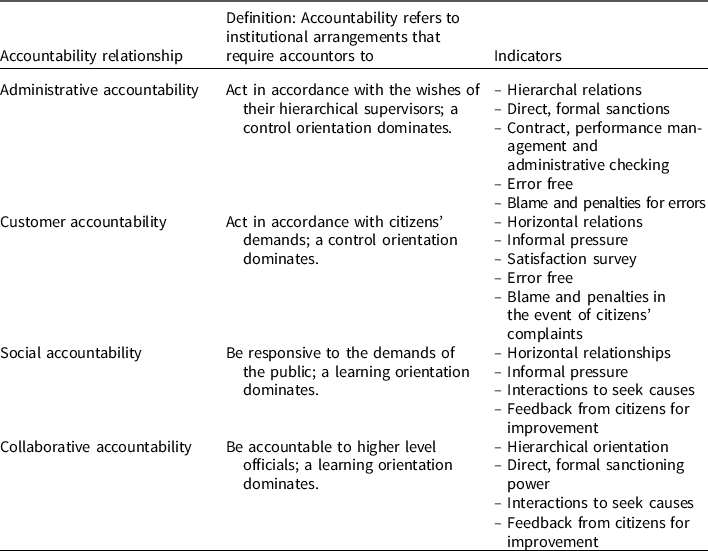
We argue that the two obligations and the two orientations of accountability can be used to formulate four types of accountability relationships (see Table 1).
-
1. Administrative accountability corresponds to traditional administrative control, in line with what Romzek and Dubnick (Reference Romzek and Dubnick1987) call bureaucratic accountability. From this perspective, accountability is often conceptualised in terms of a principal–agent relationship (Schillemans and Busuioc Reference Schillemans and Busuioc2015). It is characterised by a hierarchical obligation, which implies that accountors act in accordance with the wishes of their hierarchical supervisors. Under such an accountability relationship, a hierarchy dominates and higher level supervisors possess sufficient formal sanctioning power. Moreover, this accountability relationship implies a control orientation. Higher level supervisory organisations and officials attempt to achieve control through the use of various governance instruments such as audits, performance management, contracts and administrative checking. This results in an error-free culture in which errors result in blaming and penalties (Bovens et al. Reference Bovens, Schillemans and ’T Hart2008).
-
2. Customer accountability implies that accountors are held responsible by accountees that are not in a formal, hierarchically superior position like citizens, social groups, business, other governments, media and so on, and a control orientation dominates. This may be an accountability relationship characterised by control through citizens’ participation, to make accountors conform to the public’s preferences (compare Hupe and Hill Reference Hupe and Hill2007). Unlike the situation in administrative accountability, it is not so much the formal sanctioning power of superiors that impacts upon accountors, but informal horizontal pressures. This accountability relationship has a strong control orientation, which is characterised by an error-free culture and an emphasis on customer satisfaction and performance. Underperformance and failure lead to citizens’ complaints, exposing failures, blaming and attracting media attention, with the risk of reputational damage and hierarchical interventions by higher level officials or governments (the shadow of hierarchy).
-
3. Social accountability means that accountors are held responsible to accountees that are not in a formal, hierarchically superior position, such as citizens, social groups, business, other governments and media, and a learning orientation dominates. Pressures tend to be mainly external and of an informal nature. Accountors have to justify their actions to, for instance, citizens. In this sense, social accountability, like customer accountability, relates to the concept of participatory accountability as used by Hupe and Hill (Reference Hupe and Hill2007). However, in contrast to customer accountability, social accountability is orientated towards learning, and its main aim is to improve government performance, not seek out accountors’ errors (cf. Ma Reference Ma2012). It often implies that accountors and accountees engage in a dialogue to seek reasons for errors and that governments use citizens’ feedback to improve their performance.
-
4. A collaborative accountability relationship means that accountors are accountable to higher level supervisors, and a learning orientation dominates. Collaboration here refers mainly to the fact that higher level and lower level officials work together to improve governance performance. On the one hand, it is characterised by a hierarchical obligation, and accountors have to follow the priorities of their higher level supervisors, who have formal sanctioning power. On the other hand, this accountability relationship is learning based. Higher- and lower level officials preserve a constructive relationship. This means that, in this relationship, errors are tolerated and superiors as accountors enter into a dialogue to investigate the causes of failure (Aucoin and Heintzman Reference Aucoin and Heintzman2000; Bovens et al. Reference Bovens, Schillemans and ’T Hart2008).
Four types of accountability relationships

In the following, the operationalisation of the four accountability relationships is presented (Table 2).
The operationalisation of four accountability relationships
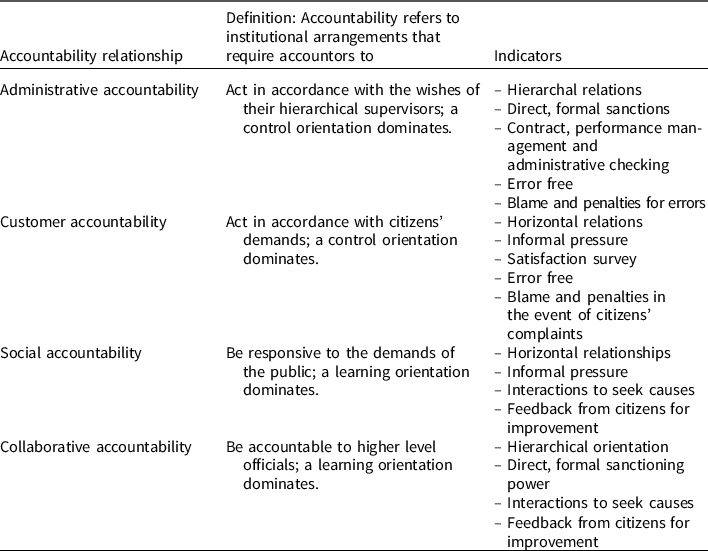
The above developed typology functions as an ideal type, a heuristic device to help us analyse the nature and the dynamics of accountability relationships. In practice, as the discussion on accountability overload has already suggested, accountability relations can be hybrid, meaning that accountors may have to deal with at least two types of accountability relationships simultaneously. It may be that various accountees are present simultaneously, or that accountors are engaged in both control and learning relationships. Moreover, accountability relationships may change over time (Jantz and Jann Reference Jantz and Jann2013). It may be that a shift occurs in the presence of accountees. For instance, vertical accountability may be replaced or supplemented by horizontal accountability, or the other way around. These shifts will have implications for accountability mechanisms and standards used, and for the accountors’ behaviour or performance. It may also be that a control orientation is replaced by a learning orientation, or the other way around. Although the typology is an ideal type, it can be used as a reference to establish the specific nature of accountability relationships and their dynamics in the case studied. Consequently, the typology should not be seen as a static box of four ideal types, but as an indication of the playing field in which accountability relationships can take a position, close to the ideal type or more in between types, and over time, they can shift from one box or position to another.
Method
Our main interest in this paper is to map the nature of, and the shifts in, accountability relationships in Nanjing’s ten-thousand-citizen review over time. A case study is an appropriate approach to answer this type of question (Yin Reference Yin2008). Our case is a typical case because it displays the general characteristics of citizen review initiatives designed by governors in several Chinese cities. Since the 1990s, many new performance evaluation approaches widely applied in Western democracies have been adopted in the Chinese context such as citizen reviews, administrative effectiveness evaluations and third-party evaluations. Amongst them, the citizen review approach has been very influential. Since 1998, citizen review initiatives have mushroomed in several Chinese cities such as the citizens’ performance assessment in Hangzhou in 2000, the ten-thousand-citizen review initiative in Zhuhai in 1999 and the citizens’ review on government in Shenyang in 1998. In these citizen review initiatives, citizens were given opportunities to review government performance. Conclusions drawn in this contribution could be generalized to these citizen review cases.
The case is also interesting for theoretical reasons. It allows us to examine whether the introduction of horizontal accountability relations results in multiple accountabilities disorder issues and, if so, how governments deal with them (see Eriksen Reference Eriksen2020). Nanjing is a good case to study in this respect, as urban-level participatory governance is introduced in a top-down authoritarian governance context. So, it is an ideal context for exploring the tensions associated with the multiple accountabilities disorder. Furthermore, at the time of the research, the Nanjing ten-thousand-citizen review had been in practice for a period of 18 years, thereby allowing us to conduct an in-depth longitudinal case study. This provided us with the opportunity to study the dynamics of the accountability relationships involved. Of course, the case was also selected for practical reasons. As some of the authors of this paper worked in Nanjing, they could use their network to access data and respondents. To collect our data, we conducted fieldwork from October to December 2018. First, we conducted an interview with two officials responsible for coordinating the operations of the ten-thousand-citizen review. This interview lasted about 1.5 hours. The officials provided detailed information about the emergence, development, and status quo of this initiative. Second, we visited the Nanjing Police Bureau and organised a focus group, in which five respondents attended. Nanjing Police Bureau was ranked first in the previous three years in the ten-thousand-citizen review. The focus group lasted 2.5 hours, and the respondents discussed mainly how this initiative influenced the Police Bureau’s performance. Then, we organised two focus groups in Gulou district and Qinhuai district, respectively. The first one lasted 2.5 hours and the second, 2 hours. Seventeen respondents from different backgrounds, including officials, citizens and managers of residential communities attended. These respondents discussed their viewpoints about this initiative. In total, we had 24 respondents. Their details are presented in Appendix 1.
The interviews were recorded and transcribed. In addition, we collected secondary data from news reports in local and national mass media and from websites of government work units. We focused on news reports from some of the best-known mainstream media (such as Renmin Daily, Xinhua News Agency and China Central Television) and Nanjing Municipality’s official websites.
Case
In 2018, the ten-thousand-citizen review initiative had already existed for 18 years and had gone through three stages, which are characterised by three main changes in accountability relationships in the initiative. They are elaborated in detail below, preceded by a description of the situation existing before the start of the initiative.
The initial situation: the cadre target responsibility system in Nanjing before 2001
The cadre target responsibility system is the dominant approach in China for the state to manage bureaucracies. In general, this system and the citizen review focus on different dimensions: the former mainly on the achievement of organisational-level performance indicators established by higher level governments; the latter on officials’ working styles and working efficiencies. Generally, officials’ working styles and working efficiency are difficult to measure, and they are not included in the routine target responsibility system. Therefore, the citizen review was implemented to fix the deficiencies of the target responsibility system. It was supposed to supplement the target responsibility system and not to override it in determining officials’ careers. So, the citizen review did not operate on a greenfield site, and to explore its nature and dynamics, it is necessary to take its relationship to, and interaction with, the municipality’s existing target responsibility system into account. Before the introduction of the ten-thousand-citizen review initiative in Nanjing, lower level officialsFootnote 1 were accountable solely to their higher level supervisors, who have sufficient formal power to penalise or promote them (Chan and Gao Reference Chan and Gao2009). The lower level officials faced substantial pressures from those above them, and they took the opinions of their higher level supervisors seriously in their daily work.
This accountability relationship is control oriented. Nanjing Municipality established sophisticated performance measures, including various dimensions such as economic development, public service delivery, environmental protection, education, and so on. Government work units signed contracts with the municipality, and the work units were ranked by their achievements. Their rankings were significant determinants of the remunerations of the units’ staff and directors. Essentially, this performance system binds lower level officials’ accomplishment of their targets to their career, thereby guaranteeing that they will follow the priorities of their higher level supervisors (Almén Reference Almén2018). Moreover, in the Chinese political system, higher level officials have the power to regularly check the daily work of their subordinates, and they have various means at their disposal to do so, such as warning, talking, criticism and discipline within the party to prevent officials from making errors (Chan and Gao Reference Chan and Gao2009). If lower level officials make mistakes or do not complete their preassigned tasks, their bonus or career is negatively influenced. Before the launch of the ten-thousand-citizen review initiative, Nanjing Municipality used performance management approaches to control the conduct of lower level officials in its work units, and the main goal was to avoid the occurrences of errors.
So, in this period, an administrative accountability relationship prevailed within the municipality: a relationship in which the relationship between senior and lower level officials was hierarchical in nature, the performance measurement system imposed standards and the accountability culture was aimed at getting lower level officials to perform and avoid errors. Sanctions were both formal and informal in nature.
Phase 1: the launch of the ten-thousand-citizen review (2001–2004)
In 2001, the ten-thousand-citizen review initiative was launched with high ambitions, to get 10,000 citizens to review the performance of 89 government work units affiliated to Nanjing Municipality. A respondent from a street-level government (respondent 11) stated: “its [the ten-thousand-citizen review initiative] implementation at the beginning was to improve government performance in serving the public through the evaluations of citizens”. The initiative coordinators ask randomly chosen citizens to complete the review table. Sometimes, these citizens do not return the review tables for various reasons, such as losing the tables or invalid tables. The citizens that participate in the ten-thousand-citizen review initiative can be subdivided into five groups. The first category is formed by Nanjing residents, mostly randomly chosen through a lottery approach and with different backgrounds, such as teachers, employees from private sector and state-owned enterprises, journalists, lawyers and retired persons. Their reviews account for 35% of the final scores of the ten-thousand-citizen review. The second group consists of key leaders from the municipality, and their reviews account for 20% of the final scores. The third group comprises clients of public services. Their reviews account for 20% of the final scores. The fourth group consists of official representatives and self-employed supervisors. Their reviews account for 10% of the final scores. The fifth category is composed on the basis of the evaluation result of the hotline “12345”Footnote 2 and the district government service centre is established by the municipality. These reviews account for 15% of the final scores. The relative proportion of these five different groups of citizens have remained virtually the same over time.
This initiative received strong support from Li Yuanchao, the Nanjing Municipal Party Committee Secretary. He stated publicly that the ten-thousand-citizen review was a test for all government work units and the 6.4 million citizens in Nanjing were the judges. Further, he proposed that the director of the work unit that ranked last in this review should be demoted. In 2001, about 8,900 residents were invited to evaluate the performance of government work units. Later, the full review report was released, listing the ranking of the units. Two directors, one from the City Landscape Bureau and one from the Housing Management Bureau, whose agencies ranked last, were demoted. In 2002, the full report of the review outcome was not released; it was circulated only amongst government work units. It showed, however, that the Planning Bureau and the City Landscape Bureau ranked last in the policy implementation unit category, and the Supply and Marketing Agency and the Civil Defense Office ranked last in the comprehensive unit category.Footnote 3 It has been reported that these four directors received corresponding penalties.Footnote 4 In 2004, the three directors who ranked last in this review were invited to have a talk with key leaders of Nanjing Municipality.Footnote 5
To sum up, from 2001 to 2004, the existing administrative accountability relation was supplemented and overruled by a new horizontal relationship. The two relationships mingled, as the implications of the citizen review were decided upon and implemented by the superiors of the officials who were reviewed. The horizontal accountability relationship with citizens, therefore, took the shape of a customer accountability relationship. It was horizontal in the sense that a horizontal obligation emerged; officials came under external pressures. Ordinary citizens from Nanjing were allowed to evaluate the performance of various municipal work units, and their opinion was the dominant criterion for determining these officials’ remunerations, or even their political careers.
This relationship was strongly control oriented, as citizens’ input was used to punish officials whose departments received the lowest scores: the citizens’ reviews were used to blame and penalize lower level officials. This resulted in an error-free culture: the municipality at this stage cared primarily about the rankings of its work units, and lower level officials attempted to avoid making errors. Moreover, the municipality attempted to find the “guilty” individuals and blame or punish them. In 2001, many lower level officials in the Nanjing Municipality work units were shocked that the directors of the Housing Management Bureau and the City Landscape Bureau were demoted because their bureaus ranked last. As one manager of a residential community (respondent 19) interviewed contended:
“I do believe the ten-thousand-citizen review initiative should be an instrument instead of an aim……it should not be too radical as this would result in complaints from, and huge pressures on, lower-level officials.”
At the same time, it can be concluded that the accountability arrangement that emerged was not purely customer accountability, as it consisted of a triangular relationship in which citizens’ reviews were used by high-ranking municipal officials to sanction lower level officials. Therefore, a strong hierarchical element remained part of the new relationship. The preexisting control orientation may explain why the citizens’ input was used in the way that it was: by looking at underperformance and imposing sanctions. Nevertheless, the sanctions imposed as a result of the citizen review shocked officials within Nanjing Municipality. In the traditional accountability context, citizens’ interests were not taken that seriously.
However, the Nanjing Municipal Party Committee Secretary, Li Yuanchao, was personally committed to the ten-thousand-citizen review to resolve the accountability deficit. Thanks to his strong support, this initiative was implemented instantly in Nanjing. As an official from a district government (respondent 17) stated: “Li Yuanchao at that time fired the first shot and demoted several senior officials. This hugely shocked officials around the whole city”. So, the control orientation and the sanctions coupled to the citizen review were also the result of a strong leader’s ambition to show his governance capabilities for resolving the accountability deficit.
Phase 2: the exploration of the ten-thousand-citizen review (2005–2009)
After 2005, some lower level officials complained that the ten-thousand-citizen review initiative put them under too much pressure. Also, the diffusion of this initiative to other cities around China faced some difficulties; a critical reason for this was that it was too radical to be implemented elsewhere. Consequently, Nanjing Municipality recognised that it was essential to design a much better evaluation system to avoid criticism and concerns around the whole country. The form of this initiative then underwent some changes. One key revision was that government work units were able to review one another, meaning that officials were allowed to give scores to their peers. Moreover, the municipality decided not to disclose review outcomes to the public, and the punishment on low-level officials resulting from the initiative was lessened.
In this period, despite the review outcome not being disclosed, lower level officials still faced a lot of pressure to meet citizens’ demands. An interviewed official from Nanjing Municipality argued that lower level officials increasingly recognised that they had to serve the public seriously, irrespective of whether or not the outcome was revealed (respondent 1). So, it can be concluded that, from 2005 to 2009, the horizontal pressures on reviewed municipal officials persisted. Nevertheless, these pressures worked in a more indirect way. Like in the former period, hierarchical elements in the relationship remained in place. It was the municipality that took notice of citizens’ opinions and decided upon the implications.
What changed during this phase was the orientation of the accountability relations. From 2005, the government increasingly used the outcomes of the ten-thousand-citizen review initiative to improve performance. It designated key issues to be addressed specifically by government work units. In 2006, it focused on the development of government offices’ working style. The review outcome in 2006 showed that private corporates had a low satisfaction with the performance of work units affiliated to Nanjing Municipality. In 2007, Nanjing Municipality established services for business as the key issue for improvement. In 2009, key issues to be addressed included officials’ working environment and attitude to work. So, it can be concluded that the municipality responded to feedback received from the public to improve service quality; this indicates a shift towards a learning orientation. To some extent, this can be qualified as a shift towards a social accountability relationship, with an acknowledgement of the hierarchical elements that remained part of this accountability practice.
This is in line with observations on how the municipality struggled to reconcile the relationship between public participation and lower level officials’ motivation to work. After the demotion of directors in the former period, lower level officials complained that they were under too much pressure. After 2005, lower level officials’ complaints and disagreements about the citizen review initiative increased, and some of their enthusiasm for work seemed to decrease. Some work units ranked last for several years, and they had little motivation to improve their performance. As stated by a manager of a residential community (respondent 19):
“Under such a context [high pressures from the ten-thousand-citizen review initiative], lower-level officials would predominantly focus on coping with the review and they have no time and energies to invest in their own job”. Likewise, another respondent from a street-level government (respondent 11) complained:
“It is not necessary to demote the director, given that the review result may have its own limitations. If the review scores on our agency are low, but it is impossible to find reasons for this, we would have no ideas about how to improve our performance.”
Consequently, the municipality decided to reduce the pressures on lower level officials, and this approach hence started showing a “soft” dimension. Increasingly, blame and penalties were replaced by attempts to define ways to improve working attitudes and performance. This development was also made possible by the fact that, in 2007, Li Yuanchao moved to Beijing. His successors believed the initiative to be Li’s political legacy and that the initiative’s further development and popularity would not garner many political benefits for them. On the other hand, the initiative had gained a lot of public support and had changed relationships, making it difficult to abandon it. Instead, its implementation became less radical and allowed for a shift towards a social accountability relationship: horizontal pressure endured and was combined with a learning orientation. Again, this was not a purely horizontal, social accountability relationship, because the citizens’ reviews were guided and interpreted by the hierarchical superiors of the reviewed lower level officials and units. Actually, it can be concluded that the traditional administrative accountability relationship that co-existed within the municipality was also influenced by the ten-thousand-citizen review.
Phase 3: the institutionalisation of the ten-thousand-citizen review (2014–now)
Since 2014, the municipality has recognised that it is problematic to depend solely on the citizen review outcome to determine lower level officials’ political career. For instance, one of the responsibilities of the Civil Affairs Bureau is to provide social security to disadvantaged citizens, and many citizens tend to be highly satisfied with it. However, officials from the City Management Bureau often implement unpopular policies, such as rules about car parking and waste collection, which tend to result in direct confrontation with citizens. Citizens in turn tend to have a negative impression of that bureau. Hence, the initiative’s function of “promoting the exemplary” (tui xianjin) is increasingly emphasised. This implies that more emphasis is put on mobilising lower level officials’ inspiration and enthusiasm to improve government performance. The municipality publicly praises the work units with high scores, for instance, with the aim of promoting officials’ enthusiasm. However, some citizens have questioned the need for such an initiative to exist at all. They have pessimistically pointed out that this initiative is not that useful for them in supervising the work of officials. However, government officials argue that the ten-thousand-citizen review will continue in the future and has become an important instrument for the municipality to sound out public opinion.
From 2014, the accountability relationships within Nanjing Municipality again shifted. Unlike what happened at the beginning, citizens’ scores on government work units did not play a crucially important role in determining lower level officials’ bonus and political career. Direct sanctions based on citizens’ reviews have become highly unlikely, and the dominant obligation of lower level officials to other actors is upwards. This is partly a return to the old situation of administrative accountability: a shift from a more horizontal relationship, with pressures from citizens’ judgments, towards a vertical one. Lower level officials increasingly recognise that their higher level supervisors are their dominant principals. However, something has changed; although citizens’ reviews no longer have a direct impact upon how officials and units are rewarded, they provide an input for the hierarchical accountability system.
The orientation of the accountability system at this stage has also changed. Instead of emphasising the importance of “letting citizens judge”, the municipality started framing the initiative as its channel to collect public opinion in order to improve government performance. In the citizen review table, there is a column allowing citizens to express their concerns, complaints and grievances about the government. As a respondent from the working style office (respondent 1) told us, he had to spend a lot of time summarising the concerns of the public when citizens submitted their review tables. Sometimes, thousands of comments are collected from the public. These comments are used by the municipality to draft proposals to help relevant municipal work units to identify their problems with the aim of improving their performance. Whereas in earlier phases no information was collected on why citizens made certain judgments, now this information is collected and used. Hence, the use of citizen feedback for improvement indicates the emergence of a learning orientation.
To sum up, in this period, the citizens’ review no longer has a direct impact on how lower level officials in the municipality are rewarded. In this respect, it can be stated that the old vertical accountability system has been rehabilitated and the influence of horizontal pressures reduced. Yet, something has changed: citizens’ opinions are still an input, and the orientation of how this information is used shows a shift towards a learning orientation. One could argue that, thanks to the citizen review initiative, the accountability relationships in Nanjing eventually shifted to a collaborative accountability relationship: vertical in nature and learning oriented. That, however, would neglect the continuing role of citizens’ input in the accountability process. Rather, it can be concluded that, in this phase, we see the last step in how a horizontal accountability mechanism was incorporated in an existing vertical structure, resulting in a hybrid – although predominantly hierarchical – a practice that combines vertical and horizontal elements.
The ten-thousand-citizen review evolved parallel to the existing hierarchical cadre target responsibility system and has experienced a lot of resistance. This raises the question of why, even though its influence has diminished, it remains an important horizontal element in the accountability mechanism in Nanjing. The first explanation can be found in the fact that many citizens in Nanjing have become familiar with it and recognise it as a mechanism towards good governance. As a manager of a residential community (respondent 13) argued: “the ten-thousand-citizen review initiative indeed helps citizens to resolve their concerns in their daily life”.
Precisely because of the high social acceptance of this initiative, the municipality recognised that it could not be easily abandoned. As our respondent from the working style office (respondent 1) in Nanjing Municipality stated that the ten-thousand-citizen review would be continuously implemented mostly because of its citizen basis (Qunzhong Jichu).
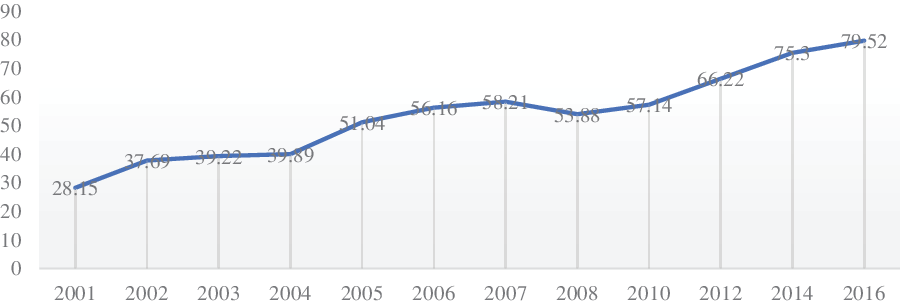
This first explanation cannot be separated from the second one: the initiative had an impact. Since the implementation of this initiative, the general citizen satisfaction with Nanjing Municipality’s performance improved from 28.15% in 2001 to 79.52% in 2016 (Qin and Li Reference Qin and Li2020). Details are presented in Figure 1. As one interviewed official from a district government (respondent 8) pointed out:
“The ten-thousand-citizen review initiative must have played a positive role in governance processes. If not, it could not have lasted for over 18 years. Take our district as an example. Citizen satisfaction in 2002 was only 34.87%. But it has reached 91.77% in 2018. This is a substantial improvement over the past years……Until now, I do believe it is the most useful approach to improve [lower-level] officials’ working style. I could not find a better approach to replace it. This is an important reason for its continuation.” Likewise, an interviewed resident (respondent 18) argued:
“I got to know the ten-thousand-citizen review initiative last year. We [residents] had lots of contacts with officials from health and education bureaus. Now when we receive services from government officials, we feel that their service attitude and efficiency have improved substantially……. Citizens’ evaluation must have had a positive effect on officials [lower-level officials’ performance]”.
Citizen satisfaction from 2001 to 2016.

Discussion
The evolvement of the ten-thousand-citizen review initiative shows an interesting tension between horizontal and vertical accountability relationships. As a horizontal arrangement, it was vertically imposed within an existing practice of administrative accountability. It led to confusion, resistance and qualitative accountability overload, because lower level officials felt horizontal pressures that were reinforced by their hierarchical superiors. At the same time, the old accountability system was still in place. In this situation, the relations were control oriented, inhibiting learning behaviour. What is more, these officials simultaneously had to take care not to make mistakes that might be sanctioned by the old reward system.
The accountability overload problem imposed a lot of pressure upon lower level officials and resulted in a bottom-up repulsion amongst these officials towards the ten-thousand-citizen review initiative. Only when the Party Committee Secretary, who had championed the initiative, moved to Beijing did it become possible to accommodate the accountability overload of lower level officials by loosening the reins. The citizens’ reviews were used in a more indirect way, and this change at the same time opened the way to look in a more substantive way at citizens’ opinions and how their feedback could be just constructive. However, this also meant that the traditional cadre target responsibility system regained salience.
The confusion about the nature of the idea of letting citizens judge becomes even more understandable if we look at the nature of the accountability relationships and the way in which they developed. Although the initiative introduced horizontal pressure and contributed to horizontal accountability, our study shows that hierarchy dominated during all the phases that the initiative went through. The ten-thousand-citizen review functioned in the shadow of hierarchy. Key municipal leaders determined both whether societal actors should be allowed to engage in the accountability system and the accountability orientations that would be adopted to manage lower level officials’ behaviour.
The review can be seen as a means for municipal leaders to deal with the existing accountability deficit: the lack of attention on the interests of citizens. It can also be argued that the municipal leaders used the review instrumentally to strengthen hierarchical control: mobilising citizens to increase pressures upon lower level officials to improve their performance. Nevertheless, the initiative was successful in the sense that it resulted in the incorporation of horizontal accountability elements in Nanjing Municipality’s accountability system and in increased attention on the quality of public services and citizens’ interests. The incorporation of the review in the existing hierarchical rewards system also reduced the multiple accountabilities disorder problem: lower level officials recognize that their higher level supervisors are their dominant principals, who see citizens’ opinions as an import standard to which the former has to be held accountable.
Conclusion
This contribution reports an in-depth study into the nature and the dynamics of accountability relationships in the case of the Nanjing ten-thousand-citizen review. In order to be able to make sense of accountability relations, in this case, we identified four ideal types of accountability relationships on the basis of two dimensions: hierarchical versus horizontal obligations and a control versus a learning orientation. Our case study has shown that the introduction of horizontal accountability did not replace the existing hierarchical control-dominated accountability system, but resulted in a multi-accountability context, in which characteristics of the ideal types were combined. It also shows that accountability relationships evolve over time, as does their influence on the existence of accountability problems. In our case, the municipal officials used horizontal accountability (the judgments of citizens) to strengthen their hierarchical control over their subordinates. This contributed to confusion, stress, resistance and a multiple accountabilities disorder. Only gradually, influenced by both coincidence (the departure of the Party Committee Secretary) and learning behaviour, did a new practice develop in which the accountability characteristics were aligned and the accountability deficit and overload were reduced. This demonstrates the difficulties and the challenges of designing and introducing horizontal and learning-oriented accountability arrangements, as this happens mostly within an existing accountability system and requires alignment, a learning process that takes time, and supportive management.
Theoretically, our study makes three main contributions. First, the existing literature still provides little knowledge about the nature of accountability relationships in specific contexts and how various accountability relationships interact with one another (Aleksovska et al. Reference Aleksovska, Schillemans and Grimmelikhuijsen2019; Schillemans Reference Schillemans2008). We constructed a framework that allowed us to investigate these relationships and to shed light on the hybrid and fuzzy nature of these relationships and their interactions. Second, Schillemans (Reference Schillemans2015, p. 1433) suggested that the field of accountability should “move further from conceptual discussions and varieties of mappings to more dynamic theoretical approaches to public accountability”. The analytic framework constructed in our study and its application to a longitudinal case study helped us to analyse the dynamics of accountability in this case. It contributed to our insights into these dynamics and suggested ways to further study these dynamics. Third, accountability often implies a multiple accountabilities disorder problem (Eriksen Reference Eriksen2020; Overman et al. Reference Overman, Schillemans and Grimmelikhuijsen2020). Our study shows how our framework can be helpful in revealing the nature of this accountability overload problem in concrete cases, and how Chinese governors have aligned the various accountability relationships over time.
As regards the practical relevance of our case study, one of the lessons that Chinese governments can draw from it – and perhaps this has also a more general application – is the risk of introducing multiple accountabilities disorder issues by simply introducing a new accountability relationship, while neglecting the fact that this relationship is being added to existing relationships and needs to be aligned. Another lesson is that introducing a new institutional practice is a dynamic learning process that takes time, continuous reflection and ongoing adaptations on the basis of new insights.
Last but not least, we suggest that more empirical studies are needed to increase our understanding of the nature and the dynamics of horizontal accountability and its introduction in existing accountability systems like the introduction of the ten-thousand-citizen review in Nanjing, China. Our study has illustrated the value of in-depth, longitudinal case studies. We need more of these longitudinal case studies on comparable cases in China to arrive at more generalisable insights and make comparisons. In addition, large-N and medium-N studies (surveys or qualitative comparative analysis) might be considered. In our study, we developed an ideal type in order to unravel the nature and the dynamics of accountability relations and accountability problems by looking at two dimensions. Future research might be aimed at further developing this work by including other dimensions, such as process or outcome, or known or unknown evaluation criteria. Moreover, our study has shown that attempts to deal with an accountability deficit may contribute to accountability overload (Eriksen Reference Eriksen2020). So, more studies should be conducted not only into accountability deficits, but also into accountability overload in the future.
Acknowledgements
We gratefully thank three anonymous reviewers and the editors of Journal of Public Policy, for their constructive comments and helpful suggestions.
Funding
This study was funded by The National Philosophy and Social Sciences Office of China (Grant Number: 20BZZ036).
Data Availability Statement
This study does not employ statistical methods and no replication materials are available.
Appendix 1. The interviewee list