Implications
The general view is that in concentrated diets for lactating dairy cows, long hay is preferred over short hay to prevent sub acute ruminal acidosis (SARA). Notwithstanding, under the conditions of this study (non-lactating cows fed at restricted intake) chopped wheat hay was better than long wheat hay in preventing sorting, whereas increasing intake and digestibility, and preventing SARA. If this finding is demonstrated also in experiments with lactating cows fed at ad libitum intake, then, chopping wheat hay might be useful to increase farmers’ profit.
Nutrient Requirement of Cattle (NRC) (2001) recommended adding between 0.6% and 0.8% DM buffer to concentrated diets for lactating cows. Under the conditions of this study, even addition of double amount of buffer (1.5% of DM) to the wheat silage TMR had no effect on intake, rumen pH, creation of SARA and digestibility. If this finding is demonstrated also in experiments with lactating cows fed similar diets at ad libitum intake, then the dairy industry might reduce feeding expenses of extra buffer and sodium pollution of land and recycled water by cows’ feces and urine.
Introduction
The main challenge in feeding high-producing dairy cows is to maintain proper rumen functioning while allowing the cow to consume maximal energy for milk production. According to the literature, ruminal pH should not be <5.8 for >5 to 6 h/day, to minimize health disturbances due to SARA (Zebeli et al., Reference Zebeli, Tafaj, Weber, Dijkstra, Steingass and Drochner2012). A model based on 64 studies and 257 different dietary treatments found that content of NDF above the 8 mm sieve (physically effective NDF, peNDF) >18.5% of dietary DM prevents SARA (Zebeli et al., Reference Zebeli, Mansmann, Ametaj, Steingass and Drochner2010 and Reference Zebeli, Tafaj, Weber, Dijkstra, Steingass and Drochner2012). SARA may result from insufficient peNDF in dairy cow rations that reduces rumination and buffer secretion via saliva to the rumen to maintain pH, especially under massive volatile fatty acid (VFA) accumulation (Plaizier et al., Reference Plaizier, Krause, Gozho and McBride2008). According to a field survey, 19% of early lactation and 26% of mid-lactation dairy cows in herds in the United States suffer from SARA (Garrett et al., Reference Garrett, Nordlund, Goodger and Oetzel1997).
Although many studies have examined the effect of peNDF originating from temperate forages on SARA and digestibility, the effect of dietary peNDF content on intake, digestibility and rumen pH changes in cows fed diets based on just 30% wheat silage or hay as the sole roughage source – as is common practice in many countries using low-quality roughages – is unknown. Wheat silage and hay grown under limited winter rainfall around the world are characterized by low quality as expressed in high-NDF content (55% to 60%), low starch (<20%) and limited in vitro DM digestibility (60%, Ben-Ghedalia et al., Reference Ben-Ghedalia, Kabala and Miron1995). Such low-quality roughages are included in lactating cow rations at a level that provides 17% to 19% roughage NDF in the diet as recommended (NRC, 2001). Therefore, wheat particle size in the TMR should be accurately balanced.
Previous studies with lactating cows showed that decreasing peNDF content in concentrated diets (without wheat forages) improves intake and NDF digestibility, positively affects rumen fermentation and reduces sorting behavior (Kononoff et al., Reference Kononoff, Heinrichs and Lehman2003; Yang and Beauchemin, Reference Yang and Beauchemin2006).
Therefore, the first hypothesis of this study is that also in concentrated rations containing 30% wheat hay as the sole roughage source, short wheat particles might prevent sorting by the cow compared with long particles, resulting in increased NDF intake and digestibility of the TMR while preventing SARA.
In contrast to wheat hay, wheat silage contains higher proportion of VFAs and lactic acid, which are the end products of bacterial fermentation during ensiling (Ben-Ghedalia et al., Reference Ben-Ghedalia, Kabala and Miron1995). These acids reduce wheat silage pH to 4.0 and thus may theoretically contribute to reduction in rumen pH compared with wheat hay feeding. Unfortunately, there is a lack of data pertaining to the effect of wheat forage preservation method (low-pH wheat silage v. neutral pH wheat hay) on diurnal rumen pH changes and digestibility. The second hypothesis of this study is that feeding wheat silage as wheat hay replacer might reduce rumen pH and create SARA in cows.
Sodium bicarbonate buffer has been routinely added to dairy cattle rations since the early 1960s (Russell and Chow, Reference Russell and Chow1993) at levels up to 1.5% of TMR DM. This buffer often increased rumen pH in maize silage-based diets (Hu and Murphy, Reference Hu and Murphy2005). However, studies of buffer addition in TMRs based on other grasses (not including wheat) and legumes demonstrated a lack of effect on milk fat, milk yield, and rumen pH (Hu and Murphy, Reference Hu and Murphy2005). The need for sodium bicarbonate as a buffer for TMRs based on 30% wheat silage as the sole roughage source is unknown. The third hypothesis of this study is that in concentrated diets for dairy cows based on 30% wheat silage as sole roughage source, the addition of up to 1.5% NaHCO3 buffer is unnecessary.
The objective of this study was to evaluate in ruminally cannulated non-lactating cows effects of feeding one of the four TMRs designed for lactating cows with various wheat roughage sources (either short or long hay or buffer addition), on: diurnal changes in rumen pH, duration of SARA, intake and in vivo digestibility of TMR components, rumination, ruminal in vitro methane production and changes in the rumen microbial communities.
These rumen measurements require the use of rumen-cannulated cows, however, our metabolic barn is not suitable to house lactating cows, and therefore we employed non-lactating cows, limited in their voluntary intake (up to 11.4 kg DM/day).
Material and methods
Animals, diets and sampling procedures
Four ruminally cannulated non-lactating Holstein cows (605±26.0 kg BW) were housed in individual tie stalls with free access to water, and individually fed one of the four TMRs examined in a Latin square design (four cows×four periods). The four TMRs differed in the forage source (30% of TMR DM) being either short or long wheat hay, or wheat silage with or without addition of 1.5% NaHCO3 buffer. Each of the four periods consisted of 1 week adaption to the diet fed at ad libitum intake (10% orts) followed by 2 weeks of adaptation to the diet with cows fed only 95% of their ad libitum intake and consequently by 3 weeks of experimental period. This intake limit was used to avoid orts within 24 h. During the 3 weeks experimental period, cows were fed 50% of the TMR at 0600 until 0700 h, then feed was unavailable for 6 h (orts removed at 0700 and mixed with the remaining 50%), and consequently (after 1300 h), cows were allowed to eat the remaining diet up to 95% ad libitum intake. The experimental period was dedicated for measurements of DM intake (at 95% ad libitum), in vivo digestibility, diurnal changes in rumen pH, sampling of rumen fluid and measurements of in vitro methane activity in the rumen. Carry-over effects on the parameters examined were measured after 21 day adaptation to the diet, and this period was found adequate to avoid any carry-over effect.
All wheat forages (Galil variety) were grown in the same field (Yavne, Israel) on 400 mm rainfall. Wheat hay was harvested at the early stage of grain maturation, whereas wheat silage was harvested at the soft-dough stage and contained 20% grains. Wheat hay was chopped in a chopping mixing wagon with sharp knives (Siloking self-line 1000+3024; SilokingTM, Berlin, Germany) for either 5 min (long hay) or 30 min (short hay). Hays (either short or long) were manually mixed with the concentrate mixture before feeding each cow. The wheat silage was ensiled in polyethylene-wrapped bales for 60 days before feeding (Weinberg et al., Reference Weinberg, Chen, Miron, Raviv, Nahim, Bloch, Yosef, Nikbahat and Miron2011) and manually mixed before feeding with 70% concentrate with or without addition of 1.5% NaHCO3.
Structural and chemical analyses and in vitro digestibility
The wheat hays and silages and the four TMRs were sampled every 2 days during the experimental period. Particle-size distribution of forages, TMRs and orts at 12 h post-morning feeding was determined by a Penn State Particle Separator (PESP), with a 19 mm screen (long), an 8 mm screen (medium) and a pan (fine) (Lammers et al., Reference Lammers, Buckmaster and Heinrichs1996). The content of physically effective NDF remaining above the 8 mm sieve of the separator was designated as peNDF.
Samples were dried in an aerated oven at 60°C for 48 h, ground to pass a 1 mm screen in a hammer-mill (Retsch S-M-100; Retsch Co., Haan, Germany) and analyzed according to Association of Official Analytical Chemistry (AOAC) (1990) for DM (method 925.40), total N (method 984.13), ether extract (EE, method 920.39) and ash content (method 923.03). CP was calculated as N×6.25. aNDF was determined according to Van Soest et al. (Reference Van Soest, Robertson and Lewis1991) using a heat-stable amylase without sodium sulfite. ADF and ADL were determined using the sequential method of Van Soest et al. (Reference Van Soest, Robertson and Lewis1991). Hemicellulose was calculated as NDF−ADF and cellulose as ADF−ADL. The Ankom apparatus (Ankom220; Ankom Technology, Macedon, NY, USA) was used for extracting and filtering. Non-structural carbohydrate (NSC) content was calculated as
 $${\rm NSC}\,\left( {{\rm g\,/\,kg}\,{\rm DM}} \right)\,{\rm {\equals}}\,{\rm DM}\,{\minus}\,{\rm CP}\,{\minus}\,{\rm aNDF}\,{\minus}\,{\rm EE}\,{\minus}\,{\rm ash}{\rm .}$$
The two-stage digestibility technique of Tilley and Terry (Reference Tilley and Terry1963) was used to calculate in vitro DM digestibility of the feeds and TMRs, using rumen fluid obtained from two ruminally fistulated dry Holstein cows, with each sample in four replicates. The rumen fluid donor cows were offered 30% wheat silage and a mix of other dietary components.
In vivo digestibility
Cows were fed at 95% of ad libitum intake to avoid orts within 24 h. Sorting behavior of the cows at 12 h post-feeding was measured by comparison of particles distribution on the three sieves of the particles size Pennsylvania separator between orts at 12 h post-feeding to the submitted TMR. Sorting index was calculated as the quantitative ratio between actual intake to predicted intake (without sorting) of particles retained on each sieve of the separator (Leonardi and Armentano, Reference Leonardi and Armentano2003).
Fecal grab samples were collected twice daily from each cow over 6 days, at 12 h intervals, advancing each day by 2 h around the clock. Fecal samples were composited per cow, dried at 60°C for 48 h in a forced-air oven, ground to pass a 1.0 mm screen and used for chemical analyses as described above. Estimation of daily fecal DM excretion was based on measurement of indigestible-NDF concentrations in the feces and TMR according to the modification of Adin et al. (Reference Adin, Solomon, Nikbachat, Zenou, Yosef, Brosh, Shabtay, Mabjeesh, Halachmi and Miron2009) using the equation
 $$\eqalignno{&{\rm DM}\,{\rm digestibility}\, {\rm{\equals}}\, \cr \quad{\rm 1}{\minus}\left( {{\rm TMR}\,{\rm indigestible}\,{\rm NDF\,/ \cr \,fecal}\,{\rm indigestible}\,{\rm NDF}} \right)$$
The digestibility of each chemical component (DM, CP, EE, NDF, cellulose, hemicelluloses, and NSC) was calculated in each cow using the average (6-day pool sample) individual dry matter intake (DMI) and fecal output according to equation (1).
Rumen pH, in vitro methane production and rumination
During the 2nd week of each experimental period, ruminal pH was measured using a data logger system (LRCpH Data Logger; DASCOR™, Escondido, CA, USA) as described by Penner et al. (Reference Penner, Aschenbach, Gabel, Rackwitz and Oba2009). The loggers were placed with tied weights in the floor of the ventral ruminal sac of each cow, and pH was recorded every 5 min for the 6-day data-collection period. Daily mean pH, and time duration below pH 6.0, 5.8 and 5.6 were calculated for each cow. In addition, rumen samples were taken for bacterial community analysis at two time points: 1 h before feed delivery (−1 h) and 6 h after the morning feeding (6 h) during 6 days of the 2nd week. The samples were taken from below the floating layer via the rumen cannula into 500 ml plastic bottle and sealed. The samples were then squeezed through six layers of cheesecloth, immediately frozen in liquid nitrogen and kept at −80°C until bacterial DNA analyses.
In vitro methane production in the rumen of each cow was measured twice a day at 1 h before feeding and 6 h after the morning feeding during the 3rd week of the experimental period. Freshly sampled rumen fluid from each cow (1 ml) was mixed with 2 ml buffer (Tilley and Terry, Reference Tilley and Terry1963) in rubber sealed anaerobic 5 ml GC vials (Supelco, Bellefonte, PA, USA) without substrate addition (in triplicate vials). Vials were incubated for 48 h at 38°C, and then 500 µl of the upper gas phase produced in each vial was sampled by automatic sampler and injected into a gas chromatograph (HP GC 5890II; Hewlett Packard, Palo Alto, CA, USA) equipped with a semi-capillary column (molsieve 5A; Supelco) and a FID detector, for quantitative methane measurement according to the method of Harinder et al. (Reference Harinder, Makkar and Vercoe2007).
The cows were equipped with collar-mounted tags (HR-Tags; SCR Engineers Ltd, Hadarim, Netanya, Israel) that monitored and transmitted rumination time (Adin et al., Reference Adin, Solomon, Nikbachat, Zenou, Yosef, Brosh, Shabtay, Mabjeesh, Halachmi and Miron2009). Rumination data were recorded by a microphone that detected chewing actions (rumination) by analyzing signals. Data were stored in 2 h blocks and uploaded twice daily to the computer.
Bacterial DNA extraction from rumen samples
DNA was extracted from the thawed rumen samples as described by Jami et al. (Reference Jami, Shabtay, Miron and Mizrachi2012). Cell lysis in the rumen samples was achieved by bead disruption with lysis buffer (500 mM NaCl, 50 mM Tris-HCl, pH 8.0, 50 mM ethylenediaminetetraacetic acid (EDTA), and 4% w/w sodium dodecyl sulfate), followed by ammonium acetate (10 M) DNA extraction. The final supernatant was precipitated with 1 volume of isopropanol and resuspended overnight in 50 to 100 μl TE buffer (100 mM Tris pH 8.0, 1 mM EDTA), and then stored at 4°C for short-term use, or archived at −80°C.
Automated ribosomal intergenic spacer analysis (ARISA)
ARISA is an inexpensive method of analyzing bacterial diversity and community fingerprinting in ecological samples. ARISA uses the natural variability in length of the DNA fragment found between the 16S and 23S genes in different bacterial lineages to generate a whole bacterial community fingerprint, which can be further analyzed using statistical evaluation of the changes between the different diets. The DNA from each rumen sample was subjected to PCR amplification for ARISA as described by Jami et al. (Reference Jami, Shabtay, Miron and Mizrachi2012).
The PCR products were analyzed using an ABI Prism 3100 Genetic Analyzer (Applied Biosystems, Carlsbad, CA, USA). The labeled fragments were separated on the capillary sequencer along with a custom-made ROX-labeled 250- to 1150-bp standard (BioVentures Inc., Murfreesboro, TN, USA). Raw data generated by the genetic analyzer were initially analyzed using GeneMarker software (SoftGenetics LLC, State College, PA, USA) according to Kovacs et al. (Reference Kovacs, Yacoby and Gophna2010). After performing accurate size calling using the program, all data were exported to Excel (Microsoft Corp., Redmond, WA, USA) for further analysis. The file generated by Excel was transferred to Paleontological Statistics (PAST) software. The Bray-Curtis distance indexes, as well as the non-numeric multidimensional plotting, were performed using this program.
Statistical analysis
Data of rumination and ruminal pH were summarized by day and analyzed using a mixed model in JMP® software (JMP) (SAS Institute, 2003). The restricted maximum likelihood model included dietary treatments as fixed effect, considering the effects of period, cow and period×cow interaction, with day included as a repeated measure. Data of DM intake, in vivo digestibility, methane production and sorting index were analyzed by a mixed model in JMP (SAS Institute, 2003). The model included dietary treatments as fixed effect, and period, cow and period×cow interaction as random effects. DM intake data were constant at 95% of ad libitum intake, but varied between periods and treatments.
Data of particle-size distribution and peNDF content in the forages, TMRs and orts at 12 h post-feeding, were averaged by day within period and analyzed by including particle length variables as fixed effects considering period effect. Effects of the treatments were declared significant at P<0.05. Data are reported as least squares means.
Results
Intake and digestibility
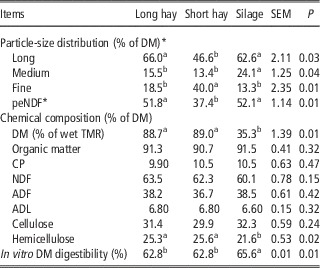
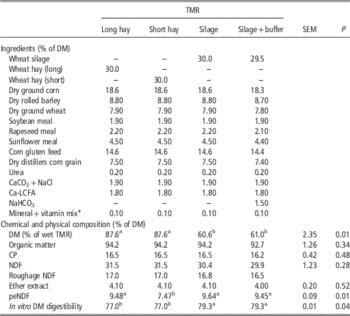
The long wheat hay and the wheat silage had similar peNDF content, higher (P<0.01) than that of the short wheat hay (Table 1). This difference was reflected in lower peNDF content of the short hay TMR than in the other TMRs (Table 2). The wheat silage was characterized by lower hemicellulose content and higher in vitro DM digestibility than the two hays (Table 1).
Chemical composition and particle-size distribution of the wheat hays and silage included as sole roughage source in cows’ rations

DM=dry matter; peNDF=physically effective NDF remaining above the 8 mm sieve of the separator; TMR=total mixed ration.
a,bMeans within rows with different superscripts differ significantly at P<0.05.
* Particle-size distribution was determined by the Penn State Particle Separator with a 19 mm screen (long), 8 mm screen (medium), and a pan (fine).
Ingredients and chemical composition of the total mixed rations (TMRs), with wheat hays or silage as the sole roughage source, fed to rumen-cannulated dry cows

Ca-LCFA=calcium salts of long-chain fatty acids; peNDF=physically effective NDF remaining above the 8 mm sieve.
a,bMeans within row marked with different superscripts differ significantly at P<0.05.
* Containing (g/kg of mix DM): Zn, 24; Fe, 24; Cu, 12.8; Mn, 24; I, 1.44; Co, 0.32; Se, 0.32; 16 000 000 IU of vitamin A; 3 200 000 IU of vitamin D3; and 48 000 IU of vitamin E.
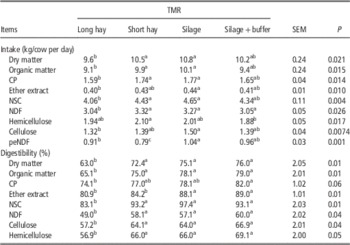
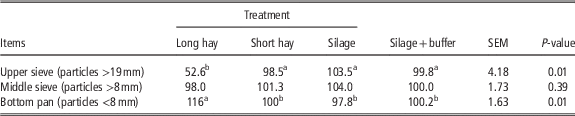
Cows fed the short hay and the wheat silage TMRs consumed more daily DM, CP and NDF than those fed long hay. However, short hay cows consumed less daily peNDF than the other three treatments (Table 3). Sorting behavior data at 12 h post-morning feeding show that the cows fed long hay sorted against large hay particles, preferred to consume during day time the short particles, and consequently during night hours consumed the residual long hay particles (Table 4) finishing the entire diet within 24 h. These differences in physical structure, composition and intake of the four TMRs affected their in vivo digestibility. The short hay and two silage-based TMRs had similar DM, OM, NSC, NDF, cellulose and hemicellulose digestibility values, which were significantly higher than those of the long hay TMR (Table 3). The addition of 1.5% buffer to the wheat silage TMR did not improve either intake or digestibility of the dietary components compared with the silage TMR without buffer.
Effect of dietary treatments on intake and digestibility by rumen-cannulated dry cows fed at 95% of ad libitum intake

peNDF=physically effective NDF remaining above the middle sieve (8 mm) of the Penn State Particle Separator; NSC=non-structural carbohydrate.
a,b,cMeans within row marked with different superscripts differ significantly at P<0.05.
Sorting indexFootnote 1 of the rumen-cannulated cows fed the various TMRs at 12 h post-feeding time

TMR=total mixed ration.
a,bMeans within rows with different superscripts differ significantly at P<0.05.
1 Sorting index was calculated as the quantitative ratio between actual daily intake to predicted daily intake (without sorting) of particles retained on each sieve of the PESP separator. A sorting index of 100 indicates lack of any sorting. Sorting index below 100 indicates sorting by cows against non-consumed large particles >8 mm. Sorting index above 100 indicates preference to consume small particles (Leonardi and Armentano, Reference Leonardi and Armentano2003).
Rumen pH changes, methane production and rumination
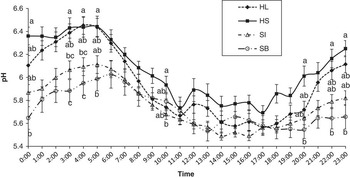
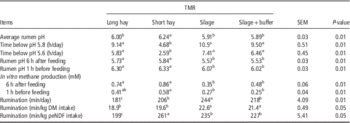
Rumen pH data collected by indwelling loggers for an entire week are summarized in Figure 1 and Table 5. SARA (pH<5.8 for 5 h) was found in three of the four dietary treatments examined in this study: the long hay and two silage-based TMRs, whereas only the cows fed the short hay TMR were not under SARA. In all groups, the highest daily rumen pH values were observed 1 to 2 h before the morning feeding, and the lowest 5 to 7 h after feeding (Figure 1), and this dictated the times of rumen sampling for bacterial characterization and in vitro methane production. At both rumen sampling points (1 h pre-feeding and 6 h post-feeding), the rumen pH of the cows fed the hay-based TMRs was higher than that of the cows fed the silage-based diets. Within each cow and dietary treatment, the reduction in rumen pH between 1 h pre-feeding and 6 h post-feeding was accompanied by a concomitant increase in methane production (Table 5).
Diurnal distribution of ruminal pH in dry cows fed total mixed ration based on: long wheat hay (HL), short wheat hay (HS), wheat silage (SI) and wheat silage+buffer (SB). a,b,cPoint values marked by different letters differ significantly at P<0.05.

Effects of dietary treatments on rumen pH, in vitro methane production by rumen fluid and rumination parameters

peNDF=physically effective NDF remaining above the middle sieve (8 mm) of the Penn State Particle Separator; DM=dry matter.
a,bMeans within rows with different superscripts differ significantly at P<0.05.
Rumination data (Table 5) showed highest daily rumination in cows fed the silage TMR, and lowest in cows fed the long hay TMR. The short hay and silage+buffer groups were intermediate. However, length of rumination time per kg peNDF ingested was highest in cows fed the short hay TMR and lowest in the cows fed long hay TMR.
Bacterial community changes
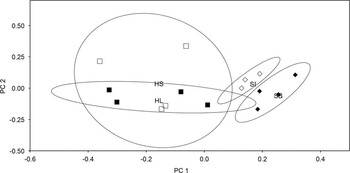
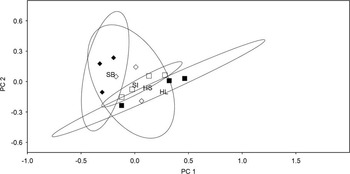
The ARISA of rumen fluid sampled 1 h pre-feeding (Figure 2) showed distinct separation between the wheat hay-based TMR clusters and the wheat silage-based ones. Interestingly, analysis of the microbiota 6 h post-feeding (Figure 3) did not show any separation between the different TMR clusters, suggesting that during peak fermentation (6 h post-feeding) in the rumen, microbiota from the different dietary treatments have similar profiles. Such an effect could stem from changes in dominance within the microbial community, where the fast growing microbes are enriched due to increase availability of soluble sugars resulting from the large amount of rapid degradable carbohydrates in both dietary regimes.
Non-metric multidimensional scaling analysis of microbiota sampled at 1 h pre-feeding from the rumen of dry cows fed total mixed ration based on: long wheat hay (■ – HL), short wheat hay (□ – HS), wheat silage (♦ – SI) and wheat silage+buffer (◊ – SB).

Non-metric multidimensional scaling analysis of microbiota sampled at 6 h post-feeding from the rumen of dry cows fed total mixed ration based on: long wheat hay (■ – HL), short wheat hay (□ – HS), wheat silage (♦ – SI) and wheat silage+buffer (◊ – SB).

Discussion
Effect of wheat particle size on intake, digestibility and rumen parameters
This study used four TMRs that were similar in wheat forage (300 g/kg) and concentrates content. Cows fed the wheat silage and short hay TMRs consumed more DM, CP, NDF and NSC, than the cows fed the long hay TMR. However, the cows fed the short hay TMR ingested less daily peNDF (P=0.03) than the cows fed the other three diets (Table 3). Moreover, the cows fed the short hay TMR showed higher average rumen pH and less SARA (only 4.68 h/day at pH<5.8) compared with the other three groups, that in fact were under SARA (9.1 to 10.5 h/day at pH<5.8, Table 5 and Figure 1). A possible explanation for these pH findings might be the lack of sorting and higher rumination time per kg peNDF ingested in cows fed the short hay TMR (Tables 4 and 5). Increasing rumination may have increased internal buffer secretion via saliva into the rumen and resulted in higher rumen pH. In addition, the higher surface area of the short hay particles may encourages better adhesion to and degradation of NDF, cellulose and hemicellulose components by ruminal cellulolytic bacteria (Miron et al., Reference Miron, Ben-Ghedalia and Morrison2001) as compared with the long hay particles (Table 3). The difference between the long hay and short hay TMRs with respect to rate of pH decline and creation of SARA conditions initiated immediately after the morning feeding (at 0800 h) and continued until 2100 h (Figure 1). This pH picture might be associated with our observations that cows fed the long hay TMR sorted out long hay particles, rapidly ingested TMR concentrates, and delayed ingestion of the long hay particles to the night and early morning hours.
These results are in accordance with previous studies with lactating cows showing that decreasing peNDF content in concentrated diets (without wheat forages) improves intake and NDF digestibility, positively affects rumen fermentation and reduces sorting behavior (Kononoff et al., Reference Kononoff, Heinrichs and Lehman2003; Yang and Beauchemin, Reference Yang and Beauchemin2006).
On the other hand, data from the present study contradict those of Zebeli et al. (Reference Zebeli, Aschenbach, Tafaj, Boguhn, Ametaj and Drochner2007) who showed that in lactating cows increasing forage particle size in a diet containing a high level of concentrates, extends rumination time by 100 min/day, but does not affect rumen pH or digestibility. A possible explanation for this discrepancy between studies is the use of lactating cows ingesting higher DM intake containing higher forage NDF content (251 g/kg DM) in the hay diets of the previous study (Zebeli et al., Reference Zebeli, Aschenbach, Tafaj, Boguhn, Ametaj and Drochner2007) compared with the present one (restricted intake below 10.8 kg DM/day, and lower forage NDF content, 170 g/kg DM , Table 2).
Using a model based on 64 studies and 257 different dietary treatments (without wheat forages), Zebeli et al. (Reference Zebeli, Mansmann, Ametaj, Steingass and Drochner2010 and Reference Zebeli, Tafaj, Weber, Dijkstra, Steingass and Drochner2012) found that increasing the content of peNDF to over 149 g/kg TMR DM decreases DMI; on the other hand, decreasing peNDF content in the TMR below 185 g/kg DMI might reduce rumen pH below 5.8 and create SARA conditions (Zebeli et al., Reference Zebeli, Mansmann, Ametaj, Steingass and Drochner2010 and Reference Zebeli, Tafaj, Weber, Dijkstra, Steingass and Drochner2012). According to the results of the present study, it is suggested that Zebeli’s rules are probably valid for the TMRs commonly used in the United States and Europe to feed lactating cows (500 g/kg forage and 500 g/kg concentrates, Zebeli et al., Reference Zebeli, Mansmann, Ametaj, Steingass and Drochner2010), but the opposite trend might be present in concentrated TMR containing only 300 g/kg DM roughage with peNDF below 104 g/kg DM, as used in this study to feed non-lactating cows.
Effects of feeding wheat hay v. silage
In the present study, the short hay TMR was the only one that did not create SARA, showing the highest average rumen pH values (6.24) compared with other treatments (5.89 to 6.0, Table 5, Figure 1). This was due to the better rumination per kg peNDF and the lack of particles sorting (as observed at 12 h post-feeding) by cows fed short hay TMR. The cows fed the short hay TMR and the two silage TMRs could not sort out long hay particles (Table 4).
The advantage in preventing SARA in cows fed the short hay TMR compared with cows fed the silage TMR (Table 5 and Figure 1), contradict previous studies (Jaakkola and Huhtanen, Reference Jaakkola and Huhtanen1993; Murphy et al., Reference Murphy, Akerlind and Holtenius2000) which found no significant difference in rumen pH of lactating cows fed diets (at much higher intake) that contained either grass silage or grass hay as the sole roughage source in the TMR. A possible explanation for this conflict between the studies beside the differences in intake levels, might be the presence of 20% wheat grains in the silage used in this study, unlike the previous studies which used hay and silage harvested at the same early maturity stage (Jaakkola and Huhtanen, Reference Jaakkola and Huhtanen1993; Murphy et al., Reference Murphy, Akerlind and Holtenius2000). Under restricted intake, this difference in composition between wheat hay and wheat silage increased in vitro DM digestibility of the wheat silage (Table 1), contributed to the low pH of the silage itself (4.0), and motivated a rapid reduction in rumen pH and formation of SARA in cows fed the two silage-based TMRs. However, these pH changes did not negatively affect DM or NDF digestibility of the silage TMRs, which was similar to that of the short hay TMR (Table 3).
Effects of buffer addition on cows fed wheat silage diets
The NRC (2001) recommends adding at least 0.6% to 0.8% NaHCO3 buffer to concentrated lactating cow TMRs to prevent the risk of SARA. The present study shows that the addition of even double amount NaHCO3 buffer (1.5%) to the silage-based TMR did not affect intake, digestibility, SARA length, average rumen pH, methane production and rumination. These findings are in accordance with previous studies that compared rations based on grass silages with and without buffer and found no advantage to adding buffer (Khorasani and Kennelly, Reference Khorasani and Kennelly2001; Mooney and Allen, Reference Mooney and Allen2007; Doepel and Hayirli, Reference Doepel and Hayirli2011). Moreover, analyses of 27 experiments conducted from 1980 to 1999 showed that buffer addition to rations that contained several silages (excluding corn silage) had no positive effect on rumen pH, milk yield or milk composition (Hu and Murphy, Reference Hu and Murphy2005). This finding encourage performance studies with lactating cows to determine the need for buffer in commercial TMRs based on wheat silage.
Relationship between rumen pH and in vitro methane production
Within each cow and dietary treatment, the reduction in rumen pH between 1 h pre-feeding and 6 h post-feeding was accompanied by a concomitant increase in methane production (Table 5). These results are in congruence with recent findings reported in experiments done with bulls (Hunerberg et al., Reference Hunerberg, McGinn, Beauchemin, Entz, Okine, Harstad and McAllister2015). A possible explanation for this finding is that more available carbohydrate causes more fermentation and proliferation in rumen methanogens (Jami et al., Reference Jami, Shabtay, Miron and Mizrachi2012). At 6 h post-feeding, maximal fermentable carbohydrates were available for all rumen population as supported by ARISA findings (Figure 3) and pH decline (Figure 1), showing that during peak fermentation in the rumen, microbiata from the different dietary treatments had similar profiles. Thus, peak of fermentation (at 6 h post-feeding) may increase available hydrogen and sequentially hydrogenotrophic methanogenesis by rumen archaea. However, at 1 h pre-feeding, less soluble carbohydrates were available for ruminal bacteria to be fermented, as reflected by the high rumen pH (>6.0), whereas decreasing available hydrogen and sequentially hydrogenotrophic methanogenesis. This explanation is supported by previous studies (Ann et al., Reference Ann, Van Kessel and Russell1996; Lana et al., Reference Lana, Russell and Van Amburgh1998) conducted in vitro in tubes, showing that constant carbohydrate availability hardly affected methanogenic activity.
Recent studies showed that a rhythmic fluctuation in the gut microbiome of mice and human occur during the day (Thaiss et al., Reference Thaiss, Zeevi, Levy, Zilberman-Schapira, Suez, Tengeler, Abramson, Katz, Korem, Zmora, Kuperman, Biton, Gilad, Harmelin, Shapiro, Halpern, Segal and Elinav2014). In accordance with our findings (Figures 2 and 3), Welkie et al. (Reference Welkie, Stevenson and Weimer2010) found that during the daily feeding cycle of cows, increase in fermentation and decrease in rumen pH after feed delivery were accompanied by large changes in the microbiome profile. These changes in the rumen microbiome could be the cause or the effect of the change in the methane production. Recent studies have demonstrated that some methanogenic archea are proliferated on available carbohydrate, whereas other species are encouraged by NDF-rich substrate (Mizrahi et al., unpublished data). Thus, further research is needed to understand the mechanism of changes in methane production in the rumen.
Conclusions
In this study, a concentrated TMR containing only 30% DM chopped wheat hay was better than long wheat hay at preventing feed sorting, maintaining high rumen pH, preventing SARA and improving intake and in vivo digestibility. Replacing short hay with wheat silage resulted in decreased ruminal pH and creation of SARA conditions in the rumen, but did not affect intake or digestibility. Addition of 1.5% NaHCO3 buffer to the wheat silage TMR did not affect intake, digestibility, duration of SARA conditions, rumen pH, methane production and rumination. An interesting finding stemming from these experiments is the convergence and divergence of the rumen microbial community developed in cows fed the different diets as a function of time from feeding as well as changes in methane production during the feeding cycle.
Acknowledgements
The authors express their appreciation to Yavne Feeding Center for the TMR production. This study was supported by the Israeli Dairy Board Foundation projects 362-0342 and 362-0375.