INTRODUCTION
The world's oceans have suffered an abrupt decline in their capacity to provide crucial ecosystem goods and services (Crowder & Norse, Reference Crowder and Norse2008), all areas are affected by human influence and a large fraction (41%) strongly affected by multiple drivers of ecological change (Halpern et al., Reference Halpern, Walbridge, Selkoe, Kappel, Micheli, D'Agrosa, Bruno, Casey, Ebert, Fox, Fujita, Heinemann, Lenihan, Madin, Perry, Selig, Spalding, Steneck and Watson2008). Cetaceans face multiple threats (Bearzi, Reference Bearzi and Notarbartolo di Sciara2002; Bearzi et al., Reference Bearzi, Holcer and Notarbartolo di Sciara2004; Kelly et al., Reference Kelly, Glegg and Speedie2004; MacLeod et al., Reference MacLeod, Bannon, Pierce, Schweder, Learmonth, Herman and Reid2005; Weilgart, Reference Weilgart2007). In European waters, cetaceans and their habitats are included in various conventions, treaties and agreements; many embrace creation of Marine Protected Areas (MPAs) (Evans, Reference Evans2008) which are increasingly used as a management tool (Villa et al., Reference Villa, Tunesi and Agardy2001; Lubchenco et al., Reference Lubchenco, Palumbi, Gaines and Andelman2003; Palumbi, Reference Palumbi2004). During the last decade, progress has been made in establishing MPAs but site identification, management and monitoring remains ad hoc (Evans, Reference Evans2008). Knowledge of cetacean population ecology is fundamental for formulating conservation policy (Reid et al., Reference Reid, Evans and Northridge2003) and effective policy depends on understanding relationships between species and habitats (Cañadas & Hammond, Reference Cañadas and Hammond2008) but for many cetacean species this information is largely non-existent (Reid et al., Reference Reid, Evans and Northridge2003).
Monitoring spatial and temporal variation in cetacean abundance may determine if management action is required and helps identify remedial action (Evans & Hammond, Reference Evans and Hammond2004). Cetacean dispersion, determinants of patterns, habitat requirements and time-series data are also considered valuable in identifying changes to, or disruption of marine ecosystem processes (Reid et al., Reference Reid, Evans and Northridge2003). Habitat modelling has predicted cetacean habitats in previously un-surveyed areas (Moses & Finn, Reference Moses and Finn1997; Hamazaki, Reference Hamazaki2002) and predicted habitat shifts associated with oceanographic changes (Hamazaki, Reference Hamazaki2002). Spatial and temporal data for cetaceans have helped identify appropriate areas for MPAs (Hooker et al., Reference Hooker, Whitehead and Gowans1999; Cañadas et al., Reference Cañadas, Sagarminaga and García-Tiscar2002, Reference Cañadas, Sagarminaga, De Stephanis, Urquiola and Hammond2005; Gomez De Segura et al., Reference Gomez De Segura, Crespo, Pedraza, Hammond and Raga2006; Weilgart, Reference Weilgart2006) and to develop conservation and management plans within protected areas (Hastie et al., Reference Hastie, Wilson and Thompson2003; Cañadas & Hammond, Reference Cañadas and Hammond2008; Panigada et al., Reference Panigada, Zanardelli, MacKenzie, Donovan, Mélin and Hammond2008).
Collection of necessary data is difficult (Compton et al., Reference Compton, Banks, Goodwin and Hooker2007; Kiszka et al., Reference Kiszka, Macleod, Van Canneyt, Walker and Ridoux2007) as most cetacean species are highly mobile and spend substantial time below surface. This makes detection, identification, and group size estimation difficult (Redfern et al., Reference Redfern, Ferguson, Becker, Hyrenbach, Good, Barlow, Kaschner, Baumgartner, Forney, Ballance, Fauchald, Halpin, Hamazaki, Pershing, Qian, Read, Reilly, Torres and Werner2006). Weather and more specifically sea state also affects the detectability of cetacean species (Hammond et al., Reference Hammond, Berggren, Benke, Borchers, Collet, Heide-Jorgensen, Heimlich, Hiby, Leopold and Øien2002). A variety of approaches can be used dependent on species and available resources and these are reviewed in Evans & Hammond (Reference Evans and Hammond2004). Environmental, biotic or anthropogenic factors can influence spatial and temporal patterns and correlation of environmental variables with sightings data can improve ecological understanding and highlight factors affecting distribution (Davis et al., Reference Davis, Fargion, May, Leming, Baumgartner, Evans, Hansen and Mullin1998). Findings are varied and frequently species-specific. However, bathymetry, specifically depth and seabed relief are often significant variables associated with cetacean distribution (e.g. Baumgartner, Reference Baumgartner1997; Cañadas et al., Reference Cañadas, Sagarminaga and García-Tiscar2002; Hastie et al., Reference Hastie, Wilson and Thompson2003, Reference Hastie, Wilson, Wilson, Parsons and Thompson2004; MacLeod et al., Reference MacLeod, Weir, Pierpoint and Harland2007) as well as sea surface temperature (e.g. Selzer & Payne, Reference Selzer and Payne1988), seasonality (e.g. Hooker et al., Reference Hooker, Whitehead and Gowans1999) and coastal currents (Tynan et al., Reference Tynan, Ainley, Barth, Cowles, Pierce and Spear2005). However, these may be secondary to environmental variables aggregating prey species (e.g. Baumgartner, Reference Baumgartner1997; Bearzi et al., Reference Bearzi, Fortuna and Reeves2008) including tidal fronts, seabed and coastal topography, which can all influence cetacean distribution through aggregating prey (Reid et al., Reference Reid, Evans and Northridge2003).
Historic sightings and catch data have helped define habitat areas for the North Pacific right whale (Eubalaena japonica) (Shelden et al., Reference Shelden, Moore, Waite, Wade and Rugh2005) and to identify previous summer feeding grounds of the North Atlantic right whale (Eubalaena glacialis) (Smith et al., Reference Smith, Barthelmess and Reeves2006). Historical literature, photographic records, osteological (bone) collections and strandings data have established past distribution and declines of common dolphin (Delphinus delphis) in various Mediterranean Sea areas (Bearzi et al., Reference Bearzi, Reeves, Notarbartolo di Sciara, Politi, Cañadas, Frantzis and Mussi2003). Analyses of cetacean strandings data have identified changes in cetacean communities attributed to increased sea temperature (MacLeod et al., Reference MacLeod, Bannon, Pierce, Schweder, Learmonth, Herman and Reid2005). Incidental sightings data have been seen to reflect effort corrected data (Camphuysen, Reference Camphuysen2004; Siebert et al., Reference Siebert, Gilles, Lucke, Ludwig, Benke, Kock and Scheidat2006) and may constitute a valuable resource particularly in areas with limited or no specific survey work (Siebert et al., Reference Siebert, Gilles, Lucke, Ludwig, Benke, Kock and Scheidat2006). Interpretation of incidental data is made difficult without quantification of sightability and effort (Evans & Hammond, Reference Evans and Hammond2004; Witt et al., Reference Witt, Broderick, Johns, Martin, Penrose, Hoogmoed and Godley2007a, Reference Witt, Penrose and Godleyb); nonetheless, with stringent data interrogation and filtering valuable patterns and trends can be identified (Witt et al., Reference Witt, Penrose and Godley2007b; Tomás et al., Reference Tomás, Gozalbes, Raga and Godley2008).
SCANS, a large-scale line transect survey using ships and aircraft in the North Sea and adjacent waters determined abundance estimates as a basis for conservation strategy in European waters (Hammond et al., Reference Hammond, Berggren, Benke, Borchers, Collet, Heide-Jorgensen, Heimlich, Hiby, Leopold and Øien2002). SCANS-II aimed to update abundance estimates for the whole of the European Atlantic continental shelf, make recommendations for future monitoring and facilitate development of by-catch management models (Hammond & MacLeod, Reference Hammond and MacLeod2006). Such large-scale studies have a major role to play but there is also a need for an understanding of fine scale distribution and seasonal changes (Evans & Hammond, Reference Evans and Hammond2004).
In Cornwall and the Isles of Scilly a marine sightings scheme, Seaquest Southwest, and the Marine Strandings Network are hosted by the Cornwall Wildlife Trust (CWT) and run in conjunction with the Environmental Records Centre for Cornwall and the Isles of Scilly (ERCCIS). These allow members of the public and other interested parties to report cetacean sightings and strandings data. Here we undertake a comprehensive analysis of these data between 1991 and 2008 aimed at increasing knowledge of spatial and temporal ecology of cetaceans in the south-west of the UK.
MATERIALS AND METHODS
Sightings
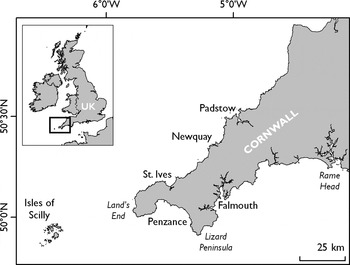
The Seaquest Southwest database held 14,623 records, all non-cetacean sightings were removed (N = 6418). Cetacean sightings were recorded within seventeen species categories. Three further categories held sightings that had not been identified to species level. Each entry represented single or multiple animal sightings. A Geographical Information System (GIS) land map was created for the county of Cornwall using coordinates conforming to the British National Grid projection (metres). A 50 nautical mile (92.6 km) buffer shape was projected from the coast; the resulting polygon was deemed the study area. Formulae were used to determine the year and month of all sightings and to convert all sighting locations into decimal degree co-ordinates (longitude, latitude; WGS84). All sightings records prior to 1 January 1991 and subsequent to 31 December 2008 were removed (N = 214) together with cetacean strandings (N = 61). This date range represented the period that the sightings scheme had been running as a dedicated electronic database; records prior to 1991 were significantly sparser. Records that fell outside the study area (N = 1153) or that were not spatially locatable to a place name (N = 146) were removed; in total 6631 records were retained. In addition, a 12 nautical mile (22 km) buffer was projected from the Cornish coast and was edited to produce north and south sectors that excluded the Isles of Scilly. This buffer focused analysis on Cornish coastal waters and reduced the total number of sightings to 4991 for this part of the analysis. Three Marine Tour Operators (MTOs) were identified within the dataset who had contributed sightings data independently since 2003 from the areas of Land's End/Mount's Bay and Falmouth Bay (Figure 1). These sightings were recorded during marine wildlife tours and resulting data were analysed separate to sightings held in the Seaquest Southwest database.
Location map for Cornwall and the Isles of Scilly. Harbour areas are identified as Padstow, Newquay, St Ives, Penzance and Falmouth. The Land's End peninsula includes the headlands of Pendeen, Cape Cornwall and Gwennap Head.

Strandings
The strandings database held 1889 records of cetacean strandings in Cornish waters for the study period. Strandings were recorded within twelve species categories. Nine further categories held strandings that had not been identified to species level. Each entry represented a single animal stranding. A mass stranding event of common dolphins (N = 26) in 2008 on the south coast of Cornwall was reduced to one entry due to the potential for this to dominate subsequent statistical analyses. Validation of the spatial coordinates given with each stranding was carried out in accordance with the methodology described for sightings. Records that fell outside the study area (N = 3) or that were not spatially referencable (N = 5) were removed; 1856 records were retained and 1786 of these records occurred within 12 nautical miles of land. All spatial analysis was undertaken using ArcView 9.2 (ESRI, Redlands, US, http://www.esri.com).
Statistical analysis
Statistical analysis was undertaken using R (R Development Core Team, 2008). Species-specific sightings as proportions of all sightings by year excluding MTO data, all sightings by year excluding MTO data and bottlenose dolphin (Tursiops truncatus) sightings and species-specific strandings as proportions of all strandings by year were analysed using generalized additive modelling (GAM) or general linear modelling (GLM) where the GAM suggested that the relationship was linear. GAM was undertaken using the package mgcv 1.4-1 utilizing integrated smoothness estimation. Results from GAM statistical modelling were validated using diagnostic plots, including qq plots, residuals versus linear predictor, distribution of residuals and response versus fitted values. Results from GLM statistical modelling were validated using diagnostic plots, including residuals versus fitted values and qq plots.
The spatial patterns and densities of all cetacean sightings and strandings (1991–2008; coastline to 50 nautical miles offshore), species-specific cetacean sightings and MTO species-specific sightings were determined using an interlaced grid of hexagonal polygons. This procedure was undertaken using custom written scripts in MATLAB (The MathWorks, v7.11).
RESULTS
Temporal analysis
SIGHTINGS: GENERAL TRENDS
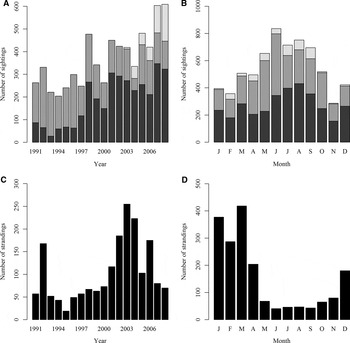
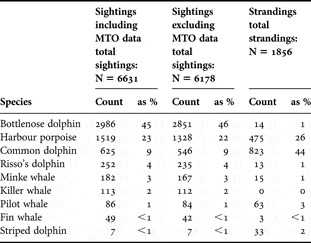
Between 1991 and 2008, 6631 cetacean sightings were recorded in the study area. The most commonly sighted species, each representing >3% of the total sightings (which on average represents at least 10 records per year), were bottlenose dolphin (N = 2986), harbour porpoise (Phocoena phocoena) (N = 1519), common dolphin (N = 625), Risso's dolphin (Grampus griseus) (N = 252) and minke whale (Balaenoptera acutorostrata) (N = 182) (Table 1). Sightings that represented >0.5% but ≤3% of total sightings were killer whale (Orcinus orca) (N = 113), pilot whale (Globicephala melas) (N = 86) and fin whale (Balaenoptera physalus) (N = 49) (Table 1). There were also records for humpback whale (Megaptera novaeangliae) (N = 21), white-beaked dolphin (Lagenorhynchus albirostris) (N = 12), striped dolphin (Stenella coeruleoalba) (N = 7), sperm whale (Physeter macrocephalus) (N = 4), sei whale (Balaenoptera borealis) (N = 3), white-sided dolphin (L. acutus) (N = 3), Cuvier's beaked whale (Ziphius cavirostris) (N = 1), false killer whale (Pseudorca crassidens) (N = 1) and northern bottlenose whale (Hyperoodon ampullatus) (N = 1). Three further categories recorded sightings that had only been identified as dolphin spp. (N = 704), whale spp. (N = 49) or cetacean spp. (N = 13); these were considered as one category, ‘unidentified species’. MTO data contributed 453 sightings. The number of these annual sightings increased from first appearing in the dataset from 53 in 2004 to 163 in 2008 (Figure 2A; see Supplementary Table 1 online).
(A) Number of sightings for all cetacean species by year from 1991 to 2008 (N = 6631). Marine Tour Operator (MTO) sightings 2003 to 2008 are shown as light grey caps (N = 453). Bottlenose dolphin sightings are shown as mid-grey (N = 2851). All other sightings are shown as black (N = 3327); (B) number of sightings for all cetacean species by month from 1991 to 2008. MTO sightings 2003 to 2008 are shown as light grey caps. Bottlenose dolphin sightings are shown as mid-grey. All other sightings are shown as black; (C) number of strandings for all cetacean species by year from 1991 to 2008 (N = 1856); (D) number of strandings for all cetacean species by month from 1991 to 2008.

Most commonly sighted and stranded species as identified. Totals and percentages are given for sightings including and excluding Marine Tour Operator (MTO) data.

Annually, there was a broad increase in total recorded sightings (Figure 2A). However, when MTO data were removed, sightings remained relatively constant over the last eight years of the dataset (2001–2008). Sightings of bottlenose dolphin showed an absolute decline over the whole period, whereas, total sightings for all other species show a steady increase. Seasonality is evident in the sightings data with peak sightings being recorded in the summer months June to September (Figure 2B).
STRANDINGS: GENERAL TRENDS
Between 1991 and 2008, 1856 cetaceans were recorded stranded in the study area. Individual species that represented >0.5% of all strandings were common dolphin (N = 823), harbour porpoise (N = 475), pilot whale (N = 63), striped dolphin (N = 33), minke whale (N = 15), bottlenose dolphin (N = 14) and Risso's dolphin (N = 13) (Table 1). Species not recorded as stranded but sighted, were killer whale, humpback whale, sei whale, false killer whale and northern bottlenose whale. Supplementary Table 1 online details all stranded species, counts and percentages.
Annually, total recorded strandings had increased since 1991, peaking in 2003 but subsequently declined (Figure 2C). Peak years showed high levels of strandings for harbour porpoise and/or common dolphin. Seasonality was evident for strandings with peaks in winter and early spring (Figure 2D).
SIGHTINGS: SPECIES-SPECIFIC TRENDS
By year
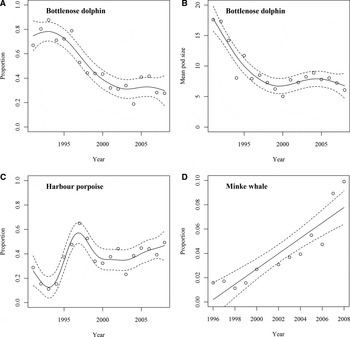
Generalized additive modelling analysis highlighted significant negative trends in the number of bottlenose dolphin sightings as a proportion of total sightings (F1,16 = 21.95, P < 0.001; Figure 3A) and in pod size (F1,16 = 23.66, P < 0.001; Figure 3B). Analysis of pod size related to records where more than one individual was sighted.
(A) Bottlenose dolphin sightings as proportion of all sightings excluding Marine Tour Operator (MTO) data by year 1991 to 2008 (N = 2851; generalized additive modelling (GAM): F1,16 = 21.95, P < 0.001); (B) bottlenose dolphin mean pod size (N = 2596; GAM: F1,16 = 23.66, P < 0.001); (C) harbour porpoise sightings (N = 1328; GAM: F1,16 = 7.43, P < 0.01) as proportion of all sightings excluding MTO and bottlenose dolphin data by year 1991 to 2008; (D) minke whale sightings (N = 167; GLM: F1,10 = 41.13, P < 0.001) as proportion of all sightings excluding MTO and bottlenose dolphin data by year 1996 to 2008. All figures show 95% confidence intervals (broken lines).

Bottlenose dolphin sightings represented over 46% of all records; therefore, any temporal trend for this species could have potentially skewed trends for other species. As a result, temporal trends for all other species were analysed without the inclusion of bottlenose dolphin data. When the significant decline in bottlenose dolphin over time was corrected for there remained a significant positive trend in the number of harbour porpoise sightings as a proportion of total sightings (F1,16 = 7.43, P < 0.01; Figure 3C) and a significant trend in minke whale sightings. Preliminary GAM analysis suggested a linear relationship for minke whale sightings as a proportion of total sightings; subsequent GLM analysis showed a significant positive trend (F1,10 = 41.13, P < 0.001; Figure 3D).
Minke whale sightings were absent for the first 5 years (1991 to 1995), therefore we felt it inappropriate to fit the GLM to these years, as such GLM analysis only included data from 1996 onwards. The proportion of minke whales sightings in 2001 represented 23% of all minke whale sightings (an exception for any species in the dataset), as such we chose to eliminate these data during GLM analysis given the likelihood that they would compromise the derivation of a meaningful linear relationship.
By month
Analysis of species-specific sightings as proportion of all cetacean sightings records by month was made to take account of the inherent flux in monthly sightings that was potentially attributable to survey effort. This allowed the contribution of a single species to the monthly patterns of sightings to be seen. Bottlenose dolphin showed twin peaks in sightings in late spring and autumn (see Supplementary Figure 1A online). Harbour porpoise showed a peak in winter (see Supplementary Figure 1B online). Common dolphin, Risso's dolphin, minke whale and pilot whale generally showed main seasonal peaks in late summer, though common dolphin also displayed spikes in April and December and pilot whale in November (see Supplementary Figure 1C, D, E, & G online). Killer whale sightings peaked in May (see Supplementary Figure 1F online); however, this was driven by a cluster of sightings during 1998. Fin whale showed a winter peak (see Supplementary Figure 1H online).
STRANDINGS: SPECIES-SPECIFIC TRENDS
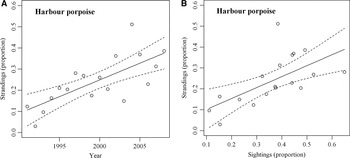
Preliminary GAM analysis suggested a linear relationship for harbour porpoise strandings as a proportion of total strandings, subsequent GLM analysis showed a significant positive trend for this species (F1,16 = 17.01, P < 0.001; See Supplementary Figure 2B,C online). Harbour porpoise strandings were significantly correlated by year with sightings (F1,16 = 10.3, P < 0.01; Figure 4B).
(A) Harbour porpoise strandings as proportion of all strandings by year 1991 to 2008 (N = 475; generalized linear model (GLM): F1,16 = 17.01, P < 0.001); (B) linear regression between harbour porpoise sightings and strandings by year (GLM: F1,16 = 10.3, P < 0.01). All figures show 95% confidence intervals (broken lines).

Evidence for seasonality of strandings was mixed. The most frequently stranded species, harbour porpoise and common dolphin both showed clear winter peaks (see Supplementary Figure 2B, C online). Total numbers of strandings for the other four species were low and therefore patterns may not be truly representative but are included for completeness (see Supplementary Figure 2A & D–F online).
Spatial analysis
SIGHTINGS
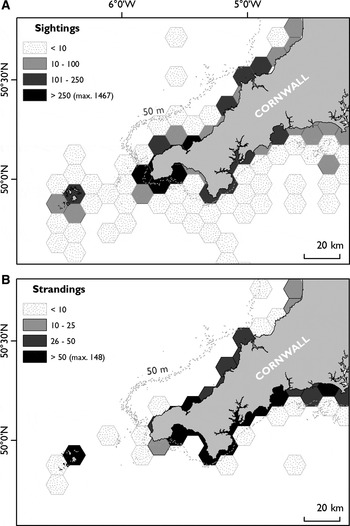
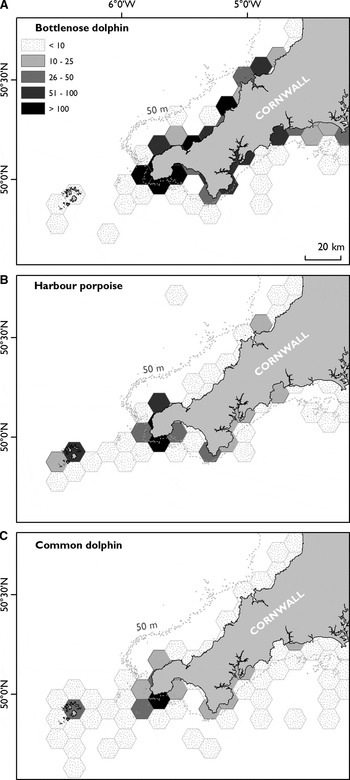
Spatial distribution mapping (hexagonal polygonal binning) gave clear indication of a high density of sightings around the Land's End peninsula and to a lesser extent around several north and south coast headlands and in some bay areas on the south coast. There was a lower density of sightings to the north-east of the county (Figure 5A). Bottlenose dolphin sightings were concentrated around north and south coast harbour areas as well as Land's End (Figure 6A). There was a low (relative) density of sightings for this species off the Isles of Scilly. There was a greater density of harbour porpoise sightings around Land's End, the Lizard and the Isles of Scilly (Figure 6B). Common dolphin had a greater density of sightings off the south coast than the north; this species also demonstrated an increased density of sightings off the Isles of Scilly (Figure 6C).
Hexagonal polygon binning density estimates for (A) cetacean sightings with Marine Tour Operator data removed 1991 to 2008 (N = 6178) and (B) cetacean strandings 1991 to 2008 (N = 1856).

Hexagonal polygon binning density estimates for species-specific cetacean sightings with Marine Tour Operator data removed 1991 to 2008 for (A) bottlenose dolphin (N = 2851), (B) harbour porpoise (N = 1328) and (C) common dolphin (N = 546).

Analysis of records occurring up to 12 nautical miles from the north and south coasts of Cornwall further highlighted species-specific spatial distribution patterns. This analysis focused on coastal waters and excluded the Isles of Scilly. The reduced area of this spatial analysis reduced total numbers of sightings analysed to N = 4991. Neither bottlenose dolphin nor harbour porpoise showed specific bias between north and south coasts. The greatest variation was seen with minke whale: 22% north/78% south, pilot whale 24% north/76% south and common dolphin: 27% north/73% south.
STRANDINGS
There was evidence for an increased density of strandings on the south coast compared to the north coast with strandings particularly associated with coastal embayments (Figure 5B) thus supporting the observations made by Leeney et al. (Reference Leeney, Amies, Broderick, Witt, Loveridge, Doyle and Godley2008). Harbour porpoise strandings were mainly concentrated in south coast bays. Common dolphin showed greater range in their spatial patterns with higher density along the south coast and at St Ives. Minke whale strandings were concentrated along the south coast. Pilot whale, bottlenose dolphin and Risso's dolphin showed no specific strong north/south bias. Analysis of records occurring within 12 nautical miles of land further highlighted species-specific spatial patterns. The total numbers of analysed strandings reduced to N = 1786. All species showed a notable division of strandings between north and south coasts. Bottlenose dolphin and Risso's dolphin showed a split 38% north/62% south and 40%/60% respectively. The greatest variations were seen with common dolphin: 17% north/83% south, minke whale 20% north/80% south, harbour porpoise: 25% north/75% south and pilot whale 31% north/69% south. There were clear similarities between species-specific sightings and strandings patterns for north and south coasts.
MTO sightings: distance and depth
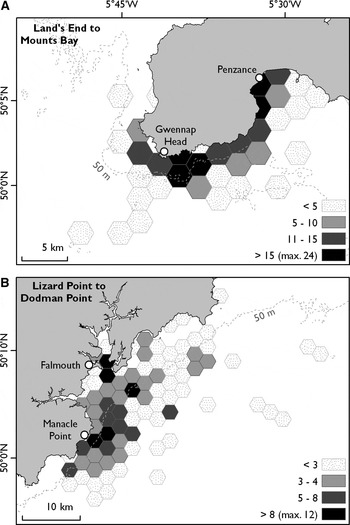
Only two of the MTOs held data spatially referenced ‘at sea’. Spatial density mapping used for both sets of MTO sightings data showed an increase in density of cetacean sightings eastward of significant bathymetric features at Gwennap Head and Manacle Point as well as increased density in sightings near harbour areas (Figure 7). Increased sightings near harbours may however be artefacts of MTOs operating from their home port. Maps of species-specific distributions (see Supplementary Figure 3 online) show bottlenose dolphin in shallow coastal waters generally ≤20 m depth and ≤2 km (approximately 1 nautical mile) from shore. Harbour porpoise were seen across a wide spectrum of depths but generally 20–60 m <5 km (approximately 2.5 nautical miles) from shore. Common dolphin favoured deeper water with depths between 50 and 70 m up to 9 km (approximately 5 nautical miles) from shore.
Hexagonal polygon binning density estimates for Marine Tour Operator (MTO) sightings for all species: (A) Land's End to Mount's Bay (N = 234); (B) Lizard Point to Dodman Point (N = 253). For MTO species-specific plots see Supplementary Figure 3 online.

DISCUSSION
The sightings and strandings databases held records for a broad range of cetacean species, predominately toothed cetacean. The top three species recorded sighted were bottlenose dolphin, harbour porpoise and common dolphin. As the sightings data were collected with a greater effort from the coast and in near-shore waters, relative proportionality highlights species habitat use rather than species abundance with inshore species being sighted more often. This is supported through the MTO data.
Marine Tour Operator data showed distinct species-specific spatial patterns. Bottlenose dolphins were found in shallow near-shore coastal waters. The spatial density mapping for all data for this species showed sightings concentrated in harbour and bay areas often within or close to estuary mouths as well as around Land's End headlands. The existence of separate coastal and offshore populations of bottlenose dolphin has been documented throughout its range (Würsig & Würsig, Reference Würsig and Würsig1979; Hoelzel et al., Reference Hoelzel, Potter and Best1998). River estuaries, headlands and sand banks with uneven seabed relief and/or strong tidal currents are often favoured in coastal waters (Reid et al., Reference Reid, Evans and Northridge2003). MTO data showed harbour porpoise and common dolphin were distributed across a broad range of depths and distance but with harbour porpoise also closer inshore in shallower depths than common dolphin. Kiszka et al. (Reference Kiszka, Macleod, Van Canneyt, Walker and Ridoux2007) found harbour porpoises to show a preference for the shallow waters of the western English Channel with common dolphins being sighted in deeper shelf and oceanic waters. Spatial density mapping suggests an increase in density of cetacean sightings eastward of pronounced bathymetric features. Localized conditions such as tidal fronts, uneven bottom topography, narrow channels and eddies downstream of headlands and islands can favour biological productivity and aggregate prey, thereby influencing cetacean distribution (Reid et al., Reference Reid, Evans and Northridge2003).
The overall increase in sightings records potentially reflects increased awareness and use of the sightings scheme as opposed to actual increase in cetacean occurrence. Similarly, the overall seasonality of sightings could indicate effort related bias. However, the shifts seen in species patterns over time, specifically those associated with proportionality of bottlenose dolphin, harbour porpoise and minke whale sightings may indicate changes in species occurrence. Such shifts could also reflect an increase in public education or awareness of species identification but, if so, one would also expect a decreasing trend of non-categorized species, which was not evident.
Reid et al. (Reference Reid, Evans and Northridge2003) describes several resident bottlenose dolphin populations in UK waters. Wood (Reference Wood1998) discussed the residency pattern in Cornish waters of a group of approximately 25 to 30 animals between 1993 and 1996. Field studies and photo-identification suggested an emigration or loss of individuals from the area in 1994 and 1996. This reflects the trends seen in this study with a reduction in pod numbers to between 5 and 10 since 1996. The associated reduction in the proportion of bottlenose dolphin sightings may reflect a decrease in the potential for smaller pod sizes to be sighted from shore. The model of sudden population drop-off appears to fit these data better than one of a gradual decline. In 2005, SCANS-II (Hammond & MacLeod, Reference Hammond and MacLeod2006) reported an increase in harbour porpoise and minke whale abundance in the areas of the Channel and Celtic Sea over the previous 1994 SCANS survey (Hammond et al., Reference Hammond, Berggren, Benke, Borchers, Collet, Heide-Jorgensen, Heimlich, Hiby, Leopold and Øien2002). MacLeod et al. (Reference MacLeod, Brereton and Martin2009) have also observed an increase in harbour porpoise occurrence in the English Channel albeit during winter months. These regional increases in species abundance reflect trends for harbour porpoise and minke whale seen in this study. Camphuysen (Reference Camphuysen2004) reported similar trends for harbour porpoise in Dutch coastal waters. It was suggested that prey availability had triggered a shift in distribution and that the observed trend should not be interpreted as a population recovery.
Both harbour porpoise and fin whales showed seasonal trends in sightings that did not mirror patterns that could be attributed to seasonal effort related bias. Harbour porpoise held winter/early spring peaks; these again replicate the findings of Camphuysen (Reference Camphuysen2004). Fin whale held a winter peak in sightings, specifically December. This species mainly occur off the coast of the UK between June and December with part of the population overwintering and breeding south of Ireland and in the Western Channel Approaches (Reid et al., Reference Reid, Evans and Northridge2003). This may account for the seasonal pattern of these sightings.
Overall density of sightings was greater at headlands and in some bay areas. This may reflect increased effort. Pelagic species, common dolphin, Risso's dolphin, minke whale and pilot whale had a greater number of sightings off the south coast. Greater recreational boat use here may increase sightings of these species. Coastal bathymetry could also exaggerate this trend; depth contours run significantly closer to the south coast than the north, which may result in pelagic species staying a greater distance from the north coast. Bottlenose dolphin and harbour porpoise showed no notable north/south bias. This may reflect habitat use with these species being more readily sighted from the coast and therefore showing an even north/south distribution of sightings. It is also possible that a combination of bathymetry, specifically depth and seafloor relief (e.g. Baumgartner, Reference Baumgartner1997; Cañadas et al., Reference Cañadas, Sagarminaga and García-Tiscar2002; Hastie et al., Reference Hastie, Wilson, Wilson, Parsons and Thompson2004; Azzellino et al., Reference Azzellino, Gaspari, Airoldi and Nani2008) and coastal currents or tidal fronts (Reid et al., Reference Reid, Evans and Northridge2003; Tynan et al., Reference Tynan, Ainley, Barth, Cowles, Pierce and Spear2005), are influencing cetacean distribution between north and south coasts.
Conspecific stranding patterns were in inverse proportion to sightings for bottlenose dolphin, harbour porpoise and common dolphin, supporting the suggestion that sightings numbers do not reflect abundance. Strandings trends and patterns for these data to 2006 have been discussed at length in Leeney et al. (Reference Leeney, Amies, Broderick, Witt, Loveridge, Doyle and Godley2008). However, with the inclusion of data for 2007 and 2008, strandings overall, have shown a recent decline. This is principally due to a decrease in the absolute number of strandings of common dolphin and partly of harbour porpoise. Harbour porpoise strandings as a proportion of all strandings showed a significant positive trend that was significantly correlated by year to the increase in the proportion of sightings for this species. This lends credence to the proposition that changes in abundance and distribution may in part have led to an increase in recorded strandings for this species (Jepson, Reference Jepson2005; Sabin et al., Reference Sabin, Chimonides, Spurrier, Evans-Jones, Jepson, Deaville, Reid, Patterson, Penrose and Law2006). Leeney et al. (Reference Leeney, Amies, Broderick, Witt, Loveridge, Doyle and Godley2008) reported a significant trend in common dolphin strandings between 1973 and 2006. With the inclusion of more recent data, this trend was no longer significant.
Seasonality of strandings was evident. Leeney et al. (Reference Leeney, Amies, Broderick, Witt, Loveridge, Doyle and Godley2008) noted that patterns in strandings do not reflect the seasonal pattern of recreational coastal use. Similarly, these strandings patterns do not reflect the patterns of seasonality in sightings attributable to survey effort. It was therefore considered that these strandings patterns were not affected by effort. Common dolphin and harbour porpoise were the most frequently recorded stranded species. Both species held clear winter peaks. It is acknowledged that by-catch has been the major cause of death in UK stranded harbour porpoise and common dolphin since 1990 (Jepson, Reference Jepson2005) and that the south-west of England (Cornwall and Devon) represents a hotspot for such strandings. Leeney et al. (Reference Leeney, Amies, Broderick, Witt, Loveridge, Doyle and Godley2008) highlight the potential for various fisheries to affect cetacean populations through by-catch. Locally, concern has been raised over the potential impact of inshore gill/tangle net fisheries on cetaceans in south-west waters (CWT, 2006). With the sustained positive trend in harbour porpoise strandings and sightings combined with the seasonal trend for inshore sightings, the potential for this interaction should not be dismissed.
Spatial patterns for strandings broadly support those reported by Leeney et al. (Reference Leeney, Amies, Broderick, Witt, Loveridge, Doyle and Godley2008) with greater density of strandings on the south coast than north. Interestingly, this pattern was also seen with bottlenose dolphin and harbour porpoise: species recognized by this study as having no specific north/south bias in sightings. This lends support to the observation by Leeney et al. (Reference Leeney, Amies, Broderick, Witt, Loveridge, Doyle and Godley2008) that local prevailing winds and/or currents may in part drive strandings distribution.
Mindful of the inherent temporal and spatial bias within incidentally collected data (Evans & Hammond, Reference Evans and Hammond2004; Witt et al., Reference Witt, Broderick, Johns, Martin, Penrose, Hoogmoed and Godley2007a, Reference Witt, Penrose and Godleyb) with rigorous and methodical interrogation and editing together with cautious interpretation, significant temporal/spatial patterns have been shown for the species bottlenose dolphin, harbour porpoise, common dolphin, minke whale and fin whale. Further dedicated work using effort corrected line transect surveys or fixed passive acoustic monitoring using C-PODS (Carstensen et al., Reference Carstensen, Henriksen and Teilmann2006) may corroborate the seasonal patterns observed in this study and assemblage of time-series data will identify trends. This study particularly highlights the potential resource held within publicly driven recording schemes. Providing data are gathered without causing disturbance to the animals, engaging with collectors and enhancing the quality of data collected, particularly spatial referencing and recording effort, may prove a worthwhile consideration.
ACKNOWLEDGEMENTS
Our sincere gratitude is expressed to the Cornwall Wildlife Trust for the compilation and release of the sightings and strandings data used in this study, R. Dennis who co-ordinates the sightings database and the host of individuals whose voluntary reports build these databases. M.J.W. and B.J.G. are supported by the Peninsula Research Institute for Marine Renewable Energy (PRIMaRE), by the Darwin Initiative and the European Social Fund.
Supplementary materials and methods
The Supplementary material referred to in this article can be found online at journals.cambridge.org/mbi.