




No CrossRef data available.
Article contents
- Abstract
- A Model of Domestic Constituency Mechanism
- Compliance with the 1985 Sulphur Protocol: An Illustration
- Implications for International Institutions
- Conclusion
- Appendix 1: Formal Solutions
- Appendix 2: Variables Used to Measure Domestic Environmental Activism
- Appendix 3: Ranking countries by domestic environmental activism over acid rain
- References
Why Comply? The Domestic Constituency Mechanism
Published online by Cambridge University Press: 17 May 2005
Article contents
- Abstract
- A Model of Domestic Constituency Mechanism
- Compliance with the 1985 Sulphur Protocol: An Illustration
- Implications for International Institutions
- Conclusion
- Appendix 1: Formal Solutions
- Appendix 2: Variables Used to Measure Domestic Environmental Activism
- Appendix 3: Ranking countries by domestic environmental activism over acid rain
- References
Abstract
Why do countries comply with international agreements? While scholars have done rigorous work to address compliance and enforcement in an international game, less analytical attention has been paid to domestic mechanisms of compliance. However, because international agreements have domestic distributional consequences, there exist domestic sources of enforcement. In this article, I develop an analytical framework of domestic accountability, where I identify specific channels of influence through which domestic constituencies can influence national compliance. Using a game theoretic model, I show that a government's compliance decision reflects the electoral leverage and the informational status of domestic constituencies. This framework further provides a theoretical rationale for why and how international institutions may influence states' compliance through domestic mechanisms. The European acid rain regime offers an empirical illustration of the domestic constituency argument.I have benefited from the generous help of many colleagues and friends in the course of this research. I would particularly like to thank the editor-in-chief of IO, anonymous reviewers of this article, as well as William Bernhard, Paul Diehl, Daniel Drezner, James Fearon, Robert Keohane, Charles Lipson, Ronald Mitchell, Robert Pahre, Duncan Snidal, Detlef Sprinz, Milan Svolik, and Pieter van Houten. Nazlı Avdan provided valuable research assistance. MacArthur Foundation, the U.S. Institute of Peace, Fuqua School of Business at Duke University, and the Research Board at University of Illinois at Urbana-Champaign sponsored various phases of this research.
Information
- Type
- Research Article
- Information
- Copyright
- © 2005 The IO Foundation and Cambridge University Press
In the framework of the Long Range Transboundary Air Pollution (LRTAP) Convention, twenty-one European countries agreed in 1985 to reduce their sulphur emissions by at least 30 percent before 1993. In 1993 most countries reported reaching this goal, and some reported much steeper reductions. This presents characteristics of a classic collective action problem. On one hand, sulphur emission reduction entails large short-term costs; on the other hand, because acid rain travels over a long distance and often across borders, potential benefits of emission reduction are widely diffused. The combination of concentrated costs and diffuse benefits may give rise to free-riding incentives. A natural question to ask, therefore, is why do countries comply with their commitments?
Scholars have written much about how international institutions can resolve such collective action problems at the international level. International institutions monitor states' compliance with treaties. By providing compliance information, they facilitate reciprocity and thus induce compliance. Analytically, as in the repeated prisoners' dilemma game, a cooperative equilibrium can be supported with tit-for-tat strategies if the players' behavior is transparent. When information on players' behavior is missing, then defection may not be punished with sticks while compliance may not be rewarded with carrots, thus the cooperative equilibrium may break down.1
See Keohane 1984; Axelrod 1984; Oye 1986; and Kreps 1990.
However, the monitoring program under the LRTAP Convention only monitors the aggregate pollution levels. It does not monitor or verify each country's emission reduction. Rather, for compliance measurements, the convention essentially relies on governmental self-reports. Indeed, faced with collective action problems, many international institutions do not directly monitor states compliance with treaties.2
For an explanation of diverse monitoring arrangements in treaty regimes, see Dai 2002a.
For the need to better understand how international institutions influence states' behavior, see Martin and Simmons 1998; as well as Simmons and Martin 2002.
This article conceptualizes an alternative mechanism of compliance. The point of departure is that problems that resemble a prisoners' dilemma game at the international level may present governments with an entirely different strategic environment domestically. Within a country, some actors gain while others may lose if the government does not comply with an international agreement. When those who are victimized by noncompliance have crucial leverage over the government, compliance can be rational even if the country as a whole pays for it more than benefits from it. One needs to specify such domestic sources of enforcement before one can begin to identify, in theoretically coherent ways, how international institutions may work through these sources to influence national compliance.
I thus model a government's compliance decision in the shadow of competing domestic constituencies. Two key observations inspire this conception. First, governments are to varying extents in agency relationships with their domestic constituents. That is, a government (as an agent) makes policy decisions on behalf of various domestic constituents (as principals). While the agent's decision affects the welfare of the principals, the principals have the power to sanction the agent through various mechanisms. In the context of this article, while a government makes compliance decisions that affect the welfare of domestic constituents, the latter can exercise certain leverage to influence the government's compliance decisions. Constituents possess political leverage over governments because national leaders want to stay in office by making and implementing policies that have the constituent support. Second, a government is usually accountable to a variety of constituencies with competing claims. Trade agreements, for instance, affect import competing industries and consumers differently within a single country. Similarly, regarding compliance with environmental agreements, industries and environmental groups often take opposing stands. In such cases, interest groups who care about compliance decisions compete to get the government to devote relatively more time and effort to their interests at the expense of the interests of other groups. In order to maximize political support, the government must respond to different claims from competing constituents.
The central task in this model is, therefore, to specify how competing constituencies influence a government's compliance decision. In agency relationships, the problem of moral hazard often presents itself: while the agent takes an action that affects the principals' welfare, the principals may not observe the action directly.4
See Holmström 1979; and Grossman and Hart 1983.
As this model shows, a government's compliance decision is determined not only by the electoral leverage of domestic constituencies but also by their informational endowment. On one hand, compliance decisions tend to bias toward large interest groups that have significant electoral influence. On the other hand, interestingly, compliance decisions can also bias toward special interests if these groups are much better informed about the policy process. This is because, facing an inference problem, the relatively better informed group is more likely to base its approval of the government on the actual policy rather than noise in the policy process. Accordingly, the policymaker would lose more support by fooling the well-informed than by fooling the ill-informed.
The European Acid Rain regime provides an important empirical illustration of the domestic constituency mechanism. Typically viewed as in a classic collective action problem, European countries' compliance with the LRTAP Convention is often taken as evidence for the direct effect of international institutions. A closer look however, reveals that national compliance varies significantly from country to country, which suggests a domestic story in the first place. To illustrate how the domestic constituency mechanism works in this case, I conduct categorical data analysis involving all participating countries as well as in-depth examination of some of these countries. Consistent with the central finding in the model, European countries' compliance with the 1985 Sulphur Protocol reflects the electoral leverage and informational status of domestic constituencies.
While the primary purpose of this article is to advance a theory of domestic compliance mechanism and to delineate specific channels of influence by domestic constituencies, this study also has important implications on international institutions. The fact that compliance decisions tend to reflect the electoral leverage and the informational status of domestic constituencies suggests indirect but incentive-compatible ways in which international institutions can influence national compliance. Specifically, international institutions can facilitate national compliance by increasing the electoral leverage and improving the informational status of procompliance constituencies. In doing so, international institutions can facilitate a decentralized compliance system, where the enforcement source is not from some states over others, but rather from some domestic constituencies over their government. In the case of the LRTAP Convention, I find that the Convention has empowered domestic environmental activists by providing them with specific relevant information and by legitimizing their demands.
The article proceeds as follows. The next section develops a model of domestic compliance mechanisms and, in that framework, delineates specific channels of influence over national compliance. The third section provides an empirical illustration of the domestic constituency mechanism. The fourth section highlights major implications for the role of international institutions in the context of domestic enforcement. The last section concludes.
A Model of Domestic Constituency Mechanism
In this section, I develop a model in which a government makes a compliance decision in the shadow of competing domestic constituencies. I build on moral hazard models in political science, where voters' retrospective voting gives the policymaker incentives to attend voters' interests.5
In particular, see Ferejohn 1986; Lohmann 1998; and Fearon 1999.
I begin with the basic setup of the model, where I first discuss the environment in which players interact and derive their preferences accordingly and then describe the sequence of the game. I then analyze equilibrium decisions in two scenarios, one where the chief policymaker faces electoral pressure and the other where the chief policymaker does not face any pressure. Finally, I compare the two equilibrium decisions of compliance. With the compliance decision under no electoral pressure as a benchmark, I derive the central result about the effects of domestic constituencies on compliance through the electoral process. Appendix 1 contains the complete derivations of all formal results.
The Setup of the Model
There are three players in this model of domestic enforcement: besides the national government or the chief policymaker, there are two distinctive groups of voters or interest groups.6
This of course does not mean that all voters can be categorized into two competing interest groups. What matters in this model are those constituents who have preferences on the given issue rather than those who are indifferent. The former can be categorized roughly into two competing interest groups. Naturally, those who do not care about an issue can be subsequently persuaded by those who do. That possibility is captured by the changing size of two interest groups.
A thoughtful reader would question treating the compliance stage independent of the negotiation stage and thus treating the content of the agreement exogenous, because it does not confront an important alternative hypothesis that compliance is because of shallow agreements.7
Downs, Rocke, and Barsoom 1996. However, Gilligan 2004 argues that broad multilateral agreements are not necessarily shallow.
The interest groups differ in their preferences regarding compliance. Each group i has an ideal point xi, for i ∈ {1,2}. Each group i desires the policymaker to take a compliance policy x as close to its ideal point xi as possible. A simple function representing these preferences is the negative quadratic, −αi(x − xi)2, where αi ∈ (0,1) reflects the intensity of preferences. To mark the difference between the two groups, let group 1 prefer a low compliance level and group 2 prefer a high compliance level. That is, x1 < x2.
The interest groups also differ in another aspect: their informational endowment. Domestic constituents do not perfectly observe a government's compliance efforts. They, do however, experience their welfare, which depends partly on the government's compliance efforts and partly on exogenous and probabilistic factors. In deciding whether to vote for the incumbent policymaker, both groups need to infer how much the welfare they experience is attributable to the government's compliance policy versus some exogenous factors. The relative accuracy of their inference depends on how well each group understands the policy process.9
This is a general assumption to capture the informational asymmetry between the principals and the agent. The acid rain case to be investigated in the empirical section of this article fits this hidden action assumption just as well as economic voting where this assumption is frequently applied. Regarding an economic policy, voters do not necessarily observe the policy taken by the government, but they do experience how much money they have in their pockets. Similarly, regarding an environmental policy, domestic groups do not necessarily observe the policy taken by the government, but they do have a sense of how polluted the surrounding air is. However, assuming that voters and groups experience their own welfare does not mean that they know the precise effect of the policy in question, because their welfare is a function of more than the policy. Just as voters do not know precisely how and how much an economic policy that they do not perfectly observe contributes to their pocket book, whether domestic groups can infer how and how much an environmental policy that they do not perfectly observe contributes to the air quality depends on how much they invest in monitoring the governmental policy and learning about the policy process. That uncertainty and its effect are partially what the analysis below seeks to capture.
Accordingly, each interest group experiences a group-specific outcome of the government's compliance policy. Formally, each group's single-period utility function is

It is a function of the group's preference as well as its informational endowment, in addition to the compliance policy chosen by the policymaker.
The policymaker's preference over the compliance decision is shaped by both his public spirit and his private interest. While the policymaker aims to increase the aggregate welfare, he also desires to increase his chance of getting reelected into office. Thus, the policymaker's utility function consists of two main components:

The first part,

, captures aggregate social welfare, where Ui is the utility function of interest group i. The second part, Pr(ω)δV, captures the expected value of getting reelected, where Pr(ω), is the probability that the policymaker wins reelection, δ ∈ (0,1) is the discount factor and V > 0 is the benefit of being reelected.
The assumption that the policymaker cares about aggregate social welfare ensures that any predictions that I make about the policymaker's shifting attention to those with more electoral leverage and better information stem from the electoral process rather than the policymaker's preferences. However, this assumption is not necessary for the central result in this model. An alternative assumption, for instance, is that the policymaker is either a partial rent-seeker or a pure rent-seeker.10
Important recent studies have explored rent-seeking behavior as a function of regime types. See, for instance, Persson, Tabellini, and Trebbi 2001; and Bueno de Mesquita, Smith, Siverson, and Morrow 2003. In the current model, I do not assume different preferences for political leaders in different regimes. My purpose is to isolate the effect of electoral accountability from that of preferences.
The other assumption about the policymaker's preference is that, the policymaker values holding office and thus chooses policies to maximize his chance of staying in office. It implies that the policymaker is concerned with how voters evaluate his performance on a given policy. This assumption is crucial: if the policymaker does not value holding office and thus is indifferent to his chance of retaining office, the policymaker does not need to pay any attention to what voters want. Then the source of electoral accountability is eliminated. It is of course possible that the policymaker may maximize his chance of retaining office until he is reasonably sure that he has enough to win. In that case, electoral accountability reaches the cap at the point when the policymaker feels secure. That point, however, is arguably difficult to reach in a competitive election and particularly with a risk-averse policymaker. The qualitative results in this model hold so long as the policymaker cares about gathering public support to some extent.
There are two periods in the model. I use subscript t ∈ {1,2} to denote each of the two periods of the game. In the first period, the sequence of events goes as follows. First, the policymaker chooses a compliance policy, x. Then, observing the policy outcome, each group i subsequently votes the incumbent policymaker either in or out. In the second period, the incumbent policymaker remains in power if he receives the majority of votes.11
To capture the intuition that voters in each group may possibly vote differently, one can interpret the probability that group i votes for the incumbent policymaker as the percentage of voters within that group that vote for the incumbent policymaker.
As a common assumption in this sort of formal models, the competing candidate does not play any active role. The importance of the competing candidate lies in his or her availability, without which the voters' leverage over the incumbent would be diminished.
The assumption that no policymaker can stay in office for more than two terms is not necessary for the central results in this model. The purpose of this simplifying assumption is to allow the governmental action without electoral pressure to serve as a benchmark for the governmental action with electoral pressure. Because I assume that most governments do care about staying in office, the central question that this model addresses is: When a government is motivated by reelection and thus constituencies have leverage over the government's fate of staying in power, what influences the government's choice of the compliance policy?
Equilibrium Analysis
To trace how domestic constituencies influence the government's compliance policy through the electoral process, I compare the government's compliance decision in the first period under electoral pressure with that in the second period where the government no longer faces any electoral pressure. To do so, I first derive the equilibrium decisions in the two scenarios respectively.
Proposition 1: The following strategies constitute a Subgame Perfect Equilibrium: In the first period, the incumbent chooses a compliance level

and interest group i chooses the retrospective voting rule

In the second period, the incumbent chooses a compliance level

Throughout, φi = fi(0), and λi = ∂Pr(ω)/∂Pr(vi = 1), for i ∈ {1,2}.
In the second period, the incumbent policymaker cannot get reelected for any more terms. Without electoral pressure, the compliance level simply reflects the ideal points of the two groups and their preference intensity.
In the first period, however, the policymaker can compete for reelection. Because the goal of this model is to understand the domestic sources of enforcement attributed to electoral accountability, I now focus on the policymaking with electoral pressure in the first period.
In choosing the compliance policy, the policymaker must consider how his decision in the first period affects the probability that he gets reelected in the second period. As shown in Appendix 1, the effect of the compliance policy on his chance of getting reelected can be expressed as follows:

. This effect consists of two elements. One term, ∂Pr(vi = 1)/∂x, captures how the compliance level affects the probability that each interest group votes for the incumbent policymaker. The other term, ∂Pr(ω)/∂Pr(vi = 1), captures how the probability that each group votes for the incumbent policymaker affects the probability that the incumbent wins reelection.
Regarding the term ∂Pr(vi = 1)/∂x, whether a chosen compliance policy can induce a particular interest group to vote for the policymaker depends on the voting strategy of that group. The voting strategy for each interest group is a rule that says whether, at the end of the first period, to reelect the incumbent policymaker. Because the groups do not directly observe the actual compliance policy, they assess how much the policymaker attends their interests according to the welfare they experience. Group i votes for the incumbent, if and only if the first period welfare for group i is at least as great as ki, that is, Ui(x) ≥ ki.13
The voting strategy often takes the form of a cut rule. See, for instance, Ferejohn 1986; and Fiorina 1981. For how a cut rule is a delicate choice for voters, see Fearon 1999.
Arguably, the interest groups and voters who use retrospective voting rules are not entirely rational, because it is not certain that their retrospective voting strategy serves their prospective interests. Nevertheless, if the voters seek to influence their future welfare with their votes and yet they are bounded in the amount of information they have and their ability to process the information, then a government's retrospective performance provides voters with a proxy of how the government may serve their interests in the future. In this sense, therefore, a retrospective voting strategy has a prospective purpose. For an excellent discussion on this point, see Schultz 1998.
The importance of the information status or the monitoring ability is consistent with earlier moral hazard models such as Ferejohn 1986; Lohmann 1998; and Fearon 1999. However, most authors focus on these traits of the electorate as a whole rather than that of disaggregated interest groups, except for instance Lohmann 1998.
Regarding the other term ∂Pr(ω)/∂Pr(vi = 1), besides the voting strategy of each group, the policymaker must also consider the extent to which the support of a particular group enhances his chance of getting reelected. That is, the policymaker must consider the electoral significance of each group. Empirically, the electoral significance or leverage of a group can be a number of things, depending on the specific electoral mechanism. It can be the number of voters in each group, or the amount of campaign contributions the group can generate, or the ability of the group to mobilize those with weaker preferences over a given issue, just to name a few.
Anticipating the effect of his compliance decision on his chance of reelection, the incumbent policymaker decides on a compliance policy,

for i ∈ {1,2}. Again, φi = fi(0), where fi is the probability density function of the group-specific exogenous shock θi. Capturing the informational status of group i, φi influences group i's voting strategy. Furthermore, λi = ∂Pr(ω)/∂Pr(vi = 1). Capturing the electoral significance of group i, λi reflects how group i's actual vote affects the election outcome. To examine how these group-specific factors influence the compliance policy, I turn to comparative statics.
Comparative Statics
To establish the effect of constituencies on the government's compliance policy through the electoral process, I compare the compliance decision with electoral pressure in the first period to that without electoral pressure in the second period as a benchmark.
Proposition 2: The compliance policy in the first period differs from that in the second period, if and only if two interest groups differ in the interactive effect of their electoral leverage and informational status, xt=1*(ki*) = xt=2* [hArr ] λ1φ1 = λ2φ2, ∀i ∈ {1,2}.
Furthermore, the compliance policy under electoral pressure increases with the electoral leverage and the monitoring ability of the group that favors compliance, (∂/∂λ2)xt=1* > 0 and (∂/∂φ2)xt=1* > 0. It decreases with the electoral leverage and the monitoring ability of the group that opposes compliance, (∂/∂λ1)xt=1* < 0 and (∂/∂φ1)xt=1* < 0.
So long as the two groups differ in their electoral leverage and informational status, the compliance level under electoral pressure as in the first period deviates from that without electoral pressure as in the second period. If one considers the deviation of the compliance level in the first period from that in the second period as a policy bias induced by electoral control, the direction as well as the magnitude of the policy bias is determined by the electoral leverage and the informational status of interest groups. Specifically, the equilibrium policy under electoral pressure favors the more electorally significant group. All else equal, the more electorally significant the group that favors compliance, the higher the compliance level, that is, (∂/∂λ2)xt=1 > 0. Furthermore, the equilibrium policy in the first period also favors the better informed group. All else equal, the better informed the group that favors compliance—better able to monitor the governmental action—the higher the compliance level, that is, (∂/∂φ2)xt=1 > 0.
It is important to note that the strength of each group originates not only from its electoral leverage, but also from its informational endowment. Here is an example of how these factors influence the compliance decision. Assume that one important indicator of a group's electoral leverage is the size of the group. Now suppose the group that prefers a high compliance level (for example, environmental groups and interested public) is two times as large as the group that prefers a low compliance level (for example, industry groups). Then, the policymaker will bias the compliance decision in favor of the larger group, if both groups have the same monitoring ability. Typically, however, special interests such as industry groups may be better informed because their activities may be directly subject to regulations. If the smaller group is three times as information rich as the larger group, then the policy bias turns to favor special interests. As the less informed larger group improves its informational status, the policy bias toward the originally better informed special interests decreases.
Electoral control is therefore exercised through the electoral leverage and the informational endowment of interest groups. The importance of the electoral leverage is intuitively straightforward, so long as one assumes a government cares about maximizing support. However, the way information works in this model is less intuitive. Besides considering which group controls more votes, an incumbent policymaker also considers what it takes for each group to vote him back into office. The voting strategy of each group depends on how well each group is informed about the policy process. Compared to the less well informed group, the better-informed group is more likely to base its voting decision on the policy, since their inference of the policymaker's compliance decision from their welfare is less disturbed by noise. In other words, the incumbent policymaker would lose more votes by deceiving the well-informed than by deceiving the ill-informed.
While the direction of the policy bias is solely determined by the attributes of interest groups, the magnitude of the policy bias is influenced by two additional factors. That is, the stakes the incumbent perceives in getting reelected and his discount factor directly affect the compliance level under electoral control. First, the more the incumbent values the reelection benefits, the more the policy favors the electorally significant and the better informed group. Second, the less the incumbent discounts the future, the more the policy favors the electorally significant and the better-informed group.
Although I do not have space to expand, the second point above deserves a brief comment. One way to interpret this result is that, a government under immediate electoral pressure—with a low discount factor—responds more to the electoral control of domestic interests than a government that is more insulated. It is thus possible that, to the extent that democratic governments face more regular and frequent elections than nondemocratic governments, electoral accountability tends to shape the compliance decision in democratic states more than it does in nondemocratic states. This alone, however, does not mean that democratic states tend to comply with international agreements more than nondemocratic states do. This is because, although democratic institutions may intensify the effect of electoral control, the direction of electoral effect on the compliance level is determined by the attributes of competing domestic interests such as their electoral leverage and informational endowment. This is consistent with the finding that popular pressure in democratic states does not necessarily point toward a higher level of compliance with international agreements.16
To fully account for the effects of democratic institutions—a fascinating but a much broader and different issue than the one addressed in this article—one needs to look in addition at various other dimensions of democratic institutions17 as well as the preferences that go into the institutions.18Compliance with the 1985 Sulphur Protocol: An Illustration
The preceding analysis suggests, because governments are interested in retaining office, a country's compliance effort responds to the demands of domestic constituencies. Specifically, compliance reflects the electoral leverage and the informational status of competing domestic constituencies. To illustrate how the domestic constituency mechanism works empirically, I take another look at the LRTAP Convention.
Responding to acid rain that typically travels across borders, European countries collaborated within the framework of the LRTAP convention. Since the establishment of the LRTAP Convention in 1979, there have been a series of substantive protocols requiring specific amounts of pollutant emission reductions. I focus here on the 1985 Sulphur Protocol, which required signatory countries to reduce sulphur emissions by at least 30 percent by 1993, with 1980 as the base year. As this protocol was the first substantive agreement in the framework of the LRTAP Convention and it reached its deadline for implementation the earliest, it allows a sufficient time span to study the subsequent compliance with the protocol. Furthermore, the fact that more than twenty countries signed this protocol offers variation in dependent and independent variables.
In this section, I examine how domestic constituents affected national compliance with the 1985 Sulphur Protocol. I carry out the analysis in two different modes. I first conduct categorical data analysis with opinion survey data involving all signatory countries. To supplement the data analysis, I then examine some signatory countries in more depth. By combining quantitative and qualitative evidence, I hope to provide both a broad picture about and an in-depth look into how domestic compliance mechanisms work in this case.
A Broad Picture
To provide a general pattern of national compliance as mapped against politically relevant traits of domestic constituencies as suggested by the formal model, I first develop measures for the dependent and independent variables, respectively, and then trace how they relate to each other.
A measure of the dependent variable is straightforward. As required by the 1985 Sulphur Protocol, each participating country should reduce sulphur emissions by at least 30 percent with 1980 as the base year. As compliance is defined as the degree to which the explicit treaty provision is achieved, the actual percentage reduction of sulphur emissions thus serves as the perfect measure of compliance in this case. Consistent with the definition of compliance as capturing outcomes ranging from noncompliance to overcompliance, the percentage reduction of sulphur emissions is a continuous variable capped at 100 percent.19
Consistent with the general conceptualization of compliance in the literature, the definition of compliance does not address the motivations behind the observed behavior. See Fisher 1981; Mitchell 1994; and Raustiala and Slaughter 2002.
Regarding independent variables, a natural measure of the electoral leverage and the informational status of competing domestic constituencies in this case is what I call domestic environmental activism mobilized around the acid rain issue. First, this measure captures both political clout and informational status of domestic constituents, because it covers the following four specific dimensions: (1) public opinion regarding acid rain; (2) public consciousness over the environment; (3) the membership of environmental nongovernmental organizations (NGOs); and (4) the electoral strength of Green parties. Two of these dimensions—the size of environmental NGOs and potential votes for political parties that endorse environmental agendas—contribute to the electoral leverage of environmental activism. Two other dimensions—the public awareness of the environment in general and the acid rain problem in particular—reflect the informational status of environmental activism.20
Incorporating both electoral leverage and informational status into one independent variable is consistent with the theoretical expectation from the model. While the model captures the individual effect of electoral leverage and informational status respectively, it also captures the interactive effect of the two, allowing the strength in one dimension to compensate the weakness in the other. Of course, with a fuller empirical model and sufficiently more data points, one could measure these dimensions separately while taking into account their interactive effect.
I construct an ordinal measure of domestic environmental activism. That is, I rank order the signatory countries according to the level of environmental activism mobilized around the acid rain issue. I have six data sets, each of which provides useful information on at least some dimensions of domestic environmental activism in at least some countries under study here. These are Euro-barometer 25, 29, 31A, 35, 43.IBIS, and the International Social Survey Program (ISSP) on Environment.21
See Rabier, Riffault, and Inglehart 1988; Reif and Melich 1990, 1993, and 1998; Reif and Marlier 1998; and International Social Survey Program 1996.
With each data set, I derive a ranking of the signatory countries covered in that data set by the level of domestic environmental activism mobilized around the acid rain issue. This takes three steps. First, I rank order the signatory countries along each of the four dimensions. Second, I sum up each country's rankings along all dimensions to attain an aggregate score for that country. Third, I rank order the signatory countries according to the aggregate score of each country. Thus, a country that ranks consistently high along all dimensions tends to rank high in domestic environmental activism around the acid rain issue. Appendix 3 contains the ranking of relevant countries in each data set.
The first four data sets, Euro-Barometer 25, 29, 31A and 35, cover six signatory countries under investigation here. These six countries naturally form two groups, with Denmark, West Germany, and the Netherlands ranking consistently at the top and Belgium, Italy, and France ranking consistently at the bottom. The ISSP Environment data set covers, in addition, Norway and several Eastern European countries. With Italy—from the second group in each of the first four data sets—as a reference point, Norway falls into the first group above Italy and East Germany, Czechoslovakia, Bulgaria, and Hungary form a third group below Italy.22
There is additional support for this categorization. For instance, Kitschelt 1993 finds that the influence of green and other left-libertarian parties is much more significant in Norway than in Italy. In Eastern European countries, according to Jancar-Webster 1993a, environmental movements sprang out of democratic movements and the priority they placed on the environment per se was unclear.
Compared to the other five data sets, the Euro-Barometer 43 is not good for this analysis because it is the only one among these six data sets that was conducted after the Sulphur Protocol reached its implementation deadline. However, if using this data set carries with it any bias, it is a bias against my argument. Sweden, Austria, and Finland were among the most significantly traumatized by the acid rain problem, which was a more serious problem in the mid-1980s. If any data had been collected on these countries, then these countries would have more likely ranked even higher than other countries but not lower. For instance, since the late 1970s, the acidification problem was one of the most prominent environmental issues on the Swedish public agenda. Beginning in the early 1990s, political priorities shifted somewhat from environmental issues towards economic issues, when the country entered a recession with growing unemployment.
As a result, three groups present themselves, with domestic environmental activism around the acid rain issue ranging from high to low: (1) West Germany, the Netherlands, Denmark, Norway, Sweden, Austria, and Finland; (2) Belgium, Italy, and France; and (3) East Germany, Bulgaria, Czechoslovakia, and Hungary.24
Signatory countries to the 1985 Sulphur Protocol that are not covered by any of these data sets are inevitably left out of the analysis.
This is largely consistent with Dalton 1994, who studied some of the signatory countries. Domestic environmental activism is treated less systematically in studies of international cooperation to combat acid rain, but see Sprinz 1992.
Average level of sulphur emission reduction in signatory countries of the 1985 Sulphur Protocol, by domestic environmental activism mobilized over acid rain, with signatory countries categorized into three groups and four groups respectively

With signatory countries categorized into three groups, the group of countries with the highest level of domestic environmental activism reduced their sulphur emissions by 72 percent on average by 1993; while the group of countries with the lowest level of domestic environmental activism reduced their sulphur emissions by only 26 percent on average by 1993. The positive correlation between sulphur emission reductions and domestic environmental activism around the acid rain issue persists when the signatory countries are categorized into four groups. Just as remarkably, the average reduction of sulphur emissions increases with domestic environmental activism mobilized around the acid rain issue. Consistent with the core hypotheses from the model, European countries' compliance with the 1985 Sulphur Protocol has remarkably reflected the electoral leverage and the informational endowment of domestic constituencies.
An In-depth Look
A closer look into individual countries supports the aggregate finding that compliance with the 1985 Sulphur Protocol reflected the electoral leverage and the informational status of domestic constituencies. Because of space limitations, I focus here on a subset of signatory countries, namely Norway, West Germany, France, and the former Czechoslovakia. In presenting the evidence from each country, I identify competing domestic interests and examine both their electoral leverage and their informational conditions.
Norway
Facing similar ecological and geographic vulnerability as Sweden, Norway joined Sweden early on to push for an international solution to the acid rain problem. However, compared to Sweden, the implementation of sulphur reduction policies in Norway was more contested. The treaty compliance process activated both procompliance activism and anticompliance interests.
The major opposition was the industrial sector. Initially it was not particularly interested in the acidification policy, as Norwegian effort was mainly framed as getting central European countries and Britain to reduce their sulphur emissions. As information regarding abatement costs unfolded and as the industry came to realize that the LRTAP negotiations would have serious domestic consequences, the industrial sectors pushed the corresponding ministries to voice both reservation over sulphur reduction at home and opposition to further international targets.27
Laugen 2000, 120–24.
Overcoming this opposition, however, was the growing strength of procompliance interests. Initially only the Norwegian Ministry of Environment and the natural science community showed much interest in the acid rain issue.28
Ibid., 120.
Two important organizations are Nature and Youth (Natur og Ungdom) and Bellona (Reitan 1997, 294).
Reitan 1997, 294.
Laugen 2000, 121.
Reitan 1997, 305.
Ibid., 305–6.
Against the background of increasing political salience of the acid rain issue, costly measures were still being introduced to reduce the sulphur contents in oil in 1985 and 1989. This was well after Norway had met the minimum compliance requirements. Furthermore, this was despite the fact that its sulphur emissions contributed only about 5 percent of total sulphur dioxide fallout in Norway and thus even the most costly measures would not dramatically reduce the ecological damage Norway suffered from acid rain. Yet, these measures made sense as the environment emerged to be the single most important issue in the late 1980s.35
Laugen 2000, 121.
West Germany
Achieving an even greater percentage of sulphur reductions, West Germany experienced less domestic opposition in the compliance process while witnessing a high level of domestic environmental activism mobilized around the acid rain issue. The position of the West German government itself toward the LRTAP regime began to change after the discovery of German forest death in the early 1980s. This alarming information and the subsequent media coverage overwhelmingly alerted the public and even partially silenced the potential opposition to sulphur reduction policies.
The industrial sector largely maintained a neutral position regarding sulphur reduction policies, partially because the three leading industries—fabricated metal products, wholesale and retail, and real estate and business—were neither among those highly vulnerable to exposure nor among those particularly hurt by abatement costs. The only sector that opposed the LRTAP process was the automobile industry, which was, however, somewhat compensated by tax exemptions provided by the federal government.36
Sprinz and Wahl 2000, 154.
The government's effort to buy off any opposition and to adopt aggressive abatement measures was more than justified by the overwhelming surge in procompliance sentiments. In addition to environmental NGOs and Green parties, procompliance interests in Germany also included part of the industrial sector: industries producing abatement technologies and industries selling environment friendly products.37
Ibid., 155.
The strength of procompliance interests, in terms of both informational conditions and electoral leverage, was significant in the 1980s. The increase of public environmental awareness was clearly shown in the German election surveys: 43 percent of voters viewed environmental protection as very important in 1972. This number increased to 69 percent in 1987.38
Coupling the growing environmental awareness was the large number of citizen action groups concerned with environmental issues. By 1980 there were more than 130 supraregional and more than 1,100 regional environmental groups.39 The grass-roots environmental organizations served a voluntary monitoring function over governmental implementation of desulphurization policies at different levels. These organizations further voiced the increasingly widespread public concern over the acid rain issue to increase its salience. Capitalizing on scientific reports and media coverage, environmental activists helped ensure that the acid rain issue was widely discussed and debated in Germany. Such information about the acid damage to German forest and the debate over acidification policies further mobilized public opinion and brought out widespread support for environmental policies.Meanwhile, with the increase in public environmental consciousness, air pollution became one of the central electoral issues in the 1980s. This substantially facilitated the electoral success of the Greens. According to surveys in the late 1980s, the public viewed the Greens as the party best suited to solve environmental problems.40
Frankland 1995, 30.
France
Unlike such leaders as West Germany and Norway in complying with the 1985 Sulphur Protocol, France along with Belgium and Italy displayed much less impressive records of compliance. In France, sulphur reductions in the early 1980s were largely attributable to a switch of energy policy to rely on nuclear power. In the years after the 1985 Sulphur Protocol was signed, France barely undertook any further reductions. A look into its domestic dynamics helps illustrate why.
When the 1985 Sulphur Protocol was being negotiated and signed, France viewed sulphur pollutants as originating from the heavy industry in East Europe and thus considered itself not so vulnerable. The government's low profile in the LRTAP process spurred little opposition from the industrial sectors. However, when the acid rain damage soon became associated with motor vehicle exhaust emissions, the French automobile industry led the opposition to domestic and international measures to reduce air pollution. Taking advantage of the lack of knowledge at the domestic level on the science of acid rain, the automobile industry questioned whether new measures or technologies were truly necessary and thus further contributed to the aura of skepticism over the acid rain issue.42
Skea and du Monteuil 2000, 245, 249.
Facing such opposition, procompliance elements enjoyed neither informational nor electoral advantage. Regarding public awareness, the French public knew little about the acid rain problem and was by and large not concerned with it. This had to do with several factors. First, sulphur emissions resulted in increased vulnerability only in certain regions in France and not the whole country. Consequently, sulphur damage did not get exposed extensively in the media. Second, although the scientific community gathered more information on the science of acid rain through international networks, that information did not achieve any significant degree of salience domestically, partially because of a lack of either an elite or a grass-roots element to employ it. Unlike Germany, where the Greens helped ensure the salience of the acid rain issue in national politics and environmental NGOs helped monitoring governmental policies at various levels, French Greens and environmentalists played a limited role in information gathering and dissemination.
Partially resulting and further worsening the low level of public environmental awareness was the limited electoral leverage of procompliance interests. First, environmental NGOs in France were traditionally marginalized. In fact, a large percentage of the public perceived ecological policies as opposing national welfare, a perception that was further fueled by the anticompliance alliance of the car industry and the Ministry of Industry.43
Even though the public gradually gained greater awareness of environmental issues, it was more attributable to the rise of Europe-wide ecological movements and much less to the acid rain issue in France or any other national or local environmental issues. See Cole and Doherty 1995, 59.
Cole and Doherty 1995, 56, 60–63.
Czechoslovakia
Different from Norway and West Germany and also different from France, Eastern European signatory countries including the former Czechoslovakia share, among other things, the following: they have been among the most heavily polluted, and yet such vulnerability did not translate into a high level of environmental activism around the acid rain issue. Accordingly, their compliance with the 1985 Sulphur Protocol was limited.
In Czechoslovakia, the opposition to sulphur reduction policies came from the energy sector that traditionally relied on the combustion of fuel high in sulphur. As these industries were largely state-owned, local governments took the lead in opposing air pollution abatement proposals. They argued that governmental authorities at the federal level should place priority on economic goals.46
Adamova 1993, 53.
Countering such opposition, procompliance interests were limited in both informational advantage and political clout. First, although most air pollution in Czechoslovakia stemmed from sulfur dioxide emissions, basic information on acid rain was limited until the late 1980s. This had to do with a number of factors. One factor was the sparse scientific research into these matters. Another factor was the information control, or what has been called “a state embargo on environmental data.”47
Ibid., 43.
Ibid., 44. Also see Jancar-Webster 1993b for Eastern Europe in general.
Such preference ordering of the public over the economy and the environment partially explains why the procompliance force became even weaker in the years following the transition from communism to a multiparty system. Despite the improvement in its informational conditions and overall hospitable changes, such as freedom in press and association, the environmental movement lost strength in membership. The environmental concern of the public was overshadowed by the much more pressing economic survival. Jobs and social security were viewed by the public as much more important than the environment. The new government—including previous leaders of the environmental movement—had electoral obligations to fulfill their promises of not only a democratic society but also economic prosperity.49
Consistent with such weak support for sulphur reduction policies, right before the separation of the two republics, Czechoslovakia was still quite some distance away from the minimum compliance requirement.The purpose of the above empirical analysis—both quantitative and qualitative inquiries—has been to illustrate how the domestic constituency mechanism works. I have therefore focused on the informational and electoral advantages of competing domestic interests. This, of course, is not to say that no other factors have anything to do with sulphur emission reductions. However, the focus on domestic constituencies provides a key to understanding the political nature of domestic enforcement of international agreements in this case.
Implications for International Institutions
In the preceding sections, I have developed a model of domestic compliance mechanism and provided preliminary empirical evidence that compliance reflects the electoral leverage and informational status of competing domestic constituencies. A natural question to ask is that, if compliance is largely a function of domestic constituencies, what is the role of international institutions? In this section, I develop implications for international institutions in the context of domestic enforcement.
Although the formal model does not explicitly incorporate international institutions as a strategic player, the conceptualization of domestic compliance mechanism provides a theoretical rationale for why and how international institutions may influence states' compliance indirectly. Because a policymaker's pursuit for reelection is ultimately determined by voters, and thus governments are primarily responsive to domestic constituencies, international institutions may influence the policymaker's compliance decision through domestic constituencies. To explore how outside-interested parties such as international institutions may use domestic pathways of influence, I turn to those factors that are subject to deliberate manipulation in the model. As shown in the model, two manipulable parameters determine the direction of policy bias under electoral pressure. Indeed, international institutions can influence both parameters through specific features or activities.
One parameter is the incremental change in the probability that the incumbent policymaker wins reelection due to the change in the probability that an interest group votes for the policymaker. This captures the electoral leverage of interest groups. International institutions can strengthen the electoral leverage of those who favor compliance. For instance, by writing compliance provisions into international agreements and by providing this information directly or indirectly to potential victims of noncompliance, international institutions may help increase the number of people who favor compliance.
The other parameter is the variance of the density function of the exogenous shock. This captures the informational status or monitoring ability of interest groups. While few international institutions are able to directly inspect states' compliance, many can facilitate domestic constituencies in monitoring their governments. For instance, international institutions can publish information associated with compliance to make it easier for domestic groups to infer states' compliance. They can also publish governmental reports, thereby enabling domestic constituents to check them.
Therefore, international institutions can influence states' compliance calculations through two specific channels: (1) strengthening the electoral leverage and (2) improving the informational status of procompliance constituencies. Frequently, domestic constituencies use the information made available by international institutions to mobilize support. Often, domestic constituencies employ international initiatives in debates for legitimation purposes. Thus, while domestic constituencies are the direct source of enforcement, international institutions may influence governments' compliance decisions indirectly by empowering procompliance constituencies. Furthermore, given the resource constraints that international institutions usually face, rational institutions have incentives to endorse low-cost enforcement mechanisms. It may be both effective and efficient for international institutions to facilitate domestic enforcement.
In the remainder of this section, I discuss briefly how the LRTAP Convention has indirectly influenced states' compliance with the 1985 Sulphur Protocol.50
While the aggregate level of sulphur pollution has been declining since the early 1980s, most signatory countries of the 1985 Sulphur Protocol have reported much deeper reductions in sulphur emissions than nonsigners. On average, nonsigners and signers have reduced 17 percent and 50 percent, respectively, with 1980 as the base year (Economic Commission for Europe 1993).
First, the LRTAP Convention facilitated research on acid damage and helped disseminate research findings.51
For the coordination by the LRTAP of national research programs and the effects of such coordination, see Levy 1993, 87–90.
There was no official connection between the LRTAP convention and the German forest survey, but some experts attribute the decision to conduct such a national survey partially to the influence from Nordic countries through the LRTAP convention. Author's interview with German forest survey experts.
See Enyedi, Gijswijt, and Rhode 1987; Wetstone and Rosencranz 1983; and Levy 1993. Author's interviews with officials from the Austrian Federal Environmental Agency and the Hungarian Ministry of Environment.
Author's interviews with staff members at the Swedish NGOs Secretariat on Acid Rain and World Wide Fund for Nature.
Second, the LRTAP Secretariat compiled information on emission trajectories and abatement strategies. This information enabled environmental activists to better understand the policy processes and thus made them better able to monitor governmental action. The LRTAP Secretariat coordinated the Cooperative Program for Monitoring and Evaluation of the Long-range Transmission of Air Pollutants in Europe (EMEP). Its main objective was to provide “information on the deposition and concentration of air pollutants, as well as the quantity and significance of the long-range transmission of pollutants and fluxes across boundaries.”55
In addition, governments were required to report on policies taken in accordance with the Sulphur Protocol. Through the annual review meetings, the LRTAP Secretariat published compilations of abatement strategies. The abatement strategies adopted by one country were frequently cited by environmental activists in other countries in demanding stricter environmental policies.56Author's interviews with staff at the World Wide Fund for Nature.
Third, what was important for the above two channels to be effective was that the LRTAP Convention facilitated the involvement of environmental activists in the compliance process. The review meetings of the LRTAP Convention were open to environmental NGOs. For example, Greenpeace and World Wide Fund for Nature were regular participants at such meetings. This was instrumental to environmental activism in three ways. First, environmental NGOs could get all documents released by the convention.57
Author's interviews with staff from the LRTAP Secretariat.
Ibid.
Sand 1991. See also Haas 1989; and Young 1989.
Finally, the LRTAP Convention helped legitimize the environmental demands of procompliance advocates. The signing of the convention and the Sulphur Protocol helped establish expectations regarding environmental policies and their implementation. To some extent, it functioned as a benchmark for correct governmental behavior. This was particularly important in those countries where environmental activists lacked domestic instruments. For instance, shortly after Czechoslovakia ratified the Sulphur Protocol, about 300 people in North Bohemia protested against government authorities regarding the inadequate system to control air pollution. For the first time, environmental protesters were not punished. Instead, government representatives promised to take appropriate action.60
Even for countries where substantial measures have been taken to reduce sulphur emissions, the fact that a more demanding sulphur protocol was already in the making under the LRTAP Convention lent support to environmental demands to actually go much beyond the minimum level of compliance. In Norway and Sweden, the way that environmental activists resorted to the convention was particularly interesting. Procompliance activists in these countries argued that “now that we finally got other countries to sign up on the Convention and the Protocol, we need to set an example with deeper reductions.”61Author's interview with staff at the Swedish NGOs Secretariat on Acid Rain.
Overall, rather than enabling states to enforce each other through carrots or sticks, the LRTAP Convention performed important functions to empower domestic environmental activism, which directly affected governments' compliance calculations.
Conclusion
This article advances a theory of domestic constituency mechanism. Because a government's pursuit for reelection is ultimately determined by domestic constituencies, a government's compliance policy is primarily responsive to competing domestic interests. Within such a conceptual framework of electoral accountability, I identify specific channels of influence through which domestic constituencies can influence national compliance. In analytically distinctive ways, policymakers attend disproportionately not only those with more political clout but also those better informed. To illustrate the domestic constituency mechanism empirically, I show that European countries' compliance with the 1985 Sulphur Protocol reflected the electoral leverage and the informational status of competing domestic constituencies. Among major implications this study provides, I highlight the role of international institutions in the context of domestic enforcement. The conceptualization of domestic constituency mechanism provides a theoretical rationale for why and how international institutions may influence national compliance indirectly through domestic mechanisms. Indeed, the LRTAP Convention empowered domestic environmental activists by providing them with specific relevant information and by legitimizing their demands.
I conclude with a discussion of how this study contributes to three broad areas in the fields of international cooperation. First, whereas scholars have done rigorous work to address compliance and enforcement in an international game,62
less analytical attention has been paid to domestic enforcement. Indeed, in the increasingly large literature on compliance, systematic theorizing of domestic mechanisms has been limited. Among those studies that allude to domestic stories, the theoretical component is often confined to a laundry list of possible mechanisms, without careful attention to how these mechanisms interact in a unified theoretical framework. This article fills the gap by developing a conceptual framework, where I spell out the logic of domestic constituency mechanism and delineate specific channels of influence. One frequently recognized channel of influence is domestic support in terms of size or financial endowment of competing interests. Yet, in politics, sheer number does not always determine the outcome. What explains varying success of those who are numerous? This study takes into account the less theorized trait of informational status and specifies how information may affect policy outcomes through political accountability.Second, this study joins the scholarly effort to uncover indirect ways in which international institutions may influence state behavior. Early theories of international institutions have focused primarily on the functions that international institutions perform directly for states. Although these functions remain important, the state centric focus has left unaccounted for a range of indirect pathways through which international institutions may influence national policies.63
For the need to specify, not just whether, but how international institutions influence national policies, see Keohane and Martin 1995; and Martin and Simmons 1998. For early calls and recent efforts to explore how international institutions work through domestic mechanisms, see Haggard and Simmons 1987; Milner 1997; and Martin 2000.
See Weiss 1997; and Abbott and Snidal 2000. See also Lipson 1991.
Third, this study also contributes to the literature on transnational politics of information. Although many studies frequently refer to information dynamics and describe an increasing number of relevant factors in these dynamics,66
Studies of environmental commitments are rich in describing relevant international and domestic factors. See Haas, Keohane, and Levy 1993; Victor, Raustiala, and Skolnikoff 1998; Weiss and Jacobson 1998; and Underdal and Hanf 2000.
Appendix 1: Formal Solutions
Proof of Proposition 1. The game is solved by backwards induction. In the second period, because the incumbent policymaker can no longer compete for reelection, Pr(ω) = 0.

The first-order condition is

. The second-order condition is

. Thus, the policymaker's choice of the compliance level is

, as solved in Equation (5).
In the first period, because the policymaker can compete for reelection, Pr(ω) ≠ 0.

The first-order condition is given by

To solve for x, we need to figure out ∂Pr(ω)/∂x, that is, how the incumbent's choice of the compliance level changes his chance of reelection, given voters' voting strategies.
Let vi be the voting strategy of group i. Because the interest groups do not directly observe the actual compliance level, they assess—in deciding how to vote—how much the incumbent has attended their interests according to the first period welfare they observe. Thus, for i ∈ {1,2},

How does interest group i decide on the optimal threshold ki*? If one lets Fi(.) be the cumulative density function of θi, the probability that group i votes for the incumbent policymaker is

How precisely do the voting strategies of interest groups affect the government's choice of the compliance level? Applying the generalized chain rule,

Thus, the impact of the compliance level on the probability that the incumbent policymaker wins reelection is expressed in terms of (1) the effect of the compliance level on the probability that each interest group votes for the incumbent policymaker; and (2) the effect of the probability that each group votes for the incumbent policymaker on the probability that the incumbent wins reelection.
Letting ∂Pr(ω)/∂Pr(vi = 1) = λi, which represents the electoral leverage of group i, and applying Equation (10),

Now that one has figured out ∂Pr(ω)/∂x, the first-order condition defined by Equation (8) becomes

Provisionally assuming that the second-order condition is also satisfied, Equation (13) implicitly defines the policymaker's best response as a function of ki,i ∈ {1,2}. I now proceed to find out the optimal threshold ki* and the best response x*(ki*) in the following three steps.
Step 1. Rearranging terms of the first-order condition as expressed in Equation (13), for group 1,

It is straightforward to verify that the right-hand side of Equation (14) is decreasing in x, given that x1 < x2 and x1 < x < x2 and if f2′(k2 + α2(x − x2)2) ≥ 0, which is to be verified later. Accordingly, x is smallest when the left hand of Equation (14) is at the maximum. So, group 1–who prefers a low compliance level—chooses a unique cut rule k1* so as to maximize the left hand and thus minimize x. The assumption that f1(.) is strictly unimodal and symmetric with mean zero implies that f1(.) reaches its maximum at f1(0). Thus, to induce a lowest possible compliance level, group 1 chooses k1* such that k1* + α1(x(k1*) − x1)2 = 0.
Step 2. Rearranging terms of the first-order condition as expressed in Equation(13), for group 2,

The right hand side of Equation (15) is increasing in x, because x1 < x < x2 and f1′(k1 + α1(x − x1)2) ≥ 0. Regarding f1′(k1 + α1(x − x1)2) ≥ 0, it is satisfied at k1* because, as shown in Step 1, group 1 chooses k1* such that k1* + α1(x(k1*) − x1)2 = 0 and thus f1′(0) = 0. Thus, x is biggest when the left hand of Equation (15) is at the maximum. So, group 2—who prefers a high compliance level—chooses a unique cut rule k2* so as to maximize the left hand. Again, the assumption that f2(.) is strictly unimodal and symmetric with mean zero implies that f2(.) reaches its maximum at f2(0). Thus, to induce the highest possible compliance level, group 2 chooses k2* such that k2* + α2(x(k2*) − x2)2 = 0, and thus f2′(0) = 0.
Because k2* is chosen such that k2* + α2(x(k2*) − x2)2 = 0 and thus f2′(0) = 0, the condition pending for verification from Step 1, f2′(k2 + α2(x − x2)2) ≥ 0, is therefore satisfied at k2*.
Therefore, interest group i chooses the optimal cut rule ki* such that ki* + αi(x(ki*) − xi)2 = 0, for i ∈ {1,2}, as given in Equation (4).
Step 3. With the optimal strategies ki* such that ki* + αi(x(ki*) − xi)2 = 0,i ∈ {1,2}, Equation (13) which implicitly defines the policymaker's best response x* becomes

Because fi is strictly unimodal and symmetric with mean zero, the value of fi(0) decreases with the variance of the density function fi. That is, the better informed group i is, the higher the fi(0) value. This term expresses how well informed group i is. Letting fi(0) = φi, one can solve directly for the incumbent policymaker's best response,

, as given in Equation (3).
It remains to check that the second-order condition is indeed satisfied at x* and ki*. Carrying on from Equation (13), the necessary second-order condition is

This is true because ki* + αi(x*(ki*) − xi)2 = 0, fi(0) > 0, and fi′(0) = 0,∀i ∈ {1,2}.
Proof of Proposition 2. I now turn to what makes the second period compliance policy differ from that in the first period. Given xt=1*(ki*) and xt=2* as in Proposition 1, ∀i ∈ {1,2},

Thus, xt=1*(ki*) = xt=2* [hArr ] λ1φ1 = λ2φ2, as provided in Proposition 2.
Furthermore, it is straightforward to verify the following comparative statics:


Appendix 3: Ranking countries by domestic environmental activism over acid rain

References
REFERENCES
Abbott, Kenneth W., and
Duncan Snidal.
2000.
Hard and Soft Law in International Governance.
International Organization
54 (3):421–56.Google Scholar
Adamova, Eva.
1993.
Environmental Management in Czecho-Slovakia. In
Environmental Action in Eastern Europe: Responses to Crisis,
edited by
Barbara Jancar-Webster,
42–57.
Armonk, N.Y.:
M. E. Sharpe.
Axelrod, Robert.
1984.
The Evolution of Cooperation.
New York:
Basic Books.
Boehmer-Christiansen, Sonja, and
Jim Skea.
1991.
Acid Politics: Environmental and Energy Policies in Britain and
Germany.
New York:
Belhaven Press.
Bueno de Mesquita, Bruce,
Alastair Smith,
Randolph M. Siverson, and
James D. Morrow.
2003.
The Logic of Political Survival.
Cambridge, Mass.:
MIT Press.
Burley, Anne-Marie, and
Walter Mattli.
1993.
Europe Before the Court: A Political Theory of Legal
Integration.
International Organization
47 (1):41–76.Google Scholar
Cole, Alistair, and
Brian Doherty.
1995.
France: Pas commes les autres—The French Greens at the
Crossroads. In
The Green Challenge: The Development of Green Parties in
Europe, edited by
Dick Richardson and
Chris Rootes,
45–65.
New York:
Routledge.
Conradt, David, and
Russell Dalton.
1988.
The Western German Electorate and the Party System: Continuity and
Change in the 1980s.
Review of Politics
50 (1):3–29.Google Scholar
Cortell, Andrew P., and
James W. Davis.
1996.
How Do International Institutions Matter? The Domestic Impact of
International Rules and Norms.
International Studies Quarterly
40 (4):451–78.Google Scholar
Dai, Xinyuan.
2002a.
Information Systems in Treaty Regimes.
World Politics
54 (4):405–36.Google Scholar
Dai, Xinyuan.
2002b.
Political Regimes and International Trade: The Democratic Difference
Revisited.
American Political Science Review
96 (1):159–65.Google Scholar
Dalton, Russell.
1994.
The Green Rainbow: Environmental Groups in Western Europe.
New Haven, Conn.:
Yale University Press.
Downs, George W.,
David M. Rocke, and
Peter N. Barsoom.
1996.
Is the Good News About Compliance Good News About
Cooperation?
International Organization
50 (3):379–406.Google Scholar
Economic Commission for Europe.
1991.
Assessment of Long-Range Transboundary Air Pollution: Report
Prepared Within the Framework of the Convention on Long-range
Transboundary Air Pollution
(gov. doc. no. UN/ECE/EB.AIR/26).
New York:
United Nations.
Economic Commission for Europe.
1993.
The State of Transboundary Air Pollution: 1992 Update: Report
Prepared Within the Framework of the Convention on Long-Range
Transboundary Air Pollution
(gov. doc. no. UN/ECE/EB.AIR/34).
New York:
United Nations.
Economic Commission for Europe.
1995.
Strategies and Policies for Air Pollution Abatement: 1994 Major
Review Prepared under the Convention on Long-Range Transboundary Air
Pollution
(gov. doc. no. UN/ECE/EB.AIR/44).
New York:
United Nations.
Enyedi, György,
August Gijswijt, and
Barbara Rhode.
1987.
Environmental Policies in East and West.
London:
Taylor Graham.
Fearon, James D.
1998.
Bargaining, Enforcement, and International Cooperation.
International Organization
52 (2):269–305.Google Scholar
Fearon, James D.
1999.
Electoral Accountability and the Control of Politicians: Selecting
Good Types versus Sanctioning Poor Performance. In
Democracy, Accountability, and Representation, edited by
Adam Przeworski,
Susan Stokes, and
Bernard Manin,
55–97.
New York:
Cambridge University Press.
Ferejohn, John.
1986.
Incumbent Performance and Electoral Control.
Public Choice
50 (1–3):5–26.Google Scholar
Fiorina, Morris P.
1981.
Retrospective Voting in American National Elections.
New Haven, Conn.:
Yale University Press.
Fisher, Roger.
1981.
Improving Compliance with International Law.
Charlottesville:
University of Virginia Press.
Frankland, Gene.
1995.
Germany: The Rise, Fall and Recovery of Die Grünen. In
The Green Challenge: The Development of Green Parties in
Europe, edited by
Dick Richardson and
Chris Rootes,
23–44.
New York:
Routledge.
Gilligan, Michael.
2004.
Is There a Broader-Deeper Trade-off in International Multilateral
Agreements?
International Organization
58 (3):459–84.Google Scholar
Goldstein, Judith.
1996.
International Law and Domestic Institutions: Reconciling North
American “Unfair” Trade Laws.
International Organization
50 (4):541–64.Google Scholar
Goldstein, Judith, and
Lisa Martin.
2000.
Legalization, Trade Liberalization, and Domestic Politics: A
Cautionary Note.
International Organization
54 (3):603–32.Google Scholar
Grossman, Sanford J., and
Oliver D. Hart.
1983.
An Analysis of the Principal-Agent Problem.
Econometrica
51 (1):7–45.Google Scholar
Haas, Peter.
1989.
Do Regimes Matter? Epistemic Communities and Mediterranean Pollution
Control.
International Organization
43 (3):377–403.Google Scholar
Haas, Peter,
Robert Keohane, and
Marc Levy.
1993.
Institutions for the Earth: Sources of Effective International
Environmental Protection.
Cambridge, Mass.:
MIT Press.
Haggard, Stephan, and
Beth Simmons.
1987.
Theories of International Regimes.
International Organization
41 (3):491–517.Google Scholar
Hardi, Peter.
1994.
East Central European Policy Making: The Case of the
Environment. In
Environmental Cooperation in Europe: The Political Dimension,
edited by
Otmar Höll,
177–201.
Boulder, Colo.:
Westview Press.
Holmström, Bengt.
1979.
Moral Hazard and Observability.
Bell Journal of Economics
10 (1):74–91.Google Scholar
International Social Survey Program (ISSP).
1996.
International Social Survey Program: Environment, 1993
[computer file]
(study no. 6640).
Ann Arbor, Mich.:
Inter-University Consortium for Political and Social
Research.
〈www.icpsr.umich.edu〉.
Jancar-Webster, Barbara.
1993a.
Eastern Europe and the Former Soviet Union. In
Environmental Politics in the International Arena: Movements,
Parties, Organizations and Policy, edited by
Sheldon Kamieniecki,
199–221.
Albany:
State University of New York Press.
Jancar-Webster, Barbara, ed.
1993b.
Environmental Action in Eastern Europe: Responses to Crisis.
Armonk, N.Y.:
M. E. Sharpe.
Keck, Margaret, and
Kathryn Sikkink.
1998.
Activists Beyond Borders: Advocacy Networks in International
Politics.
Ithaca, N.Y.:
Cornell University Press.
Keohane, Robert O.
1984.
After Hegemony: Cooperation and Discord in the World Political
Economy.
Princeton, N.J.:
Princeton University Press.
Keohane, Robert O., and
Lisa L. Martin.
1995.
The Promise of Institutional Theory.
International Security
20 (1):39–51.Google Scholar
Kitschelt, Herbert.
1993.
The Green Phenomenon in Western Party Systems. In
Environmental Politics in the International Arena: Movements,
Parties, Organizations and Policy, edited by
Sheldon Kamieniecki,
93–112.
Albany:
State University of New York Press.
Kreps, David.
1990.
Corporate Culture and Economic Theory. In
Perspectives on Positive Political Economy, edited by
James Alt and
Kenneth Shepsle,
90–143.
Cambridge:
Cambridge University Press.
Laugen, Torunn.
2000.
The Reluctant Pusher: Norway and the Acid Rain Convention.
In
International Environmental Agreements and Domestic Policies: The
Case of Acid Rain, edited by
Arild Underdal and
Kenneth Hanf,
109–38.
Aldershot, Britain:
Ashgate.
Levy, Marc.
1993.
European Acid Rain: The Power of Tote-Board Diplomacy. In
Institutions for the Earth: Sources of Effective International
Environmental Protection, edited by
Peter Haas,
Robert Keohane, and
Marc Levy,
75–132.
Cambridge, Mass.:
MIT Press.
Lipson, Charles.
1991.
Why are Some International Agreements Informal?
International Organization
45 (4):495–538.Google Scholar
Lohmann, Susanne.
1998.
An Information Rationale for the Power of Special Interests.
American Political Science Review
92 (4):809–28.Google Scholar
Martin, Lisa L.
1992.
Coercive Cooperation: Explaining Multilateral Economic
Sanctions.
Princeton, N.J.:
Princeton University Press.
Martin, Lisa L.
2000.
Democratic Commitments: Legislatures and International
Cooperation.
Princeton, N.J.:
Princeton University Press.
Martin, Lisa L., and
Beth A. Simmons.
1998.
Theories and Empirical Studies of International Institutions.
International Organization
52 (4):729–57.Google Scholar
Milner, Helen.
1997.
Interests, Institutions, and Information: Domestic Politics and
International Relations.
Princeton, N.J.:
Princeton University Press.
Mitchell, Ronald B.
1994.
Regime Design Matters: Intentional Oil Pollution and Treaty
Compliance.
International Organization
48 (3):425–58.Google Scholar
Morrow, James D.
1994.
Modeling the Forms of International Cooperation: Distribution Versus
Information.
International Organization
48 (3):387–423.Google Scholar
Oye, Kenneth, ed.
1986.
Cooperation Under Anarchy.
Princeton, N.J.:
Princeton University Press.
Persson, Torsten,
Guido Tabellini, and
Francesco Trebbi.
2001.
Electoral Rules and Corruption.
NBER Working Paper 8154.
Cambridge, Mass.:
National Bureau of Economic Research.
Rabier, Jacques-Rene,
Helene Riffault, and
Ronald Inglehart.
1988.
Euro-Barometer 25: Holiday Travel and Environmental Problems, April,
1986 [computer file]
(study no. 8616).
Ann Arbor, Mich.:
Inter-University Consortium for Political and Social
Research.
〈www.icpsr.umich.edu〉.
Raustiala, Kal, and
Anne-Marie Slaughter.
2002.
International Law, International Relations and Compliance.
In
Handbook of International Relations, edited by
Walter Carlsnaes,
Beth A. Simmons, and
Thomas Risse-Kappen,
539–58.
London:
Sage.
Reif, Karlheinz, and
Eric Marlier.
1998.
Euro-Barometer 43.1BIS: Regional Development and Consumer and
Environmental Issues, May-June 1995 [computer file]
(study no. 6840).
Ann Arbor, Mich.:
Inter-University Consortium for Political and Social
Research.
〈www.icpsr.umich.edu〉.
Reif, Karlheinz, and
Anna Melich.
1990.
Euro-Barometer 29: Environmental Problems and Cancer, March-April
1988 [computer file]
(study no. 9083).
Ann Arbor, Mich.:
Inter-University Consortium for Political and Social
Research.
〈www.icpsr.umich.edu〉.
Reif, Karlheinz, and
Anna Melich.
1993.
Euro-Barometer 31A: European Elections, 1989: Post-Election Survey,
June-July 1989 [computer file]
(study no. 9360).
Ann Arbor, Mich.:
Inter-University Consortium for Political and Social
Research.
〈www.icpsr.umich.edu〉.
Reif, Karlheinz, and
Anna Melich.
1998.
Euro-Barometer 35.0: Foreign Relations, The Common Agricultural
Policy, and Environmental Concerns, Spring 1991 [computer
file]
(study no. 9697).
Ann Arbor, Mich.:
Inter-University Consortium for Political and Social
Research.
〈www.icpsr.umich.edu〉.
Reitan, Marit.
1997.
Norway: A Case of ‘Splendid Isolation.’ In
European Environmental Policy: The Pioneers, edited by
Mikael Skou Andersen and
Duncan Liefferink,
287–331.
New York:
Manchester University Press.
Sand, Peter.
1991.
International Cooperation: The Environmental Experiences.
In
Preserving the Global Environment: The Challenge of Shared
Leadership, edited by
Jessica T. Mathews,
236–79.
New York:
Norton.
Schultz, Kenneth.
1998.
Domestic Opposition and Signaling in International Crises.
American Political Science Review
92 (4):829–44.Google Scholar
Sikkink, Kathryn.
1993.
Human Rights, Principled Issue-Networks, and Sovereignty in Latin
America.
International Organization
47 (3):411–41.Google Scholar
Simmons, Beth A.
2000.
International Law and State Behavior: Commitment and Compliance in
International Monetary Affairs.
American Political Science Review
94 (4):819–35.Google Scholar
Simmons, Beth A., and
Lisa L. Martin.
2002.
International Organizations and Institutions. In
Handbook of International Relations, edited by
Walter Carlsnaes,
Beth A. Simmons, and
Thomas Risse-Kappen,
192–211.
London:
Sage.
Skea, Jim, and
Caroline du Monteuil.
2000.
What's This Got to Do with Me? France and Transboundary Air
Pollution. In
International Environmental Agreements and Domestic Policies: The
Case of Acid Rain, edited by
Arild Underdal and
Kenneth Hanf,
225–53.
Aldershot, Britain:
Ashgate.
Snidal, Duncan.
1985.
Coordination versus Prisoner's Dilemma: Implications for
International Cooperation and Regimes.
American Political Science Review
79 (4):723–42.Google Scholar
Sprinz, Detlef.
1992.
Why Countries Support International Environmental Agreements: The
Regulation of Acid Rain in Europe.
Ph.D. diss.,
University of Michigan,
Ann Arbor.
Sprinz, Detlef, and
Andreas Wahl.
2000.
Reversing (Inter)National Policy—Germany's Response to
Transboundary Air Pollution. In
International Environmental Agreements and Domestic Policies: The
Case of Acid Rain, edited by
Arild Underdal and
Kenneth Hanf,
139–66.
Aldershot, Britain:
Ashgate.
Underdal, Arild, and
Kenneth Hanf, eds.
2000.
International Environmental Agreements and Domestic Policies: The
Case of Acid Rain.
Aldershot, Britain:
Ashgate.
Victor, David,
Kal Raustiala, and
Eugene Skolnikoff.
1998.
The Implementation and Effectiveness of International Environmental
Commitments: Theory and Practice.
Cambridge, Mass.:
MIT Press.
Weiss, Edith Brown.
1997.
International Compliance with Nonbinding Accords.
Washington, D.C.:
American Society of International Law.
Weiss, Edith Brown, and
Harold K. Jacobson.
1998.
Engaging Countries: Strengthening Compliance with International
Environmental Accords.
Cambridge, Mass.:
MIT Press.
Wetstone, Gregory, and
Armin Rosencranz.
1983.
Acid Rain in Europe and North America: National Responses to An
International Problem.
Washington, D.C.:
Environmental Law Institute.
Young, Oran.
1989.
The Politics of International Regime Formation: Managing Natural
Resources and the Environment.
International Organization
43 (3):349–75.Google Scholar
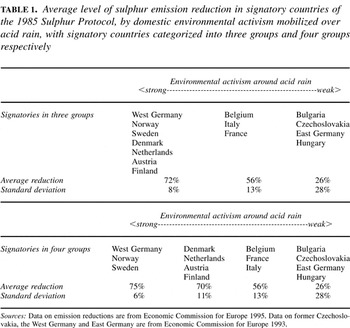
Average level of sulphur emission reduction in signatory countries of the 1985 Sulphur Protocol, by domestic environmental activism mobilized over acid rain, with signatory countries categorized into three groups and four groups respectively
 You have
Access
- 186
- Cited by