Introduction
Lichens are the dominant life forms in c. 8% of the land surface of the earth (Ahmadjian Reference Ahmadjian1995), mainly in polar regions and on mountain tops. Vegetation growing in these places experiences severe abiotic stresses such as desiccation, temperature extremes and high light intensities. Arguably, what makes lichens special, and what separates them from most other eukaryotic organisms, is their ability to tolerate extreme stresses. Lichens have been termed ‘extremophiles’, organisms that can thrive in conditions that do not permit other, less specialized organisms to survive. Understanding the physiological processes that lie behind stress injury, and how lichens tolerate environmental stress, is therefore of great importance in lichen biology. While desiccation tolerance has received a great deal of attention in recent years, given their natural habitats, many lichens also need to tolerate high light levels, not only when hydrated but also at times when metabolic activity is not possible. The aim of this review is to outline our current understanding of the effects of high light on lichens and mechanisms enabling its tolerance, with an emphasis on recent publications. We have not exhaustively reviewed all the existing literature on light stress in lichens. An additional aim is to suggest new lines of research for studying tolerance to high light in lichens, often based on recent findings in free-living relatives of lichen photobionts.
This review is dedicated to Professor Peter Crittenden, who made, and continues to make, an immensely valuable contribution to lichenology. It was Peter that helped the first author more than 35 years ago by awarding him a postdoctoral grant to work in Finnish Lapland. RB learned much during the tenure of this grant which inspired a love of arctic and boreal lichens that continues to the present day.
Acclimation and adaptations of lichens to their light environment
The concept of high light stress is closely linked to acclimation or induced tolerance, and the ability of a lichen to cope with an unfavourable light environment. Generally, stress tolerance in lichens often increases as a result of exposure to prior stress (Beckett et al. Reference Beckett, Kranner, Minibayeva and Nash2008). A lichen is then said to be acclimated (or hardened) by means of phenotypic plasticity. Acclimation can be distinguished from adaptation, which usually refers to a genetically determined level of resistance acquired by a process of selection over many generations. As will become clear in this review, adaptation and acclimation to light stress result from changes that occur at all levels of organization, from the anatomical and morphological level to the cellular, biochemical and molecular level.
Lichens display considerable plasticity in their responses to high light stress, as evidenced in their ability to display seasonal variations in photosynthetic capacity, and the ability of lichens to show ‘sun’ or ‘shade’ forms. In this, they resemble other photosynthetic organisms, which must be able to respond to rapidly changing environmental conditions to optimize their light usage, and deal with excess light (Osmond et al. Reference Osmond, Badger, Maxwell, Bjorkman and Leegood1997). Early work demonstrated that the way lichens respond to light varies throughout the year. For example, Stålfelt (Reference Stålfelt1938) showed that Evernia prunastri and Ramalina farinacea have higher rates of photosynthesis in summer than in winter. Later studies, in particular the detailed gas exchange measurements made by Prof. Ken Kershaw's group, confirmed the ability of lichens to adapt to seasonal changes in their light environment. Furthermore, changes could be replicated by exposure to light under laboratory conditions (for review see Kershaw (Reference Kershaw1985)).
In addition to seasonal changes, there is abundant evidence that members of the same species of lichen can, as for higher plants, display sun and shade forms (Piccotto & Tretiach Reference Piccotto and Tretiach2010). Lichens from shaded habitats tend to have lower light saturation and compensation points than those of sun-exposed habitats (Green et al. Reference Green, Büdel, Meyer, Zellner and Lange1997), as observed in vascular plants, and shade forms also have less cortical pigments (Dietz et al. Reference Dietz, Büdel, Lange and Bilger2000). Interestingly, other parameters, such as photosynthetic capacity and chlorophyll content which clearly differ in the sun and shade leaves of higher plants, show less clear patterns in lichens. Possibly, pigments in the fungal upper cortex provide lichen photobionts with far stronger light screening than that given by cuticles to photosynthetic cells in plant leaves. Therefore, in heavily melanized sun-exposed thalli the photobiont could still be shade-adapted (Gauslaa & Goward Reference Gauslaa and Goward2020). Furthermore, although lichen thalli superficially resemble leaves, they are small ‘organismic ecosystems’. Other than simply photosynthesizing, lichen thalli need to optimize water and nutrient absorption and carry out reproduction (Piccotto & Tretiach Reference Piccotto and Tretiach2010). Therefore, the adaptations present in sun and shade thalli represent more than adaptations to light. For example, Piccotto & Tretiach (Reference Piccotto and Tretiach2010) showed that nitrogen supply can greatly affect the photosynthetic parameters of a particular species.
While the way lichen photobionts display significant plasticity in their response to light is notable, it is clear that genetic adaptation, even within a single species, is also important. It is not always easy to distinguish phenotypic changes from genetic adaptation. Williams et al. (Reference Williams, Colesie, Ullmann, Westberg, Wedin and Büdel2017) transplanted thalli of the widespread lichen Psora decipiens between climatic zones in Europe and showed that the photobionts were unable to adapt to transplantation, and tended to die. Gene sequencing indicated that the photobionts from different populations were genetically distinct (Williams et al. Reference Williams, Colesie, Ullmann, Westberg, Wedin and Büdel2017). Such transplant experiments demonstrate that there are limits to photobiont plasticity, and the mycobiont ‘switches’ to a locally adapted photobiont when environmental challenges exceed a certain threshold.
Why is excess light absorption harmful to photosynthetic organisms?
Even in lichens adapted to high light conditions, when the maximum rate of photosynthesis (Pmax) has been reached, photosynthesis will no longer be able to use further light. In higher plants, even the hardiest individuals reach Pmax at less than full sunlight, and individual leaves on plants growing in full sun commonly experience excess light intensities (Pospíšil Reference Pospíšil2016). In fact, even under moderate light, energy transfer and electron transport in photosystem II (PSII) unavoidably lead to the production of various reactive oxygen species (ROS) (Pospíšil Reference Pospíšil2016). For example, the transfer of energy from triplet chlorophyll in the reaction centre of a photosystem (e.g. PSII) to molecular oxygen produces the highly reactive singlet oxygen (1O2). At the other end of the electron transport chain, at the acceptor side of photosystem I (PSI), electrons can be leaked to molecular oxygen, forming the superoxide anion radical (O2.−). Superoxide dismutates into hydrogen peroxide (H2O2), which feeds into many redox signalling pathways but can also be reduced by Fe2+ or Cu+ to form highly reactive hydroxyl radicals (HO.−) (Foyer Reference Foyer2018). Reactive oxygen species production greatly increases when the light absorbed exceeds that which can be utilized for carbon fixation; this will occur particularly when a plant is stressed and fixation reduced (Liu et al. Reference Liu, Lu, Hua and Last2019). There are few studies that have directly demonstrated that ROS are induced by light stress in lichen photobionts. Carniel et al. (Reference Carniel, Zanelli, Bertuzzi and Tretiach2015) used a histochemical technique based on dichlorofluorescin diacetate to show light increased ROS production in both cultured and symbiotic Trebouxia from the lichen Parmotrema perlatum recovering from desiccation stress. However, more detailed information is available from free-living algae. In Chlamydomonas reinhardtii, H2O2 production under saturating light is lowered when CO2 availability is restricted (Roach et al. Reference Roach, Na and Krieger-Liszkay2015), whereas symptoms of singlet oxygen (1O2) stress are closely associated with excess light/photo-oxidative stress (Roach et al. Reference Roach, Baur, Stöggl and Krieger-Liszkay2017). These results are consistent with results obtained from higher plants (Triantaphylidès et al. Reference Triantaphylidès, Krischke, Hoeberichts, Ksas, Gresser, Havaux, Van Breusegem and Mueller2008; Noctor et al. Reference Noctor, Mhamdi and Foyer2014). When the production of ROS, and particularly 1O2, exceeds the capacity of the plant's detoxification systems, they can react with thylakoid membranes, leading to lipid peroxidation or damage to the protein complexes of the photosynthetic apparatus, contributing to a reduction in photosynthesis in what is often termed ‘photoinhibition’ (Li et al. Reference Li, Aro and Millar2018). Strong evidence exists that photoinhibition regularly occurs in lichens in field situations. For example, Gauslaa & Solhaug (Reference Gauslaa and Solhaug2000) and Jairus et al. (Reference Jairus, Lõhmus and Lõhmus2009) both showed that lichens growing on trees with reduced canopy cover (e.g. as a result of the felling of surrounding trees) display sustained reductions in photosynthesis. Photoinhibition may occur on an annual basis in some environments. For example, Míguez et al. (Reference Míguez, Fernández-Marín, Becerril and García-Plazaola2017a) showed that lichens from subalpine environments display an annual winter photoinhibitory response. However, even under normal mild temperate conditions, continuous field measurements of photosynthesis in Lecanora muralis over several days indicated that photoinhibition is a regular occurrence (Leisner et al. Reference Leisner, Green and Lange1997).
Why are poikilohydric organisms particularly sensitive to light stress?
Poikilohydric organisms such as lichens may be particularly sensitive to high light stress for at least three reasons. First, during drying, carbon fixation often stops before photophosphorylation, increasing the ‘leakage of electrons’ to ground state oxygen and therefore stimulating ROS production (Challabathula et al. Reference Challabathula, Zhang and Bartels2018). Second, even though lichens may rapidly dry out when exposed to high light, they can suffer from light stress even when desiccated (Kershaw & MacFarlane Reference Kershaw and MacFarlane1980). In bryophytes, desiccation does not stop the transfer of excitation energy from the light-harvesting pigments to the reaction centres (Heber et al. Reference Heber, Bilger and Shuvalov2006). However, the highly quenched state of chlorophyll upon desiccation shows extremely efficient dissipation of photons, lowering 1O2 formation. Third, even if light only causes the formation of tiny amounts of ROS in desiccated thalli, normal repair processes do not take place (Buffoni Hall et al. Reference Buffoni Hall, Paulsson, Duncan, Tobin, Widell and Bornman2003). Enzyme reactions are severely restricted by ‘rubbery’ cytoplasmic states that occur at the onset of desiccation, and are totally restricted in glassy cytoplasmic states (Fernandez-Marin et al. Reference Fernandez-Marin, Kranner, San Sebastian, Artetxe, Laza, Vilas, Pritchard, Nadajaran, Miguez and Becerril2013), typically found in air-desiccated lichens during the day. Furthermore, recovery upon hydration is a key issue for poikilohydric organisms, with clear legacy effects of the duration of desiccation, which can be considered in some respects as ‘ageing’, in for example conversion rates of zeaxanthin back to violaxanthin and cellular redox states (Kranner et al. Reference Kranner, Zorn, Turk, Wornik, Beckett and Batic2003). At the other end of the spectrum, the absence of a cuticle means that sometimes a lichen thallus can become oversaturated with water. Under these conditions CO2 diffusion is very slow, reducing its fixation rate (Cowan et al. Reference Cowan, Lange and Green1992). As saturated lichens will still be absorbing light, this excess energy needs to be dissipated. The study of Leisner et al. (Reference Leisner, Green and Lange1997), involving continuous measurements of photosynthesis in Lecanora muralis, showed that thalli regularly become saturated and display a strong depression of photosynthesis under field conditions, probably as a result of the combination of low CO2 supply and photoinhibition.
Although not directly related to poikilohydry, as discussed in the Introduction, lichens often dominate in cold boreal and subpolar regions, and on the tops of mountains. As carbon fixation is an enzymatic process, low temperatures will increase the chance that more light is harvested than can be used in metabolic activity, resulting in excess PSII excitation pressure (Huner et al. Reference Huner, Öquist and Sarhan1998; Öquist & Huner Reference Öquist and Huner2003). While lichens are clearly well adapted to cold environments (e.g. Cho et al. Reference Cho, Lee, Hong and Lee2020), the specific adaptations of their photosynthetic apparatus to low temperatures remain unclear (Sahu et al. Reference Sahu, Singh, Singh, Mishra, Karakoti, Bajpai, Behera, Nayaka and Upreti2019). Further work is needed to elucidate precisely how lichens can protect themselves under contrasting environmental conditions.
Overview of tolerance mechanisms
Tolerance to high light levels in photosynthetic organisms has been reviewed many times (e.g. Derks et al. Reference Derks, Schaven and Bruce2015; Liu et al. Reference Liu, Lu, Hua and Last2019). Tolerance mechanisms can be divided into three broad categories: 1) ROS formation can be reduced by synthesizing light screening pigments or by dissipating the excess energy absorbed radiationlessly as heat; 2) ROS can be scavenged once formed; 3) ROS-induced damaged can be repaired. According to the classical model of stress resistance developed by Levitt (Reference Levitt2012), screening, dissipation and scavenging would be classed as stress avoidance, while only repair would be classed as true tolerance. However, for simplicity, in this review any mechanism that reduces the potential for high light stress on lichens will be referred to as tolerance.
Avoidance by Light Screening
The algal partner in lichens is protected against high light by screening in the upper cortex of the lichen thallus. The amount of visible light transmitted by a moist cortex ranges from c. 90% for rainforest lichens to only 45% for lichens from high light exposed sites (Dietz et al. Reference Dietz, Büdel, Lange and Bilger2000). Transmittance is highly reduced in the dry state (Ertl Reference Ertl1951). Cortical screening results from secondary compounds that absorb radiation or from the optical properties of the fungal hyphae in the cortex. Increased screening in the dry state is important because, as discussed above, lichens have less opportunity to dissipate excess energy or repair damage from excess radiation when dry. Therefore, exposure to high or medium light levels of visible radiation for long periods in the dry state may result in accumulated severe damage (Gauslaa & Solhaug Reference Gauslaa and Solhaug1996; Gauslaa et al. Reference Gauslaa, Coxson and Solhaug2012; Mafole et al. Reference Mafole, Solhaug, Minibayeva and Beckett2019b).
Lichens often contain large amounts of fungal-produced secondary compounds. More than 1050 different secondary compounds have so far been isolated and characterized (Huneck & Yoshimura Reference Huneck and Yoshimura1996; Molnar & Farkas Reference Molnar and Farkas2010). Most of these secondary compounds, particularly those that occur in the cortex, absorb UV radiation and some also absorb visible radiation. The extinction coefficients (see Huneck & Yoshimura Reference Huneck and Yoshimura1996) show that most lichen compounds absorb UV-B radiation very efficiently. The high concentration of secondary compounds that normally comprise several percent of the thallus dry mass indicates that these compounds effectively screen harmful UV-B. However, high extinction coefficients in organic solvents do not necessarily mean that the secondary compounds screen efficiently in vivo. Many secondary compounds occur as crystals outside fungal hyphae. Screening efficiency might then be less than predicted because light may pass between the crystals (McEvoy et al. Reference McEvoy, Solhaug and Gauslaa2007b; Solhaug & Gauslaa Reference Solhaug and Gauslaa2012). As most of the secondary compounds are almost insoluble in water, light transmission between crystals will also occur for lichen thalli in the moist state, and the screening efficiency in vivo might be less than what is indicated by absorbance spectra in an organic solvent. Although the absorbance spectra of secondary compounds show that they have high potential for screening radiation, other functions such as herbivore protection may be more important (reviewed by Solhaug & Gauslaa (Reference Solhaug and Gauslaa2012)). In addition, there is a trade-off between visible light protection against photoinhibition and photosynthetic efficiency under low light. The blue light-absorbing compounds parietin in Xanthoria species and vulpinic acid in Letharia vulpina protect these lichens against photoinhibition, although the quantum yield of photosynthesis is reduced (Solhaug & Gauslaa Reference Solhaug and Gauslaa1996; Phinney et al. Reference Phinney, Gauslaa and Solhaug2019).
Most secondary lichen compounds do not absorb visible light. Among the few coloured lichen compounds, the most widespread are yellow compounds that absorb blue light and can therefore protect against these wavelengths. Higher plants, algae and cyanobacteria are more photoinhibited by blue light than by red and green light (see Zavafer et al. Reference Zavafer, Chow and Cheah2015), which is probably a consequence of the action spectra of the two major processes responsible. The first process is damage to the oxygen-evolving complex of PSII, which has an action spectrum that increases steeply with decreasing wavelengths in the blue and UV region of the spectrum; the second process involves the destruction of PSII (Ohnishi et al. Reference Ohnishi, Allakhverdiev, Takahashi, Higashi, Watanabe, Nishiyama and Murata2005). The second process has an action spectrum similar to the absorbance spectrum of chlorophyll. Strong UV and blue light photoinhibition can be explained by damage to the oxygen-evolving complex of PSII (Ohnishi et al. Reference Ohnishi, Allakhverdiev, Takahashi, Higashi, Watanabe, Nishiyama and Murata2005; Zavafer et al. Reference Zavafer, Chow and Cheah2015). The dominance of yellow secondary compounds in lichens might therefore be explained by a greater need for screening against blue light-induced photoinhibition. Although not absorbing visible light, removal of atranorin from Physcia aipolia by acetone rinsing considerably reduced the reflectance of moist thalli, presumably because crystals either directly reflect light or raise reflection by preventing water from entering air spaces in the cortex (Solhaug et al. Reference Solhaug, Larsson and Gauslaa2010).
Several lichens contain melanins (reviewed by Mafole et al. (Reference Mafole, Solhaug, Minibayeva and Beckett2019a)). They may either be produced constitutively as melanins in the lower cortex such as in Parmelia species or throughout the outer cortex such in fruticose lichens such as in dark Bryoria species; alternatively, they may be induced by UV-B radiation in the upper cortex as in Lobaria pulmonaria (Solhaug et al. Reference Solhaug, Gauslaa, Nybakken and Bilger2003). Interestingly, although melanins in the upper cortex are induced by UV-B radiation, they are not necessary for UV-B protection of the photobiont because non-melanized thalli tolerate extremely high UV-B levels (Gauslaa et al. Reference Gauslaa, Alam, Lucas, Chowdhury and Solhaug2017). However, for melanins there is also a trade-off between visible light screening and photosynthetic efficiency in L. pulmonaria. High light acclimatized thalli of L. pulmonaria synthesize melanins in the upper cortex, reducing cortical transmission of photosynthetic active light (Gauslaa & Solhaug Reference Gauslaa and Solhaug2001), which may give protection against photoinhibition in high light sites (Mafole et al. Reference Mafole, Solhaug, Minibayeva and Beckett2019b). The strategy can sustain similar growth rates in lichens transplanted to sites that vary widely in forest canopy openness (Gauslaa & Goward Reference Gauslaa and Goward2020). However, the photosynthetic efficiency in low light is reduced (Mafole et al. Reference Mafole, Chiang, Solhaug and Beckett2017). Melanic Bryoria hair lichens are more resistant to photoinhibition in the dry state than the yellow usnic acid-containing species Usnea and Alectoria. This difference probably explains why Bryoria species are mainly found in the upper canopy, whereas usnic acid-containing species are more frequent in the lower canopy (Färber et al. Reference Färber, Solhaug, Esseen, Bilger and Gauslaa2014).
Melanins affect the energy budgets of lichens. For instance, the dark, melanic thalli of some hair lichens absorb more light and may even melt snow in winter, feeding the lichens with water (Coxon & Coyle Reference Coxson and Coyle2003). The thallus temperature of L. pulmonaria may be 3 °C higher in melanized than in pale thalli (McEvoy et al. Reference McEvoy, Gauslaa and Solhaug2007a). Melanic fungi are more frequent in cold areas (Gostinčar et al. Reference Gostinčar, Muggia and Grube2012) where the melanin-induced heating might represent a competitive advantage. However, melanization of the fungal partner of a lichen might be a trade-off between protection against high light photoinhibition and avoidance of high temperature damage. This might explain the lower frequency of dark melanic lichens in hot areas where heat damage can be a problem.
The cyanobacterial lichens in the genera Collema, Gonohymenia and Peltula growing in high light sites contain the yellow-brown pigment scytonemin as a screening compound (Büdel et al. Reference Büdel, Karsten and Garcia-Pichel1997). In contrast to secondary lichen compounds produced by the mycobiont discussed above, scytonemin is synthesized only by their cyanobacterial photobionts (Büdel et al. Reference Büdel, Karsten and Garcia-Pichel1997). Scytonemin is located extracellularly in the outer sheath of some cyanobacteria, and it is also found in free-living cyanobacteria (Garcia-Pichel & Castenholz Reference Garcia-Pichel and Castenholz1991). Its absorbance spectrum shows that it has high screening efficiency for UV radiation. In addition, it has high screening potential, especially for blue wavelengths of the electromagnetic spectrum (Garcia-Pichel & Castenholz Reference Garcia-Pichel and Castenholz1991) the most photoinhibitory range of visible radiation.
A frequent strategy in lichens when dry is to increase reflectance (see e.g. Gauslaa Reference Gauslaa1984) and decrease cortical transmission (Ertl Reference Ertl1951; Gauslaa & Solhaug Reference Gauslaa and Solhaug2001; McEvoy et al. Reference McEvoy, Solhaug and Gauslaa2007b). It seems likely that the absence of water between cortical hyphae will increase reflection from hyphal surfaces. This is analogous to the situation in higher plants where infiltrating leaves with water reduced the optical path of light, thereby increasing transmission (Vogelmann Reference Vogelmann1993). Therefore, hydration will reduce the reflection of the upper cortex, and at the same time light transmission will increase.
Finally, some lichens display ‘structural avoidance’ of high light by curling their thalli. The edges of L. pulmonaria thalli, for example, will curl inwards during drying, making them less susceptible to high light photoinhibition in the dry state (Barták et al. Reference Barták, Solhaug, Vráblíková and Gauslaa2006). An extreme example of structural avoidance is the vagrant lichen Xanthoparmelia hueana in the Namib Desert. In the dry state it curls, exposing only the highly melanic lower side, whereas when moistened it uncurls and exposes the green upper side (Büdel & Scheidegger Reference Büdel, Scheidegger and Nash2008).
Avoidance of ROS Formation by Regulating Light-Use Efficiency
Despite possessing a variety of light screening pigments, there are times when the amount of light that reaches the photobiont exceeds that which can be used in photosynthesis. This can be problematic because, as discussed above, excess light energy results in elevated levels of ROS produced by chlorophyll (1O2) and electron transport chains (O2.− and H2O2), thus leading to photo-oxidative damage (Roach & Krieger-Liszkay Reference Roach and Krieger-Liszkay2019). Photobionts use several processes to regulate the efficiency at which light energy is used, which are collectively referred to as non-photochemical quenching (NPQ). Estimating NPQ in lichens with chlorophyte photobionts (chlorobionts, eukaryotic algae) is relatively simple with standard chlorophyll fluorescence devices (see Kalaji et al. (Reference Kalaji, Schansker, Ladle, Goltsev, Bosa, Allakhverdiev, Brestic, Bussott, Calatayud and Dabrowski2014) for details). For cyanobacterial photobionts (cyanobionts), specialized devices using red excitation light are required. Nevertheless, it is important to keep in mind that several NPQ components can occur simultaneously (Roach & Na Reference Roach and Na2017), each affecting chlorophyll fluorescence and requiring careful interpretation of the measurements.
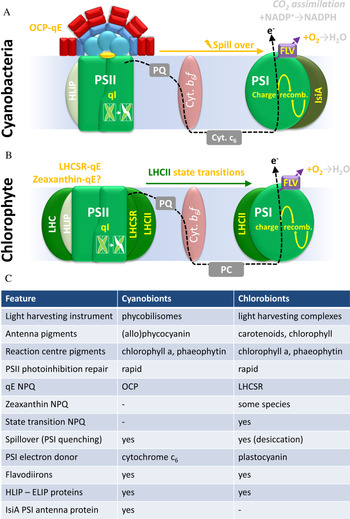
The light energy needed to excite PSII is harvested in completely different ways in cyano- and chlorobionts. Cyanobacteria possess phycobilin proteins (also called phycobilisomes) made up of light-absorbing tetrapyrrole-containing phycocyanin and allophycocyanin pigments (Fig. 1A). These have been functionally replaced in chlorobionts by light-harvesting complex (LHC) antenna proteins (Fig. 1B), which contain carotenoid and chlorophyll pigments. Safely converting excess light energy to heat is referred to as thermal dissipation, or qE (Müller et al. Reference Müller, Li and Niyogi2001). Activation of qE is rapid, and it can increase within seconds to minutes (Niyogi & Truong Reference Niyogi and Truong2013; Erickson et al. Reference Erickson, Wakao and Niyogi2015), although on transition to darkness it may take longer to reduce or ‘relax’ (Kromdijk et al. Reference Kromdijk, Głowacka, Leonelli, Gabilly, Iwai, Niyogi and Long2016). Regardless of the photobiont, lichen desiccation is associated with induction of regulated thermal dissipation of excess light, a trait found in all desiccation-tolerant organisms (Calatayud et al. Reference Calatayud, Deltoro, Barreno and del Valle-Tascon1997; Heber et al. Reference Heber, Bilger, Bligny and Lange2000; Komura et al. Reference Komura, Yamagishia, Shibata, Iwasaki and Itoha2010; Wieners et al. Reference Wieners, Mudimu and Bilger2018).
Regulation of the light use efficiency in lichen photobionts, as depicted on cross-sections of thylakoid membranes that host the various photosynthetic protein complexes. In cyanobacteria (cyanobionts) (A) stromal phycobilisomes (blue and red) assist as light harvesting antenna for PSII, with excess energy thermally dissipated (qE) by the orange carotenoid protein (OCP-qE). In contrast, in chlorophyte photobionts (eukaryotic algae, chlorobionts) (B) thylakoid membrane-embedded light-harvesting complexes (e.g. LHCII) assist in harvesting light, while other LHC-type proteins dissipate excess energy (e.g. LHCSR) upon protonation, and the xanthophyll cycle contributes to thermal dissipation in some photobionts (zeaxanthin-qE). Photoinhibition (qI) is a universal attribute of PSII, lowering charge separations in PSII, also affecting light use efficiency. Electrons released by PSII enter the photosynthetic electron transport chain (PETC, black-dashed line), first transported by plastoquinone (PQ) to the cytochrome b6f complex (Cyt. b6f). Subsequently, electrons are transported by a cytochrome (Cyt. c6) in cyanobacteria, and by plastocyanin (PC) in eukaryotes, to PSI, and eventually reduce NADP+ to NADPH. The PSI reaction centre, P700, is also an excellent quencher via charge recombination, which may facilitate removal of excess energy from PSII via ‘spill-over’, particularly when PSII and PSI come in close contact during desiccation. In cyanobacteria, IsiA proteins can assist PSI with harvesting light, while in eukaryotes LHCII can migrate between PSII and PSI, during state transitions. At the donor side of PSI, flavodiiron proteins (FLV) can take electrons and reduce O2 to H2O, averting excess reducing power. (C) Similarities and differences between the two photobionts listed. ELIP – HLIP = early high light-inducible proteins; NPQ = processes to regulate the efficiency at which light energy is used; PSI and PSII = photosystems I and II.

Considering the major structural differences between the phycobilisomes that occur in cyanobionts and the LHC of chlorobionts, it is not surprising that major differences in the regulation of light harvesting exist between these two photobionts (Fig. 1). Cyanobacteria contain an Orange Carotenoid Protein (OCP). OCP is coded by a highly conserved gene that is present in most of the known cyanobacterial genomes, including Nostoc, a common lichen photobiont (Boulay et al. Reference Boulay, Abasova, Six, Vass and Kirilovsky2008; Kerfeld et al. Reference Kerfeld, Melnicki, Sutter and Dominguez-Martin2017). Excess energy collected by phycobilisomes can be rapidly dissipated by OCP (Wilson et al. Reference Wilson, Punginelli, Gall, Bonetti, Alexandre, Routaboul, Kerfeld, van Grondelle, Robert and Kennis2008), thereby preventing excess ROS formation by photosystem reaction centres (Fig. 1A). OCP binds various carotenoids and, like zeaxanthin, can function as an antioxidant (Sedoud et al. Reference Sedoud, López-Igual, Ur Rehman, Wilson, Perreau, Boulay, Vass, Krieger-Liszkay and Kirilovsky2014). PSI reaction centres can rapidly dissipate excess energy via charge recombination, even from the PSII antenna in a process described as ‘spillover’ or ‘state transitions’ (Fig. 1A). However, due to the absence of LHC in cyanobacteria, cyanobacteria-type state transitions are mechanistically unrelated to state transitions of algae (Calzadilla et al. Reference Calzadilla, Zhan, Sétif, Lemaire, Solymosi, Battchikova, Wang and Kirilovsky2019), which involve the migration of LHC between photosystems (see below). Cyanobacteria also possess chlorophyll-binding (CAB) proteins such as IsiA, which is produced under stress conditions and transfers light energy to PSI, counteracting PSI photoinhibition (Havaux et al. Reference Havaux, Guedeney, Hagemann, Yeremenko, Matthijs and Jeanjean2005). However, the CAB/LHC proteins in cyanobacteria that are most closely related to those from eukaryotic algae are the early high light-inducible proteins (ELI/HLIP) which bind chlorophylls and assist in biogenesis of other chlorophyll-binding proteins (e.g. PSII) and assist in other light-stress-associated processes (Komenda & Sobotka Reference Komenda and Sobotka2016).
In contrast to the phycobilisomes of cyanobacteria, eukaryotic algae have LHC antenna proteins and, as a result, dissipate excess energy using strategies similar to those found in plants. The enzyme-catalyzed xanthophyll cycle responds to changing light intensities, whereby the carotenoid violaxanthin is enzymatically converted to zeaxanthin in a pH-regulated process that occurs during increases in light intensity. Zeaxanthin is involved in thermal dissipation in some but not all chlorobionts (Demmig-Adams et al. Reference Demmig-Adams, Adams, Czygan, Schreiber and Lange1990; Míguez et al. Reference Míguez, Schiefelbein, Karsten, García-Plazaola and Gustavs2017b). In such cases, an alternative role of zeaxanthin, further to antioxidant and structural roles, is the facilitation of recovery of PSII activity during rehydration (Štepigová et al. Reference Štepigová, Gauslaa, Cempirková-Vráblíková and Solhaug2008; Verhoeven et al. Reference Verhoeven, Garcia-Plazaola and Fernandez-Marin2018).
LHC proteins have diversified into several isoforms, each having a unique function in light harvesting and NPQ (Büchel Reference Büchel2015). Thus, rather than a typical light-harvesting role, the LHC-stress related (LHCSR or LHCX) proteins accumulate under stress to thermally dissipate excess energy (Peers et al. Reference Peers, Truong, Ostendorf, Busch, Elrad, Grossman, Hippler and Niyogi2009). In chlorobionts, LHCSR proteins are thought to dissipate excess energy in LHCII-PSII complexes, but LHCSR3 may also protect PSI from photoinhibition (Bergner et al. Reference Bergner, Scholz, Trompelt, Barth, Gabelein, Steinbeck, Xue, Clowez, Fucile and Goldschmidt-Clermont2015; Roach et al. Reference Roach, Na, Stöggl and Krieger-Liszkay2020). This is probably related to state transitions, an NPQ mechanism that is important in Chlamydomonas reinhardtii, for instance, for acclimation to high light, in which LHC migrates between PSII and PSI (Allorent et al. Reference Allorent, Tokutsu, Roach, Peers, Cardol, Girard-Bascou, Seigneurin-Berny, Petroutsos, Kuntz and Breyton2013). Presumably, LHCSR3 can protect PSI by quenching LHCII when it is diverting energy to PSI after transition to state II (Girolomoni et al. Reference Girolomoni, Cazzaniga, Pinnola, Perozeni, Ballottari and Bassi2019). The downstream effect of state transitions is a change in the relative activities of PSII and PSI, and therefore redox poise of the photosynthetic electron transport chain which is important for efficient photosynthesis (Rochaix Reference Rochaix2011). Although work with lichens is just beginning, measurements of slow and rapid chlorophyll fluorescence kinetics in chlorophycean photobionts strongly suggest that state transitions are highly active (Mishra et al. Reference Mishra, Hájek, Tuháčková and Barták2015; Marečková & Barták Reference Marečková and Barták2016).
There have been limited studies on the ecophysiology of NPQ. As discussed above, an inevitable consequence of being poikilohydric and growing in generally harsh environments, is that lichen photobionts frequently absorb more light energy than they can use in carbon fixation. For example, Lecanora muralis and Fulgensia fulgens were shown to be metabolically active for only a third of the year and could carry out photosynthesis for less than half that time (Lange Reference Lange2002; Lange & Green Reference Lange and Green2008). The NPQ mechanisms discussed above require moist thalli with active metabolism. When lichen thalli are exposed to high direct solar radiation for a significant time they will desiccate and remain dry and mainly metabolically inactive for most of the time exposed to high light. However, chlorophyll in the dry thalli will still absorb excess light which needs mechanisms not dependent on metabolic activity to dissipate the light in a safe way (Verhoeven et al. Reference Verhoeven, Garcia-Plazaola and Fernandez-Marin2018). These mechanisms are poorly known but at least two different quenching mechanisms in desiccated lichens have been proposed and discussed in a series of papers by Ulrich Heber (see e.g. Heber et al. Reference Heber, Bilger, Turk and Lange2010; Heber Reference Heber2012). First, there may be direct quenching in PSII, possible from charge recombination. The second, and possibly more important, quenching mechanism in dry lichen thalli is spillover from PSII to PSI (see Fig. 1) when the two photosystems come in closer contact during desiccation (Slavov et al. Reference Slavov, Reus and Holzwarth2013). The chlorophyll-containing reaction centre of PSI is an excellent quencher of excess light energy.
Studies with model algae and cyanobacteria have revealed a plethora of mechanisms required for regulation of light energy. Unfortunately, no studies appear to have been carried out on OCP-based dissipation in cyanobionts, or on specific roles for LHCSR in chlorobionts. Nonetheless, for chlorobionts two general conclusions can be drawn. First, unlike in plants, xanthophyll pigments are not always involved in thermal dissipation. Second, in general, high levels of thermal dissipation have been found in lichens that need photoprotection. For example, Calatayud et al. (Reference Calatayud, Deltoro, Barreno and del Valle-Tascon1997) showed that NPQ tends to be induced in drying thalli of Parmelina quercina. Vráblíková et al. (Reference Vráblíková, McEvoy, Solhaug, Barták and Gauslaa2006) studied seasonal variation of NPQ in Xanthoria parietina sampled in one location in Norway for one year. NPQ rapidly increased from early spring until summer solstice, suggesting a higher need for photoprotection in the season with the highest solar irradiance. As discussed in our conclusions below, further studies are needed, for example to test seasonal variations in NPQ in more species and to separate out when diurnally and seasonally each component is required.
Finally, as with any tolerance mechanism, it is important to realize that there is a ‘cost’ to photosynthetic organisms of increasing NPQ. This cost is a reduction in photosynthetic capacity (Demmig-Adams et al. Reference Demmig-Adams, Cohu, Muller and Adams2012), especially following a reduction in light intensity (Kromdijk et al. Reference Kromdijk, Głowacka, Leonelli, Gabilly, Iwai, Niyogi and Long2016), because NPQ takes a finite time to ‘relax’. The photobiont must carry out a balancing act, on the one hand efficiently utilizing every possible photon to fix carbon when light is limited, while on the other hand dissipating energy when there is an excess. Careful regulation of the transitions between these two alternative states of the photosynthetic system is essential for optimizing both productivity and safety in continuously changing environments.
Scavenging ROS by Enzymatic and Non-Enzymatic Antioxidants
Enzymatic antioxidants
When light absorption overwhelms the capacity of quenching mechanisms, ROS formation in the photosynthetic apparatus will result. In higher plants, a multi-level H2O2 removal system exists in chloroplasts, including many thiol peroxidases (e.g. peroxiredoxins), and the ascorbate-glutathione pathway (also known as the Halliwell-Asada cycle). This latter pathway effectively removes ROS from chloroplasts and other cellular locations using ascorbate, gluthione (GSH) and NADPH along with the enzymes linking them (Pandey et al. Reference Pandey, Singh, Achary and Reddy2015; Hasanuzzaman et al. Reference Hasanuzzaman, Borhannuddin Bhuyan, Anee, Parvin, Nahar, Al Mahmud and Fujita2019). In higher plant chloroplasts, superoxide dismutase (SOD) dismutates O2.− to H2O2 which is then broken down to H2O and O2 in a reaction catalyzed by chloroplastic forms of ascorbate peroxidase (APX), with most reactions occurring in the stroma. In the process, ascorbate is converted to monodehydroascorbate (MDHA), some of which disproportionates to dehydroascorbate (DHA). Ascorbate is regenerated from DHA by dehydroascorbate reductase (DHAR) in a reaction involving the oxidation of GSH to oxidized glutathione (GSSG). GSH is recovered from GSSG by glutathione reductase (GR), with NADPH providing the reducing power. Monodehydroascorbate reductase (MDHAR) reduces any MDHA that has not disproportionated directly back to ascorbate. In higher plants the effectiveness of this cycle may be limited by the sensitivity of APX to H2O2 (Kitajima Reference Kitajima2008), particularly at low ascorbate concentrations. However, APX may be less sensitive in free-living algae such as Chlamydomonas reinhardtii (Takeda et al. Reference Takeda, Ishikawa and Shigeoka1997), which also have much lower ascorbate contents than plants (Gest et al. Reference Gest, Gautier and Stevens2013). Interestingly, for higher plants, Maruta et al. (Reference Maruta, Sawa, Shigeoka and Ishikawa2016) have proposed an alternative view that the more H2O2 resistant chloroplastic peroxiredoxins protect sensitive sites. The sensitivity of APX to H2O2 allows the formation of high levels of H2O2 under stressful conditions, with H2O2 functioning as a signalling molecule.
Whether a classical chloroplast ascorbate-glutathione pathway occurs in free-living cyanobacteria and chlorophycean algae remains unclear. Apparently, some cyanobacteria possess APX-like activity and similar thiol-based redox recycling mechanisms (Tel-Or et al. Reference Tel-Or, Huflejt and Packer1985; Miyake et al. Reference Miyake, Michihata and Asada1991). Haghjou et al. (Reference Haghjou, Shariati and Smirnoff2009) studied the role of the ascorbate-glutathione pathway in the free-living green alga Dunaliella salina. While all of the components of the pathway appeared to be present, high light stress only increased the activity of SOD and the amount of ascorbate and GSH, but had little effect on the activity of the other enzymes involved in the pathway. By contrast, exposing C. reinhardtii to high light for 1 h increased APX (Roach et al. Reference Roach, Na and Krieger-Liszkay2015) and GR activity (Lin et al. Reference Lin, Rao, Lu, Chiou, Lin, Chao, Zheng, Cheng and Lee2018), and GSH content (Lin et al. Reference Lin, Rao, Lu, Chiou, Lin, Chao, Zheng, Cheng and Lee2018; Roach et al. Reference Roach, Stöggl, Baur and Kranner2018). The thorough database survey of Maruta et al. (Reference Maruta, Sawa, Shigeoka and Ishikawa2016) indicated that unicellular green algae contain only chloroplastic monofunctional APXs that lack any transmembrane domains, suggesting that they might occur in the stroma. However, the concentrations of ascorbate in green algae is typically around 100–400 μM, much lower than those found in higher plants (Gest et al. Reference Gest, Gautier and Stevens2013). For the other enzymes involved in the ascorbate-glutathione pathway, two GR isoforms have been found in C. reinhardtii, thought to be localized in the cytoplasm and chloroplast (Serrano & Llobell Reference Serrano and Llobell1993), and certainly microalgae contain SOD isoforms that are chloroplastic (Wolfe-Simon et al. Reference Wolfe-Simon, Grzebyk, Schofield and Falkowski2005). However, the location of other enzymes in the ascorbate-glutathione pathway in green algae (e.g. MDHAR and DHAR) remains unclear. However, even if in algae most detoxification occurs in the cytoplasm, it seems likely that, as in higher plants, cytosolic ROS detoxification imparts ‘cross compartment protection’ of organelles during periods of stress (Davletova et al. Reference Davletova, Rizhsky, Liang, Shengqiang, Oliver, Coutu, Shulaev, Schlauch and Mittler2005). Finally, catalase is important in algae for tolerating high H2O2 levels and may contribute to H2O2-mediated light stress signalling, although its cellular location is unclear (Michelet et al. Reference Michelet, Roach, Fischer, Bedhomme, Lemaire and Krieger-Liszkay2013). Taken together, the available data suggest that free-living algae can readily break down H2O2 produced by the photosystems, but whether they possess the classical chloroplast ascorbate-glutathione pathway found in higher plants is uncertain.
In lichens, only fragmentary information is available on the role of enzymatic antioxidants in scavenging high light-induced ROS. One reason for this it that investigations are complicated by the high ratio of fungal to algal biomass in the thallus. Lichen mycobionts certainly contain GR (Kranner Reference Kranner2002; Kranner et al. Reference Kranner, Cram, Zorn, Wornik, Yoshimura, Stabentheiner and Pfeifhofer2005) and other key enzymes such as SOD (Weissman et al. Reference Weissman, Garty and Hochman2005). While Vráblíková et al. (Reference Vráblíková, Barták and Wonisch2005) showed that high light reduces total thallus GSH levels in Umbilicaria antarctica and Lasallia pustulata, the location of the GSH (mycobiont or photobiont) was unclear. In a more detailed study, Kranner et al. (Reference Kranner, Cram, Zorn, Wornik, Yoshimura, Stabentheiner and Pfeifhofer2005) quantified GSH in an isolated photobiont of Cladonia vulcani, although the changes of GSH in the isolated symbionts in response to desiccation were clearly different to those in intact thalli. In theory, ascorbate metabolism should be easier to study, because fungi do not contain ascorbate and the associated enzymes (Smirnoff Reference Smirnoff2018). Unfortunately, we currently lack a clear overview of the ROS scavenging enzymes in lichen photobionts. Transcripts and proteins possess unique sequences depending on whether they are from the fungus or the photobiont, and therefore meta-transcriptomics/proteomics will be very useful tools in future studies, allowing photobiont- and mycobiont-specific processes to be distinguished.
Non-enzymatic antioxidants
Apart from their roles in the ascorbate-glutathione cycle, ascorbate and GSH probably act as antioxidants on their own, or as part of other protective pathways. Indirect evidence for the general importance of ascorbate comes from the observation that a depleted ascorbate level in the mutant vacuolar transporter chaperone 2 (VTC2) deficient free-living alga Chlamydomonas reinhardtii probably led to elevated NPQ values (Vidal-Meireles et al. Reference Vidal-Meireles, Tóth, Kovács, Neupert and Tóth2020). Ascorbate is also a substrate for violaxanthin de-epoxidase during the formation of zeaxanthin (Yamamoto & Higashi Reference Yamamoto and Higashi1978), although not in C. reinhardtii (Vidal-Meireles et al. Reference Vidal-Meireles, Tóth, Kovács, Neupert and Tóth2020). GSH is a powerful ROS scavenger in free-living algae; for example, Roach et al. (Reference Roach, Stöggl, Baur and Kranner2018) showed that GSH conjugates very quickly with electrophiles produced during photo-oxidative stress. While ascorbate and GSH appear highly likely to be important in scavenging light-induced ROS in photobionts, the role of other low molecular weight antioxidants remains speculative. These include a great variety of secondary metabolites with strong in vitro antioxidant activity (Kosanić et al. Reference Kosanić, Ranković and Vukojević2011; Thandhani et al. Reference Thadhani, Choudhary, Ali, Omar, Siddique and Karunaratne2011). However, as discussed above, classical lichen secondary metabolites mostly occur as crystals on the cell walls of the mycobiont (Molnar & Farkas Reference Molnar and Farkas2010) and would seem unlikely to directly scavenge ROS produced inside the photobiont. Similarly, while fungal melanins are also powerful antioxidants, they are located in the cell walls of the mycobiont (Mafole et al. Reference Mafole, Solhaug, Minibayeva and Beckett2019a). More plausibly, some photobionts such as Trentepohlia contain high concentrations of carotenoids, such as β-carotene. While carotenes can act as light screening pigments (Kharkongor & Ramanujam Reference Kharkongor and Ramanujam2015), it seems likely that in addition they behave as lipid-soluble antioxidants. Certainly, pigments from free-living algae have recently been shown to provide health benefits due to their antioxidant potential (Sathasivam & Jang-Seu Reference Sathasivam and Jang-Seu2018). Furthermore, Kranner et al. (Reference Kranner, Cram, Zorn, Wornik, Yoshimura, Stabentheiner and Pfeifhofer2005) showed that desiccation reduces β-carotene in the photobiont of Cladonia volcani, presumably as a consequence of oxidative stress. However, the ability of β-carotene to protect algal cells by scavenging light-induced ROS appears not to have been tested directly, either in free-living algae or photobionts. Future studies need to test whether tolerance to high light is correlated with the levels of molecules having the potential to scavenge ROS. For example, chloroplasts of alpine plants contain up to ten times the amount of ascorbate and glutathione found in lowland individuals of the same species (Streb et al. Reference Streb, Feierabend and Bligny1997), and it would be interesting to test whether the photobionts of high-altitude lichens also contain elevated levels of these low molecular weight antioxidants.
Repair
The PSII repair cycle
In photosynthesizing organisms, an important target for light stress is the PSII complex in which electron transport can be impaired due to damage of the catalytic Mn cluster of the water oxidizing complex (Vass et al. Reference Vass, Kós, Knoppová, Komenda and Vass2014). The D1 and D2 proteins, which form the backbone of the reaction centre complex, appear particularly sensitive and are also damaged by UV-B exposure (Li et al. Reference Li, Aro and Millar2018). Some damage appears to occur even under moderate light intensities; therefore, photosynthesizing organisms must continuously repair the damage to these proteins. The balance between damaging processes and restoration of the structural and functional integrity of PSII complexes determines the extent of the PSII damage. The ‘PSII-repair cycle’, occurring in both chloroplasts and cyanobacteria, involves proteolytic removal of the damaged D1 and D2 proteins, production of new subunits, incorporation of them into the PSII complex, re-ligation of redox cofactors and finally activation of the reaction centre (Nath et al. Reference Nath, Jajoo, Poudyal, Timilsina, Park, Aro, Nam and Lee2013; Vass et al. Reference Vass, Kós, Knoppová, Komenda and Vass2014). In free-living chlorophycean algae adapting to high light, chloroplasts can gradually acquire greater capacity for such repair (Kim et al. Reference Kim, Nemson and Melis1993). Similarly, in the algal symbionts of corals, application of an inhibitor of PSII repair, lincomycin, in combination with light stress has a greater effect on coral adapted to high rather than low light (Jeans et al. Reference Jeans, Campbell and Hoogenboom2013). Perhaps surprisingly, the PSII repair cycle appears not to have been studied in lichen photobionts. Although such a cycle is only likely to operate in hydrated lichens (Buffoni Hall et al. Reference Buffoni Hall, Paulsson, Duncan, Tobin, Widell and Bornman2003), upregulation of this cycle might help them to acclimate to high light.
Recent studies have revealed that for efficient PSII repair, photolyase-mediated repair of DNA is required (Vass et al. Reference Vass, Kós, Sass, Nagy and Vass2013). DNA is highly sensitive to high light stress, which can cause the formation of polymerase-blocking lesions in the molecule. Unrepaired DNA damage interrupts the PSII repair cycle at the step of gene transcription, and thus inhibits de novo D1 and D2 protein synthesis. Most of these DNA lesions are cyclobutane pyrimidine dimers which can be effectively reversed to native functional nucleotides by the photolyase enzymes. Photolyases and cryptochromes form an almost ubiquitous family of blue light photoreceptors involved in the repair and maintenance of DNA integrity or regulatory control (Franz et al. Reference Franz, Ignatz, Wenzel, Zielosko, Putu, Maestre-Reyna, Tsai, Yamamoto, Mittag and Essen2018). The roles of these enzymes in UV-induced signalling and DNA repair were shown in the free-living cyanobacterium Synechocystis (Vass et al. Reference Vass, Kós, Knoppová, Komenda and Vass2014) and the green alga Chlamydomonas reinhardtii (Franz et al. Reference Franz, Ignatz, Wenzel, Zielosko, Putu, Maestre-Reyna, Tsai, Yamamoto, Mittag and Essen2018). Interestingly, mutant Synechocystis that lacks the cryptochrome Syn-CRY, also displayed reduced levels of proteins involved in CO2 fixation (Vass et al. Reference Vass, Kós, Knoppová, Komenda and Vass2014). Possibly this mutant with a reduced capacity to fix CO2 has a decreased rate of PSII repair due to an enhanced accumulation of ROS and, as a result, the inhibition of synthesis of PSII proteins and especially the D1 protein.
As described above, LHC proteins are important in photoprotection in plants and algae by dissipating excess light energy. Interestingly, some of these proteins also appear to be involved in the regulation of chlorophyll synthesis and in the assembly and repair of PSII and PSI, possibly by mediating the insertion of newly synthesized pigments into the photosynthetic reaction centres (Rochaix & Bassi Reference Rochaix and Bassi2019).
The extraordinary ability of lichens to survive harsh environments that include light stress have been proved in astrobiological experiments. Within the framework of the ‘Lithopanspermia’ space experiment, the lichen Aspicilia fruticulosa from the Guadalajara steppic highlands was exposed to open space for 10 days. While the space vacuum and cosmic radiation did not impair the metabolic activity of the lichen, solar electromagnetic radiation, especially in the wavelength range between 100 and 200 nm, reduced chlorophyll a yield fluorescence. Interestingly, however, there was a complete recovery after 72 h of reactivation (Raggio et al. Reference Raggio, Pintado, Ascaso, de la Torre, de los Ríos, Wierzchos, Horneck and Sancho2011). All samples showed positive rates of net photosynthesis and dark respiration in a gas exchange experiment. The authors concluded that A. fruticulosa can repair any space-induced damage to its photosynthetic apparatus. In other experiments, the lichen Xanthoria elegans was exposed to space conditions and simulated Mars-analogue conditions for 18 months. According to the LIVE/DEAD staining results, the lichen photobiont showed an average viability rate of 71%, whereas the even more resistant lichen mycobiont showed a rate of 84% (Brandt et al. Reference Brandt, de Vera, Onofri and Ott2015). Successful recovery of photosynthetic activity if properly re-activated was demonstrated.
Given their typical habitats, lichens often experience multiple stresses from high light, UV exposure and desiccation (see above sections). Therefore, it is likely that cross-tolerance repair-based mechanisms operate to allow lichens to tolerate these stresses, similar to those found in the desert cyanobacterium Chroococcidiopsis after exposure to Mars-like UV flux and long-term desiccation. Expression analysis of the genes responsible for repair of UV-induced DNA damage, including a photolyase encoding gene (phrA), showed that repair of UV-induced DNA damage contributes to the repair of desiccation-induced damage (Mosca et al. Reference Mosca, Rothschild, Napoli, Ferré, Pietrosanto, Fagliarone, Baqué, Rabbow, Rettberg and Billi2019).
Chlorophagy
As outlined above, during photoinhibition chloroplasts become an active site of ROS formation. Recent studies have shown that autophagy, a process that functions in eukaryotes for the intracellular degradation of cytoplasmic components, participates in the removal of damaged chloroplasts (Nakamura & Izumi Reference Nakamura and Izumi2018). TEM images suggest that entire chloroplasts can be engulfed by the autophagosomes, which eventually fuse with the central vacuole where the chloroplasts are digested. Although not yet observed in lichen photobionts, chlorophagy-like breakdown of components of the chloroplast can occur in green microalgae (Gorelova et al. Reference Gorelova, Baulina, Ismagulova, Kokabi, Lobakova, Selyakh, Semenova, Chivkunova, Karpova and Scherbakov2019) and involves the target of rapamycin (TOR) kinase signalling, as in other eukaryotes and higher plants (Pérez-Pérez et al. Reference Pérez-Pérez, Couso and Crespo2017). Future studies need to test whether similar processes occur in lichen photobionts.
Conclusions
In this review, we have outlined mechanisms that enable lichens to tolerate high light stress, including mechanisms that are important in free-living relatives of lichen photobionts but that have not yet been studied in lichens. However, some potential mechanisms are unlikely to be important in lichens. First, one potential avoidance mechanism is the Mehler reaction, in which PSI reduces molecular oxygen, leading to the formation of ATP and O2.− without NADPH. The latest view is that this process saturates at relatively low irradiances and therefore, while clearly operating, probably only makes a minor contribution to avoidance (Foyer Reference Foyer2018). Second, chlororespiration, another potential avoidance mechanism, is a process in plant chloroplasts that involves a respiratory electron transport chain within the thylakoid membrane. Recent work suggests that chlororespiration is probably not important in protecting algae from continuous high light (Nawrocki et al. Reference Nawrocki, Buchert, Joliot, Rappaport, Bailleul and Wollman2019). Interestingly, however, Nawrocki et al. (Reference Nawrocki, Buchert, Joliot, Rappaport, Bailleul and Wollman2019) present data suggesting that chlororespiration may prevent photoinhibition under conditions of rapidly fluctuating light. As these conditions are exactly those that may be experienced by lichens growing under a dense canopy and deriving most of their light energy from ‘sun flecks’ (Coxson & Stevenson Reference Coxson and Stevenson2007), chlororespiration is a process worthy of more detailed study.
Research on high light stress in lichens is now entering an exciting phase. Even a cursory reading of the literature on light stress in plants and algae reveals that there is great interest in elucidating precise mechanisms of energy dissipation (Kaiser et al. Reference Kaiser, Galvis and Armbruster2019), and signalling pathways during high light stress (Gollan & Avo Reference Gollan and Aro2020). Much of this research is driven by the need to improve the performance of crop plants. Studies on lichen photobionts are just beginning but might potentially inform work on other photosynthetic organisms. For example, recent modelling studies on crop plants have suggested that slow reductions in NPQ as plants transition from high to low light may limit yield (for review see Kaiser et al. (Reference Kaiser, Galvis and Armbruster2019)). Various attempts have been made to genetically engineer faster reductions in NPQ, for example by upregulating zeaxanthin epoxidase or controlling thylakoid proton gradients. However, it may be instructive to compare NPQ in lichens that grow in environments that experience extremely rapid fluctuations of light, for example ‘sun-fleck’ species, with those that grow in habitats with more stable light conditions. Potentially, sun-fleck species might display more rapid relaxation of NPQ. Understanding the mechanisms whereby this occurs might help studies aimed at generating more efficient crop plants.
At a broader scale, ecophysiological observations reported in the older literature can now be investigated at a more biochemical level. For example, Kershaw & MacFarlane (Reference Kershaw and MacFarlane1980) reported that populations of Peltigera aphthosa collected from the dense shade of spruce are extremely sensitive to quite modest levels of light, while populations collected from open habitats are much more tolerant. It should now be possible to explain whether screening, energy dissipation, ROS scavenging or repair are responsible for the greater tolerance of a population. Future work will benefit from modern molecular biological techniques (e.g. meta-transcriptomics) that can clearly identify changes in activity of the genes of the photobiont separately from those of the mycobiont. Furthermore, it will be possible to test the relative importance of these strategies in different types of lichens growing in diverse habitats. For example, it could be predicted that the adaptations found in Lobaria pulmonaria, which grows in habitats where the maximum light level is c. 100 μmol m−2 s−1 and is often less (Gauslaa & Solhaug Reference Gauslaa and Solhaug2000), will be different from those in lichens that form desert soil crust communities. More information is needed about the ability of lichens to ‘harden’ to changing levels of light stress (i.e. to display phenotypic plasticity). It could be predicted that high plasticity might occur in lichens that grow in habitats with regular changes in light, such as temperate corticolous lichens subjected to regular seasonal changes in solar radiation and canopy cover. By comparison, lichens growing in habitats with much less temporal variation in light, such as those from exposed sites in sub-tropical or tropical areas, could be predicted to display less ability to harden.
Finally, it is worth qualifying our suggestions, made throughout this review, that future studies on light stress in lichens will benefit from the results of studies using other photosynthetic organisms, particularly free-living algae and cyanobacteria. It is important to remember that photobionts display higher stress tolerance when part of a functioning lichen thallus than when grown as isolated cultures (Kranner et al. Reference Kranner, Cram, Zorn, Wornik, Yoshimura, Stabentheiner and Pfeifhofer2005), although the reasons for this increased tolerance remain unclear. Future work will need to address exactly how symbiosis influences tolerance to high light in photobionts. Intriguingly, in a completely different symbiosis, photosynthetic sea slugs have been shown to induce protective changes to the light reactions of the chloroplasts they steal from algae (Havurinne & Tyystjärvi Reference Havurinne and Tyystjärvi2020). Conversely, lichen photobionts may be subjected to stresses absent in free-living algae. For example, they may have an increased sensitivity to photoinhibition as a lichen thallus dries slowly (Calatayud et al. Reference Calatayud, Deltoro, Barreno and del Valle-Tascon1997), and paradoxically also when a thallus is oversaturated as a result of limited diffusion of CO2. Lichens are symbiotic organisms and their photobionts probably possess unique adaptations to high light stress.
Acknowledgements
RB thanks the Russian Government Program of Competitive Growth of Kazan Federal University for partial financial support. FM thanks the Russian Science Foundation (grant no. 18-14-00198) and the Russian government assignment of FRC Kazan Scientific Center of RAS for financial support. TR thanks the NRF and the OeAD (project ZA 14/2019) for funding for a bilateral agreement between Austria and South Africa. All the authors are grateful to Yngvar Gauslaa for numerous useful discussions over many years, and valuable comments on the present manuscript.
Author ORCIDs
Richard Peter Beckett, 0000-0002-0530-4244; Farida Minibayeva, 0000-0003-0827-181X; Knut Asbjørn Solhaug, 0000-0003-3368-5205; Thomas Roach, 0000-0002-0259-0468.