Introduction
Which union strategy might challenge neoliberal regimes and foster a shift toward a more pro-labor regime? Over the past decade and a half, labor revitalization scholarship has focused on and prescribed social movement unionism (SMU) as the single most important repertoire of labor for challenging neoliberal globalization. Many scholars of North American labor argued early and convincingly that unions there that invested in this citizen rights-based repertoire succeeded in revitalizing labor (Moody, Reference Moody1998; Dreiling, Reference Dreiling2001; Turner et al., Reference Turner, Katz and Hurd2001). Interest in SMU quickly spread across the Atlantic, where it became the focus of institutionalist scholars of labor (Frege and Kelly, Reference Frege and Kelly2004), and fit well with the fast (re-)emerging New Social Movement paradigm that studied grassroots mobilization against neoliberal globalization (della Porta, Reference della Porta2005, Reference della Porta2006). But what is frequently forgotten in these literatures is that this citizen repertoire of labor was first theoretically elaborated in Apartheid South Africa, where activist-scholars conceived of a dialectic between SMU and the strategy of political unionism (Phone Interview, Rob Lambert, Australia, 2000; Lambert, Reference Lambert2002). This attention to political unionism faded as it passed to the United States, where the historical absence of a labor party in the US party system conditioned the neglect. And it has faded in many discussions of labor and mass mobilization in the neoliberal age – an age, moreover, that is presumed to mark an epochal breach in world history.
This paper’s historically based look at Italian labor repertoires gives pause to the singular focus on the citizen repertoire and to the neglect of political unionism; but it also gives pause to the confinement of the neoliberal putsch to the post-Washington Consensus age. It shows instead that both the neoliberal polity and the citizen repertoire relate to a US-led hegemonic order, and that a historically proven path to resisting that order has been political unionism. Historically, the citizen repertoire has helped labor survive a neoliberal order, but political unionism has played a central role in changing it.
This study builds on the ‘regime–repertoire’ hypothesis, which combined the tools of the Contentious Politics program with the typological approaches of Varieties of Capitalism and the Welfare Capitalism literature (Gentile and Tarrow, Reference Gentile and Tarrow2009; Gentile, Reference Gentile2011). According to that hypothesis, in this age of neoliberal globalization one can still speak of a variety of labor repertoires, that is, of repertoires that vary by regime of capitalism: From the perspective of labor, there are corporatist regimes, such as Sweden and Germany, where labor still relies heavily on its labor repertoire, featuring performances such as the strike, the go-slow, and stop-work meetings. This repertoire is afforded to labor by legal institutions and political exchange processes that ‘categorize’ labor as a member of the polity. And there are neoliberal regimes, such as the United States, post-Thatcher Britain and post-Howard Australia. Here, labor’s legal rights domain and political exchange rights are severely curtailed, ‘decategorizing’ it as a member of the polity. To fight its battles and engage in solidarity actions, labor in neoliberal regimes typically draws upon the legal domain that defines citizen rights and it engages in performances of collective action that are characteristic of the social movement repertoire – that is, the citizen repertoire – performances such as demonstrations and community assemblies in place of the more overt industrial picket.
Selecting a country from southern Europe, a region that the Varieties of Capitalism literature tends to eschew for its ‘messiness’, this study’s deviant case analysis (George and Bennett, Reference George and Bennett2005; Bennett and Elman, Reference Bennett and Elman2007) of Italy at first challenges the regime–repertoire hypothesis, noting that Italian unions utilize both a citizen and a labor repertoire; and it qualifies the thesis by showing that Italian ‘deviance’ was born of the historical sequence of a post-WWII neoliberal regime followed by a labor-categorizing corporatist regime established between the Autunno Caldo and the 1990s collapse of the post-war party order, during which interim a labor repertoire was layered into a citizen repertoire. But ultimately this deviant case analysis extends the regime–repertoire thesis: First, when seeking to explain the emergence of a neoliberal regime in Italy decades before the Washington Consensus, it finds its way into territory too often ignored by students of labor contention and Varieties of Capitalism: the US hegemonic origins of OECD regimes of capitalism; that hegemonic order’s bias toward the neoliberal variant; that variant’s characteristic citizen repertoire and weak parties of labor; and non-US unions’ political unionism path away from a neoliberal order.
It is hard to ignore the similitude of, on one hand, the neoliberal regime of capitalism, its signature citizen repertoire, and its labor-weak party system, with, on the other, the longstanding neoliberal regime, citizen repertoire, and labor-partyless system of the American hegemon itself. As world systems theorists and Gramscian international political economists have long argued, hegemonic states typically project values and institutions that conform with their own self-image, and thus each hegemon creates a ‘new modernity’ from such projections (Rupert, Reference Rupert1995; Taylor, Reference Taylor2002; Wallerstein, Reference Wallerstein2002). But modernist policies of ‘transfer’ rarely produce a carbon copy of the original. Thus, by blowing some dust off classics of labor studies and by delving into the past two decades of archive-scouring Italian labor history, we locate the agents of hegemonic neoliberal projection during its first, post-war wave – most of them non-elite actors and connected to the American Federation of Labor (AFL); we follow the dynamics of those actors’ interactions; we identify the main objects of their intervention, most notably, the party system and the union movement; and we note the intended and unintended outcomes of their actions on parties and unions outside the United States.
Most importantly, the study then asks how Italy underwent regime change from its post-war neoliberal political order and to a more labor-categorizing corporatist order 40 years later. It notes that the hegemonic bloc’s politics of transfer weakened Italy’s parties of labor but did not destroy them. And its politics split the Italian labor movement and converted one element of it to ‘(party-)free trade unionism’, but, over the longer term, its self-reflecting anti-party norm failed to take root in Italy. For whereas all Italian union confederations turned to the citizen repertoire to survive the neoliberal regime, all of them, including the AFL’s local convert, also pursued political unionism in order to change that regime. Through the anti-hegemonic strategy of political unionism, Italian unions achieved stronger workplace representation, new labor-categorizing laws and a place at the table of political bargaining.
Finally, we will utilize our insights from Italy to suggest that all OECD party systems and union movements were to greater and lesser degrees objects of hegemonic projection. Whereas, projection produced labor’s decategorization in the more challenging south of Europe (with strong communist parties), throughout the OECD hegemonic projection, nevertheless, contributed to a weakening of unions’ workplace mobilizing power. And while all OECD union confederations rhetorically accepted the norm of free trade unionism, all rejected it in practice, relying instead on political unionism to increase their power. But caveat emptor! All OECD union movements except those in the United States, where an exceptional labor-partyless system precluded that path to power.
If political unionism was the core strategy that challenged the first wave of hegemonic projection, and if the survival or reinvention of labor-related parties permitted unions the path to regime change toward strong labor-categorizing regimes, it follows that political unionism has been erroneously neglected by many students of labor revitalization. The concluding section of this paper will thus reconsider the question of OECD labor revitalization in the post-Washington Consensus era. Noting that the emergence of the ‘cartel party’ (Katz, Reference Katz1990; Katz and Mair, Reference Katz and Mair1995) distinguishes the second wave of neoliberal projection from the first, we will suggest that, rather than shifting whole stock to the citizen arena, labor movements that have experienced neoliberal regime change might direct some of their efforts and their new citizen repertoire to the task of recapturing parties of labor or to creating new ones – or risk long-term US-style labor decategorization.
The regime–repertoire hypothesis
In a study designed to test the race to the bottom thesis, Gentile and Tarrow (Reference Gentile and Tarrow2009) argued that, in the post-Washington Consensus age of neoliberal globalization, variety is still a salient feature of the world of capitalist states, and repertoires are still nationally embedded and vary by regime type: In corporatist Sweden and Germany, labor still relies upon a labor repertoire, involving classic performances such as the strike, the industrial boycott, the go-slow, the stop-work meeting, and alliances with other unions, and resorts to labor courts and tribunals for dispute resolution. By contrast, in neoliberal capitalist regimes such as the United States, labor relies heavily on the citizen repertoire, which typically involves performances from the social movement repertoire, such as the demonstration, the community assembly (in place of industrial pickets), alliances with community groups and with other unionists acting collectively ‘as citizens’, and resorts to civil legal institutions for ultimate protection. Deprived of a strong legal rights domain that defines worker and union rights, and of routine political exchange, the citizen realm is the only one that offers workers and unionists in neoliberal regimes the political and institutional opportunity to defend themselves.
In an attempt to move beyond a static model, however, Gentile and Tarrow (Reference Gentile and Tarrow2009) also predicted that, when faced with regime change from a corporatist regime to a neoliberal one, the unions that ‘hat-switched’ from the category and rights domain of labor to the category and rights domain of citizen, and who thus deployed a citizen repertoire and utilized their citizen rights in civil courts, were more likely to survive as organizations. This was because to continue to utilize the labor repertoire in that now labor decategorized order meant that unions would run a high risk of crippling penalties and deregistration under new anti-union laws that were designed to enforce strike bans. The testing of this hypothesis on two notable cases of regime change from a corporatist regime to a neoliberal regime – 1980s Britain and 1990s Australia – supported the claim.
That regime/repertoire thesis was formulated on cases selected from OECD regimes that feature in Nordic Europe, northern Europe, the Antipodes, and North America – from countries that Varieties of Capitalism classifies as Coordinated Market Economies or as Liberal Market Economies (Hall and Soskice, Reference Hall and Soskice2001). What happens when we look at southern Europe? Long ignored by this typological approach to the study of capitalism, the implication has been that southern Europe has little to offer general theory.Footnote 1 Selecting Italy from the region, we will first demonstrate that Italian unions utilize both a labor and a citizen repertoire and ask, to what can we attribute this apparent dualism?
Italian labor’s two repertoiresFootnote 2
The Berlusconi years provide us with various types of contentious episodes to peruse, including clearly worker-related episodes and politically more embracing episodes. In both types, Italian labor has combined the labor repertoire with the citizen repertoire and alliances with citizens: In 2002, the Berlusconi-led government moved to abolish Articolo 18 of the Statuto dei Lavoratori, the job protection clause that Italian workers had prized from the government and employers in 1970. To protest that labor-threatening proposal, Italy’s union confederations organized industry-wide strikes and a general strike. And they organized a mass rally of citizens and workers, filling Rome’s Circo Massimo to the tune of 2.7 million people.Footnote 3 In 2003, to protest the same government’s support for the invasion of Iraq and to prevent the transportation of arms between the US military base at Camp Darby and the port of Livorno, unionized workers in Tuscany conducted go-slows, declared strikes, and occupied the port. And they joined anti-war rallies and coordinated their worker protest with No Global-turned-anti-war activists. We will turn to this last episode in detail.
In early 2003, the Berlusconi government enthusiastically joined US president George Bush’s War on Terror and push to invade Iraq, allowing the transportation of arms between Camp Darby and the port of Livorno, and the militarization of that civilian port. Before any hint of the port’s pending militarization, Federazione Italiana Lavoratori Trasporti-Confederazione General Italiana del Lavoro (FILT-CGIL’s) train drivers in Tuscany delayed passenger trains, behind which were trains carrying arms, and they did so by cooperating with no less than disobbedienti activists who had been chaining themselves to rail tracks in an action they called ‘Trainstopping’. Once the arms reached the port and military personnel were dispatched to load and unload, the FILT-CGIL port workers of Livorno’s Compagnia Portuale declared a strike and occupied the port. They too came to coordinate their protest with the disobbedienti. Port-worker leader Maurizio Colombai and members of his port-worker cooperative met with disobbedienti activists, and the two groups decided on a division of territory and protest labor – the disobbedienti would continue the demonstration and disruptive actions outside the port gates in solidarity with the striking port workers who refused to leave ‘their’ port to ‘invaders’.
One might argue that the direct threat posed to Livorno’s port workers and Tuscany’s citizens constituted a particularly strong incentive to engage in worker–citizen alliances and mixed repertoires, and that the Livorno port workers’ ‘red history’ predisposed them to such actions. But a comparative overview by region and industry suggests more. For anti-war demonstrations in Italy spread rapidly in 2003 – demonstrations at which not only anti-war activists participated, but also contingents of union leaders and activists with clearly marked banners. Moreover, these contingents ranged right across the ideological gamut – from the ‘left’ unions of the main confederations, such as the metalworker unions Federazione Impiegati Operai Metallurgici-Confederazione General Italiana del Lavoro and Federazione Italiana Metalmeccanici-Confederazione Italiana Sindacato Lavoratori (FIM-CISL), to the transport workers of FILT-CGIL and Federazione Italiana Trasporti-Confederazione Italiana Sindacato Lavoratori on the ‘right’. But nor did unions stop at the citizen-based performance, the demonstration: on 21 March 2003, a day after the first bombs fell on Iraq, all three Italian confederations, CGIL, CISL, and Unione Italiana del Lavoro (UIL), declared a 2-hour general strike.
The year ended with Italy’s three confederations declaring that the next May Day march would be held in Assisi, the legend-laden town of the 12th century mendicant and pacifist St. Francis. On that May Day, the peace movement coordinating organization, PACE, joined the unionists’ march.
Was that dual repertoire and cross-class alliance contingent on the Berlusconi era? The year 2004 was not the first time that PACE had joined the unions’ May Day. The alliance had long been customary in Italy, so customary that PACE’s national office was and is still located in the Rome headquarters of the CGIL. As specialized studies (cf. Hellman, Reference Hellman1975, Reference Hellman1988; Tarrow, Reference Tarrow1975, Reference Tarrow1989; Crouch and Pizzorno, Reference Crouch and Pizzorno1978a, Reference Crouch and Pizzornob; Lange et al., Reference Lange, Ross and Vannicelli1982; Golden, Reference Golden1988a, Reference Goldenb; Abse, Reference Abse1994) of the past decades testify, mixed repertoires and broad social alliances have been the order of the day since the Italian union movement’s Autunno Caldo that began in 1967.
Historical ethnography suggests that, during that ‘critical juncture’ (Capoccia and Kelemen, Reference Capoccia and Kelemen2007), a labor repertoire was ‘layered’ (Thelen, Reference Thelen2009; Mahoney and Thelen, Reference Mahoney and Thelen2010) into a pre-existing citizen repertoire. In their classic essay for the 1978 Crouch and Pizzorno volumes (Crouch and Pizzorno, Reference Crouch and Pizzorno1978a, Reference Crouch and Pizzornob), and long before Charles Tilly had coined the analytically useful terms, ‘repertoire’ and ‘performance’ (Tilly, Reference Tilly2008), Regalia, Regini, and Reyneri recorded of their team of ten’s four years of participant observation:
When strikes failed during the fifties and mid-sixties, the unions substituted other forms of action: tents and sit-ins in public squares, urban demonstrations etc. They had a double purpose: to give the impression that the conflict was still continuing, and to exert pressure on the political system so that it should intervene in favour of the weaker side, that of the workers.
After 1968 the centre of industrial conflict moved inside the factories; however, the various forms of external action did not disappear, but were added to the internal ones, assuming different functions in the course of 1968-75 (Regalia et al., Reference Regalia, Regini and Reyneri1978: 117).
Translated into Tillyan terms, the repertoire used by Italian labor between the 1950s and the Autunno Caldo, featuring performances such as ‘tents and sit-ins in public squares’ and ‘urban demonstrations’ (Regalia et al., Reference Regalia, Regini and Reyneri1978: 117), was a citizen repertoire. Following the explosion of wildcat strikes in the late 1960s and union leaders’ decision to ride them, a worker repertoire was reclaimed and expanded by new performances, such as ‘the sciopero a singhiozzo’, ‘the sciopero bianco’, and ‘the sciopero a scacchiera’ Footnote 4 (cf. Tarrow, Reference Tarrow1989).
That direct union engagement with the rank and file, however, was historical. Since the 1947 ousting of Left parties from Italy’s post-war unity government, unions had been effectively ostracized from the workplace, leaving workers there exposed to repressive rhythms of work, easy dismissal, and the daily dictates of their employers. The rights to strike, to organize, and to workplace representation, though enshrined in the post-war Republic’s Constitution, were effectively nullified by the Christian Democrat’s landslide 1948 electoral victory. In addition, subsequent Christian Democratic-led governments refused to translate the new Constitution’s provisions for union recognition into operable law, depriving workers of a collective vehicle through which to organize and thus to exercise their constitutional right to strike (Regalia et al., Reference Regalia, Regini and Reyneri1978).
Sealing this 1948 order, as LaPalombara’s study of Italian interest groups showed long ago, was a policy formation process in which the Italian Communist Party (PCI)-associated CGIL was declared ‘persona’ non grata (LaPalombara, Reference LaPalombara1964). Even the Democrazia Cristiana (DC)-associated CISL struggled to achieve meaningful input, subordinated as it was to the DC’s broad spectrum of interest groups and to the ever watchful eye of the Vatican-created Associazioni Cristiane Lavoratori Italiani (ACLI). In contrast to labor, LaPalombara showed, employers had routine access to this party-government and clientelist relations with the government’s ministries.
In short, from 1948 up until 1970, the Italian polity’s pattern of power alignments bore all the features of a neoliberal capitalist regime: institutionalized civil and political rights for citizens; strong ties between organized capital and the government bureaucracy; and the effective decategorization of organized labor, excluded as it was from processes of political exchange and from legal-institutional recognition.
By the late 1960s, following the entrance of left parties into DC-led governments as junior partners, the establishment within the DC of a strong pro-labor faction, and the occupation of key labor-related ministries by these pro-labor elements of government, insurgent labor found tribunes in the halls of power who could transform its claims into meaningful legal institutions. Drafted by Socialist lawyer Gino Giugni, and passed by a left-leaning coalition government, the Statuto dei Lavoratori of 1970 laid the legal-institutional structure for labor’s categorization and labor repertoire when it provided for workplace structures of union representation, and thus a vehicle for mobilizing workers’ constitutional right to strike. But the equally essential routine political exchange that consolidates labor’s categorization did not ensue immediately, due to the heavily internalized Cold War order, the imperative of which was the exclusion of the PCI from government, and, alongside it, the largest union confederation, CGIL.
The late 1980s/early 1990s end of the Cold War and collapse of the old party system opened the door to labor’s political categorization. With Carlo Azeglio Ciampi’s left-leaning government followed by a ‘technical government’ that was supported by the left; with an employer association that had been discredited by the Mani Pulite revelations of political corruption; and with no Cold War constraints on inter-confederal unity-in-action, labor achieved a path-breaking social pact, such as to convert and consolidate an institutionally more labor-categorizing regime into a New Competitive Corporatist regime, complete with processes of routine political exchange (cf. Salvati, Reference Salvati1995, Reference Salvati2000; Regini and Regalia, Reference Regini and Regalia1997; Rhodes, Reference Rhodes2001, Reference Rhodes2003; Regalia and Regini, Reference Regalia and Regini2004). To be sure, this new corporatism proved less stable than other forms north of the Alps, given its attendant productivity compromises by organized labor and electoral swings toward Berlusconi-led governments (Molina and Rhodes, Reference Molina and Rhodes2007; Erne, Reference Erne2008; Regini and Colombo, Reference Regini and Colombo2011). Italy’s New Competitive Corporatist regime, nevertheless, saw labor backed by a bank of two repertoires, deployed alone or in tandem as it saw fit.
But how might we explain the establishment of a labor-decategorizing Italian polity of the neoliberal type outside the United States well before the Washington Consensus, and at a time when northern Europe was in the throes of Keynesianism, constructing citizen- and labor-categorizing corporatist regimes? What were the processes involved and who were the chief agents?
Hegemonic intervention in Italy’s post-WWII political system
Our attention turns to the critical post-WWII juncture that saw the Italian Resistance defeat fascism and establish a unity government and democratic parliamentary system and, indeed, a strong realm of labor rights when the founders of the First Republic drafted a constitution that declared Italy ‘una repubblica fondata sul lavoro’. But, within three years, parties of labor were ousted from the governing coalition; the unitary union movement fragmented; society polarized; and capital found greater political access to governments, all from whence a more labor-decategorizing regime emerged.
The close-up process tracing below suggests that two large and interrelated processes, based on US-led international intervention, were pivotal to the creation of a post-war neoliberal polity in Italy: Political boundary drawing centered on the party-political system and aimed at excluding the PCI from the party-government system. This form of international intervention interacted with domestic politics: conservative domestic leaders perceived or came to perceive their interests as best served by the fast forming pro-hegemonic international bloc. That common perception was boosted when international actors offered local leaders all manner of incentives – financial, electoral, organizational, training, diplomatic brokerage, publicity tours, and certification by international organizations – and, backing up such mechanisms of cooptation was the threat of withdrawing support if particular policies were not adopted. Political boundary drawing had direct and intended negative consequences for communist parties, but it also had less intended negative consequences for other parties of labor, such as socialist and social democratic parties.
Second was a process of self-image projection onto the union movements. International actors split Italy’s unitary union confederations and created an anti-communist one modeled on US-inspired ‘free trade unionism’. The aim of that intervening bloc of actors was to bring the local convert into the International Confederation of Free Trade Unions (ICFTU) that this same bloc was busy creating in opposition to the World Federation of Trade Unions. In these actors’ efforts to project the US image of unionism, they not only promoted a split in world labor, but also the creation of the insignia of Italian unionism to this day, that is, ideologically divided union confederations.
The core of the hegemonic bloc consisted of US government elites, and, even before most elites, US-rooted immigrant labor leaders, the AFL leadership,Footnote 5 and leaders of the International Transport Workers Federation (ITF). No two of these had perfectly coterminous aims, and some were often in competition with each other; but each evolved toward pro-US Cold War preferences and here found grounds for cooperation.
Re-drawing the boundaries of Italy’s parties of laborFootnote 6
Immediately following the Allies’ 1943 landings in Sicily and advance to Rome, US policy’s main priorities for Italy were stabilization and economic relief (Miller, Reference Miller1986). By contrast, the unionists and immigrant networks based in New York in David Dubinsky’s International Ladies Garment Workers Union (ILGWU) were more concerned with shaping Italy’s post-war party and union systems. Largely composed of immigrant Jewish and Italian workers, the ILGWU had long been the exception to the AFL rule of international isolationism (Parmet, Reference Parmet2005). The ILGWU had nearly two decades of experience in raising funds, dispatching aid, organizing speaking tours, and lobbying the US government for anti-Nazi and anti-fascist causes. Chief among the Italian-American immigrants was Luigi Antonini, president of ILGWU Local 89 and founder of the Italian-American Labor Council (IALC). Over the long period of Italian Fascism, the IALC had assisted anti-fascist exiles, including leading lights of the Italian Socialist Party (PSI): Giuseppe Modigliani, Ignazio Silone, Giuseppe Saragat, and Pietro Nenni. Its longer term aim was to contribute to Italy’s political reconstruction and to the revitalization of its labor movement.
Reconstruction and revitalization, however, were neither ideologically neutral, nor necessarily based on the preferences of the local Italian population and Resistance movement. The IALC promoted anti-communist preferences that were shaped by bitter struggles between socialists and communists on US soil, namely in the ILGWU during the 1920s and 1930s.Footnote 7 Antonini, like Dubinsky, were among the socialist/social democratic victors of those battles.Footnote 8 Now politically and ideologically re-rooted in American battles of labor, such immigrant leaders had little sympathy for Italy’s popular front politics and post-war unity governments.
As the war drew to a close, the IALC and the ILGWU worked solidly to reinforce the right and center factions of the PSI. Represented by Modigliani, Silone, and Saragat, these factions questioned the wisdom of Nenni’s continued commitment to the wartime PCI–PSI unity pact, and worked toward changing the balance of power within the PSI so as to cancel the agreement. Following the pact’s renewal in October 1946, however, and with an eye on his American supporters’ resources, Giuseppe Saragat split away from the PSI and in January 1947 established the Partito Socialista dei Lavoratori Italiani (PSLI). For its profound dependence on the money, tours, and publicity provided by the IALC and ILGWU, and, within 12 months, by the US government, the PSLI would soon become known in Italy as ‘the American party’. This was to be the first of two major splits of the PSI, both driven heavily by transnational relations and resources.
Up until this point, Washington and its Rome embassy had been relatively distant from the PSI’s upheaval (Miller, Reference Miller1986). But Washington’s historic turn to the policy of containment in mid-1946 and the Republicans’ victory at the late 1946 congressional elections marked a major turn that was to prove decisive for the PSI’s demise and for the reshaping of the Italian party system as a whole. Washington’s turn marked an increasing attention to the Catholic end of the unity government as its potential Cold War partner in a strategically vital country of Europe and the Mediterranean.
Alcide de Gasperi, leader and founder of DC and head of the unity government, made his first visit to Washington in January 1947, seeking aid and credits. The response was limited. But the announcement of the Truman Doctrine on 12 March signaled the possibility of substantial support in exchange for a strong anti-communist stance, prompting de Gasperi to state to Truman in a personal message of 28 April 1947 that he was willing to broaden his coalition to include the newly formed PSLI and the Republicans and thus, it was implied, to dilute the power of the PCI within the unity government. De Gasperi repeated this to US Ambassador James C. Dunn at a meeting of 5 May, but to little avail (Miller, Reference Miller1986: 228). The ambassador, instead, signaled that future aid was contingent on the PCI’s ousting from the coalition. On 12 May 1947, de Gasperi resigned from the coalition and formed a minority government, but, having failed to attract the PSLI and Republicans to his side, he had to rely on votes from neo-Fascists (Miller, Reference Miller1986: 229). Though embarrassed by this, Washington, nevertheless, released aid and credits, and promised more after the June 1947 announcement of the Marshall Plan.
Once the unity government was brought down, and with critical national elections set for April 1948, Antonini deployed his own substantial resources to encouraging the PSLI and Republicans to join the DC-led government. To Washington’s satisfaction, they did at the end of 1947, but by then the Vatican had entered the fray to turn Washington’s favors further to the right. With Italy in the midst of economic crisis, the Vatican conveyed a fear of communist insurrection to Washington that resonated strongly with the new National Security Council. Meetings took place between US Embassy staff, the Vatican, and, most crucially, the head of Catholic Action’s Comitati Civici, Luigi Gedda. With an entire social network at his disposal and a keen Vatican behind him, Gedda convinced the Americans of his ability to organize widespread psychological operations in order to steer a decisive electoral win for the DC (del Pero, Reference del Pero2001).
Thus began the United States’ first major European experiment in political boundary drawing that saw promises of massive injections of aid for the reconstruction of a war-torn country now in economic crisis; a public relations campaign that left the electorate with no doubt that the aid was conditional on the DC’s victory; and, as the campaign’s cornerstone, an alliance between Luigi Gedda and James Jesus Angleton’s US counter intelligence unit that enabled the mobilization of thousands of parish priests and local Catholic Action cells for the DC’s electoral campaign. Priests from their pulpits and Catholic Action activists in communities right down the peninsular warned Italians of more poverty in this life and fire and brimstone in the next should the PCI enter government. And, in an effort to neutralize the extensive grassroots networks of PCI cadres, they collected information, parish by parish, on the personal lifestyles of declared or suspected communists that was used to discredit them both morally and politically (Confidential correspondence to author, 2011).
For its part the National Security Council issued a series of directives that not only approved greater aid to the de Gasperi government, but also plans for military intervention should his victory provoke a communist uprising; plans to secure British and French imprimatur for de Gasperi in foreign diplomatic circles; covert funding for the DC and PSLI; and a public relations campaign starring DC government officials, high profile American citizens, Italian-Americans and ambassadorial staff.
The DC’s resounding and never-to-be repeated victory – 48% of the vote and an absolute parliamentary majority – hollowed out Italy’s political spectrum:
The combined vote of the Popular Front was 31 percent. Due to Italy’s preferential voting system, the PCI increased its representation from 104 to 141 deputies, while the Socialists dropped from 115 seats to 42. The Social Democrats [PSLI] fell from 52 to 33 seats (Miller, Reference Miller1986: 249).
For our purposes, hegemonic intervention helped build and legitimize the conservative party, and left Italy with no party of labor with the potential to win government in the foreseeable future: the PCI was excluded by hegemonic dictum; the PSI was electorally devastated for more than a decade to come; and the tiny PSLI was now destined to play junior partner in DC-led governments. Under such anti-labor conditions, the Italian Constitution’s labor-categorizing clauses could not be converted into operable law, much less would the rump of organized labor be offered the opportunity to engage in political exchange. By contrast, capital could build the strong clientele relations with the government bureaucracy that LaPalombara observed long ago. The resulting polity led by Catholic social forces was in effect a labor-decategorizing polity of the neoliberal variety.
Projecting ‘free trade unionism’ onto Italian labor
Elite intervention in the labor movement was also a step behind non-elite involvement, but wartime conditions provided opportunities for network building between elites and non-elites. The labor desk of the wartime intelligence service, the Office of Strategic Services (OSS), in tandem with officers of the ITF and the ITF’s network of socialist Italian and German exiles, followed Allied troops up the peninsula so as to begin organizing railway workers in southern Italy.Footnote 9 Within the labor division of the OSS in its London and North African bases were many American unionists and future AFL foreign policy makers, such as Irving Brown. This wartime experience was to provide these AFL-linked unionist-soldiers and AFL-linked ITF leaders with labor networks in Italy, elite networks in the US government, and the organizing skills they would later deploy to reshape Italian labor in accordance with the anti-communist preferences of the AFL’s Free Trade Union Committee (FTUC). The FTUC would prove critical in the splitting of the Italian union movement, not least because of its zealotry in promoting its gospel of free trade unionism. This gospel, though referring to unions free of political parties since Samuel Gompers’ founding of the AFL, had now narrowed its referent, in practice, to ‘communist party-free’ trade unionism.
Urged by labor cold warriors of old, Matthew Woll and David Dubinsky, the AFL had established the FTUC at the AFL’s 1944 Convention, appointing communist-turned-anti-communist Jay Lovestone as Executive Secretary and, through Lovestone, drawing in Irving Brown as AFL-FTUC representative in Europe. As labor historians Anthony Carew (Reference Carew1987) and Federico Romero (Reference Romero1992) have demonstrated, the self-projecting FTUC worked to turn labor all over Europe away from united front alliances between socialists and communists; to undermine the establishment of the World Confederation of Trade Unions (WFTU) in which sat both communists and the AFL’s competitor, the CIO; and to promote in the WFTU’s stead an international anti-communist trade union organization in the image of the AFL. The US government’s 1946 turn to the policy of containment opened a wealth of opportunity to the FTUC to solder a US union–government relationship: the FTUC pushed for the creation of union-experienced labor attachés in US embassies and to grant American unions the right to co-appoint those attachés, while the Marshall Plan and new post-war intelligence agencies opened the door to never before known financial resources for union-related activities.
From 1948, Lovestone and Brown, together with their kindred labor attaché in Rome’s US embassy, Col. Lane, took over from the immigrant-based IALC the lead in grassroots American intervention in Italian unions (Filippelli, Reference Filippelli1992). Whereas the IALC had focused most of its efforts on parties, it had, nevertheless, not ignored unionists, supporting Italian social democrats within the CGIL in the hope that these would eventually take over the organization. But, by contrast, Lovestone and Brown sought the immediate break-up of the CGIL in order to have an Italian organization at the ready to join their new international ‘free’ trade union. Their immediate imperative was to identify an element in CGIL with the greatest propensity to organize a mass exodus from it. As government elites had found in the party system, that component was the Catholic component. Thus, as ILGWU president and FTUC co-founder, Dubinsky increasingly heeded Lovestone and Brown instead of Antonini, and ILGWU funds were diverted toward a Catholic group of unionists under the leadership of Giulio Pastore (Filippelli, Reference Filippelli1992).
Lovestone, Brown and Col. Lane had two major resources to offer CGIL’s potential defectors: money from US unions and government, and certification by Marshall Plan agencies and the new international organization of labor. They focused their efforts on Giulio Pastore, but, nevertheless, always included the leaders of the social democratic and Republican wings of CGIL. These latter, the FTUC hoped, would provide a new Catholic-dominated organization with enough secular cover to enter the new international as a confederation ‘free’ of both party and Church. Thus, the leaders of the three minority factions of CGIL were invited to attend London conferences for pro-Marshall Plan unions, and were taken on tours to the United States, where the Americans’ preconditions for material support were put to them. But they were also offered a special ideological resource, that is, the doctrine of aconfessional and apolitical trade unionism. Though Pastore had long been a strong proponent of ‘white’ unionism (Baglioni, Reference Baglioni2011), he was quick to convert to free trade unionism, seeing it as a new form of unionism that could distinguish him from the political unionism of CGIL, and from the rigidly white unionism that his longstanding competitor in ACLI, Luigi Gedda, promoted. Most importantly, he hoped to attract anti-communist secularists with it.
The FTUC’s first victory was Pastore’s success at ACLI’s September 1948 congress in obtaining a decision in favor of creating a ‘Libera’ [Free] Confederazione Generale Italiana del Lavoro (LCGIL) instead of Gedda’s white version; its second was LCGIL’s birth in time to have Pastore join the international preparatory committee of the new ICFTU. For his part, Pastore presented US Ambassador Dunn with a bill for 900 million Lira (US $1,500,00) (figures from Romero, Reference Romero1992: 161 and Filippelli, Reference Filippelli1989: 151, respectively) for the first 9 months of LCGIL’s operation; and, with the support of the FTUC-backed General Secretary of the ICFTU, J.H. Oldenbroek, Pastore was placed on the ICFTU’s executive council. Moreover,
[t]o officials of the embassy in Rome, ‘[Pastore] was proud to be able to say that the LCGIL was the only labor union in Europe which followed completely the American concept of [free] trade unionism’ (Romero, Reference Romero1992: 171).
The anti-clerical social democrats and Republicans in CGIL, however, did not follow Pastore out of CGIL, hoping instead to bide their time until they had greater numbers from among the socialists to take with them. But in June 1949, the FTUC pressured them to rush out of the CGIL to form the Federazione Italiana di Lavoro (FIL). The FTUC’s hope was that FIL leaders would prepare their grassroots to accept a merger with the Catholics and hence put a stop to national and international concerns that, at heart, and despite its free trade unionism rhetoric, LCGIL was a Catholic union. It was here, however, that Brown, Lovestone and Lane met the full force of the secular-religious divide in Italy: the social democrats and Republicans refused to be treated as a secular fig-leaf for an organization dominated by Catholics. Despite intense meetings, bargaining, buying, and, indeed, bullying, only a small number of the social democrats followed their leader, Giovanni Canini, and even fewer Republicans followed their leader, Enrico Parri, into a merger with LCGIL in April 1950 to form the CISL, preferring instead, alongside ‘autonomist’ Socialists, to establish the UIL. UIL, nevertheless, also adopted the now legitimating frame of free trade unionism, and wielded it against the AFL-backed CISL in its 2-year battle for certification by the ICFTU and Marshall Plan-funding agencies, claiming that CISL was neither non-religious nor unassociated with a party, the DC.
To capital’s advantage, the Italian union movement was now split in three. Labor could not construct unity-in-action to achieve basic worker rights, nor could it construct a solid program for legal reform to present to the party of government. Despite uniquely pro-labor provisions in the Italian Constitution, DC governments had little incentive to convert the constitutional clause for union representation into operable law. On the contrary, as numerically the ‘most representative’ union, the PCI/PSI-associated CGIL would have been entitled to a place at the table of political exchange. And CISL, despite concerted effort to have itself ordained as the confederation entitled to political exchange with DC-led governments, won little against the desires of Confindustria.
By the late 1950s, capital’s hold over work conditions was strangulating workers and costing both non-communist confederations their credibility at the workplace. CISL started to change track. Following Bruno Storti’s appointment as general secretary in 1958, CISL secretly explored workplace unity of action, including with the CGIL. For his trouble, he was denied an invitation to an AFL convention, signaling that the CISL’s substantial US-based support would follow suit if he were not to withdraw his plans – which he did (Confidential correspondence with author, 2011). The 1950s attempts at workplace unity were not the last; at each turn, CISL and UIL had to confront the disapproval of their American ‘uncles’ and the ICFTU. But a second path was also being explored.
Italy’s political unionism path to labor categorization
At the same time that Bruno Storti was taking a more conciliatory stance toward CISL’s competing confederations, others in CISL decided that, despite their rhetoric of free trade unionism, party politics and the parliamentary arena were the key to regime change. In 1958, Giulio Pastore, CISL’s founder and star convert to free trade unionism, entered politics as a DC member of parliament with the express purpose of building a pro-worker faction within the party.
As Joseph LaPalombara argued in The Italian Labor Movement (Reference LaPalombara1957) and in Interest Groups in Italian Politics (1964), the politics of transferring American-born trade unionism to Italy had proven an abject failure, as had the policy of building unions through external funding: transfer politics, external funding, and, we can now add, selective international certification had largely only weakened Italian labor. And contrary to Washington’s and the FTUC’s insistence in the press, recorded LaPalombara, all union confederations, including CISL, had parties in parentela, and each aimed to use its influence with its parente to shift into the political arena its worker-focused agenda. In short, they were pursuing a strategy of political unionism.
But, as a precondition to political unionism, a union confederation’s familial party needed to survive or be reinvented. How? CISL chose reinvention, struggling within the DC to build a pro-labor faction that might transform the party. CGIL had two fully formed familial parties, but those parties’ first challenge was survival in a highly hostile state. The PCI’s path to survival was to switch firmly to a strategy focused on civil society and hence to broaden its social (citizen) alliances, beginning with the party’s reorganization in the late 1940s as a mass party organized into sections rather than cells (Tarrow, Reference Tarrow1967). The PSI, instead, repositioned itself vis-à-vis the cold war order. Following the Hungarian Uprising of 1956, the PSI left its alliance with the PCI and gradually sought a center–left alliance with the social democrats and the left faction of the DC itself. From 1963, following openings by key DC social Catholic, Aldo Moro, it entered into a series of DC-led coalition governments as the second largest party. As we saw earlier in this paper, the PSI’s new alliance delivered it the labor ministry, which in turn drafted the Statuto dei Lavoratori, thus beginning the process of labor’s institutional categorization and hence regime change away from the neoliberal order.
The completion of this transition to a labor-categorizing order was not a forgone conclusion, however. The conservative wing of the DC intermittently regained the ascendency in the 1970s, and US President Jimmy Carter, despite his softer rhetoric, remained strongly opposed to the DC–PCI bridging compromesso storico. Then, the historical rise of PSI governments under Bettino Craxi in the 1980s ended in corruption trials that swept his party and the DC aside. Paradoxically, however, these trials, together with the end of the Cold War, prompted polity-shaking reforms to the party system that rendered unions’ strategy of political unionism more sustainable results. The United States lost its raison d’être to block concertation between confederations, and the PCI renamed itself and entered an alliance with the left Christian Democrats to support a technical government and to even form a center–left one. Thus, by the early 1990s, the three union confederations had familial parties in power and constructed sufficient unity to negotiate a series of social pacts, thus marking the beginning of a New Competitive Corporatist regime (Rhodes, Reference Rhodes2001, Reference Rhodes2003).
What deviant Italy tells us about post-war hegemony and paths to labor’s power
Viewed from today, post-war international intervention by a hegemonic bloc in Italy was most dramatic and even brutal. But as historians of US intervention in OECD countries attest, the process of new boundary drawing focusing on the party system plus the projection of anti-political union norms were evident all over Europe (cf. Eisenberg, Reference Eisenberg1983, Reference Eisenberg1996; Weiler, Reference Weiler1988; Wilford, Reference Wilford2002, Reference Wilford2003). To greater and lesser degrees, depending on the American government’s perception of a country’s strategic importance vis-à-vis the Cold War, all over the OECD Marshall Plan and other forms of multi- and bi-lateral aid became the means to boosting non-communist party-governments and unions; international certification by new international planning bodies often depended on Cold War policies; and the FTUC funded and the ICFTU certified new unions and spread the gospel of free trade unionism.
The categorical distinction in the OECD is that hegemonic intervention led to the decategorization of labor in the more challenging region of non-dictatorship southern Europe, which had strong communist movements, whereas in most of the OECD, where communist parties had stronger social democratic competitors, the intervening bloc tolerated social democratic parties as a means to keep communism at bay, thereby providing room for a degree of labor categorization.Footnote 10 Universal to both regions, however, were new institutions that restricted unions’ workplace mobilizing power.
Those union-restricting workplace institutions were most notable in northern Europe, with West Germany, initially under direct military occupation, leading the way: works councils were made autonomous from unions by statute, limiting unions’ power to directly access the workforce despite unions’ legal recognition as bargaining partners; laws limited union-called strikes to contract bargaining periods, and banned them for works councilors; and political and solidarity strikes were banned tout court. Indeed, the US-assisted social democratic exiles from Nazi Germany who founded the Deutscher Gewerkschaftsbund declared the passing of the 1952 Works Constitution Act that introduced many of those institutions ‘a black day in the development of democracy’ (Mueller-Jentsch and Sperling, Reference Mueller-Jentsch and Sperling1978). These unionists persisted in the struggle to access and unionize the workplace, sometimes even spurred by radical works counselors who survived red baiting campaigns (Interviews, Hamburg, 2005). But they also pursued a political unionism path to change. For despite a legal ban on union-party affiliation, the DGB, nevertheless, stayed closely connected with the social democratic party through its leaders’ individual memberships, and it reserved certain places and roles for Christian Democratic unionists (Interviews, Duesseldorf, 2006). With time, political unionism bore fruit: after two decades of Christian Democratic rule, the election of Willy Brandt’s social democratic party ensured that pro-union amendments to the Works Constitution Act were finally passed.Footnote
That original loss of union power through new workplace-restricting institutions in northern and Nordic Europe is frequently buried in the Institutionalist literature (including Varieties of Capitalism), as are the contentious and hegemonic origins of all current day regimes of capitalism (e.g. Thelen, Reference Thelen2000; Hall and Soskice, Reference Hall and Soskice2001). Relatedly, those literatures – as well as the competing World Systems Theory literature (e.g. Silver and Arrighi, Reference Silver and Arrighi2001; Silver, Reference Silver2003) – have tended to ignore northern European unions’ strategic struggles against the post-war settlement and the gains made through political unionism.
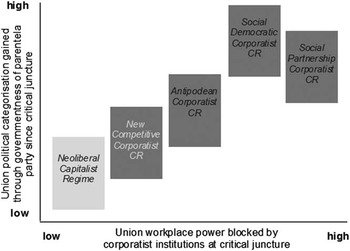
Union power resources since critical contentious juncture.11Dark shade: corporatist regime; labor repertoire.Light shade: neo-liberal regime; citizen repertoire.White script: historical sequence of neo-liberal/authoritarian regime followed by corporatist regime; two repertoires.Social Partnership Corporatism: Germany, Netherlands, Belgium.Social Democratic Corporatism: Nordic Europe.Antipodean Corporatist: Australia (pre-1997), New Zealand (pre-1991).New Competitive Corporatist: Italy, Spain, Portugal, France, Greece.Neo-liberal: USA.

Instead, this study of ‘deviant’ Italy and the first wave of US hegemonic ordering of OECD capitalist regimes suggests the following hypothesis of OECD labor movements’ paths to power: to varying degrees, all OECD national union movements emerged from the critical juncture of post-war hegemonic construction with institutionalized losses of union power at the workplace. Labor’s losses were not simply a function of domestic contention, but rather of varying degrees of international intervention and interaction across the international-domestic arenas as a hegemonic bloc projected the preferences and image of the neoliberal United States onto countries and union movements with decidedly different histories, institutions, and norms. Moreover, those polities in southern Europe with strong communist parties and communist-led union movements emerged from this critical juncture with the additional and qualitative burden of labor’s decategorization, forming either a proto-neoliberal polity such as Italy’s, where citizens were categorized but labor was not; or reinforcing authoritarian regimes, such as in Greece, Spain, and Portugal, where both citizens and workers were decategorized.
In response to the workplace losses universally sustained by organized OECD labor, all movements – bar that of the labor-partyless United States – turned to or reinforced their existing strategy of political unionism so as to nullify their institutionalized restrictions and, in the case of labor decategorized regimes, to struggle for regime change toward a more labor-categorizing regime. Overall, OECD unions pursued political unionism despite hegemonic efforts to transfer and universalize the norm of apolitical unionism, and this anti-hegemonic strategy was successful to the extent that unions’ familial parties ranked high over the years in cabinet incumbency (Figure 1).
The real exception that is becoming less so: neoliberal United States
In the standard-bearing neoliberal regime of capitalism that was and is still the United States, unions had no labor-related party to turn to even before the construction of post-war hegemony and, hence, no opportunity to pursue a strategy of political unionism. Its characteristic form of unionism across the ideological divide is syndicalism, relying on strong workplace power union by union (Kimeldorf, Reference Kimeldorf1999). Long studied under the rubric of ‘American Exceptionalism’, scholars have interrogated the complex history of the United States’ political development, initially by asking Werner Sombart’s question, ‘Why no Socialism in America?’ and, subsequently, by reducing it to ‘Why no Labor party in America?’ (cf. Salisbury, Reference Salisbury1979; Wilson, Reference Wilson1982; Marks, Reference Marks1989; Lipset and Marks, Reference Lipset and Marks2001). This party-government system that, linearly speaking, ranks lowest among OECD systems in ‘partyness of government’ (Katz, Reference Katz1986, Reference Katz1987) is, from organized labor’s perspective, also categorically different by virtue of the absence of a labor-related party, whether social democratic, social Christian democratic, or by some other cleavage.
Historically, US labor’s strategic response to this closure of party-political opportunity became ‘free trade unionism’. US labor’s long 19th century of intense class struggle had ended in one loss after another as workers met the full might of highly resourced capital, state repression, and a hostile judiciary (cf. Hattam, Reference Hattam1993; Barrett, Reference Barrett1999; Zieger and Gall, Reference Zieger and Gall2002; Stepan-Norris and Zeitlin Reference Stepan-Norris and Zeitlin2003; Fantasia and Voss, Reference Fantasia and Voss2004; Storch, Reference Storch2009). Sealing the fate of labor in this neoliberal political order was many a failed attempt by workers to form cross-class alliances through which to establish an electorally viable labor party and, with each failure, the refusal by some elements of labor to even try (Buhle, Reference Buhle1999; Sanders, Reference Sanders1999; Dubofsky and Dulles, Reference Dubofsky and Dulles2004). Though other lessons might have been learned from these failures, a defensive lesson, ‘the Gompers Formula’, became the dominant norm: leaders of craft unions turned away from ‘outsiders’ (largely immigrants, Blacks, and farmers) rather than open up to them to swell union ranks and to construct mass labor parties. From Samuel Gompers’ founding of the AFL forth, US labor responded to the labor-decategorizing state by building strong and direct workplace power, and apolitical ‘bread and butter unionism’. Highly successful as a strategy for craft unions’ survival, the later part of the strategy became a gospel with a nemesis. At its 1895 convention, the AFL inserted a special commandment into its constitution:
party politics shall have no place in the conventions of the American Federation of Labour (quoted in Sanders, Reference Sanders1999: 85).
In the 20th century, ideologically hardened by battles with, first, socialist party, and then communist party members within or against the AFL, AFL leaders exploited their privileged role as union movement of the new hegemon and organized to project their political doctrine internationally in the most zealous tradition of modernist transfer politics. Nevertheless, even at that critical juncture, the American political system’s obstinacy did not deter all unionists from trying to form a labor party: immediately following the announcement of the Truman Doctrine, elements of the CIO supported Henry A. Wallace’s new Progressive Party and decidedly pro-union campaign. When the anti-labor Taft–Hartley Bill was also introduced, Truman deployed his presidential veto against its passing so as to redirect unions away from the Wallace campaign to his own, doing so in the full knowledge that Congress would eventually overturn his veto (Zieger, Reference Zieger1995: 275–276). With that initial veto, Truman reinforced the voices within the CIO who reasoned according to the basic logic of plurality voting: a vote for Wallace constitutes a vote for the Republican Party. With Truman’s subsequent victory at the 1948 elections and Congress’s overturning of the presidential veto, the Truman Doctrine-flanking Taft–Hartley Act ushered in an era of severe repression against communist unionists and brought the labor-categorizing momentum of the New Deal and Wagner Act to a halt (Stepan-Norris and Zeitlin, Reference Stepan-Norris and Zeitlin2003). Thus, the national and international fields were left open to AFL cold warriors and to the remains of the CIO.
Politically and institutionally the US polity remained categorically anti-labor, and, by definition, it did not even feature workplace institutions of representation to restrict unions’ workplace mobilizing power. From the Taft–Hartley era to this day, the unions that survived this anti-labor political order did so through an anti-statist/syndicalist strategy (Kimeldorf, Reference Kimeldorf1999). Worker rights and workers’ right to withdraw their labor power were kept to a minimum – largely in those situations that placed workers’ personal health and safety at risk. As was detailed elsewhere (Gentile and Tarrow, Reference Gentile and Tarrow2009), once this minimal labor rights domain is exhausted, US workers turn to the sole category and rights domain at their disposal – the domain of the ‘citizen’.
Consistent with this, it should not surprise that it is precisely that citizen realm that has recently proved successful in establishing and expanding unionized worksites in the United States, as studies of SMU have well noted. Nor should it surprise that African-Americans, with a higher proportion of working class members than white Americans, campaigned for the codification and application of their civil rights rather than (specifically) their labor rights during the United States’ most change-inducing social movement campaign of the 20th century. Nor is it inconsistent that those select US unions who organized in the 1980s to challenge the AFL-CIO’s pro-government foreign policy in Central America did so in the liberal language of human rights (Rupert, Reference Rupert1995).
This study suggests, however, that what might surprise is that this citizen repertoire alone – without regard for the additional regime-changing power of political unionism – is frequently studied and proposed as non-US union movements’ path to revitalization too. Unless it can be argued that, by contrast to the immediate post-war cases of neoliberal projection, the Washington Consensus era of neoliberalization features new elements that preclude political unionism as a strategic option or diminish its worth ….
The political unionism path to OECD labor revitalization in the current neoliberal era
It would be almost axiomatic to say that international intervention and neoliberal projection in the post-Washington Consensus era are largely the domain of international institutions and structures of governance, most originating in the first wave of normative ordering and revitalized in the early 1980s. Nevertheless, the party system still mediates and ultimately determines the extent of neoliberal regime change at the domestic level. As argued in depth elsewhere, during this wave of neoliberalism, factional conflicts in conservative parties that produced party-room victories for the neoliberal factions have normally initiated the process of neoliberal regime change (cf. Gentile, Reference Gentile2011). These transformed conservative parties, once in government, end routine political exchange, legislate away workers’ rights, and erect legal barriers to unions’ right to organize, to bargain, and to deploy performances from the labor repertoire. But unlike the first wave, post-Washington Consensus parties of labor have frequently failed to challenge the substance of these changes.
From labor’s perspective, what distinguishes the first and second eras of neoliberal regime change is the emergence of ‘the cartel party’ (Katz and Mair, Reference Katz and Mair1995) signaled by a Third Way turn away from unions, as parties of labor seek new strategies that might cope with the electoral and ideological successes of conservative parties and the latter parties’ demonization of union movements in public discourse. The tie between unions and labor parties in the OECD has palpably weakened in the current age (cf. Piazza, Reference Piazza2001). Third Way parties have distanced themselves from unions’ demands and reduced unions’ voting weight in the party, thus narrowing the opportunity structure for political unionism and increasing the attraction to unions of a strategy focused on the citizen repertoire alone.
This study of Italy in a comparative-historical perspective, however, suggests that scholarship, union revitalization strategies, and pro-worker social movements that fail to also consider the incentive to struggle to re-route familial parties from Third Ways or to create electorally viable new parties of labor, risk the normalization and universalization of the neoliberal polity, complete with the destruction of the political category of ‘worker’ and the diminution of all citizens’ social rights. Labor movements with a familial party in a fast neoliberalizing national or supranational political system might deploy their citizen repertoire, not simply to survive as individual unions, but also to force change upon their familial parties.
There are not insignificant signs that OECD unions and workers in neoliberalizing regimes are dedicating their efforts to a complex strategy for labor revitalization, one that includes the battle for parties of labor. In Britain, the first OECD country to undergo full regime change during neoliberalism’s second wave, the country’s largest unions – Unite, Unison, and the General Union of Britain – have focused part of their efforts on challenging and changing the Labour Party from within, while the Rail, Maritime, and Transport Union has swung between supporting left faction candidates of the Labour Party and supporting the formation of a new party – all in addition to their community strategies (Ludlam and Taylor, Reference Ludlam and Taylor2003; Upchurch et al., Reference Upchurch, Taylor and Mathers2009; Connolly and Darlington, Reference Connolly and Darlington2012). In 1998 Australia, in the midst of a dogged campaign by John Howard’s Liberal government against the Maritime Union of Australia (MUA) and the Australian Council of Trade Unions (ACTU), the MUA and ACTU developed and then wielded a new citizen repertoire in part to pull the Australian Labor Party (ALP) back to their side (Gentile, Reference Gentile2011). Then, in 2005, the ACTU organized a major ‘Your Rights at Work’ campaign in the community and the media, contributing to the electoral defeat of that same government in 2007 and putting the ALP back on a road to more pro-labor reforms (Wilson and Spies-Butcher, Reference Wilson and Spies-Butcher2011). Similarly, in southern Europe, Greek unionists, overwhelmed by debt, unemployment, neoliberal nostrums from the EU, financial institutions, and left parties of the past two decades who had followed Third and further ways, not only took to the streets in broad-based social alliances, but also helped build a new party of labor, Syriza, which proved a force to be reckoned with in the 2012 elections.
But a greater attunement to unions’ efforts to combine the citizen repertoire with political unionism might also help us gage signs of successful hegemonic imaging, as measured by the emergence of an, in effect, labor-partyless system. A key candidate here is Italy since the late-2000s. Two decades of Berlusconi’s populist and media-driven rule and changes to the electoral law have rendered a political system incapable of responding to Italy’s sovereign debt crisis, leading to repeated presidential intervention and appointments of technical, non-party-governments from 2011 to this day. In the midst of this turmoil, Italian labor has shown a loss of direction. Indeed, at the height of the 2012 austerity reforms, the Italian union movement was conspicuous in southern Europe for its failure to mobilize against the reforms, including to changes to its hitherto sacred Article 18.
No small element of this lack of direction is unions’ confusion as to an object in the party system that can incorporate their goals. The top-down amalgamation in 2007 of the Catholic-based Margherita party with the last remnants of the PCI, the Democrats of the Left, to form the Partito Democratico (PD), failed to build unity across its constituent elements and a solid left identity. This failure was palpable when 101 PD parliamentarians did not vote for the party’s own nominees for President of the Republic in early 2013, bringing down, first, a former union leader and then Romano Prodi, known critic of austerity politics. A new party that even dropped the word ‘left’ from its name and developed quasi-American style primaries for the selection of party leaders, one of the strongest candidates for the PD’s leadership since that incident is Matteo Renzi, who has modeled himself on Tony Blair and declared his dedication to the Third Way. Indeed, the party’s link to unionists is weak by comparison to its predecessors, as measured by union leadership background in the Chamber of Deputies: Whereas, in 1987, 28.5% of PCI deputies and 27.3% of DC deputies had union backgrounds, in 2008 the new PD, which combined parts of the former PCI and the left of the DC, had a total of 24.2% former unionists in its ranks (Verzichelli, Reference Verzichelli2010: 88). Even at the European level, the PD has failed to join the Party of European Socialists, deciding instead to participate peripherally as a member of the group Progressive Alliance of Socialists and Democrats.
But what of potential new entrants into the Italian parliament? The populist and internet-driven movement Il Movimento 5 Stelle (M5S) that has risen to prominence over recent years has rejected the very concept of a party, much less a party of labor (cf. Biorcio and Natale, Reference Biorcio and Natale2013; Corbetta and Gualmini, Reference Corbetta and Gualmini2013). Under the firm control of former comedian Beppe Grillo and internet marketing specialist Gianroberto Casaleggio, M5S ideologically rejects representative democracy, promoting instead participatory and direct democracy (used interchangeably) as representative democracy’s Other. Just as emphatically, M5S exalts only one political category, that of ‘the citizen’ as the virtuous Other of ‘la casta’ – politicians and confederal unionists.
M5S’s extreme citizen-based discourse and practices are historically anomalous among Italian social movements. To return to our Trainstoppers of 2003: often portrayed by the media at the time as anti-party anarchists, the disobbedienti were in fact a more complex array of activists. The Trainstoppers’ logistics base was a provincial office of the Rifondazione Comunista party, and, at the helm of their tiny core of disobbedienti organizers were ‘MX’ and ‘GX’, both members (and one, a founder) of Rifondazione’s youth wing, the Giovani Comunisti. While their primary allegiance was to the No Global and anti-war causes, they, nevertheless, saw Italy’s party system as an important, if flawed, reality, one which provided readymade social networks and connected them to power centers as well as to unionists. Party activity was unavoidable in Italy, they held, and though their own party was particularly worthy, party membership was to them ‘an instrument’ (Interviews, ‘MX’ and ‘GX’, Florence, 2005). This is not the case with M5S.
This study of neoliberalism as a projection of the archetypically neoliberal polity of the United States suggests that, to the extent that the PD continues along its ambiguous path vis-à-vis labor, and that new entrances into the parliamentary arena who are opposed to the very concept of representative democracy gain ascendency, Italian unions will be deprived of the opportunity to pursue political unionism and thus, by contrast to the post-war wave of hegemonic projection, risk reproducing that hegemon’s image in strong form. At stake in this current critical juncture in Italy is, again, the category of ‘labor’ and the political and institutionalized rights domain that sustains it.
Acknowledgments
For invaluable comments on earlier avatars of this paper: Gabriele Ballarino, James Barrett, Maurizio Ferrera, Manuela Galetto, Marco Giuliani, Michael Hanagan, Richard Hyman, Richard Katz, Beate Kohler-Koch, Joseph LaPalombara, Paul Marginson, Liborio Mattina, Ida Regalia, Sidney Tarrow, co-panelists at the Social Science History Association Conference 2010, the Seminar Series of the Industrial Relations Research Unit of Warwick University 2011, the International Political Science Association 2012, and the Societa’ Italiana di Scienza Politica 2012 and 2013, and two anonymous reviewers. For archival assistance, I thank the research teams at The Modern Records Centre, University of Warwick; L’Archivio della Fondazione Giulio Pastore, Roma; l’Archivio Storico CISL, Roma; l’Archivio Storico CGIL, Roma; l’Archivio Storico UIL, Roma.