Introduction
Cigarettes are widely used in the US military despite major cessation efforts. The prevalence of smoking in the US active duty military is estimated to be 13.9% and 32.5% for US veterans (Cypel et al., Reference Cypel, Hamlett-Berry, Barth, Christofferson, Davey and Eber2016; Meadows et al., Reference Meadows, Engel, Collins, Beckman, Cefalu and Hawes-Dawson2018). Specifically, in the US Navy, approximately 13.5% of service members currently smoke (Meadows et al., Reference Meadows, Engel, Collins, Beckman, Cefalu and Hawes-Dawson2018). Evidence suggests that many military members begin tobacco use before entering the service (Ames, Cunradi, & Moore, Reference Ames, Cunradi and Moore2002). Recent studies of military members have found that cigarette use is relatively more frequent among white and Hispanic male enlisted members under the age of 35 – these being the largest demographic groups within the military (Bray & Hourani, Reference Bray and Hourani2007; Haddock, Klesges, Talcott, Lando, & Stein, Reference Haddock, Klesges, Talcott, Lando and Stein1998; Institute of Medicine (US) Committee on Smoking Cessation in Military and Veteran Populations; Bondurant & Wedge, Reference Bondurant and Wedge2009; Meadows et al., Reference Meadows, Engel, Collins, Beckman, Cefalu and Hawes-Dawson2018). Despite these known correlations, little is known about their role in cessation efforts and behaviors.
There is considerable interest in the US military to eliminate cigarette use. Recent efforts include the implementation of programs and policies that encourage cessation and expand prohibited smoking areas on military bases (Smith, Poston, Haddock, & Malone, Reference Smith, Poston, Haddock and Malone2016). Some have even proposed making the military entirely tobacco-free (Smith et al., Reference Smith, Jahnke, Poston, Williams, Haddock, Schroeder and Malone2014).
Numerous reasons for emphasizing cessation exist. In regard to the military, smoking is a contributing factor to decreased physical readiness and higher physical fitness test failure rates (Collee, Clarys, Geeraerts, Dugauquier, & Mullie, Reference Collee, Clarys, Geeraerts, Dugauquier and Mullie2014). Active smoking status has also been correlated with poor outcomes in other military readiness factors such as mental health, substance abuse and problems with the law (Haddock, Pyle, Poston, Bray, & Stein, Reference Haddock, Pyle, Poston, Bray and Stein2007). Presumably, eliminating cigarette use would not just prevent long-term consequences but also result in immediate health benefits and improve operational readiness.
Military members seeking to quit smoking have a wide range of options available including counseling, training programs, and prescription medications. In addition, readily available nicotine replacement therapies (NRT) such as the patch, nicotine gum, and inhalable devices like electronic cigarettes (EC) and vaporizers may be used to help quit smoking. The US military does not endorse ECs for recreational use or as a treatment for nicotine dependence (Navy, 2012). Despite the lack of endorsement, in 2015 it was estimated that the total US military prevalence of EC use was 12.4% and the Navy had an EC use prevalence of 14.5% (Meadows et al., Reference Meadows, Engel, Collins, Beckman, Cefalu and Hawes-Dawson2018). Due in part to marketing efforts, ECs are becoming a popular method for aiding cessation Walley, Jenssen, and Section on Tobacco, Reference Walley, Jenssen and Section on Tobacco2015). Despite promotions of ECs as a smoking cessation method, recent findings indicate that EC users may actually be less likely to quit smoking than those who do not use ECs (Kalkhoran & Glantz, Reference Kalkhoran and Glantz2016).
Smoking is harmful to personal health and degrades military readiness. Considerable effort has been made to eliminate smoking among service members. New trends such as ECs are emerging among a wide range of traditional techniques as a popular cessation method. Despite the abundance of cessation resources and funding to support them, little is known regarding their usage and efficacy in military populations. This study sought to understand which cessation techniques were being utilized and the effectiveness of those methods using a sample of US Navy service members.
Methods
An anonymous cross-sectional survey was conducted within the aviation medicine clinic at Naval Air Station Jacksonville during an 11-month period from August 2015 to June 2016. All active duty military personnel who reported to the clinic for their required annual physical health assessment (PHA) were invited to participate in the study. Individuals met inclusion criteria if they were active duty US Navy personnel, 18 years of age or older, and were visiting the clinic for their annual PHA. Individuals were excluded if they were presenting to clinic for any reason other than their initial visit for the annual PHA. The average number of individuals requiring a PHA each month is approximately 200 at this study site but generally varies by month and clinic location. Participants were given the survey in paper form in addition to their usual annual health screening paperwork. Informed consent, the promise of anonymity, and the voluntary nature of the study were described and preceded the question portion of the survey. Completed surveys were turned in by the participant to the medical staff. Only surveys that were returned to the staff with the agreement to participate were included in the analysis. This study was approved by the US Naval Hospital Portsmouth institutional review board.
Basic demographic data, as well as smoking and cessation behaviors, were assessed using lists of cessation techniques and questions modeled from the Center for Disease Control's Youth Risk Behavior Survey (Centers for Disease et al., Reference Brener, Kann, Shanklin, Kinchen, Eaton and Hawkins2013). A current cigarette smoker was defined as someone who smoked within the past 30 days, whereas a former cigarette smoker was defined as having smoked sometime in the past but not within the past 30 days. Likewise, a current EC user was defined as having used an EC within the past 30 days, whereas a former EC user was defined as having used ECs sometime in the past but not within the past 30 days. Dual use was defined as being a current EC user and cigarette smoker. Individuals who were current or former EC users were classified as having tried ECs. Similarly, individuals who were current or former cigarette smokers were classified as having tried cigarettes. Non-smokers and non-EC users were those who never had a cigarette or EC, respectively.
Some respondents were inconsistent in their responses to some of the cessation behavior questions in the survey (e.g., current smokers reporting on ancillary questions that they do not smoke cigarettes; non-smokers reporting when they last tried to quit or are seriously thinking about quitting cigarettes). Individuals were primarily defined into smoking categories by reported use, ancillary usage responses that conflicted with the primary use definition were excluded from analysis.
Statistical analysis
Descriptive statistics (i.e. frequencies, prevalence rates) were computed. Where indicated from post-hoc power analyses, individual categories with insufficient sample sizes were combined into more generalized and inclusive groups. These groups are also appropriate divisions for practical use within the US Navy. For example, the 25 original military rank options were assigned to five groups: junior enlisted (E1–E5), senior enlisted (E6–E9), warrant officer (CWO1–CWO5), junior officer (Midshipman-O3), and senior officer (O4–O10). Education levels were reorganized into two general education groups: less than a bachelor degree, and a bachelor degree or higher. Likewise, the six original job categories were assigned to two general job groups: aircrew and non-aircrew.
Some respondents were inconsistent in their responses to some of the cessation behavior questions in the survey. For example, in response to how many times they tried to quit in the past year, four‘current smokers’ reported that they did not use tobacco in the past 12 months. In response to whether they are seriously thinking about quitting cigarettes, 18 ‘current smokers’ reported that they do not smoke cigarettes. Other cases of inconsistencies include non-smokers ‘seriously thinking about quitting cigarettes’ in the near term instead of responding that they ‘do not smoke cigarettes’ at the present time; and non-smokers reporting how long they stayed off during the last time they tried to quit smoking, instead of responding that they ‘have never smoked cigarettes’. Inconsistent responses to particular questions were excluded from the analysis, whereas the individuals’ responses to the other questions in the survey were consistent and therefore included in the analysis. Consequently, the overall pool of respondents of 977 was not reduced.
The Kolmogorov–Smirnov and Bartlett tests were used for the goodness-of-fit analyses (Bartlett, Reference Bartlett1937a, Reference Bartlett1937b; Smirnov, Reference Smirnov1939). The analyses concluded that the data set conformed to non-normal and heteroscedastic behavior and therefore hypothesis testing was conducted using the Kruskal–Wallis test for multiple-sample datasets, and using the Mann–Whitney test for two-sample datasets (Kruskal & Wallis, Reference Kruskal and Wallis1952; Mann & Whitney, Reference Mann and Whitney1947). Post hoc multiple-comparison tests (Tukey multiple-comparison, Newman–Keuls and Duncan multiple-range, and Scheffe multiple-contrast tests) were conducted for each of the factors and interactions in order to identify pairwise combinations and interactions contributing to variance (Duncan, Reference Duncan1951, Reference Duncan1955; Newman, Reference Newman1939; Scheffe, Reference Scheffe1953, Reference Scheffe1959; Tukey, Reference Tukey1949, Reference Tukey1953). Power analyses were conducted for each test to determine if the sample size was statistically adequate, and to identify precision and confidence intervals (Zar, Reference Zar1999). Missing values were excluded from individual calculations. The level of significance was set at α = 0.05 with a corresponding confidence interval of 95%. The statistical analysis was conducted using Intel Visual Fortran Compiler XE 2013 and Microsoft Excel 2016.
Results
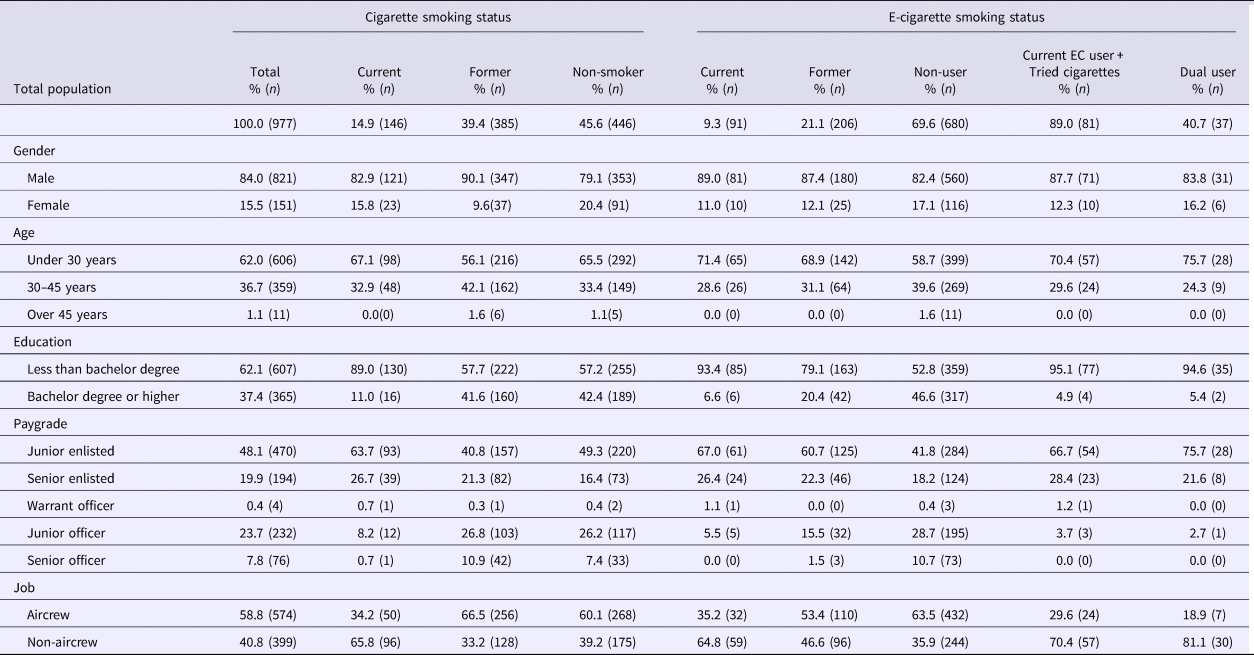
Of the approximately 2200 individuals who were invited to participate in this study, 977 responded, corresponding to an approximate response rate of 44.4%. The overall population of 977 was primarily male (84%, 821), under 30 years of age (62%, 606), enlisted (68%, 664), had less than a bachelor degree (62.1%, 607), and worked in an aircrew job (58.8%, 574). These sample population demographics were similar to the US Navy overall (84.4% male, 73.4% under 34 years of age, and 82.8% enlisted) and the Naval base from which the sample was drawn (79.4% male, 75.9% under 30 years of age, and 78.9% enlisted) (‘Defense Medical Surveillance System’, 2017; Meadows et al., Reference Meadows, Engel, Collins, Beckman, Cefalu and Hawes-Dawson2018). The demographic details for the current, former and non-smoking population in this study are summarized in Table 1.
Demographic information for the study population organized by cigarette smoking status and electronic cigarette use status

Demographic subcategory sum may not equal total population count due to unreported demographic. Integration over all smoking classes or overall categories for a given demographic metric may not sum to the total respondent population of 977 due to some individuals deferring from answering questions in the survey that allows for classification. Dual users are a current cigarette and EC users. Current use is defined as use within the past 30 days. Former use is last use greater than 30 days ago.
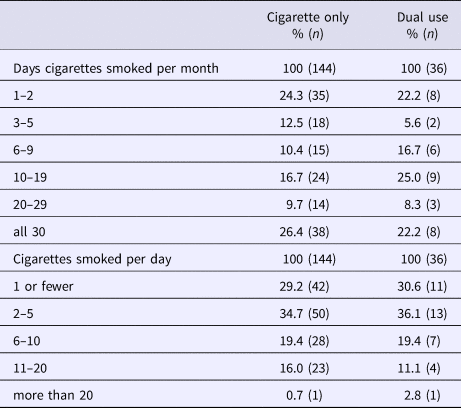
Among the 977 study participants, 14.9% (146) were current smokers, 39.4% (385) were former smokers, and 45.6% (446) never smoked cigarettes. Regarding EC status, 9.3% (91) were current EC users, 21.1% (206) were former EC users, 69.6% (680) were non-EC users, and 3.8% (37) were current EC users that currently smoke cigarettes (i.e., dual users). Among the 144 current smokers who reported smoking over the past 30 days, the largest group had smoked each of the previous 30 days (26.4%, 38) and smoked two–five cigarettes per day (34.7%, 50) (Table 2). Current cigarette smokers were more likely to be under 30-years-old, junior enlisted, non-aircrew, and have less than a bachelor degree (P < 0.0001 for all); these demographic groups were also more likely to be dual users (current smokers and EC users, P < 0.01 for all). Differences in current cigarette use (P = 0.601) and in dual-use (P = 0.149) between males and females were not significant.
Frequency of cigarette use among different cigarette user groups
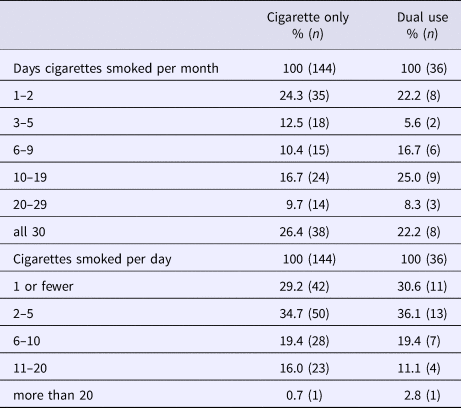
User groups included only current cigarette users (cigarette only) and individuals who currently use cigarettes and electronic cigarettes (dual use).
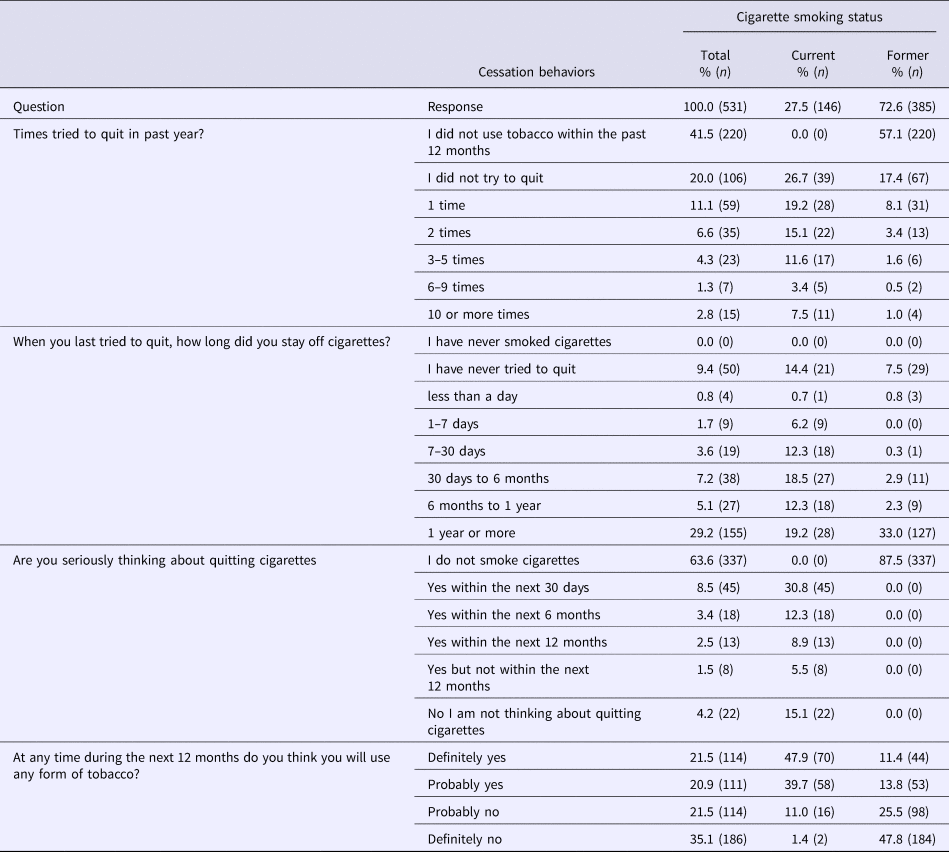
Cessation behaviors and intentions for current and former smokers are summarized in Table 3. Most (87.7%, 128) of the 146 current smokers believed that they will use tobacco within the next year. Approximately one-quarter (25.6%, 97) of the 384 former smokers believed they will use tobacco within the next year.
Cessation behaviors and responses for former and current smoking categories

Demographic subcategory sum may not equal total population count due to under-reporting by study participant.
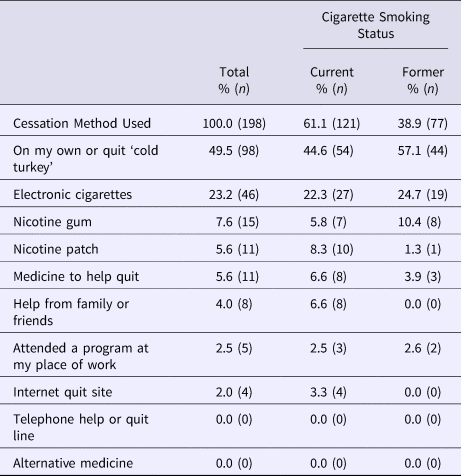
The utilization of tobacco cessation methods for current and former smokers is summarized in Table 4. Among the 384 former smokers, 77 former smokers who quit within the past year responded to the specific question of the cessation method used to quit smoking. Former smokers who quit within the past year used no help (‘cold turkey’), ECs, nicotine gum, medicine, workplace program, and NRT patch in their cessation efforts. No one in this group used a telephone helpline, internet quit site, hypnosis or alternative medicine, or family counseling for cessation.
Reported cessation methods used by current and former smokers

Percentages were calculated using the number of individuals who tried the method within the respective smoking category. Those who did not report a method were excluded from this figure.
Among the 146 current smokers, 82.9% of current smokers who attempted cessation within the past year responded to the specific question of the cessation method used. Current smokers who previously attempted cessation utilized no help (‘cold turkey’), ECs, NRT patch, medicine, family or friends, nicotine gum, internet quit sites, and workplace programs. No one from this group used a telephone helpline or hypnosis or alternative medicine. Smokers with less than a bachelor degree were more likely (compared with other categories in the demographic group) to be using ECs as a method of cessation (P = 0.034), whereas differences in EC use as a method of cessation were insignificant across age groups (P = 0.193), genders (P = 0.412), military ranks (P = 0.063), times in service (P = 0.568), and job types (P = 0.179).
Nearly all (89.0%, 81) of the 91 current EC users tried cigarettes, and 40.7% (37) are current smokers (i.e., dual users) (Table 1). Of the 91 current EC users, more than half (56.0%, 51) think that they will either definitely or probably use cigarettes within the next year, and over one-third (34.1%, 31) reported that they used ECs within the past 12 months to aid in quitting smoking. The number of daily cigarettes smoked by EC dual users was not significantly different from those who smoked only cigarettes (P = 0.92), and the mean of the difference between EC dual users and cigarette-only users was not significantly different from zero (P = 0.74, Table 4). The number of days cigarettes were smoked per month did not significantly differ between EC dual users and cigarette only smokers (P = 0.75), and the mean of the difference between EC dual users and cigarette-only users was not significantly different from zero (P = 0.76).
Overall, aircrew members and those with more than 25 years of time-in-service were more likely to quit smoking (P = 0.02 and P = 0.05, respectively), whereas differences in likelihood of quitting smoking were insignificant across age groups (P = 0.28), genders (P = 0.10), military ranks (P = 0.06), and education levels (P = 0.06). Males, senior enlisted personnel, and those without a college education were more likely to successfully stop smoking using ECs compared with their respective demographic groups (P < 0.01 for all, whereas differences were insignificant across age groups (P = 0.41), times-in-service (P = 0.33), and job types (P = 0.83).
Discussion
This cross-sectional survey of EC use and cigarette cessation behaviors in a small sample of US Navy personnel resulted in several important conclusions. The findings suggest that EC use, cigarette use, and dual EC and cigarette use have a notable prevalence within this US Navy sample. While many different cessation methods were attempted by the participants in this study, ‘cold turkey’ was the most successful technique reported. In respect to ECs, these findings indicate that they do not notably contribute to cigarette cessation or reduce the number of cigarettes smoked per day or month.
The finding that the majority (87.6%) of current smokers in this study believed they would ‘definitely’ or ‘probably’ continue to use tobacco products within the next year suggests that the wide availability and variety of cessation aids does not appear to provide either an incentive to quit or confidence in their ability to quit. This finding may be due in part to the facts that the majority (56.8%) of current smokers tried (at least 1 time) but failed to quit within the previous year and that 26.7% of this population did not try to quit. Furthermore, 25.3% of former smokers believed they will smoke sometime within the next year, suggesting that some former smokers may not be highly confident in maintaining a new healthy nonsmoking lifestyle. Thus, past failed attempts to quit smoking may be a contributing factor behind the intention of future smoking and tobacco use. This intention is also borne out even among those who successfully quit, and among those who did not attempt cessation.
Current and former smokers utilized similar cessation methods. As a group, nicotine replacement methods (gum, patch, and ECs) appear to be highly utilized, compared with other methods, by smokers attempting cessation. ECs were a notable cessation method used by both current and former smokers. Telephone helplines and alternative medicine techniques were not used by the participants, suggesting that either they were not aware of the programs, the programs were not available to them, or they did not think these programs were helpful in cessation. Similarly, very few former and current smokers used family counseling, workplace programs, or the internet to help quit. These smoking cessation observations may help to tailor future programs to better target populations seeking assistance to quit smoking.
It was observed that most current EC users (89.0%) had tried cigarettes and 40.7% were current smokers. This finding highlights the possibility that ECs may be one avenue for non-smokers to become exposed to and subsequently at risk of nicotine addiction. It is notable that EC use among current smokers (i.e., dual users) resulted in no significant reduction in either the number of cigarettes smoked per day or the number of days smoked per month compared with the cigarette-smoker-only group. These findings challenge the narrative that ECs can aid in cessation by reducing cigarette use.
The finding that more than half of current EC users think that they will continue to smoke cigarettes suggests that some users may not be using ECs to assist with smoking cessation, doubt the efficacy of ECs in cigarette cessation and/or lack the confidence to stick with ECs as a cessation method. Despite these findings, the study results also suggest that ECs may be beneficial in smoking cessation efforts for select populations such as males with less than a college education.
Aircrew members demonstrated a low prevalence of cigarette use and a higher likelihood of quitting tobacco use compared with non-aircrew members. Smoking prevalence was nearly 5 times higher, and EC use was about 3 times higher, among non-aircrew compared with aircrew. These findings are consistent with previous findings that pilots (a component of the aircrew) exhibit a higher health consciousness and improved health outcomes compared with non-pilots (MacIntyre et al., Reference MacIntyre, Mitchell, Oberman, Harlan, Graybiel and Johnson1978; York, Mitchell, & Graybiel, Reference York, Mitchell and Graybiel1986).
This study was limited by several factors. The study design attempted to ensure that patients were not influenced to participate and this lack of pressure may have resulted in the low response rate of 44.4%. Consequently, the responses may be biased for a number of reasons, such as self-selection, response, and recall biases. These biases may have resulted in under- or over-reporting of the behaviors explored in this study. In addition, inconsistencies in responses to different questions in the survey by a small number of respondents (e.g., ‘current smokers’ reporting that they have not used tobacco in the past 12 months or do not smoke cigarettes) can compromise the integrity of the results. Additionally, the 30-day interval used for defining current use versus former use, while widely used, has been challenged because it may not accurately distinguish between experimentation and true use prevalence (Amato, Boyle, & Levy, Reference Amato, Boyle and Levy2016). Beyond the 30-day criteria, the ‘former smoker’ definition does not distinguish among various former-smoking rates (e.g., cigarettes per day), duration of the former-smoking period, or how recently beyond 30 days did these former smokers quit smoking. Finally, due to this small and unique sample, and low response rate the findings may have limited generalizability to the public or military. Despite this concern, it is reassuring that the proportion of current smokers in this sample study (14.9%) is similar to the rates of among US active duty military (13.9%) and of US Navy active duty (13.5%) (Meadows et al., Reference Meadows, Engel, Collins, Beckman, Cefalu and Hawes-Dawson2018).
The findings in this study challenge current beliefs about smoking prevalence and cessation. These results suggest that current and former smoking rates in the US Navy may be sufficiently high, and cessation rates sufficiently low, as to call into question the degree of efficacy of these cessation methods and/or the confidence of smokers who seriously want to quit smoking. Despite a variety of resources, successful cessation attempts were largely accomplished by quitting ‘cold turkey’. In light of this result, it may be recommended that future programs focus on helping individuals who choose to go ‘cold turkey’ become more successful. Although ECs have been considered by some as a viable cessation method, this study suggests that they do not notably contribute to cigarette cessation, nor do they significantly reduce the number of cigarettes smoked per day or the number of days someone smoked per month. These findings aid in elucidating current smoking cessation behavior in a sample of US Navy personnel and may help direct future cessation program funding and research efforts.
Acknowledgements
We would like to thank CAPT Brenda Hamilton, DMD and Mr. Almer Mendoza for the many ways that they helped in accomplishing this study.
Financial support
This study received no external funding.
Conflict of interest
The clinicians who conducted this study currently work within the department where this study was completed. No other conflicts of interest exist be it financial or otherwise. Research data derived from an approved Naval Medical Center, Portsmouth, VA IRB NHJX.2015.0003. The views expressed in this article are those of the author(s) and do not necessarily reflect the official policy or position of the Department of the Navy, Department of Defense or the US States Government. The authors are military service members and employees of the US Government. This work was prepared as part of our official duties. Title 17 U.S.C. 105 provides that ‘Copyright protection under this title is not available for any work of the United States Government.’ Title 17 U.S.C. 101 defines US Government work as a work prepared by a military service member or employee of the US Government as part of that person's official duties.
Ethical standards
The authors assert that all procedures contributing to this work comply with the ethical standards of the relevant national and institutional committees on human experimentation and with the Helsinki Declaration of 1975, as revised in 2008.