Introduction
Lannea microcarpa (Anacardiaceae) is one of the important multipurpose tree species from the African savanna. Together with other savanna tree species, L. microcarpa is considered endangered as a result of over-exploitation and repetitive severe drought spells in recent decades. Regular propagation of local tropical trees species is important for successful reforestation. Propagation is generally carried out via seeds in nurseries. However, little research has been conducted on the seeds. The lack of knowledge of the seed physiology of L. microcarpa is a major problem for the sustainable management and successful implementation of reforestation programmes.
L. microcarpa inflorescences are racemes, in which fruits of different stages of maturity are found (Neya, Reference Neya2006). Freshly depulped seeds have water contents in the range 30–40%. Seeds of L. microcarpa have been classified previously as recalcitrant (Hong et al., Reference Hong, Linington and Ellis1996). However, recent studies showed that these seeds are desiccation tolerant (Daws et al., Reference Daws, Gaméné, Sacandé, Pritchard, Groot, Hoekstra, Sacandé, Jøker, Dulloo and Thomsen2004; Flynn et al., Reference Flynn, Turner and Dickie2004; Pritchard et al., Reference Pritchard, Daws, Fletcher, Gaméné, Msanga and Omondi2004), but often have low germination after drying (Neya, Reference Neya2006), which led to an incorrect conclusion about their recalcitrant behaviour.
Germination of both fresh and dry seeds of Lannea is very variable. This variation was observed between seeds collected in different years, or in the same year, but from different maturity stages of fruits (Neya, Reference Neya2006). The increase of germination to ≥ 80% by mechanical scarification indicates that the generally low germination of L. microcarpa seeds is caused by coat-imposed constraints (Neya, Reference Neya2006). Differences in the extent of such constraints are likely to be the cause of the variability in germination observed among and within seed accessions. Coat-imposed constraints can be eliminated by artificial treatments, such as mechanical or acid scarification, natural causes such as fire, high temperature or fluctuation in temperature, or biological actions, such as micro-organisms or passage through the gut (Baskin and Baskin, Reference Baskin and Baskin1998, Reference Baskin and Baskin2000; Jones, Reference Jones1999; van Assche et al., Reference Van Assche, Debucquoy and Rommens2003; Manzano et al., Reference Manzano, Malo and Peco2005).
The seed coat (testa) in the Anacardiaceae family is not well developed (undifferentiated), and its functional role is performed by the fruit coat, represented by the endocarp (Baskin et al., Reference Baskin, Baskin and Li2000). The endocarp in the Anacardiaceae family develops from the inner epidermis of the ovary wall and contains four layers (Baskin et al., Reference Baskin, Baskin and Li2000). The three innermost layers are palisade-shaped and may cause mechanical and permeability constraints (Li et al., Reference Li, Baskin and Baskin1999a, Reference Li, Baskin and Baskinb; Baskin et al., Reference Baskin, Baskin and Li2000; Baskin and Baskin, Reference Baskin and Baskin2004). A number of mechanisms have been proposed by which seed/fruit coats can inhibit germination (Bewley and Black, Reference Bewley and Black1994; Adkins et al., Reference Adkins, Bellairs and Loch2002). These include: (1) interference with water uptake; (2) mechanical constraints; (3) interference with gas exchange; (4) retention of inhibitors; and (5) inhibitor production. Often, several of the possible constraints act together to maintain the intact seed in a dormant state (Bewley and Black, Reference Bewley and Black1994).
In the present study, the germination patterns of non-scarified and scarified seeds were used to test the possible mechanisms of endocarp-imposed constraints of the germination of dried L. microcarpa seeds.
Materials and methods
Plant material
Seeds of Lannea microcarpa (Engl. & K. Krause) were harvested from a natural stand in Ipélcé, Burkina Faso. They were collected from fully mature (purple-black) fruits and were, on the same day, soaked in water and depulped at the Centre National de Semences Forestières (CNSF) in Ouagadougou. The seeds were rubbed with sand to remove the mesocarp tissue and washed with water. Subsequently, they were dried at ambient conditions (c. 29°C and 53% relative humidity) in the laboratory for 2–3 h, and seeds surrounded by an intact endocarp were then selected and sent the next day to Wageningen (The Netherlands) in cotton bags, arriving 2 d after harvest. Water content of seeds on arrival was 0.32–0.43 g H2O g− 1 (DM, dry mass basis).
Moisture content and germination
Three replicates of five seeds were used to assess seed moisture content (MC) throughout the study. Seeds were weighed before and after drying at 103°C for 17 h (ISTA, 1999), and their MCs were calculated as g H2O g− 1 (DM). The MC during incubation was determined by temporary removal of the seeds from the germination medium and surface-drying with tissue paper before the fresh mass was weighed. From the increase in mass, the actual MC was calculated.
For each single germination assay, 25 seeds in duplicate (unless stated otherwise) were used. The seeds were sown on moist filter paper contained in transparent plastic boxes (11 cm × 17 cm × 5 cm) for germination and incubated at 30°C in an incubator. Seeds were scored for germination at least twice a week until all viable seeds had germinated. They were regarded as germinated when the radicle had emerged to at least 2 mm. Soft and rotten seeds were considered as non-viable and discarded.
Mechanical scarification
Scarification consisted of making a small hole in the endocarp of seeds on the proximal (above the axis) or on the distal ends, with respect to the micropylar region of the seed, using a nail-clipper or a razor blade. Damage to the embryo during this process was avoided, and seeds with visibly damaged embryos were discarded. Seeds were scarified prior to sowing or later during incubation. In the latter case, they were first incubated non-scarified at 30°C for 3, 6, 9, 12 or 15 d, before being scarified at the proximal end and returned to the germination medium for further incubation at 30°C.
Electron paramagnetic resonance spectroscopy
Electron paramagnetic resonance (EPR) spectra were recorded at room temperature with an X-band EPR spectrometer (Bruker, Rheinstetten, Germany, Model Elexsys 500). The water-soluble nitroxide radicle, perdeuterated TEMPONE (PDT; kindly provided by Professor I. Grigoriev, Institute of Organic Chemistry of the Russian Academy of Sciences, Novosibirsk, Russia), was used as the spin probe for testing the integrity of the plasma membranes of the cells in excised axes, according to the method described by Golovina and Tikhonov (Reference Golovina and Tikhonov1994). The seeds were first decoated and rehydrated for 2 h or incubated intact at 30°C on moist filter paper for 15 d. Then axes were dissected and incubated in 1 mM PDT+120 mM potassium ferricyanide for at least 20 min. EPR spectra of PDT in the isolated axes were recorded at 0.25G modulation amplitude and 18 dB (3.17 mW). The spectra were recorded on individual axes, and the ratio of amplitudes of water/lipid (W/L) was calculated for each spectrum.
Respiration and ethylene measurements
Respiration of seeds was investigated using headspace analysis. The individual seeds were allowed to respire in air-tight 7 ml vials for c. 5 h at 30°C. If seeds were incubated in water prior to respiration measurements, pieces of wet filter paper were placed at the bottom of the vials to avoid drying of the samples. After 5 h, 40 μl headspace gas samples were taken from the vials and injected into a gas chromatograph (GC) equipped with a catharometer detector as described by Leprince and Hoekstra (Reference Leprince and Hoekstra1998), which allowed O2 uptake and CO2 release to be measured simultaneously. The sensitivity of the GC detection was enhanced by an additional amplifier, connected to an electronic integrator. The carrier gas was He. Calibration of the respiratory gases was performed with pure CO2 and air, assuming a gas composition of the air at atmospheric pressure of 20.95 vol % O2, 0.93 vol % Ar, and 78.09 vol % N2. Accuracy of the quantification was on the basis that the sum of the injected gases (CO2, O2, Ar and N2) equalled 100%.
For ethylene measurements, samples of the headspace gas of intact and scarified seeds (proximal end) were taken from corresponding vials after 9 h of accumulation. One-ml samples were taken and analysed using a gas chromatograph equipped with an alumina column and a flame ionization detector. Temperatures were 180 and 200°C for the oven and the detector, respectively. Ethylene peaks were registered by an integrator coupled to the GC and quantified by comparison with peaks of ethylene standards.
2-Amino-ethoxyvinylglycine treatments
Seeds were scarified on the proximal end and incubated at 30°C in Petri dishes containing filter paper soaked in 0.1, 1, 5 or 10 mM AVG solutions, plus a water control. At daily intervals, four seeds were removed from each Petri dish (with different AVG concentrations) and individually placed into air-tight 7 ml vials, where they were allowed to accumulate ethylene for c. 2 h. Subsequently, headspace gas samples were taken for ethylene analysis as described above. For germination tests, 25 seeds in duplicate were sown in transparent plastic boxes containing filter papers moistened with each of the AVG solutions and incubated at 30°C.
Fourier transform infrared microspectroscopy
Transmission Fourier transform infrared (FT-IR) spectra were recorded at room temperature on a Perkin-Elmer 1725 IR-spectrometer (Perkin-Elmer, Beaconsfield, UK), equipped with a narrow-band, liquid nitrogen-cooled mercury/cadmium/telluride detector and a Perkin-Elmer microscope. The optical bench was purged with dry CO2-free air (Balston, Maidstone, UK). The acquisition parameters were 4 cm− 1 resolution, 32 co-added interferograms, 2 cm− 1 moving mirror speed, and 3600 to 800 cm− 1 wavenumber range. Spectral analysis and display were carried out using Spectrum version 2.00 (Perkin-Elmer).
Samples scratched from the outer or inner layers of the endocarp by a scalpel were placed between two diamond windows that were mounted into a temperature-controlled holder. The sample was pressurized until sufficient transparency was obtained. To determine the components of the endocarp, recorded spectra were compared with spectra of the natural reference material kapok fibres, containing a mixture of cellulose, lignin and hemicellulose.
Results
Water content and germination pattern
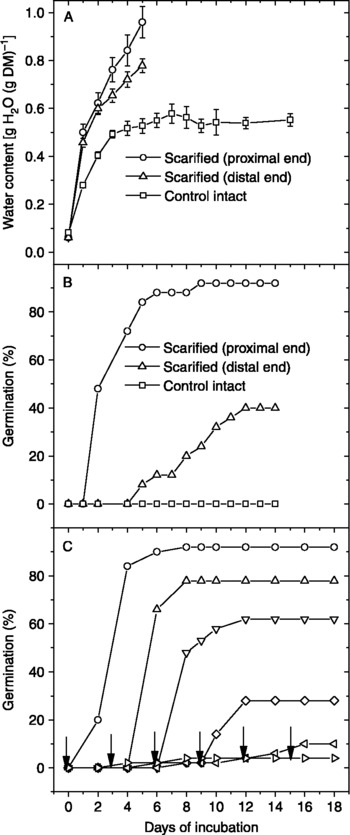
Intact and scarified seeds have different patterns of increased water content during incubation in water (Fig. 1A). Water content in intact seeds levelled off after 3 d of incubation, whereas water contents of the scarified seeds continued to increase. The increase of water content was similar for both types of scarified seeds during the first 2 d. Later on, the increase of water content was faster in seeds scarified on the proximal end than on the distal end.
Effect of scarification on water uptake (A) and germination (B and C) of Lannea microcarpa seeds incubated on moist filter paper at 30°C. Scarification of air-dried seeds was carried out on dry seeds (A and B), or 0, 3, 6, 9, 12 and 15 d after the start of incubation (C, arrows indicate the day of scarification). Scarification of dry seeds was carried out either on proximal or distal ends of the seed (A and B). Delayed scarification was carried out on the proximal end (C). Each point is the average water content of ten individual seeds ± SE (A) or the average germination percentage of two batches of 2 × 25 seeds each (B and C).

The range of germination for fresh seeds was 16–28%. After drying, intact seeds did not germinate during 2 weeks of incubation in water (Fig. 1B). When scarified on the proximal end, seeds began to germinate on the second day of incubation, with a maximum germination of 92% at day 9. Germination of seeds scarified on the distal end occurred through the hole made during scarification, i.e. opposite to the normal germination side. Radicle protrusion in these seeds started at the fifth day of incubation, and a maximum germination of 40% was reached at day 12. Delayed scarification of the proximal end at different times during incubation showed a gradual decrease of seed viability until day 15, when scarification caused only 2–4% of the seeds to germinate (Fig. 1C).
Membrane intactness in axes from non-germinated seeds
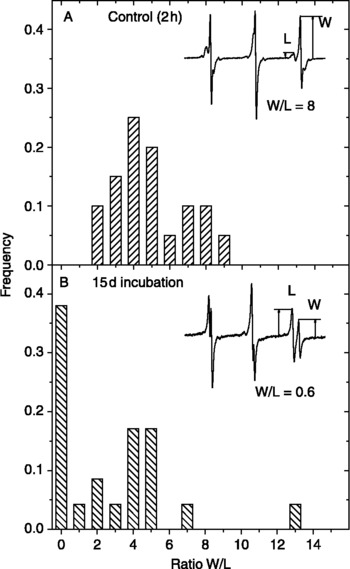
Membrane intactness in axes of non-germinated seeds after 15 d of incubation was analysed by a spin-label technique. Briefly, the axes were placed in an aqueous solution of spin label (PDT) and broadening agent (ferricyanide ions) for labelling. The EPR spectrum of PDT in axis cells contained two superimposed components, originating from the spin label in the aqueous cytoplasm and lipid bodies (Fig. 2A and B, inserts). In leaky cells, the aqueous cytoplasmic signal is zero because of the broadening effect of ferricyanide ions that have entered the cells through damaged membranes, whereas the lipid signal remains unchanged. The upper part of the high field (right-hand-side of the spectrum) water line was used to estimate the aqueous component of the spectra (W), which is proportional to the total cytoplasmic volume of cells with intact membranes. The amplitude of the lipid component (L) is proportional to the total number of cells in a sample without respect to membrane intactness. By measuring W/L in the EPR spectra, the proportion of cells with intact plasma membranes was estimated (Golovina and Tikhonov, Reference Golovina and Tikhonov1994; Golovina et al., Reference Golovina, Tikhonov and Hoekstra1997; Neya et al., Reference Neya, Golovina, Nijsse and Hoekstra2004). Axes with higher W/L ratios (Fig. 2A, insert) contain more intact cells then those with low W/L values (Fig. 2B, insert). The extent of cell swelling during imbibition or cell extension during germination should increase the proportion of the water component in the spectra and thus W/L values.
Distribution of the W/L ratios calculated from the electron paramagnetic resonance (EPR) spectra (inserts) of perdeuterated TEMPONE (PDT) in individual axes from Lannea microcarpa seeds. Axes were excised from decoated seeds that were rehydrated at 30°C for 2 h (n = 20; panel A), or from intact seeds after 15 d of incubation at 30°C (n = 50; panel B). Inserts show representative EPR spectra of PDT in cells of an axis excised from a decoated seed after 2 h of imbibition (top) or from a seed after 15 d of incubation (bottom). The spectra contain two superimposed components. Determination of the heights of the lines representing aqueous cytoplasm (W) and lipid bodies (L) is as indicated in the figure. The ratio W/L was used as an indicator of cellular integrity.

Figures 2A and 2B show the distribution of W/L values of individual axes isolated from decoated, 2 h rehydrated seeds and from intact seeds after 15 d of incubation at 30°C, respectively. Axes from the 2 h incubated decoated seeds (control) had a distribution of W/L values ranging from 2 to 9. Because all the cells in the control samples are viable, the range of the distribution of W/L values is likely caused by the different extent of cell swelling. The distribution of W/L from the seeds incubated for 15 d was different. Thirty-eight percent of the axes from 15-d incubated seeds lost firmness and did not stain in tetrazolium chloride. EPR spectra of rotted axes did not have a water component (W/L = 0), indicating the absence of living cells. All other axes stained in tetrazolium chloride, but scarification on the proximal end did not induce their germination (Fig. 1C). The W/L value of 13 probably indicates cell extension, which occurred in a few cases (2–4% of which germinated, Fig. 1C). The W/L values below 2 are out of the range expected for viable axes. The rest of the axes had W/L values from 2 to 7, which was within the range of the viable control.
Effect of drying and rehydration on seed respiration
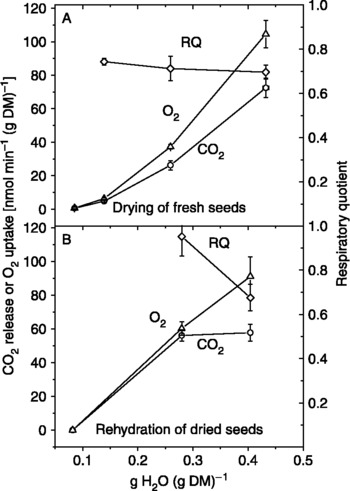
Oxygen uptake and CO2 evolution during drying of freshly depulped seeds from 0.43 g H2O g− 1 to the air-dried state are shown in Fig. 3A. Respiratory activity decreased with the loss of water to reach immeasurably low values c. 0.1 g H2O g− 1. The respiratory quotient (RQ) was c. 0.7. On drying, there was no indication of unbalanced respiration caused by a possibly impeded O2 uptake. During the first 2 d of rehydration of the air-dried seeds, respiration increased to values similar to those of the freshly depulped seeds at comparable water contents (Fig. 3B). Also, RQ values returned to approximately the same values. This indicates that the seeds were able to recruit sufficient O2 to avoid fermentative metabolism, at least during the first 2 d of rehydration.
Effects of (A) drying of freshly depulped seeds and (B) rehydration of intact, air-dried seeds of Lannea microcarpa on respiratory gas exchange and respiratory quotient (RQ). Samples for gas analysis by gas chromatography were taken after 5 h of seed respiration in 7-ml flasks at 30°C. Conditions for the depulped seeds (A) were 8 d total drying time, 5 seeds per flask (n = 4) ± SE, and for the rehydrating seeds (B) were 2 d rehydration, 1 seed per flask (n = 6) ± SE.

Effect of scarification on seed respiration
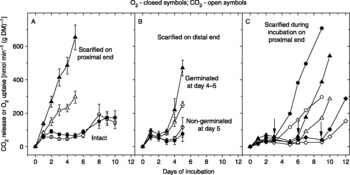
The gas exchange rate from scarified seeds (proximal end) was higher than that from intact seeds at day 1 of incubation, and continued to increase following radicle emergence at day 2 (Fig. 4A). The respiratory activity of the non-germinating intact seeds remained constant during days 1 through 6 after an initial increase due to rehydration, and then slightly increased, perhaps due to the decay of some of these seeds.
Effect of scarification on respiratory gas exchange from rehydrated Lannea microcarpa seeds at 30°C. (A) Seeds were intact and did not germinate (open and closed circles) or were scarified on the proximal end (open and closed triangles), which allowed for emergence of the radicle from day 2 onwards; data are the average ( ± SE) of measurements of 6–10 individual seeds. (B) Seeds were scarified on the distal end of the seed and categorized according to whether they displayed radicle emergence at day 4–5 (n = 6) or did not at day 5 (n = 4). (C) Seeds were scarified on the proximal end at 3, 6 and 9 d of incubation; each point is the average value of 5 individual seeds. Samples for gas analysis by gas chromatography were taken after 5 h of seed respiration in 7 ml flasks at 30°C. Closed symbols, oxygen uptake; open symbols, carbon dioxide release.

Seed scarification on the distal end also allows oxygen to have free access to the embryo. Because gas exchange measurements were performed on individual seeds, categories of non-germinating and germinating seeds were tested for respiratory activity separately. Those seeds that did not germinate in spite of scarification had the same amount of respiration as intact non-scarified seeds. The upsurge of respiration coincided with the emergence of the radicle (Fig. 4B).
Further support of these results was obtained in experiments with delayed scarification. Seed scarification on the proximal end at days 3, 6 and 9 of incubation led to an upsurge in respiration, but with decreasing intensity (Fig. 4C). The degree of respiration upsurge correlated with the percentage of germinated seeds (Fig. 1C). In all cases, the RQ was c. 1 for non-germinating seeds and c. 0.7 for germinating seeds (data not shown).
Possible role of ethylene in the regulation of seed germination
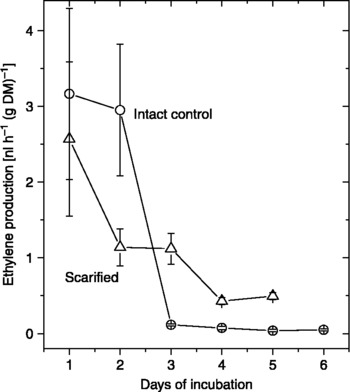
Figure 5 shows the evolution of ethylene from intact and scarified seeds (at their proximal ends) during incubation in water. The rate of ethylene production was determined by sampling headspace gas after 9 h of ethylene accumulation. After a peak in the production on day 1, the ethylene emanation by scarified seeds gradually decreased with time of incubation. The controls had high ethylene production at days 1 and 2, after which ethylene emanation fell to almost zero.
Ethylene release by intact and scarified (proximal end) Lannea microcarpa seeds upon incubation at 30°C. Each point is the average value of the ethylene production of ten individual seeds ± SE. Ethylene was allowed to accumulate in the headspace of 7 ml flasks for c. 9 h.

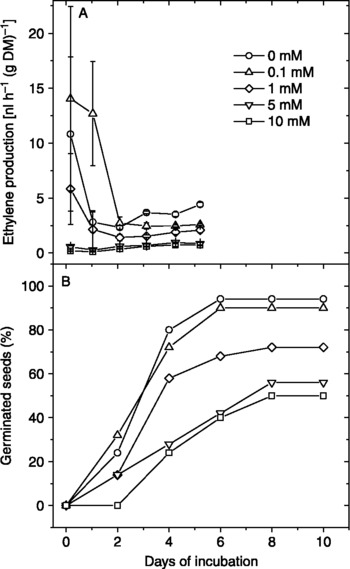
The effect of the 1-aminocyclopropane-l-carboxylic acid (ACC)-synthase inhibitor amino-ethoxyvinylglycine (AVG) on ethylene evolution is shown in Fig. 6A. Seeds scarified on the distal end were incubated in solutions of a range of AVG concentrations. Ethylene production was determined in headspace gas after 2 h of accumulation. Inhibition of ethylene production by AVG was concentration dependent, and ≥ 1 mM AVG caused almost complete inhibition during the first 4 h of seed incubation. Inhibition of ethylene production decreased the rate and final percentage of germination (Fig. 6B). The inhibition of germination was concentration dependent; but even at high AVG concentrations, when ethylene production was almost zero (Fig. 6A), half the seeds still germinated (Fig. 6B).
Effect of amino-ethoxyvinylglycine (AVG) on (A) ethylene biosynthesis and (B) percentage germination of Lannea microcarpa seeds upon incubation at 30°C. All seeds were scarified on the proximal end prior to rehydration in the AVG solutions. Each point in (A) is the average ethylene production of four individual seeds ± SE. Ethylene was allowed to accumulate for c. 2 h. Each point in (B) is the average percentage germination of 2 × 25 seeds.

Seed coat composition
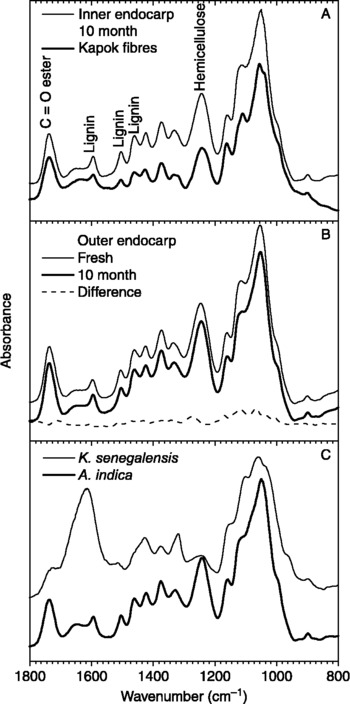
Using FT-IR, the main endocarp components were determined on the basis of specific IR-absorption peaks. Figure 7A shows the IR-spectrum of material scraped from the inner layer of the endocarp. There was no evidence for the presence of lipids or proteins. Instead, a number of IR-absorption peaks could be linked to structural carbohydrates and lignin (Yu et al., Reference Yu, Christensen, Christensen and McKinnon2005).
Fourier transform infrared spectra. (A) Material from the inner layer of the endocarp of air-dried Lannea microcarpa seeds after 10 months of storage (0% germination), with dry kapok fibres shown for comparison. The position of peaks associated with the carbonyl C = O stretching vibration (1737 cm− 1), the lignin-specific aromatic ring vibrations (1461, 1505, 1595 cm− 1) and hemicellulose (1243 cm− 1) are indicated. (B) Comparison of material from the outer layer of endocarp from fresh L. microcarpa seeds (28 ± 6% germination) and after 10 months of storage, with the difference spectrum shown at the bottom of the panel. (C) Material scraped from the outer layer of the endocarp from Azadirachta indica and from the seed coat of Khaya senegalensis.

The carbonyl C = O stretching absorbance at 1737 cm− 1 refers to the ester bonds of the hemicelluloses, lignins and cellulose, and the absorbance at 1243 cm− 1 points to the presence of hemicelluloses (Yu et al., Reference Yu, McKinnon, Christensen and Christensen2004, Reference Yu, Christensen, Christensen and McKinnon2005). The peaks at 1595, 1505 and 1461 cm− 1 are associated with aromatic ring vibrations in lignin molecules (Dorado et al., Reference Dorado, Almendros, Field and Sierra-Alvarez2001; Sun et al., Reference Sun, Sun and Sun2004), whereas the main peak at 1050 cm− 1, associated with C–O stretching, and another at 1159 cm− 1 can be assigned mainly to cellulose (Ilharco et al., Reference Ilharco, Garcia, Lopes da Silva and Vieira Ferreira1997; Sun et al., Reference Sun, Sun and Sun2004). The other peaks may be the result of both lignin and cellulose, since these compounds have overlapping peaks in this wavenumber region (Dorado et al., Reference Dorado, Almendros, Field and Sierra-Alvarez2001).
For comparison, the spectrum of kapok fibres is shown in Fig. 7A. It resembles to a large extent the spectrum of the inner endocarp layer of L. microcarpa. Kapok has a composition of c. 43% cellulose, 13–15% lignin and 32% hemicellulose (Brink and Escobin, Reference Brink and Escobin2003). From this similarity, it is assumed that the endocarp of L. microcarpa has approximately the same composition. Figure 7B shows representative spectra of material from the outer layer of the endocarp, isolated from fresh seeds (0.43 g H2O g− 1) and seeds after 10 months of dry storage (0.04 g H2O g− 1). There was no large difference in peak position and area under the peaks, as evidenced by an almost flat difference spectrum. FT-IR analysis was carried out with two or three specimens from three seeds, each scraped from the outer and inner layers of the endocarp. The endocarp of neem (Azadirachta indica) seed, removal of which promotes radicle emergence (Neya, unpublished data), exhibited an IR spectrum almost identical to that of the L. microcarpa endocarp (Fig. 7C). On the contrary, the IR-spectrum of the Khaya senegalensis seed coat differed considerably from that of the L. microcarpa endocarp, in that hemicelluloses were low and lignins were almost absent. Growing radicles of K. senegalensis always break through the seed coat easily (Neya, Reference Neya2006).
Discussion
Endocarp impedes germination of L. microcarpa seeds
Germination of both fresh and dry seeds of L. microcarpa is very variable among and within seed accessions. Drying increases germination of seeds from green fruits, does not influence the germination of seeds from green-red fruits and decreases the germination of seeds from purple-black fruits (Neya, Reference Neya2006). The increase of seed germination with drying is related to seed maturation (Neya, Reference Neya2006) or to loss of physiological dormancy (Pritchard et al., Reference Pritchard, Daws, Fletcher, Gaméné, Msanga and Omondi2004). The decrease of seed germination with drying of mature seeds from purple-black fruits obviously relates to coat-imposed constraints, because mechanical scarification improved germination considerably (Fig. 1B). Differences in the extent of such constraints among seeds are likely to be the cause of the variability in germination.
The embryo of L. microcarpa seeds is enclosed by a seed coat (testa) and a fruit coat (endocarp). The seed coat is a thin, papery layer and can hardly impose any constraints on seed germination. However, the endocarp is a well-developed outer covering of the seeds (Baskin et al., Reference Baskin, Baskin and Li2000), which is responsible for the constraints of germination. In spite of the fact that impermeability of the endocarp for water is common in the Anacardiaceae family that inhabits arid and semi-arid regions (Baskin and Baskin, Reference Baskin and Baskin1998), the endocarp of L. microcarpa is water permeable, and the seed imbibes freely during incubation (Pritchard et al., Reference Pritchard, Daws, Fletcher, Gaméné, Msanga and Omondi2004; Neya, Reference Neya2006; Fig. 1A). The production of inhibitors by coats is also unlikely, because the removal of only a small part of the endocarp during scarification allows seed germination (Fig. 1B). The possible involvement of three other mechanisms was tested: interference with gas exchange, retention of inhibitors and mechanical constraints.
Interference with gas exchange
Permeability of the endocarp to water does not necessarily rule out its ability to interfere with gas exchange (Bewley and Black, Reference Bewley and Black1994). Drying of L. microcarpa seeds decreased their subsequent germination from 16–28% to 0%. If the permeability of the endocarp to respiratory gases changes during their drying, respiration characteristics will also change, leading to the inhibition of respiration and stimulation of fermentation (Wager, Reference Wager1974; Rolletschek et al., Reference Rolletschek, Borisjuk, Koschorreck, Wobus and Weber2002). The end products of such fermentation may be damaging to the seed, causing loss of viability (Fig. 1C). A high CO2/O2 ratio (RQ), reaching values considerably above 1, is diagnostic for the lack of sufficient oxygen. From the low RQ values ( < 1) in Fig. 3, it can be deduced that sufficient oxygen is available during rehydration of intact seeds. Moreover, the rates of gas exchange were almost the same at similar water contents in both dehydrating fresh seeds and rehydrating seeds (Fig. 3). Thus, the endocarp does not impede respiratory gas exchange in imbibed L. microcarpa seeds.
However, endocarp permeability for oxygen may be still not enough to allow radicle emergence, when seed demands for oxygen increase. Seeds, scarified on the proximal end attained much higher rates of respiration than intact seeds (Fig. 4A). This might be interpreted as the result of free access to oxygen due to scarification. If this were the case, scarification on the distal end would also cause the immediate increase in respiration. However, the increase of respiration took place only after radicle protrusion (Fig. 4B). In general, high respiratory activity appears to be closely associated with radicle protrusion, but not with making holes in the endocarp during scarification (Fig. 4C). This is comparable with the results of Derkx et al. (Reference Derkx, Smidt, Van der Plas and Karssen1993), who found that dormancy breaking in seeds of Sisymbrium officinale does not cause an upsurge in O2 uptake, but completion of germination does. Radicle protrusion as the result of completed germination also caused a decrease of the RQ from 1 (carbohydrate oxidation) to 0.7 (oil oxidation). This indicates the switch of metabolism from using carbohydrates (sugars) as substrates for respiration to oil, which is a sign of the mobilization of the major storage reserves during seedling growth.
Ethylene production
The effect of the endocarp on seed germination may also be connected with insufficient ethylene production (Bewley and Black, Reference Bewley and Black1994). Ethylene is produced by the embryo during the initial stages of germination and has a close relationship with cell elongation (Abeles, Reference Abeles1986; Sánchez-Calle et al., Reference Sánchez-Calle, Delgado, Bueno, Diaz-Miguel and Matilla1989). In the ethylene biosynthesis pathway, the conversion of 1-aminocyclopropane-l-carboxylic acid (ACC) to ethylene is oxygen dependent (Adams and Yang, Reference Adams and Yang1979). The release of seeds from dormancy is associated with enhanced consumption of oxygen, which is not only involved in respiration, but also in other metabolic processes playing a role in the breaking of dormancy. Insufficient oxygen supply may decrease ethylene production and influence cellular extension and radicle protrusion. Therefore, ethylene emanation from intact seeds of L. microcarpa was compared with that of seeds scarified on their proximal end. A peak in ethylene in the headspace gas over both intact and scarified seeds was noted early during incubation; after that the evolution fell to low values (Fig. 5). This demonstrates that the endocarp is permeable to ethylene and does not interfere with ethylene production by the seed.
Usually the peak of ethylene production is associated with radicle protrusion (Kepczynski and Kepczynska, Reference Kepczynski and Kepczynska1997). In the case of scarified seeds, ethylene emanation decreased considerably at day 2, when radicles started to emerge (Fig. 1B and Fig. 5). The ethylene production by scarified seeds remained in the range of 0.5–1 nl h− 1 g− 1 at days 4 and 5, which could be associated with radicle growth occurring at the same time. On the contrary, intact seeds continued to produce ethylene on day 2 at the same rate as on day 1. However, at day 3 and after, intact seeds did not produce ethylene, even though they were still viable, and scarification on this day led to 78% germination (Fig. 1C). At day 3, the increase in water content levelled off. Probably, both events were associated with the inability of the cells to elongate. Thus, the endocarp does not interfere with ethylene production.
While almost all seeds produce ethylene during germination, requirements for this hormone vary among species (Lalonde and Saini, Reference Lalonde and Saini1992). To verify whether ethylene production is necessary for the germination of L. microcarpa seeds, the effect of amino-ethoxyvinylglycine (AVG), an ACC-synthase inhibitor, on ethylene evolution and seed germination was followed. In germinating seeds, ethylene is known to be synthesized exclusively from ACC produced de novo (Kepczynski and Kepczynska, Reference Kepczynski and Kepczynska1997). The inhibition of the ethylene production by AVG (Fig. 6A) shows that ethylene in L. microcarpa seeds is also produced via de novo synthesized ACC and not by conversion of pre-existing ACC. Germination decreased with the increased concentration of AVG (Fig. 6B). However, even when the production of ethylene was almost abolished by a high concentration of AVG, 50% of seeds were still able to germinate. These data show that the requirements for endogenous ethylene during germination of L. microcarpa seeds vary among seeds.
Mechanical constraints and retention of inhibitors
Because the endocarp in L. microcarpa seeds is hard, tough tissue, it is reasonable to expect mechanical constraints as the main mechanism of inhibition of seed germination. The radicle always emerged through the hole made during scarification, even when it was made on the end opposite from where the radicle normally emerges – evidence for a strong mechanical restriction of germination.
The continuing increase of water content in seeds scarified on the proximal end shows that this treatment allows cellular extension followed by radicle protrusion at day 2. In intact seeds the endocarp prevents cellular extension, and water content increases only due to osmotic forces, and thus levelled off after 3 d of incubation. However, seeds scarified on the distal end had the same pattern of water content increase as seeds scarified on the proximal end, despite the observation that radicle protrusion occurred 3 d later (Fig. 1A and B). In this case, radicle extension also took place early during incubation, but inside the seed, enabling the radicle to find the hole for visible protrusion. This occurred in only 40% of the seeds. Probably, only the most vigorous embryos can emerge from the hole at the distal end of the seeds.
The different patterns of germination of seeds scarified on the proximal and distal ends also suggest that the retention of inhibitors is not involved in lack of germination of intact seeds. If this were the case, the position of the hole made by scarification would not influence the pattern of germination because of inhibitor leakage through the hole.
Loss of viability of incubated intact seeds
The percentage of radicle protrusion decreased with time of seed incubation in water before scarification (Fig. 1C). Germination fell to 2–4% when the seeds were scarified at day 15. Apart from 38% soft, obviously rotten seeds after 15 d of incubation at 30°C, the remaining 62% of seeds were still firm and looked viable. However, there was no sign of cellular extension. This follows from the fact that the majority of axes from the firm seeds had W/L values of 2–7 (Fig. 2B), which is within the range established for just-rehydrated, but not extended, viable axes (from 2–9) (Fig. 2A). Only in few cases (c. 4%) did W/L increase to 13 or decrease to 1 (Fig. 2B). W/L = 1 indicates a loss of membrane integrity in the majority of cells; W/L = 13 relates to cellular extension. If cellular extension occurred in all the axes, the distribution of W/L values would be well above 9 after 15 d of rehydration. The inability of cells to extend is also supported by the limited increase of water content in non-scarified seeds (Fig. 1A). Thus, endocarp-imposed mechanical constraints prevent not only radicle emergence, but also cell extension before protrusion.
The inability of seeds to germinate results in their slow decay, but the reason for this is unclear, because the endocarp does not interfere with water and gas exchange. Also, ethylene is not involved in the slow decay of the hydrated, intact seeds, because radicle emergence could be evoked by delayed scarification of the incubated, intact seeds (Fig. 1C), long after ethylene had dissipated. The loss of seed viability after long incubation without germination of intact seeds may be associated with the exhaustion of the sugar pool as a respiratory substrate for the axes and inability to use other substrates (oil), because the program of seedling growth is not switched on. The CO2 production of c. 60 nmol min− 1 g− 1at 30°C by hydrated, intact seeds (Fig. 4) leads to a (calculated) weight loss of c. 0.3% of the DM per day and consequently to 4.5–5% after 15 d.
Relationships between endocarp composition and hardness
In situ Fourier transform infrared microspectroscopy (FTIR) was used to find the relationships between endocarp composition and its hardness. The hard endocarps of L. microcarpa (Fig. 7A) and A. indica (Fig. 7C) contain lignin and hemicellulose. On the contrary, K. senegalensis seeds do not have such an endocarp; their seed coats are soft and do not contain lignin and hemicellulose (Fig. 7C).
The FTIR spectra of the endocarp of L. microcarpa are not changed upon drying and dry storage of seeds (Fig. 7B), while hardness increases and does not decrease after rehydration. There may be irreversible structural changes in the endocarp during drying. This may relate to covalent binding of lignin to hemicellulose, which confers mechanical strength to the cell wall. The cross-linking of polysaccharides by lignin is an potential obstacle for water absorption by the cell wall (http://en.wikipedia.org/wiki/Lignin), which may prevent endocarp swelling during rehydration.
Ecological and practical consequences of L. microcarpa seed germination behaviour
L. microcarpa seeds are shed at the beginning of the rainy season (Arbonnier, Reference Arbonnier2002), i.e. favourable conditions for immediate germination. They are not subjected to maturation drying, but can withstand dehydration and maintain viability in dry state for 2 years or more (Neya, Reference Neya2006). However, drying may cause the endocarp-imposed constraints to germination. It is debatable as to whether endocarp strengthening can be considered as secondary dormancy, which aids in the dispersal of L. microcarpa seeds in space and time, or a fatal constraint, such that dry seeds will never germinate in nature. Nevertheless, non-germinated dry L. microcarpa seeds can still be used for reproduction in forestry practice if they are scarified on the micropylar end of the seed before germination. The loss of viability of rehydrated seeds (Fig. 1C) within 15 d at 30°C is not a likely strategy followed in nature.
Acknowledgements
The fellowship of the Dutch Organization for the Advancement of Tropical Research (WOTRO) for O.N. is gratefully acknowledged.