Introduction
Influenza is an important cause of morbidity and mortality for older people living in aged care facilities (ACFs), but influenza outbreaks in such facilities are also an additional cause of morbidity, and (rarely) mortality in the staff, and such outbreaks can lead to a reservoir of infection for the local community, and influence the spread and persistence of infection in a wider area. This mix of individual and public health issues make influenza control and management a complex area for general practitioners, geriatricians, public health physicians, ACF staff and providers and has major implications for policy and practice. Adding to this complexity is the still commonly heard phrase that ‘pnuemonia is the old man's friend’, with some including influenza in this dictum. However, influenza is much more than an individual illness that could be the final illness for a frail older person, it is a highly infectious agent, and as most frail older people live in regular contact with other people, these factors will clearly influence the management of infection in older people. ACFs are not isolated islands but a dynamic part of local communities, with frequent movement of staff and residents and thus are ideal vehicles to spread infectious diseases such as influenza. The term ‘aged care facilities’ covers the variety of group residential living arrangements for older people variously called nursing homes, residential homes, group homes, hostels (low-level care facilities in Australia), and long-stay hospitals. They are all characterized by group living arrangements in shared or single bedrooms/wards, with carers providing some or all care in basic and extended activities of daily living.
Search methods
Bibliographic literature was searched using the terms: aged; influenza; immunogenicity; amantadine; nursing homes; and aged care facilities. Extensive use was made of the completed systematic reviews in the Cochrane Library. This review has concentrated on seasonal influenza and not pandemic influenza A/H1N1.
Burden of influenza for older people
Influenza causes infection, predictably in the winter months (equatorial regions often have two seasons in the year), with major outbreaks of infection every three or four years.Reference Tillett, Smith and Gooch1, Reference Brotherton, Wang, Schaffer, Quinn, Menzies, Hull, Lawrence, Wood, Wood, Rosewell, Newall, MacIntyre, Macartney, Gidding, McIntyre and Booy2 Hospitalization and deaths are most common in older people, with those in ACFs particularly at risk.Reference Molinari, Ortega-Sanchez, Messonnier, Thompson, Wortley, Weintraub and Bridges3 In England and Wales there are about 800,000 general practitioner consultations, 19,000 hospital admissions and between 12,000 and 18,000 deaths per year attributed to influenza, with most deaths amongst older people.Reference Pitman, Melegaro, Gelb, Siddiqui, Gay and Edmunds4 In the USA there are over 40,000 deaths per annum. In the United Kingdom, rates of 22.9/10,000 hospitalizations for those 65 years and over have been estimated (less than due to Streptococcus pneumonia but greater than hospitalizations due to Haemophilus influenzae or respiratory syncytial virus).Reference Muller-Pebody, Crowcroft, Zambon and Edmunds5 Deaths attributed to influenza are almost certainly an under-estimate, with those with pre-existing heart and lung disease at particular risk.Reference Sprenger, Mulder, Beyer, Van Strik and Masurel6 As residents of ACFs are likely to have cardiorespiratory chronic disease, they have a much higher risk of dying from influenza infection. In previous studies, the costs of influenza in ACFs have been mainly attributed to the costs of hospitalization, but these types of studies may not represent current costs, with the additional public health active surveillance and interventions, including the cost of the use of anti-virals for treatment and prophylaxis.Reference Carroll, Delafuente, McClure, Weakley, Khan and Cox7
Recognizing an outbreak
The characteristics of influenza-like illness (ILI) are used to identify potential influenza cases.8 The definition has a number of variations but are all based on the fever, cough and/or other respiratory symptoms. The likelihood of a resident of an ACF having influenza with these types of symptoms depends on many factors. Outside the usual influenza season, the likelihood will be low. In a typical influenza season, the pre-test likelihood is much higher, and in the context of an established outbreak, the diagnosis should be influenza until proven otherwise. This emphasizes the importance of the routine surveillance systems that indicate when an influenza season has commenced, and the need to relay this data to appropriate primary care teams. In fact, during a confirmed influenza outbreak, it is reasonable to assume that any new illness in a resident of an ACF is influenza.
One promising method of identifying influenza outbreaks is active surveillance. In one recently reported study, a policy of active surveillance consisting of thrice weekly telephone calls to 16 ACFs resulted in the identification of seven respiratory outbreaks in a six-month period in the southern hemisphere autumn to spring (including all the winter months).Reference Rosewell, Chiu, Lindley, Dwyer, Moffatt, Shineberg, Clarke, Booy and MacIntyre9 In this study, great efforts were made to make an aetiological diagnosis. In three of the outbreaks the cause was not found, one was due to respiratory syncytial virus (RSV), one due to parainfluenza and two due to influenza A. This study is important for three reasons: more outbreaks were detected than indicated by data from the routine reporting systems in the area; a surprisingly large number of outbreaks occurred; and only a minority of outbreaks were actually due to influenza. Correct diagnosis is now important otherwise people may be exposed to unnecessary or ineffective treatment if all respiratory outbreaks are assumed to be influenza.
Making the correct aetiological diagnosis
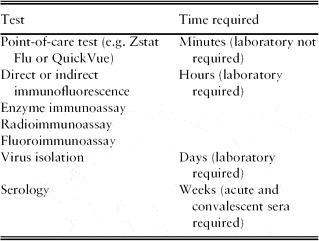
With the advent of anti-viral treatment for influenza it is now important to make an early diagnosis. Patients with ILI should be tested for influenza. Until recently this was a difficult procedure. The correct sample had to be taken with the correct swab (a nasopharyngeal swab, taken with enough vigour to obtain columnar epithelial cells lining the nasal passages), with the swab then placed in viral transport medium to avoid desiccation, and ideally transported to the laboratory at 4°C as quickly as possible.Reference Playford and Dwyer10 Whilst this is still the gold standard, there are now point-of-care (POC) kits that can indicate influenza infection in a matter of minutes. Again, the correct technique for collecting the sample to be tested is essential but with appropriate training, nursing staff at ACFs can perform these investigations. The advantage of the POC test is that an early confirmation of an outbreak can be made and interventions started whilst a formal laboratory confirmation is made (and this is still important). The main laboratory investigations are shown in Table 1.
Diagnostic tests for influenza

Control of an outbreak
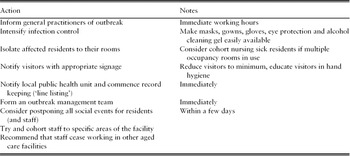
An outbreak can be defined as two cases of ILI in staff or residents over a 3-day period, with at least one testing positive for influenza, or, alternatively, three cases of ILI in staff or residents over a 7-day period.Reference Rosewell, Chiu, Lindley, Dwyer, Moffatt, Shineberg, Clarke, Booy and MacIntyre9 Once an outbreak is established there are a large number of steps that must be taken to reduce the impact (Table 2, Figure 1) in addition to managing the care of the residents who are sick.Reference Jefferson, Del Mar, Dooley, Ferroni, Al-Ansary, Bawazeer, van Driel, Foxlee and Rivetti11 If members of staff are identified as having influenza they need to go home and be off sick until recovered or at least 5 days after onset.
Required actions following declaration of influenza outbreak8

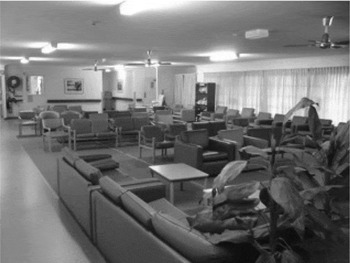
A picture taken during the day of the lounge in an aged care facility during an influenza outbreak: residents were confined to their rooms.

Treatment and prophylaxis of influenza outbreaks
There are two main available influenza control strategies: vaccination and anti-viral treatment. Although vaccination has been the mainstay of prevention for decades, the advent of anti-viral medication has led to additional options being available. The public health benefits of vaccination for older people in ACFs should accumulate from several different strategies: herd immunity in a highly vaccinated community; vaccination of the residents of ACFs; and vaccination of staff of ACFs (or both staff and residents).
There is very strong public health advice and guideline recommendation to have high vaccination levels for both residents and staff of ACFs, but interestingly formal reviews of the primary evidence have not been as convincing as might be expected. The Cochrane Systematic Review by Jefferson and colleagues found little convincing data of the value of influenza vaccination in adults aged 65 years or older, and recommended that appropriately large randomized controlled trials (RCTs) were carried out (with public funds if necessary). They noted that significant biases were likely in the large database of largely non-RCT data.Reference Jefferson, Di Pietrantonj, Al-Ansary, Ferroni, Thorning and Thomas12 However, over-emphasis on the very highest levels of evidence (the methodologically purest approach) may not be appropriate for interventions for which there is little risk (such as vaccination), where observation studies can provide additional data and for a population for which it is notoriously difficult to do high quality RCTs.Reference Ridda, Lindley and MacIntyre13 Kelly and colleagues have also pointed out the difficulty of ethically performing a new RCT in an area with a well-established public health intervention (influenza vaccination for older people).Reference Kelly and Newall14 Others have used a different approach to obtain evidence to support vaccination; for example, Dean et al. estimated vaccine effectiveness (VE) during a large cluster RCT of influenza control and found that VE was: 61% for laboratory proven influenza; 51% for ILI; 82% for pneumonia and influenza related hospital admission and 71% protection against mortality from all causes (albeit with large confidence intervals).Reference Dean, Moffatt, Rosewell, Dwyer, Lindley, Booy and MacIntyre15 These data are reassuring that vaccination does indeed play a role in such frail older people, despite evidence that their immune response will be less robust than younger healthier adults.Reference Goodwin, Viboud and Simonsen16
The value of vaccination of health care workers has also been systematically reviewed, and again the authors concluded that the data were unsatisfactory although showing promise in reducing the non-specific outcomes of ILI, general practitioner consultations for ILI, and all-cause mortality for residents older than 60 years.Reference Thomas, Jefferson and Lasserson17 This review consisted of four cluster RCTs and one cohort study, but they were considered to have a moderate to high risk of bias.
On the other hand, epidemiological studies have been far more encouragingReference Sprenger, Mulder, Beyer, Van Strik and Masurel6, Reference Armstrong, Mangtani, Fletcher, Kovats, McMichael, Pattenden and Wilkinson18–Reference Thijs, Beyer, Govaert, Sprenger, Dinant and Knottnerus20 but have been criticised as being too optimistic in their estimates of the benefit of vaccination to prevent influenza death and morbidity in older people.Reference Simonsen, Taylor, Viboud, Miller and Jackson21
In summary, we have very strong public health advice to vaccinate older ACF residents, the staff of such facilities and the general population. With this current public health environment, further RCTs are ethically difficult, and there is the risk of sending conflicting messages to the general public. Given that the risks of vaccination are extremely small and the potential benefits substantial, and that policy is now entrenched, it appears reasonable to continue with current practice, albeit recognizing that there would be great value in obtaining more reliable data on vaccination efficacy. One potential solution is to find an area of the world where influenza vaccination is not widespread for older people, but where influenza is an important cause of morbidity and mortality. In such a country, a new RCT could be justified, as participants would have a 50% chance of getting a potentially beneficial immunization, which would otherwise be unavailable. The advantage of this strategy would be the production of appropriate evidence to introduce such immunization to the currently unvaccinated community.
Anti-viral treatment
The advent of anti-viral medication has allowed a far more active approach to be taken for influenza outbreaks. Available anti-virals include amantadine and rimantidine (M2 ion channel inhibitors) and oseltamivir and zanamavir (neuraminidase inhibitors). Following the introduction of the neuroaminidase inhibitors, the use of the M2 ion channel inhibitors has become less common due to their less favourable side-effects, their lack of efficacy for influenza B and increased rates of resistance, although these may still have value in difficult outbreak situations.Reference Alves, Rocha-Crispino-Santos and Alves da Cunha22 Oseltamivir (given orally) and zanamavir (inhaled) work by inhibiting neuraminidase and thus prevent the influenza virus from leaving the host cell. They are both effective for influenza A and B.23 There are two main indications to use the neuraminidase inhibitors: treatment of affected individuals and for prophylaxis of close contacts. A recent systematic review showed that these drugs, in healthy adults and children, were effective at preventing infection if given for prophylaxis and helped reduce the period of illness.Reference Jefferson, Jones, Doshi and Del Mar24 However, there was difficulty in obtaining data on other important secondary outcomes such as complications, and thus there is uncertainty of any benefits for these particular outcomes.Reference Jefferson, Jones, Doshi and Del Mar24 There have been few studies conducted in ACFs. One study compared inhaled zinamivir to rimantadine and found that zanamivir was well tolerated.Reference Schilling, Povinelli, Krause, Gravenstein, Ambrozaitis, Jones, Drinka, Shult, Powers and Gravenstein25 However, the design and size of this particular study did not allow any definitive recommendations about treatment. A large cluster RCT has been completed comparing a policy of influenza outbreak control with two arms: a policy of oseltamivir for the treatment of affected individuals versus a policy of treatment of affected individuals and prophylaxis of close contacts, in addition to active surveillance. This study included residents and staff and has been presented but not yet published in detail.Reference Rosewell, Chiu, Lindley, Dwyer, Moffatt, Shineberg, Clarke, Booy and MacIntyre9, Reference Dean, Moffatt, Rosewell, Dwyer, Lindley, Booy and MacIntyre15, Reference Lindley, Booy, Heron, Macintyre, Dwyer and Yin26 The preliminary results from this RCT suggest that the policy of treatment and prophylaxis was more effective at reducing the number of cases, deaths and length of ACF outbreaks.Reference Lindley, Booy, Heron, Macintyre, Dwyer and Yin26 However, the very large number of residents that had to be treated in the ‘treatment and prophylaxis’ group suggests that this intervention will be difficult to implement in routine clinical practice without careful planning. One complication for prescribing oseltamivir for frail older people is the requirement to reduce the dose for those with renal impairment. In an emergency outbreak situation this can be a very time-consuming process. Some guidelines have suggested an ‘influenza’ standing order template that allows ACF staff to administer anti-viral treatment on telephone advice from Public Health, or other authority (Table 3).8
An example of an anti-viral standing order form for aged care facilities (adapted from reference 8)

The decision whether to await confirmation of influenza before commencing anti-viral treatment mainly depends on the pre-test probability of influenza being the causative agent.23 In low influenza periods, it is better to await confirmation of the aetiological viral illness.Reference Sintchenko, Gilbert, Coiera and Dwyer27 In the midst of the influenza season, a policy of treat first and await results is probably more effective. After an outbreak has been declared in an ACF, all new febrile illnesses should be assumed to be influenza until proved otherwise.
In general the neuroaminidase inhibitors are well tolerated, with nausea and vomiting being the commonest side-effect seen with oseltamivir, and bronchospasm (very rarely) for zanamivir.23 Both agents can cause hypersensitivity reactions or skin rashes, but these side-effects are rare. The dose of oseltamivir for treatment of influenza is 75 mg orally twice a day for 5 days, and 75 mg once a day for 10 days. Reduced doses should be used for those with renal impairment. Treatment is available as an elixir that is particularly important for frail older people with neurological disability or those with tube feeding. Zanamivir is administered by inhalation by a diskhaler at an adult dose of two 5 mg inhalations twice a day for 5 days for treatment, and two 5 mg inhalations once a day for 10 days for prophylaxis. Treatment is indicated when it can be started within 48 hours of onset of symptoms. Prophylaxis is generally only recommended for a 10-day period, and ‘seasonal’ prophylaxis, i.e. giving prophylaxis through the entire influenza season, is not recommended.Reference Stephenson, Clark and Pareek28 Resistance has been reported and this will require continued vigilance over the next few years. It is not yet certain what effect the influenza A/H1N1 pandemic outbreak had on seasonal influenza susceptibility to the neuroaminidase inhibitors.Reference Van Der Vries, Jonges, Herfst, Maaskant, Van Der Linden, Guldemeester, Aron, Bestebroer, Koopmans, Meijer, Fouchier, Osterhaus, Boucher and Schutten29
Whilst the scientific advances of vaccination and anti-viral treatment can preoccupy many, the importance of good infection control cannot be overemphasized. Good hand hygiene and effective infection control measures will do a great deal to reduce the risk of spread of influenza and control an outbreak, once established.Reference Jefferson, Del Mar, Dooley, Ferroni, Al-Ansary, Bawazeer, van Driel, Foxlee and Rivetti11 Efforts to maintain such quality infection control remain difficult but must provide the basis for all other interventions. Aged care facilities provide an ‘incubator’ for influenza, and the daily movement of staff and visitors in and out of the facility and into the general community provide a very efficient spread of infection. Control of influenza is therefore not only an issue for the individual residents but also a major public health concern.
In summary, like many aspects of geriatric medicine, success in controlling influenza in ACFs depends on doing many simple things well. This can be difficult to achieve without appropriate planning, training and guidance from locally agreed protocols. Whilst the care of the individual is often our major preoccupation, influenza outbreaks in ACFs have a major public impact as a source of infection not only for those living within the facility but also for the workers and visitors. Given the potential risks for frail residents, and the real risks posed to workers and the local population, vaccination remains a key preventative measure. Despite a paucity of good quality research data, there is now some evidence that active management of influenza outbreaks, in addition to general infection control measures, using the new anti-virals is effective. Despite the enormous practical difficulties of conducting research in ACFs, this type of research should be a major priority given our ageing populations and the importance of improving quality of life for frail older people.
Conflict of interest
Richard Lindley has been a paid consultant for CSL, makers of influenza vaccines, in his role as Chairman of Data Monitoring Committees for new randomized trials of influenza vaccination.
Acknowledgements
Richard Lindley is supported by an infrastructure grant from NSW Health.