Introduction
Although clothing is an important means by which women construct and present a feminine identity, the topic has generally been dismissed by academics as trivial (Tseelon Reference Tseelon, Guy, Green and Banim2001). The literature that does exist is primarily in the fields of cultural studies, art and art history. As noted by Klepp and Storm-Mathisen (Reference Klepp and Storm-Mathisen2005) and Twigg (Reference Twigg2007), studies tend to focus narrowly on one or more of: the elite fashion industry, gendered and classed clothing practices, sexual and erotic styles of dress, and the unique clothing markers used by sub-cultural or counter-cultural groups. There has also been some investigation of the ways that weight-conscious women experience consumer culture and use clothing to conceal perceived weight-related bodily flaws (Colls Reference Colls2006; Kwon Reference Kwon1992; Kwon and Parham Reference Kwon and Parham1994; Rudd and Lennon Reference Rudd and Lennon2000; Trautmann, Worthy and Lokken Reference Trautmann, Worth and Lokken2007). In addition, Klepp and Storm-Mathisen (Reference Klepp and Storm-Mathisen2005) and Lurie (Reference Lurie1992) have analysed how clothing is used to differentiate individuals by age. Similarly, Twigg (Reference Twigg2007) theorised about how the clothing choices of older people are enforced and limited by moral discourses that discipline aged bodies. While this literature has provided critical insights into the ways in which older women's bodies are represented, and policed by the framing culture, it has not been supplemented by narrative, everyday accounts of older women's experiences of and attitudes towards clothing.
Building on the extant research, we draw on interviews with 36 women aged 71 to 93 years to explore how older women perceive and use clothing both as a beauty practice and as a means of managing the ageing body. We begin by analysing the women's perceptions of social norms and prescriptions for older women's fashion, and then examine the various strategies that they employed to compensate for manifestations of advanced age and the physical and social realities of ageing. We discuss how the women made clothing choices to negotiate ageism, and elucidate the barriers that they identified in adhering to clothing prescriptions and implementing clothing strategies. In conclusion, we consider older women's clothing choices in the light of current theorising about ageism and the body.
Literature review
Ageism
The physical manifestations of older age, such as wrinkles, grey hair and changes in body composition and skin elasticity, are both normative and a means of delineating those who deviate from societal standards of beauty (Chrisler and Ghiz Reference Chrisler, Ghiz, Davis, Cole and Rothblum1993; Fairhurst Reference Fairhurst, Nettleton and Watson1998). Visible signs of ageing are used as a means of assigning social value, resources and opportunities based on actual and perceived chronological age. In this way, ageism is rooted in an insidious societal obsession with youthfulness and the discriminatory assumption that ‘youth is good, desirable, and beautiful; old age is bad, repulsive, and ugly’ (Healey Reference Healey, Davis, Cole and Rothblum1993: 48; Bytheway Reference Bytheway1995; Nelson Reference Nelson2002; Palmore Reference Palmore1999). Socialised to be more concerned with their appearances than men (Bartky Reference Bartky1990; Bordo Reference Bordo1993), and incessantly compared with the cultural ideal of female beauty – a young, thin, toned, shapely body (Bartky Reference Bartky1990; Bordo Reference Bordo1993; Cortese Reference Cortese2004; Gimlin Reference Gimlin2002; Wolf Reference Wolf1991), women experience the loss of a youthful appearance as particularly damaging. Indeed, women face a ‘double standard’ of ageing (Sontag Reference Sontag1972) and gendered ageism (Ginn and Arber Reference Ginn and Arber1996) as they are simultaneously old and female.
Clothing and the management of the stigma of old age
Barring surgical intervention and sophisticated ‘impression management’ (Goffman Reference Goffman1959), an individual's approximate age is usually evident in face-to-face interactions. Thus, an older woman may experience her physical appearance as bodily capital that is ‘discredited’ if physical markers of age are readily visible, and ‘discreditable’ if the markers exist but are not immediately apparent to the observer (Goffman Reference Goffman1963: 4). Goffman also noted that ‘the stigmatised individual tends to hold the same ideas about identity as we do’ (1963: 7), and as such, tends to downplay the ‘visibility’ (1963: 4) of their stigma, if and whenever possible. In the context of ageing, this entails concealing or diminishing the perceptibility of both the supposed ‘abominations of the body’ represented by physical age-related changes, as well as the perceived ‘blemishes of individual character’ that are signified by any demonstration of increased dependence or loss of mental capacity (loc. cit.).
Previous research has explored the ways in which older women use various forms of beauty work interventions, such as hair dye, make-up and surgical and non-surgical cosmetic procedures, to respond to the perceived social pressure to alter their appearance and obfuscate their chronological age (Hurd Clarke and Griffin Reference Hurd and Griffin2008; Hurd Clarke, Repta and Griffin Reference Hurd, Repta and Griffin2007). Studies of the beauty practices of women aged 70 or more years are lacking, however, and there has been little investigation into how and if older women use clothing as a means of engaging in beauty work. Twigg (Reference Twigg2007: 286) argued that clothing ‘mediates the relationship between the body and the social world, forming the vestimentary envelope that contains and makes manifest the body, offering a means whereby it is experienced, presented and given meaning in particular social contexts’. Thus, particular clothing choices and strategies provide older women with a means of ‘passing’ as younger bodies (Goffman Reference Goffman1963: 73), by concealing or diminishing their discreditable attributes (i.e. those physical markers that would immediately identify them as ‘old’). Clothing is, therefore, a form of ‘masquerade’ (Ballard, Elston and Gabe Reference Ballard, Elston and Gabe2005; Biggs Reference Biggs1999, Reference Biggs2004; Woodward Reference Woodward1991) that is central to the performance of a socially and personally acceptable ageing femininity. This performance is shaped and constrained by the simultaneous ‘submission to dominant codes and resistance to them’ (Biggs Reference Biggs1999: 75).
Referring to socially sanctioned ideologies of dress, Lurie (Reference Lurie1992) acknowledged that clothes have always been an important means of age differentiation, and that what is considered acceptable for a certain age group shifts with time and place. It follows that older women's clothing choices are influenced by moral and inherently ageist prescriptions. As bodily changes occur over the life course and women find themselves progressively less in accordance with the prevailing ideals of beauty (Klepp and Storm-Mathisen Reference Klepp and Storm-Mathisen2005), clothing choices are affected and to some extent determined. More specifically, several trends are apparent when examining the clothing choices of older women. Later-life clothing styles tend to be longer, looser and more shapeless than those of younger adults, and the colours of older women's clothing choices are often muted, dull or soft (Lurie Reference Lurie1992). In general, there is a retreat from any style or colour that may garner attention, as well as an avoidance of sexuality (Twigg Reference Twigg2007).
Twigg (Reference Twigg2007: 295) contended that these social standards result in the ‘policing of the aged body’ and described dress as ‘part of a set of wider processes around disciplining the body, constraining and enabling its expression, making it subject to the discourses of morality’. As a result, lapses of dress according to these prescriptions can indicate either social or moral decline, or an inappropriate attempt to appear youthful. While there is no prescribed age at which women are expected to alter their clothing choices to conform to cultural prescriptions, older styles of dress clearly exist. Women tend to internalise these standards from a young age, and are thus cognisant of the cultural construction of appropriate and inappropriate fashion for their ages and the societal imperative of growing old gracefully (Fairhurst Reference Fairhurst, Nettleton and Watson1998; Twigg Reference Twigg2007).
Situating the current paper
Twigg (Reference Twigg2007: 286) has argued that the way that clothing functions with respect to age is crucial for our understanding of how societal expectations concerning age ‘act upon and present the body’. This theoretical work has not been supplemented, however, by narrative, everyday accounts of older women and their choices, constraints and strategies in the realm of fashion. Using Goffman's (Reference Goffman1963) theorising about the management of stigma, this paper addresses a gap in the literature and examines how older women experience fashion within a gendered and ageist social world (Garner Reference Garner and Garner1999; Ginn and Arber Reference Ginn, Arber, Arber and Ginn1995; Stewart Reference Stewart, Franz and Stewart1994) and strategically use clothing to manage the stigma of having an ageing and aged body.
Data and methods
The study design
The data for this paper were drawn from in-depth interviews with 36 Canadian women aged 71 to 93 years. Following extensive training, a research assistant conducted the interviews under the careful supervision of the primary investigator (the first author). The average duration of the interviews was 1.8 hours. All interviews were digitally recorded and transcribed verbatim with the consent of each participant. The interview schedule had open-ended questions about the women's experiences of various beauty practices, including make-up, hair and nail care, sun tanning and fashion. This paper focuses on the last, which was investigated through questions about the women's perceptions of fashion for their age group, their experiences of shopping for clothing, their personal clothing styles, their choices and constraints with respect to fashion, and their perceptions of how social norms pertaining to clothing for older women had changed or stayed the same over time. Probes and clarifying questions were used to elucidate the complexity and nature of the meanings that individuals attached to specific ideas and experiences so as not to ‘take for granted common-sense assumptions and understandings’ (Bogdan and Taylor Reference Bogdan and Taylor1984: 96).
The sample
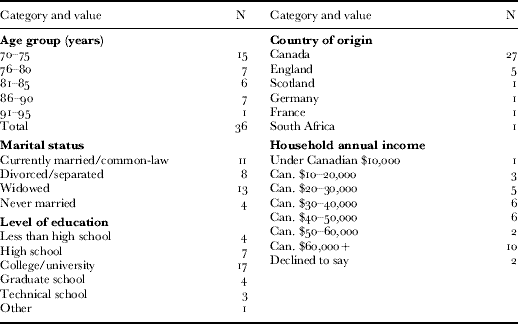
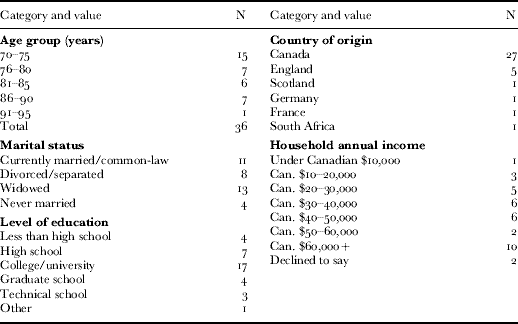
A non-probability sample was recruited using advertisements in newspapers and snowball methods. The advertisement and letter of introduction indicated that the study entailed an examination of older women's use of a range of beauty practices including make-up, hair and nail care, fashion, and sun tanning, but emphasised that participants need not engage in each, or any, of the listed beauty-work practices to take part. Interested individuals were invited to contact the principal investigator. The majority of the participants were interviewed in their own homes although several preferred to be interviewed at the University of British Columbia. Other than reimbursement for their travel or parking expenses, no compensation was given. The informants were of diverse ages, countries of origin, educational attainment, employment histories and status, incomes and marital status, but the majority were Caucasian, heterosexual women born in either Canada or Western Europe (Table 1).
Sample characteristics
Analysis
The analysis used the concept of open and axial coding (Strauss and Corbin Reference Strauss and Corbin1998), a process by which transcribed interviews were read and re-read to generate an initial code book, in which fashion was an open code or broad analytic category. The fashion code was then read repeatedly to generate an additional eight axial codes, which were sub-categories of the broader concept of fashion and illustrated nuances and tensions within the overarching code. The sub-codes were: age-appropriate clothes, age-inappropriate clothes, clothing choice as a reflection of lifestyle, clothing as a compensation strategy, clothing and the presentation of self, growing old gracefully, dressing to keep/get a partner, and the experience of shopping for clothes. These sub-codes were subsequently grouped together and collapsed into the three overarching themes presented in this paper: clothing prescriptions for the older female body (comprising the ‘age-appropriate clothes’ and the ‘age-inappropriate clothes’ sub-codes); strategic clothing choices in later life (which included the sub-codes ‘clothing as a compensation strategy’, ‘clothing and the presentation of self’, and ‘dressing to keep/get a partner’); and the social context of changing clothing choices (which included the sub-codes ‘clothing as a reflection of lifestyle’, ‘growing old gracefully’, and ‘shopping for clothes’). Although elements of the growing old gracefully sub-code spanned the second and third broader themes, through discussion and reference to both the raw data and the analytic framework of the paper we decided that it logically fitted under the social context of changing clothing choices category.
Findings
Clothing prescriptions for the older female body
To begin, the majority of the participants asserted that older women should never dress ‘too young’ for their ages. The women differentiated the clothing options of younger and older women mainly in terms of colour choices and styles, and by how much of the body was revealed by the clothing. For example, many women identified overly bright colours as being inappropriate using terms such as ‘harsh’ or ‘garish’, and made comments similar to those of a 72-year-old woman:
Older women should be careful with colours … don't wear that neon, for God's sake. … If you have good colours they'll soften. If you're going into an expensive store, you'll never see harsh colours … go into the expensive stores, where you have beautiful natural dyes and silks and, ah, just lovely.
Eschewing bright, bold colours, the women tended to express a preference for navy blues, beiges and soft pastels. Relatively few felt that bright clothing was acceptable for older women. One exception, an informant aged 72 years said, ‘I like bright clothing. I try to keep up with some of the styles that are in for my age group or try not to dress too young or too old, which is kind of tough, to know which is which sometimes. But I would say, other than the bright colours, I'm pretty conservative really … but I do love bright colours.’
Some of the women emphasised the importance of wearing ‘classic’ or ‘traditional’ styles, as conveyed by an 85-year-old woman:
I don't like boldness in clothes. … I don't like to see too fashionable things on older ladies. I'd rather see traditional clothes – clothes that, well, they are part of your personality but they don't strike you. They blend in more with things rather than wearing a red skirt and a red jacket, sort of thing. That's making too much of a statement with your clothes.
For many women, the definition of ‘traditional’ or ‘classic’ clothing directly related to how revealing the clothing was perceived to be, as expressed by another 72-year-old woman:
There are styles for young people and there are styles for mature people, and I don't think that I should wear young people's styles … like clothes showing my midriff or low-rise pants or … platform shoes or calf-high boots with short, short skirts. … Those styles were designed and manufactured with a certain age group and body style in mind, and those are the people who should wear them. There are other styles that are designed and manufactured for different types of bodies.
For some, the exposure of older bodies through inappropriately revealing clothing contravened norms of sexuality and the appropriate performance of ageing femininity, as stated by another 72-year-old woman:
Extra tight clothing or clothing that really defines the shape of the body or leaves too much skin exposed is inappropriate. If you get down to the very basic level of bodies … the showing of a lot of skin, in a very primitive way, suggests that this person is ready for mating. Do you think an 80-year-old is ready to mate? [Laughs]. Not for procreation anyway.
In other words, trying to ‘pass’ as a youthful, sexually desirable body served to ‘discredit’ the older individual (cf. Goffman Reference Goffman1963). However, several women felt that revealing clothing was inappropriate for all females, irrespective of their ages. As a 76-year-old said:
I don't even like to see a very revealed body on a very young girl, as beautiful as it might be. … I'm being very biased but I think in our day, that's something I'm glad about, we saved that intimacy, the nudity and whatever, we saved that for our husbands. It was something that was special … it wasn't shared with the general public every day. And the gals might think, ‘Oh hey, aren't I great? Everybody's having a look!’ But everybody is having a look, and that's what older women have to remember.
For others, wearing insufficient clothing transgressed beauty norms by virtue of failing to mask or hide the visible signs of ageing, thereby ‘discrediting’ the embodied individual as ‘ridiculous’ or ‘silly’ (cf. Goffman Reference Goffman1963). As another 72-year-old said:
‘Mutton dressed up as lamb’, that's what we used to say when I was young. In other words, there are certain styles … things you can't wear when you get older, no matter what, because it looks ridiculous. I mean, you can't show your arms when you're older. They're ugly for one thing … they make you look like a corpse! I don't think that old women should be going around in sleeveless dresses. It looks awful. You can look very nice older, without trying to look young. You have to find the right things for your age, for you. But don't try to look young, it doesn't work. It makes you look worse; it makes you look older.
Strategic clothing choices in later life
As well as discussing clothing prescriptions, many women described their clothing choices as a strategic means of masking or compensating for changes that had occurred in their bodies over time. First of all, many women stated that their clothing choices reflected and were constrained by the realities of having acquired extra body weight. For example, the women indicated that they had adopted loose clothing styles and habits, such as leaving their shirts un-tucked in order to hide unwanted weight. One 83-year-old said, ‘What I like now are things that hang over rather than being tucked in … because when you're thinner, tucked in things look nice but as you get thicker through the middle … things that hang out are more comfortable and they look better. They really do.’ Another woman, aged 87 years, put it this way, ‘As you get older, everything sinks. Everything sinks to the ground. Even your bust goes down. You know, you get a bundle of fat across your bottom. You have to conceal that rather than flaunt it.’ Other women indicated that their clothing styles were influenced by changes in their body shapes that had occurred over time. An 80-year-old informant said:
No matter how you exercise or whatever, your body changes. The biggest thing being that your spine shortens. If you've had children and many surgeries, you have that protruding abdomen that we often have to cope with. … We have to be more careful as we're older because we don't have the perfect shape that we hope we once had – think we once had.
Some of the women targeted specific body parts as being in need of strategic clothing choices. For example, one-third expressed a perceived need to hide or cover sagging or ‘flabby’ arms, also referred to as the ‘bat wing’ or ‘flesh that wobbles’ under the arm. The women contended that changes to their arms necessitated alterations to their sleeve lengths. One 73-year-old said, ‘The older woman has to watch the bat wing. She should not, if she thinks she's well dressed, go out with short sleeves … it should be a long sleeve and avoid this bit, the bat wing’. Stating that they would never wear sleeveless or strapless tops, short sleeves, spaghetti straps, or sundresses, some of the women described how they regularly wore sleeves down to the wrist or elbow, even in uncomfortably hot weather. An 80-year-old explained:
I fell in love with a black dress … it's beautiful. Everything I loved about it but it had no sleeves. So I bought it and then I took it to a dressmaker and I had black sheer sleeves put in. … I would like to wear short sleeves because it's certainly much cooler – that's why I had this sheer put into this dress – but I think I would still always wear long sleeves. … When I look at older women, elderly women in sleeveless, I think ‘Oh please!’ Arms are not pretty. They flop around a bit or else they're wrinkled or they have brown marks. Arms and hands give you away first, and the most.
Still others referred to their wrinkles as needing to be camouflaged by their clothing. A 93-year-old woman put it this way:
You tend to wear things with sleeves when you're older. Probably because of, we have this expression ‘our arms need pressing, the skin on our arms needs pressing’. That's one of my expressions … and that's because women show age in two places … and they do in their arms because the skin hangs and so do the backs of your legs. So people tend to wear longer skirts and wear slacks more than they would.
One-fifth of the women expressed dismay with the wrinkles on their necks and chests and indicated that they refrained from wearing low-cut tops and used turtlenecks and scarves to hide what they referred to as their ‘turkey wattles’, the skin under their chins. An 87-year-old confided that:
I have to admit I like to wear things with a turtleneck … because it looks better. Most women as they get older, they get the turkey wattle here you know … the fat sinks from here, goes to under your chin and you'll find that older women have a bunch of fat hanging down here. … Remember Doris Day? She always wore turtleneck things to hide her old neck … I like things with a turtleneck because they hide that ugly part.
At the same time, one-third of the women indicated that they consciously used their style of dress to compensate for and conceal age-related health issues. For example, some participants stated that trousers or pants (rather than dresses or skirts) were a crucial item of clothing that they used to hide varicose veins or swelling in the lower extremities, as an 83-year-old woman related: ‘I'm wearing pants all the time and that's partly because my ankles are more swollen and partly because I wear these support hose. I have varicose veins on my legs and they're not attractive at all. Pants cover a lot of ground. Now, at this stage in my life, I have absolutely no choice in what I wear.’ Another woman, aged 78 years, described her compensation strategy of wearing trousers because she had lost the mobility needed to put on pantyhose:
I wear pants a lot. Because if I try to get pantyhose on, it's very hard for me to get them up with my hip fused, because the hip's stiff and you can't bend and pull without ripping them. So I wear pants a lot … and then I make the top a little fancier if I'm going someplace fancy. And so I sort of adjust that way, but I wish I had more choice.
Comfort and ease of attire were also necessary clothing features for women coping with arthritis and who thus had difficulties manoeuvring into and out of certain items of clothing. As a 93-year-old said:
You have to wear things that are easier to put on. I'm only now sort of conscious of that – what's hard to take off. At night when you go to bed you can't be struggling with something with buttons all the way down the back or something like that. You have to be conscious of comfort in that sense. It's easier in a way to pull something over your head – as long as it isn't tight in the neck – than it is to take off a jacket. Sometimes, I'm finding now, taking off a jacket can be quite difficult for me. I've got to take it and pull it right over my head, which means that I'll have to have my hair down and everything and be prepared to go to bed before I can do that … that's something that I never thought of before.
Some of the women pointed to the impact of chronic conditions such as osteoporosis on their body shape and appearance and the resulting clothing restrictions. For example, an 80-year-old participant asserted:
No matter how you keep your shape, your spine changes. You get what we refer to as a dowager's hump. And that does not look as good in a t-shirt as something that's less tight or revealing … so fashions and styling mean even more when you're older because you have to think of the negatives and enhance the positives.
Descriptions of constrained clothing choices extended to footwear. Some women conveyed feelings of disappointment and regret at no longer being able to wear high heels, in some cases because of foot problems. As one 71-year-old explained, ‘I can't wear high heels anymore … I've got bunions and they hurt my feet. I used to like wearing high heels. As my feet have gotten older, my bunions have gotten worse. I've just given them up. For a special occasion now I wear sort of a mid-heel. If I don't have to walk around too much, it's okay.’ Some of these women reported having to wear specialised footwear or orthotics as a result of arthritis and/or bunions, a requirement that they confronted with great chagrin. An 82-year-old explained, ‘The orthopaedic doctor told me that they made orthotics for me. I have to go buy some of these horrible running shoes. I don't know whether I'll go out in the street. I feel awful having to wear something like that.’ Others indicated that a fear of falling underscored their decision to refrain from wearing high-heeled shoes. One said, ‘I don't wear high heels anymore because I'm too old for that. I think they're dangerous for me at the age of 74. I do love to wear them but I think they're dangerous for me. At the age of 74 you can stumble a little bit if you're not careful.’ Only two women resisted the trend to forgo high heels altogether, by either wearing them only for short periods or by choosing a lower heel. A 73-year-old woman described the practice in this way:
What I have to do is take a pair of ordinary runners or something and I take a stiletto, but I take it in a plastic bag and then I go into the washroom and I change when I come out – and again I have to be careful. That's another thing; when you're older, you have to be careful if you're wearing high heels what you're doing, you are more likely to trip.
The social context of changing clothing choices
Many of the interviewees described the impact of changing societal norms on their clothing choices and options. Some women argued that clothing styles in general had become overly casual or ‘sloppy’, such that women of all ages lacked ‘classic’ or ‘elegant’ choices. An 83-year-old woman put it this way:
When I was young, in my twenties, we dressed pretty much like our mothers, but today that doesn't happen. Today, the girls in this generation, or maybe a few generations – they're not going to be as stylish as we were. Things have changed. Society has changed and the girls today, they go around looking sloppy. They're not put together properly. They think they look smart but they don't. Occasionally you do see some young people that are interested in their appearance and they do know how to dress, but it's not very often today. So the generation growing up today really won't be elegant like their mothers or their grandmothers.
Other women welcomed the change from the formal styles of their youth to the more casual current styles. Indeed, changing clothing norms had brought a new sense of freedom for many older women, as expressed by one 73-year-old:
When I was in my twenties, when I had my babies, we wore little hats and white gloves. We don't do that anymore, and in fact, women didn't wear pants. Mom and I wore dressy slacks in the car travelling and that was considered very avant-garde at the time. And even the first year I taught, which was when I was 32, I think, one of the principals said to me, ‘You know, some people don't approve of teachers wearing pants to school.’ The 1960s, that's when it all loosened up. I think it was a good thing.
Some women suggested that their preferred way of dressing had evolved with changes in their lifestyle over time. While one participant was a volunteer, none were working and, as was frequently remarked, had few social events to attend. In addition to their comments about the appropriateness of casual clothing for a less formal lifestyle, some women also mentioned that they had less disposable income than when they were younger or working, and were therefore less inclined to buy clothes frequently, or to buy expensive clothing. We were told that they spent between Can$200 and $10,000 on clothing per year, with the higher amounts generally being reported by women with the highest incomes. Women on lower incomes were keenly aware that their clothing choices were constricted, as exemplified in the comments of a 72-year-old woman, who was married and had a moderate income:
I don't dress the way I used to dress. I used to choose my clothes with care. So I think when you're not working, you're just hanging out all the time. I don't need to spend that money. I don't have it anymore. I'm not working. So I have a couple of good things to go out in. Day to day, I wear jeans around the house and I'll wear jeans shopping, and around the house I wear really old t-shirts. Because you were coming I put on a nicer top today. I hate to say you let it all go but you don't have the money anymore. If I had the money I'd certainly go for it, baby. I like nice things but it's just not that important. I'd rather spend the money on different things now.
Reflecting a shift in values from when they were younger, many participants stated that they dressed according to their lifestyles, current incomes and personal circumstances rather than age. One woman, aged 75 years, commented that she had become less concerned with her appearance because her priorities had changed:
I wore these expensive suits with blouses and all the rest of it, and good shoes. Then I retired at age 57. … My daughter said, ‘Mom, you're retired now, get rid of all those clothes you wore’. She took me in and she bought me some Reebok shoes. So I went to sweat suits and Reeboks when I retired. I got used to wearing more casual stuff. I've never gone back to my old way of dressing except for church. When I go to church, I dress up the way I used to years ago. … We had parties, parties, parties, and all the women would dress in really neat dresses and have fancy hair-dos. You know, go to the hairdresser just before you went to the party, and fancy lipstick to match your dress and nail polish and shoes. I guess I did that in those years but my values, I suppose, have changed over the years. I think as you age your values change from things to people.
In this way, cultural norms pertaining to later life and age-appropriate behaviour liberated the women from the mandates of beauty culture, but at the same time many commented that designers and clothing manufacturers did not create attractive clothing for an older woman's shape. As a 78-year-old disclosed, ‘I'm having trouble now finding clothes that are fashionable … I can be size 12 or 14 up here but … am 18 down here, so it's very hard to find clothes that fit both ways. There are some ‘plus size’ places [stores] … but they're not stylish at all. I don't have the choice that I used to have.' Indeed, several women complained about the lack of variety in clothing for older women. The majority of their comments built on the idea that current fashions were solely aimed at young women, and that there was a scarcity of stylish clothing that suited an older woman's body. One 75-year-old participant asserted that the lack of options for older women extended beyond the realm of fashion:
Clothing and beauty products are all aimed at the young. It's always towards the young people…I think it's ridiculous. … Now when I say young, I mean like the teens and college students, working people. But once it gets beyond that – like, I don't know of any ad that says, ‘Okay, this is for older women’.
Other opinions included the view that items of clothing available in stores were often in too small sizes, or that clothing meant for older women was expensive and only came in limited or undesirable colours. A 74-year-old on a limited income lucidly explained these points:
I think as you get older, you don't have as many choices. Like, you might want a dress – I mean, you don't care what colour it is or anything but you know – everything's for size fours and twos. You have to go to a certain store to get something to fit you … and pay more money. You go to a department store and everything's dowdy. The designers think just because you're 70 or 80 that you can't wear a nice suit. And pink? Why does it have to be like tan? Or brown? Who the hell wants to wear brown?
One-third of the women referred to another socially motivated usage of clothing, and indicated that they dressed to resist ageist assumptions. The women frequently articulated the importance of not ‘letting oneself go’ and attending to one's appearance in order to avoid being both socially ‘discredited’ and ‘discreditable’ (cf. Goffman Reference Goffman1963). As an 82-year-old said:
I see them coming to the opera in running shoes – this is letting yourself go. Don't they have any self-respect? Don't they have any self-esteem? The older you get, the better you should dress. My dressmaker said ‘When you are in your twenties, you can put on a potato sack and you look good because youth will carry you.’ But when you get older and you put on a pair of, I don't know, polyester pants that you've had for the last 20 years and they are sagging and bagging and all pulled down and some nondescript sweater on top – it makes you look even older. Once in a while you see an older woman smartly dressed and oh boy! Immediately, the whole appearance is younger.
A few women suggested that not attending to one's appearance would result in negative aspersions of one's character and to poor treatment, as a 72-year-old woman articulated well:
Older women tend to come in two categories – those who are very well dressed and very stylish who are given immediate attention, and those who look like somebody's dear old granny who is completely overlooked. You watch, in a department store, watch who the clerks go for. If you're an older woman, it will be someone who is very much up to date, they will get the attention. On the other hand, some nice little grey-haired little old lady, your typical little old lady who's standing looking at the same articles is the one that's overlooked.
Many of the women argued that they must attend to their appearances to counter negative societal judgements about their age and the pervasive assumptions that their bodies and minds were in decline. Most of these comments pertained to participants' attempts to show family members and others that they were independent, healthy and mentally astute. A 76-year-old described the extra effort she made to dress in a way that would alleviate her family's worries:
When my daughter comes over on weekends and stuff, I try to pull myself together a little more. My daughter is not particularly healthy or well, most of the time. And when she comes over here, I don't want her to look at me and say, ‘Mom, you should be doing this. Or eating that, or not doing that.’ I want her to see that I look well and cared for and coping well, and then she doesn't have to worry about me. She can just worry about herself.
Others endeavoured to dress in a way that would make their families feel proud. As an 80-year-old said, ‘I don't care what age you are, you want your family to feel proud of you. And you don't have to be a fashion plate but you're proud when someone is dressed properly for the occasion or for whatever. I think it helps a lot to not dress or behave in a way that's old.’ In addition, some of the women described how a lack of attention to appearance might signify that they were dependent on others, or in need of assistance, as expressed by a 74-year-old woman: ‘I certainly don't want to look younger. I'm quite happy at my age. So maybe I'm trying to show that when you're 74, you can take care of yourself, and you present yourself to the world as a smart, independent person … and doing the best you can’.
Discussion and conclusions
This paper has examined the meanings that older women constructed and attributed to clothing options, choices and strategies with respect to their ageing bodies. The participants uncritically identified, internalised and reinforced today's restrictive clothing norms for older women. These norms are defined largely in terms of chronological and perceived ages, with the result that growing older results in increasingly limited and conservative clothing options. Underlying these norms is an insidiously ageist interpretation of older bodies, in effect that the physical realities of ageing are deemed repugnant and in need of camouflage. Among the aspersions they cast on their own bodies, the women expressed particular dismay over their ‘turkey wattles’, ‘bat wings’, bunions, wrinkles, sagging flesh and increased weight. These bodily transgressions entail highly visible and stigmatising evidence of the women's inability to achieve and perform the ideal female appearance. How one dressed, however, was perceived to be an important strategy by which to mitigate physical flaws. Indeed, clothing offered the women a practical and socially acceptable (if not always affordable) means of concealing, diminishing and compensating for the ‘abominations of the body’ (Goffman Reference Goffman1963: 4) and the concomitant experience of discrediting stigma (1963: 4). Like other forms of beauty work, such as make-up and hair-dye, clothing masked and redressed the offending body parts as well as the visibility of the women's chronological ages. Although the clothing strategies could not make the bodily transgressions disappear entirely, they transformed the women's discrediting bodily capital into less perceptible discreditable stigma, and allowed them to ‘pass’ for normal (Goffman Reference Goffman1963: 73).
Adherence to these restrictive clothing prescriptions involved juggling multiple concerns while endeavouring to avoid social blunders. More specifically, the women were restricted by a limited range of clothing styles and stores that catered for their needs and financial resources. They also had to negotiate the changing fashion for more casual styles, which they found both liberating and constraining, and to compensate for changes in their body shapes while also carefully choosing clothing that they saw as age appropriate but not ‘dowdy’. Thus, the women had to beware of inadvertently enacting the ‘mutton dressed as lamb’ truism by wearing overly bright, revealing or suggestive clothing, even as they worked not ‘to let themselves go’ by adopting the frumpy or overly-casual clothing that is stereotypically associated with older women. When successful in meeting these often-conflicting clothing prescriptions, their styles of dress shored up or even ameliorated the loss of social currency commonly ascribed to older women. In contrast, failure to navigate appropriately these clothing norms discredited the individual's character (cf. Goffman Reference Goffman1963). Indeed, the women were quick to label their peers who did not attempt to conform, or who deviated in any way from accepted codes of dressing, as being silly, ridiculous and lacking credibility.
At the same time, the women used clothing choice strategically to resist the stereotype of the frail, incompetent older adult, even if in many cases their choices were constrained by inadequate financial resources. Some women argued that attending carefully to their styles of dress and overall appearance would stave off ageism and elicit desired responses from family, friends and strangers. By clothing their bodies deliberately and in accordance with socially-sanctioned prescriptions, the women effectively managed the impressions of others through the projection of a happy, healthy and cognitively-intact self (cf. Goffman Reference Goffman1959). Additionally, the performance of an acceptable ageing appearance through the ‘masquerade’ of clothing alleviated the worries of significant others and commanded more respect from younger people (cf. Ballard, Elston and Gabe Reference Ballard, Elston and Gabe2005; Biggs Reference Biggs1999, Reference Biggs2004; Woodward Reference Woodward1991).
The findings of this study illustrate the uneasy tensions that exist between older women's ability freely to choose their clothing and the degree to which their choices are determined by social norms and ageism in consumer culture. On the one hand, the women articulated numerous ways in which they exercised agency in their decisions about what clothing they wore, and they expressed a sense of liberation from the cultural shift by which casual clothing has become acceptable at all life stages, including in retirement. On the other hand, the women's clothing choices reflected underlying ageist assumptions about the aged female body, both in terms of how the body is perceived and how they were expected to respond. The women's everyday experiences of negotiating these perceptions and required responses were limited by the ever-present societal obsession with female appearance as well as the assignment of social currency on the basis of a woman's ability to achieve and maintain the ideal female body. Thus, the women's options were ultimately restricted both by a limited range of available and affordable clothes as well as by the pervasive and oppressive disciplining of the female, aged body.
A limitation of this study has been the small sample size and the convenience sample. While our sample participants were of diverse ages, most were well educated, none identified as lesbian or ‘queer’, and all were Caucasian, so the experiences and voices of visible minorities, less-educated women, and lesbian or ?queer? women were not well represented. In the future, it will be important to study the experiences of a more diverse group of women and to investigate more fully the attitudes of younger people, as well as members of the retail community with respect to clothing and fashion for older women. In conclusion, the findings suggest that far from being a trivial issue, clothing is a central part of older women's experiences of ageing, ageism and the body. Clothing is clearly a powerful tool that allows individuals to construct and project desired images of the self even as it disciplines and restricts the aged female body. Elucidating the perceived tendency of individuals to rely on appearance in often hasty and obdurate assumptions about older adults, the paper highlights the power of physical appearance in our ageist and image-oriented society.
Acknowledgements
This research was supported by a Michael Smith Foundation for Health Research Career Scholar Award and a Michael Smith Foundation for Health Research Establishment Grant, both awarded to the first author. The authors thank all the women who participated in the study for the gift of their time and their thoughtful insights and personal reflections.