INTRODUCTION
Deficits in understanding proverbs are considered a hallmark of schizophrenia. In general, proverbs used in mental status testing (e.g., You can't judge a book by its cover) involve metaphor, in which an expression is used to describe something other than its literal referents; although this is not true of all phrases considered proverbs, such as Ignorance is bliss. Compared to normal individuals, schizophrenia patients tend to interpret proverbs less accurately (Brune & Bodenstein, 2005; Harrow et al., 1972), less abstractly or more concretely (Braff & Beck, 1974; Gorham, 1956; Reed, 1968; Reich, 1981; Sponheim et al., 2003), and more idiosyncratically (Harrow et al., 1972; Shimkunas et al., 1967; Sponheim et al., 2003). Although proverb interpretation does not reliably differentiate schizophrenia from other psychiatric illnesses (Andreasen, 1977; Braff & Beck, 1974; Reich, 1981), its frequent impairment in schizophrenia has led to its inclusion in the clinical examination of schizophrenia patients, and in rating scales for the disorder such as the Positive and Negative Syndrome Scale (PANSS) (Kay et al., 1989).
The relationship between these proverb interpretation difficulties and the underlying causes of schizophrenia, however, has not been conclusively established. On one view, failure to arrive at the standard interpretation of a proverb is thought to reflect interference from tangential or idiosyncratic associations that also are presumed to cause disorganized speech more generally (Buss & Lang, 1965; Carpenter & Chapman, 1982; Shimkunas et al., 1967). Along similar lines, Gibbs and Beitel (1995) proposed that in schizophrenia patients “the ability to provide figurative interpretations to proverbs is disturbed because (the patients) are more easily distracted by associations between words in proverbs and their own personal experiences.” In view of experimental evidence that disorganized speech in schizophrenia patients is associated with a relative overactivation of remote versus strong semantic associations (Kostova et al., 2005; Moritz et al., 2001; Moritz et al., 2003; Spitzer et al., 1993), advocates of this hypothesis have suggested that this abnormal activation may also lead to tangential and hence inaccurate proverb interpretations.
According to a different hypothesis, first proffered by Goldstein (1944), schizophrenia patients' primary deficit rests in their inability to adopt an “abstract attitude,” in which “we detach ourselves from the given impression, and the individual thing represents to us an accidental sample or representative of a category.” This hypothesis implies impairment in establishing a set of correspondences among elements of the proverb and other more abstract concepts.
Studies of schizophrenia patients have identified some neuropsychological and symptomatic correlates of proverb interpretation abnormalities which may help shed light on their underlying causes. In schizophrenia patients, concreteness of proverb responses was found to correlate with lower scores on tests of attention (serial search), memory (figural reproduction) and executive function (planning and set shifting) (Sponheim et al., 2003); while a combined rating of accuracy and abstraction correlated with performance on tests of executive function and theory of mind (Brune & Bodenstein, 2005). In addition, abstraction (Brune & Bodenstein, 2005; Carpenter & Chapman, 1982; Shimkunas et al., 1966), accuracy, and lower idiosyncrasy (Carpenter & Chapman, 1982) of proverb responses have been found to correlate with verbal intelligence as measured by vocabulary tests. Taken together, these data suggest that schizophrenia patients may not give the standard, abstract interpretation of a proverb due to fundamental abnormalities impairing a wide range of higher cognitive functions. Moreover, other studies have reported no correlation of accuracy and abstraction with either positive, negative or disorganized symptoms in schizophrenia (Brune & Bodenstein, 2005; Sponheim et al., 2003), although response idiosyncrasy has been found to correlate with disorganization (Sponheim et al., 2003). These results would seem to suggest that while processes underlying disorganized speech may contribute to more idiosyncratic language use in schizophrenia patients, they are unlikely to be the primary cause of their abnormal proverb interpretations.
According to recent advances in cognitive theory, the ability to attain the standard interpretation of a metaphorical proverb can be seen as just one instance of a process of meaning construction called conceptual integration (Coulson & Oakley, 2000; Fauconnier & Turner, 1998). This process involves establishing mappings between elements and their relationships across mental domains, in order to project emergent meaning to a “blended” domain. This theory builds on previous work describing analogical thinking as the selection of one-to-one mappings between aspects of two different situations (Gick & Holyoak, 1983; Hummel & Holyoak, 2003). Conceptual integration is postulated to be essential for a wide range of higher cognitive phenomena, including analogy, metaphor, categorization and hypothetical reasoning. According to conceptual integration theory, a correct understanding of a proverb such as People in glass houses shouldn't throw stones requires mapping elements from a concrete source domain to a more abstract target domain. In this case, being in a glass house is mapped to the characteristic of having faults or weaknesses, and throwing stones to the act of criticizing others. In addition, the relationship between these elements—the fact that the potential reciprocation of stone throwing would be particularly apt to harm the inhabitant of a glass house—is mapped to the idea that the potential reciprocation of criticism would be particularly apt to harm the individual who has faults or weaknesses. These mappings are reflected in a response such as Don't go ridiculing people for what they do if you've done it yourself. In contrast, a schizophrenia patient's response such as People should watch what they say around other people so they don't hurt their feelings is a somewhat less complete mapping—although mappings to the target domain are established for glass house and throwing stones, the relationship between them is absent.
Conceptual integration theory offers a framework for elaborating on hypotheses about the source of proverb interpretation difficulties in schizophrenia. On one view, which we will refer to as the disorganized-associations hypothesis, overactivation of unusual associations to concepts, which causes disorganized speech in general, also affects proverb interpretation by preventing correct mappings which involve normatively strong associations (Gibbs & Beitel, 1995). For instance, consider the patient response:
If you're the President of a school and you live across from the campus, as they did in Keene, Texas, and Elder Scales was the President of the school, he lived in a glass house, so to speak, because people were always able to see him. You live right across the street from the campus and you live in a glass house, and people can see what you're doing, they can say: “That's not so.”
Here, glass house may have activated an idiosyncratic association (the concept of living in visible proximity to one's associates or subordinates) to an abnormal degree, resulting in the mapping of glass house to this concept instead of to its standard counterpart, thus precluding a correct interpretation of the proverb.
Within the conceptual integration model, proverb interpretation difficulties in schizophrenia could also stem from a diminished ability to maintain representations of multiple elements of source and target domains in working memory (WM) while performing the operations necessary to establish aligned mappings between them (we will refer to this view as the WM-deficiency hypothesis). In fact, a number of models of relational reasoning in general (Halford et al., 1998; Hummel & Holyoak, 2003; Waltz et al., 2000), and of figurative language interpretation in particular, posit an important role for WM in the process (see Glucksberg, 2003, for review). Moreover, WM impairments have been extensively described in schizophrenia (see Lee and Park (2005) for a meta-analysis). The WM-deficiency hypothesis is consistent with the view that proverb interpretation deficits in schizophrenia reflect primarily a difficulty in the “abstract attitude,” which according to Goldstein (1944) included the ability “to keep in mind simultaneously various aspects,” and “to break up a given whole into parts and to isolate them voluntarily,” in order to “generalize,” “abstract common properties,” and “think or perform symbolically.”
In the present study, we aimed to test the disorganized-associations and WM-deficiency hypotheses of abnormal proverb interpretation in schizophrenia, by seeking correlational evidence for each of these hypotheses. Importantly, these two hypotheses are not mutually exclusive, especially since disorganization and WM deficits tend to co-occur in schizophrenia patients (Daban et al., 2002; McGrath et al., 2001; Melinder & Barch, 2003). Therefore, either or both of the hypotheses could potentially be true, with the latter being the case if WM deficiency contributes to both disorganization and abnormal proverb interpretation.
In order to test these hypotheses, we administered the Delis-Kaplan Executive Function System (D-KEFS) Proverb Test (Delis et al., 2001) to schizophrenia patients and control participants, and rated responses on both accuracy and abstraction. Patients' symptoms were rated with the Scale for Assessment of Negative Symptoms (SANS) (Andreasen, 1984a) and the Scale for Assessment of Positive Symptoms (SAPS) (Andreasen, 1984b). In patients, Letter-Number Span Test (LNS) (Gold et al., 1997) scores were used as a measure of attention-dependent auditory WM. The LNS was designed as a relatively specific measure of WM, defined as the ability to simultaneously store and manipulate information (Baddeley, 1992; Gold et al., 1997). As a convergent measure, the Wisconsin Card Sorting Test (WCST) (Heaton et al., 1993) was also administered. Although this test involves a mixture of complex cognitive operations (Gold et al., 1997; Hartman et al., 2003), performance on it in schizophrenia has been found to reliably correlate with deficits in attention-dependent WM (Gold et al., 1997; Hartman et al., 2003; Kurtz & Wexler, 2006). In addition, the California Verbal Learning Test (CVLT-II) (Delis et al., 2000) was administered as a measure of verbal recall, since there is behavioral and neuroimaging evidence to suggest that deficits in this function and in working memory may result from a common underlying cause (Barch et al., 2002; Bruder et al., 2004). We hypothesized that, if the disorganized-associations hypothesis is true, then proverb accuracy and abstraction ratings would correlate with the SANS/SAPS-derived Disorganized symptom factor (Miller et al., 1993). Alternatively or in addition, if the WM-deficiency hypothesis is true, then proverb interpretation ratings would be correlated with LNS, WCST and CVLT-II performance.
As a secondary aim, we sought to characterize whether proverb interpretation deficits in schizophrenia are correlated with a spectrum of lower- to higher-level cognitive operations, from early sensory processing to real-world functioning. Emerging evidence supports the view that deficits in pre-attentional stages of information processing may be a fundamental cause of schizophrenia patients' impairments in more complex cognitive tasks (Kawakubo & Kasai, 2006; Light & Braff, 2005a; Light et al., in press). In this conception of schizophrenic pathology, pre-attentional processes may determine the extent to which task-relevant information is available for further controlled processing (Braff & Light, 2004). The mismatch negativity (MMN), an event-related brain potential (ERP) component elicited by deviants among unattended auditory stimuli (Naatanen et al., 1978), is considered a measure of pre-attentional sensory processing. It is postulated to reflect discrepancy with a sensory-memory trace (Naatanen et al., 1989), and thus has been used as a measure of accuracy of encoding in sensory (or “echoic”) memory (Naatanen, 2003). Its amplitude has been consistently found to be smaller than normal in schizophrenia (reviewed in Michie, 2001), suggesting an abnormality of sensory-memory encoding. The possibility that this abnormality in turn may affect more complex cognitive functions (Javitt et al., 1995; Javitt et al., 1997) is raised by the reported correlation of MMN deficits with poor functional status in schizophrenia (Light & Braff, 2005a, 2005b). However, it is unclear whether processes reflected in decreased MMN cause functional impairment, and, if so, what the chain of causally mediating factors might be. Alternatively, decreased MMN and functional impairment may both be related to some other factor without being directly causally linked (Braff & Light, 2004). As a step toward further clarifying the nature of the relationships between MMN amplitude reductions and functional impairment, we examined the correlations between: (1) MMN, (2) functional status, and (3) proverb interpretation and other neurocognitive functions associated with it. Functional status was measured via a clinician rating and a standardized functional-skills assessment (Patterson et al., 2001), since a combination of assessment modalities may improve the validity of measurement of actual real-world function (McKibbin et al., 2004). We also cannot infer causation from correlation per se. However, if these variables are intercorrelated, it would be consistent with the possibility that abnormalities in processes involved in proverb interpretation mediate the relationship between sensory-memory encoding deficits and functional impairment, or that some common process underlies all of these deficits. On the other hand, if a particular neurocognitive function is not correlated with MMN and functional measures, this would help rule it out as a mediator between sensory-memory encoding deficits and functional impairment.
METHODS
Participants
Participants included 18 schizophrenia patients and 18 normal control participants. Patients were recruited from community residential facilities and through physician referral. All were outpatients. Controls were selected to match patients on age, sex, and parental socioeconomic status (SES), and were recruited through newspaper advertisements, and flyers posted at the University of California, San Diego (UCSD) Medical Center. All participants were assessed on their capacity to provide informed consent and, after they were given a detailed description of the study, gave written consent via the UCSD Institutional Review Board approved consent form (# 030510). Participants were compensated in cash.
Patients were assessed with the Structured Clinical Interview for DSM-IV (SCID) (First et al., 1995), and were screened to rule out any other Axis I diagnosis including substance abuse. Controls were assessed using the SCID (non-patient edition) to rule out any past or present Axis I or II diagnoses including substance abuse. Exclusion criteria for both patients and controls also included any current or past neurological disorder. Parental SES was computed using the index of Hauser and Warren (1996). Demographic characteristics of the study sample are shown in Table 1.
Demographic characteristics of the study sample, and clinical characteristics of the patient group (means ± SD given where applicable)

Twelve patients were prescribed second-generation antipsychotic medications, two were prescribed first-generation antipsychotics, and two were prescribed a combination of first- and second-generation antipsychotics. Two patients were not taking any antipsychotics.
Symptom ratings
Patients' symptoms were assessed with the SANS (Andreasen, 1984a) and SAPS (Andreasen, 1984a). Based on these ratings, we calculated scores for Psychotic, Negative and Disorganized symptom factors as derived by Miller et al., (1993)—the Psychotic factor was the sum of global ratings for delusions and hallucinations; the Negative factor was the sum of global ratings for affective flattening, avolition/apathy and anhedonia/asociality; and the Disorganized factor was the sum of global ratings for positive formal thought disorder and bizarre behavior. Patients' clinical characteristics are shown in Table 1.
Neuropsychological tests
The tests described in this section were administered to both patients and controls.
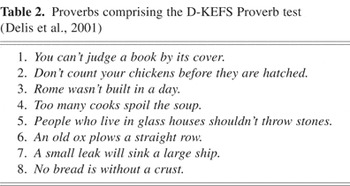
The Free Inquiry section of the Delis-Kaplan Executive Function System (D-KEFS) Proverb Test (Delis et al., 2001) was administered. The test proverbs are shown in Table 2. Accuracy and abstraction of each response were rated according to the test manual by two independent raters, one of whom was blind to participant group. Accuracy and abstraction are rated independently of each other. Accuracy (rated 0, 1 or 2) reflects the degree to which the response includes key elements of either the literal or figurative meaning of the proverb. Abstraction (rated 0 or 2) is defined as generalization to concepts other than those referred to in the proverb (regardless of accuracy). For each participant, overall accuracy and abstraction scores from each rater were computed, by averaging the corresponding ratings across all proverbs.
Proverbs comprising the D-KEFS Proverb test (Delis et al., 2001)

In the LNS test of auditory WM (Gold et al., 1997), the examiner verbally presents strings of alternating numbers and letters (e.g., W7T4), and participants respond by saying the numbers from smallest to largest followed by the letters in alphabetical order (47TW). The test involves 3 trials at each string length, beginning with 2-item strings and proceeding up to 8-item strings. The test is terminated if a participant fails all 3 trials at any one string length. The overall score consists of the number of trials answered correctly (out of a maximum of 21).
Participants also received a 64-card short form of the WCST (Haaland et al., 1987; Heaton et al., 1993), which was scored on the number of perseverative responses, and the number of categories achieved.
Participants completed the California Verbal Learning Test (CVLT-II) (Delis et al., 2000) as a measure of verbal recall. This involves 5 trials in which the same list of 16 words (which can be grouped into 4 semantic clusters) is presented; recall is assessed after each trial. The immediate free recall score is the sum of the number of words recalled after each of these 5 trials. Recall of this list is then also assessed after administration of an intervening, different list (short-delay free recall), and after a 20-minute delay (long-delay free recall), with the scores being the number of words recalled.
Participants also completed the Peabody Picture Vocabulary Test (PPVT) (Dunn & Dunn, 1997) as a measure of receptive vocabulary.
MMN
The MMN of the scalp-recorded electroencephalographic ERP was elicited and recorded according to the procedure described in additional detail in Light and Braff (2005a). Participants were presented binaurally with 1-kHz 85-dB tones with stimulus-onset asynchrony of 500 ms while they watched a silent cartoon video; standard tones (P = .90) are 50 ms in duration, and deviant tones (P = .10) are 100 ms in duration. For each participant, recording was terminated after at least 225 artifact-free deviant trials were collected. A difference ERP was formed by subtracting the average ERP to standard stimuli from the average ERP to deviant stimuli. MMN amplitude was measured as the mean amplitude from 135–205 ms of the difference ERP, at the midline frontal site Fz (according to the International 10–20 electrode placement system) with the tip of the nose as reference.
Assessments of functional status
The Global Assessment of Functioning (GAF) scale (American Psychiatric Association, 2000) was used to assess patients' current overall psychological, social and occupational functional status via a single anchored measure. The GAF Scale is divided into 10 ranges of functioning. Each 10-point range contains a description with 2 components: (1) symptom severity and (2) functioning. A clinical rater selects a score within a particular decile if either the symptom severity or the level of functioning falls within that range.
Patients' everyday functioning was also assessed through the UCSD Performance-Based Skills Assessment (UPSA) (Patterson et al., 2001). In contrast to the GAF, the UPSA directly measures functional skills, using standardized tasks that are commonly encountered in everyday situations and considered necessary for independent community living. Participants role-play these tasks, which encompass 5 domains: general organization and planning, finance, communication, transportation, and household chores. The examiner assigns points for correct performance of different components of each task. Subscale scores range from 0 to 20 points, and total scores range from 0 to 100 points.
Data analysis
To determine whether patients and controls differed on continuous dependent measures, independent-samples t-tests were performed, with the following exceptions. If the measure was not normally distributed for at least one group, the Mann-Whitney test was used. If the measure was normally distributed for both groups but variances were unequal, Welch's t-test was used. Normality was assessed by the Shapiro-Wilk test. To determine whether patients and controls differed on sex distribution (a categorical dependent variable), a χ2 test was used.
To assess inter-rater reliability for the Proverb Test, Cohen's kappa was calculated for each proverb for the two independent raters.
Within patients, pairwise correlations were calculated among assessment scores. When both variables were normally distributed, Pearson's correlation co-efficient r was calculated; if at least one of the variables was not normally distributed; Spearman's rank-order co-efficient ρ was calculated.
RESULTS
D-KEFS Proverb Test
Cohen's kappa between the two independent raters for accuracy ratings ranged from 0.63 to 0.91 for the eight proverbs, with a mean value of 0.83. Kappa for abstraction ratings ranged from 0.68 to 1, with a mean value of 0.86. These values confirmed high inter-rater reliability for both accuracy and abstraction ratings. The mean of the two raters' scores was used in subsequent analyses.
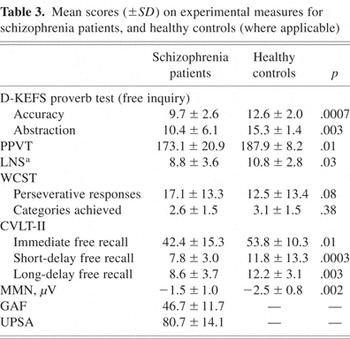
Mean accuracy and abstraction scores for the two groups are shown in Table 3. Patients scored lower than controls on both measures. When analyzed with years of education as a covariate, abstraction remained lower in patients than in controls [F(1,33) = 4.83, p = .035], although accuracy no longer differed significantly between the two groups [F(1,33) = 2.73, p = .11].
Mean scores (±SD) on experimental measures for schizophrenia patients, and healthy controls (where applicable)

Other Cognitive Measures and Functional Measures
Mean scores on other cognitive measures and functional measures for the two groups are also shown in Table 3. Grand-average MMN ERPs for the two groups are shown in Figure 1. Compared to controls, patients scored lower on the PPVT, LNS, and CVLT-II, and had smaller MMN amplitudes.

Grand-average difference waves formed by subtracting average ERPs to standard tones from average ERPs to deviant tones, for schizophrenia patients (n = 18; dashed line) and healthy controls (n = 18; solid line), at electrode site Fz. ERPs are time-locked to tone onset.
Correlations Between D-KEFS Proverb Test Scores and Other Measures
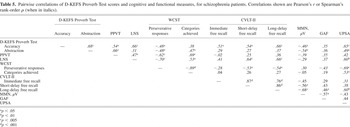
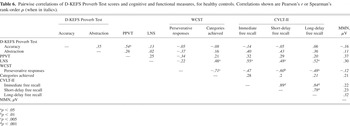
For the patient group, D-KEFS Proverb Test accuracy and abstraction scores were not significantly correlated with any of the three symptom factors, as shown in Table 4. In addition, neither accuracy (ρ = −.16, p = .53) nor abstraction (ρ = −.04, p = .86) was correlated with the Positive Formal Thought Disorder subscale of the SAPS. Correlations of D-KEFS Proverb Test scores with cognitive and functional measures are shown in Table 5 for patients, and in Table 6 for controls. Patients' accuracy and abstraction scores were significantly correlated with more perseverative responses on the WCST, lower PPVT scores, smaller MMN amplitudes and lower UPSA scores. In addition, accuracy was correlated with lower LNS and CVLT-II scores; and abstraction was correlated with fewer categories achieved on the WCST.
Spearman correlations of patient SANS/SAPS factor scores with D-KEFS Proverbs Test accuracy and abstraction ratings (n = 18)

Pairwise correlations of D-KEFS Proverb Test scores and cognitive and functional measures, for schizophrenia patients. Correlations shown are Pearson's r or Spearman's rank-order ρ (when in italics).

Pairwise correlations of D-KEFS Proverb Test scores and cognitive and functional measures, for healthy controls. Correlations shown are Pearson's r or Spearman's rank-order ρ (when in italics).

DISCUSSION
As expected based on previous literature, we found that schizophrenia patients exhibited proverb interpretation deficits compared to matched controls, as indexed by lower accuracy and abstraction scores on the D-KEFS Proverb Test. In the patient group, both accuracy and abstraction were significantly correlated with a greater number of perseverative responses on the WCST, lower PPVT scores, smaller MMN amplitudes, and lower UPSA scores. In addition, accuracy was correlated with lower LNS and CVLT-II scores, and abstraction was correlated with fewer categories achieved on the WCST. However, neither accuracy nor abstraction ratings were significantly correlated with patients' disorganized, psychotic, or negative symptom factors.
In contrast to the predictions of the disorganized-associations hypothesis, we did not find a correlation between proverb interpretation deficits and disorganized symptoms. According to this hypothesis, overactivation of remote semantic associations, which is presumed to cause disorganized speech, also causes proverb interpretation deficits. More generally, the lack of any significant correlation between proverb interpretation scores and disorganized, psychotic or negative symptoms fits with the findings of Sponheim et al. (2003), and with the view that a variety of cognitive deficits in schizophrenia are relatively independent of positive and negative symptoms (Keefe et al., 2006).
However, our results do provide support for the WM-deficiency hypothesis of proverb interpretation deficits in schizophrenia. The ability to produce a correct response to a proverb—one that includes the standard abstract interpretation of all the main elements—was correlated with LNS scores, consistent with a role for auditory WM in proverb interpretation. The correlations of proverb interpretation accuracy with working memory and executive function are in keeping with the conceptual integration model, which implies that proverb comprehension requires the ability to maintain and manipulate information from multiple domains in WM while aligning mappings between them (see Coulson & Van Petten, 2002). This account is buttressed by the report that other higher mental processes such as categorization and general language comprehension (Fauconnier & Turner, 2002), which depend on conceptual integration processes, are also impaired in schizophrenia in proportion to WM deficits (Bagner et al., 2003; Condray et al., 1996; Glahn et al., 2000; Silver et al., 2003).
Although LNS scores were significantly correlated with ratings of proverb accuracy, they were not significantly correlated with abstraction. This suggests that adequate WM capacity may be necessary but not sufficient for proverb interpretation, implicating other capacities in either selecting the correct abstract target domain or performing appropriate mappings between it and the source domain. These other capacities may be related in some way to vocabulary, as vocabulary was strongly correlated with both accuracy and abstraction, and has also been reported elsewhere to be associated with proverb interpretation ability in schizophrenia patients (Brune & Bodenstein, 2005; Carpenter & Chapman, 1982; Shimkunas et al., 1966; Sponheim et al., 2003). It is unlikely that low vocabulary per se prevented patients from understanding individual words in the tested proverbs, since all of these words were likely within the functional vocabulary of the patients. It is possible, however, that vocabulary indexes general world knowledge—including knowledge about the types of abstract domains that people commonly use proverbs to describe—and that the disease process impairs development, maintenance, and/or quick access to this type of knowledge.
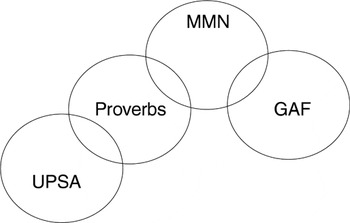
Lower proverb accuracy and abstraction ratings were both associated with reduced MMN amplitudes and with poorer skills of daily functioning (as measured by the UPSA), but not with a clinician-rated measure of global functional status (the GAF). In addition, MMN amplitudes were associated with GAF scores but not with UPSA scores. Thus, some of these variables shared significant variance but others did not, as represented diagrammatically in Figure 2. Proverb interpretation may have been significantly associated with UPSA scores but not GAF scores because the GAF is a less direct indicator of deficits in functional skills than is the UPSA (see McKibbin et al. (2004) for a review of the different characteristics and biases of different types of functional measures). Our data are also consistent with the possibility that MMN reflects processes which affect GAF through one set of mediating mechanisms, and affect UPSA through another, although the present study was not designed to test such causal hypotheses.

Venn diagram representing shared variance between variables as the area of overlap between circles (Cohen & Cohen, 1983).
The correlation of proverb interpretation deficits with both decreased MMN amplitudes and impaired functional skills raises the possibility that some process or processes necessary for proverb interpretation also may mediate the previously reported association between reduced MMN and poorer everyday functioning in schizophrenia patients (Light & Braff, 2005a). One candidate for such a process might be deficits in auditory verbal memory, which have been found to be associated with reduced MMN amplitudes in schizophrenia (Kawakubo et al., 2006). Thus, it may be that auditory sensory-memory encoding deficits contribute to a reduced capacity for short-term storage of verbal information, which could in turn interfere not only with proverb interpretation, but also with everyday tasks, like those tested in the UPSA, that involve the use of linguistic information. This conjecture is also supported by the correlations observed in our patient sample between reduced MMN amplitudes and the ability to recall verbal information as tested by the CVLT-II. Further work is necessary to confirm whether the relationship between decreased MMN amplitude, deficits in higher cognitive functions such as proverb interpretation, and functional impairment is causal, and, if so, to clarify the mediating mechanisms.
Alternatively, difficulties with proverb interpretation might be correlated with both decreased MMN and impaired functional skills not because these deficits are causally linked, but because they are all independently related to some other process. Our overall results, in combination with previous findings, are consistent with these deficits forming part of a syndrome of abnormalities in schizophrenia related to generalized frontal cortical dysfunction. First, we found that proverb interpretation difficulties in schizophrenia patients were correlated both with WM deficits, and with a commonly-used measure of executive function (the WCST). Multiple lines of evidence suggest that WM deficits in schizophrenia are mediated by prefrontal cortical dysfunction (Barch et al., 2002; Goldman-Rakic & Selemon, 1997). These deficits have in turn been proposed to underpin impairments in more complex cognitive tasks, such as executive function and abstract reasoning, that are also associated with frontal lobe pathology (Gold et al., 1997; Goldman-Rakic & Selemon, 1997; Kremen et al., 2004). Second, there is evidence that decreased MMN amplitude in schizophrenia, which we found to be correlated with proverb interpretation difficulties, reflects a specific deficiency in a prefrontal cortical neural generator (Baldeweg et al., 2002; Naatanen, 2003; Sato et al., 2003). Third, additional support for a frontal-lobe mechanism for proverb interpretation deficits comes from their increased prevalence in dementia of the frontal type in particular (Moretti et al., 2002), and from the association of frontal lobe disease with deficits in figurative language comprehension and in analogical reasoning (Cacciari et al., 2006; Morrison et al., 2004). Taken together, these results are consistent with the view that proverb interpretation deficits in schizophrenia are one manifestation of generalized frontal cortical pathology.
ACKNOWLEDGMENTS
This study was supported by grants HD22614 and NIA08313 to M. Kutas, a grant from the Department of Veteran Affairs (VISN 22 Mental Illness Research, Education and Clinical Center), and grants MH042228 and MH065571 from the National Institute of Mental Health. M. Kiang is supported by a Canadian Institutes of Health Research Postdoctoral Fellowship. M. Kutas was a Lady Davis Fellow at Hebrew University during the writing of this manuscript. We thank Barbara Haugeland, Sheldrick Holmes, Katrin Meyer-Gomes, Pete Sharp, Joyce Sprock, and Kari Tweedale for technical assistance.