The worldwide production of goat milk along with the suggestion that goat milk exhibits specific nutritional benefits, such as low allergenic potential, high content of short- and medium-chain fatty acids, higher content of oligosaccharides compared to other ruminants’ milk and higher content and bioavailability of minerals than cow milk (Park and Haenlein, Reference Park, Haenlein, Wendorff, Park and Haenlein2017; Verruck et al., Reference Verruck, Dantas and Prudencio2019), indicate that goat milk yoghurt is a dairy food of special interest. However, the lower casein and αs1-casein content, the lower sedimentation rate of the casein micelles, the higher β-casein solubility, the higher calcium and phosphorus contents and the lower heat stability of goat milk compared to cow milk results in a weak texture of goat milk yoghurt (Moatsou and Park, Reference Moatsou, Park, Wendorff, Park and Haenlein2017). Therefore, the exploitation of goat milk nutritive and biological properties in fermented milks is often hampered by the weakness of goat milk acid gels. Considering that whey protein concentrates (WPCs) can serve as texture enhancers and carriers of various types of additional biofunctionality (Zulueta et al., Reference Zulueta, Maurizi, Frígola, Esteve, Coli and Burini2009; Karam et al., Reference Karam, Gaiani, Hosri, Burgain and Scher2013; Nielsen et al., Reference Nielsen, Beverly, Qu and Dallas2017), the present study was undertaken. Our hypothesis was that the fortification of goat milk base with whey protein concentrate (WPC) could improve the textural and biofunctional properties of set-style yoghurt. For this purpose, yoghurts were manufactured from goat milk fortified with two different types of WPC and studied throughout a 4-week storage period. Fortification of goat milk base has been reported by Bruzantin et al. (Reference Bruzantin, Daniel, da Silva and Spoto2016) who used skim milk powder and by Gursel et al. (Reference Gursel, Gursoy, Anli, Budak, Aydemir and Durlu-Ozkaya2016) who used skim milk, sodium caseinate, WPC and whey protein isolate (WPI) powders. The new element of the present study is the use of two WPCs with similar protein content but of different origin and with different protein and mineral profile for the fortification of goat milk yoghurt base.
Materials and methods
Yoghurt manufacture and sampling
Four different set-style yoghurts were manufactured from goat milk bases in triplicate within three consecutive weeks. Control base A was non- fortified raw goat milk, B was fortified with 0.5% (w/w) whey protein concentrate from cow milk with 80% protein (mWPC), C was fortified with 1.5% (w/w) mWPC and D was fortified with 0.5% (w/w) whey protein concentrate from Feta cheese whey with 80% protein (fWPC). The composition of milk bases was chosen after testing their heat stability. Yoghurt manufacture and sampling were carried out according to Moschopoulou et al. (Reference Moschopoulou, Sakkas, Zoidou, Theodorou, Sgouridou, Kalathaki, Liarakou, Chatzigeorgiou, Politis and Moatsou2018).
Analyses of milk and whey protein concentrates
Gross composition of raw goat milk and major minerals of goat milk and WPCs were estimated by the atomic absorption spectrometry and molecular absorption methods (Moschopoulou et al., Reference Moschopoulou, Sakkas, Zoidou, Theodorou, Sgouridou, Kalathaki, Liarakou, Chatzigeorgiou, Politis and Moatsou2018). Quantification of total N/protein (TN/TP), soluble N (SN) and non-protein N soluble at 12% TCA (TCAN) was carried out in 5% (w/w) solutions of WPCs (w/w) by means of Kjeldahl method (Moschopoulou et al., Reference Moschopoulou, Sakkas, Zoidou, Theodorou, Sgouridou, Kalathaki, Liarakou, Chatzigeorgiou, Politis and Moatsou2018). The casein fraction of goat milk and the protein fraction of WPCs were analyzed by means of RP-HPLC (Moatsou et al., Reference Moatsou, Hatzinaki, Samolada and Anifantakis2005, Reference Moatsou, Moschopoulou, Mollé, Gagnaire, Kandarakis and Léonil2008).
Yoghurt analyses
Gross composition at day one and pH, acidity and thermophilic bacteria counts at all sampling points were determined. Physical properties, i.e. water holding capacity, firmness and viscosity and texture profile analysis and color were assessed throughout storage. Proteolysis at day one and day 28 was estimated by means of nitrogen solubility in 12% trichloroacetic acid (TCAN) and the respective ACE inhibitory activity (ACE-IA) was estimated by RP-HPLC. DPPH. radical scavenging activity (DPPH.-RSA), Fe2+ chelating activity (Fe2+-CA) and superoxide scavenging activity (SOSA) were assessed at day one, 14 and 28 and the anti-inflammatory effect of water soluble extracts (WSEs) of yoghurts was studied at 28 d of storage. All yoghurt analyses were carried out as described by Moschopoulou et al. (Reference Moschopoulou, Sakkas, Zoidou, Theodorou, Sgouridou, Kalathaki, Liarakou, Chatzigeorgiou, Politis and Moatsou2018).
Statistical analysis
The effect of the composition of milk base and of the storage on yoghurt properties was assessed by analysis of variance (ANOVA) using Statgraphics Centurion XVI (Manugistics, Inc., Rockville, MA 20852, USA). The significant differences were further tested by the least significance difference method (LSD) at P < 0.05.
Results
The average fat, protein and ash content of raw goat milk was 4.36, 3.29, 0.70 g per 100 g milk respectively. One hundred g of casein fraction was consisted of 6.7, 18, 19.1 and 56.2 g of κ-, αs2-, αs1- and β + γ-casein respectively. The concentration of Ca, Mg, K, Na and P was 100, 13.7, 144, 57 and 87 mg per 100 g milk respectively.
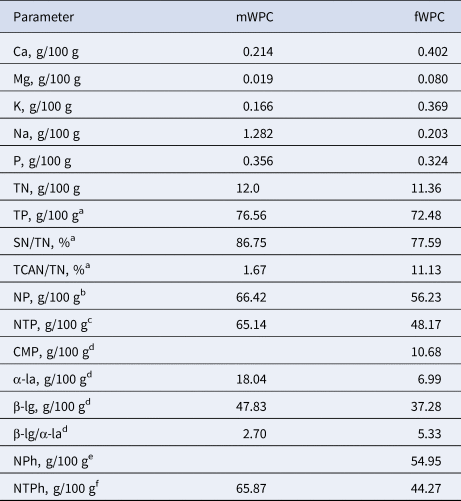
The mWPC was manufactured from milk while fWPC came from the draining of a non-heated cheese curd. Their manufacturing conditions were not declared and according to labels their respective lactose content was 6.5 and 10.5 g/100 g and both contained 80 g protein/100 g. Moreover, analyses results showed that they were differentiated in regard to minerals and protein profile (Table 1). Of specific interest are the Ca, Mg and Na contents. The high Na content and the non-typical Ca/P and K/Na ratios of mWPC in combination with the low Ca and Mg contents imply that a treatment aiming to reduce divalent ions that impair heat stability could have been applied. Moreover, as expected mWPC did not contain caseinomacropeptide (CMP) and its protein fraction consisted mainly of the two major whey proteins β-lactoglobulin (β-lg) and α-lactalbumin (α-la). On the other hand, fWPC contained a considerable amount of nitrogenous compounds soluble in 12% trichloroacetic acid (TCAN, Table 1). The native true protein content (NTP) was calculated by subtracting the TCAN content from the SN content of both WPCs.
Compositional parameters of whey protein concentrates (WPCs) utilized in the present study

mWPC, from cow milk; fWPC, from Feta cheese whey; N, nitrogen; TN, total nitrogen; TP, total protein; SN, soluble N; TN, total nitrogen; TCAN, N soluble in 12% trichloroacetic acid; NP, native protein; NTP, native true protein; WP, whey proteins; CMP, caseinomacropeptide.
a Estimated by the Kjeldahl method as TN × 6.38.
b TP × (SN/TN).
c (SN − TCAN) × 6.38.
d Estimated by the RP-HPLC method.
e Sum of the peaks of native whey proteins of the RP-HPLC profiles.
f Estimated as NPh-CMP.
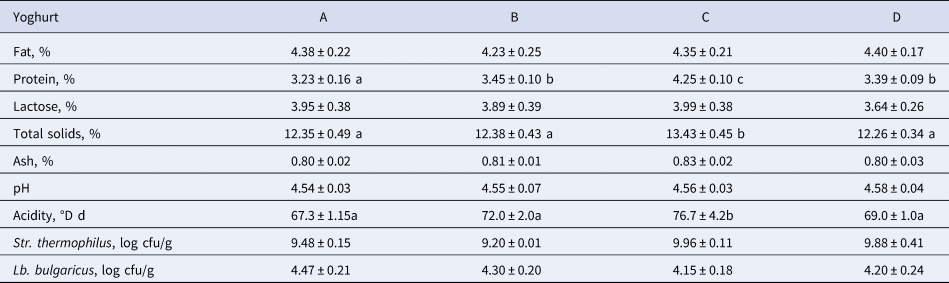
The physicochemical properties and the bacteria counts of the yoghurts on day one post-manufacture are shown in Table 2. Yoghurts were statistically significantly differentiated (P < 0.05) because of their protein and total solids content. Yoghurt C had the highest protein content due to the highest fortification rate whereas yoghurts B and D had similar protein contents, both significantly higher (P < 0.05) than that of control A and lower than that of D. A similar trend was observed for total solids content. Fat content of yoghurts ranged from 4.23 to 4.40%, lactose content from 3.64 to 3.95% and ash content from 0.80 to 0.83%. The acidity increased statistically significantly (P < 0.05) during storage in all yoghurts and most intensively within the first seven days (online Supplementary Fig. S1). At the end of the storage period, i.e. at 28 d, the acidity of A, B, C and D yoghurts was 0.89 ± 0.025, 0.93 ± 0.059, 1.02 ± 0.023 and 0.92 ± 0.035 g lactic acid per 100 g yoghurt respectively.
Characteristics of set-style yoghurts manufactured from goat milk fortified with WPCs, at day one post-manufacture

A, control yoghurt made from non-fortified goat milk; B and C, made from goat milk with 0.5% and 1.5% (w/w) mWPC from cow milk respectively; D, made from goat milk supplemented with 0.5% fWPC made from Feta whey.
Means of three experiments ± standard deviation.
a–c, different letters indicate statistically significant differences within rows (LSD, P < 0.05).
d°Dornic = % lactic acid × 100.
The fortification of goat milk base and the storage time did not affect significantly (P > 0.05) the counts of thermophilic bacteria of yoghurts. The counts of Streptococcus thermophilus were very high ≥109 cfu/g, in contrast to low Lactobacillus delbrueckii subsp. bulgaricus counts, which were approximately 104 cfu/g (Table 2). The average thermophilic cocci at 1, 7, 14, 21 and 28 d of storage were 9.63 ± 0.36, 9.43 ± 0.39, 9.27 ± 0.05, 9.33 ± 0.21 and 9.38 ± 0.45 cfu/g respectively. The respective cfu/g counts of thermophilic bacilli were 4.28 ± 0.14, 4.41 ± 0.43, 4.30 ± 0.17, 4.06 ± 0.31 and 4.0 ± 0.07.
The physical properties of yoghurts (Table 3) were not affected significantly by the storage (P > 0.05) but they were affected by the composition of the milk base. Therefore, Table 3 presents the average of all sampling points for each yoghurt. Yoghurt C with the highest protein and total solids content (P < 0.05) had the most viscous and firm gel with significantly enhanced (P < 0.05) water holding capacity (WHC). On the other hand, yoghurt D supplemented with fWPC exhibited inferior textural properties (P < 0.05) compared to control yoghurt A, despite its significantly higher (P < 0.05) protein content. Moreover, the addition of fWPC did not affect the WHC of yoghurt gel, in contrast to the positive effect of mWPC in B and C yoghurts. Color parameters L, a* and b* were not affected by storage but they were influenced by the composition of the goat milk base. Yoghurt D had lower (P < 0.05) lightness and accordingly the most intense green/yellow color which can be attributed to the origin of fWPC, which comes from the cheesemaking of sheep/goat milk.
Physical properties of set-style yoghurts manufactured from goat milk fortified with WPCs

A, control yoghurt made from non-fortified goat milk; B and C, made from goat milk with 0.5% and 1.5% (w/w) mWPC from cow milk respectively; D, made from goat milk supplemented with 0.5% fWPC made from Feta whey.
Means of three experiments × five sampling points ± standard deviation.
a–c, different letters indicate significant differences within columns (LSD, P < 0.05).
a Water holding capacity g/100 g.
b In g.
c In mPa s.
d In N.
e In N × mm.
f In N.
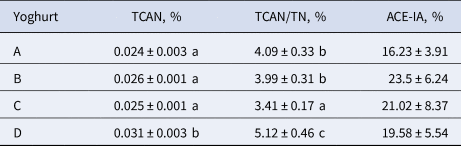
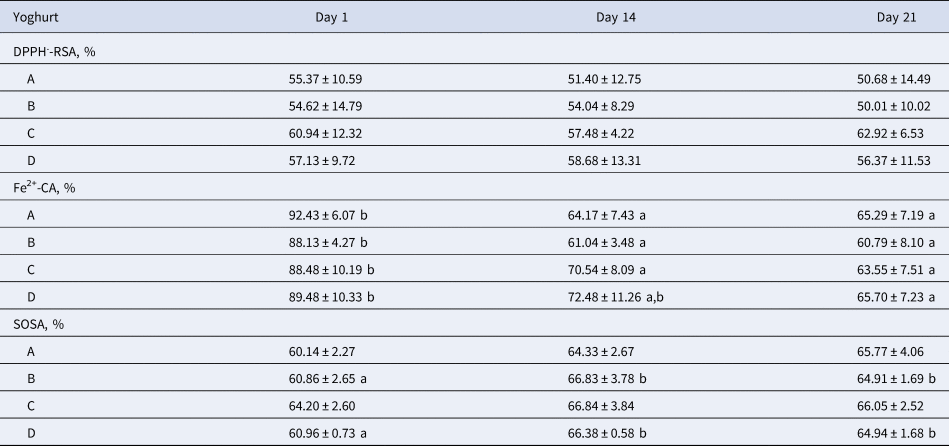
The fraction of medium and small size nitrogen compounds (TCAN) did not increase during storage (P > 0.05). Both the WPC type and the storage did not affect statistically significantly this activity ACE-IA. Therefore, the results are presented as the average of all sampling points (Table 4). The objective of the three different reaction-types utilized for the study of the evolution of antioxidant potential of yoghurts during storage has been discussed in the previous study of Moschopoulou et al. (Reference Moschopoulou, Sakkas, Zoidou, Theodorou, Sgouridou, Kalathaki, Liarakou, Chatzigeorgiou, Politis and Moatsou2018). All tested activities were high and rather stable during storage with the exception of Fe2+-CA (Table 5). The composition of milk base did not affect DPPH.-RSA, Fe2+-CA and SOSA. The water soluble extracts (WSEs) of goat milk yoghurts exhibited a potent immunomodulatory activity, i.e. modulation of the expression of pro- and anti-inflammatory genes by ovine monocytes and neutrophils (Theodorou and Politis, Reference Theodorou and Politis2016), after 28 d of storage (Fig. 1). In the case of monocytes there was a statistically significant down-regulation of IL12b only, while expression of IL1b and IL10 of treated samples did not differ statistically significantly compared to the control.
Proteolysis and antihypertensive potential of set-style yoghurts manufactured from goat milk fortified with WPCs

A, control yoghurt made from non-fortified goat milk; B and C, made from goat milk with 0.5% and 1.5% (w/w) mWPC from cow milk respectively; D, made from goat milk supplemented with 0.5% fWPC made from Feta whey. TN, total nitrogen; TCAN, nitrogen soluble in 12% TCA; ACE-IA, angiotensin converting enzyme inhibitory activity.
Means of three experiments × two sampling points±standard deviation.
a–c, different letters indicate significant differences within columns (LSD, P < 0.05).
Antioxidant activities of set-style yoghurts manufactured from goat milk fortified with WPCs

A, control yoghurt made from non-fortified goat milk; B and C, made from goat milk with 0.5% and 1.5% (w/w) mWPC from cow milk respectively; D, made from goat milk supplemented with 0.5% fWPC made from Feta whey. RSA, radical scavenging activity; CA, chelating activity; SOSA, superoxide anion scavenging activity.
Means of three experiments ± standard deviation.
a, b, different letters indicate statistically significant differences within rows (LSD, P < 0.05).
Effect of treatment of ovine monocytes and neutrophils with water soluble extract of yoghurts at 28 d of storage. CTR, analysis control; A, control yoghurt made from non-fortified goat milk; B and C, made from goat milk with 0.5% and 1.5% (w/w) mWPC respectively; D, made from goat milk supplemented with 0.5% fWPC; IL1B, interleukin-1b; IL12B, interleukin-12b; IL10, interleukin-10; IL1RA, interleukin-1 receptor antagonist. a, b, different letters indicate statistically significant differences (LSD, P < 0.05).

Discussion
Under the conditions of the present study, the addition of WPC in the goat milk base did not affect the bacterial growth in yoghurts. Marafon et al. (Reference Marafon, Sumi, Alcântara, Tamime and de Oliveira2011) report that WPC fortification of cow milk base causes a very intense decrease of Lb. delbrueckii subsp. bulgaricus counts, in contrast to the data of Unal and Akalin (Reference Unal and Akalin2013) who observed an increase when WPC was used instead of skim milk powder supplementation.
Sodini et al. (Reference Sodini, Remeuf, Haddad and Corrieu2004) in their review conclude that the physical properties of yoghurt are strongly affected by the protein to total solids and whey protein to casein ratios and should depend on the heat treatment of the milk base. The significant differences in the WHC and textural parameters of Table 3 cannot be attributed to manufacturing parameters, such as heat treatment, starters and incubation because they were similar for all yoghurts. Interestingly, the increase of protein positively affected B and C yoghurts, but not D. In particular, yoghurts B and D supplemented with equal quantities of WPC, were significantly different in regard to their physical properties. The cause of this difference could be related to physicochemical features of WPCs and their possible intervention in gelation.
According to Vasbinder et al. (Reference Vasbinder, Alting, Visschers and de Kruif2003), the first step for yoghurt gel formation is the heat treatment of milk that results mainly in the covalent linking of κ-casein with β-lg and secondly in soluble disulfide-linked whey protein aggregates and polymers of κ-casein (Gaspard et al., Reference Gaspard, Auty, Kelly, O'Mahony and Brodkorb2017). The second step is the acidification of heated milk, in which the exposed thiol groups formed during the first step play a significant role for gel texture. During acid-induced gelation of heated milk, disulfide-linked protein structures are brought by SH-oxidation into S–S bonds and/or by SH-induced S–S interchange reactions. Disulfide bonds between κ-casein and β-lg contribute to the hardness and elasticity of acid-induced milk gels. Also, the amount of free thiol groups after heating is positively related to gel hardness and occurs on a time scale of hours, as happens with yoghurt gel formation (Vasbinder et al., Reference Vasbinder, Alting, Visschers and de Kruif2003). Caseins exhibit a chaperone-like activity in heat denaturation of whey proteins. Kehoe and Foegeding (Reference Kehoe and Foegeding2011) report that the aggregates of heated whey proteins formed in the presence of β-casein within a pH range from 5.5 to 6.5 are smaller in size and of different shape compared to self-aggregates of whey proteins; this effect of β-casein is diminished at pH < 6.0 or at the presence of 5 mm CaCl2 at pH 6.5. Therefore, the particular texture of acid gels manufactured from heat-treated goat milk could be assigned to the abundance of β-casein in this milk. Key-factors for yoghurt texture are the complexes of casein micelles and denatured whey proteins along with the soluble complexes of (i) κ-casein and β-lg and (ii) denatured whey proteins (Lucey et al., Reference Lucey, Tamehana, Singh and Munro1998; Sodini et al., Reference Sodini, Remeuf, Haddad and Corrieu2004). Their extent and distribution depends on limited milk pH changes, e.g. from pH 6.5 to 6.7. At low pH, the denatured whey proteins are bound onto micelles, thus increasing the particle size, and at higher pH they participate in soluble complexes with κ-casein due to the dissociation of the latter from the micelles (Anema and Li, Reference Anema and Li2003). The pH of milk bases of the present study was not expected to affect the texture of the yoghurts because in all yoghurts it ranged from 6.47 to 6.54 and from 6.24 to 6.29 before and after heat treatment, respectively.
Possible effects of compositional parameters of fWPC on the gel characteristics of yoghurt D, i.e. higher Ca content, lower native true protein; higher CMP (Table 1) should be taken into consideration. Goat milk bases C and D had similar Ca concentrations despite their differences in physical properties and the latter was fortified by a double quantity of Ca compared to B. The goat milk used in the experiments contained 24.95 mm Ca, and according to Table 1 the milk bases A, B, C and D contained 24.95, 25.22, 25.75 and 25.45 mm of calcium respectively. The role of calcium is very important for yoghurt gels affecting primarily the heat stability of the milk base. According to Gaspard et al. (Reference Gaspard, Auty, Kelly, O'Mahony and Brodkorb2017), the addition of 2.5 mm CaCl2 before heating at pH 6.7 in reconstituted milk protein concentrate decreased heat-stability by increasing the formation of large aggregates as shown in the aggregation kinetics of β-lg and α-la (Kehoe and Foegeding, Reference Kehoe and Foegeding2011). Moreover, calcium and other minerals along with acidification induce the gelation of denatured whey protein polymers. Disruption of casein micelles using >25 mm trisodium citrate results in non-successful yoghurt gels while the addition of low levels of trisodium citrate 10–20 mm improved the textural properties of cow milk yoghurt by chelating calcium and causing CCP removal, which in turn enhanced the formation of crosslinks (Ozcan-Yilsay et al., Reference Ozcan-Yilsay, Lee, Horne and Lucey2007). Nevertheless, the concentration of calcium alone only partially explains the results because milk base C contained more calcium than the inferior yoghurt gel D. We suggest that calcium in relation to the protein content of gels should be taken into consideration. The ratio mm Ca to % protein of milk bases (Table 2) was different due to high protein content of C. This ratio was 7.58, 7.04, 5.77 and 7.23 for A, B, C and D respectively and implies that the potential of Ca to impair gel properties could be reduced by increasing the protein content as happened with yoghurt C.
The mWPC and fWPC had similar total protein content but the latter contained much less whey protein in the native form and more N compounds soluble at 12% TCA (Table 1), that is medium- and small-size nitrogenous compounds and variable quantities of caseinomacropeptide (Léonil and Mollé, Reference Léonil and Mollé1990). Consequently, supplementation with fWPC resulted in the addition of a higher amount of denatured whey protein and non-protein nitrogenous compounds in the milk base, which could affect the gel texture. Milk base D contained 0.05% more non-protein nitrogen (Table 4) due to the presence of CMP in fWPC, which does not participate in the gel structure. According to Svanborg et al. (Reference Svanborg, Johansen, Abrahamsen, Schüller and Skeie2016) the increase of CMP to TP ratio increases the porosity of WPC heat-induced gels, which in turn decreases their WHC and also reduces the gel strength at both pH 7.0 and pH 4.0. Moreover, the addition of denatured whey proteins (fWPC) that cannot be associated with casein during heat treatment of yoghurt milk could be an additional reason for the inferior texture of yoghurt D. According to Britten and Giroux (Reference Britten and Giroux2001), spherical polymers of denatured WP are more sensitive to extensive aggregation and result in larger particles and softer gels after acidification. Tamime et al. (Reference Tamime, Kalab, Muir and Barrantes1995) conclude that denatured whey proteins act as fat globules and do not interact with other milk proteins. Similarly to the behavior of yoghurt D in the present study (Table 3), Sandoval-Castilla et al. (Reference Sandoval-Castilla, Lobato-Calleros, Aguirre-Mandujano and Vernon-Carter2004) report that the addition of denatured microparticulated whey protein decreases the firmness and increases the cohesiveness of low fat cow milk yoghurt compared to the addition of typical WPC.
The heating of mixtures of casein and particles of denatured whey protein does not increase significantly free SH groups. The opposite holds true for mixtures of casein and WPI, in which the whey proteins are in the native form. The weak gel of the former model system is consistent with the lack of disulfide connections between this type of denatured whey protein and κ-casein and/or other proteins, which might even obstruct the formation of network with the participation of native whey proteins such as WPI (Liu et al., Reference Liu, Jæger, Lund, Nielsen, Ray and Ipsen2016). Therefore, we suggest that the addition of fWPC in the goat milk base impaired the physical properties of the yoghurt gel due to a combinational effect of the high CMP and calcium content in relation to its total protein content and of the high ratio of denatured to native proteins.
The TCAN content of yoghurts was low (Table 3), similar to that of raw goat milk and in accordance with the low bacilli counts of the yoghurts. This result contrasts with several other findings on proteolysis in yoghurt as has been extensively discussed in our previous publication (Moschopoulou et al., Reference Moschopoulou, Sakkas, Zoidou, Theodorou, Sgouridou, Kalathaki, Liarakou, Chatzigeorgiou, Politis and Moatsou2018). The significantly higher (P < 0.05) TCAN content of yoghurt D was due to the higher non-protein N content of fWPC (Table 1). The supplementation of milk bases B and C with the mWPC with lower non-protein content (Table 1) than goat milk, apparently caused a decrease in the TCA/TN ratio of the B and C yoghurts compared to control A.
ACE-IA of the present yoghurts (Table 4) was lower than that reported in other studies as reported by Moschopoulou et al. (Reference Moschopoulou, Sakkas, Zoidou, Theodorou, Sgouridou, Kalathaki, Liarakou, Chatzigeorgiou, Politis and Moatsou2018). The low ACE-IA of all four yoghurts was in agreement with the lack of proteolysis and low lactobacilli counts. In regard to WPC addition, our results were not in accordance to previous studies of yoghurts supplemented with WPC. Unal and Akalin (Reference Unal and Akalin2012) reported that ACE-IA is significantly enhanced by the addition of WPC at 2%. Recently, Akalin et al. (Reference Akalin, Unal and Dinkci2017) observed a significant increase of proteolysis during 14 d of storage in cow milk probiotic yoghurt supplemented with 2% WPC and a significant increase of ACE-IA, which ranged from 70 to 90%, throughout storage.
Antioxidant properties of yoghurt have been correlated with antioxidant and proteolytic activities of the starter strains (El-Fattah et al., Reference El-Fattah, Sakr, El-Dieb and Elkashef2016). According to Farvin et al. (Reference Farvin, Baron, Nielsen and Jacobsen2010) Fe2+-CA comes from amino acids and compounds of 3–10 kDa. In the present study, significant proteolysis did not take place, therefore, the major source of the high antioxidant potential observed in all yoghurts is the pool of milk compounds with antioxidant activity (Grażyna et al., Reference Grażyna, Hanna, Adam and Magdalena2017). In general, it is difficult to compare findings on antioxidant activity due to the variability of the assay conditions appearing in literature. Nevertheless, DPPH-RSA of the present yoghurts was high compared to the reported activities of yoghurts made mostly from cow milk, but low compared to that of Unal and Akalin (Reference Unal and Akalin2012) and Farvin et al. (Reference Farvin, Baron, Nielsen and Jacobsen2010) and close to that of Moschopoulou et al. (Reference Moschopoulou, Sakkas, Zoidou, Theodorou, Sgouridou, Kalathaki, Liarakou, Chatzigeorgiou, Politis and Moatsou2018). Fe2+-CA was very high and higher than that reported by Unal and Akalin (Reference Unal and Akalin2013) or Farvin et al. (Reference Farvin, Baron, Nielsen and Jacobsen2010), but decreased significantly (P < 0.05) after 14 d of storage. During this period, the lactic acid concentration of the yoghurts increased, indicating that residual lactose decreased due to the continuation of fermentation. The decrease of residual lactose could be a possible explanation for the decrease of Fe2+-CA, since lactose can form complexes with the Fe2+ of the assay (Bachran and Bernhard, Reference Bachran and Bernhard1980).
Taking into consideration that whey exhibits antioxidant properties (Zulueta et al., Reference Zulueta, Maurizi, Frígola, Esteve, Coli and Burini2009), the hypothesis was that the fortification of goat milk base with WPC could affect these properties. According to the results (Table 5), the addition of WPCs at the ratios of the present study did not affect statistically significantly the assessed activities. There are only a few studies on the effect of milk base on the antioxidant potential of yoghurts. In the recent study of Moschopoulou et al. (Reference Moschopoulou, Sakkas, Zoidou, Theodorou, Sgouridou, Kalathaki, Liarakou, Chatzigeorgiou, Politis and Moatsou2018), it was shown that milk kind affected DPPH.-RSA and marginally the SOSA. The present results are partially in accordance with those of Unal and Akalin (Reference Unal and Akalin2012), who reported that the WPC fortification of cow milk did not affect DPPH.-RSA and hydrogen peroxide scavenging activities but increased significantly Fe2+-CA of the yoghurt.
The anti-inflammatory effect was more pronounced in ovine neutrophils when compared to monocytes as documented by the concomitant down-regulation of the pro-inflammatory IL1b and IL12b and the up-regulation of the anti-inflammatory IL10. Both IL1 and IL12 are known promoters of the Th1 cytokine phenotype which is linked to chronic inflammation, insulin resistance and obesity (Mishra et al., Reference Mishra, Kumar, Bajpai, Singh and Tripathi2011; Suárez-Álvarez et al., Reference Suárez-Álvarez, Solís-Lozano, Leon-Cabrera, González-Chávez, Gómez-Hernández, Quiñones-Álvarez, Serralde-Zúñiga, Hernández-Ruiz, Ramírez-Velásquez, Galindo-González, Zavala-Castillo, De León-Nava, Robles-Díaz and Escobedo2013), while IL10 has an opposite and antagonizing effect (Medeiros et al., Reference Medeiros, Mattos, Menezes, Fares, Talvani, Dutra, Rios-Santos, Correa-Oliveira and Gomes2018). It should be noted that IL1b expression values were numerically elevated in treated samples with that increase being negated, however, by an equal or in some cases higher increase of IL1RN expression, which directly inhibits the action of IL1b. The presence of WPC did not influence this effect. The general consensus is that a significant number of immunomodulatory peptides are derived from caseins (Nielsen et al., Reference Nielsen, Beverly, Qu and Dallas2017). Considering that in the present study equal amounts of protein content were used in the treatment of immunocompetent cells, further examination of immunomodulatory properties of whey would be of specific research interest.
In conclusion, the research hypothesis of the present study was confirmed in part by the findings. Firstly, the effect of fortification of the goat milk base with WPCs on the textural properties of yoghurt depended on the detailed composition of the protein and the mineral fraction of WPC. Coinciding with the lack of proteolysis, the majority of biofunctional properties did not change during storage. Finally, the WPC addition did not alter either the endogenous or the fermentation- or storage-derived biofunctionality of yoghurts under the manufacturing conditions used here.
Supplementary material
The supplementary material for this article can be found at https://doi.org/10.1017/S0022029919000499
Acknowledgements
This work was supported by the Greek General Secretariat for Research and Technology in the framework of the program SYNERGASIA II_2011 (code 530 11SYN_2_1265). The authors thank the Greek Dairy Company Delta S.A. and especially the Research and Development Department, in the premises of which (pilot plant, laboratory) the yoghurt manufacture and part of the analyses were carried out.