Introduction
Increasing numbers of people are encountering the challenges of being an older person. The World Health Organisation (WHO) recognised that life expectancy was rising and there were growing proportions of older people in industrialised countries (WHO 2002). Many age successfully notwithstanding the challenges of decreased physical activity levels, obesity and inappropriate nutrition (Whitaker Reference Whitaker2005). The ideology of positive ageing was championed by the WHO (2002) and in their Active Ageing policy framework they espoused the importance of opportunities for health, participation and security to enhance quality of life. In addition, they identified the benefits to society in older people continuing to make an economic, social and cultural contribution. Older people as productive members of society are intrinsic components of healthy and caring communities. Individuals who have a vital and interesting old age have happier lives (Vaillant Reference Vaillant2002). Kahn and Rowe (Reference Kahn and Rowe1987) identified the psycho-social gerontology of successful ageing through social support and perceptions of control and autonomy. Underpinning successful ageing is the concept of individual responsibility for self-reliance and independence. Davey and Glasglow (Reference Davey and Glasglow2006: 24) identify: ‘the onus is on people not only to contribute and to be economically active, but to finance their own retirement and to live healthy lives.’
Critiques of these discourses focus on the failure of the strategies to recognise the realities of later life (Davey and Glasglow Reference Davey and Glasglow2006). Health issues, financial pressure and unsuccessful ageing in late adulthood are often outside the control of the individual and may be consequential to employment misfortune and lifestyle decisions made earlier in life. Being held individually responsible could lead to further marginalisation. Yet all older people should have the right of access to positive ageing experiences, such as those provided through outdoor adventure experiences. The maintenance of physical activity, social connectedness, environmental engagement and psychological involvement has well-established health benefits for individuals and for society in general (see Alves and Sugiyama Reference Alves and Sugiyama2006).
Within this context, this study sought to explore how older people experience and understand outdoor adventure activities such as mountain biking and backpacking in a community-based programme in a rural New Zealand town. The research is multidimensional and maintains a holistic view. The research questions explore the ways older people engage in outdoor adventure activities. Specifically, how do older people conceptualise and engage in adventure activities? How does the programme achieve its outcomes? What is the role of the natural and social environments? What are the social, physical and psychological benefits for the individual and which of these are more important? How may adventure engagement contribute to successful ageing?
Review of literature
Who is an older person?
It is easy to focus on chronological age as a determining factor and many community-based older people's groups have a lower age limit of somewhere between 50 and 60 for eligibility. As there is a vast range of attributes and abilities within that age range this indicates a definitional problem. Laslett (Reference Laslett1996) proposed a theory of ageing based on four stages. His first two stages were childhood and adulthood. The third stage coined ‘Third Age’ was seen as a time when people were socially connected with family and friendship networks and when they could fulfil their personal goals, dreams and life plans. People were seen to have good health and financial means. Laslett's Fourth Age was marked by dependence and decrepitude.
Successful ageing
Traditionally, research into ageing has taken a reductionist approach with studies focused through different disciplines on aspects of ageing such as functional decline, chronic disease, life satisfaction, wellbeing and socio-economic conditions (Phelan et al. Reference Phelan, Anderson, LaCroix and Larson2004). The concept of successful ageing is being increasingly conceptualised in the literature as a multidimensional phenomenon that includes components of: (a) physical health, e.g. free from chronic diseases; (b) social health, e.g. family and friends; (c) psychological health, e.g. feeling good about myself; and (d) functional health, e.g. staying involved with the world and people (Fernandez-Ballesteros et al. Reference Fernandez-Ballesteros, Garcia, Abarca, Blanc, Efklides, Kornfeld, Lerma, Mendoza-Numez, Mendoza-Ruvalcaba, Orosa, Paul and Patricia2008, Reference Fernandez-Ballesteros, Garcia, Abarca, Blanc, Efklides, Moraitou, Kornfeld, Lerma, Mendoza-Numez, Mendoza-Ruvalcaba, Orosa, Paul and Patricia2010). This approach had been supported by writers such as Kahn and Rowe (Reference Kahn and Rowe1987) who proposed that successful ageing included factors such as lifestyle, habits, age and health but also psycho-social factors like social support and feelings of autonomy and control.
There is consistent agreement across different cultures and countries about the key components of successful ageing (Fernandez-Ballesteros et al. Reference Fernandez-Ballesteros, Garcia, Abarca, Blanc, Efklides, Moraitou, Kornfeld, Lerma, Mendoza-Numez, Mendoza-Ruvalcaba, Orosa, Paul and Patricia2010). Depp and Jeste (Reference Depp and Jeste2009) conducted a meta-analysis of 28 quantitative studies with large samples of older adults. These studies confirmed the most frequent definitions of successful ageing to be: younger age, non-smoking, absence of chronic disease, greater levels of physical activity, more social contacts, better self-rated health, absence of depression, absence of cognitive impairment and fewer medical conditions. They classified about one-third of older people as ageing successfully.
In a development of multidimensionality, Hildon et al. (Reference Hildon, Montgomery, Blane, Wiggins and Netuveli2009) argued that resilience is an essential component of successful ageing, particularly in the face of adversity with increasing age. Adversity was seen to be omnipresent in the domains of health, living circumstances and negative life events. The strongest association to psychological resilience was social capital (social relationships and community integration), that led to positive coping mechanisms. The successful ageing components of social capital, physical activity and engagement with the natural environment, are integral components of outdoor adventure activities to which I now turn.
Outdoor adventure
There is complexity and diversity in the ways of experiencing outdoor adventure. Adventure activities include pursuits such as mountain climbing, strenuous hiking, mountain biking and wilderness camping. While adventures are meaningful embodied experiences in interaction with nature, they are also socially constructed within a broader social and cultural environment. Adventure has been described as: ‘voluntary engagement in novel, uncertain and most often emotionally intense recreational activity’ (Holyfield, Jonas and Zajicek Reference Holyfield, Jonas, Zajicek and Lyng2005). However, it has not always been defined in this way. Early psycho-social conceptualisations placed risk engagement as central to the experience and defined adventure by the mechanics of risk engagement (Ewert Reference Ewert and Ewert1989; Martin and Priest Reference Martin and Priest1986). Hence the deliberate seeking of risk and danger was paramount and the emotional response to fear was interpreted as fun, thrill and excitement (Stranger Reference Stranger1999). Flowing from risk engagement were the implications that adventurers needed to take responsibility for their activities and welfare. They needed to be skilled, experienced and committed to achieve continued success, especially as personal skill levels grew.
Martin and Priest (Reference Martin and Priest1986) employed play theory, optimal arousal theory and Czikszentmihalyi's (Reference Csikszentmihalyi1975) flow concept to underpin adventure involvement through examining the interplay of personal competence and risky outdoor activities. Where there was a match of personal competence to environmental challenge, positive personal outcomes like flow and peak experience (Maslow Reference Maslow1964) accrued; where there were mismatches, boredom or anxiety were likely consequences.
Uncertainty is a commonly mentioned feature of an adventure. Simmel (cited in Wanderer Reference Wanderer1987) defined it in relation to goal achievement thereby the content of the adventure activity (e.g. mountain) was converted into goals (e.g. climb it). The uncertainty comes from not knowing if the goals are realistic and includes the role of the unexpected (e.g. rain). As goals are attained others are created through symbolic conversion of the situation into new goals. Goals are redefined upwards in the face of success and downwards in the face of failure. These ideas were supported by Mortlock (Reference Mortlock1984) and Martin and Priest (Reference Martin and Priest1986). Holyfield, Jonas and Zajicek (Reference Holyfield, Jonas, Zajicek and Lyng2005) embrace uncertainty in the modern context, arguing that adventure tourist operators engineer a sense of uncertainty within an emotional frame that includes perceptions of risk, the environment and the social group.
Cater (Reference Cater2006) made a solid argument for the repositioning of risk in a study of the risk perceptions of adventurers in the adventure tourism industry. The prime motivation was thrill and excitement and the respondents saw the chance of injury to be very low to non-existent. He also confirmed that in these activities consequences were known, so questioned the role of uncertainty. He surmised that the pursuit of fear and not risk was the central attraction. The activities were about pleasure, fun, learning and the embodied experience. Many older people form part of the tourist cohort. Outside tourism, experienced leadership ensures similar situations exist for older people.
The commodification of adventure is a modern phenomenon where adventure is manufactured and packaged for consumption (Loynes Reference Loynes1995). Adventure consumption involves experiences that can be conveniently accessed in safe and comfortable settings with the support of urban infrastructure. Generally they provide structured and managed frameworks for experiencing emotions and offer the illusion of risk (Holyfield, Jonas and Zajicek Reference Holyfield, Jonas, Zajicek and Lyng2005). The experience is embodied, emotional and aesthetic in contrast to the daily realities of contemporary life.
Clearly, adventure can take multifarious contexts such as adventure tourism, adventure education and outdoor pursuits. This led to categorisation into a continuum of soft and hard adventures (Ewert Reference Ewert and Ewert1989). Hard adventures were those undertaken with high risk presence by skilled experienced adventurers' often working solo or in small groups. Soft adventures involved low risk levels, professional leaders, low skill levels, novices and structured programmes such as adventure tourism and programmes for older people. Varley (Reference Varley2006: 188) coined the word post-adventure to describe ‘those who consume the marketed, branded and packaged’ versions of soft adventure. It is not the content of the experience that creates the adventure but the form. Simmel (cited in Wanderer Reference Wanderer1987) argued for adventure as a subjective experience, in that any form of experiencing could constitute an adventure.
As a reflection of the modern order, leisure risk taking is embraced in a globalised risk society (see Beck Reference Beck1992). In neoliberal societies, the values of individualism are promoted and the onus for risk taking has become the responsibility of the individual, most likely in the role of a consumer (Simon Reference Simon, Baker and Simon2002). Risky activities provide opportunities for individuals to create their own paths and meet self-set personal challenges often against environmental challenges. Outdoor adventures take place in natural environments, sometimes pristine and untrammelled. There is strong evidence to suggest that adventurers build strong environmental rapport. Stranger (Reference Stranger1999) wrote of surfers' harmony with the ocean, ecstatic feelings of oneness with the environment, and an aestheticised appreciation of the sublime; Vagias, Morais and Dziubek (Reference Vagias, Morais and Dziubek2005) noted the most important motivation for white-water rafters was enjoyment of nature; Varley (Reference Varley2006) of adventurers deep communion with nature, the formation of a romantic connection with nature, and the potential for spiritual renewal; Holyfield, Jonas and Zajicek, (Reference Holyfield, Jonas, Zajicek and Lyng2005) of nature as part of an emotional framework and nature appreciation as a persistent theme; and Walle (Reference Walle1997) learning about the environment and local ecology as a quest for personal insight. Brymer, Downey and Gray (Reference Brymer, Downey and Gray2009) report that extreme sports participants develop intimate connections to landscape and nature linked to the growth of environmental awareness and ecologically sustainable practices.
As important as the natural environment is the social milieu. Some adventures are conducted solo but often with backup support. Others are conducted in pairs (e.g. alpine climbing) and groups (river rafting) and in these modes very strong bonds develop. The predominant mode for soft adventure is the group and social interaction is built into the emotional frame. A number of researchers have identified the social nature and benefits of engagement: feeling of warm community (Varley Reference Varley2006); meeting new friends and social support (Patterson and Pan Reference Patterson and Pan2007); interacting with family and friends as a key motivation (Vagias, Morais and Dziubek Reference Vagias, Morais and Dziubek2005); strong sense of community (Walle Reference Walle1997); shared experiences in a surfing community (Stranger Reference Stranger1999) amongst others.
There has been little research on older people engaged in adventure activities in a holistic sense. Work on the lived leisure experiences of older rural women by McCormack et al. (2008: 161) confirmed that baby-boomers constructed personally meaningful leisure from an interaction of up to five dimensions: authenticity, choice, being physically active and healthy, social interaction and a desire for a rural lifestyle. Meanings were associated with enjoyment, pleasure, relaxation, fun and unpressured time. Parallels can be drawn with adventure activities, where similar attributes are evident. In a study of baby-boomers in adventure tourism, Patterson and Pan (Reference Patterson and Pan2007) substantiate that the motivations of enjoyment, flow, escape, challenge, social support, experiencing nature and physicality were as important for this generation as any other. Unique factors relating to the cohort were to: relive youth, improve health, change negative stereotypes of older people, recognise physical limitations and meet high safety standards.
Benefits of participation
Seen holistically, outdoor adventures include physical engagement in a leisure activity within the context of the natural outdoor environment and a supportive social group. Considerable research has been conducted on the importance of social connectivity for the health and wellbeing of older people and the advantages of experiences in the natural outdoor environment. In addition, the literature on the importance of physical activity for older persons is well established and persuasive. These three aspects tend to have been compartmentalised into discrete entities and examined in isolation. The adventure context has the advantage of bringing them together. This section provides a brief overview of the literature outside the adventure context for consideration of its applicability within that context.
Social health in the form of family and friends has been identified as an essential component of successful ageing (Fernandez-Ballesteros et al. Reference Fernandez-Ballesteros, Garcia, Abarca, Blanc, Efklides, Moraitou, Kornfeld, Lerma, Mendoza-Numez, Mendoza-Ruvalcaba, Orosa, Paul and Patricia2010). These aspects have been described as social capital: ‘those intangible assets that count for most in the daily lives of people: namely good will, fellowship, sympathy and social intercourse’ (Wood and Giles-Corti Reference Wood and Giles-Corti2008: 155). This leads to trust, connection and reciprocity at the level of the individual. Social capital has also been linked to strong communities: ‘the glue that holds society together’ (2008: 155). There are well-documented health benefits from being socially engaged. Benefits for mental health were reported by Araya et al. (Reference Araya, Dunstan, Playle, Thomas, Palmer and Lewis2006), and physical and mental health by Ziersch et al. (Reference Ziersch, Baum, MacDougall and Putland2005). Also described were fewer cases of depression (Kawachi and Bergman Reference Kawachi and Bergman2001), greater social integration and more perceptions of safety (Kweon, Sullivan and Wiley Reference Kweon, Sullivan and Wiley1998; Wood et al. Reference Wood, Shannon, Bulsara, Pikora, McCormack and Giles-Corti2008). Conversely, low social capital has been linked to dysfunctional and unstable communities with higher problem severity (McCulloch Reference McCulloch2003).
There is a plethora of support for the importance of physical activity to functional health and wellbeing. The ground for older people is well covered in two meta-analyses by Alves and Sugiyama (Reference Alves and Sugiyama2006) and Chodzko-Zajko, Schwingel and Park (Reference Chodzko-Zajko, Schwingel and Park2009). In summary:
1. Physical benefits: improved sleep, prevention/delay of illness, improved functional ability, reduced chance of falling, stronger with better endurance, better flexibility, better balance and co-ordination, a longer lifespan, maintenance of velocity of movement and better chemical balance (e.g. glucose, and endorphin levels).
2. Psychological benefits: improved cognitive performance, less cognitive decline, better memory, feelings of control and positive effects on negative emotions.
3. Social benefits: meet new friends, engage in co-operative activities, maintain social networks, experience fellowship and goodwill, give and receive social support.
4. General wellbeing: an independent lifestyle, improved sleep patterns, learn new skills, enjoy life, feelings of wellbeing, delay ageing, life satisfaction.
5. Societal benefits: more cohesive communities, reduce health and social care costs, enhance a positive and active image of older adults.
The importance of natural outdoor environments for human welfare and the perpetuation of the environment itself should not be underestimated. In studies of gardens as sources of healing and restorative experiences, Marcus and Barnes (Reference Marcus, Barnes, Marcus and Barnes1999) and Ulrich (Reference Ulrich, Marcus and Barnes1999) highlight the value of sensory engagement. This involves tacit experiences such as viewing trees and flowers, feeling the breeze, smelling the bush, earth and flowers, listening to water, experiencing sunlight and enjoying fresh air. These experiences have positive health outcomes. As with the adventure literature, environmental immersion also leads to pro-environmental behaviour and feelings of guardianship (Hinds and Sparks Reference Hinds and Sparks2008).
The Inclusive Design for Getting Outdoors (IDGO) project (Alves and Sugiyama Reference Alves and Sugiyama2006) provides an excellent overview of the benefits of older people being immersed in natural places. They identify: (a) health benefits: exposure to natural sunlight – vitamin D intake (Alves and Sugiyama Reference Alves and Sugiyama2006), better sleep quality (Hood, Bruck and Kennedy Reference Hood, Bruck and Kennedy2004), maintenance of temporal cues (night and day) – (Alves and Sugiyama Reference Alves and Sugiyama2006), less illness (de Vries et al. Reference de Vries, Verheij, Groenwegen and Spreeuwenberg2003), reduced risk of developing stress-related illnesses (Grahn and Stigdotter Reference Grahn and Stigdotter2003); (b) restorative effects: restoration (Kaplan Reference Kaplan1995), stress reduction and recovery (Ulrich Reference Ulrich, Marcus and Barnes1999), more calm and balanced individuals (Marcus and Barnes Reference Marcus, Barnes, Marcus and Barnes1999), better retention performance (Hartig et al. Reference Hartig, Evans, Jamner, Davis and Garling2003) and (c) wellbeing: longevity (Takano, Nakamura and Watanabe Reference Takano, Nakamura and Watanabe2002), life satisfaction (Wallenius Reference Wallenius1999), quality of life (Sugiyama, Ward Thompson and Alves Reference Sugiyama, Ward Thompson and Alves2009), sense of achievement, confidence and satisfaction (Milligan, Gatrell and Bingley Reference Milligan, Gatrell and Bingley2004).
Method
The research focus of this paper is on exploration of the ways older people engage in outdoor adventure activities in a community-based programme. While the literature supports the benefits of physical activity, social engagement and the natural environment as discrete entities, little is known about the combined and integrative effect of the outdoor adventure context. A mixed-methods sequential exploratory design was utilised to obtain qualitative and quantitative data with the qualitative approach prioritised (Creswell et al. Reference Creswell, Plano Clark, Gutmann, Hanson, Tashakkori and Teddlie2003). This design is characterised by an initial phase of qualitative data collection (by semi-structured interviews) and analysis followed by a phase of quantitative data gathering (a survey) and analysis. The findings of these two phases are integrated during the interpretation. This methodology was chosen as the primary focus of the investigation was to explore the outdoor adventure phenomenon for older people. The two data collection methods enable triangulation of the evidence (Huberman and Miles Reference Huberman and Miles2002).
Data collection and analysis
The interviews were conducted with four women and two men aged between 63 and 80 years and the programme director of a Third Age Adventures programme located in New Zealand. The interviewees were selected purposively. The interviews were semi-structured and began with warm-up questions to obtain a profile of the programme. The physical, social and psychological benefits of the programme were explored followed by questions about the influence of the natural environment. Finally, probes about engagement in adventure were asked. As the Third Age programme had been running for five years, any first-hand experiences in the programme were considered valuable. The design of the interview schedule was informed by the literature and open-ended questions were asked to enhance the identification of new perspectives. The interviews were transcribed verbatim and detailed information emerged inductively from the transcripts. This was organised into a priori areas of adventure, environment, social, physical and psychological. The qualitative information provided insight into the many facets of adventure and firmed up the preparation of the survey.
The survey participants were 80 of the approximately 110 members of the Third Age Adventures programme; 63 per cent of the participants were female and 37 per cent male; the average age was 67 years, ranging from 54 to 83 years. Overwhelmingly, European New Zealanders were the predominant ethnic group (98%).
The participants reported good health and only 17 per cent had experienced a health scare; 95% rated their physical fitness levels as normal to better and about 33 per cent had noted improvements to blood pressure and blood lipids that they attributed to the programme. In terms of previous outdoor experiences, very few were experts and most were beginners. Most had been with the Third Age programme for some time, the mean years of engagement being 4.8 years.
The programme director reported a number of considerations relating to the particular nature of the cohort. From her experiences leading the programme for five years she knew that: energy levels were good in the mornings but less as the day wore on; five hours of activity a day was enough; regular breaks were important, hence adherence to morning tea, lunch and afternoon tea. She highlighted the need to know about the medical conditions of the participants as most had conditions of some sort. She felt the group members were very good at being aware of others needs and maintaining a supportive environment.
The survey was based on the information from the interviews and some items were added based on research evidence in the literature. Demographic questions obtained information on gender, age, ethnicity, prior or existing occupation, health status, physical fitness level, social connections, prior outdoor experience and years of involvement in the Third Age programme. Information on blood pressure and blood lipid changes was gained by a question that asked if any improvements had been noted that were attributable to programme engagement. Additional medical evidence was also sought where available. Subsequent sections gathered information on adventure engagement, environmental experiences, physical benefits, social benefits, psychological benefits and other benefits. The null hypothesis was that the experiences and benefits would be valued equally with the programme and demographic factors being the independent variables and the experiences and benefits the dependent variables. One departure was where blood pressure and blood lipid levels were analysed as dependent variables to the programme. A segment was also devoted to programme features. The sections presented a number of statements with seven-point Likert scales where participants were asked to indicate their level of agreement with each of the statements. The scale was set with 1=not at all to 7=very much so. Qualitative information was requested on barriers to participation and suggestions for improvements to the programme.
The survey was formatted through the web-based programme Surveymonkey and hard copies were made available. Approximately 110 invitations to participate were sent out; 80 completed surveys were received, a response rate of 73 per cent. Of these, 62 (78%) were completed by hand and 18 (28%) electronically. The survey data were analysed in SPSS 16 where data normality was assessed and descriptive statistics computed. The means and standard deviations (SD) for each question were compiled into a rank order for each section. One-way analysis of variance was employed to investigate the independent demographic variables. Consistent with a sequential exploratory design, the analysis merges descriptive statistical information and the quotes from the interview data to address the research questions.
Results and discussion
The Third Age Adventures programme
In the Third Age Adventures brochure, the programme objectives are: (a) immerse yourself in wilderness areas; (b) challenge yourself with adventure-based activities; and (c) be a member of a supportive social group. A monthly newsletter presents a prospective programme and includes narratives of previous trips. A wide range and progression of trips is available to meet individual needs. Included are half-day walks and bike rides through to multi-day pack-carrying trips and biking expeditions.
The programme was appraised by the participants via seven-point Likert scales through a series of statements from the interview data: ‘the trips are appealing’, ‘I go to places I didn't know about’, ‘there is experienced and supportive leadership’, ‘the programme is flexible and adaptable’, ‘the organisation is done for me’, ‘a bus is provided’, ‘I feel safe and secure’, ‘a progression from easy to hard trips is available’, ‘my individual needs are met’, ‘our knowledge and experience is valued’, ‘it is affordable’, ‘the trips are held during the week’, and ‘I self choose the activities’. All of the items in this section of the survey received very high levels of support with means between 6.30 and 6.8 out of a possible 7 and SD between 0.43 and 0.93. Several of the items relate to the organisation of the programme such as ‘the organisation is done for me’ and ‘there is experienced and supportive leadership’. Other items such as ‘my individual needs are met’ and ‘our knowledge and experience is valued’ indicate the positive effect of the programme on the participant. Affordability is a key component that may become increasingly important in modern ages of austerity. The availability of a range of trips of differing difficulty levels and mid-week timing met individual needs. Overall, these statements are indicators of a solid and well-thought through programme, which contributes appreciably to the outcomes.
Adventure engagement
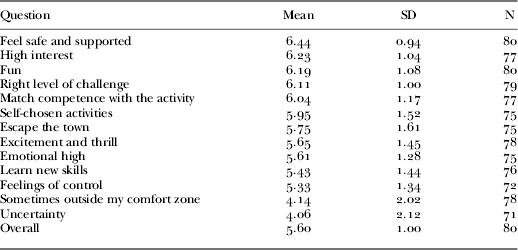
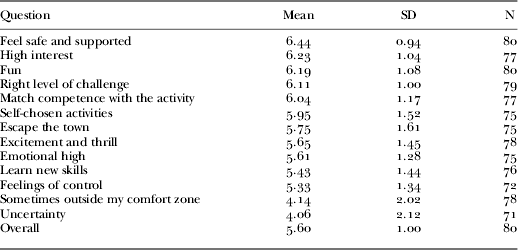
The items in this section appear in Table 1 and unequivocal support is evident with most items being above a mean of 5.3 out of 7. The literature identifies the positive and emotional frame of an adventure experience and these aspects are supported by the participants. Items like ‘fun’, and ‘excitement and thrill’ suggest that this cohort embrace adventures for the same reasons as the general populace. This is illustrated by the comment: ‘Afterwards I feel exhilarated, especially after a challenging trip’ (female, age 68).
Levels of agreement with elements of adventure activities
Notes: The data come from a seven-point Likert scale where 1=not at all, 7=very much so. SD: standard deviation.
The engagement with risk is an interesting one for this cohort. As stated:
At this stage of your life you don't seek risky experiences. But I am quite happy to be put outside my comfort zone. The challenge side is quite appealing in the programme but not [to the point of being] life threatening … I have no problem feeling uncomfortable, occasionally apprehensive. (female, 63)
The conundrum between risk embrace and uncertainty, on one side, and risk aversion and safety, on the other, is well stated. The pursuit of an authentic, emotional experience is desired; but the pursuit of high levels of fear and apprehension are not. The two survey items that received moderate support, ‘sometimes out of my comfort zone’ and ‘uncertainty’, are indicative of this position. For these adventurers, risk seeking is secondary to the many other facets of the experience. Risk engagement is in the soft adventure/post-adventure spectrum where the actual risk factors are not high, skill levels may be low and there are professional leaders (Ewert Reference Ewert and Ewert1989; Varley Reference Varley2006). The programme and the participants make every effort to ensure that personal competence is matched with the challenge of the activity as per Martin and Priest (Reference Martin and Priest1986). There is provision for individual needs in self-selection from a range of options of varying demand. Some actively avoid trips that have risks deemed unacceptable: ‘I don't go in snow now as I am more accident prone and not as stable on my feet’ (male, 76). There are possibilities to retreat from risk engagement: ‘if you find it too much, it is quite acceptable to go back down’ (female, 63). These mechanisms support the creation of appropriate emotional frames (Holyfield, Jonas and Zajicek Reference Holyfield, Jonas, Zajicek and Lyng2005), and an ideal balance of challenge.
The question needs to be asked: are these real adventures? Reading the quotes already discussed supports the notion that the adventure situations are perceived as being real and therefore are real in their consequences. The authenticity debate rests in the symbolic conversion of the tangible experience into meaning (Simmel, cited in Wanderer Reference Wanderer1987). The establishment of goals by the participants that they are initially unsure of meeting, later translate into successful engagement as the goals are achieved, modified or abandoned. The links of fear to emotionality are evident with several participants reporting feelings of nervousness and apprehension before departure: ‘I'm always nervous before I go – it's a nervous excitement … it is a very emotional time’ (female, 63). This emotional state of apprehension is linked to the exhilaration experienced afterwards: ‘The adrenaline is running high afterwards; Just taking your pack off and lying on your back, flat’ (female, 63).
The successful management of this balance is in the hands of competent leadership. In the words of a female aged 70: ‘Having capable leaders and knowing that they are professional in their field; you feel very safe’. The potential for accidents is recognised but so too the safety aspects: ‘There is security in the programme but we like the challenge’ (female, 63). As well as interview comments the survey item that gained a highest level of agreement was ‘feel safe and supported’. Good leaders also expand horizons: ‘The places that you go that you wouldn't be able to get to on our own’ (female, 68).
The support for the motivation to ‘escape the town’ is suggestive of Lyng's (Reference Lyng and Lyng2005) sociological explanations of edgework. The statement: ‘I love to get my feet off the asphalt’ (female, 68) taken metaphorically could be regarded as resistance to modernity, but in retirement what is being escaped? The sociological explanation is just as likely to be the embrace of adventure as part of late modernity. Participation in the programme, at least in part, is consumption of a marketed and packaged adventure experience. Key differences between this programme and a typical adventure tourism experience include community location, profit motive and the subsequent accessibility to those on limited incomes.
Another key point of difference could be the integration of learning. As one person stated: ‘Learning new skills is one of the great things’ (male, 66). In addition to the skills of the outdoor pursuits, the opportunities to learn about the environment and the social history of the area were valued: ‘I have learned so much about the environment’ (female, 70). The programme director recognised the participants as being a rich resource and built learning opportunities about place and history into the programme as well as exploiting the teachable moment. ‘The group [members] come from all walks of life and someone always knows about something’ (female, 68). The embrace of their knowledge and experience made the participants feel valued, in contrast to some of the diminishing experiences of being an older person in modern western society.
The role of the environment
The natural environment provides the context and raw material in which outdoor adventures take place, e.g. bush and mountain. The literature identifies adventurers who see the environment as wallpaper or an exploitable resource (see Berns and Simpson Reference Berns and Simpson2009), others who find the sublime (Stranger Reference Stranger1999), and those who embrace an environmental ethic (Brymer, Downey and Gray Reference Brymer, Downey and Gray2009). One participant identified the challenge provided by the environment: ‘I like the battle with the elements, wind, rain, clouds; I don't mind getting wet or walking in the rain’ (female, 68). The same person also identified the aesthetic aspects: ‘It is the awe, the smells, the earth, the lovely mossy smell and the ferns and the bush, the sunset, the sparkle of the sea and those things – the wow factor’. Another interviewee stated: ‘It is a moment in time that sears into your brain’ (female, 70).
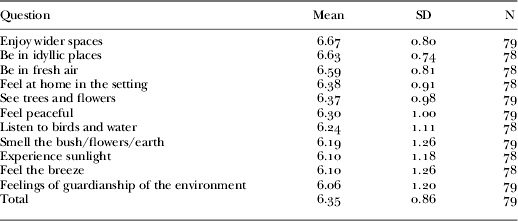
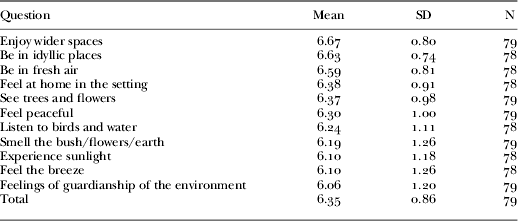
Table 2 demonstrates the high level of support for all of the items relating to the environment. The adventure experience is embodied and multi-sensory. A number of items in this section focus on the sensory aspects, e.g. ‘smell the flowers’ and ‘feel sunlight’. The tactility is nicely highlighted by the comment: ‘I love the mud – getting muddy’ (female, 68). Other items explore the panoptic meanings of the environment, e.g. ‘enjoy wider spaces’ and ‘feel at home in the setting’. As identified earlier, there is a strong learning component linked to the environment: ‘To open your eyes to a special environment, e.g. tussock lands’ (male, 66). The findings in this section are supportive of the benefits of interaction with a natural environment as reviewed by Hinds and Sparks (Reference Hinds and Sparks2008). Overall, it is a feature of this cohort that they value highly the environment in a micro and macro sense and develop feelings of guardianship that are indicative of proactive behaviour. Interestingly, those who had been longer in the Third Age programme also rated guardianship higher (F(1,74)=6.18, p=0.02).
Environmental experiences provided by adventure engagement
Note: SD: standard deviation.
Social aspects
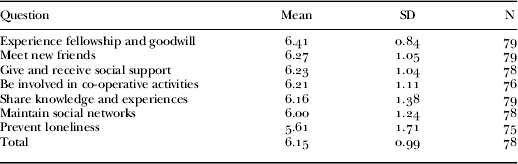
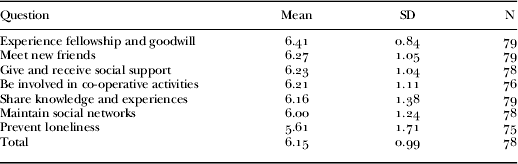
As can be seen from Table 3 the participants rated their social experiences highly. This is reflected in the following comment: ‘I enjoy the comradeship and group most, the social activity and the discussion. There is such a wide variety of people. We are tremendously supportive of each other, very conscious of anyone struggling’ (female, 68).
Social benefits of adventure engagement
Note: SD: standard deviation.
As well as comaraderie, awareness and support of those in need is heightened. This may be reflective of the health factors in play with older people. Knowing that a level of social support is inbuilt is attractive for the participants. The programme also offers opportunities for people to make new friends and to integrate into the community: ‘[I like] the opportunity to meet new people and to be involved in the community’ (female, 63). In addition to the effective social management of the group by the staff, the provision of a bus for transport is a significant factor in promoting social capital: ‘Travelling as a group on the bus sets the tone for the trip. It pulls the group together. Everybody talks, jokes and swaps seats’ (female, 70). In the participants lives, the Third Age group was the strongest source of friendship networks (51% had many Third Age friendships) compared to family (41% had many connections) and other friendship networks (26%). Furthermore, friends made in the adventure context had become friends in wider society: ‘What tends to happen is that through friends I have met through Third Age we have gone off and done things’ (female, 70). Overall, these findings support prior research outcomes regarding the social benefits of engagement in adventure (e.g. Varley Reference Varley2006) and in social engagement in general (e.g. Wood and Giles-Corti Reference Wood and Giles-Corti2008).
Physical and psychological benefits of adventure engagement
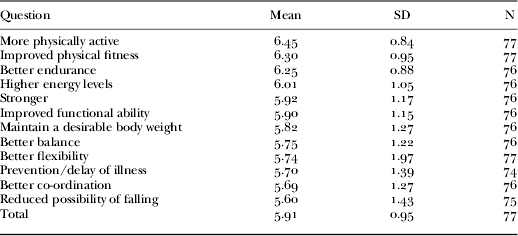
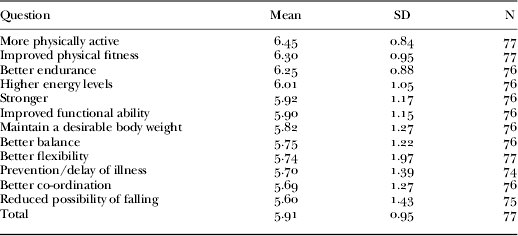
The activities incorporated levels of physical activity above the norms of a usual day and ideal for the participants' capabilities. Some of the benefits identified by Chodzko-Zajko, Schwingel and Park (Reference Chodzko-Zajko, Schwingel and Park2009) appear in Table 4 where a uniformly high level of support is noticeable.
Physical benefits of adventure engagement
Note: SD: standard deviation.
In the interview data, physical improvements were noted at a time of life when physical decline is to be expected: ‘My health has improved since the programme. I was once hospitalised with arthritis but I am over that. With the exercise I am just great now’ (female, 70). Evidence of motivation to improve fitness was also provided: ‘I did a day trip first and realised I was not fit enough. So I did a lot more walking myself to build fitness for the trips. Within a year I did a pack-carrying trip; I loved it’ (female, 63).
Interestingly, links were reported between engagement in the programme and an improvement in blood pressure and blood lipid levels, with 33 per cent reporting improvements. One individual produced medical evidence of his reduction that coincided with his programme involvement and which he attributed to the programme. A range of other links were also evident: e.g. improved sleep patterns F(1,48)=5.77, p=0.02; and stress reduction F(1,43)=4.31, p=0.04; and others. Caution should be exercised in the interpretation of these serendipitous findings, but it flags the area as worthy of future research incorporating the physiological and psychological.
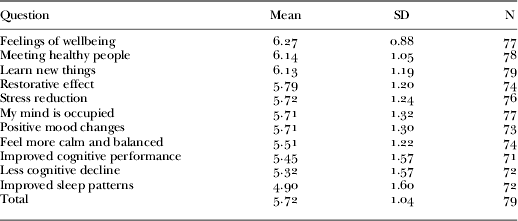
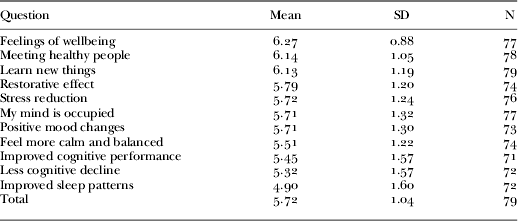
Some of the psychological effects of adventure engagement are presented in Table 5 and engendered good levels of support. Interview comments reflect the positive effect on wellbeing: ‘The mind is occupied and I am meeting healthy people. The group has made such a difference’ (female, 70). ‘I like being in the present, rather than the past – talking about what you are doing now’ (female, 63).
Psychological benefits of adventure engagement
Note: SD: standard deviation.
Some of these items, like ‘less cognitive decline’ may be difficult to answer as they are imprecise and difficult to judge. This could relate to their location near the bottom of the rank order, with larger standard deviations. It seems that the positive effects on wellbeing draw from the combination of activity, environment and social interaction to create the positive effects discussed. It has been beyond the scope of this study to tease these relationships out and this would be useful for future research.
Other aspects
A number of other aspects were supported by the participants. These included: ‘a positive and active image of older adults’ (mean=6.24, SD=1.0); a more cohesive community (mean=5.77, SD=1.34) and ‘a reduction in health and social care costs (mean=5.55, SD=1.55). These indicate that the cohort thought there were benefits for the community and the state.
Conclusion
This study took a holistic approach to adventure activities as successful ageing experiences of a group of Third Age citizens. The study employed a mixed-methods research design with the qualitative data prioritised. The researcher was an insider who spoke the language of both an adventurer and an older person. Hence the perspectives gained include the interaction of researcher and participant. The group may be unique in comparison to other people, and their socio-cultural context may not be typical of society in general. The participants have chosen to be there and are the success stories in the ageing stakes. Those less fortunate are not included. As a consequence of these factors the outcomes do not lend themselves to a collective meaning.
The impact on these people's lives was notable. The activities were typically ‘soft adventure’ and the cohort confirmed that risk engagement was desirable but situations of over-extension were avoided. From the perspective of the individual, authenticity, embodiment and emotional engagement through fun, pleasure and excitement were sought. Uncertainty was accepted but not to the point of discomfort or threats to safety. Of similar importance were social and environmental experiences and learning. The inimitable combination of these elements produced a flavour of adventure that was unique. The participants were very happy participating in adventures and saw considerable personal and social benefits from engagement. An effective programme tailored to the needs of the participants and coupled with good leadership played no small part in its success.
The challenge and aesthetic aspects of the environment were considered integral and defining to the experience. Acute awareness of the sensory aspects was a common feature, environmental learning was valued and feelings of guardianship were espoused. The Third Age group are strong allies of the environment, and an under-utilised resource. The findings broaden Brymer and Gray's (Reference Brymer and Gray2009) assertion that extreme adventurers develop a strong environmental ethos, to also include soft adventures and older people. The outcomes also support the natural environment as an integral part of successful ageing.
The quality of the social experiences of the programme were one of the highlights of the research. People spending time or living together in authentic problem-solving modes intensified social processes. People came to know one another well, giving and receiving support and building strong friendship networks. Friendships made in the programme led to outside friendships and the growth of community-based networks. As Hildon et al. (Reference Hildon, Montgomery, Blane, Wiggins and Netuveli2009) identified, social capital is based on quality social relationships and community integration and is an important feature of successful ageing. Social capital provides protective functions and coping mechanisms for the challenges of late adulthood. This research profiles an adventure-based group that contributes to this role.
Psychological and physical benefits were reported in the interviews and supported in the surveys. Improvements in physical fitness and lowering of blood pressure and blood lipids were evident with the latter being worthy of further investigation. Health and wellbeing improvements were noted and benefits for the community and the state were identified. Ideas that would warrant further investigation include physiological support for the link between blood pressure and blood lipid levels and programme involvement; measurement with accelerometers of the physical activation levels of the programme compared to sedentary lifestyles; further exploration of the role of outdoor environmental experiences and wellbeing; in-depth examination of the mechanics of social support; and further exploration of the role of adventure in the lives of the Third Age participants. Quantitative studies that incorporate control groups and standardised measures would also be useful.
Adventure for the older people in this study shares many of the attributes of the adventure engagement of the young. The attraction lies in intense, embodied experiences in natural places with supportive others. The activities are highly interesting, fun and enjoyable, novel and uncertain. They provide opportunities to escape the mundane of daily life, embrace risk taking and experience self-transcendence. Communion with nature offers renewal and wellbeing. The outcomes support these qualities similar to the findings of Patterson and Pan (Reference Patterson and Pan2007). Key variations for older adults include lower and carefully paced exertion levels and the avoidance of situations that overextend. Socially the group is of like-minded individuals of comparable abilities and interests in a similar stage of the lifecycle. Broader-based learning about place is valued and environmental appreciation is sharpened. It is essential that the activities offered are tailored to the needs of older people and enable self-selection and self-pacing.
Adventure as a positive leisure experience contains opportunities for physical activity, social engagement and interaction with the natural environment. Prior research indicates the benefits of these components as discrete entities. The present research supports the integration of these components into the adventure package and supports the benefits of such engagement. Overall, this group of adventurers have embraced successful ageing. They take personal responsibility for their health and wellbeing, contribute to their communities and lead healthy lives. They are fortunate that their health issues have been surmountable and they have the desire, economic means and access to a successful programme. In an age of austerity, programmes such as these are worthy of state preventive health investment and provide fresh ways to age gracefully.