Introduction
Human life expectancy has been increasing at a rapid rate, but the major problem of focusing on increasing the length and not the quality of life is that simply increasing life expectancy will also increase morbidity since people will experience increased exposure to age-related disease, disability and dysfunction (Brown, Reference Brown2015). Moreover, a European survey states that people generally favour quality over length of life (Higginson et al., Reference Higginson, Gomes and Calanzani2014); thus, research needs to focus more on increasing quality of life indicators, such as functional health.
Functional health status is one of the most important health indicators for older adults, since functional status measures trace the transitions from older adults’ well states to conditions of disability along the continuum of health (National Research Council (US), Reference Gilford1988). Despite the lack of a standardised definition, functional health is often defined as one’s ability to perform daily activities required to meet basic needs, fulfil usual roles, and maintain one’s health and well-being (Wilson and Cleary, Reference Wilson and Cleary1995). The nature of functional health is multidimensional, encompassing physical, cognitive, mental health and social functions (National Research Council (US), Reference Gilford1988). Despite the extensive literature on the topic, studies that emphasise and highlight the multidimensional facets of functional health are much more scarce; therefore, a combination of these measures is recommended to determine functional health status and broaden the operational definition of health beyond the absence of disease. Nevertheless, literature suggests that ‘overall functional capacity’ is difficult to measure and, to better define it, various components of well-being should be measured, encompassing physical health, mental health, economic resources and cognitive function rather than looking to single dimensions (Fillenbaum, Reference Fillenbaum2013; Mao et al., Reference Mao, Han and Chen2016).
Health has been consistently linked with socio-economic status (SES). It has been shown that a disadvantaged SES is a strong predictor of poor physical and mental health throughout the life course, and that this relationship is well established worldwide (Stringhini, Carmeli, et al., Reference Stringhini, Carmeli and Jokela2018; Kivimäki et al., Reference Kivimäki, Batty and Pentti2020). However, the relation between SES and health might be time-dependent (Alwin and Wray, Reference Alwin and Wray2005; Schöllgen et al., Reference Schöllgen, Huxhold and Tesch-Römer2010; Stringhini, Carmeli, et al., Reference Stringhini, Carmeli and Jokela2018; Vable et al., Reference Vable, Gilsanz and Kawachi2019), and it is plausible that the strength of this association changes with age (Alwin and Wray, Reference Alwin and Wray2005). For example, it is known that socio-economically disadvantaged children have worse adult health (Haas, Reference Haas2008; Vable et al., Reference Vable, Gilsanz and Kawachi2019; Soares et al., Reference Soares, López-Cheda and Santos2020), having been influenced by cumulative impacts of daily living that include exposures associated with the individual’s placement within social and economic hierarchies. Yet, the influence of the ‘long arm of childhood’ (Hayward and Gorman, Reference Hayward and Gorman2004) itself can change over time, which makes it challenging to study the longitudinal aspects of SES as an exposure.
Literature describes three competing hypotheses for the pathways through which socio-economic mobility may impact health in later life. On the one hand, childhood economic disadvantage may accumulate with poor educational attainment and occupation, producing worse health patterns (cumulative hypothesis) (Singh-Manoux et al., Reference Singh-Manoux, Ferrie and Chandola2004). On the other hand, the ‘age-as-leveler’ hypothesis suggests that health should eventually converge across groups because of the biological ageing process, meaning a weaker effect of SES on health (Dupre, Reference Dupre2007). Also, a hypothesis of continuity exists that assumes that SES in early life influences health at older ages in a continuous and stable way (O’Rand and Henretta, Reference O’Rand and Henretta1999). Moreover, the relation between life-course SES and health not only varies across populations but also depends on which SES indicators and health outcomes are used (Vable et al., Reference Vable, Gilsanz and Kawachi2019), and a recent systematic review was able to show that, for example, looking only to studies that use education as SES measure, there are a variety of studies confirming all of the aforementioned competing hypotheses (Wang and Hulme, Reference Wang and Hulme2021), suggesting that more research is needed to better explain these heterogeneities.
The risk of disability increases with age and peaks from 70 onwards (Wahrendorf et al., Reference Wahrendorf, Reinhardt and Siegrist2013). When considering prospective studies, SES is more widely studied in relation to specific diseases, multimorbidity and non-communicable risk factors (Allen et al., Reference Allen, Williams and Townsend2017; Stringhini, Zaninotto, et al., Reference Stringhini, Zaninotto and Kumari2018; Kivimäki et al., Reference Kivimäki, Batty and Pentti2020) and to better understand the predictive value of SES for functional health in later life, more research is needed (Stringhini, Carmeli, et al., Reference Stringhini, Carmeli and Jokela2018). Nonetheless, whereas most studies focus exclusively on SES from adulthood as a cause of functional limitations at older ages, current research indicates that socio-economic circumstances in adulthood provide an incomplete view of the relation between SES and functional health, and that the combination of adulthood and childhood SES is a promising predictor of disability in later life (Zhong et al., Reference Zhong, Wang and Nicholas2017; Landös et al., Reference Landös, von Arx and Cheval2019).
Studies examining social inequalities in health in later life have had less consistent findings when compared to the ones encompassing a working-age population (McMunn et al., Reference McMunn, Nazroo and Breeze2009), and studies focusing on the specificities of this relation exclusively in older adults are rare (Schöllgen et al., Reference Schöllgen, Huxhold and Tesch-Römer2010). Given the current context of rapid global ageing, increase in life expectancy and, consequently, the importance of enhancing older people quality of life (Beard et al., Reference Beard, Officer and de Carvalho2016), a deeper examination of the social determinants and their relation with functional health in this particular population is essential to a sustainably ageing society and highly relevant to public health policy. Therefore, this study aimed to assess the relation between life-course SES and different dimensions of functional health in non-institutionalised older adults with at least 50 years of age, namely by exploring whether adulthood SES can compensate for childhood SES.
Methods
Study design and participants
The present work analyzes data from participants in the EPIPorto study, a population-based cohort of non-institutionalised adults residing in the Porto metropolitan area, Portugal, and recruited in 1999–2003 (baseline) with the aim of assessing the determinants of health in the adult population (Ramos et al., Reference Ramos, Lopes and Barros2004). Participants were selected using random digit dialling at a time when 97% of households had a landline telephone. The participation rate was 70%, and during this period 2485 participants, of which 1539 women, were recruited. In 2005–2008, the first follow-up of the cohort was conducted and 1682 participants were reassessed. In this evaluation in particular, a more complete sociodemographic module of questions was included, comprising not only the participants’ characteristics such as education and occupation but also their parents’ SES.
Between 2013 and 2015, a second follow-up was conducted and a total of 2190 participants were eligible. Of those, 117 refused to participate, 129 had died, and 951 had were not evaluated in this follow-up. For the present analysis, we further restricted the sample to those who were 50 years or older at this second follow-up, resulting in an analytic sample of 821 participants (501 women).
In all evaluations, a structured questionnaire to assess participants’ sociodemographic, behavioural and clinical characteristics was administered by trained professionals during face-to-face interviews.
Functional health outcomes
Functional health outcomes encompassed physical, mental and cognitive domains and were assessed during the 2013–2015 follow-up.
Physical and mental functioning were evaluated using the Portuguese version of the Medical Outcomes Study Short Form 36 (SF-36), which contains 35 self-reported health-related quality-of-life items covering eight subscales: physical function (10 items), role limitations due to physical health problems (4 items), bodily pain (2 items), general health (5 items), vitality (4 items), social function (2 items), role limitations due to personal or emotional problems (3 items) and mental health (5 items) (Severo et al., Reference Severo, Santos and Lopes2006). When scores for all eight subscales are available, they are aggregated into two summary measures, also known as component scores: physical health, covering the first four subscales, and mental health, covering the last four subscales (Ware and Sherbourne, Reference Ware and Sherbourne1992; Ware et al., Reference Ware, Kosinsky and Keller1994). All subscales and summary measures were directly transformed into a 0–100 scale with lower scores indicating more disability.
Cognitive function was evaluated using the Portuguese-validated version of the Montreal Cognitive Assessment (MoCA) test, a brief cognitive screening instrument with documented sensitivity in the early detection of mild cognitive decline (Freitas et al., Reference Freitas, Simões and Alves2011). This test measures eight cognitive domains through several tasks, namely visuospatial/executive, naming, memory, attention, language, abstraction, delayed recall and orientation (to time and place), with a maximum score of 30 points (Nasreddine et al., Reference Nasreddine, Phillips and Bédirian2005). Normative values for the Portuguese population were established according to age and education at the first follow-up, and cognitive impairment was considered when values were two standard deviations (SDs) below the age- and education-adjusted norms (Freitas et al., Reference Freitas, Simões and Alves2011).
Handgrip strength was assessed three times on the dominant and non-dominant hands with the Jamar Hydraulic Hand Dynamometer. Each participant was directed to perform their full strength for 5 seconds, measured in kilograms. An average value of the measures was computed for analysis.
Walking speed was assessed through the 25-Foot Walk Test (T25-FW). The T25-FW is a quantitative mobility and leg function performance test based on a timed 25-walk. This test is simple and quick to perform and was developed for measuring gait impairment in multiple sclerosis, but it has been shown to be a good proxy of long-distance walking performance in the general population (Phan-Ba et al., Reference Phan-Ba, Pace and Calay2011). Each participant was directed to one end of a clearly marked 25-foot course and instructed to walk 25 feet (7.65 m) at their usual pace. The time was calculated from the initiation of the instruction to start and ended when the participant reached the 25-foot mark. The task was immediately administered again by having the individual walk back the same distance. Time walked (in seconds) was averaged across the two trials and then categorised into tertiles, with the highest tertile representing individuals who took the longest time. Participants could use assistive devices when doing this task, but they were immediately allocated into the highest tertile, independently of the time taken to conduct the task.
Life-course SES
All SES variables were retrieved from the 2005–2008 follow-up. Childhood SES was defined based on participants’ paternal occupation, and adulthood SES was characterised using participants’ own occupation. Occupation and parental occupation were categorised using the Portuguese Classification of Occupations that is line with the European Socio-economic Classification (ESeC) (Rose and Harrison, Reference Rose and Harrison2007) and aggregated into two categories: non-manual (professional, managerial and non-manual skilled occupations) and manual professions (manual skilled, semi-skilled and unskilled occupations) (Galobardes et al., Reference Galobardes, Shaw and Lawlor2006). Four possible life-course SES patterns were computed, consistent with previous research (Stringhini, Zaninotto, et al., Reference Stringhini, Zaninotto and Kumari2018; Rocha et al., Reference Rocha, Stringhini and Henriques2020): ‘stable high’ (non-manual paternal occupation and non-manual own occupation), ‘upward’ (manual paternal occupation and non-manual own occupation), ‘downward’ (non-manual paternal occupation and manual own occupation) and ‘stable low’ (manual paternal occupation and manual own occupation). Participants who had never worked, housewives or those with an omitted profession were classified as manual professions. The classification used in the present study is available in a supplementary table (Table S1).
Statistical analysis
Descriptive statistics (mean and SD or median and interquartile range [IQR] for continuous measures; counts and percentages for categorical variables) were computed and tabulated. For functional health outcomes measured on a continuous scale (SF-36 subscales and summary measures; handgrip strength), linear regression was used to estimate their relation with life-course SES, after adjusting for age and sex. The present analysis does not include adjustment for variables after childhood, since they are mediators of the main association and not covariates, and adjusting for mediators can lead to a bias on the estimates (Victora et al., Reference Victora, Huttly and Fuchs1997). To estimate adjusted odds ratios for the relation of life-course SES with cognitive impairment and with walking test tertiles, binary and multinomial logistic regression were used, respectively. Confidence intervals (95% CIs) for linear regression were based on the coefficient standard error and the normal distribution; those for binary and multinomial logistic regression were based on the likelihood ratio statistics by profiling the likelihood. We formally tested an interaction between sex and life-course SES, but it was not significant; therefore, results are presented for women and men together. All analyses were conducted in R, version 4.0.1 (Team, Reference Team2021).
Ethics
The study protocol was approved by the Ethics Committee of the Porto Medical School of Hospital São João (approval number: CE HSJ n°65- 20/10/95). In all evaluations, written informed consent was obtained from participants before data collection.
Results
Table 1 displays the sociodemographic characteristics of the study participants. In this sample, the median age in the second follow-up (2013-2015) was 66.0 years (IQR: 60.1–72.7) and around 60% were female, had nine or less years of school education (Basic Education) and had a non-manual occupation. Almost half of the study participants had fathers with manual occupations, and a third presented a less favourable SES (i.e., downward mobility and stable low life-course SES; 7.1% and 26.6%, respectively) (Table 1).
Sociodemographic characteristics of the study participants the 2005–2008 follow-up (n = 821)

SES, socio-economic status.
* Except for age, summarised as median and interquartile range (IQR).
a Non-manual (professional, managerial and non-manual skilled occupations); manual professions (manual skilled, semi-skilled and unskilled occupations).
b Computed based on the four possible combinations between participant’s occupation and paternal occupation: ‘stable high’ (non-manual paternal occupation and non-manual own occupation), ‘upward’ (manual paternal occupation and non-manual own occupation), ‘downward’ (non-manual paternal occupation and manual own occupation) and ‘stable low’ (manual paternal occupation and manual own occupation).
Regarding the evaluated functional health outcomes, the lowest SF-36 scores, corresponding to more disability, were obtained for general health (mean [SD]: 58.0 [18.8]), vitality (mean [SD]: 58.4 [19.6]) and role limitations due to personal or emotional problems (mean [SD]: 30.3 [38.1]). Probable cognitive impairment was identified in 10.6% of the study participants. The average grip strength of the dominant hand was 22.0 kg (SD: 11.1), and that of the non-dominant hand was 19.0 kg (SD: 10.5) (Table 2).
Characterisation of participants’ functional health at the 2013–2015 follow-up

SF-36, Medical Outcomes Study Short Form 36; SD, standard deviation; T25-FW, 25-Foot Walk Test.
* Except for SF-36 and handgrip strength, summarised as mean and standard deviation.
a Cognitive impairment was considered when values were 2 standard deviations below the age- and education-adjusted normative values for the Portuguese population.
b Average value of three measures on each hand.
c Participants using assistive devices were immediately allocated into tertile 3.
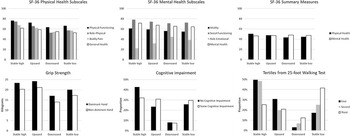
Concerning the relation between life-course SES and functional health outcomes, overall, lower SF-36 scores were more frequently reported by individuals who accumulated social disadvantage over the life course and those who presented a downward SES trajectory. Regarding walking speed, among those who were in the third tertile and took longer to perform the walking test, 41.6% had a stable low SES trajectory. By comparison, individuals in the stable high trajectory consistently presented better functional health for most of the outcomes considered. For most functional health outcomes, those with a downward SES fared worse than those with a stable low SES (e.g., dominant hand grip strength: 17.0 kg vs 20.1 kg, respectively). However, only 7.1% of the sample (n = 58) were in the downward SES trajectory, resulting in those observed differences not being statistically significant at the 0.05 level, and some functional health outcomes showed an opposite association (e.g., role-emotional: 44.8 vs 38.6, respectively). Among those presenting some cognitive impairment, 32.1% had been classified as stable high SES, 30.9% as upward SES, 7.4% as downward SES and 29.6% as stable low SES (Figure 1).
Functional health outcomes according to life-course SES trajectory.

A more in-depth analysis of the association between life-course SES and different functional health outcomes is presented in Table 3. Overall, and independently of age, sex and the health outcome considered, participants who experienced a stable low life-course SES had higher chances of presenting a greater degree of functional impairment than those with a stable high SES. More specifically, those in the stable-low SES presented a score for the physical functioning that was, on average, 9.75 points lower than the score of the ones in the stable high SES (SF-36 physical functioning: β = −9.75; 95% CI: β14.34; β5.15), and a similar negative association was found for the mental health subscale (SF-36 mental health: β = β7.33; 95% CI: β11.55; β3.11) Regarding handgrip strength, participants in the least favourable SES category had, on average, 1.60 kg less strength in their dominant hand (β = −1.60; 95% CI: −2.86; −0.35), and they took significantly more time to conduct the walking test (highest tertile: OR = 5.28; 95% CI: 3.07; 9.09) when compared to their stable high SES counterparts. Regarding the role-emotional SF-36 subscale, the opposite trend was observed, with those in the stable low SES presenting higher scores, that is, less limitations due to emotional problems (β = 16.50; 95% CI: 8.31; 24.77). When the two summary measures of SF-36 were considered, a negative and significant association was only observed for physical health (stable low SES: β = −5.53; 95% CI: −7.72; −3.34). For dominant and non-dominant handgrip strength, those with an upward SES trajectory were not statistically different from those in the stable high SES for most of the health outcomes. However, those with an upward SES trajectory tended to have had nearly a twofold increase in the odds of cognitive impairment (OR = 1.75; 95% CI: 0.96; 3.19). A downward SES trajectory resulted in close to a fivefold increase in the odds of slower walking speed (OR = 4.62; 95% CI: 1.78; 11.95) (Table 3).
Age- and sex-adjusted effects (β and ORs) of life-course SES on functional health at the 2013–2015 follow-up

OR, odds ratio; SES, socio-economic status; SF-36, Medical Outcomes Study Short Form 36; T25-FW, 25-Foot Walk Test; Ref., reference; 95% CI, 95% confidence interval; β, beta coefficient.
* Estimated by binary logistic regression for cognitive impairment and multinomial logistic regression for walking test.
Discussion
This study was able to show that a life-course disadvantaged SES is an important predictor of multiple outcomes of functional health among adults aged 50 years and older, independently of their sex and age. Overall, for most of the SF-36 subscales, for handgrip strength and for walking speed, a social gradient was observed in relation to life-course SES, with those who accumulated disadvantage and had a stable low SES presenting worse patterns of functional impairment, when compared to those with a stable high SES. A downward SES trajectory also disfavoured walking speed. On the other hand, regarding cognitive impairment, it was observed that those in the upward SES trajectory tended to be more prone to some cognitive impairment than their counterparts in the stable high trajectory, although the difference was not statistically significant.
The present study was able to show comparable associations between life-course SES and different functional health outcomes, and the variability of the results supports the idea that looking at only a specific domain of functional health provides an incomplete view of the overall outcome and enhances the benefits of looking at a broader spectrum of functional health, namely when the aim is to address the impact of socio-economic deprivation.
Regarding physical functioning measured through SF-36 and leg function performance using T25-FW, those in the stable low SES category had the highest chance of presenting more functional impairment, showing that the accumulated socio-economic disadvantage across the life course increases adult disease risk (Ben-Shlomo and Kuh, Reference Ben-Shlomo and Kuh2002). These results are in line with previous literature that show the negative effect of a consistently low life-course SES trajectory (Otero-Rodríguez et al., Reference Otero-Rodríguez, León-Muñoz and Banegas2011; Lacey et al., Reference Lacey, Belcher and Croft2013). By comparison, an opposite trend was found for the role-emotional subscale, with the least favourable SEP trajectories being associated with more limitations due to personal or emotional problems. The authors hypothesise that this surprising result can be explained by resilience mechanisms that were not measured in this study. In fact, older adults are capable of high resilience despite socio-economic backgrounds, personal experiences, and declining health (MacLeod et al., Reference MacLeod, Musich and Hawkins2016) and even experience high well-being and high quality of life and consider themselves to be ageing successfully despite the onset of chronic conditions (Bowling and Iliffe, Reference Bowling and Iliffe2011), which may, at least partially, explain the positive association between disadvantageous SEP and less limitations due to emotional problems. Moreover, culture influences emotions and shapes how they are felt and expressed (Lim, Reference Lim2016). Since southern European countries are often characterised by higher levels of informal social support namely from friends and family (Pichler and Wallace, Reference Pichler and Wallace2007), this might also buffer the negative consequences of low SEP on health, which was previously observed in this cohort (Henriques et al., Reference Henriques, Silva and Severo2020).
Additionally, individuals in the upward trajectory had a higher chance of worse functional health, namely for the physical health aspects of the SF-36 scale and cognitive function. Regarding the specific SF-36 subscales, despite the worse functional health for those in the upward trajectory, these participants were in a better position when compared to those from the stable low SES, which supports the positive influence of moving to a more advantageous position during adulthood. Specifically regarding the trend for cognitive function, inconsistent results are still observed in the literature, with some studies highlighting the importance of a high financial and cultural capital in late life independently of their early childhood SES (Peterson et al., Reference Peterson, George and Gilsanz2021), while others assume that a disadvantaged childhood SES is associated with lower cognitive function but adulthood SES partially mediates this relationship, with a stable high SES providing an advantage in cognitive function (Lyu and Burr, Reference Lyu and Burr2016). At the same time, not all studies show a significant relationship between SES and cognitive decline (Karlamangla et al., Reference Karlamangla, Miller-Martinez and Aneshensel2009). Different approaches to conceptualise childhood SES, adult SES and cognitive function might at least partially explain this variation across studies. For the SF-36 mental health summary measure, handgrip strength and walking speed, those in the upward SES trajectory were not different from the ones in the stable high SES, showing that adulthood SES was able to compensate for childhood adversity. These results are in line with previous findings for other health outcomes (Stringhini, Zaninotto, et al., Reference Stringhini, Zaninotto and Kumari2018; Rocha et al., Reference Rocha, Stringhini and Henriques2020) and functional health measures (Vable et al., Reference Vable, Gilsanz and Kawachi2019) and support that it is possible to mitigate or reverse the effects of early economic hardship. Thus, the results found for the upward SES trajectory suggest that, at least for some health aspects, health inequalities that arise in early life are mutable and programmes or policies facilitate upward SES mobility might help to achieve health equity.
Apart from the SF-36 physical health and handgrip strength, individuals who experienced a downward SES had similar functional health to those who had stable low SEP, suggesting once again the importance of the achieved SES during adulthood. An exception was observed for handgrip strength, with individuals who experienced a downward SES having presented less handgrip strength when compared to those who had stable low SEP. These results suggest that downward social mobility modifies the effect of initial early-life socio-economic circumstances and that a disadvantaged SES in adult life can outweigh the health benefits of a better start in life. (Hallqvist et al., Reference Hallqvist, Lynch and Bartley2004). Downward social mobility leads to an undesirable loss of the assigned socio-economic position at birth and therefore associated changes in practices, behaviours and norms. Also, the perception of downward social mobility may be seen as unfair which, together with psychological maladjustment to a new environment, can precipitate chronic stress and ultimately compromise the health of these individuals. However, these results should be interpreted with caution since the downward trajectory was a phenomenon that occurred only in 58 individuals (7%) of this sample; therefore, evidence about this SES category is limited. Moreover, the results for this particular trajectory might also reflect some reverse causality, since it is plausible that poor health during childhood preceded their downward SES. Further studies need to study this particular group of older people, namely by disentangling the causes of an unfavourable SES trajectory.
Previous literature showed gender differences in functional ability (Arber and Ginn, Reference Arber and Ginn1993) and mental health outcomes (Angelini et al., Reference Angelini, Howdon and Mierau2019) among older adults. Thus, we formally tested an interaction between sex and life-course SES, but it was not statistically significant. This result is in line with literature studying the relation between SES and functional health in the second half of life (Schöllgen et al., Reference Schöllgen, Huxhold and Tesch-Römer2010), where no statistically significant interaction between gender and SES was also observed. Moreover, considering previous works using data from the EPIPorto cohort, no gender differences were found regarding other health outcomes, such as quality of life (Henriques et al., Reference Henriques, Silva and Severo2020). Despite the statistical reasons, a growing body of evidence is reinforcing that gender gaps at younger ages tend to narrow in late life in terms of health and disability, with exception of mental health, that still favours men (Carmel, Reference Carmel2019). Taking all this information together, we believe that the lack of gender differences observed in the present study is not, at least totally, due to an artefact of the sample size.
Several strengths can be found in this study. First, this work was able to characterise multiple aspects of functional health among Portuguese older adults, encompassing physical, cognitive and mental health domains, providing a more complete picture of this multidimensional construct and of healthy ageing (National Research Council (US), Reference Gilford1988) while using instruments widely used with older adults worldwide (Krawczyk-Suszek and Kleinrok, Reference Krawczyk-Suszek and Kleinrok2022). Moreover, SES at two points in the life course was assessed, which enabled us to measure the impact of an unfavourable childhood SES and to what extent adulthood SES can compensate those who have their social origin at the bottom of the social ladder.
Several limitations warrant mention. The EPIPorto cohort had differential losses to follow-ups throughout time, particularly for those individuals with fewer years of education. This fact might be also reflected in a selective survival and, consequently, in an overestimation of good functional health at this age. Also, this work did not include institutionalised individuals. As both poor SES and low functional impairment are linked to a higher risk of institutionalisation (Luppa et al., Reference Luppa, Luck and Weyerer2010), it is possible that we underestimated the impact of SES on functional health; therefore, future research still needs to consider older adults besides those living in the community. Likewise, this study was conducted with adults residing in the Porto metropolitan area, in the north of Portugal, and results should not be extrapolated to the rest of the country, since regional inequalities in health and health care may occur, namely between rural and urban areas.
Since life-course SES spans childhood and adulthood, only measures already established in childhood were considered possible confounders, namely age and sex. Similar to previous studies (Vable et al., Reference Vable, Gilsanz and Kawachi2019), the present analysis did not include variables after childhood, since these variables would likely act as mediators of the main association, and adjusting for mediators could lead to estimation bias (Victora et al., Reference Victora, Huttly and Fuchs1997). However, we might have unmeasured confounding regarding other possible aspects established during childhood, namely childhood health status, social capital or family structure, which were used as confounders in previous studies (Vable et al., Reference Vable, Gilsanz and Kawachi2019). Additionally, variables that could characterise parental health status, namely during participants’ childhood, would have been an added value to this work in case they were available, since they could capture the genetic influence on health between two generations, as well as provide some clues regarding health behaviours within the household.
To conclude, the present study suggests that life-course SES is an important determinant of functional health, but this relation is complex and dependent on the health outcome considered. Overall, more favourable SES over the life course will lead to better functional health at older ages, but for mental health functioning, handgrip strength and walking speed, it is possible to overcome the social disadvantage from childhood during adulthood. Thus, these results reinforce that even though health disparities may start early in life, they are mutable and capable of changing through the improvement of socio-economic conditions. Future studies need to examine in detail the mechanisms underlying the association between SES and functional health at these ages in order to develop effective and tailored strategies and policies to help all citizens achieving better functional health and, consequently, better quality of life at older ages.
Supplementary material
The supplementary material for this article can be found at https://doi.org/10.1017/S0021932023000093
Data availability statement
The data that support the findings of this study are not included in the article, but they can become available upon reasonable request to the EPIPorto scientific committee (email: hbarros@med.up.pt/ana.henriques@ispup.up.pt).
Author contribution
Ana Henriques: conceptualisation, formal analysis and writing – original draft; Luís Ruano: writing – review and editing; Sílvia Fraga: writing – review and editing; Sara Soares: writing – review and editing; Henrique Barros: funding acquisition and writing – review and editing; Makram Talih: conceptualisation, formal analysis, supervision, and writing – review and editing.
Financial support
This study was supported by FEDER through the Operational Programme Competitiveness and Internationalization and national funding from the Foundation for Science and Technology – FCT (Portuguese Ministry of Science, Technology and Higher Education), I.P., within the scope of projects UIDB/04750/2020 and LA/P/0064/2020. It is also acknowledged two Scientific Employment Stimulus contracts (CEECIND/01793/2017 and CEECIND/01516/2017 to AH and SF, respectively).
Funders had no role in the design, execution, analysis and interpretation of data, or writing of the study.
Competing interests
The authors have no relevant financial or non-financial interests to disclose.
Ethical standard
The study protocol was approved by the Ethics Committee of the Porto Medical School of Hospital São João (Approval number: CE HSJ n°65- 20/10/95). In all evaluations, written informed consent was obtained from participants before data collection.