The interest in advanced learners, high-level proficiency, and ultimate attainment in a second language (L2) is rather recent in SLA research. It was from the 1990s forward (with the exception of Coppieters, Reference Coppieters1987) that the field became productive (e.g., Birdsong, Reference Birdsong1992; Bongaerts, Reference Bongaerts and Birdsong1999; Carroll & von Stutterheim, Reference Carroll and von Stutterheim1997; Ioup, Boustagui, El tigi, & Mosette, Reference Ioup, Boustagui, Eltigi and Mosette1994; Lambert, Reference Lambert1997). As Hyltenstam, Bartning, and Fant (Reference Hyltenstam, Bartning and Fant2005) state, knowledge is less elaborated in regards to higher stages—namely, those stages in which speakers may appear to have stopped developing their L2 proficiency even though learning may still be going on.
More recently, there has been a growing interest in finding relevant measures to register possible differences between highly proficient L2 users—or learners—and native speakers (NSs; see Birdsong, Reference Birdsong, Davies and Elder2004, Reference Birdsong2005, Reference Birdsong2006; Hyltenstam, in press; Montrul & Slabakova, Reference Hyltenstam2003; Muñoz & Singleton, Reference Montrul and Slabakova2007; Paradis, Reference Muñoz and Singleton2009; Sorace, Reference Paradis2003). In a recent study by Bartning, Forsberg, and Hancock (Reference Bartning, Forsberg and Hancock2009), it was shown that for L2 French, three linguistic domains—morphosyntax (i.e., noun phrase and verb phrase morphology, complex syntax), formulaic language (i.e., NS’s preferred patterns of multiword sequences), and information structure (i.e., structuring utterances in thematic and rhematic constituents)—can fruitfully be combined to investigate high-level proficiency in terms of the resources or obstacles that facilitate or hinder the route toward nativelike production.
Morphosyntactic deviances (MSDs) are expected to be more or less absent in late L2 French according to some researchers (e.g., Lambert, Carroll, & von Stutterheim, Reference Lambert, Carroll and von Stutterheim2003; Perdue, Reference Perdue2000; von Stutterheim, Reference von Stutterheim2003). Others show, on the contrary, that they continue to be present even at very high levels of proficiency (Hyltenstam, Reference Hyltenstam and Harris1992; Lardière, Reference Lardière2007; Sorace & Serratrice, Reference Sorace and Serratrice2009). In the present study, accuracy is viewed as “the conformity of second language knowledge to target language norms” (Housen & Kuiken, Reference Housen and Kuiken2009, p. 462; Wolfe-Quintero, Inagaki, and Kim, Reference Wolfe-Quintero, Inagaki and Kim1998, p. 4), and the MSDs seem to be the last challenge for the very advanced learner or user of a L2. Thus, the main research goal is to explain the lack of accuracy in high-level proficiency as illustrated by these MSDs. It is believed that MSDs do not just appear randomly in the nonnative speaker (NNS) data. Rather, they indicate that it may well be precisely the distribution and nature of formulaic language (FL) as well as the information structure of the utterance that influence their appearance. The present study focuses, consequently, on FL and information structure as linguistic contextual explanatory factors that influence the appearance of MSDs.
The three NNS groups investigated can all be labeled as advanced and highly proficient L2 speakers, but they are distinguished by their different lengths of residence (LOR) in France. Judging from earlier results, the developmental differences are not deemed to be very pronounced. However, the primary reason for including three different groups is to have a solid amount of data from advanced L2 French speakers (n = 30) in the study. Therefore, the present study does not focus on developmental aspects but will use the different subcorpora to study the effects of information structure and FL on morphosyntax as such.
The results presented will be linked to the ongoing debate on complexity, accuracy, and fluency (CAF; see Housen & Kuiken, Reference Housen and Kuiken2009; Skehan, Reference Skehan1998). These three concepts are most often studied separately, but it is suggested that it may be fruitful to adopt a more integrative approach; that is, to investigate how measures of fluency and complexity, such as FL and the syntactic complexity of information structure organization, can explain different degrees of accuracy (as illustrated by the MSDs).
ILLUSTRATIONS OF THE THREE LINGUISTIC DOMAINS
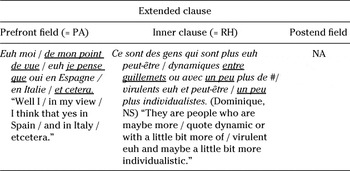
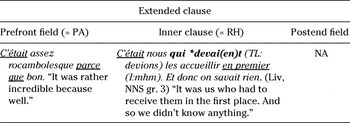
It is necessary first to illustrate the three domains and the type of utterances examined in the present study as shown in the two examples in Tables 1 and 2. A préambule or preamble (PA; Morel & Danon-Boileau, Reference Morel and Danon-Boileau1998, p. 37) is the thematic or modal part of the utterance preceding the rheme (RH) and corresponds roughly to what is being talked about, or includes the point of view along with one or several connectives. The RH, in contrast, is the part of the utterance that expands on the PA. In other words, it is what is said about what is being said. For the purposes of the present study, the model of Morel and Danon-Boileau (Reference Morel and Danon-Boileau1998) was adopted, and the analysis of the dyad PA and RH was also inspired by the description of the extended clause in positional grammar applied to conversations by Lindström (Reference Lindström2008).
The utterance in Table 1, which is a NS production, contains a PA (or prefront field) and an inner clause with a RH. The utterance in Table 2, however, is from a NNS. The clause in bold is an example of a MSD. The MSD is produced in the rhematic part, and it is a form of the irregular verb devoir (used to express obligation) in the third-person imperfect—either singular or plural, as both are phonologically identical—instead of the first-person plural form devions (had to), and in complex syntax, c’est X qui ____ (it’s X who ____). The underlined sequence in Table 2 is an example of a formulaic sequence (FS)—an umbrella term for a large number of multiword combinations that are supposedly the preferred choice of NSs (see Pawley & Syder, Reference Pawley, Syder, Richards and Schmidt1983, for the concept of nativelike selection)Footnote 1—and functions as the unit of analysis for FL.
The extended clause in native speaker discourse

The extended clause in nonnative speaker discourse

Note
Bold indicates a morphosyntactic deviance; underlined text indicates a formulaic sequence.
THEORETICAL AND METHODOLOGICAL CONSIDERATIONS
Morphosyntactic Deviances in SLA
As has already been stated, the point of departure of this study is the presence of MSDs in the production of very advanced learners and users. Morphosyntactic deviances, as simplified systems, are well-known features of L2 French morphology and syntax and are already present in early-intermediate French L2 acquisition (see Ågren, Reference Ågren2008, for verb phrase and noun phrase morphology; Bartning & Schlyter, Reference Bartning and Schlyter2004; Carroll, Reference Carroll2005; Granfeldt, Reference Granfeldt2003, for noun-phrase [NP] morphology; Hawkins, Reference Hawkins2004, for gender; Herschensohn, Reference Herschensohn2006; Housen, Kemps, & Pierrard, Reference Housen, Kemps, Pierrard, Labeau and Myles2009; Kihlstedt, Reference Kihlstedt1998; Labeau, Reference Labeau, Labeau and Myles2009, for the tense, mood, and aspect system; Labeau & Myles, Reference Labeau and Myles2009, for surveys; Leclercq, Reference Leclercq, Labeau and Myles2009; Véronique, Reference Véronique2009, for surveys). It was shown in Bartning et al. (Reference Bartning, Forsberg and Hancock2009) that MSDs are still present in high-level L2 productions, even after 20 years of residence in France. These nonnative features thus occur in advanced learners as well as in speakers approaching near-native status.
In the literature on fossilization and stabilization, many of these phenomena are debated. Lardière (Reference Lardière2007), in her longitudinal study of a Chinese learner acquiring English during 19 years, showed that the features of agreement and tense marking were not acquired during this period, whereas subject pronouns were. Simply put, one of Lardière’s explanations was that syntax is acquired before morphology, and that there is a mapping problem between these two modules. In contrast, Hawkins and Chan (Reference Hawkins and Chan1997) have proposed the failed functional features hypothesis, which states that functional categories determine the parametric differences between languages, such as inflections on nouns, adjectives, and verbs. In the case of a grammatical area such as gender agreement, it follows that adult learners whose first language (L1) lacks gender agreement will have difficulty in acquiring this area, whereas learners of a L1 that contains gender agreement will not (see R. Ellis, Reference Ellis2008). Features not present in the learner’s L1 are consequently not possible to acquire in the L2 if the L2 is learned after the age of puberty, according to the critical period hypothesis (see Franceschina, Reference Franceschina2005, for Spanish L2).
Mention must also be made of a relevant study on the acquisition of gender in L1-L2 French—namely, Frenck-Mestre, Foucart, Carrasco, and Herschenson (Reference Frenck-Mestre, Foucart, Carrasco and Herschenson2009)—that showed, on the contrary, that “it is clearly not the case that acquisition is limited to those features present in the L1 nor by age of the learner”; rather, “salient phonetic cues can enhance the online processing of agreement and arguably the grammaticalization of these rules” (p. 100).
It is interesting to note that other studies have shown that nativelikeness in morphosyntax can be acquired by NNSs after all (see Birdsong, Reference Birdsong1992; Hopp, Reference Hopp2010, for L2 German by L1 Russian, English, and Dutch learners; Montrul & Slabakova, Reference Montrul and Slabakova2003; Sorace, Reference Sorace, Doughty and Long2003, for L2 Italian). In regards to L2 German, Hopp (Reference Hopp2010) proposed that “inflectional variability is thus attested at all stages in adult L2A. Across these stages research has found two robust characteristics of L2 inflectional variability. First, inflectional variability is systematic, and, second, it is modulated by L1-TL differences” (p. 903).
The MSDs included in the present study are particularly interesting developmental features of stabilization that stem from the acquisitional history of the dynamic interlanguage system (Bartning & Hancock, in press). These MSDs may also reveal late but not yet completely automatized forms and may thus reveal deficits in implicit knowledge rather than explicit knowledge. These MSDs may, in contrast, be evidence of the suggestion made by Paradis (Reference Paradis2009) that L2 productions are manifestations of explicit knowledge because L2 acquisition is principally governed by declarative, explicit knowledge and memory. In the case of MSDs, this knowledge does not suffice or is not available. The present study’s contribution to this debate is to show that, from a processing perspective, some internal contextual features—coming from the interface of other linguistic levels than grammar—influence the appearance of late MSDs in very advanced and near-native users’ oral productions of French L2.
The selection of categories of MSDs was drawn, in part, from the results in overviews of late features in SLA research (see Ågren, Reference Ågren2008; Bartning, Reference Bartning, Labeau and Myles2009; Bartning & Schlyter, Reference Bartning and Schlyter2004; Howard, Reference Howard and Dewaele2005; Labeau, Reference Labeau, Labeau and Myles2009). As will become clear, focus is on the deviances, as not all the target language (TL) forms will be considered.
The following categories within the verb phrase are considered:
• Subject-verb agreement (as shown in example [1])
• Tense, mood, and aspect (TMA): a broad category for simplification patterns in the tense system—for example, present tense as a substitute for past tenses in past tense contexts; the compound past for pluperfect (see Labeau, Reference Labeau, Labeau and Myles2009); the indicative for the subjunctive; and problems with auxiliaries, such as avoir (to have) rather than être (to be). It should be noted that the TMA category is of course also semantic (e.g., verbal aspect). Nonetheless, the label MSDs will be used in what follows.
The study also focuses on the following category within the noun phrase:
• Gender agreement of determiners (of different kinds), adjectives (in different positions), and subject pronouns.
The example in (1) is an illustration of MSD in subject-verb agreement. The example in (2) is from the TMA system (see von Stutterheim & Lambert, Reference von Stutterheim, Lambert and Hendriks2005) and involves discussion about the fact that it takes time to learn French. As the example in (2) shows, there is a use of the imperfect for the compound past in narrative contexts, which differs from that of French TL use. The example in (3) shows a gender error in the NP.
(1)E: Et pendant qu’ils sont absents il y a des cambrioleurs qui vient [viennent] ouvrir la portequi rient bien en pensant deux pauvres vieux qui sont partis au théâtre. (Minna, gr. 3)
“And while they are absent there are some thieves who come to open the door who laugh thinking: two poor old people who left for the theatre.”
(2)E: Bon (I: d’accord ouais) mais pour moi c’était long. Et je sentais que euh # ensuite j—# au bout d’un an je rentrais (for je suis rentrée )en Suède. Je continuais (for j’ai continué) les études là-bas entre autres des études de français. Euh au bout d’un moment mon futur mari est venu me me rejoindre et donc je parlais presque plus français. (Minna, gr. 3)
“Well (I: OK yeah) but for me it was long. And I felt that euh # then # after a year I went back to Sweden. I continued the studies back there among other things French studies. And after a while my future husband came to join me and so I nearly did not speak French any longer.”
(3)(PA:) C’est vrai que c’est pas # (RH:) moi j’ai pas uN [une] image très romantique (I: mhm) de ces gens-là. (Liv, gr. 3)
“It’s true that it is not # me I do not have a very romantic picture (I:mm) of these people.”
Information Structure and Complexity
Complexity.In this section contextual factors of complexity will be presented to look for possible explanations of the appearance of MSDs from a processing perspective. The main aim is to demonstrate the methodological decisions of the present study. The extended clause is used as a basis for the analysis, and thus complexity is analyzed at two levels. At the local level, syntactic complexity—such as subordination and elliptic structures inside the PAs and RHs—is measured. The analysis is also concerned with complexity at the discourse level—that is, in the combination of PAs and RHs.
As the ongoing debate on complexity indicates (e.g., Norris & Ortega, Reference Norris and Ortega2009), defining complexity in a clear-cut way is a challenge, especially within spoken language. One way to handle the notion would be to take into account the dynamic online construction of the utterance as reflected in the division of PAs and RHs. The prefront field (see Tables 1 and 2) forms a complex unit together with the core of the utterance, the RH. It could be that the formulation of a prefront field—functionally well separated from the core utterance and containing several slots for referential and modal framings (i.e., topic, temporal, spatial, and modal expressions)—facilitates, at some level, the task of processing the ensuing RH. Most of the referential framing (in the PA) needed for the RH would then already be set when this part is to be formulated. Additionally, modal and circumstantial expressions, often manifested as FSs, function as time savers and thus as stepping-stones for the formulation of the RH that follows. The contribution of the present study to the current discussion about complexity at the utterance level would be the application of a syntactic process perspective (see Geluykens, Reference Geluykens1992; Hancock, Reference Hancock2007; Lindström, Reference Lindström2008; Morel & Danon-Boileau, Reference Morel and Danon-Boileau1998).
To illustrate this process perspective, note that the PA contains the topic (theme), together with the circumstances (temporal, spatial, and conditional) and the speakers’ perspective on the upcoming RH. The example in (4) is taken from a NNS within the corpus:
(4)En Suède j’ai l’impression que les gens / ils vivent pas pendant la semaine.
“In Sweden I have the impression that people do not live during the week.”
The PA (i.e., the part of the utterance that precedes the slash) contains a circumstance (en Suède), a perspective (j’ai l’impression que), and the topic (les gens). The RH (i.e., that which follows the slash) is then the part of the utterance where something is said about what is being said, as in ils vivent pas pendant la semaine, in which the speaker expresses his opinion about les gens.
Simple and Complex PAs and RHs at the Local Level: Definitions and Examples.It is important to know whether RHs are more complex than PAs, in general, without considering the presence of MSDs. To investigate, a sample was examined from the transcripts of each interview of the 30 NNSs previously mentioned as well as those of the 10 NSs; the analysis of which produced a total of about 2,473 sequences (for a complete explanation of the group breakdown, please refer to Table 4). All the occurrences of PA sequences, along with the first immediately following RH, were analyzed. to capture the ongoing process of building utterances and extended clauses in oral French, syntactic complexity was measured according to certain criteria (see Bartning & Kirchmeyer, Reference Bartning and Kirchmeyer2003; R. Ellis, Reference Ellis2008; Skehan & Foster, Reference Skehan and Foster1997): (a) the presence of subordination (i.e., clausal subordination—introduced by conjunctions such as temporal, conditional, causal, or relative clauses; X V que-clauses; etc.), and (b) the presence of syntactically condensed structures such as gerund and infinitival structures.
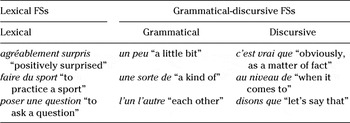
Categorization of formulaic sequences

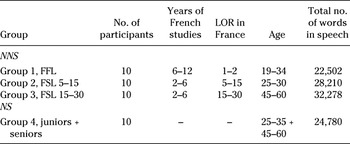
The four groups of participants from the InterFra-corpus

For the present study, the analysis was based on two important distinctions: First, a simple PA is a sequence in the prefront field of the extended clause that does not contain subordination or condensation, whereas a complex PA is a sequence in the prefront field containing at least one subordinate clause or condensed structure. Second, a simple RH is a sequence in the inner clause that does not contain subordination or a condensed structure, whereas a complex RH is a sequence in the inner clause containing subordination or a condensed structure.
The examples shown in (5) and (6) are of two different types of complex PAs, temporal (5) and causal (6):
(5)[PA] Alors quand ils—ils commencent à travailler [RH] ils n’en savent rien. (Lena, gr. 1)
“So when they—they start to work they don’t know anything about it.”
(6)[PA] Mais comme on a comme on a la présomption d’être beaucoup plus démocratique que les autres (I: ouais) la démocratie [RH] c’est beaucoup une question de travail. (Sarah, gr. 4)
“But as one has as we pretend to be much more democratic than the others (I: yeah) democracy is a question of work.”
The same criteria were used for complex RH analysis. As is illustrated in examples (7–8), the most common type of subordination in RHs is relative clauses. The example in (7) shows one relative clause, whereas the example in (8) shows two (marked in bold):
(7)[PA] Ben c’est / [RH] c’est pas un film que j’aurais choisi moi. (Hedda, gr. 2)
“Well it’s / it’s not a movie that I would have chosen myself.”
(8)[PA] Et je croyais que / [RH] c’était déjà quelqu’un qui *connaît déjà très très bien la personne qu’il traduisait. (Minna, gr. 3)
“And I thought that it was at least someone who knows already very very well the person whom he was translating.”
The example in (8) also shows a simple PA, whereas examples (5) and (6) show simple RHs.
Formulaic Language and Analytical-Holistic Processing
Formulaic language can be said to reflect fluency in the sense that the presence and access to FSs, as readymade chunks, increase the fluency, because they are processed faster than productive language (see Conklin & Schmitt, Reference Conklin and Schmitt2008; Erman, Reference Erman2007). However, as the present study shows, FL use and an increase in fluency are not necessarily connected for L2 speakers, even though this seems to be the case for L1 speakers. Some FSs are entirely holistic and contribute to fluency in all speakers, whereas some sequences contain open slots for gender and verb agreement and thus imply creative rule application to a certain extent. Grammatical-discursive FSs (e.g., c’est vrai que, “actually”) can mainly be seen as related to fluency, whereas lexical FSs (e.g., monter une boîte, “start a business”) are more related to lexical complexity (Bulté, Housen, Pierrard, & van Daele, Reference Bulté, Housen, Pierrard and van Daele2008) because they are a measure of what is traditionally considered as vocabulary depth. Formulaic language thus relates both to fluency and complexity as well as to accuracy, given that it is hypothesized that most FSs are accurately produced.
It seems quite plausible that these different types of sequences are not processed in the same manner in different languages. In regards to Romance languages, the large number of verb or gender inflections would, in the case of adjective-noun and verb-noun collocations, impede holistic (fluent) processing because it is not possible to produce these sequences without using productive rules for person and number inflection. This is why Erman, Fant, Forsberg Lundell, and Denke (2011) propose a categorization of FSs that takes into account the variability of the sequences and particularly their connection to the productive rule system. Thus, in Erman et al., building on Erman and Warren (Reference Erman and Warren2000), FSs are divided into two main categories: lexical and grammatical-discursive FSs.
Formulaic Sequences in the Present Study.The two most commonly used ways to identify FL in corpora are the statistical method and the phraseological method (Granger & Pacquot, Reference Granger, Pacquot, Granger and Meunier2008). In the first approach, words that occur together—more often than is predicted by chance—are labeled as collocations (a category of FL). Within the phraseological methodology, on the contrary, the researcher identifies potentially formulaic or conventional sequences on the basis of linguistic criteria related to syntactic, semantic, and pragmatic restrictions. In view of the small size of the present study’s corpus, it was decided that a phraseological method would be more useful because a statistical method requires a larger corpora to yield interesting results.
Classification and Identification of FSs. As previously stated, FSs can be classified as lexical or grammatical-discursive. A similar categorization for phraseological units was recently proposed by Granger and Pacquot (Reference Granger, Pacquot, Granger and Meunier2008), who classified units into referential, textual, and communicative sequences. Table 3 shows the categorization of FSs with examples.
Lexical FSs incorporate at least one content word. They are used for extralinguistic reference and denote actions, states, objects, and so on. When it comes to the practical identification of these sequences, Erman and Warren’s (Reference Erman and Warren2000) criterion of restricted exchangeability is used such that for a sequence to qualify as a FS, the exchange of one of the words for a synonymous word must always result in a change of meaning or a loss of idiomaticness (Erman & Warren, Reference Erman and Warren2000). Thus, the first step is to select the lexical FSs that meet this criterion. This is then complemented by searches on Google.fr. To test the extent to which restricted exchangeability applies to a sequence, an analogous sequence that has been subject to one or several modifications is created (e.g., either the exchange of one of the words for a synonym or an antonym, or an article change). For a sequence to be counted as formulaic, it has to appear at least twice as frequently on Google as any of the modified versions.
Grammatical-discursive sequences operate at the phrase and sentence levels, and, depending on whether their scope is either phrasal or clausal (i.e., at the sentence level) or wider stretches of discourse (i.e., at the text level), they will be labeled grammatical and discursive, respectively. Grammatical FSs typically function as quantifiers, determiners, and aspectual or temporal markers. Discursive FSs are functional in nature, and their meaning becomes salient through their function as operators on other structures. The members of this group typically function as information- or argumentation-structuring devices or as speech- and interaction-regulation devices. Discursive FSs correspond to what are usually called discourse markers. Grammatical-discursive FSs are typically fixed, with few possibilities for internal manipulation (compare the manipulation possibilities of monter une boîte, “to start a business,” with c’est vrai que, “actually”). They are indeed so fixed in form that there is no need to resort to Google searches to ascertain that the sequences’ status is formulaic.
The first important difference between lexical and grammatical-discursive FSs is their function in discourse; lexical FSs are similar to content words, whereas grammatical-discursive FSs are similar to function words. The second important difference, which has implications for the present study, is that they have different internal structures; grammatical-discursive FSs are, in most cases, more fixed than lexical ones. This is not to say, however, that there are no lexical FSs that are fixed (as is the case for compound nouns such as cordon bleu, “skilled chef”) or that there are no grammatical-discursive FSs that allow for internal manipulation (which is the case for c’est vs. ce sont [“there is” vs. “there are”] or un peu de vs. un petit peu de [“a bit of” vs. “a little bit of”]). It is thus a question of distinctive traits of the two different categories and not of mutually exclusive criteria.
The distinction between lexical and grammatical-discursive FSs is fundamental for the present study because it may help to explain the appearance of MSDs. In other words, if a MSD does appear within the confines of a FS, which would be impossible if the sequence were processed holistically, this deviance can be explained by the application of productive rules.
At this stage, and given the limits of this article, there is little possibility for a description of a theoretical model of memory and processing works in L2 acquisition. However, the assumptions of the present study about the production and creation of utterances should be clarified. To this end—and as is shown in Bartning and Hammarberg (Reference Bartning and Hammarberg2007)—Levelt’s (Reference Levelt1989) model of speech production is a fruitful framework with three different steps of conceptualization, formulation, and articulation in which these three subprocesses work both simultaneously and in parallel. The parts of the utterance are delivered continuously so that the next processing component can start working while the preceding component is being delivered (see the notion of incremental processing of utterances, by Kempen & Hoenkamp, Reference Kempen and Hoenkamp1987, as cited by Bartning & Hammarberg, Reference Bartning and Hammarberg2007). It is also assumed that the patterns of the three domains under investigation can be understood in the light of a usage-based conception of language—a model in which linguistic representations emerge as a result of experience and gradual entrenchment of cognitive routines (N. Ellis, Reference Ellis2002).
RESEARCH QUESTIONS, HYPOTHESES, AND DATA
It is presumed that MSDs can be found in certain predictable contexts and are expected to be absent within FSs due to the fact that FSs are supposedly processed as whole units and do not require creative rule application (Forsberg, Reference Forsberg2008; Wray, Reference Wray2002). The presence of FSs would thus offer processing advantages, and the speaker would avoid the risk of making MSDs in that way. However, it should be stressed that not all FSs need be subject to processing advantages, and as yet there has not been enough empirical research on this matter to clearly distinguish analytical and holistic processing.
In contrast to FSs, a context that favors the appearance of MSDs is the verbal phrase in the rhematic part of the information structure. When the rhematic part is to be formulated, the L2 speaker has to make both syntactic and morphological choices (e.g., of person or number), in which errors can occur. It is also reasonable to assume that complex syntax (e.g., subordination) would attract MSDs, as this entails another difficulty for the L2 speaker, who has to process and organize the speech online.
Additionally, it is expected that the PA, as opposed to the rhematic part, does not a priori require much creative rule application—with the exception of FSs that contain open slots for gender and verb agreement—because the PA consists mainly of adverbial expressions and discourse markers (the latter expression types are often FSs themselves, such as à vrai dire [to tell you the truth] and en fait [actually]). In this sense, the distribution of FSs in the thematic and rhematic parts of the information structure may influence the appearance of MSDs. Because there is also a supposed interrelation between FL and information structure, the PA would, as a consequence, contain fewer MSDs than the rhematic part.
Research Questions and Hypotheses
This study was guided by four principal research questions:
1. Can the MSDs that remain in high-level L2 French be predicted by contextual factors?
2. Do the MSDs appear within the confines of FSs?
3. How does the organization of the different parts of the information structure (i.e., presence, length, and syntactic complexity of the PAs and the RHs) influence the occurrence of MSDs?
4. How are FSs distributed within the information structure?
In reference to the second research question, it is hypothesized that MSDs are more often found outside of FSs than inside. However, if the MSDs are found within FSs, they are found within those that are not entirely fixed and require some creative rule application. This is typical of lexical FSs. As for the third research question, it is expected that MSDs will be more frequently found in RHs than in PAs due to the fact that the rhematic part is longer and more complex than the PA with respect to subordination, condensed constructions, and number of words. Finally, as pertains to the fourth research question, it is hypothesized that the rhematic part will contain fewer FSs than the PA. Because MSDs would appear less often within the confines of FSs, this would explain why MSDs would occur more frequently in the rhematic part.
Data
These hypotheses will be investigated in three different subcorpora of advanced L1 Swedish–L2 French speakers, compared to a subcorpus of NSs (all from the already-established InterFra-corpus). It is important to emphasize that this study does not aim to investigate possible developmental differences between these groups but, rather, to provide evidence for the systematicness and stabilization of advanced L2 French morphosyntactic errors and contextual factor distribution. Consequently, it was deemed important to test the hypotheses in several populations of advanced L2 speakers with different degrees of exposure.
As shown in Table 4, Group 1 consists of 10 advanced university students with a LOR of 1–2 years. It includes advanced semiformal learners—that is, university students and doctoral students (ages 19–34 years) classified as learners at stages 5 and 6 on the continuum of stages proposed by Bartning and Schlyter (Reference Bartning and Schlyter2004). Group 2 consists of 10 advanced L2 users: Swedish-speaking young adults (ages 25–30 years), with a LOR of 5–15 years. Their ages of arrival in France were on average 18–19. Group 3 consists of 10 Swedish-speaking adults who have lived in France for 15–30 years. They are 45–60 years old, live in bilingual families, work in bilingual settings (Swedish-French), and came to France at approximately 21–24 years of age.Footnote 2 Group 4 contains 10 NSs from two groups (Paris NS juniors: 5 participants, 25–35 years old; Paris NS seniors: 5 participants, 45–60 years old). These two groups were chosen to match the ages of the NNS groups: 5 from the Paris NS juniors and 5 from the Paris NS seniors participated in the same type of tasks.
These descriptions reveal different LORs, which, again, would lead to the assumption that some kind of development is expected between these groups. However, it was demonstrated in Bartning et al. (Reference Bartning, Forsberg and Hancock2009) that LOR had no effect on the occurrence of MSDs. Indeed, as Piske, MacKay, and Flege (Reference Piske, MacKay and Flege2001) suggest, additional years of experience in the L2 appear to be unlikely to lead to a significant change for highly experienced L2 learners, which seems to apply at least to MSDs.
In the present study, different parts of interviews between a NS interviewer and the NNSs have been used for the calculation of the different linguistic measures, given that some features are numerous (e.g., FSs, PAs, and RHs), whereas other are scarce (e.g., the MSD). Either a three-page sample of the interview with each participant (minus the NS interviewer speech) or the complete interview (again, minus the NS interviewer speech) has been analyzed. For the substudy on effects of FSs on MSD, the three-page samples have been used; for the substudy on the occurrence of MSDs in PAs or RHs, the complete interviews have been used. The two studies on local and discourse complexity have made use of the three-page samples, as has the last substudy on the distribution of FSs in the information structure.
RESULTS
The Effects of Formulaic Sequences on MSDs—Do MSDs Occur within Formulaic Sequences?
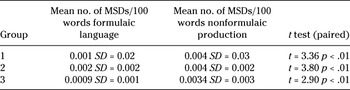
How does the use of FSs influence the appearance of MSDs? The first hypothesis stated that more MSDs were expected to be found outside the FSs than within them, given that FL is not rule based and tends to be acquired and used in a nonproductive manner. It is thus expected that the speakers would not try to compute number or gender agreement while using FSs. To investigate this hypothesis, a word count had to be conducted that divided the total number of words into two groups: (a) words that were part of FSs, and (b) words occurring outside FSs, here labeled as nonformulaic production.Footnote 3 The number of MSDs per each word group was then calculated, the results of which are shown in Table 5.
The appearance of morphosyntactic deviances in formulaic sequences versus in nonformulaic production

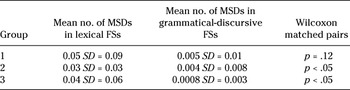
As Table 5 shows, it can indeed be confirmed that MSDs occur more frequently in nonformulaic speech than within the confines of FSs. It can thus be assumed that the use of FSs has a positive effect on MSDs. This, then, raises the question of how the errors that do occur within FSs can be explained. According to the hypothesis, MSDs are only expected to be found in FSs that require some creative rule application (i.e., lexical FSs). Table 6 accounts for the distribution of MSDs in lexical versus grammatical-discursive FSs.
The distribution of morphosyntactic deviances in lexical versus grammatical-discursive formulaic sequences

The results in Table 6 mainly confirm the second hypothesis that the majority of the MSDs found within FSs are found within lexical FSs (i.e., sequences in which productive rules are involved), even though the visible difference in group 1 is not statistically significant, probably due to the low number of occurrences. It is interesting to note that most MSDs are gender related—even the few MSDs found within grammatical-discursive FSs are also gender related. Two examples of MSDs within FSs are given here:
(9)Je pars comme ça du jour au lendemain. Je prends un décision / et puis je pars. (Elisa, gr. 2)
“I leave like that from one day to another. I make a decision / and then I leave.”
(10)On a on a besoin d’u:n d’un sorte de / d’engagement ou quelque chose. (Lena, gr. 1)
“One needs one needs a sort of of commitment or something.”
It is striking that gender agreement and assignment seems to be the feature that underpins most of the errors, occasionally even within FSs, for L2 speakers at high levels of proficiency (see Bartning, Reference Bartning, Labeau and Myles2009).
The Distribution of MSDs in the Information Structure: Complexity at Two Levels
In this section, the distribution of the MSDs will be investigated in relation to the utterance structure complexity considered in sequences of PAs and RHs. Measures of utterance complexity have been used at a local level—inside each PA and RH—as illustrated by syntactic subordination and elliptic or condensed structures, and at the discourse level, as manifested in the length and the proportion of the number of words between the PAs and RHs. The focus is thus the combination of the two discursive entities, the PA and the RH.
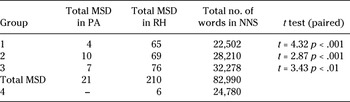
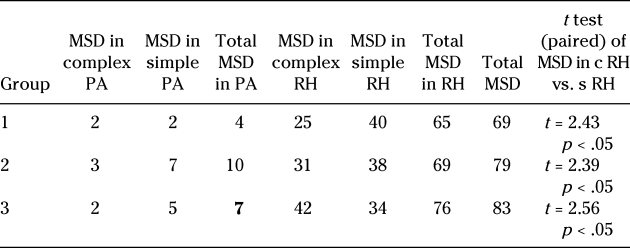
Results of the Interplay between MSDs and Information Structure PA and RH.To test the hypotheses that concern the interaction between information structure, utterance complexity, and appearance of MSDs, the MSDs in the PAs and the RHs were analyzed in the transcripts of the complete interviews of the four groups. Table 7 shows that the great majority of the MSDs appear in the RHs. This is a confirmation of the first hypothesis. This proportional pattern is the same for all three learner groups. As can also be seen in the Table 7, the NSs exhibit very few MSDs, if at all, and they always appear in the RH.
Distribution of morphosyntactic deviances in the preambles and rhemes

It appears from Table 7 that MSDs are 7–16 times more frequent in the RH than in the PA. Even when taking into account that RHs are longer than PAs, the MSDs are still more frequent in the RHs.Footnote 4 The difference in the distribution of MSDs in the PAs and the RHs is statistically significant for all groups. Thus, there is still an overrepresentation of MSDs in the RHs that remains to be explained by factors other than the length of the RHs.
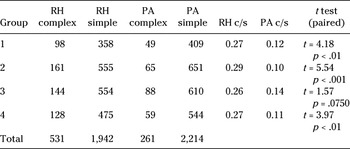
Local Complexity in RHs and PAs in Relation to MSDs.Table 7 shows that RHs appear to attract MSDs. The present study now seeks to explain when that is. It was hypothesized that RHs are more complex than PAs and are consequently potential generators of obstacles of the MSD kind for the users or learners. To compare the number of complex RHs and PAs, the ratio between complex and simple (= c/s) RHs and PAs is shown in Table 8.Footnote 5 This table shows that complex RHs in the four speaker groups are twice as frequent (or more) as the complex PAs (0.26/0.14–0.29/0.10). A t test showed that the difference was significant, except for group 3.
Number of preamble plus first rheme sequences

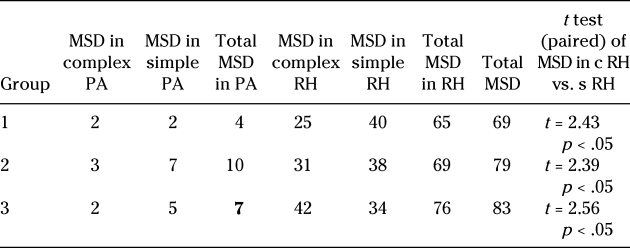
Turning now to consider Table 9, taking the MSDs into account, it appears that MSDs are more frequent in RHs than in PAs (as shown in Table 7). Morphosyntactic deviances are also more frequent in complex RHs than in simple ones.Footnote 6 These results confirm the hypothesis that MSDs appear more frequently in RHs (Table 9) than in PAs, and that they also occur more frequently in complex than in simple RHs (Table 9). T-tests were significant (p < .05).
Total number of morphosyntactic deviances in simple and complex preambles and rhemes
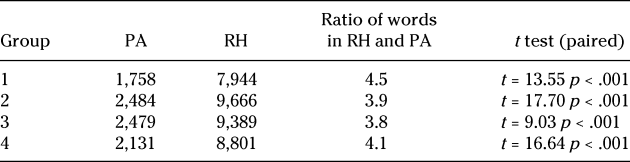
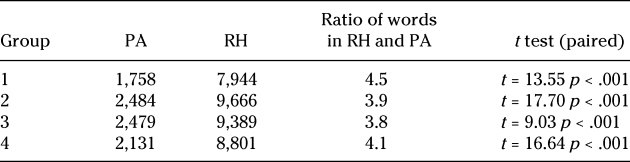
Discourse-Level Complexity: The Proportion and the Number of Words in the PAs and the RHs.Besides the degree of complexity measured in the simple and complex RHs and PAs, another measure of complexity—at discourse level—is the proportion of words in the PAs and the RHs in the sequences of the sample, as shown in Table 10. It is expected that the number of words will be higher in the RHs than in the PAs in both NS and NNS productions. This would provide an additional explanation as to why RHs are more difficult to process and thus attract more MSDs. In this example, all of the RHs that follow the PAs have been counted, not just the first RH. Table 10 also shows that the number of words in the RHs in all groups is approximately four times higher than in the PAs, still another indication that confirms the higher degree of complexity of the RHs. The difference was significant in all the groups, shown by t test (p < .001).
The number of words in the sequences of preambles and rhemes in the sample
The Distribution of Formulaic Sequences in the Information Structure
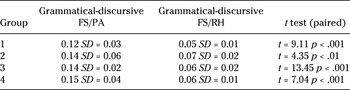
It has been shown that FL and the complexity of information structure influence the incidence of MSDs. To add additional explanations to the occurrence of MSDs, the present section examines the distribution of FSs in the PAs and RHs and thus pertains to research question 4, according to which the rhematic part contains fewer FSs than the PA and more FSs that require creative rule application.
Two specific questions need to be addressed. First of all, do the PA and the RH contain equal proportions of FSs, and, secondly, do the PA and the RH contain equal proportions of lexical and grammatical-discursive FSs? The examples in (11) and (12) illustrate the distribution of FSs (in bold) in the PA and in the RH. The PA of the utterance in (11) is an example of a long PA, which contains six constituents (delimited by slashes), whereas the PA in example (12) only contains two:
(11)[PA] Mais / c’est vrai que / par exemple / par rapport à la Suède / en hommes femmes / un homme / [RH] c’estun homme. (Jenny, gr. 2)
“But / it’s true that / for example / compared to Sweden / when it comes to men and women / a man / he’s a man.”
(12)[PA] Moi / je trouve qu’ / [RH] il y aaussi une ouverture d’esprit quand même. (Moa, gr. 3)
“I think that there is also an open-mindedness still.”
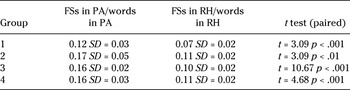
Table 11 accounts for the distribution of FSs, all included, in the PAs and in the RHs.
Number of formulaic sequences in the preambles versus the rhemes

The results of the statistical tests show that the PA contains significantly more FSs than the RHs for all groups. This would consequently contribute to the contextual explanations of the MSDs. As previously demonstrated, MSDs rarely appear within the PAs, and the relevant question is why. It is not only because the PAs are less syntactically complex but also because the PAs contain more FSs that have been shown to be resistant to MSDs.
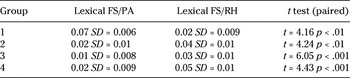
The next question to be examined requires looking more closely at the distribution of FSs in the information structure. It has already been shown that the PA generally contains more FSs than the RH and that FSs, in general, contain fewer MSDs. Furthermore, if errors do occur occasionally within a FS, it is always within a special category of FSs (i.e., lexical FSs) that typically involve creative rule application in French, something that is not the case for grammatical-discursive FSs, which are quite fixed in form (Erman et al., 2011). Tables 12 and 13 include figures for the distribution of lexical and grammatical-discursive FSs in the PA and in the RH. The tables allow for the following conclusions to be drawn: First, lexical FSs tend to appear significantly more often in the RH than in the PA, except for group 1 (an interesting result, because this group differs from the other groups in other respects as well; see Bartning et al., Reference Bartning, Forsberg and Hancock2009). Second, the second table shows that grammatical-discursive FSs, in contrast, appear significantly more frequently in the PA than in the RH. These results thus add even more explanations to the distribution of MSDs in the RH and the PA. The RH contains, generally speaking, significantly more lexical FSs—that is, the type of FS that can allow for MSDs to appear—whereas the PA contains significantly more grammatical-discursive FSs, a type of FS within which MSDs are hardly ever found, due to lack of creative rule application.
Number of lexical formulaic sequences in the preambles versus the rhemes

Number of grammatical-discursive formulaic sequences in the preamble versus the rheme

In conclusion, it could be claimed that a prototypical extended clause in French contains a PA with quite a high degree of FSs—specifically of the grammatical-discursive category—and is followed by a longer RH, which contains fewer FSs than the PAs, and thus fewer fixed elements. This leaves more room for creative rule application, which, in turn, may give rise to MSDs.
(13)[PA] C’est vrai que/ quelque part / je me rends compte que [RH] je suis dans un pays quand même vachement négatif. (Camilla, gr. 3)
“As a matter of fact / somehow / I realize that I live in a country which is still extremely negative.”
These results allow for the confirmation of the hypothesis under research questions 3 and 4—namely, that it is not only the complexity of the RH that attracts MSDs but also its distribution of FL.
DISCUSSION AND CONCLUDING REMARKS
The present study of French L2 high-level proficiency in 30 NNSs and 10 NSs investigated whether there may be explanatory factors of the residual difficulties of morphosyntax to be found in the linguistic context, namely in the organization of information structure in PAs and RHs, and the distribution and the nature of FSs. The study finds that MSDs rarely occur within FSs, and when they do, they most often occur within sequences containing open slots for creative rule application. Furthermore, the study looked into the effect of complexity of information structure on MSD occurrence. It is shown that the rhematic part of the utterance attracts more MSDs, in all speaker groups, probably due to the fact that the rhematic part is more syntactically complex than the PA and thus implies a higher processing load. The mean length of the rhematic part, which is longer than the PA, provides an additional explanation. Finally, it has been shown that the rhematic part contains a smaller proportion of FSs than the PA (thus more productive language use) and more FSs that contain open slots for creative rule application. In conclusion, when MSDs do occur at advanced levels of acquisition, their appearance can be predicted by their linguistic context and distribution.
In regards to the widely used concepts of CAF, it was argued that the measures investigated correspond to (a) MSDs as a measure of accuracy, (b) FSs as a measure especially of fluency but also of lexical complexity, and finally (c) information structure and syntactic organization as measures of complexity. The results of the current study show that fluency supports accuracy (i.e., the use of grammatical-discursive FSs seems to help the L2 user avoid making MSDs). On the contrary, FSs, which require rule application (lexical FSs) and are thus more complex to compute, can attract MSDs, and consequently hinder accuracy. Complexity in general was shown by the measures investigated here to have a negative effect on accuracy because the majority of MSDs are found in linguistically complex contexts. Additionally, it has been shown that fluency devices, such as grammatical-discursive FSs, have a particular distribution in the information structure—in the PAs and some rhematic parts—which also suggests a link between complexity and fluency. It is probably easier to process a long PA if it is composed of fixed elements, which convey processing relief, before dealing with the RH, which has been shown to contain more complex syntax and fewer readymade elements. All in all, this shows that complexity, accuracy (MSDs), and fluency (FSs) are interrelated, and it would be beneficial to study them as such and not separately, as has been mostly done to date (see Skehan, Reference Skehan2009).
Finally, it should be noted that even if the developmental aspect among these different high-proficiency groups of learners and users was not the focus of the present study, it would be worthwhile to continue to examine possible differences, especially with regard to information structure and FL use, given that the analyses have shown slight differences (although they are not discussed here; see Bartning et al., Reference Bartning, Forsberg and Hancock2009) between group 1 and the other L2 groups. These domains of high-level proficiency are further investigated in Forsberg Lundell, Bartning, Engel, Gudmundsson, Hancock, and Lindqvist (2012), in which the topic is a discussion of differentiation between several highly advanced stages in a developmental perspective. Additionally, a native listener test of pass as a native (Abrahamsson & Hyltenstam, Reference Abrahamsson and Hyltenstam2009) will be added to the other measures of FL, discourse structure, and morphosyntax, in the previously mentioned ongoing study of the same high-proficient groups.