Introduction
Soil and water are indispensable resources for the sustainability of agriculture and the environment, but they are under immense pressure due to the ever-increasing human population and changing climate (Singh et al. Reference Singh, Goyal and Choudhary2022). Globally, c. 52% of total productive land has been degraded, and annually c. 10 million ha of cropland becomes unproductive due to soil erosion (Gachene et al. Reference Gachene, Nyawade, Karanja, Leal Filho, Azul, Brandli, Ozuyar and Wall2019). The agricultural production system is at stake due to the continuously increasing pressure on underground water resources (Kumar et al. Reference Kumar, Sirohi, Pandey, Devi and Choudhary2019, Sidhu et al. Reference Sidhu, Jat, Singh, Sidhu, Gupta and Singh2019). Moreover, changing climate is projected to accentuate water demand globally for irrigation by c. 40% (Kumawat et al. Reference Kumawat, Yadav, Samadharmam, Rashmi, Meena and Datta2020). The emerging scenario of land degradation and acute water shortages could severely jeopardize global food security and reduce environmental quality. Therefore, judicious use as well as conservation of soil and water resources are more imperative than ever for sustaining agricultural production systems, particularly in rain-fed areas where soil moisture has always been a major factor limiting crop yields.
Rain-fed agriculture accounts for 80% of global agriculture and plays a critical role in food security, yet it is highly vulnerable to climate variability and change (Choudhary & Sirohi Reference Choudhary and Sirohi2022). As opportunities for the expansion of irrigated land are limited, unlocking the potential of large cultivated rain-fed and dryland areas is important to address the potential challenges emerging from the burgeoning human population and the rising demand for food projected to occur over the next several decades (Garg et al. Reference Garg, Wani, Barron, Karlberg and Rockstrom2012).
Rain-fed farming in India is practised in two-thirds of the total cropped area and contributes nearly 44% of the nation’s food production (Kumar et al. Reference Kumar, Singh, Singh, Singh and Jha2020); however, it suffers from multifaceted challenges. Rising temperatures and erratic rainfall are likely to have negative impacts on the yields of rain-fed crops (Choudhary & Sirohi Reference Choudhary and Sirohi2020). The cultivable lands of rain-fed areas are also characterized by poor soil fertility due to low organic and mineral contents and by being subject to top-soil erosion (Garg et al. Reference Garg, Wani, Barron, Karlberg and Rockstrom2012). These ecological problems are further aggravated by socioeconomic constraints including abject poverty, poor rural infrastructure and inadequate credit and extension services (Bouma & Scott Reference Bouma and Scott2006, Dar et al. Reference Dar, Bantilan, Anupama, Deepthi, Padmaja, Balisacan and Fuwa2007); these result in economic marginalization of the population that is dependent on rain-fed agriculture.
Among various measures to enhance and sustain crop productivity in rain-fed areas, the adoption of appropriate soil and water conservation measures (SWCMs) in farms has widely been accorded prime importance (Nkegbe et al. Reference Nkegbe, Bhavani and Graziano2011, Kumar et al. Reference Kumar, Singh, Singh, Singh and Jha2020). Some farm-level SWCMs that are extensively practised worldwide include contour bunding, field bunding, grass and tree planting on bunds, agroforestry and orchard plantation (Mishra et al. Reference Mishra, Singh, Kumar, Chaudhari, Patra and Biswas2018); these limit top-soil loss and improve the quality as well as water retention capacity of soil (Mwango et al. Reference Mwango, Msanya, Mtakwa, Kimaro, Deckers and Poesen2015, Singha Reference Singha2017).
Adoption of SWCMs may also increase crop productivity. Studies in Ethiopia (Yaebiyo et al. Reference Yaebiyo, Tesfay and Assefa2015), Latin America, the Middle East and sub-Saharan Africa (Barron et al. Reference Barron, Noel and Mikhail2009), northern Ghana (Nkegbe & Shankar Reference Nkegbe and Shankar2014) and China (Chen et al. Reference Chen, Zhu, Krotta, Calvo, Ganesh and Makot2013) have reported positive impacts of SWCMs on farm productivity and income.
In India, research and development programmes on SWCMs have been conducted over the past five decades across various regions (Joshi et al. Reference Joshi, Jha, Wani, Joshi and Shiyani2005). Although there has been much research on the impacts of SWCMs on hydrological and various environmental and ecological parameters in rain-fed areas (Garg et al. Reference Garg, Wani, Barron, Karlberg and Rockstrom2012, Singh et al. Reference Singh, Garg, Wani, Tewari and Dhyani2014), evidence of farm-level impacts is currently limited in India. Kumar et al. (Reference Kumar, Singh, Singh, Singh and Jha2020) improved our understanding of the impacts of soil conservation measures on crop yield to a considerable extent, but they did not account for the potential differences between adopters and non-adopters due to unobservable variables, the presence of which could lead to misinterpretations of the results (Caliendo & Kopeinig Reference Caliendo and Kopeinig2005).
Additionally, the factors influencing the farm-level adoption of SWCMs, particularly in the semi-arid tropics, are poorly explored. India ranks first among the rain-fed agricultural countries of the world in terms of both extent and value of produce (Rao et al. Reference Rao, Lal, Prasad, Gopinath, Singh and Jakkula2015), so investigating the drivers of the on-farm adoption of resource conservation measures in rain-fed areas and their farm-specific impacts is imperative. The present study therefore sought to address two important research questions: (1) what are the key determinants that influence farmers’ decisions on whether or not to adopt SWCMs? And (2) does it pay to adopt SWCMs in terms of productivity of crops and income from farming?
Material and methods
Study area, sampling procedure and data
Our analyses are based on primary survey data collected in the year 2020 from the Lalitpur district of the Bundelkhand region of central India. The district falls within the semi-arid tropics, receiving an average annual rainfall of c. 880 mm, of which the kharif season (June–September) received c. 90% and the remaining 10% is distributed throughout the remaining 9 months (October–May). The prevalent undulating topography, hard rock geology, low soil fertility, scarce groundwater resources and poor and erratic rainfall lead to frequent droughts and crop failures (Garg et al. Reference Garg, Anantha, Nune, Venkataradha, Singh and Gumma2020).
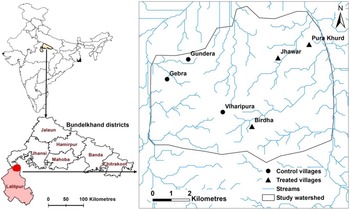
We purposively selected the three villages of Birdha, Purakhurd and Jhabar (Fig. 1) for our study because a broad set of soil and water conservation activities such as field bunding, plantation of fodder grasses on bunds and blocks, orchard plantation and agroforestry activities, farm pond construction, surface water harvesting and drainage channel construction were promoted there under the Knowledge-based Integrated Sustainable Agriculture Network Mission India for Transforming Agriculture (KISAN MITrA) project (Supplementary Annex S1, available online). Simultaneously, three contiguous non-project intervention villages, namely Gundera, Gebra and Viharipura, were identified as ‘controls’ to minimize potential biases in the estimands due to any spill-over effects between beneficiaries and non-beneficiaries. However, the selected control villages had similarities with the treatment villages in their agro-climatic, infrastructural and socioeconomic circumstances. Household heads were stratified based on land size category in each village and then a probability proportional to size method was used to draw sample households from each village. Finally, the respondent household heads were selected by using a random sampling technique.
The location of the study area.

With the help of a pre-tested and well-structured schedule (administered in Hindi), we collected data from 1031 plots of 400 households, out of which 150 farmers were adopters of SWCMs (from treatment villages) and 250 were non-adopters (from control villages).
Analytical framework
Drivers of the adoption of soil and water conservation measures
Following the theory of expected utility, we assumed that a farmer’s decision on whether or not to adopt a SWCM given the risk and uncertain prospects is based on the comparison of expected utility (Mercer Reference Mercer2004). Farmers will adopt and practise the promoted interventions if the expected utility from adoption (Ua) is greater than that derived from non-adoption (Un). As measurement of utility is difficult, profit can be used as a proxy and, if combined with attitude to risk, farmers are described as maximizing the expected utility of profit rather than expected profit (Borges et al. Reference Borges, Luzardo and Vanderson2015).
The utility derived from the adoption of SWCMs will have a binary choice component determined by observable characteristics X i and a stochastic error term ϵ i
 $$I_i^* = \beta {X_i} + \;{\varepsilon _i}; {I_i} = 1,\;\;if\;{I^{\rm{*}}} \gt 0,\;{\rm{and}}\;0\;{\rm{if}}\;{\rm{otherwise}}.$$
where Ii is a dichotomous variable for the adoption and β is a vector of parameters to be estimated. Farmers will adopt SWCMs if
 $I_i^*$
= Ua – Un > 0. The probability of adopting the technologies can then be estimated as:
 $${\rm{Pr}}\left( {{I_i} = 1} \right) = \Pr \left( {I_i^* \gt 0} \right) = 1 - D( - \beta {X_i})$$
where Pr(Ii = 1) is the probability of adoption and D represents the cumulative distribution function for εi.
Estimation of outcome variables
We focused on four outcome indicators: per hectare gross revenue, net revenue, total variable (input) cost and productivity of major crops grown in the study area. The total gross revenue from crops was calculated as:
 $GrossRenue = \mathop \sum \limits_{i = 1}^n ({Y_i} \times FG{P_i})\; + \;({Q_i}\; \times \;{P_i})$
where Y i is the quantity of the ith crop sold in the market at its farm gate price (FGP) and Q i indicates the quantity of the ith crop consumed by the household; P i is the market price of the ith crop. Net revenue was estimated by subtracting the total variable cost from the gross revenue. A major concern in the computation of costs and revenues is that there can be a composition of commodity effects instead of adoption effects driving differences in outcome variables (Singha Reference Singha2017); however, the data suggested that the crop composition between treatment and control households was similar.
Nonetheless, various methods are available for quantifying agricultural productivity at the plot level; we relied on farmers’ recall during the survey of production per hectare (i.e., yield of major crops in both of the cropping seasons). Ideally, such surveys should be carried out as soon as farmers harvest the crop; however, farmers can recall yields of up to three to six previous seasons (Erenstein et al. Reference Erenstein, Malik and Singh2007). There were untimely rains during the maturity of the kharif crops during 2019, which caused almost complete failures of crops such as sesame, green gram and black gram. Therefore, we restricted our analysis to the major crops harvested during the kharif (groundnut, maize and paddy) and rabi (wheat, mustard and chickpea) seasons of the survey year.
Propensity score matching
An empirical challenge in assessing causal effects in this study is to examine the outcome and its counterfactuals for the same farmer; what would have been the impact in the absence of farmer adoption (Holland Reference Holland1986). Ideally, the solution for this would be to randomly assign the treatment (SWCMs in this study) among farmers; however, this could not be implemented. Therefore, we relied on propensity score matching (PSM) method, a quasi-experimental technique that is widely used in impact assessment studies, to deal with the problem of the missing counterfactuals (Priscilla & Chauhan Reference Priscilla and Chauhan2019, Sharma et al. Reference Sharma, Choudhary, Singh, Kumar, Gupta and Dev2021).
The first step in PSM is to estimate the predicted probability values of participation in the soil and water conservation program (propensity scores) using a probit or logit model. We used the standard probit model (0 = untreated and 1 = treated) to obtain the propensity score (Rosenbaum & Rubin Reference Rosenbaum and Rubin1983):
 $$P\left( {{X_i}} \right) = P\left( {Z = 1|{X_i}} \right)$$
where P(X i ) is the propensity score of the ith household and P(Z = 1|X i ) indicates the probability of treatment given the observable covariates (X) of the ith household.
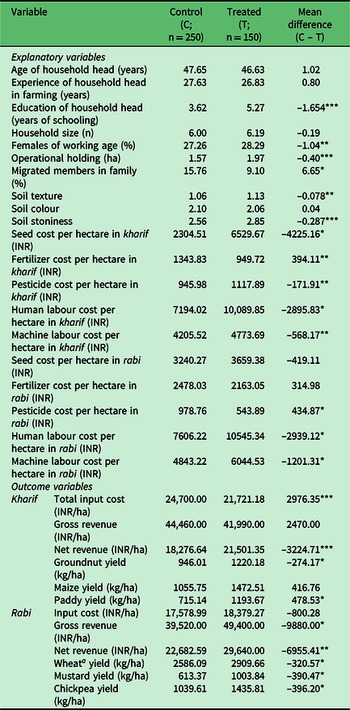
To ensure that there were no systematic differences in covariates of the treatment and control groups in the matched sample, a balancing test was conducted (Rosenbaum & Rubin Reference Rosenbaum and Rubin1985, Sianesi Reference Sianesi2004). Regarding choice of covariates, Caliendo and Kopeinig (Reference Caliendo and Kopeinig2005) suggested that these should either be fixed over time or measured before participation. Various combinations of covariates with higher-order and interaction terms were thus attempted for the balancing test. The set of covariates that satisfied the balancing test and were therefore chosen for estimating the propensity score are presented in Table 1.
Summary statistics for explanatory and outcome variables.

*p < 0.1, **p < 0.05, ***p < 0.01.
Soil texture: sandy = 1, loamy = 2, clay = 3, silt = 4; soil colour: grey = 1, red = 2, brown = 3, black = 4; soil stoniness: high = 1, medium = 2, low = 3, non-stony = 4.
1.00 USD = INR 76.00 as of 2 April 2022.
a Wheat grown in the study area is a low-input cultivar of Triticum aestivum.
Three matching algorithms – namely nearest neighbour matching (NNM), kernel-based matching with bandwidth 0.01 and radius matching with calliper 0.1 – were then employed. Though these matching procedures differ in creating the counterfactuals and assigning weights to the neighbours and have their own limitations, using all three methods provides a robustness check for the results.
PSM requires imposing conditional independence and common support assumptions for identification. If these two assumptions are met, the impacts of SWCMs on outcome variables indicated by the average treatment effect on the treated (ATT) is computed by restricting the matches to the households with propensity scores that fell in the area of common support (Caliendo & Kopeinig Reference Caliendo and Kopeinig2005):
 $${\rm{ATT}} = E\left( {Y{1_i}-Y{0_i}} \right)$$
where E(Yi) denotes the expected value of the ith outcome variable; 1 represents the treated, 0 otherwise.
Adoption of agricultural technology is also governed by unobserved confounders such as risk attitude (Shiveley Reference Shively2001), neighbourhood adoption and perception of benefits (Singha Reference Singha2017). If households in the treatment and control groups differ in these unobserved confounders, the estimated ATT will be biased. Therefore, we used a bounding sensitivity method proposed by Rosenbaum (Reference Rosenbaum2002) for the ATT that was significantly different from zero to test whether inferences regarding impact were sensitive to ‘hidden bias’ due to unobserved confounders.
Results
Descriptive statistics of the variables
The average age of the sampled household heads indicates that farm households were still in their active farming years. It is evident that the households from treated (adopters) and control villages (non-adopters) were significantly different in terms of many observed characteristics (Table 1). For instance, relative to control villages, household heads of treated villages were better educated and had larger operational holdings. Larger proportions of households in treated villages (67%) derived income from off-farm sources. Furthermore, adopters were better exposed to training and demonstrations and had better access to credit services. These differences indicate that the control group was not a clean counterfactual and thus use of matching techniques to estimate the causal impacts of SWCMs became important.
The season-wise differences in outcome indicators clearly indicate that net revenue earned per hectare of land by the households in treatment villages was significantly higher than that of control villages in both the kharif and rabi cropping seasons. This implies that adopters of SWCMs on farms were systematically better off than their non-adopter counterparts. However, as the effects of confounders have not been controlled for, it would be inappropriate to draw any inferences regarding the impacts of SWCMs on these performance indicators.
Drivers of the adoption of soil and water conservation measures
The probit model fitted the data well (Table 2). The probability of the adoption of SWCMs significantly increased with age and education of the family head. The dependency ratio that connotes economically inactive household members was negatively associated with the adoption of SWCMs. Furthermore, a positive and significant association between off-farm income and the probability of the adoption of SWCMs was observed.
Factors determining the adoption of soil and water conservation measures.

*p < 0.01, **p < 0.05.
Operational holdings and land ownership had positive effects on the probability of the adoption of SWCMs. Furthermore, both the soil type in the plot as well as the slope of the plot had significant and positive associations with the probability of the adoption of the promoted SWCMs. In line with our prior expectations, we observed that perceptions of degradation had a favourable bearing on the decision to adopt SWCMs. Exposure to training and attending farm demonstrations in the previous year (2018–2019) were also significant determinants of the adoption decision.
Matching quality
We first underline here the quality of the matching through all three algorithms as the success of PSM lies in matching the observable covariates across treatment and control groups (Becerril & Abdulai Reference Becerril and Abdulai2009). Conforming to the requirement of the balancing test, the pseudo-R2 dropped significantly to 1.2%, 0.5% and 1.8% for NNM, kernel and calliper matching, respectively, from c. 20% before matching (Table 3). The higher and significant likelihood ratio before matching signifies the presence of systematic differences between the treatment and comparison groups. The non-significant likelihood ratio after matching indicates that these differences have been removed, making the two groups comparable.
Indicators of matching quality before and after matching.

LR = likelihood ratio; NNM = nearest neighbour matching.
Furthermore, the matching procedure led to a substantial reduction in bias (65.95–79.57%) and, as per the prerequisite criteria (Rosenbaum & Rubin Reference Rosenbaum and Rubin1985), the mean standardized bias was well below 20% after matching for all three algorithms. The non-significant p-values of the pseudo-R2 of the likelihood ratio test and low mean standardized bias suggest that the specification of propensity successfully balanced the distribution of covariates between the treatment and control groups.
The distribution of propensity scores and the region of common support through all three matching algorithms are depicted in Fig. 2. Suitable matches of adopters and non-adopters are termed as ‘Treated: On support’, while adopters with bad matches from among the controls are termed as ‘Treated: Off support’ in Fig. 2. There was a clear indication of considerable overlap of the distributions of the propensity scores for the adopters and non-adopters of SWCMs after matching (Fig. 2), suggesting that the assumption of common support firmly holds.
Propensity score distribution and common support under the three matching algorithms. (a) Nearest neighbour matching, (b) kernel-based matching and (c) radius matching.

In the NNM algorithm, all of the observations from treated units found a good match and thus there were no ‘Treated: Off support’ observations (Fig. 2a). However, in the kernel and calliper matching techniques, few observations are ‘Treated: Off support’ and thus discarded during the analysis (Fig. 2b,c).
Estimation of treatment effects
The estimated causal impacts of SWCMs, depicted as ATT, on selected farm performance indicators are presented in Table 4. The estimates of different matching algorithms, while quantitatively different, were qualitatively similar.
Estimates of average treatment effect on the treated: impacts of soil and water conservation measures on farm performance based on survey data.

Figures in parentheses are bootstrapped z-statistics using 50 replications.
*p < 0.01, **p < 0.05.
NA = not applicable; NNM = nearest neighbour matching.
The ATT was positive and statistically significant for most of the outcome variables during the rabi season. The estimated impact of SWCMs on gross revenue was INR 7617–9111 per hectare. The productivity of wheat increased by 456–471 kg per hectare, while those of mustard and chickpea rose by 318–345 and 296–343 kg per hectare, respectively. Although the higher yield and gross revenue were observed with higher input costs, the significant and positive impact on net revenue (range INR 5000–6785 per hectare) suggests that SWCMs led to a significant improvement in farm performance for adopters in the study area. However, during the kharif season, only the yield of paddy significantly increased by c. 429–476 kg per hectare.
The sensitivity analysis of the effects of uncontrolled confounders showed a 1.05–1.10 value of Γ for paddy yield in the kharif season, which implies that the credibility of a positive effect of SWCM adoption on the productivity of paddy would be questioned if households with similar characteristics differed in their odds of adoption by even 5–10%. In the case of net revenue during the rabi season, the fact that the hidden bias exceeded a value of 2 suggests that for farmers who are similar in observable confounders, the causal interpretation of the impacts of SWCMs on the concerned outcomes remained intact even if they differ in their odds ratios by 100%. The higher the value of Γ, the lower the hidden bias would be, and the converse is also true (Singha Reference Singha2017).
Discussion
The present study has shown the farm-level impacts and likely effects of unobserved confounders on the estimated impacts of SWCMs. The econometric analysis indicated that older farmers were more likely to adopt SWCMs, and this may be because older farmers have relatively better farm experience and are capable of detecting soil erosion problems. Alternatively, older farmers are usually more open to risk-taking as they have the necessary network resources to get involved in soil and water conservation projects. Our findings are in congruence with Illukpitiya and Gopalakrishnan (Reference Illukpitiya and Gopalakrishnan2004) and Nkegbe et al. (Reference Nkegbe, Bhavani and Graziano2011). The learning opportunities of educated farmers from exposure to technical advice, training and farm demonstrations may be higher. The direct relationship between the adoption of resource conservation practices and the education levels of households also has good literature support (Tizale Reference Tizale2007, Wordofa et al. Reference Wordofa, Okoyo and Erkalo2020). Off-farm income relaxes the liquidity constraints of farm households (Diiro Reference Diiro2013, Choudhary & Singh Reference Choudhary and Singh2019) and has also been reported to increase the adoption of resource conservation efforts (Pattanayak et al. Reference Pattanayak, Mercer, Sills and Yang2003). The majority of the farmers in arid and semi-arid regions are resource poor; therefore, concentrated efforts by different layers of government to open avenues for non-farm employment should help promote the adoption of resource conservation practices among farmers.
Greater farm areas and tenure security support the future use of the same land and thus incentivize farmers to invest in on-farm conservation measures to reduce land degradation problems and harness long-term benefits. Earlier studies have also empirically established that the area of plots and land ownership have positive effects on the decision to adopt soil and water conservation practices (Gebremedhin & Swinton Reference Gebremedhin and Swinton2003, Kassa et al. Reference Kassa, Beyene, Haji and Legesse2013). The positive relationship of the probability of the adoption of SWCMs with soil type and slope is worth emphasizing. The majority of the farmers’ plots in the study area had gentle to steep slopes with coarse-textured soil (Rakar in local parlance) that are prone to erosion through run-off (Table 2). Training and farm demonstrations boost credibility among farmers regarding new technologies and help to counter the negative effects of a lack of formal education on the adoption decision. The positive relationship between training by extension personnel and technology adoption among farm households has good literature support (Mango et al. Reference Mango, Makate, Tamene, Mponela and Ndengu2017, Sharma et al. Reference Sharma, Choudhary, Singh, Kumar, Gupta and Dev2021).
Looking back at the previously reported findings regarding the various benefits of SWCMs to the livelihoods of people, the current study reveals that some of them may not hold true in all cases due to the interplay of several local factors. While significant improvements have been accomplished in terms of agronomic and economic parameters such as crop productivity and unit returns on cultivation during the rabi season, these impacts were marginal at best, if not negative (though statistically non-significant) during the kharif season. Such lacklustre results for the kharif season can be explained based on pre-existing cultivation practices as well as circumstances that prevailed in the study area. Groundnut (Arachis hypogae), black gram (Vigna mungo), maize (Zea may) and paddy (Oryza sativa) are the major kharif season crops in these areas. During the season under study, unseasonal heavy rains during the harvest period caused massive crop damage in terms of yield. This was combined with quality deterioration of the produce, preventing farmers from fetching good prices at the market. The yield advantage in paddy realized by the treatment farmers could not translate into unit revenue.
Additionally, anna-pratha, the traditional practice in which cattle are let loose particularly during the kharif season for free grazing in others’ fields, damaged the crops in the study area. Rathod and Dixit (Reference Rathod and Dixit2020) reported a 30–35% loss of agriculture produce due to anna-pratha in the Bundelkhand region. This loss cripples the ability of farmers to diversify as well as intensify cropping activities despite the adoption of SWCMs. The ill-conceived public policies to control free grazing could prove to be more costly and may undermine the very basis of the promotion of soil and water conservation practices in semi-arid regions. As fodder shortage during the kharif season is the underlining reasons for farmers abandoning cattle to free grazing, sincere efforts need to be directed towards increasing rain-fed fodder production and conservation measures in the study area. Construction of fodder banks at the block (district subdivision) level in fodder-stressed districts must become a priority policy focus. Additionally, initiatives for the genetic improvement of cattle breeds and rapid livestock pregnancy diagnosis will go a long way towards preventing cattle from being seen as pests.
Given the undulating topography of the study area, the targeted interventions in the treatment villages also aimed at reducing runoff velocity generated from the catchment during monsoon and harvesting a fraction of it to provide supplemental irrigation for rabi season crops. These measures effectively hold the soil layer firmly, thus reducing soil loss during heavy rainfall and increasing water percolation into the soil (Mondal et al. Reference Mondal, Singh and Jha2012, Singha Reference Singha2017). The more tangible impacts of various rainwater-harvesting interventions for the rabi season crops at different locations in central India have also been reported. For instance, the productivity of crops fed by the stored water in ponds during the rabi season increased by 15–25% (Sahu et al. Reference Sahu, Rawat and Rao2015), while in the Parasai-Sindh watershed (Jhansi district, central India) farms reported negligible changes in the yields of groundnut, sesame and black gram cultivated in the kharif season under rain-fed conditions, as supplemental irrigation was provided for rabi season crops (Garg et al. Reference Garg, Anantha, Nune, Venkataradha, Singh and Gumma2020).
Similarly to Datta (Reference Datta2015) and Singha (Reference Singha2017), in our analysis, higher yields and gross revenues were observed with higher input costs. The input cost largely comprised labour costs (Table 1). Therefore, the positive ATT of the input cost per hectare during both of these seasons (though not significant in the kharif season) may be indicative of complementarity between labour demand and on-farm soil and water conservation activities.
The values of critical levels of hidden bias (Γ; 1.05–1.10 to 2.15–2.20) were well within the acceptable range as reported in the previous literature (Mendola Reference Mendola2007, Keele Reference Keele2010). Because the critical value of Γ for the yield of rabi season crops was higher than that of kharif season crops (e.g., paddy), we conclude that the inference regarding the estimated impact on crop productivity in the rabi season will not change even in the presence of large amounts of uncontrolled heterogeneity; the impacts of SWCMs in the rabi season are less sensitive to the unobservable confounders than in the kharif season.
Conclusions
Farmers’ adoption decisions are driven by multiple factors that vary greatly under different agroecological and socioeconomic settings, and we offer important lessons for the promotion of improved resource conservation practices in arid and semi-arid regions. We suggest that households having more economically active and educated members and ownership of larger plot areas should be the focal point of entry for promoting the adoption of SWCMs. For resource-poor farmers, earnest efforts towards opening avenues for non-farm employment could be crucial to enhancing their investing capacity on farms and thus the adoption of resource conservation practices at a large scale. In addition, strengthening the extension services and training facilities and increasing their outreach will go a long way towards enhancing the adoption of conservation efforts.
We suggest that there are positive and significant impacts of the adoption of SWCMs on farm performance indicators such as crop yields and gross and net revenues in the rabi cropping season. The resource conservation measures also increase input costs in farming. Therefore, engaging labour in constructing on-farm structures for soil and water conservation during lean periods is imperative to avoiding high labour charges during cropping seasons. We also found that the impact of SWCM adoption in the rabi season is less sensitive to uncontrolled confounding factors. We underline the need to scale up SWCMs in ecologically fragile regions such as those in the arid and semi-arid tropics to address water scarcity and sustain the livelihoods of resource-poor farmers.
Supplementary material
To view supplementary material for this article, please visit https://doi.org/10.1017/S0376892922000352.
Acknowledgements
The support of the field assistant staff of the KISAN MITrA project for data collection is duly acknowledged. Special thanks are given to the editor of the journal and reviewers for their critical comments that helped to improve the manuscript.
Financial support
None.
Competing interests
The authors declare none.
Ethical standards
None.