On 3 November 1915, a somewhat anxious letter to the editor appeared in the San Francisco Chronicle. The letter concerned the music of the Panama-Pacific International Exposition (PPIE), then approaching the end of its more than nine-month tenure in San Francisco. “Last week,” the author noted, “a suggestion was made that in some way the public show their appreciation of the beautiful [Philippine] Constabulary Band. If such a well-deserved honor is paid them it should not be forgotten that there is another band at the exposition fully as deserving of public recognition.” The author feared that accounts of the exposition's music would fail to acknowledge the Hurtado Royal Marimba Band, which had performed at the Guatemalan Pavilion for most of the fair's duration. Noting the “eager crowds drawn daily to the Guatemala Building by the Marimba Band (where standing room is a premium),” the author closed his note by requesting that “the Chronicle and the P.P.I.E. management. . . find a way by which the people can express their approval and gratitude.”Footnote 1
The writer had ample reason to worry that the Hurtado band would be overlooked. Official documents from the fair's musical administration—including memoirs, programs, several chapters of the six-volume official exposition history, and press releases—largely ignored the marimba band.Footnote 2 Were it not for the prominence accorded to the Guatemalan musicians in the popular reception of the PPIE—attested to by newspaper articles and editorials, unofficial accounts of the fair, and a series of recordings by Victor Records in 1916—the Hurtado band's important role in the exposition's musical landscape may well have been forgotten.
The few musicological studies that address the PPIE describe the exposition's rich musical offerings, but because they rely primarily on official administrative records as sources, they do not discuss many of the important musical activities left out of the record.Footnote 3 Historical studies of the PPIE have also tended to focus primarily on a small subset of features and events showcased in the exposition's administrative records. These scholars have rightly characterized the exposition as a place in which race, gender, and social ideology prominently reinforced the hegemonic power of wealthy men, leaving little room for women, African Americans, and other marginalized groups.Footnote 4 Recent scholarship by feminist historians, however, has begun to uncover the variety of ways in which some marginalized groups established a presence in the PPIE by circumventing the limitations imposed by the dominant fair ideology.Footnote 5 The highly popular residency of the Guatemalan marimba band represents just one example of how marginalized musicians were seen and heard at the PPIE, despite the undeniable privilege that administrators accorded to white artists from the United States and Europe. The presence of Guatemalan, Mexican, and Native American musicians demonstrates the complex and shifting power dynamics that shaped the performance and reception of music on the fairgrounds. The stories of these musicians at the PPIE reveal that even in environments heavily shaped by dominant ideologies of race, gender, and class, multiple discourses of power and value can circulate.
Between February and December 1915, nearly nineteen million people descended on San Francisco's Marina District to attend the Panama-Pacific International Exposition, officially presented as a celebration of the Panama Canal's completion. Visitors from the United States and abroad flocked to witness flashy displays of new technology, extensive cultural programming, and exhibits of international art and cuisine. Most exposition visitors also encountered music. Concerts occurred daily across the fair, bandstands littered the grounds, and a specially designed organ was built inside Festival Hall, the site of hundreds of organ recitals and orchestral concerts. Upwards of five band performances occurred on the fairgrounds each day, with John Phillip Sousa's band, an official Exposition Band, and the Philippine Constabulary Band performing hundreds of concerts over the course of the fair's duration. Performances were also held in foreign and state pavilions, exhibit halls, areas along the San Francisco Bay marina, and within many of the concessions in the amusement zone. Music was seemingly everywhere, all the time.Footnote 6
Official fair publications claimed that the wide-ranging exhibits and pavilions of the exposition would demonstrate “the world's progress” in fields including “art, music, poetry, religion, philosophy, science, history, education, agriculture, mineralogy, mechanism, commerce, and transportation.”Footnote 7 Exposition historians, including Robert Rydell and Abigail Markwyn, have shown that the exposition's features were also designed to represent groups of people along ethnic and national lines. The fair's official guide book itself suggested as much, claiming that the exposition would give “the Western Hemisphere a more complete understanding of the peoples of the World.”Footnote 8
Owing to the sociocultural hierarchies that existed within the international community, a complicated set of politics governed the process of representation. As one might expect, foreign commissioners from wealthy and politically powerful European nations enjoyed great freedom in constructing their national pavilions and designing their exhibits.Footnote 9 In contrast, the exhibits and concessions that represented colonized nations and dependencies, particularly in Africa and the South Pacific, were designed by colonizers or wealthy businessmen, usually in exploitative ways that benefitted the interests of the designer(s). For some other nations, the process was more complicated. Commissioners from Japan and China designed national pavilions that presented their nations as modern and progressive. Commercial exhibits and concessions designed by businessmen, however, presented Japan and China in more exotic and primitive terms. Finally, several Central and South American countries constructed pavilions on the fairgrounds, but the economic and political influence of the United States in the region and intra-national hierarchies based on race and ethnicity influenced the design of these pavilions.Footnote 10
As a ubiquitous feature of the exposition, music participated powerfully in the politics of representation at the PPIE. Indeed, the exposition's musical events illustrate how international and intra-national sociocultural hierarchies interacted on the fairgrounds. The musical landscape of the PPIE did not simply reflect Western male hegemony, as the fair's official records and recent scholarship might suggest. Instead, PPIE musical events constituted a more culturally rich arena in which a mixture of dominant and marginalized voices resounded.
The official PPIE Department of Music was led by George Stewart, a Bostonian whose outlook represented a conservative perspective that venerated European art music and eschewed consciously American works.Footnote 11 Stewart devised for the exposition a daily scheme that consisted of organ recitals, concerts by a resident orchestra, and outdoor performances by visiting and resident brass bands; the music was primarily composed, performed, and consumed by middle- and upper-class white men.Footnote 12 These concerts, however, represented only a fraction of the music heard on the fairgrounds, even though such musical events received the lion's share of attention in official exposition documents. Many other musical performances, which received no funding, advertising, or administrative support from Stewart's Department, occurred across the exposition. Such unofficial musical events engaged a wide variety of genres and performers, many of whom were overlooked by the official music scheme. Middle- and upper-class female musicians established a presence through chamber music concerts in the California Building, which the PPIE Woman's Board oversaw. Popular music of the United States featured prominently in special events organized by local businesses and in several concessions within the amusement area. Music of non-European nations and territories, including Guatemala and Hawaii, was heard in their respective pavilions. Elsewhere visitors listened to Mexican and Native American music.
When the wider scope of musical activity—both within and beyond Stewart's department—is taken into consideration, the picture of music at the PPIE shifts from an expression of the administration's elite social perspective to a more variable tool for self and group representation across social categories, one that contested dominant sociocultural hegemonies and articulated different hierarchies based on specific intranational or regional contexts. Three case studies, on Guatemalan, Mexican, and Native American music performed at the PPIE, illustrate the complex and varied ways that exposition musical events reflected and challenged dominant and local ideologies of cultural value. These examples are significant because they represent some of the most frequently referenced music in the local media, and, consequently were likely encountered by a large number of exposition goers.Footnote 13 Moreover, these examples show how the music of marginalized groups was staged and received at the PPIE, sometimes in ways that proclaimed their value as producers of culture.
Guatemalans, Mexicans, and Native Americans came to be heard at the PPIE in strikingly different ways. The Guatemalan Commission sponsored the residency of the Hurtado Royal Marimba Band for the duration of the fair; by contrast, representations of Mexicans and Native Americans were primarily constructed by white North Americans at the PPIE. However, the musical performances by members of these last two groups sometimes confused or contested the ideological messages promoted by the designers. For example, although the visual design of the “Mexican Village” depicted Mexico as exotic and primitive, the music and musicians of the Orquesta Típica Torreblanca, which performed daily in the village, revealed the European influence and modern cosmopolitanism that characterized Mexico City. Finally, although Native Americans were repeatedly subjected to exoticizing and racist musical ventriloquism by white Americans at exposition events, on at least one occasion a group of Native Americans daringly used music to push for control over their own representation.
The Hurtado Marimba Band and the Guatemalan Pavilion
The national pavilions that dotted the fairgrounds communicated through their architecture, exhibits, and cultural programs. Guatemala's pavilion focused on three themes: natural resources, education, and music. Like many other Central American nations, Guatemala prominently featured its wealth of natural materials, especially coffee. In addition to exhibits and samples in the pavilion, the commission hosted an exposition-wide “Coffee Day” in November 1915 to promote the product to visitors.Footnote 14 Exhibits and events in the pavilion also highlighted the nation's educational system; in a speech on “Guatemala Day” commissioner José Flamenco explained how President Manuel Estrada Cabrera had “fostered educational development in Guatemala and that he had established the American school system in his country, believing it to be the most democratic and meritorious.”Footnote 15
Although the exhibits on coffee and education firmly supported a neocolonial relationship between the United States and Guatemala, promoting U.S. presence and influence in the region and the asymmetrical power dynamic that accompanied it, the music of the Guatemalan pavilion sent a very different message. Music became a particularly prominent feature in the pavilion; the daily marimba concerts in the pavilion were almost invariably mentioned in accounts of Guatemala at the exposition. These performances situated Guatemala as a nation that possessed a distinct and developed cultural tradition, which Europeans and (U.S.) Americans considered a marker of progress and civilization. The emphasis on formal performances in the Guatemalan pavilion pushed the representation of Guatemala at the exposition beyond a simple image of an “ideal” Central American nation, undeveloped and docile. Nevertheless, this claim for cultural sophistication in Guatemala was not without its limitations. It was made within an Euro-American framework of musical sophistication and progress, which ensured the popularity of the music on the fairgrounds but obfuscated the important contributions of indigenous and Afro Guatemalans to Guatemalan marimba music.
In virtually every account of the exposition, Guatemala became synonymous with the marimba band that performed almost daily in its pavilion. The band frequently appeared in summaries of the most memorable features of the entire exposition. Frank Morton Todd's official history includes “hearing the Marimba Band at the Guatemala Pavilion” in a list of the fair's most popular attractions, which also include “studying maps and models of development in far countries” and “hearing discussions on educational and commercial topics.”Footnote 16 In that passage from Todd's history, the marimba band was the only attraction singled out from a particular foreign or state pavilion. The ensemble clearly occupied a place of significance on the fairgrounds.
The marimba band was introduced at the PPIE at the dedication ceremony of the Guatemalan Pavilion on 15 March and became a permanent part of the pavilion's programming. Newspaper critics published many descriptive accounts of the band and its instruments, most of which emphasized the unique appearance and sound of the instrument. The San Francisco Call Post noted that “the instruments used by these musicians are of the native design and differ from anything in use in other countries. The chief one of these is the marimba, an exceedingly sweet-toned instrument, resembling a xylophone.”Footnote 17 Although all accounts emphasized the distinctiveness of the instrument, many critics compared it to instruments that would be familiar to their readers; Todd, for example, described the marimba's sound as a cross between that of an organ and a violin.Footnote 18
The chapter on Guatemala in Todd's history is the only contemporary source that identified the Guatemalan pavilion ensemble as the Hurtado Royal Marimba Band; most accounts simply refer to a “marimba band.” The group consisted of eight Hurtado siblings: Celse, Mariano, Joaquin, José, José, Oscar, Florencio, and Mariana.Footnote 19 Celse Hurtado directed the group, which was rather well known during this period, both within Guatemala and outside the country. Sebastián Hurtado, the father of the performers at the PPIE, is credited with spreading the popularity of marimba music by developing the chromatic marimba from what was previously a diatonic instrument.Footnote 20
Todd also provided some background on the instrument's origin, describing it as “the product of evolution, from an African form, developed by the Indians of Guatemala,” although he quickly added that he did “not vouch for these ethnographic details.” Todd's description of the marimba as a “product of evolution” was significant, for it implied that Guatemala's musical culture had undergone a process of development and refinement, a process that Europeans and Americans strongly associated with the art of the most “civilized” nations. Todd also added that the Hurtados had “drilled themselves into an unfailing mastery and ease of execution,” suggesting that their performances displayed the achievement of a high level of technical skill and sophistication.Footnote 21
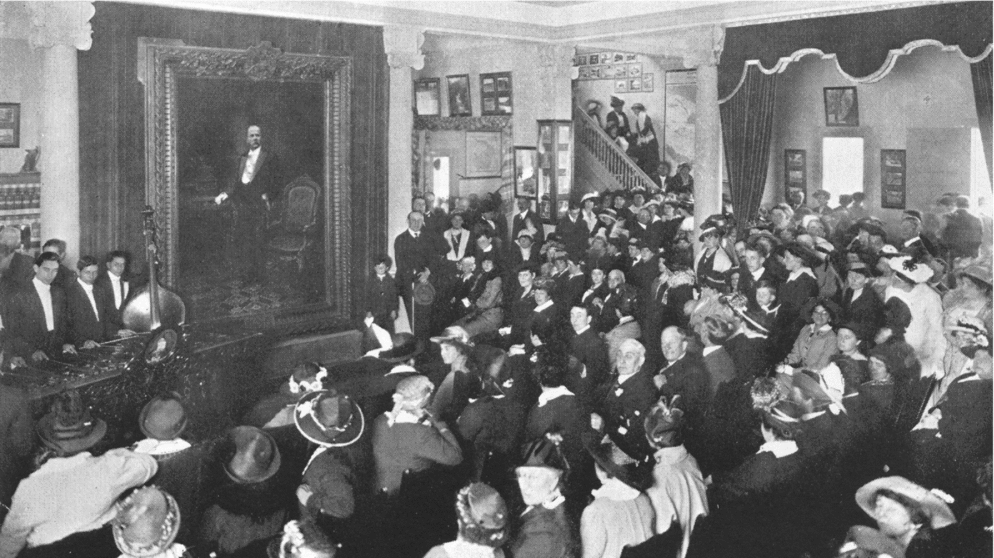
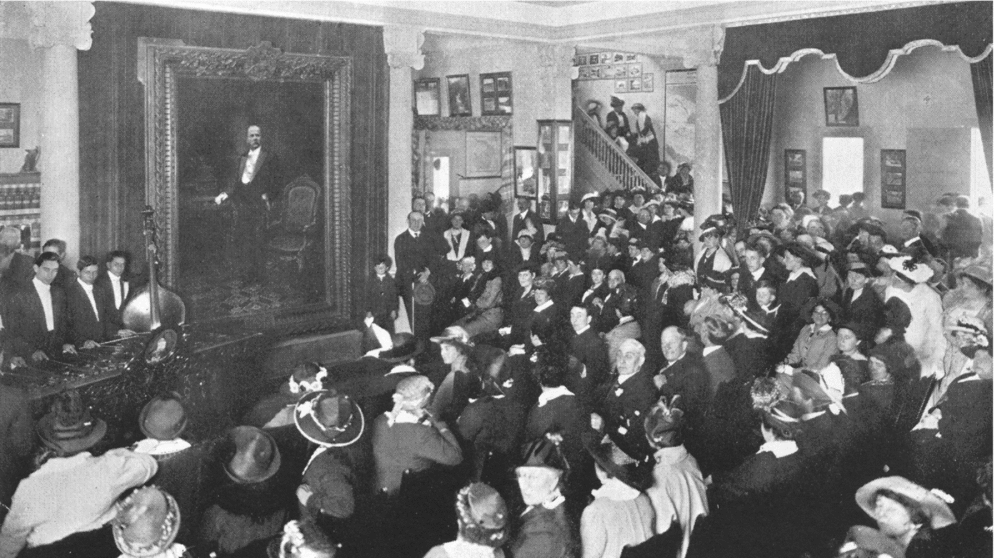
Sources suggest that the Hurtado Band performed a cosmopolitan repertoire that showcased the influence of European and U.S. music in the country. Most newspaper and guidebook accounts of the Hurtado band's repertoire were rather generic, including Ben Macomber's description of the band's repertoire as “Guatemalan airs.”Footnote 22 Other sources, however, provide more details; Todd explained that the band's repertoire comprised “serenades, dance music, cradle songs, patriotic airs, and concert pieces.”Footnote 23 A photograph reveals a double bassist accompanying the marimba players, who were all dressed in tuxedos, suggesting that the band incorporated elements of European instrumentation, performance practices, and repertoire into its performances (see Figure 1). Indeed, anthropologist Sergio Navarrete Pellicer has argued that Sebastián Hurtado's creation of the chromatic marimba led to the incorporation of “fashionable classical and semi-classical ballroom music” into the repertoire of marimba ensembles, including the Hurtados, in the urban centers of Guatemala.Footnote 24 Additionally, the repertoire performed by the Hurtado band on a series of 1916 recordings for Victor Records comprised waltzes, patriotic songs from the United States, and excerpts from canonic European operas and orchestral works. The band recorded, for example, Sousa's “Stars and Stripes Forever” march, Strauss’ “Blue Danube” waltz, selections from Verdi's Aida, and a “Guatemala-Panama March,” composed by band member Mariano Hurtado. These recordings exhibit the Hurtados performing carefully orchestrated and harmonized versions of such works. Given the close proximity of the recordings to the ensemble's appearance at the PPIE, and the similar audiences targeted by the recordings and exposition, it is reasonable to assume that the band performed similar repertoire in their concerts at the PPIE.
Members of the Hurtado Royal Marimba Band Performing in the Guatemala Pavilion. From Frank Morton Todd, The Story of the Exposition: Being the Official History of the International Celebration Held at San Francisco in 1915 to Commemorate the Discovery of the Pacific Ocean and the Construction of the Panama Canal (New York: Knickerbocker Press, 1921)
The Hurtado Royal Marimba Band sometimes substituted for brass bands at PPIE dansants (afternoon dance events) and balls, further confirming that, like the brass bands, their repertoire centered on European and European-influenced classical and dance music. Beginning in September 1915, the marimba band became a recurrent feature at the Old Faithful Inn, the restaurant on the exposition grounds, where Stewart's Exposition Orchestra had been performing nightly since the opening of the PPIE. The Guatemalan band performed each night after the Exposition Orchestra, so that patrons of the restaurant could utilize the new “broad maple dance floor” that had recently been installed in the restaurant, according to the San Francisco Chronicle.Footnote 25 Several newspaper articles commended the Hurtado ensemble for its suitability as a dance band.
The Hurtado Band became so popular at the PPIE that in November, a second marimba band, “L'Ideal,” was brought from Guatemala to perform alongside the Hurtado family at the evening reception and dance held on “Guatemala Coffee Day.” The San Francisco Chronicle reported that the public, “having accustomed itself to being content with any music that carries with it the inspiration to dance, . . . welcomes with much satisfaction the news that the famous ‘Ideal,’ the special Guatemala Marimba band, has been brought to this city to add to the pleasure of the exposition's final month.”Footnote 26
Despite the foreign origins of the instrument and performers, the Hurtado Band was received as something familiar and sophisticated at the PPIE. Reviews were overwhelmingly positive, and lacked the exoticizing rhetoric found in most descriptions of non-European music at the PPIE. In this way, the Hurtado Band at the PPIE represented to PPIE audiences a valuable, distinct, and cultivated cultural tradition in Guatemala. Ultimately, the ability for the band (and Guatemalan music) to achieve such widespread recognition and respect likely rested on their choice of repertoire, appearance, and performance practices, which would have been recognizable to many Americans at the exposition.Footnote 27 The familiar aspects of the performances—integrated with the distinctive nature of the marimba itself—allowed audiences to evaluate Guatemalan music within their own framework of cultural development.
Despite the lack of exoticizing rhetoric in descriptions of the Hurtado band, accounts in newspapers and other sources tended not to accord the ensemble the same status as the official music on the fairgrounds. Whereas Stewart's Exposition Orchestra concerts and organ recitals were treated with the utmost seriousness as performances of Art, the Hurtado Royal Marimba Band was consistently referred to as “entertainment.” An article describing “Liberal Arts Day” made this distinction clear. After detailing a performance by opera singer Inge Orner, the journalist turned to the afternoon performance by the Hurtados: “The fun-making part of the programme comes in the afternoon, when the Guatemalan Marimba Band [and others]... are to take part in the special events.”Footnote 28 Such reviews positioned the Hurtado Marimba Band as inferior to European classical ensembles, subtly diminishing the band's significance at the PPIE.
Despite such press descriptions, the Hurtado Royal Marimba Band still exercised considerable influence at the exposition. Its presentation of music belied the simple U.S.-defined conception of an ideal Central American nation, exemplified by the exhibits of coffee and imported American education, and promoted Guatemala as a nation that possessed a distinctive and cultivated cultural tradition. The success of the Guatemalan Commission nevertheless rested on their use of a Euro-American framework. By focusing on the newer, urban style of marimba music that utilized mestizo performers and emphasized European repertoire, the Commission ignored the rich and perhaps more distinctive culture of diatonic marimba performance in Guatemala's indigenous communities. Thus the commission bypassed a more radical (but probably unsuccessful) argument for cultural sophistication. Certainly the choice to emphasize the newer, urban, mestizo-based, and European-influenced marimba tradition reflected the ethnic hierarchy within Guatemala, where urban criollo and mestizo citizens had more political and social power than indigenous Guatemalans.Footnote 29
The PPIE contained more than just exhibit halls and national pavilions. Next to the main fairgrounds lay an enormous amusement area known as “The Zone.” By 1915, amusement areas had become a standard feature of international expositions in the United States, with the 1893 Chicago exposition's “Midway” and the 1904 Saint Louis exposition's “Pike” as important precedents. The Zone was a popular locale at the PPIE, and figured significantly in both media and informal accounts of the exposition.Footnote 30 As an area of great contrast with the main fairgrounds, the aural soundscape of the Zone provides another angle from which to investigate the relationship between music, power, and representation at the PPIE.
The Zone consisted of more than thirty individual concessions, each of which was privately funded and operated and aimed to draw a profit. Like amusement areas at previous international expositions, the Zone concessions included several very popular “native villages,” which exhibited people of various foreign nations and societies that PPIE visitors would likely have considered primitive. In fact, Frank Morton Todd claimed that one of the chief reasons for creating the Zone was to display “strange peoples and customs as part of the subject-matter of education.”Footnote 31 For the most part, the groups on display hailed from countries that occupied politically inferior, and often colonized, statuses in 1915. These groups included Native Americans, Mexicans, Hawaiians, Somalis, Samoans, and “Orientals.”
Unlike the national pavilions on the main fairgrounds, over which foreign commissioners wielded a relatively high level of control in self-representation, the Zone constituted an area with a drastically different dynamic of representational control. As Robert Rydell and others have demonstrated, those on display in the “native villages” generally wielded little power over the representation of their cultures.Footnote 32 These concessions were owned and operated by wealthy U.S. businessmen, who, in a reproduction of the imperial process, governed the design, content, and operation of the villages, usually imposing their own racist and imperialistic interpretations on the displays. In other words, the images of people found within these concessions were generated from without rather than from within. As the San Francisco Chronicle aptly noted, the “native villages” were “the acme of the showman's craft.”Footnote 33
Although this highly skewed power dynamic reflected the imperialistic ideology of the exposition, a close look at the music of Mexicans and Native Americans reveals that even in the Zone the politics of representation was not as simple as it might first appear. The pedigree of the orchestra representing Mexico in the “Tehuantepec Village” contradicted the message promoted by the village's visual design and advertisement, and on at least one occasion, a group of Native Americans demanded control over their own musical representation, which had been denied to them at other exposition events.
“A Bit of Old Aztec Land” and the Orquesta Típica Torreblanca
Although Mexico was an independent state by 1915, it was represented on the Zone rather than through a pavilion on the main fairgrounds. The Mexican Revolution, which began in 1910, resulted in a prolonged period of political and social instability, lasting until about 1920. By the time of the PPIE, concerns over U.S. financial interests in Mexico and border stability led to U.S. military involvement in the turmoil in Mexico. In 1914, in response to a coup by Victoriano Huerta, the U.S. military occupied the Mexican port of Veracruz. Throughout 1915, the United States continued such neocolonialist efforts to orchestrate the political organization of Mexico, providing material support to Venustiano Carranza's efforts to claim the presidency. During this period there were numerous skirmishes at the U.S.-Mexico border, and negative images of “wild” Mexicans pervaded U.S. culture.Footnote 34 Mexico did not participate officially in the exposition, owing to the domestic conflicts and friction with the United States. Thus, the Tehuantepec Village in the Zone, owned and operated by the American businessman A. W. Lewis, was the only place on the fairgrounds that represented Mexico. One journalist described the village as “semi-official,” reflecting the nature of U.S. impingement in Mexican affairs.Footnote 35
The message that Tehuantepec Village was supposed to send—that the people on display were primitive, uneducated, and in need of the educational and moral influence of the United States—was not always transmitted as simply as concessionaires may have hoped. Music became an area where the cracks in this message were pried open. The daily performances of the Orquesta Típica Torreblanca in the village's variety theater revealed the cosmopolitan and modern character of Mexico City, in contrast to the primitivistic visual display of the village.
With the tagline “A Bit of Old Aztec Land,” Tehuantepec Village paradoxically claimed to provide a living exhibit of ancient, pre-modern Mexico. The outer facade of the village drew on visual tropes of “ancient” Central American culture and civilization (see Figure 2). Todd described the facade as “a duly extravagant presentment of green-eyed and highly colored Aztec gods—or what might have passed for them with people unacquainted with any Aztec gods.”Footnote 36 As in many other Zone concessions, sexually tinged displays of exoticized women were used to depict ancient and/or primitive culture. Indeed, the women on display in Tehuantepec Village were declared to be direct descendants of the Aztecs. The San Francisco Chronicle explained shortly before the opening of the PPIE that Tehuantepec Village would “revolve about the beauty of a bevy of maidens from the far-famed Isthmus of Tehuantepec.” The same article further described these women as “jungle queens” who would “live within their novel thatched huts, plying the arts and industries of their native land.” Finally, the article connected these women to antiquity by claiming that “the Tehuana lassie is a descendant of those mysterious, pre-historical inhabitants of Central America.”Footnote 37 Writers often confused the supposed ethnic ancestry of the women. For example, Todd referred to them as “the Maya maidens from the Isthmus of Tehuantepec.”Footnote 38
The Facade of Tehuantepec Village. San Francisco Public Library Digital Image Collection. Used with permission.

The visual design of the facade and the women on display in the Tehuantepec Village became the primary vehicles for presenting “A Bit of Old Aztec Land.” Media reports emphasized the village's primitivist depiction of Mexico. In April 1915, the San Francisco Chronicle, echoing the concession's tagline, described Tehuantepec Village as “a real bit of Old Mexico, picked up from the districts to which the modern American ideas have as yet not permeated,” and argued that “the Tehuantepec village gives a faithful portrayal of the interesting and romantic life south of the Rio Grande.”Footnote 39 The advertisements and descriptions of the concession presented an image of Mexico as unchanged since Aztec rule and, correspondingly, uninfluenced by colonialism or cosmopolitanism.
In reality, Tehuantepec Village offered a much more confusing amalgam of stereotypes and images of modern, colonial, and pre-Columbian Mexico. The musicians and music heard within the concession's theater played a primary role in disrupting the simple image of “primitive” Mexico. The sounds heard within the Tehuantepec Village were not of Aztec origin, nor were they an imagination thereof. Rather, the music of the village displayed both the Spanish colonial influence on Mexican musical culture and the cosmopolitan musical life of modern Mexico City. Like the Hurtado Marimba Band, the orchestra hired to perform in Tehuantepec Village emphasized a European-influenced, urban musical style. Although programs for the orchestra's PPIE performances are unavailable, a 1931 series of Brunswick recordings made by the orchestra included waltzes, marches, pasodobles and other short-form works, mostly by Mexican composers. A 1926 concert program featuring the orchestra listed similar repertoire, with excerpts of works by European composers.Footnote 40
Music and dance were central to the concession. Along with the “señoritas” on display, music became a staple in press descriptions of the village, which failed to register the contradictions between the music and the village's visual presentation. In March 1915, the San Francisco Call Post reported that within the Tehuantepec Village there was “an attractive vaudeville theater, where one may see the plays of Mexican life and hear the songs and music. Lively Spanish dances are demonstrated by the whirling fandango girls.”Footnote 41 Another article claimed that “the big feature of the village is the theater with its Mexican band, its dancers, instrumentalists and vocalists.”Footnote 42 Todd explained that “the orchestra was large and the repertoire varied, and the concerts most generous in the number of tandas. The ‘cellist was an artist and the two performers on the zither commanded remarkable skill.”Footnote 43
From A. W. Lewis, the American owner of the Tehuantepec Village, we learn that the orchestra was the Orquesta Típica Torreblanca, made up of “very famous musicians from the capitol [sic] City of Mexico,” and that the vocal soloist, Madame Rivera, was “a graduate of the Mexico Conservatory of Music.”Footnote 44 The press descriptions of their performances, the pedigrees of the performers, the recordings for Brunswick Records, and the performances of the orchestra in other contexts make clear that this orchestra was not composed of exotic or uneducated people. Nor was the music directly or purportedly connected to the isthmus of Tehuantepec or indigenous Mexican culture. Although the members of the Torreblanca orchestra played instruments that would have been more familiar to fairgoers than the Guatemalan marimba, the Mexican performers were dressed in sombreros and more traditional outfits, in contrast to the Guatemalan marimba band's tuxedos. As in the Guatemalan pavilion, the appearance of the Mexican musicians likely influenced public reception of their music. The costumes of the Mexican musicians tempered the contradiction between the music and the primitivist visual design of the village (see Figure 3).
The Orquesta Típica Torreblanca in Tehuantepec Village, San Francisco Public Library Digital Image Collection. Used with permission.
Despite the visual appearance of the musicians, additional evidence confirms that they were, in fact, highly trained individuals. Newspaper announcements of the guest singers performing in the Tehuantepec Village emphasize the musicians’ connections to a cosmopolitan musical world. For example, on 30 July the San Francisco Chronicle ran an advertisement that described guest artists Carlota Milanes and Rafael Alvarez as “the Tetrazzini of Mexico” and “Mexico's Greatest Tenor”; Maria Caballe was announced as a “Favorite of the Famous Teatro Colon, Mexico City.”Footnote 45 The literal juxtaposition of modern European-influenced musical allusions with the claim to provide “A Bit of Old Aztec Land” shows the contradictions within Lewis's concession.
The choice of music for Tehuantepec Village likely resulted from a mixture of ignorance and financial motivation. As a businessman, Lewis sought music that would draw in audiences and increase his profits. Lewis was surely capitalizing on the popularity of vaudeville entertainment when he constructed a theater in the village and hired the Torreblanca orchestra, singers, and dancers to stage variety shows. Indeed, Todd noted that many concessions featured theaters and variety shows, owing to the genre's massive popularity with the public.Footnote 46 However, Lewis was probably also ignorant of the variety of musical traditions in Mexico, particularly within rural communities, and he likely did not even consider looking for his musical entertainment outside of the capital. Preconceived notions of Mexicans as wild, primitive, and uneducated enabled him to overlook the Torreblanca's relationship to a musical culture he otherwise would likely have understood as civilized and sophisticated.
In the end, Tehuantepec Village provided a confusing mix of images of Mexico. The architectural details, the costumed women, and the advertising slogan depicted a mythical Mexico that was primitive, ancient, and by implication, culturally and socially inferior to the United States. This imaginary place supported common U.S. sentiment towards Mexicans and U.S. neocolonialist interests in Mexico during this period. Yet the musical sounds of the orchestra, despite the costumed attire of its members, presented a much different image of Mexico. The orchestra's music revealed a modern, cosmopolitan side of Mexico, one that enjoyed access to elite European-style culture and musical education.
Contemporary accounts of “native villages” on the Zone suggest that the “natives” in many of the villages were not exactly as they appeared. In his 1915 account, Macomber hinted at the contradictions within the “native villages”: “All these people are genuine and live in primitive style on the Zone, though, to tell the truth, they are quite likely to use college slang and know which fork to use first.”Footnote 47 As Rydell has explained, several Somalians were dismissed from the PPIE for being “too tame.”Footnote 48 The people exhibited on the Zone were not pure specimens of primitive, bygone cultures and societies, as concessionaires often claimed. The musicians of the Tehuantepec Village made this contradiction between advertisement and reality clear.
Envoicing Native Americans
Unlike Mexicans, whose representation was confined within Tehuantepec Village, Native Americans appeared throughout the Zone, and the Great Northern Railway Building, located on the eastern edge of the fairgrounds, exhibited a Blackfoot village in its Glacier National Park Exhibit. Like Tehuantepec Village, all the villages of Native Americans were overseen by U.S. businessmen and not by the Native Americans themselves. Several special events related to Native Americans also occurred at the PPIE, including a multi-day “Indian Conference” in August 1915.
Music was a common feature in depictions of Native Americans at the PPIE. Unlike the Mexicans in Tehuantepec Village, however, the Native Americans at the PPIE did not usually perform the music that was used to represent them to the general public. In fact, during this period the United States government had officially banned the performance of many types of music and dance by Native Americans.Footnote 49 In most cases the Native Americans at the PPIE were envoiced by white U.S. composers and performers.Footnote 50 However, on at least one occasion the Blackfoot people in the Great Northern Building rejected such envoicing and placed music at the center of a bid for more representational autonomy. They did so by insisting on performing their own music for a powwow held at the PPIE in June 1915 and by explicitly refusing to include a performance by one of Stewart's brass bands at the event.
Concessionaires and journalists characterize the Native Americans in much the way they had described the Mexicans in Tehuantepec Village. Native Americans were referred to as an “ancient race” that maintained a primitive lifestyle that was rapidly vanishing from existence. A fascination with all things “Indian” had been developing in the United States since the late nineteenth century and, prompted by the belief that Native Americans were headed towards extinction, ethnographic research, including musical studies and transcriptions, boomed. A generation of “Indianist” composers, including John Fillmore, Arthur Farwell, and Charles Wakefield Cadman, sought to preserve the music of the “vanishing race” through musical works based on transcriptions of Native American music.Footnote 51
At the same time that Americans became fascinated by an imaginary Indian rapidly heading towards extinction, they were simultaneously anxious about the role and status of actual Native Americans within the nation. In the decades surrounding the turn of the century, debates raged over the citizenship status of Native Americans. The 1887 Dawes Act granted citizenship to Native Americans who renounced their tribal affiliations and “adopted the habits of civilized life.”Footnote 52 However, throughout the first two decades of the twentieth century, Native Americans, even those granted citizenship, were still subjected to supervision by the United States government through the Office of Indian Affairs. Well into the twentieth century, Native Americans were denied the political and social liberties enjoyed by many U.S. citizens.
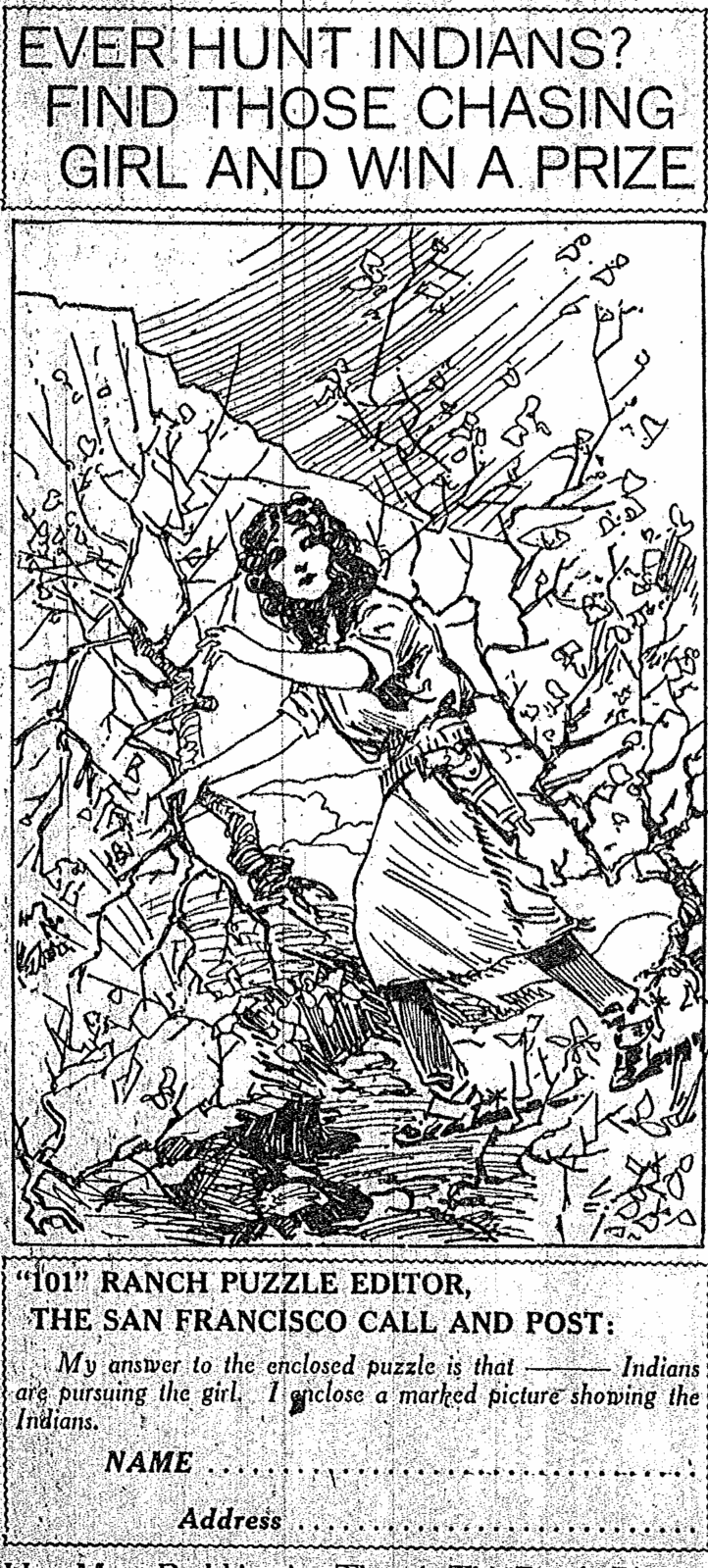
Accordingly, the reaction to the Native Americans at the PPIE varied. Many accounts sought to record the culture and traditions of the “vanishing” tribes, whereas others expressed anxiety about Native American autonomy. In a lengthy article in the Overland Monthly and Out West Magazine, journalist Anna Blake Mezquida argued for the value of the Native American exhibitions at the exposition, especially the Blackfoot village, as educational specimens.Footnote 53 By contrast, other accounts depicted Native Americans as wild, threatening, and disruptive to civilization. In March, the San Francisco Call Post sponsored a competition for children that emphasized such stereotypes. The headline for the contest read: “Ever Hunt Indians? Find Those Chasing Girl and Win a Prize” (see Figure 4). The contest instructed children to find the images of Native Americans hidden in a picture that featured a frightened white girl in the middle of the wilderness. The Call Post also lambasted the Blackfoot people at the PPIE for “openly” breaking hunting laws, “which the wisdom of many generations of white men has evolved,” during the preparations for a powwow.Footnote 54
“Ever Hunt Indians?” Contest Advertisement. San Francisco Call Post, 1915.
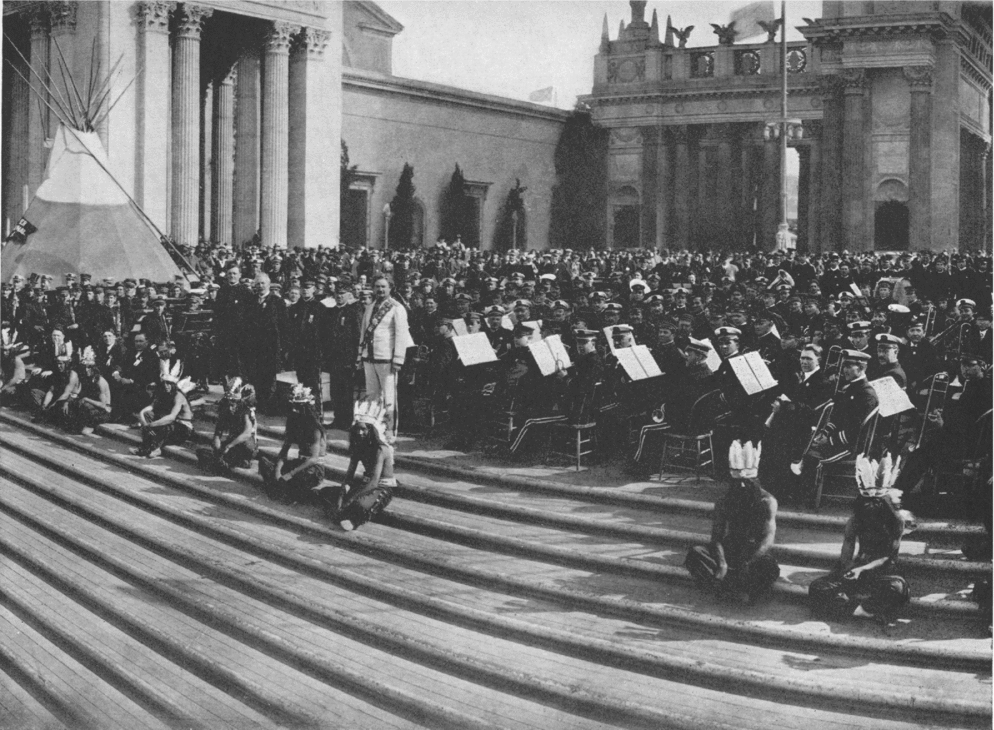
The musical events that represented Native Americans at the PPIE drew on both types of reactions to Native Americans. The most spectacular of these musical events occurred on 27 September, with the performance of Lee Johnson's The Death of Custer, which was played by several massed bands on PPIE “Musicians’ Day.” In addition to several massed bands, members of the United States Cavalry and some of the Blackfoot people from the Great Northern Building were recruited to “assist” in the performance (see Figure 5).Footnote 55 Despite the inclusion of the Blackfoot people, they did not wield much control or input on the depiction of Native Americans in the musical event.
The Performance of Lee Johnson's Death of Custer. From Frank Morton Todd, The Story of the Exposition: Being the Official History of the International Celebration Held at San Francisco in 1915 to Commemorate the Discovery of the Pacific Ocean and the Construction of the Panama Canal (New York: Knickerbocker Press, 1921).
The following passage from a review in the San Francisco Chronicle reveals that, in addition to the actual Blackfoot people recruited for the performance, there were also fifty “imitators” as well:
With the massed bands filling the space at the head of the south stairway leading down into the sunken garden, the spectacle of Custer's last fight was staged on a platform built at the foot. On this the Indians held their war dances, and over it the mounted troopers dashed. Five real Blackfeet . . . from the Glacier Park Reservation, danced with the fifty imitation redskins, apparently enjoying the show as much as anyone among the spectators.Footnote 56
White imitations of Native Americans were common during this period, and the inclusion of “imitation redskins” in this performance shows its deep connection to U.S. popular culture.
Despite Todd's opinion that the inclusion of the Blackfoot people in the performance provided “the strong flavor of realism,” the musical representation of the event, and of Native Americans, was heavily romanticized, pitting patriotic tunes against musical tropes of “savage” music and real whoops and yells. The music that opens the work, which Todd described as an “interpretation of the Sioux war dance the night before the battle,” draws on several musical tropes used in depictions of “Indian war music” since the nineteenth century.Footnote 57 Such tropes include a persistent rhythmic ostinato, imitation of whooping in the brass instruments, “hopping fifths,” and the minor mode.Footnote 58 The performance of Johnson's work, like the children's contest in the San Francisco Call Post, reinforced an image of Native Americans as barbaric and wild.
Other events used music to represent Native Americans in a slightly less dramatic, but nonetheless romanticized fashion. From 2 August through 8 August, the PPIE hosted an “Indian Conference” in conjunction with the Indian Board of Co-operation (IBC). The IBC was a controversial Native American advocacy group founded in 1913 by a Methodist minister. The honorary president of the IBC was David Starr Jordan, former Stanford University president, eugenicist, and organizer of the National Conference on Race Betterment, which was also held at the PPIE. The weeklong “Indian Conference” featured lectures and discussions on the status of Native Americans, along with exhibit displays and performances.
Although each day of the “Indian Conference” featured musical performances, music truly became the centerpiece of the conference on 6 August with a lengthy concert in Festival Hall. Although hundreds of Native Americans attended the conference, and were instructed to bring musical instruments by the IBC, Native Americans were never listed on the daily programs, nor did they participate in the primetime concert of 6 August. Instead, the concert in Festival Hall featured a series of pieces composed by Carlos Troyer, a U.S. composer of German birth, who was part of the U.S. “Indianist” movement of this period.
The works performed at the Festival Hall concert consisted of songs for piano and voice. Troyer himself played the piano, while the vocal parts were sung by Zahrah Ethel Preble, described by a June 1912 New York Times article as “a young California girl, who lived for a time among the Cliff Dwellers to learn their customs and habits.”Footnote 59 In Festival Hall, Preble wore an “Indian Costume” while performing Troyer's works. Troyer and Preble performed songs with titles such as “Zuni Lover's Wooing (or Blanket Song),” “Zunian Lullaby,” and “Hunting Song of the Cliff Dwellers.” In the program, the songs were presented as “Indian Ceremonial Songs and Dances, Transcribed and Harmonized by Prof. Carlos Troyer.” In descriptive blurbs below each title, the songs were presented as authentic, relatively unembellished versions of the music one might hear if they visited a Native American community. For example, the description of the “Hunting Song of the Cliff Dwellers” read simply: “Used by various tribes as hunting song, war-song, and Medicine-song.”Footnote 60
In reality, Troyer's songs, which were published by Arthur Farwell's Wa-Wan Press, were much like other Indianist compositions of the period. Troyer's songs fit squarely into the genre of Indianist music that Michael Pisani has termed the “Indian Character Piece.”Footnote 61 Indian character pieces, which began appearing around the turn of the twentieth century, were among the most popular Indianist compositions of the early twentieth century. They were not exaggerated caricatures of “savage” music, as heard in Lee Johnson's work and many late-nineteenth-century works. Rather, Indian character pieces were motivated by a fascination with the culture of the “vanishing race,” and represented efforts to preserve Native American culture.
Despite such motivations, Indian character pieces participated in the same representational process as the performance of The Death of Custer. Troyer's works still envoiced Native Americans. Although Troyer's songs were at least superficially connected to the actual music of Native Americans, and accorded such music more value than Johnson's work, they still situated the melodies within a European harmonic framework that was foreign to the generally monophonic music of Native Americans. Pisani refers to the Indian Character Piece as “the second level of removal from an original musical source,” with the transcription, from which the character piece is based, “the first level of removal from a fully experiential cultural source.”Footnote 62 Thus, even if Troyer intended his works as authentic recreations of Native American music, in reality they stood at a significant distance from the purported source.
Archival documents reveal that some of the Native Americans at the PPIE resisted the musical envoicing of Lee Johnson's The Death of Custer and Carlos Troyer's songs, and endeavored to exert control over their musical representation. The 15 June powwow, held by the Blackfoot tribe, became the arena for such efforts. The powwow, perhaps the only event at the PPIE at which any Native Americans exercised nearly exclusive control over programming, was held on the lawn outside the Great Northern Railway Building. According to the many newspaper advertisements, the event featured the construction of a medicine lodge, ceremonies related to the lodge, speeches by Blackfoot leaders, and games and performances.Footnote 63
When newspapers originally announced the program for the powwow, the schedule of events included a performance by Cassasa's Exposition Band. The inclusion of such a performance would not have seemed unusual to most visitors; Cassasa's Band performed at many special events on the fairground, including at the dedication ceremonies for many foreign pavilions. However, it seems that the Blackfoot Native Americans found its inclusion intrusive, perhaps imagining a repeat of The Death of Custer or something akin to Sousa's The Red Man (1910).Footnote 64 The Blackfoot people objected to the inclusion of the band concert at the powwow, and it was eventually removed from the program. As late as 14 June, a performance by Cassasa's Band still appeared in newspaper advertisements, but reviews of the event make it clear that the concert did not occur. The official PPIE records also show that the performance by Cassasa's band was crossed out by hand from the official program.Footnote 65
Numerous reviews of the powwow appeared in newspapers. Nearly all of these reviews prominently recounted the Blackfoot people's refusal of Cassasa's Band, although not one mentions details of the Blackfoot music that replaced it, perhaps because the journalists lacked the vocabulary to describe it. Frank Morton Todd claimed that the potential intrusion of Euro-American music at the event offended the Blackfoot people: “the tribal rites were too sacred, and meant too much to the red men for them to tolerate the interpolation of any pale-face music. They could furnish their own. Indians from the 101 Ranch assisted.”Footnote 66 Journalist Helen Dare explained “that the Blackfoot Indians made a spectacle of their ceremonial at all was an act of Indian graciousness to the white man's exposition: and how gravely they regarded it was evident in their refusal to have the white man's band music programmed with it, or the white man mix in with his ideas of entertainment.”Footnote 67 The attention given to the refusal reveals its significance as an act of resistance and a claim for self-representation. The successful protest of the Blackfoot people also confirms that the social structures governing musical events at the PPIE were more fluid than a cursory glance at Stewart's department would suggest. In the end, although Native Americans were often envoiced through music at the exposition, music was also the tool with which they took control over their own representation.
The musical landscape of the Panama-Pacific International Exposition was a much more complex space than has previously been imagined. Although Stewart's official music monopolized the fair's official publications and reinforced the centralization of Euro-American men at the exposition, the broader musical activities represented a space in which more complicated power dynamics played out and music was able to perform a wider variety of work. Musical events could simultaneously break down and reinforce social and cultural hierarchies, tell alternative stories, contradict the visual impression of exposition locales, and give a voice to groups that were marginalized by the exposition's ideological underpinnings.
A consideration of musical performances both within and beyond Stewart's purview exposes the constantly shifting levels of control that different groups of people wielded over their representation on the fairgrounds. In the case of three marginalized groups—Guatemalans, Mexicans, and Native Americans—their different levels of social and political privilege generally determined the amount of control they exercised over their musical representation and the depiction of their music in the press. The Guatemalan band was taken relatively seriously on the fairgrounds and given opportunities to perform outside the confines of the Guatemalan pavilion. This positive reception likely resulted from the band's formal attire and performance practices, recognizable repertoire, and the politically docile nature of Guatemala vis-à-vis the United States. As the band's performances in the Old Faithful Inn demonstrate, the marimba ensemble was considered a perfectly suitable substitution for a dance band or orchestra.
Conversely, the Torreblanca orchestra, who performed in costumes and were surrounded by primitivistic visual symbols, were not accorded the same level of respect as the Hurtado band and found few opportunities to perform outside the Tehuantepec Village.Footnote 68 The bands performed similar repertoire, and the musicians likely had similar levels of training, but the contexts that circumscribed their participation in the exposition shaped the reception, impact, and mobility of their music on the fairgrounds. Additionally, Mexico's contentious and unstable relationship with the United States—and the concomitant stereotype of Mexicans as wild and unruly—almost certainly cast Mexicans at the PPIE in a different light than Guatemalans. Still, the Blackfoot refusal of Stewart's musical intrusion in their powwow demonstrates that the power structures that governed representation and participation in the fair were not completely rigid. Sometimes groups were able to break out of the strictures that limited their autonomy on the fairgrounds and successfully push to represent themselves on their own terms.
The types of music chosen by these groups to represent themselves—at least in the case of the Hurtado band and the Orquesta Torreblanca—also reveal the internal hierarchies and racial ideologies of their nations. Accordingly, it would be inaccurate to characterize the unofficial music of the PPIE as a simple antidote to the heavy-handed discrimination of Stewart's musical scheme. Instead, these examples demonstrate that various forms of social and cultural hierarchization were still interwoven into many layers of the PPIE's musical fabric. Those marginalized in one context could easily represent the dominant order in another context.