Introduction
This paper examines data from three ADF families collected as part of a larger study being conducted by University of New England researchers, entitled ‘Young children's understanding and experiences of deployment within an ADF family’. This paper addresses a particular subset of data collected from families who participated in the author's PhD study investigating children's experiences and understandings of deployment within an ADF family using a mosaic methodology. The project, overall, has a number of unique qualities including giving attention to children's voices, with 11 families engaged in interviews. However, the subset of data used in the development of this paper used only data from interviews with parents and employed narrative analysis. Although only three of the families are represented here, the themes emerged as significant because they have not been fully explored before. Additionally, much of the data comes from family types normally marginalised in military family research, warranting specific attention. The paper aims to give educators, family workers, parents and the ADF greater knowledge of the experiences and understandings of young children in Australian military families during parental deployment cycles by focussing on the two core themes: first, narrative and, second, acculturation and ritual. It is hoped from this increased knowledge that support, resources, procedures and policies can be improved for these families and their young children.
The next section gives a brief background of deployment within the ADF to contextualise this discussion of parental experiences.
Background of the Australian Defence Force (ADF)
The ADF is one of Australia's largest employers with over 80,000 permanent and reserve members of the Navy, Air Force and Army (Australian Bureau of Statistics, 2012). Of these, 50% are under 30 years of age and the next largest cohort under 40 years (Department of Defence, 2010). These age brackets are when most people are starting families and have dependent children. The number of troops deployed from Australia varies due to international and national policies and events and federal government decisions. Duties during deployment cover myriad of supportive and combative roles. Between 1997–2010, around 64% of ADF employees have been deployed at least once, with redeployment rates averaging 22% over this 3-year period. Redeployment rates are more than 32% in the Army, but the Navy holds the record for the number of members who have redeployed six or more times, at over 6% (Australian Defence Force, 2013). The typical length of deployment is 3 to 9 months in active combat, strategic defence and peacekeeping operations (Australian Defence Force, 2013). Some deployments occur within Australia, but removed from their base and can be in remote communities or locations. Lengthy training sessions leading up to deployment are common and are generally situated away from their base. This may involve relocation of the whole family or just extra time apart.
Relocation is a feature of military life which increases stress for the family (Lincoln, Swift, & Shorteno-Fraser, Reference Lincoln, Swift and Shorteno-Fraser2008; Masten, Reference Masten2013; McFarlane, Reference McFarlane2009), undermines family support systems and children's ability to learn (Siebler, Reference Siebler2009) and increases children's attachment insecurity to parents (Medway, Davis, Thomas, Chappell, & O'Hearn, Reference Medway, Davis, Thomas, Chappell and O'Hearn1995). Many efforts have been made by the ADF to support families and modernise; however, in some ways the manner in which the ADF deals with families is structured according to an outdated model of families, which positioned the male as the breadwinner and sole worker outside the home with limited child-rearing and household responsibilities. Conversely, both the military and the family have changed the demands it makes of its members (Andres, Bowen, Manigart, & Moelker, Reference Andres, Bowen, Manigart, Moelker, Moelker, Andres, Bowen and Manigart2015a, p. 321; De Angelis & Segal, Reference De Angelis, Segal, Moelker, Andres, Bowen and Manigart2015, pp. 37–38) and in many ways both have become even ‘greedier’ institutions.
Various ADF support strategies and services are in place including social workers, education officers and padres for non-deployed family members. Their perceived effectiveness varies depending upon individuals’ experiences (Siebler, Reference Siebler, Moelker, Andres, Bowen and Manigart2015, p. 295). Also, there are issues with restructuring, funding, training and accessibility as discussed by Siebler (Reference Siebler2009) and Siebler and Goddard (Reference Siebler and Goddard2014). Physical and online resources are available, although there is an ongoing problem of families being unaware of what is available. This is exacerbated by difficulties in accessing information and variations in the way that information is delivered (Crompvoets, Reference Crompvoets2012). Innovations, such as an all-hours Defence Family Helpline for personnel and family that opened in 2012 have been welcomed. Healthcare is available for personnel through the ADF although family members need to use community services (Siebler, Reference Siebler, Moelker, Andres, Bowen and Manigart2015, p. 289). An overarching issue is the stigma associated with accessing help, which is the antithesis of the stoic defence family image (Siebler, Reference Siebler2009), an ideal that is entrenched by a strong acculturation process.
Deployment and Families
Deployment is typically described as stressful for families (Flake, Davis, Johnson, & Middleton, Reference Flake, Davis, Johnson and Middleton2009; Gibbs, Martin, Kupper, & Johnson, Reference Gibbs, Martin, Kupper and Johnson2007; Jensen-Hart, Christensen, Dutka, & Leishman, Reference Jensen-Hart, Christensen, Dutka and Leishman2012; Lowe, Adams, Browne, & Hinkle, Reference Lowe, Adams, Browne and Hinkle2012, p. 17; Medway et al., Reference Medway, Davis, Thomas, Chappell and O'Hearn1995; Palmer, Reference Palmer2008) and both the deployed and non-deployed parents and children are changed by the experience (DeVoe & Ross, Reference DeVoe and Ross2012). McGuire et al. (Reference McGuire, Runge, Cosgrove, Bredhauer, Anderson, Waller and Nasveld2012) largely disagree with these findings; however, their study – which focussed on the families who had survived deployment, and even re-deployment – did not capture those who had either left the ADF or had struggled.
Parental deployment also increases stress for the returned parent. The returning parent may experience depression and Post Traumatic Stress Disorder (PTSD) (Gewirtz, Erbes, Polusny, Forgatch, & DeGarmo, Reference Gewirtz, Erbes, Polusny, Forgatch and DeGarmo2011), have difficulties readjusting to family roles and responsibilities (Mogil et al., Reference Mogil, Paley, Doud, Havens, Moore-Tyson, Beardslee and Lester2010), issues fitting in with civilian life (MacManus et al., Reference MacManus, Dean, Al Bakir, Inversen, Hull, Fahy and Fear2012) and demonstrate hyper-vigilance (Brown, Reference Brown2014), violence, flashbacks, nightmares, addictions, anxiety, risky behaviour and suicidal thoughts (Peebles-Kleiger & Kleiger, Reference Peebles-Kleiger and Kleiger1994). There may be secondary transfer of PTSD to other family members (Bowling & Sherman, Reference Bowling and Sherman2008) that may impact on the wellbeing of all family members and the family system as a whole.
Brooks (Reference Brooks2011) describes the deployment cycle in terms of four phases: pre-deployment, deployment, reunion (reintegration) and post-deployment. Lester and Flake (Reference Lester and Flake2013) refer to it as the deployment spiral as often re-deployment occurs adding to the family's stress. A review of the literature revealed a distinct lack of Australian data about the impact of deployment on families (McFarlane, Reference McFarlane2009; Siebler, Reference Siebler2009). Even less research has been done with families who have experienced the death of a parent during deployment, or with families who have eventually left the ADF.
Overall, families generally seem to manage best when they ‘accept the military lifestyle and see meaning in the sacrifices they make’ (Brooks, Reference Brooks2011, p. 496), gaining identity within the military community (Lester & Flake, Reference Lester and Flake2013). Families understand that the ‘military is not simply a job, because it demands sacrifice from soldiers and families’ (Andres, Bowen, Manigart, & Moelker, Reference Andres, Bowen, Manigart, Moelker, Moelker, Andres, Bowen and Manigart2015b, p. 6). Further, Eran-Jona (Reference Eran-Jona, Moelker, Andres, Bowen and Manigart2015), when discussing her research with Israeli military families, says ‘the wives are recruited to provide all of the necessary assistance for their husbands’ work, so that they become, in effect, invisible workers in the military’ (p. 54). To achieve this level of acceptance and value given to the sacrifices families make, a high degree of acculturation is needed. This culture of sacrifice is created to justify the family's unpaid service in the military. Eran-Jona (Reference Eran-Jona, Moelker, Andres, Bowen and Manigart2015, p. 48) found this culture was created by six elements: absence from home, an erratic work schedule, an exhausting workload, difficult living conditions, an uncertain career path and dangerous workplaces including combat operations.
The military is often described as a tight community and there are expectations of adherence by all to their beliefs and norms (Baber, Fussell, & Porter, Reference Baber, Fussell, Porter and Feez2015, p. 41; Knouse, Reference Knouse1991). The acculturation filters down within the ADF with defence decisions made in response to Australian Government decisions and policies around international events (macrosystem) and decisions and policies implemented by members of the ADF (exosystem). Hayes (Reference Hayes, Connell, Welch, Vickers, Foley, Bagnall, Hayes, Proctor, Sriprakash and Campbell2013) suggests acculturation is asserting power over a group of people and it is those with the most power that are the least likely to be aware of its force. Welch (Reference Welch2013) is less harsh and acknowledges that, although cultures have influence and control, it is multifaceted and complex. One strategy to achieve acculturation is through the construction of cultural memory.
Cultural memory is reliant on a constructed memory including events, people and places deemed important to a group of people or a nation (Allan, Reference Allan and Mallan2014). Monuments serve to keep these memories alive, along with ‘rituals, acts of remembrance, commemorative ceremonies and creation of heroes’ (p. 16). Cultural memory often starts with eyewitness accounts or story swapping. Allan (Reference Allan and Mallan2014) explains that over time selected parts of the story are highlighted and important places become revered throughout generations and used to elicit cultural memories. Lake (Reference Lake, Lake and Renyolds2010) explains that international battlefields have become important national places for Australians. Cultural memory works at the levels of family, community, nationally and globally. Allan (Reference Allan and Mallan2014) describes the process of keeping alive cultural memory that may involve bodily performance (such as marching or clapping, lighting or blowing out candles [or flames], singing songs, dancing) or ritualised acts (being silent and remembering the fallen at an ANZAC service). Symbolism is often utilised in keeping cultural memory (Mallan, Reference Mallan and Mallan2014, p. 3), which is evident in many ANZAC Day and Remembrance Day ceremonies even though not all participants and observers realise the significance of these symbols. Such practices create family memories, assisting members deal with grief and loss and, on another level, perpetuate the cultural meta-narrative for new generations.
Deployment and Young Children
Parental deployment is also considered difficult for young children who show myriad of physical, emotional, social and cognitive responses. These include: behavioural issues (Barker & Berry, Reference Barker and Berry2009; Chartrand, Frank, White, & Shope, Reference Chartrand, Frank, White and Shope2008; Medway et al., Reference Medway, Davis, Thomas, Chappell and O'Hearn1995), developmental regression (Paris, DeVoe, Ross, & Acker, Reference Paris, DeVoe, Ross and Acker2010), attachment difficulties (Barker & Berry, Reference Barker and Berry2009; Lowe et al., Reference Lowe, Adams, Browne and Hinkle2012), increased internalised behaviours (Chartrand et al., Reference Chartrand, Frank, White and Shope2008; De Pedro & Astor, Reference De Pedro and Astor2011), depression and anxiety (Chandra, Martin, Hawkins, & Richardson, Reference Chandra, Martin, Hawkins and Richardson2010; Chartrand et al., Reference Chartrand, Frank, White and Shope2008; Waliski, Bokony, Edlund, & Kirchner, Reference Waliski, Bokony, Edlund and Kirchner2012). A major issue for young children and their parents is the impact deployment has on their development overall. Parents repeatedly deal with progression and regressions during the deployment cycle (DeVoe & Ross, Reference DeVoe and Ross2012; Pincus, House, Christenson, & Adler, Reference Pincus, House, Christenson and Adler2007). Redeployment (Chandra et al., Reference Chandra, Martin, Hawkins and Richardson2010) and the length of deployment is also significantly related to poorer child wellbeing (Chandra et al., Reference Chandra, Lara-Cinisomo, Jaycox, Tanielian, Burns, Ruder and Han2009; Cozza & Lerner, Reference Cozza and Lerner2013; Lincoln et al., Reference Lincoln, Swift and Shorteno-Fraser2008). Conversely, other studies have shown little difference in the functioning of civilian and military family members, including children (McGuire et al., Reference McGuire, Runge, Cosgrove, Bredhauer, Anderson, Waller and Nasveld2012; Ryan-Wenger, Reference Ryan-Wenger2001).
For babies and young children, attachment relationships are affected as a parent leaves the household for periodic or sustained absences. Sims and Hutchins (Reference Sims and Hutchins2013) argue that the ‘quality of the attachment relationships children have with significant people in their lives influences all areas of their development’ and that these attachments are directly linked to their emotional health and social development (p. 184). However, as Linke (Reference Linke2007) explains, parents will claim that their baby is too young to understand that one parent is no longer there. Whilst they may be unable to articulate verbally, this does not mean babies do not notice that one parent is absent during deployment. Linke (Reference Linke2007) explains that babies will show that they are missing someone in the family when they realise they are not there to provide the comfort they typically sought from that parent, especially at bedtime. Babies and young children can also pick up on the increased stress levels (Brooks, Reference Brooks2011) and decreased time and attention of the deployed parent (Lester & Flake, Reference Lester and Flake2013), who is required to do the work of both parents. Even during pre-deployment, Brooks (Reference Brooks2011) reports infants increased irritability and difficulty with feeding and sleeping as common reactions due to increased family stress. This is an example of the influence of the mesosystem, that is the level of impact on other microsystems (Sims, Reference Sims2002). Linke (Reference Linke2007) recommends parents inform pre-school children about what is happening in the family as soon as possible using age-appropriate language that emphasises the parent's return. She also suggests the parents create narratives for their children about hypothetical families who work through issues of deployment.
During pre-deployment, pre-school children may communicate their unhappiness about the impending departure through confusion, sadness, crying (Brooks, Reference Brooks2011), anger and fear (DeVoe & Ross, Reference DeVoe and Ross2012). Soon after deployment occurs, young children ask questions about when the parent will return (Barker & Berry, Reference Barker and Berry2009) because they have difficulty retaining and recalling the narrative about deployment and struggle with the complex notion of time. Due to its intangible nature, the concept of time is not something young children generally fully comprehend until the concrete operational period of cognitive development (Charlesworth & Lind, Reference Charlesworth and Lind2013). This period is when logical, organised and rational problem solving develops; most typically from around 7 to 11 years of age.
Deployment often triggers internalising and externalising behaviours in young children, such as sleep disturbances and emotional outbursts. Adjustment in roles and responsibilities occur, which may include pre-school children taking on small household tasks such as caring for pets, assisting with cleaning and gardening. During reunion when excitement is high, young children need to get accustomed to the reappearance of the deployed parent and likewise, the young child will have ‘new skills and abilities and new feelings’ (Brooks, Reference Brooks2011, p. 497).
Reintegration is one of the most important times for families and one of the least supported. It is also one of the most stressful and the least understood times (Lester & Flake, Reference Lester and Flake2013). For the returning parent, living back home with young children can be challenging (Mogil et al., Reference Mogil, Paley, Doud, Havens, Moore-Tyson, Beardslee and Lester2010) after being in a base with adults whose occupation demands extreme compliance to rules. Re-establishing an effective co-parenting relationship is often difficult because it requires very high levels of negotiation, compromise (Mogil et al., Reference Mogil, Paley, Doud, Havens, Moore-Tyson, Beardslee and Lester2010) and relinquishment of power (Bowling & Sherman, Reference Bowling and Sherman2008). During deployment, new roles have been taken on (Drummet, Coleman, & Cable, Reference Drummet, Coleman and Cable2003) and everyone in the family has changed in some way, so the family will never be exactly the same again. Most families do manage to move on successfully despite the threat of impending redeployments. Individually, family members will fashion their own meanings and narratives from the experience. Bowling and Sherman (Reference Bowling and Sherman2008) state that families can use narrative to create ‘a shared sense of meaning’ which can assist in ‘reducing stress and fostering increased family cohesion’ (p. 454).
In general, research on military children and their families has been largely conducted within a deficit model, highlighting their responses to stressful situations (Cozza & Lerner, Reference Cozza and Lerner2013). Whilst this is important information for those who work with children, the research has often ignored or minimised the strengths of the children, their families and their communities to assist them through adversity. Masten (Reference Masten2013) argues for the use of a resilience framework to understand and focus on the successes in defence families. This framework
. . .emphasizes positive objectives; building the capacity to respond effectively; the potential for recovery; and the power of relationships, families, communities and other external resources to boost resilience, in addition to individual strengths and skills (Masten, Reference Masten2013, pp. 199–200).
In summary, very little is known globally about the effects of military family life on children from birth to 5 years old who are the most vulnerable members of the military community (Cozza & Lerner, Reference Cozza and Lerner2013). Even less is known about the Australian experiences of young children within ADF families and the strengths they exhibit that enable them to manage their lives. With this in mind, I sought to investigate these research questions:
-
• What are the experiences of ADF families with young children when a parent deploys?
-
• What strengths do these families exhibit during these experiences?
The following section explains the theoretical framework underpinning this research and how the methodology aligns with this framework.
Theoretical Framework
A socio-constructivist approach has been adopted for this study that I understand to be the socially mediated construction of truth. This construction occurs through language practices, on the external plane, and is then internalised. Socio-constructivism theory identifies ‘truth’ as socially constructed by humans both individually and within social world influences based on their own experiences and their perception of these experiences (O'Toole & Beckett, Reference O'Toole and Beckett2013). The way people express their knowledge and understandings is ‘socially occasioned’ (Atwater, Reference Atwater1996, p. 827) through language which forms the basis of social constructionism (Gergen, Reference Gergen, Steffe and Gale1995). In this study, parents shared their experiences through narrative, making meaning from their own previous social and cultural understanding that they have acquired through their life experiences within their families, communities, workplaces and national culture. Parents also are in a position of power within their family unit, relating their understandings, interpretations and experiences of what has occurred. Additionally, in this study, parents also share their understandings of not only their own feelings and experiences, but what they understand of their children's feelings and behaviours. Within defence families, each family member will have their own meanings and narratives about deployment (Bowling & Sherman, Reference Bowling and Sherman2008); however, this study, as stated previously, only deals with the parents’ perspectives.
Methodology
The methodology employed was narrative research, which by definition is the study of stories that researchers gain from others (Polkinghorne, Reference Polkinghorne2007). These stories may be oral or written. Narrative research is about studying people, experiences or phenomena through listening sensitively to their stories to elicit the original peculiarities of participants’ human experiences guided by agreements about characteristics, methods and facts. Narrative research encompasses new ways of observing and learning about others and new views of social or psychological context (Shaw, Reference Shaw2001). Narrative research is less about the story that people are telling and focusses instead on the meaning people make of what has occurred. Moen (Reference Moen2006, p. 4) argues that there is a strong socio-cultural basis for all narrative research that flows from Vygotsky's belief that human development and learning happens in socially and culturally devised contexts (UNICEF, 2015; Vygotsky & Cole, Reference Vygotsky and Cole1978). The need to look at the whole context that shapes a person's experience and their interpretations is at the foundation of narrative research. The goal is to view human experience in a new way so we can have insight into what life means to the participant at the time of the research and give value to their experiences.
Participants
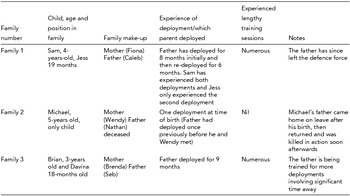
These three families were chosen using convenience sampling and represent three different defence bases within two different geographic states. They were selected due to their involvement in a storybook project about defence families conducted by the author and colleagues, one of which has been published (see Baber et al., Reference Baber, Fussell, Porter and Feez2015). Of the 15 storybooks created, these families feature in four that were written specifically for defence families addressing issues parents identified as being difficult to discuss with young children. Another storybook is for a mainstream audience and as a teaching resource addressing the significance of ANZAC Day as told through the eyes of one of the children from these families. The five children from the three selected families vary in ages from 18-months old to 5-years old. Their experiences with deployment and defence force culture vary and are summarised in Table 1 below.
Information about the three families.

This study had ethics approval from the University of New England, and did not require additional ethics approval from the ADF due to the participants not being current members of that organisation. Interviews with parents were conducted face to face, over the phone and via email contact over a 2-year period. The children's ages in Table 1 are the age they were when I initially interviewed the parent. In certain studies, it is difficult to protect the identity of the individuals involved due to the size of the town in which the study is undertaken (Habibis, Reference Habibis and Walter2013, p. 82) or the sample size. In order to protect the identity of the small population of participants, the names and selected family details have been changed. Further to this, the data has been partly scrambled between the families at their request. Similarly, Dempsey (Reference Dempsey1990) changed details of the town in which his study was conducted in order to protect participants identity.
Data Collection
The adults participating in this study were positioned as sources of knowledge about their children's experiences as Mazzoni and Harcourt (Reference Mazzoni and Harcourt2013) acknowledge. The construction of each family narrative was iterative, with families providing information in a variety of ways as best suited to their needs. Individual parents who were not currently in the ADF chose a combination from: face-to-face interviews, telephone and email communication. The style of interviewing was informal, with interviewer prompts and questions to promote their retelling. The participants shared both their family's experiences of deployment and their interpretations of these over a 4-year period from 2012. Using the written notes taken during the interviews, the data was written into separate family narratives, then thematically analysed within Bronfenbrenner's (Reference Bronfenbrenner1986) socio-ecological framework.
Analysis
Thematic analysis, one of the most common types of qualitative analysis was employed to identify themes emerging from the data, including ‘those that are predetermined and those that emerge’ (Willis, Reference Willis and Walter2013, p. 323). The socio-ecological framework (Bronfenbrenner, Reference Bronfenbrenner1986) has been applied to help ‘see and think differently’, and as Stanger (Reference Stanger2011) argues this is a necessary component of data analysis (p. 172). This framework is based on the theory that children both impact on and modify the environment around them and are themselves impacted upon and changed by the environment around them (Bronfenbrenner & Ceci, Reference Bronfenbrenner and Ceci1994). The ecological framework reveals the ‘complex layers of contextual influence’ on the child and family displaying ‘the complexity of the real world and all that happens to influence the way in which a child grows and develops’ (Bowes, Grace, & Hayes, Reference Bowes, Grace, Hayes, Bowes, Grace and Hodge2012, p. 5). The framework acknowledges the role of adults in children's lives and views them as sources of knowledge (Mazzoni & Harcourt, Reference Mazzoni and Harcourt2013) and power. Adult behaviours can mitigate or exacerbate environmental impacts on children. I concede that power in research needs to be acknowledged and used for the good of others by those in possession of it, but that it is more complex than a good or evil force (Gallagher, Reference Gallagher2008).
Each collated family narrative was scrutinised, using the socio-ecological framework for themes. In developing these themes, a process of constant comparison as originally defined by Glaser (Reference Glaser1965) was used. Willis (Reference Willis and Walter2013) describes this process as moving beyond the descriptions within the interviews to an interpretation of how these explanations fit into the field of research. Themes were the compared across all three families and two major themes are discussed below.
Family Vignettes and Themes from the Data
Vignettes from the Data
Five vignettes from the data are offered here and then discussed within two major themes. They were developed from the narrative data obtained in the interviews and email communication with parents and are a way to present the data separately to the results here. The five vignettes reveal different episodes within the family's experiences and help display various family strengths and the two themes in differing ways.
Vignette A
Within Family 2, the role of place within the family narrative was particularly important. The mother, Brenda, found that explaining the difficult concept of deployment to her young children much easier when she could remind them of the trip to the airport to see their father depart. This concrete use of place seemed to aid their recall of the event because it served as a touchstone for the accompanying cultural narrative and family discussions. For Brenda's spouse, Seb, farewelling the children at the airport was emotionally difficult because he ended up crying and then the children also cried. This created added stress for Seb who commented to Brenda he never wanted to endure this again if he was re-deployed.
Vignette B
Family 1 were involved in two of the storybooks previously mentioned exploring issues raised by many defence families with young children. These issues included difficulties the children had with understanding the concepts of deployment as well as dealing with their emotional, physical and social reactions. The parents, Caleb and Fiona had identified a lack of culturally appropriate resources for young children within the Australian context. They had requested picture books to assist children grapple with identified issues and provide a springboard for family discussions. The author and co-researchers have been involved in the production of these storybooks, using data from the families. Eighteen months after Caleb had left the defence force, Fiona showed the children the storybook involving their family again. She thought they would enjoy looking at the books and seeing photographs of themselves at a younger age and photographs of Caleb in uniform. On reading the books the son, Sam, became overwhelmed, cried for a long period and was upset for 2 days. He said he was remembering how sad he was when his father was away. His sister, Jess also cried for a long time and was upset for a day as well.
Vignette C
In Family 1, Michael's mother Wendy created a narrative to help him understand his father's death. This narrative involved his father being on the moon, rather than trying to ‘explain heaven when he was so young’. This narrative seemed to work for the family and Michael eventually asked questions as he matured about what dying actual meant and if his Daddy could come back to Earth. Wendy felt she was able to answer these questions adequately until Michael was 5-years old when issues arose. At this time, they had attended an ANZAC Day service and a reporter had said to him ‘You must be so proud to have a Daddy so brave, to die in Afghanistan’. Michael then said to Wendy ‘My Daddy died in Afghanistan’. She then contacted an older ADF parent who had lost a son in a recent battle for advice. When explaining what she wanted Michael to understand, Wendy spoke of the ‘important sacrifice her spouse had made’, that ‘he did not die in vain’, ‘he enjoyed his job’ and that ‘he had died fighting the enemy and protecting others’.
Vignette D
Wendy, from Family 2 spoke of the importance for Michael to attend ANZAC Day and Remembrance Day services to ‘keep the traditions of remembering and respecting’. In the case of Wendy's family, Michael has a day off school each year on the anniversary of his father Nathan's death and for Nathan's birthday to attend the gravesite and have quiet time together.
Vignette E
In Family 3, Brenda was touched by the message on a card she had received with a gift by the charity Legacy. They had given these to many non-deployed spouses on ANZAC Day. She was teary when she described the wording on the card ‘Thanks for your sacrifice in letting them go’. Brenda found it very moving because she felt someone finally understood how much she was going through and how much she and her children were sacrificing to have her spouse, Sebastian, on deployment.
Family Strengths Identified
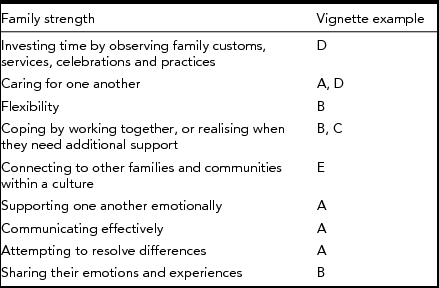
A number of family strengths were identified within the vignettes. These are outlined in Table 2 and then discussed further in the themes below.
Family strengths identified within the data (adapted from Sims, Reference Sims2002).

Overview of Themes
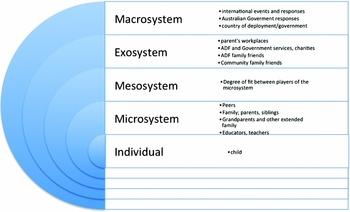
Using the model proposed by Bronfenbrenner (Reference Bronfenbrenner1986), the identified protective factors came from many parts of each family's ecosystem. These include protective factors within the microsystem (e.g. family, early childhood educators) and exosystem (ADF supports, Australian Government services, community charities) as shown in Figure 1. The mesosytem represents the ‘degree of congruence’ between the players in the microsystem (Bowes et al., Reference Bowes, Grace, Hayes, Bowes, Grace and Hodge2012, p. 7), so for example, how well the early childhood service and the parents work together to support the child. Communication and technology issues were evident throughout the microsystems, exosystems and the macrosystems that includes information technology issues in other countries where a parent was deployed. The narratives (including rituals and acculturation) are present throughout the microsystem, exosystem and more broadly through the macrosystem as meta-narratives.
Socio-ecological family model showing protective factors within the three families (adapted from Bronfenbrenner, Reference Bronfenbrenner1986).

Themes
From the themes discussed above, two core themes of ‘narrative’ and ‘ritual and acculturation’ became evident when thematic verification was employed. The next sections explore the roles of narrative and ritual and acculturation within the three families at the microsystem, mesosystem, exosystem and macrosystem levels.
Narrative
Family life is complex, involving family narratives that are ‘created, re-created, inhabited and challenged’ (Thomson, Hadfield, Kehily, & Sharpe, Reference Thomson, Hadfield, Kehily and Sharpe2012, p. 196). Within ADF families, parenting strengths are revealed in narratives that are often created by parents to prepare children for the impending deployment. Strong families often display strengths in parenting and communication, as outlined by Sims (Reference Sims2002). For young children, this narrative often involves a brief, simple, two or three sentence statement that focusses on where the parent is going, how they are travelling there, the duration of the deployment and how they are returning home. The parents, older siblings, educators, extended family and friends often encourage and scaffold children's learning of these narratives by rote, displaying congruence between the players in the mesosystem.
Fellowes and Oakley (Reference Fellowes and Oakley2014) explain that 2 to 3 year old children readily enjoy listening to stories. The children in the study seemed to find great comfort in listening to and repeating the family narrative, and the non-deployed parent repeated the familiar narrative when the child became distressed asking for their deployed parent. This type of effective emotional support is an important family strength (Sims, Reference Sims2002). Physical props were often used to assist the learning. This sometimes included a globe or map of the world with marks to depict the country of deployment and Australia. This was often complemented by a homemade calendar with stickers with which the child could mark off the days until the deployed parent returned. The ADF also supplied cultural artefacts in the form of teddy bears dressed in military uniform. These ‘care bears’ were often held when the story was being told at bedtime as a comforter and prompt. Whilst assisting children's understanding about their parent's deployment, these types of narratives aided acculturating the children into the ideals and expectations of the ADF community (Baber et al., Reference Baber, Fussell, Porter and Feez2015, p. 41) and provided them with opportunities to imaginatively play with the narratives. Nicolopoulou, McDowell, and Brockmeyer (Reference Nicolopoulou, McDowell, Brockmeyer, Singer, Golinkoff and Hirsh-Pasek2006, p. 125) discuss the intertwining relationships between play and narrative and how this promotes young children's bourgeoning language acquisition. Symbolic or pretend play is largely based on narratives enacted by young children and facilitates exploration and understanding of underlying concepts by taking on ‘roles and relationships they wish to explore’ (Harley, Reference Harley, Ebbeck and Waniganayake2010, p. 129).
Additionally, the narratives also focussed on place, such as the departure and arrival of the deployed parent at the airport, which facilitated children's understanding the process of deployment. This was outlined in Vignette A, when Brenda insisted that the children attend the airport to farewell their father as he deployed. Narratives typically involve characters, settings and events (Fellowes & Oakley, Reference Fellowes and Oakley2014) and without the trip to the airport, it was difficult for Brenda to create the setting to assist the family narrative. Due to the children's developmental abilities to recall information, the special trip to the airport provided a place-based bookmark for the children's memories whereas the setting for the deployment is likely to be an abstract notion. Other developments, such as children's speech occurs at vastly different rates and times with plateaus and regressions (Winch & Holliday, Reference Winch, Holliday, Winch, Johnston, March, Ljungdahl and Holliday2010, p. 55) which in turn is related to cognitive development. Despite her spouse Seb's protests, Brenda was determined the children's presence at the airport for future departures was something they would discuss as a family as she believed it was a pivotal part of supporting the children with the difficult concepts of deployment. In line with this, Osofsky and Chartrand (Reference Osofsky and Chartrand2013) recommend military parents prepare young children by talking to them about what is happening and answering their questions about these family changes, including sharing any feelings they are having. Additionally, the data may indicate Brenda's reluctance to deviate from the expectations within the tight ADF culture because departure events are often shared social occasions among ADF families. Vignette A also reveals parents ‘attempting to resolve their differences’ which is a characteristic family strength (Sims, Reference Sims2002, p. 56). Moreover, Vignette A exposes a family strength of effective communication and care for one another in the creation of the children's narrative.
Vignette B revealed the ability of young children to remember emotionally difficult times with the aid of storybooks containing family photos. The mother, Fiona, was surprised at the children's reaction to the storybooks and she said it made her realise how much emotion the children were holding on to from that stressful time. For Caleb and Fiona, that part of their family life had moved on so it was not something on which they dwelt. This may also be a reflection on the stoicism which is evident in many defence families (Siebler, Reference Siebler2009) and highlights the need to ‘pay attention to each family member's feelings, as each person may perceive the situation differently and have different needs’ (Brooks, Reference Brooks2011, p. 498). Fiona and Caleb quickly realised they needed to revisit the children's memories of deployment and talk as a family about the issues, showing the family strengths of being ‘flexible’, ‘pulling together’ and being able to ‘share their feelings. . .and experiences’ (Sims, Reference Sims2002, pp. 55–56). In particular, the incidence offered Caleb a chance to talk about their new life and why they had chosen it over a life within the defence force. The storybooks facilitated much-needed family discussion. This reinforces the importance of children's literature in supporting children's cognitive, social, emotional and resilience development through processing and exploring challenging issues. The important role of children's literature is described by Fellowes and Oakley (Reference Fellowes and Oakley2014) who argue it has ‘a significant role to play in the cognitive, social and emotional, language and literacy, and moral development of young children’ (p. 532).
Social and emotional development is particularly important in early childhood education programmes because these can often predict life success. Davie (Reference Davie2015) quotes Professor Heckman who states these skills are ‘empirically documented and now rigorously established as common sense that people need multiple skills to successfully navigate all of life's challenges’ (Heckman, in Davie, Reference Davie2015, p. 2). Investing in resources, effective programmes and access for families is seen globally as critical in creating solid grounding for increased national workforce participation and productivity long term (Brennan & Crosby, Reference Brennan and Crosby2015), although care needs to be taken to ensure the programmes are relevant and adaptable to specific communities (Sims, Reference Sims2002). Brennan and Crosby (Reference Brennan and Crosby2015) also believe such family assistance increases the wellbeing and happiness of children.
Vignette C outlined necessary changes in the family narrative. This was prompted by the journalist's questions and Wendy subsequently became very upset and felt the journalist had ruined the narrative that she and Michael had shared for many years. On another level, it showed Michael's need for a more detailed narrative, a more meaningful sense of his father's death and changes in the level of scaffolding required within the microsystem over time (chronosystem). Wendy's explanations had previously been adequate but a more mature narrative for Michael was something Wendy struggled with emotionally because it was about letting go of Michael's early years and accepting his maturing cognitive and emotional skills. Wendy realised she needed support and contacted another mother who had a similar life experience for advice, therefore ‘identifying when they need outside help’, another family strength highlighted by Sims (Reference Sims2002, p. 56). A crucial factor in family member's responses is their perspective on the death, ‘whether they see it as meaningful of meaningless’ (Holmes, Rauch, & Cozza, Reference Holmes, Rauch and Cozza2013, p. 152). In a larger sense, both these examples show a telling and a re-telling of the family's narrative as a constantly evolving action. This is described by Gillies and Neimeyer (Reference Gillies and Neimeyer2006) who state:
We continually author our own life stories as we reflect, interpret and reinterpret what happens in our lives, and we tell and retell our stories to other people and ourselves. Meaning then, is embedded in our life stories, and can be evoked by accessing people's stories in their own words (p. 38).
Saltzman et al. (Reference Saltzman, Lester, Beardslee, Layne, Woodward and Nash2011, p. 220) recommend family members share their experiences and issues about deployment, then construct a family narrative that recognises the way the family has overcome multiple adversities and demonstrated resilience. This should help them see their experiences and reactions as typical and ‘develop a sense of coherence about these shared experiences’ (Saltzman et al., Reference Saltzman, Lester, Beardslee, Layne, Woodward and Nash2011, p. 220). There may be instances where narrative may not be enough, and counselling is necessary during times of family trauma, such as the death of a parent on deployment. Mallan (Reference Mallan and Mallan2014) reminds us that ‘story and storytelling are embedded practices in all cultures and have evolved over time from cave drawings to digital stories’ (p. 10). Cultural narrative also plays a large role in acculturation and ritual prevalent in the ADF culture within each family's exosystem. It also features in the broader Australian cultural meta-narrative within the macrosystem which are the ‘broad societal or cultural contexts’ (Bowes et al., Reference Bowes, Grace, Hayes, Bowes, Grace and Hodge2012, p. 7), including government.
Acculturation and ritual
In Vignette D, Michael's attendance at his father's gravesite necessitating days off school is common within the defence community, as is the marking of special days within families. Spending time together observing ‘family traditions, celebrations, ceremonies and routines’ is a characteristic of strong families and is displaying their commitment to ‘care about each other’ (Sims, Reference Sims2002, p. 55). Michael's mother Wendy is a multi-generational member of the ADF community with both a grandfather and a father who served (microsystem). In her explanations about what she wanted Michael to learn about his father through the book project, it was evident the degree of acculturation was understandably very strong. For the ADF to exhibit this level of acculturation, cultural narrative and ritual are heavily utilised.
In Vignette E, an example of community cultural meta-narrative was revealed in the card and present Brenda received from the charity organisation, Legacy. In this example, Brenda is displaying a family's strength of being ‘connected to others in their communities, and culture’, thereby increasing their support base (Sims, Reference Sims2002, p. 56). On one level, the words on the card given by Legacy can be seen as an insightful and experienced level of understanding in an effort to provide emotional support for the family members left behind. On a different level, it can be positioned as part of the cultural meta-narrative within the Australian community and beyond about service to country and sacrifice for a higher purpose. Lake (Reference Lake, Lake and Renyolds2010) questions these cultural meta-narratives and calls for an explanation in the shifting of the Australian cultural meta-narrative that has been heightened by the centenary of the ANZAC landing at Gallipoli. Such cultural meta-narratives have been carefully reinforced by politicians, organisations and the media because national myths are a way to bind a society together (Gottschall, Reference Gottschall2012). Conversely, national myths are often divisive, giving a view from the dominant culture and marginalising those with differing opinions or cultural backgrounds. In the case of the ANZAC myth, Indigenous Australians, those who are pacifists and those who are from the countries we fought against are likely to have quite different narratives, but may feel silenced by the popularity of the dominant meta-narrative.
A challenging and perplexing dichotomy
Within this cultural meta-narrative, as a researcher and an early childhood educator, I have been asked by many families to write children's storybooks explaining a number of the concepts that children struggle with around deployment and explore a few common experiences. I have found this task enjoyable and rewarding, but conversely, I also struggle with the idea that I am adding to the cultural meta-narrative as described above. Whilst I have had extended family members serve Australia in various wars in the past, I myself am not from a defence family. Due to my lack of family acculturation, I am reminded afresh when I hear expressions of acculturation during the interviews with parents and when I have worked with other families including children within the larger study that is a PhD thesis in progress as previously noted. Not having a military background has been very useful in separating myself from the cultural narrative; in a research sense, assisting me see the acculturation from the outside. However, I question if I am assisting potentially vulnerable families or am I adding to the cultural meta-narrative and national myth that helps keep recruitment in the ADF at one of the highest levels since 1999 (Department of Defence, 2015). Am I perpetrating a national myth which is used to bind a society together (Gottschall, Reference Gottschall2012), or merely supporting vulnerable children and parents as they understandably struggle with deployment? Professionals working with families may also have similar ethical struggles as they reflect on their practice, which Newman and Pollnitz (Reference Newman and Pollnitz2005) believe is essential for ethical practice with children. Similarly, the practice standards of the Australian Association of Social Workers (2013) list the components of social work practice to include: ‘values and ethics, professionalism’ and ‘culturally responsive and inclusive practice’ (p. 7).
Conclusion
This study has provided insight into the experiences of three military families that serves to promote understanding of the issues they face and the way in which their experiences and perceptions are shaped by the world around them. Thematic analysis highlighted the main themes that were analysed using a socio-ecological model (Bronfenbrenner, Reference Bronfenbrenner1986) giving insight into the scaffolding structures within families and communities. A culture of sacrifice was achieved through acculturation using cultural narrative and ritual at all levels of the family's socio-ecological system. Greater understanding of these issues and how they affect ADF families is important for those assisting military families. It is also important for those who make decisions about the way the ADF provides for their families. After all, as Andres and Coulthard (Reference Andres, Coulthard, Moelker, Andres, Bowen and Manigart2015) state, the efficacy of a defence force ‘depends on maintaining the well-being of not only its service members, but also their families’ (p. 187).
Educators and family workers need to be aware of how important a family narrative is in assisting children remember, normalise and verbalise the events of deployment. Providing support by first communicating with families, then providing scaffolding to the children will support their understanding and ability to answer questions adults frequently ask. Wilson (Reference Wilson2016) describes this type of effective partnering as a means to provide ‘support signposting, ideas and strategies as well as improve children's lives’ (p. 17), providing a higher degree of congruence within the mesosystem. Educators also would benefit from communicating with parents about important dates within the calendar for their family and for the ADF in general.
Similarly, Saint-Jacques, Turcotte, and Pouliot (Reference Saint-Jacques, Turcotte and Pouliot2009) outline the essential collaboration between the family worker and family in the strengths-based approach. In line with this, Elliott (Reference Elliott, Garvis and Pendergast2014, p. 199) outlines the importance of accepting and valuing family cultural practices and principles for professionals connecting with families. Lyons, Ford, and Slee (Reference Lyons, Ford and Slee2014) also recommend educators teach about resilience as well as build children's self-esteem by recognising children's strengths. The Australian Early Years Learning Framework (DEEWR, 2009) outlines the integral sense of belonging children gain within their families, cultural group, neighbourhood and community. Within the ADF community, strong acculturation helps its members feel connected and supported. To enhance children's learning by building connections between home and the early childhood setting, educators are encouraged to ‘explore the culture, heritage, backgrounds and traditions of each child within the context of their community’ (DEEWR, 2009, p. 27). Family workers and educators can employ the powerful use of narrative to build and reinforce children's understandings of deployment and help them grow from their experiences. They can assist families resilience by helping them view themselves as ‘resourceful and skilled’ so they become ‘actively engaged in the process of addressing their issues and solving their problems’ (Silberberg, Reference Silberberg2001, p. 57). Where there has been grief and loss within military families, Walsh (Reference Walsh2007) recommends professionals should help families create a ‘shared experience of loss and survivorship’ through ‘active participation in memorial rituals’ with their community (p. 210).
Overall, many factors impact a defence children's resilience during deployment, however ‘relationships and connections matter, inside the family and out’ (Hollingsworth, Reference Hollingsworth2011, p. 225) increasing the level of congruence in the mesosystem. As a community and nation, we need to support these families and to do this we need increased understanding of their experiences and needs. Additional research is needed in this area within Australia (McFarlane, Reference McFarlane2009; Siebler, Reference Siebler2009) and with young children within military families at a global level. Further research is needed into the use of family narratives, cultural narratives, acculturation and ritual and the challenging dichotomy for researchers reinforcing the cultural meta-narratives.