Statement of Research Significance
Research Question(s) or Topic(s):
-
Despite the increased risk of Alzheimer’s disease in older adults with essential tremor (ET), there are limited data on the trajectories and predictors of cognition in ET. This prospective, longitudinal study comprehensively examined rates and demographic and motor predictors of change in multiple cognitive domains among older adults with ET diagnosed as cognitively normal at the baseline study visit.
Main Findings:
-
Participants evidenced a decline in global cognition, executive function, and attention over time. Older age predicted faster decline in all cognitive domains except attention. Tremor severity predicted faster decline in executive function, whereas rest tremor predicted faster decline in executive function and attention. Tandem gait missteps predicted faster decline in memory and visuospatial ability.
Study Contributions:
-
These results shed light on the earliest manifestations of cognitive impairment in older adults with ET and implicate different pathways by which heterogeneous cognitive changes emerge.
Introduction
Essential tremor (ET) is a highly prevalent neurodegenerative disease whose central motor feature is kinetic tremor in the arms during voluntary movement (Benito-León & Louis, Reference Benito-León and Louis2007; Louis, Reference Louis2019; Louis & McCreary, Reference Louis and McCreary2021; Louis & Ottman, Reference Louis and Ottman2014; Shukla, Reference Wagle Shukla2022). While often the only feature of ET, kinetic tremor can also be accompanied by a variety of other motor features such as rest tremor, intention tremor, and gait impairment (Peterson et al., Reference Peterson, Chapman, Iglesias-Hernandez, Tafader, Louis and Cosentino2022). Moreover, a growing literature documents the cognitive symptoms of ET (Bermejo-Pareja & Puertas-Martín, Reference Bermejo-Pareja and Puertas-Martín2012; Higginson et al., Reference Higginson, Wheelock, Levine, King, Pappas and Sigvardt2008; Lacritz et al., Reference Lacritz, Dewey, Giller and Cullum2002; Louis, Reference Louis2016, Reference Louis2021; Louis et al., Reference Louis, Benito‐León, Vega‐Quiroga and Bermejo‐Pareja2010; Louis et al., Reference Louis, Joyce and Cosentino2019; Sánchez-Ferro et al., Reference Sánchez-Ferro, Benito-León, Louis, Contador, Hernández-Gallego, Puertas-Martín and Bermejo-Pareja2017). Cognitive deficits in ET appear to span multiple domains including executive function, memory, attention, and language (Benito-León et al., Reference Benito-León, Louis and Bermejo-Pareja2006; Bermejo-Pareja & Puertas-Martín, Reference Bermejo-Pareja and Puertas-Martín2012; Higginson et al., Reference Higginson, Wheelock, Levine, King, Pappas and Sigvardt2008; Janicki et al., Reference Janicki, Cosentino and Louis2013; Lacritz et al., Reference Lacritz, Dewey, Giller and Cullum2002; Lombardi et al., Reference Lombardi, Woolston, Roberts and Gross2001; Sinoff & Badarny, Reference Sinoff and Badarny2014). While cognitive deficits can be relatively mild, several studies indicate higher rates of prevalent and incident mild cognitive impairment (MCI) and dementia in older adults with ET (Benito-León et al., Reference Benito-León, Louis and Bermejo-Pareja2006; Benito-León et al., Reference Benito-León, Louis, Mitchell and Bermejo-Pareja2011; Bermejo-Pareja et al., Reference Bermejo-Pareja, Louis and Benito-León2007; Louis et al., Reference Louis, Joyce and Cosentino2019; Thawani et al., Reference Thawani, Schupf and Louis2009). Examining the evolution of cognitive decline in ET, and its association with various motor features of the disease, will shed light on the earliest manifestations of cognitive change in older adults with ET and the potential pathways through which MCI and dementia arise.
The association between cognitive and motor function in ET has been the subject of multiple cross-sectional investigations (Kim et al., Reference Kim, Song, Shim, Park, Yoo, Kim and Lee2010; Louis et al., Reference Louis, Kellner, Morgan, Collins, Rohl, Huey and Cosentino2017; Peterson et al., Reference Peterson, Chapman, Iglesias-Hernandez, Tafader, Louis and Cosentino2022). Studies to date have produced somewhat inconsistent findings, with some linking more severe tremor to lower memory and language scores (Kim et al., Reference Kim, Song, Shim, Park, Yoo, Kim and Lee2009) and others reporting no clear association between tremor severity and cognition (Lombardi et al., Reference Lombardi, Woolston, Roberts and Gross2001; Peterson et al., Reference Peterson, Chapman, Iglesias-Hernandez, Tafader, Louis and Cosentino2022). Measures of balance and gait have also been associated with a range of cognitive scores (Kronenbuerger et al., Reference Kronenbuerger, Konczak, Ziegler, Buderath, Frank, Coenen, Kiening, Reinacher, Noth and Timmann2009; Louis et al., Reference Louis, Kellner, Morgan, Collins, Rohl, Huey and Cosentino2017; Louis & Rao, Reference Louis and Rao2015; Peterson et al., Reference Peterson, Chapman, Iglesias-Hernandez, Tafader, Louis and Cosentino2022; Rao & Louis, Reference Rao and Louis2019). While a growing body of cross-sectional research highlights the cognitive component of ET and its association with motor symptoms (Louis, Reference Louis2016, Reference Louis2021), a comprehensive examination of cognitive trajectories and their association with heterogeneous motor presentations in ET is lacking.
This prospective, longitudinal study includes a detailed examination of cognitive trajectories among older adults with ET as well as the demographic and motor features that predict such trajectories. Individuals in the current study were diagnosed as having normal cognition (NC) at the baseline evaluation of the COGNET study and underwent repeated cognitive evaluations covering the domains of attention, executive function, memory, visuospatial abilities, and language. This study describes the rates of change in these domains and examines the extent to which demographic characteristics (age, sex, education) and motor features (tremor severity, duration of tremor, presence of rest tremor, cranial tremor score, and tandem gait missteps) predict the rate of change in these domains.
Method
Study design
Participants were enrolled in the Clinical-Pathological Study of Cognitive Impairment in Essential Tremor (COGNET, NINDS R01NS086736), a prospective, longitudinal study of cognition in ET. Beginning in July 2014, subjects were recruited through advertisements on the study and International Essential Tremor Foundation websites and newsletters. ET cases were eligible for the study if they met the following criteria: (1) 55 years of age or older, (2) no history of deep brain stimulation or other surgeries for ET, (3) willingness to perform study measures, and (4) enrollment in COGNET brain donation. Participants were enrolled after providing informed consent to the study procedures, which were approved by Yale University, Columbia University, and the University of Texas Southwestern Medical Center Institutional Review Boards. All research was conducted in accordance with the Declaration of Helsinki.
The current analyses utilized data from the baseline visit (T1) and four follow-up assessments at 18-month intervals (T2, T3, T4, and T5). A trained research assistant administered the components of each evaluation, including a videotaped neurological examination, a neuropsychological battery, and demographic and clinical questionnaires, during a home visit. During this visit, information about the total number of prescription medications and the number of medications associated with impaired cognitive functioning was collected for each participant.
Tremor ratings
Using the clinical questionnaires and videotaped neurological examination, a senior movement disorders neurologist (E.D.L.) confirmed participants’ ET diagnosis using the reliable and valid criteria established in the Washington Heights-Inwood Genetic Study of ET (Louis et al., Reference Louis, Ottman, Ford, Pullman, Martinez, Fahn and Hauser1997, Reference Louis, Wendt, Albert, Pullman, Yu and Andrews1999; Louis et al., Reference Louis, Ford and Bismuth1998). Postural and kinetic tremors in the upper limbs were rated from 0 to 3 during 12 examination maneuvers (e.g., drinking, pouring) to create a tremor severity score (0–36), where higher scores indicate more severe tremor. A cranial tremor score (0–3) was calculated from the number of anatomic locations (neck, jaw, voice) where the cranial tremor was observed in a participant (Louis et al., Reference Louis, Rios and Rao2010). Intention tremor (i.e., tremor whose amplitude increased during visually guided movements toward a target) was rated in the terminal period of the finger-nose-finger test: 0 (no intention tremor); 0.5 (probable intention tremor); 1 (definite intention tremor); 2 (incapacitating intention tremor), although no cases received ratings of 2. Intention tremor was coded as present only if there was a definite intention tremor in at least one arm (Louis et al., Reference Louis, Frucht and Rios2009). Rest tremor (i.e., tremor occurring when voluntary muscle activity is absent and unintended) was evaluated as either present or absent from observations while participants were seated, standing, and walking.
Tandem gait examination
Participants were asked to walk in a straight line with the heel of one foot being placed in front of, and touching, the toe of the back foot for 10 steps (Dowd et al., Reference Dowd, Zdrodowska, Radler, Cersonsky, Rao, Huey, Cosentino and Louis2020). Outcomes for this examination were reported as the number of tandem gait missteps or the number of steps off the straight line (0–10). If participants depended on a cane, walker, or wheelchair and were unable to complete one step safely, this was coded as 10. Higher scores, or more missteps, indicate greater balance impairment.
Neuropsychological assessments
To minimize the effects of tremor severity on participants’ cognitive performance, a clinical neuropsychologist (S.C.) prepared a battery of non-motor-based assessments that were clinically valid and reliable (Cersonsky et al., Reference Cersonsky, Morgan, Kellner, Robakis, Liu, Huey, Louis and Cosentino2018, Reference Cersonsky, Kellner, Chapman, Huey, Louis and Cosentino2020). Participants completed 19 neuropsychological tests that evaluated global cognition (Mini-Mental State Examination [Folstein et al., Reference Folstein, Folstein and McHugh1975] and Montreal Cognitive Assessment [Nasreddine et al., Reference Nasreddine, Phillips, Bédirian, Charbonneau, Whitehead, Collin, Cummings and Chertkow2005]), memory (California Verbal Learning Test II [Delis et al., Reference Delis, Kramer, Kaplan and Ober2000], Wechsler Memory Scale Revised: Logical Memory [Wechsler, Reference Wechsler1987], Wechsler Memory Scale IV: Verbal Paired Associates [Wechsler, Reference Wechsler2008]), executive function (Wechsler Adult Intelligence Scale IV [WAIS-IV] Digit Span Backward [Wechsler, Reference Wechsler1997], Delis–Kaplan Executive Function System: Verbal Fluency Test, Color-Word Interference, Sorting, 20-Questions [Delis et al., Reference Delis, Kaplan and Kramer2001]), attention (Oral Symbol-Digit Modalities Test [Smith, Reference Smith1982], WAIS-IV Digit Span Forward [Wechsler, Reference Wechsler1997]), visuospatial ability (Benton Judgment of Line Orientation [Benton et al., Reference Benton, Sivan, des Hamsher, Varney and Spreen1994], Benton Facial Recognition Test [Benton & Van Allen, Reference Benton and Van Allen1968], WAIS-IV Visual Puzzles [Wechsler, Reference Wechsler1997]), and language (Boston Naming Test [Kaplan et al., Reference Kaplan, Goodglass and Weintraub1983]).
Functional assessment
Each participant designated a reliable informant for the purpose of being interviewed about the participants’ functioning and activities. Informant responses and examiner observations were used to assess each participant’s level of everyday functioning within the six domains of memory, orientation, judgment and problem-solving, community affairs, home and hobbies, and personal care as part of the Clinical Dementia Rating (CDR) Scale (Morris, Reference Morris1993, Reference Morris1997). A global CDR score was calculated from the subscores of the six domains. In the instances where an informant was not available, participants’ CDR scores were assigned based on the research assistant’s observations and participant self-report.
Consensus cognitive diagnoses
A neuropsychologist (S.C.) and a geriatric psychiatrist (E.D.H.) evaluated cases in a diagnostic consensus conference to assign each participant a diagnosis of NC, MCI, dementia, or cognitive impairment due to stroke, substance abuse, or other injuries (CI Other). Diagnostic decisions were made using neuropsychological test performance, CDR scores, and the observations of the research assistant who had conducted the evaluation. Broad diagnostic guidelines were as follows: NC: CDR = 0, > −1.5 SD on neuropsychological testing; MCI: CDR = 0.5, < −1.5 SD on at least one test in two domains or two tests in one domain; and dementia: CDR≥1, < −1.5 SD on tests in at least two domains.
Mood evaluation
Depressive symptoms were assessed with the 30-item Geriatric Depression Scale (Yesavage et al., Reference Yesavage, Brink, Rose, Virwnia, Adfy and Leirer1983), where higher scores indicated a greater number of symptoms endorsed.
Participants
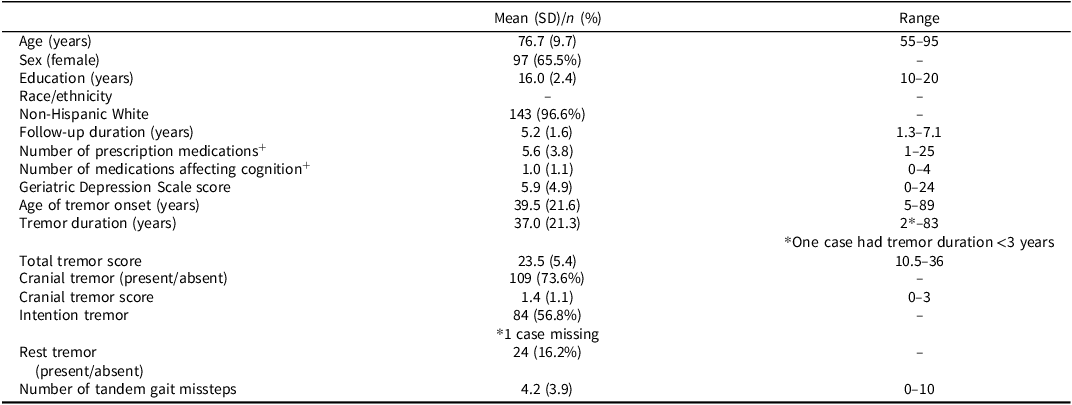
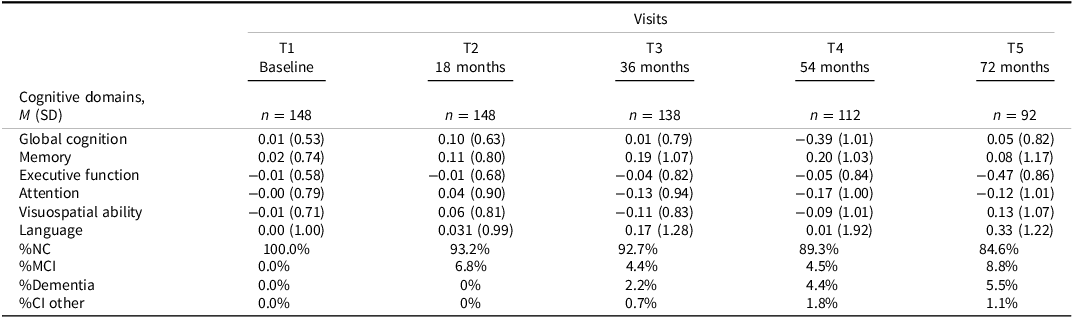
The current sample consisted of individuals with ET enrolled in the COGNET cohort who were diagnosed as NC at baseline (see Table 1 for descriptive statistics of the sample). Out of a total of 240 individuals with baseline data in COGNET, we removed: 59 because they were not cognitively normal at baseline, 22 because of diagnoses of either Parkinson’s disease (PD; n = 4), ET-PD (n = 4), or ET-dystonia (n = 14) at baseline or a later evaluation, and 11 because of lack of follow-up data. These exclusions resulted in a sample of 148 participants diagnosed as NC at baseline (T1) who completed at least one follow-up visit after 18 months (T2). Not all participants completed four follow-up evaluations (T5), as there was some dropout that occurred after T2 (see Table 2 for the number of subjects that completed visits at T3–T5).
Demographic and clinical characteristics of ET-NC participants at baseline

+Data only available for 137 participants out of the total sample of 148.
Cognitive domain z-scores from baseline visit (T1) through final visit (T5)

Note: All z-scores reflect mean (standard deviation) as derived against the baseline means and standard deviations (SD) for each domain score.
NC = normal cognition; MCI = mild cognitive impairment; CI other = cognitive impairment due to stroke, substance abuse, etc.
Statistical analyses
Raw scores for each cognitive test, at each evaluation, were converted into z-scores using means and standard deviations in the current sample at baseline (i.e., 148 ET-NC individuals). Individual test z-scores were then combined to create aggregate z-scores for memory, executive function, attention, visuospatial ability, and language. A global cognition z-score was derived as the composite of all five domain scores, producing a total of six cognitive z-score outcomes. Six generalized estimating equation (GEE) models were used to evaluate time in years as a predictor of each cognitive outcome score. Values were considered significant if p< 0.05. With standard deviation (SD; z-scores) as cognitive outcomes for all GEE models, β coefficients reported in the results section provide an indication of effect size, defined as β < 0.3 SD (small), 0.3–0.5 SD (moderate), and > = 0.5 (large).
A second series of GEE models examined the predictive effects of three demographic characteristics (age, sex, and education level) known to affect cognitive functioning (Gurvich et al., Reference Gurvich, Thomas and Kulkarni2020; Lövdén et al., Reference Lövdén, Fratiglioni, Glymour, Lindenberger and Tucker-Drob2020; Murman, Reference Murman2015) as well as six motoric clinical features of ET (tremor duration, tremor severity, cranial tremor score, intention tremor, presence of rest tremor, and number of tandem gait missteps) on change over time in each of the six cognitive scores. Each model was adjusted for age, sex, education, total number of medications, number of medications with known potential for impairing cognitive function, and number of depressive symptoms but included only the interaction term of interest. Interactions between each of these predictors and time in years were entered to examine the extent to which they predicted the rate of change in each domain. Analyses were conducted with IBM SPSS Statistics 27.
Results
As described in Table 1, the final sample comprised 148 participants with a mean baseline age of 76.7 ± 9.7 years and an average of 16.0 ± 2.4 years of education. The sample was 65.5% female and 96.6% non-Hispanic White. Participants had an average follow-up in the study of 5.2 ± 1.6 years. Motor features including tremor duration, tremor severity score, cranial tremor score, intention tremor, rest tremor (presence), and the number of tandem gait missteps are reported in Table 1.
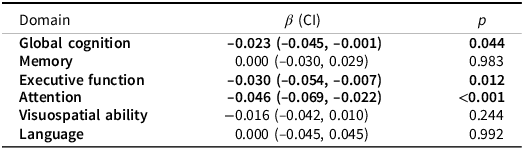
Mean cognitive z-scores for each domain at each visit are summarized in Table 2. Z-scores represent performance at each visit in reference to baseline performance. By definition, average baseline z-scores will approximate zero, while positive versus negative z-scores at subsequent visits reflect performance that is, on average, higher versus lower than baseline performance, respectively. For example, inspection of Table 2 shows that from an absolute standpoint, average performance in executive function is lower at the final visit than at baseline, whereas performance in language is higher at the final visit. GEE models, presented in Table 3, evaluate the extent to which cognitive scores changed significantly from zero over time. Results from these models (adjusted for age, sex, education total number of medications, number of medications with known potential for impairing cognitive function, and number of depressive symptoms) demonstrate statistically significant decline in the domains of global cognition (β = −0.023, p = 0.044), executive function (β = −0.030, p = 0.012), and attention (β = −0.046, p<0.001).
Rates of cognitive change among individuals diagnosed as ET-NC at baseline

Adjusted for age, sex, education, number of prescription medications, number of medications with known potential for impairing cognitive function, and number of depressive symptoms.
Bolded values reflect significant cognitive decline.
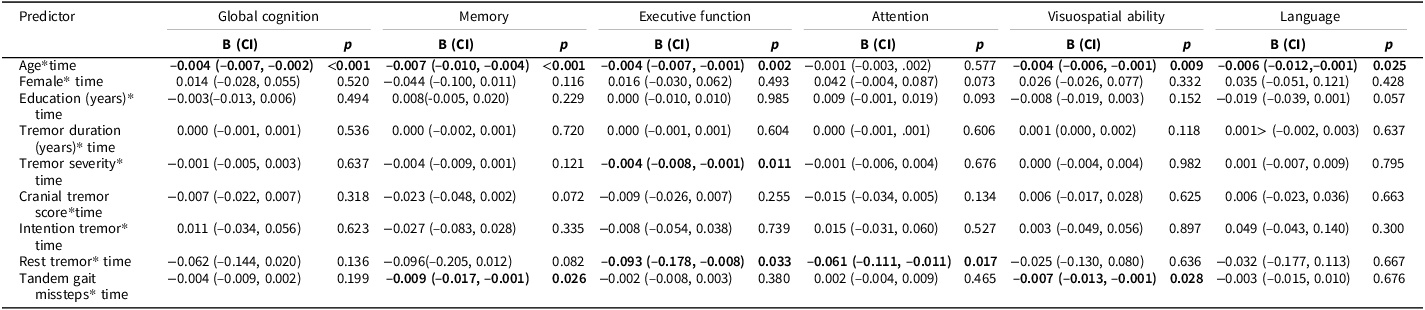
Table 4 includes results from GEE models examining the predictive effects of individual demographic variables and clinical features, collected at the baseline evaluation, on cognitive performance over time. Results indicated that older baseline age predicted faster cognitive decline over time in global cognition (β = −0.004, p<0.001), memory (β = −0.007, p<0.001), executive function (β = −0.004, p = 0.002), visuospatial ability (β = −0.004, p = 0.009), and language (β = −0.006, p = 0.025).
Baseline demographic and motor predictors of cognitive decline

Adjusted for age, sex, education, number of prescription medications, number of medications with known potential for impairing cognitive function, and number of depressive symptoms.
Bolded values reflect significant cognitive decline.
Effect sizes: β < 0.3 (small), 0.3–0.5 (moderate), > = 0.5 (large).
Motor features that predicted faster cognitive decline over time included tremor severity, rest tremor, and tandem gait missteps (Figures 1–5). Tremor severity predicted faster decline in executive function (β = −0.004, p = 0.011). Rest tremor predicted faster decline in executive function (β = −0.093, p = 0.033) and attention (β = −0.061, p = 0.017). Finally, tandem gait missteps predicted faster decline in memory (β = −0.009, p = 0.026) and visuospatial ability (β = −0.007, p = 0.028).
Discussion
Cognitive symptoms in ET have been documented across a range of cross-sectional studies (Benito-León et al., Reference Benito-León, Louis and Bermejo-Pareja2006; Bermejo-Pareja & Puertas-Martín, Reference Bermejo-Pareja and Puertas-Martín2012; Higginson et al., Reference Higginson, Wheelock, Levine, King, Pappas and Sigvardt2008; Janicki et al., Reference Janicki, Cosentino and Louis2013; Lacritz et al., Reference Lacritz, Dewey, Giller and Cullum2002; Lombardi et al., Reference Lombardi, Woolston, Roberts and Gross2001) and are even considered by some to be a primary feature of ET (Jhunjhunwala & Pal, Reference Jhunjhunwala and Pal2014; Lenka & Louis, Reference Lenka and Louis2023). The limited longitudinal data that exist suggest that the rate of cognitive change is faster in ET than in age-matched non-ET controls, even in the pre-motor stage of disease (Benito-León et al., Reference Benito-León, Louis, Sánchez-Ferro and Bermejo-Pareja2013). However, a comprehensive examination of cognitive trajectories and their association with heterogeneous motor presentations of the disease has been lacking.
This study provides one of the first prospective, detailed longitudinal characterizations of cognitive trajectories in older adults with ET. All participants, rigorously evaluated at 18-month intervals, were deemed to be cognitively normal at the baseline visit. Results suggest that on average, performance in memory, visuospatial ability, and language was relatively stable over the 5-year mean follow-up period of our study. In contrast, global cognition, executive function, and attention scores evidenced significant decline on average over time. With regard to demographic predictors of cognitive change, older age predicted faster decline in all domains except attention. With regard to motor features, tremor severity predicted faster decline in executive function, while the presence of rest tremor predicted faster decline in both executive function and attention. Finally, more tandem gait missteps predicted faster decline in memory and visuospatial ability. Below, we discuss the implications of these various findings.
The current study demonstrated that significant cognitive decline is evident over time in global cognition, executive function, and attention in a sample of older adults with ET. In contrast, memory, visuospatial ability, and language were relatively stable over the 5-year mean follow-up period. Differential decline in executive function and attention is consistent with a number of cross-sectional studies in ET (Benito-León et al., Reference Benito-León, Louis and Bermejo-Pareja2006; Bermejo-Pareja & Puertas-Martín, Reference Bermejo-Pareja and Puertas-Martín2012; Cersonsky et al., Reference Cersonsky, Morgan, Kellner, Robakis, Liu, Huey, Louis and Cosentino2018, Reference Cersonsky, Kellner, Chapman, Huey, Louis and Cosentino2020; Gasparini et al., Reference Gasparini, Bonifati, Fabrizio, Fabbrini, Brusa, Lenzi and Meco2001; Higginson et al., Reference Higginson, Wheelock, Levine, King, Pappas and Sigvardt2008; Janicki et al., Reference Janicki, Cosentino and Louis2013; Kim et al., Reference Kim, Song, Shim, Park, Yoo, Kim and Lee2009; Lombardi et al., Reference Lombardi, Woolston, Roberts and Gross2001; Sánchez-Ferro et al., Reference Sánchez-Ferro, Benito-León, Louis, Contador, Hernández-Gallego, Puertas-Martín and Bermejo-Pareja2017; Sinoff & Badarny, Reference Sinoff and Badarny2014; Tröster et al., Reference Tröster, Woods, Fields, Lyons, Pahwa, Higginson and Koller2002). Such deficits are theorized to reflect the cerebellum’s role in supporting the control of attention, especially in conditions requiring heightened attention (i.e., divided attention, working memory) (Bernard & Seidler, Reference Bernard and Seidler2013; Diedrichsen & Zotow, Reference Diedrichsen and Zotow2015). Cerebellar degeneration in ET may contribute to impaired intra-cerebellar connectivity among regions that subserve working memory (Passamonti et al., Reference Passamonti, Novellino, Cerasa, Chiriaco, Rocca, Matina, Fera and Quattrone2011), as well as impaired connectivity between the cerebellum and prefrontal cortex via cerebello-thalamo-frontal pathways (Janicki et al., Reference Janicki, Cosentino and Louis2013). Indeed, cerebellar deterioration may have particularly detrimental effects on executive functions given their heavy reliance on prefrontal regions (Schmahmann & Sherman, Reference Schmahmann and Sherman1998).
Nonetheless, there is evidence that deficits in global cognition in ET persist in tasks beyond those that are reliant on the aforementioned executive function and attention domains (Janicki et al., Reference Janicki, Cosentino and Louis2013; Kim et al., Reference Kim, Song, Shim, Park, Yoo, Kim and Lee2009). As such, the stability of memory, visuospatial ability, and language was somewhat unexpected given the increased risk of amnestic MCI and dementia that has been reported in ET. Without a non-ET control group, however, we cannot determine the extent to which cognitive trajectories in the current sample are different than what would be observed in a matched control group of individuals without ET. Consideration of longitudinal performance in the general population, while not a substitute for a matched control group, may be informative in this regard (Louis et al., Reference Louis, Joyce and Cosentino2019). In particular, Vemuri (Vemuri et al., Reference Vemuri, Lesnick, Przybelski, Knopman, Preboske, Kantarci, Raman, Machulda, Mielke, Lowe, Senjem, Gunter, Rocca, Roberts, Petersen and Jack2015) and colleagues described rates of cognitive change in the general population within the Mayo Clinic Study of Aging (MCSA). Although the MCSA had a larger sample size and a shorter mean follow-up period, the study employed broadly similar methods to the COGNET study (Vemuri et al., Reference Vemuri, Lesnick, Przybelski, Knopman, Preboske, Kantarci, Raman, Machulda, Mielke, Lowe, Senjem, Gunter, Rocca, Roberts, Petersen and Jack2015). In contrast to the current study, global cognition improved over time, hypothesized to reflect improvement with practice (Vemuri et al., Reference Vemuri, Lesnick, Przybelski, Knopman, Preboske, Kantarci, Raman, Machulda, Mielke, Lowe, Senjem, Gunter, Rocca, Roberts, Petersen and Jack2015). Indeed, practice effects are well documented among cognitively normal groups of older adults (Dodge et al., Reference Dodge, Wang, Chang and Ganguli2011; Duff et al., Reference Duff, Beglinger, Moser, Paulsen, Schultz and Arndt2010; Machulda et al., Reference Machulda, Pankratz, Christianson, Ivnik, Mielke, Roberts, Knopman, Boeve and Petersen2013), and lack of a practice effect has previously been suggested to be a possible early indicator of future cognitive decline (Bender et al., Reference Bender, Ganguli, Meiring, Hampstead and Driver2022; Jutten et al., Reference Jutten, Grandoit, Foldi, Sikkes, Jones, Choi, Lamar, Louden, Rich, Tommet, Crane and Rabin2020). While speculative, the slight decline over time in the current sample of older adults with ET could reflect greater variability in performance among the ET sample.
Demographic predictors mirrored well-known trends in the general population (Murman, Reference Murman2015; Oh et al., Reference Oh, Madison, Haight, Markley and Jagust2012; Vemuri et al., Reference Vemuri, Lesnick, Przybelski, Knopman, Preboske, Kantarci, Raman, Machulda, Mielke, Lowe, Senjem, Gunter, Rocca, Roberts, Petersen and Jack2015) and other ET cohorts (Bermejo-Pareja et al., Reference Bermejo-Pareja, Louis and Benito-León2007; Kim et al., Reference Kim, Song, Shim, Park, Yoo, Kim and Lee2009), where older age at baseline predicted faster decline in global cognition, memory, and executive function in the current study. Interestingly, sex and years of formal education did not predict the rate of change. Though speculative, the minimal impact of sex and education could suggest that there are drivers of cognitive change in an ET cohort (e.g., specific neuroanatomic changes) that exert more influence on cognitive trajectories than among a non-ET population.
With regard to motor features as predictors of cognitive decline in ET, an interesting dissociation emerged. Specifically, tremor severity predicted faster decline in executive function, and rest tremor predicted faster decline in both executive function and attention. The similar impact of tremor severity and rest tremor on executive function is consistent with the idea that cerebellar dysfunction, which has been implicated in the production of intention as well as involved in the production of rest tremor, has known effects on executive abilities (Bhalsing et al., Reference Bhalsing, Upadhyay, Kumar, Saini, Yadav, Gupta and Pal2014; Mannarelli et al., Reference Mannarelli, Pauletti, Missori, Trompetto, Cotellessa, Fattapposta and Currà2023).
In contrast, tandem gait missteps predicted faster decline in memory and visuospatial function. Balance and gait difficulties have previously been associated with cognitive deficits in ET (Kronenbuerger et al., Reference Kronenbuerger, Konczak, Ziegler, Buderath, Frank, Coenen, Kiening, Reinacher, Noth and Timmann2009; Louis et al., Reference Louis, Kellner, Morgan, Collins, Rohl, Huey and Cosentino2017; Louis & Rao, Reference Louis and Rao2015; Peterson et al., Reference Peterson, Chapman, Iglesias-Hernandez, Tafader, Louis and Cosentino2022; Rao & Louis, Reference Rao and Louis2019). Tandem gait, specifically, has been shown to correlate with global cognition (Louis & Rao, Reference Louis and Rao2015), as well as the specific domains of memory, executive function, and visuospatial ability (Peterson et al., Reference Peterson, Chapman, Iglesias-Hernandez, Tafader, Louis and Cosentino2022). It is possible that the predictive utility of tandem gait for visuospatial and memory decline reflects cerebellar dysfunction (Janicki et al., Reference Janicki, Cosentino and Louis2013; Kronenbuerger et al., Reference Kronenbuerger, Konczak, Ziegler, Buderath, Frank, Coenen, Kiening, Reinacher, Noth and Timmann2009; Louis & Rao, Reference Louis and Rao2015; Rao & Louis, Reference Rao and Louis2019); alternatively, this selective association could reflect the emergence of a broader neurodegenerative process extending into cortical and hippocampal areas. Visuospatial and memory function are less frequently impacted by cerebellar compromise than are the domains of executive function and attention (Bhalsing et al., Reference Bhalsing, Upadhyay, Kumar, Saini, Yadav, Gupta and Pal2014; Cartella et al., Reference Cartella, Bombaci, Gallo, Ledda, Pengo, Pignolo, Pozzi, Spina, Trinchillo, Palermo and Terranova2022; Lombardi et al., Reference Lombardi, Woolston, Roberts and Gross2001; Mannarelli et al., Reference Mannarelli, Pauletti, Missori, Trompetto, Cotellessa, Fattapposta and Currà2023) and could point to neuropathologic changes in parietal and hippocampal regions (Beretta et al., Reference Beretta, Carli, Caffarra and Perani2022; Cho et al., Reference Cho, Choi, Lee, Lee, Choi, Ryu, Lee and Lyoo2017; Groot et al., Reference Groot, Risacher, Chen, Dicks, Saykin, Mac Donald, Mez, Trittschuh, Mukherjee, Barkhof, Scheltens, van der Flier, Ossenkoppele and Crane2021). Ongoing examination of neuropathological changes in ET as part of the COGNET study will directly examine this possibility.
In summary, this study presents the most comprehensive overview to date of longitudinal cognitive trajectories among older adults with ET, and the demographic and motor features that predict such trajectories. Current findings contribute to the conceptualization of cognitive decline in ET and the extent to which it is informed by the motor features of ET, via dysfunction in similar pathways (Cartella et al., Reference Cartella, Bombaci, Gallo, Ledda, Pengo, Pignolo, Pozzi, Spina, Trinchillo, Palermo and Terranova2022) and/or as products of neurodegeneration (Cartella et al., Reference Cartella, Bombaci, Gallo, Ledda, Pengo, Pignolo, Pozzi, Spina, Trinchillo, Palermo and Terranova2022). Nonetheless, the current study had several limitations. First, the sample had a mean of 5.2 years of enrollment, with the last evaluation being 72 months after baseline. The results may be restricted to our study’s timeline, rather than being indicative of how normal cognitive performance changes in ET over longer time intervals. Second, as the cohort was relatively small, we may have had insufficient statistical power to detect subtle cognitive changes and motor-cognitive relationships, particularly when examining interactions. Inspection of effect sizes, however, reveals that non-significant findings were characterized by effect sizes close to zero, suggesting that even with a larger sample size, findings would be unlikely to be statistically significant. A third limitation is that the sample is mostly non-Hispanic/Latine/x White, well-educated (M = 15.97) and older (M = 76.7). This homogeneous sample composition substantially limits the generalizability of findings to ethnically and racially diverse populations with ET, as well as those with fewer years of formal education and those who are younger. This study also did not have a control group. Without having age-matched controls as previous research did (Benito-León et al., Reference Benito-León, Louis and Bermejo-Pareja2006; Bermejo-Pareja et al., Reference Bermejo-Pareja, Louis and Benito-León2007; Higginson et al., Reference Higginson, Wheelock, Levine, King, Pappas and Sigvardt2008; Louis et al., Reference Louis, Benito‐León, Vega‐Quiroga and Bermejo‐Pareja2010; Thawani et al., Reference Thawani, Schupf and Louis2009), we cannot definitively distinguish between cognitive changes specifically attributable to ET versus those associated with normal aging processes. Future studies should include more diverse samples of participants with ET as well as a matched, non-ET control group to address these limitations.
Despite these limitations, the current study has many notable strengths including stringent criteria for the diagnosis of ET. The study also used comprehensive, longitudinal evaluations of cognitive performance utilizing a robust neuropsychological battery and clinical diagnostic consensus conference to carefully identify the individuals with NC, MCI, or dementia. Furthermore, the cognitive assessments utilized in this study require little or no reliance on motor functioning, ruling out the interference of motor symptoms with cognitive test performance. Taken together, current findings shed light on the earliest manifestations of cognitive impairment in older adults with ET and implicate different pathways by which heterogeneous cognitive changes emerge. While more research is needed to determine the mechanisms underlying trajectories of cognitive change, findings can be used to identify and counsel patients who may be at risk for cognitive decline.
Scatter plot of executive function over time by tremor severity.

Scatter plot of executive function over time by rest tremor.

Scatter plot of attention over time by rest tremor.

Scatter plot of visuospatial function over time by tandem gait missteps.

Scatter plot of memory over time by tandem gait missteps.

Acknowledgments
All authors declare no competing interests. This work was supported by a National Institutes of Health Award (#R01 NS086736). NIH played no role in the design, collection, analysis, or interpretation of the data or in the writing of this manuscript.