INTRODUCTION
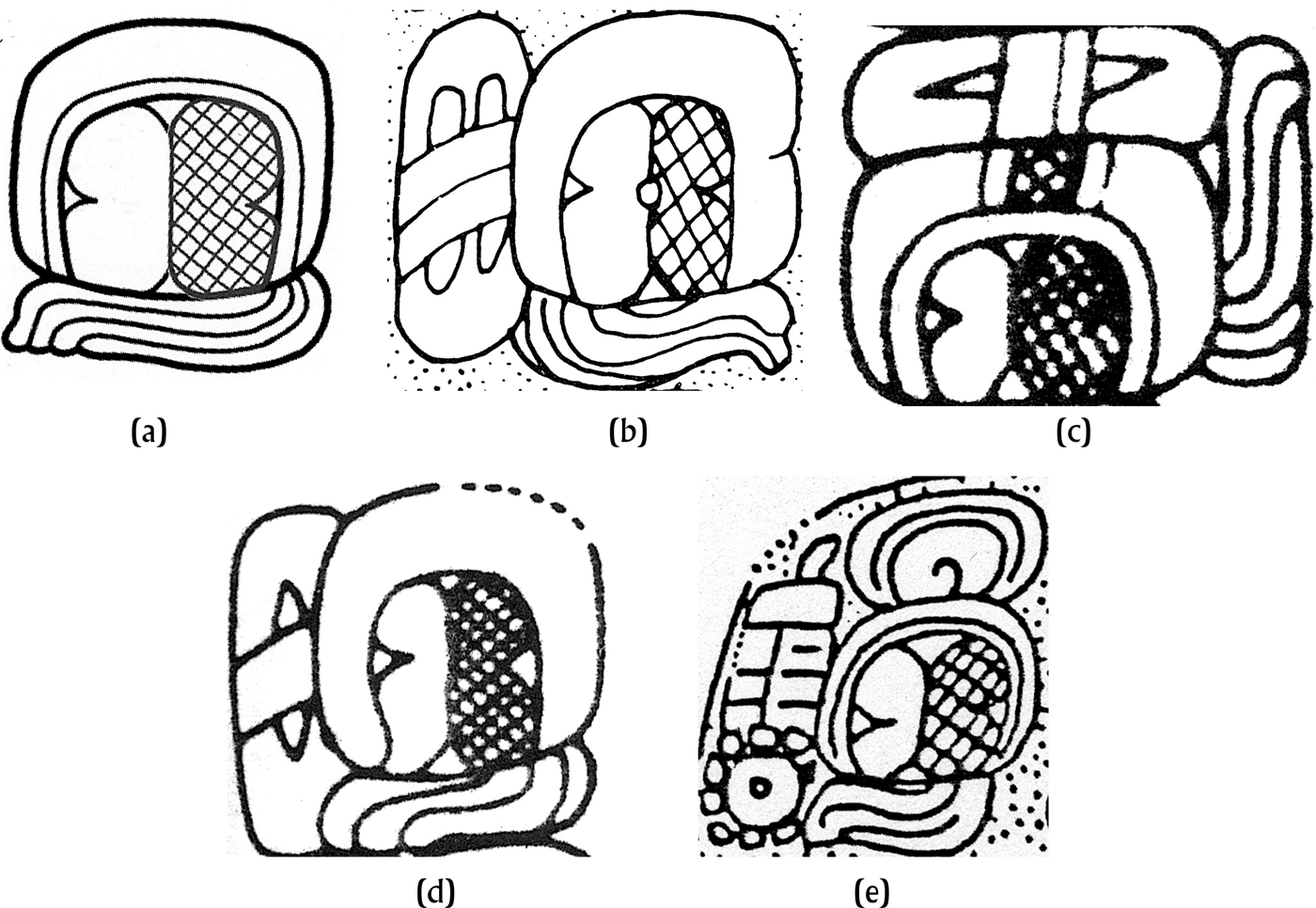
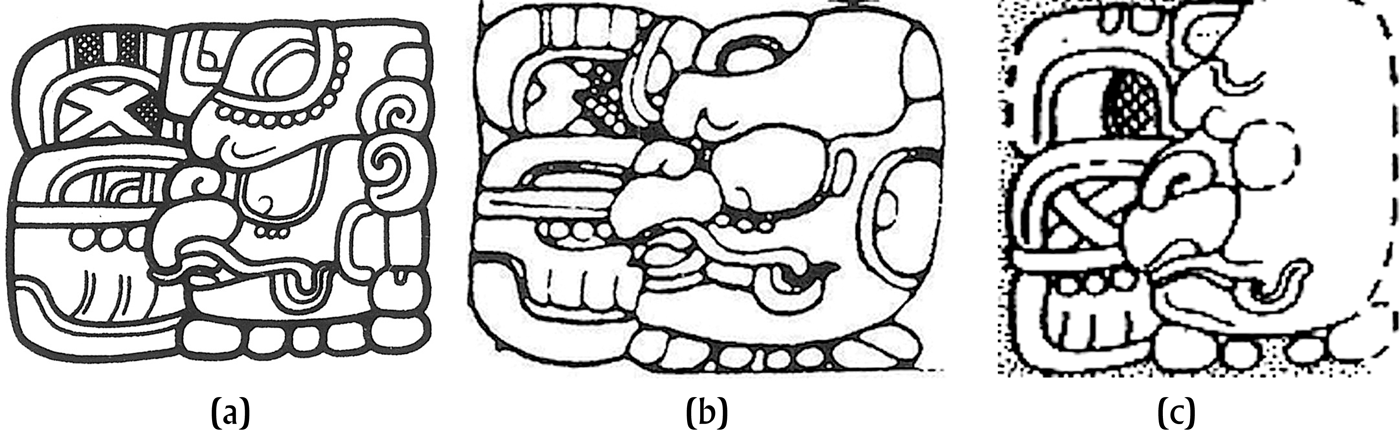
The subject of this essay is known to everyone in our field as the “eclipse glyph.” It has been so-called for nearly a century and will probably remain so far into the future, but I propose here that the “eclipse glyph” does not refer to eclipses but rather to a hidden or darkened sun and moon, hidden behind heavy cloud cover or half-darkened at the horizon. Thompson (Reference Thompson1971[1950]:139, 233, 272, 294) read the glyphs “sun darkened, moon darkened,” and I concur.
True, Maya scribes and artists used iconographic variants of this glyph to illustrate solar eclipses in the Dresden Codex Lunar/Eclipse Table, but outside of those pictures the glyph does not refer to eclipses. While this position stands in opposition to well-established iconological canons in the field, a careful analysis of the signs and their occurrences shows that the current “eclipse” interpretation is incorrect.
If this glyph does not refer to eclipses, what shall we call it? I find when discussing it with others, it is almost impossible not to refer to it as the “eclipse glyph,” since that is a referent that everyone knows; but to continue calling it that reinforces its identification with eclipses and is contrary to the purpose of this essay, so rather than coin a new name (which in all likelihood would never stick), I take a compromise position in which I continue to use “eclipse glyph” but with quotation marks indicating that it does not really refer to eclipses, in spite of its name.
THE GLYPH
I use the term “glyph” in a loose sense here because in fact the “eclipse glyph” seems to consist of two graphemes, the flanking fields (cataloged variously as T326 [Thompson Reference Thompson1962], Z88 [Zimmerman Reference Zimmerman1956], and ZQ1 [Macri and Vail Reference Macri and Vail2009]) are one grapheme and the sign between them is another. So when speaking epigraphically—as in transcription, transliteration, and translation—I use the term grapheme for the individual signs, but the term “eclipse glyph” or “the glyph in question” (for example) for the combined graphemes, the flanking fields and the sign between them.
Nowhere is it affixed with phonetic complements, either before or after (the Poco Uinic example is a separate case, discussed below). My epigraphic interpretation is that the two side elements make up a single logogram that translates something like “darkened” or “darkening” and that the variable infixed elements, usually K'IN, “sun,” or UH, “moon,” are also logographs, thus creating two-word phrases like “darkened sun” and “darkened moon.”
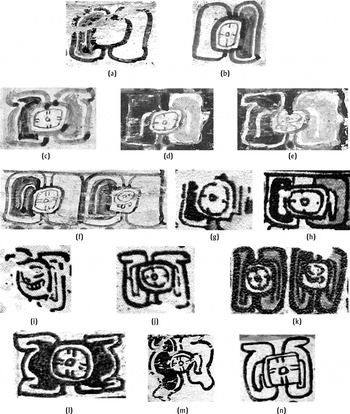
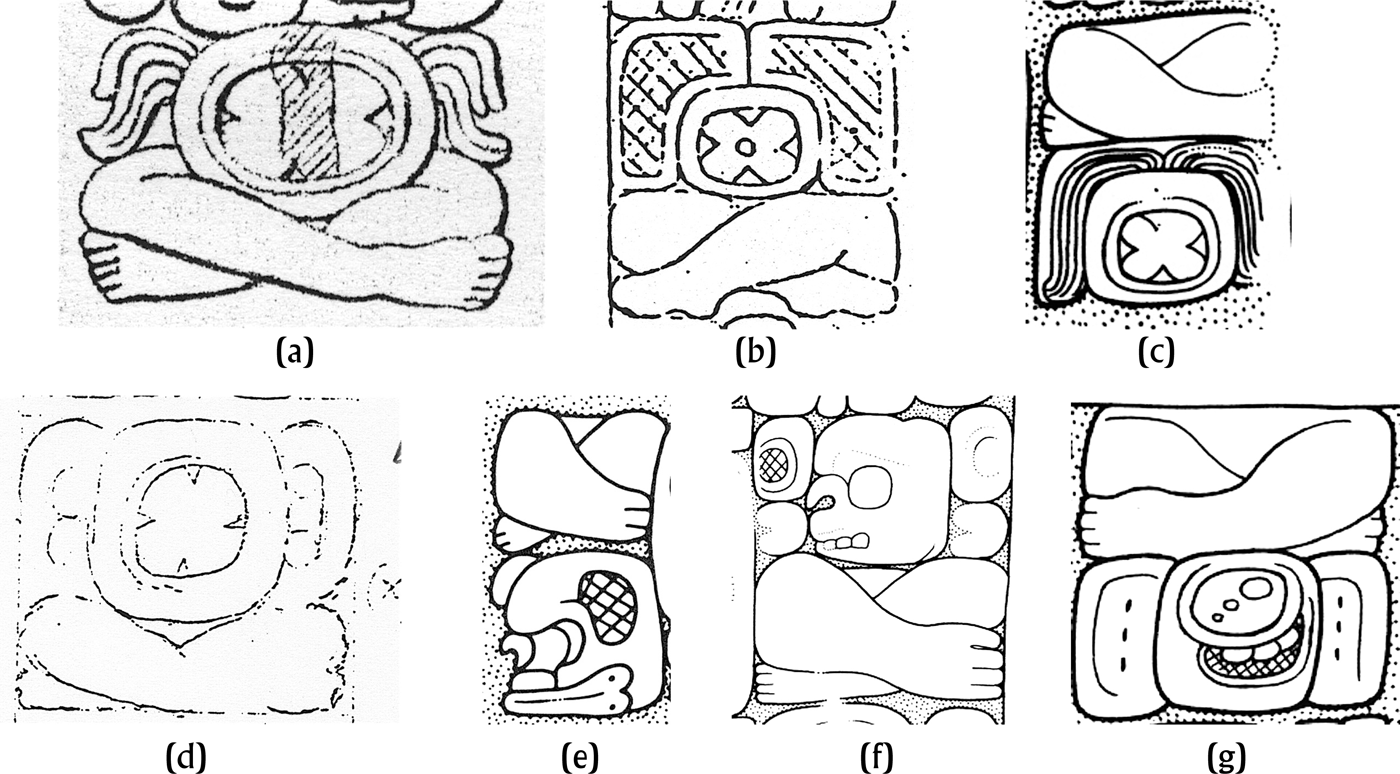
The glyph's iconographic traits are the sun or moon sign (occasionally others) between two fields, usually but not always one light and one dark, which are found almost exclusively in the Maya codices. Selected examples from the three Maya codices are presented in Figures 1a–1n.
Selected “eclipse glyphs” from the Maya codices (all images are reproductions from sources cited): (a) Dresden Codex (SLUB), p. 55; (b) Dresden Codex (SLUB), p. 57; (c) Dresden Codex (SLUB), p. 44; (d, e) Dresden Codex (SLUB), p. 78; (f) Dresden Codex (SLUB), p. 70; (g) Paris Codex (Graz), p. 22; (h) Paris Codex (Graz), p. 23; (i, j) Paris Codex (Graz), p. 4; (k) Paris Codex (Graz), p. 10; (l) Madrid Codex (Nojib'sa), p. 66b; (m) Madrid Codex (Nojib'sa), p. 16b; and (n) Madrid Codex (Nojib'sa), p. 17b.

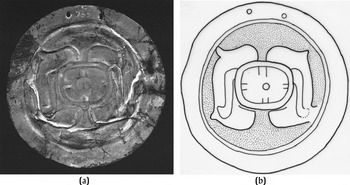
At least one example of this icon comes from a gold disk dredged from the Cenote of Sacrifice at Chichen Itza (Figure 2), almost certainly of Postclassic origin (Coggins and Shane Reference Coggins and Shane1984:118–119). A perusal of catalogues by Thompson (Reference Thompson1962), Montgomery (Reference Montgomery2002), and Macri and Looper (Reference Macri and Looper2003) confirms its absence from Classic-period monumental inscriptions.
Gold disk dredged from the Cenote of Sacrifice at Chichen Itza (8.1 cm diameter): (a) photograph from Coggins and Shane Reference Coggins and Shane1984:Plate 135; (b) drawing by the author after (a).

BACKGROUND
Perhaps the earliest published classification of these signs as eclipse glyphs is in Astronomical Notes on the Maya Codices, where Willson (Reference Willson1924:33) illustrates them and states that “the … symbol has been connected with eclipses.” Willson is followed by Gates (Reference Gates1931:167), who illustrates the glyphs in his dictionary of Maya glyphs, glossing them as “eclipse,” although Teeple (Reference Teeple1931:115), around the same time, did not view them so; and then Makemson (Reference Makemson1943:191) asserts that the “obvious interpretation” of these symbols is eclipses, “which they clearly suggest.”
All of the above are seen in light of the eclipse pages or lunar pages of the Dresden Codex (pp. 51–58), a section of the codex known since Meinhausen (Reference Meinhausen1913) to deal with lunar and/or solar eclipses. The glyph's appearances in divinatory almanacs in texts and images scattered throughout the Maya codices, apart from the eclipse or lunar pages of the Dresden Codex, however, suggests to others that the interpretation may, in fact, not be eclipses, and so we find Thompson (Reference Thompson1971[1950]:272, for example) reading them as darkened sun and darkened moon, not necessarily eclipses, and Kelley (Reference Kelley1976:43) suggesting that the glyph for eclipse has yet to be found.
Since the 1980s, however, there has been almost universal acceptance of T326 as the “eclipse glyph,” at least in published sources. Justeson (Reference John S. and Campbell1984:xi, 315, 336) lists the following scholars, speakers at the famed Albany Conference of 1979, as having personally reported to him that they interpreted Thompson's glyph T326 as a logogram for “eclipse”: Jim Fox, John Justeson, Floyd Lounsbury, Peter Mathews, Berthold Riese, and Linda Schele (see also Macri and Vail Reference Macri and Vail2009:174). This is followed by Bricker (Reference Bricker1986:151–152, 211), Bricker and Bricker (Reference Bricker, Bricker and Aveni1992:45, 73), and Schele and Grube (Reference Schele and Grube1997:170).
One of the few voices to register dissent has been my own, beginning with The Paris Codex: Handbook for a Maya Priest (Love Reference Love1994:91–93), in which I expressed my reservations regarding the eclipse interpretation of the said glyph, especially when paired in divinatory almanacs and when positioned at 28-day intervals in the Paris Codex constellation pages. Tedlock (Reference Tedlock1999:46) agrees that, in regard to the Paris Codex constellation pages, the glyph could signify the “sun suspended between light and darkness,” as at sunset and sunrise. Bricker and Bricker (Reference Bricker and Bricker2011:377), however, have more recently stated “the evidence against Love's position is now overwhelming,” which brings us to the present article, allowing me to expand and elaborate my views.
SANTA ELENA POCO UINIC: PERHAPS THE TRUE ECLIPSE GLYPH
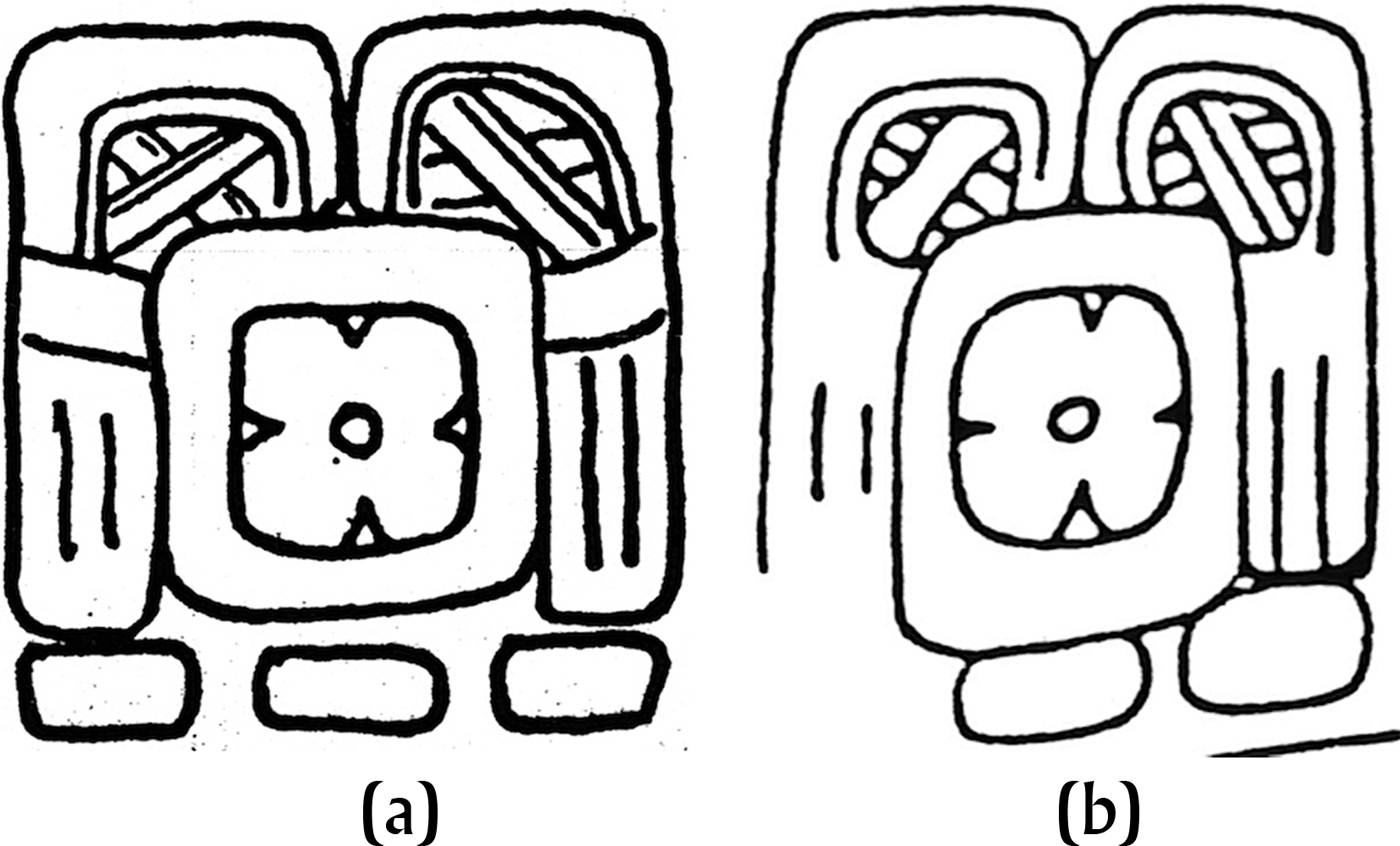
There is a glyph from the Classic period that bears a resemblance to the “eclipse glyph” that some researchers (e.g., Bricker and Bricker Reference Bricker and Bricker2011:364, Figure 9.24j; Martin and Skidmore Reference Martin and Skidmore2012:6; Prager Reference Prager2006:Figure 6) have thought to be a precursor or earlier form; that glyph is on Stela 3 at Santa Elena Poco Uinic, Chiapas. Early in the twentieth century, Teeple discovered (or it was brought to his attention) a glyph associated with a date in the Maya Long Count that coincided (within a day or two) with a total solar eclipse that had been visible from that location.
That glyph, shown in Figures 3a and 3b, has certain similarities to the Postclassic “eclipse glyph” but, in fact, is distinct. Teeple himself, as mentioned, did not correlate the two forms in his landmark study Maya Astronomy, which includes a chapter on eclipses in the Dresden Codex. He did not see the “eclipse glyphs” that appear so frequently in the Dresden Codex Lunar/Eclipse Table (pp. 51–58) as glyphs for eclipses, and he regarded the Poco Uinic glyph as unique, “the only glyph that I have found which tempts me to regard it as an eclipse glyph” (Teeple Reference Teeple1931:115).
Eclipse glyph from Santa Elena Poco Uinic, Chiapas. (a) Drawing by unknown after Teeple Reference Teeple1931:115, Figure 19. (b) Drawing by Peter Mathews after Prager Reference Prager2006:Figure 1.

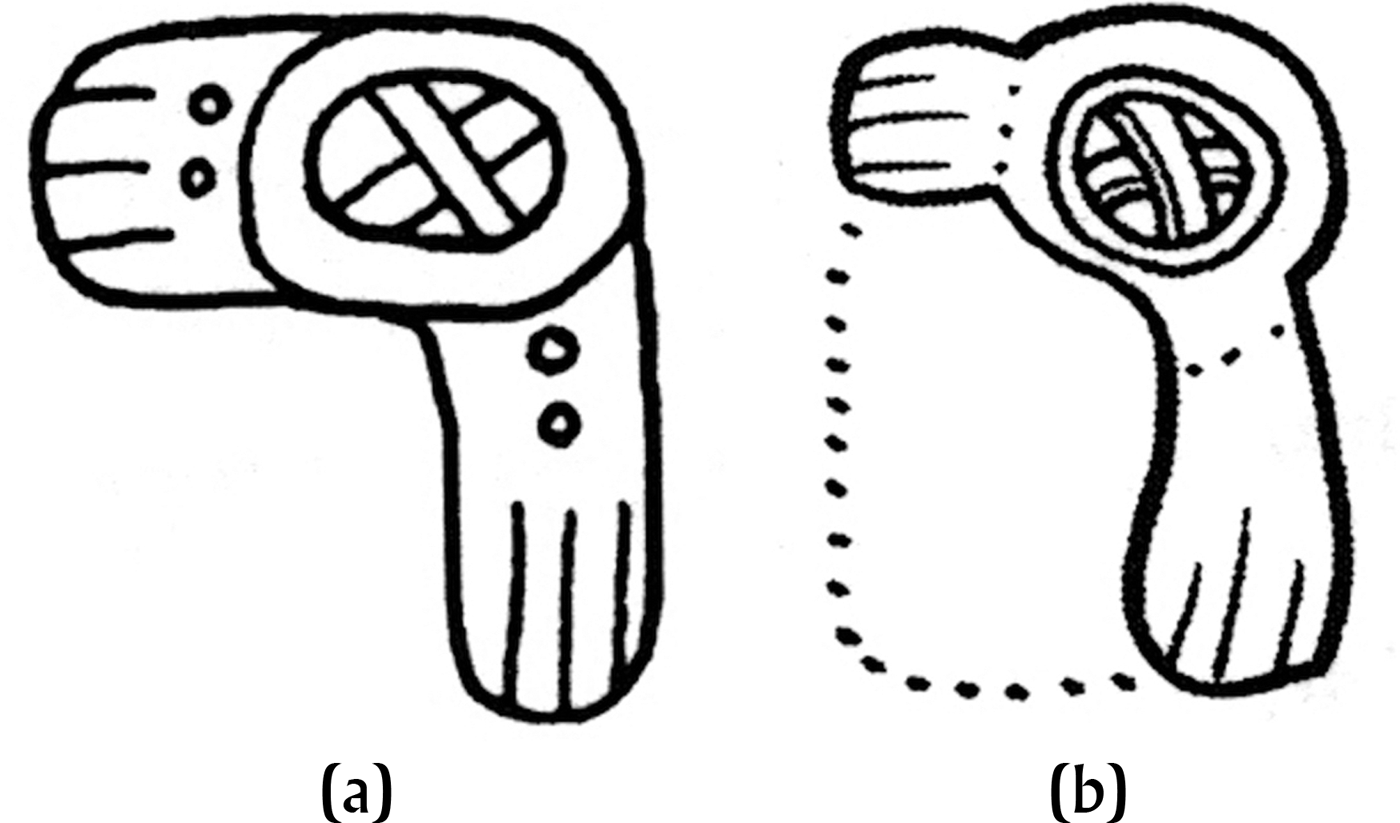
I agree that the Santa Elena Poco Uinic glyph probably marks a solar eclipse, but I also agree with Teeple that it is unique. I do not think it is an earlier version of the codex “eclipse glyphs,” for it lacks the hallmark dark and light fields on opposing sides and it contains inset crossbands and a tripartite pedestal that the codex “eclipse glyphs” never have (cf. Figure 1). Instead of being a precursor to the later “eclipse glyphs,” I follow Teeple's (Reference Teeple1931:115) suggestion that its closest similarity lies with the glyph we now know as the K‘ABA’ logogram of Classic inscriptions (Figures 4a and 4b).
Logogram K‘ABA’: (a) Montgomery Reference Montgomery2002:142; (b) Kettunen and Helmke Reference Kettunen and Helmke2010:87.

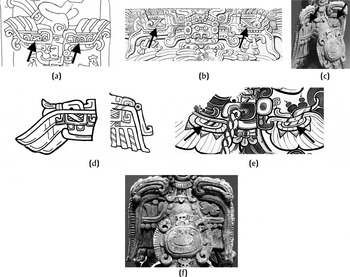
Iconographically, the Poco Uinic eclipse glyph (used without quotation marks in this case because it probably is an eclipse glyph) resembles the wings of the Principal Bird Deity, which often have crossbands (or k'in and ak'bal signs) at the crooks of the wings (Figures 5a–5e). In fact, a close up rear view of the famous blow-gunner vase (K3105e), with a sun-shield flanked by two wings (Figure 5f), bears a startling resemblance to the Poco Uinic glyph.
Crossbands and other symbols in wings of Principal Bird Deity: (a) Izapa Stela 2 (Smith Reference Smith1984:Figure 55a); (b) Tikal wooden lintel Temple C (Maudslay Reference Maudslay, Godman and Salvin1974 [1889–1902]:vol. 3, Plate 78); (c) “blow-gunner pot,” Kerr No. K3105b (Kerr Reference Kerr2013); (d) wing examples from Izapa, left, Stela 4, right, Stela 60 (Guernsey Reference Guernsey2006:Figure 5.19); (e) San Bartolo West Wall Left (Taube et al. Reference Taube, Saturno, Stuart and Hurst2010); (f) rear view of the “blow-gunner pot,” Kerr No. K3105e (Kerr Reference Kerr2013), showing back shield and flanking wings of the Principal Bird Deity in a design reminiscent of the Poco Uinic eclipse glyph. Images from Kerr Database, © Justin Kerr.

“ECLIPSE GLYPH” ICONOGRAPHY
Whatever the iconic identification of the Poco Uinic glyph, the winglike structures with crossbands on either side of the sun sign do not appear to be counterparts to the flanking light and dark fields of the codex “eclipse glyphs.” To understand those better, a closer look at the iconography is in order.
Cloth Imagery
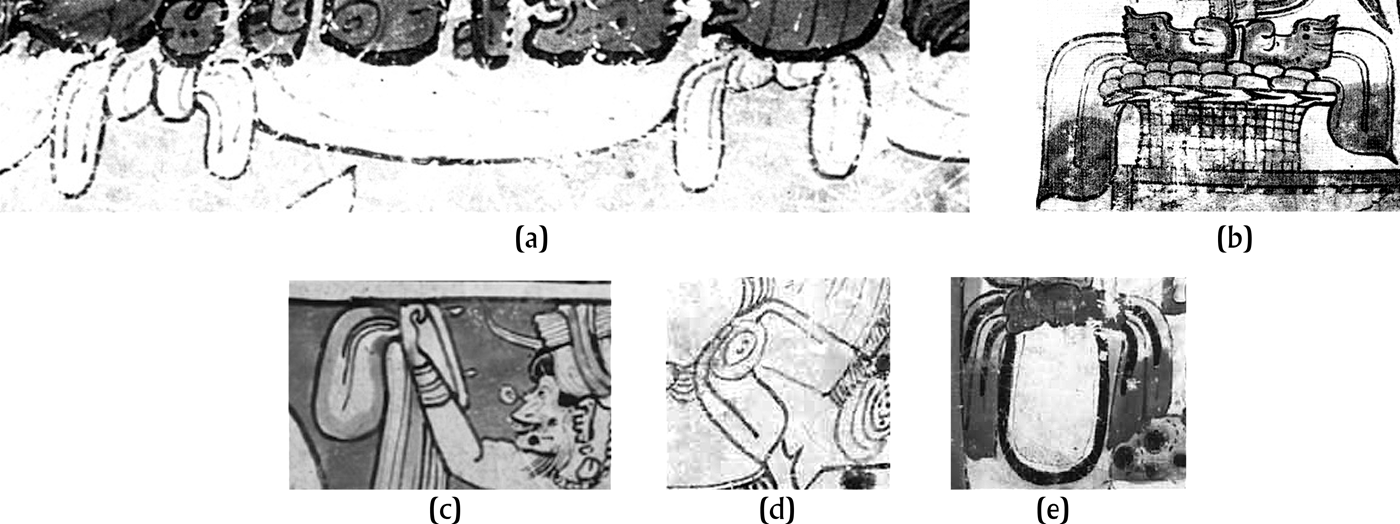
A selection of cloth imagery from Maya vases reveals striking similarities to “eclipse glyphs” (Figures 6a–6e, cf. Figure 1). A consistent element in knotted cloth images is lines, indicating folds within the drooping ends of the cloth, that find their counterpart in the “eclipse glyph,” and are, in fact, a hallmark of it.
Images of cloth on Classic Maya vases from Kerr Reference Kerr2013: Kerr Nos. (a) K5453; (b) K1392; (c) K505; (d) K3242; and (e) K1669. Images from Kerr Database, © Justin Kerr.

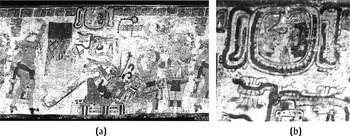
While the “eclipse glyph” does not appear in Classic-period inscriptions on monuments, something very close to it appears on at least one Classic-period painted vase (Figures 7a and 7b), the central element being an elaborate moon sign with Maize God and rabbit-in-the-moon.
Supposed lunar eclipse glyph on Kerr No. K5359 (Kerr Reference Kerr2013): (a) full roll-out; (b) detail of open-jawed serpent and lunar icon. Images from Kerr Database, © Justin Kerr.

The rabbit and Maize God enclosed and flanked on K5359 is worth looking at more closely since it is thought by some (e.g., Hull Reference Hull2000:5–6; Martin and Skidmore Reference Martin and Skidmore2012:6) to represent a lunar eclipse. We see here another example of cloth imagery, not unlike tied bundles in numerous palace scenes on pots, scenes where no eclipses are suggested (Figures 8a–8e). Even the small bumps on the cloth on K5359 (Figure 7) have their counterparts in cloth imagery on other vases, for example K1205 (Figure 8f). Example 8e is particularly relevant to our understanding of the Maize-God-and-rabbit scene because it shares a similar layout: a reclining figure, apparent disembowelment, and a wrapped object, floating as it were, above the victim.
Knotted bundles on Classic-period painted vases from Kerr Reference Kerr2013: Kerr Nos. (a) K1201; (b) K7447; (c) K4376; (d) K1366; and, (e) K3422. (f) Detail from Kerr No. K1205 cloth markings, small bump-like elements, like the ones on the so-called lunar eclipse on K5359 (such as [a]). Images from Kerr Database, © Justin Kerr.

To summarize, it appears—by comparison with other scenes on vases—that we have a bundled or wrapped moon on K5359. A bundled or wrapped moon may certainly suggest an eclipse, but considering all the cloth imagery and bundles in palace scenes without eclipse associations, can we say with any certainty that we are seeing a lunar eclipse on K5359? If the cloth imagery does not necessarily evoke eclipses, the open-jawed snake lends support to an eclipse identification for some, so we look at that in the next section.
Devouring or Emerging?
In the purported lunar eclipse on the Classic-period vase K5359 (Figure 7), does the open-jawed snake beneath the moon lend support to an eclipse interpretation? Is the writhing serpent in the center of the scene devouring the bundled moon or is the bundled moon emerging from gaping jaws? If the serpent is devouring the moon, an eclipse interpretation is supported because widespread ethnographic accounts in Mesoamerica describe lunar eclipses caused by animals devouring the moon. Some two decades ago I wrote about such a scene in the Paris Codex (Love Reference Love1994:83–84) and described the serpents as “menacing,” “threatening or attacking”, but a review of this gaping-jaw motif castes doubt on “devouring,” and instead supports “emerging.”
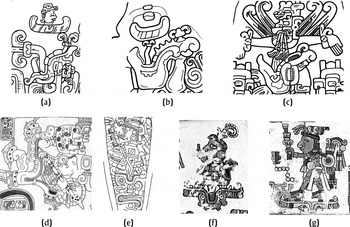
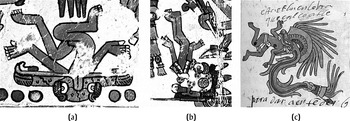
This motif can be traced throughout Mesoamerica spanning some two millennia: on Late Formative stelae from Izapa, we find at least three cases—an open-jawed serpent on Stela 3, and open-jawed toads on Stelae 6 and 11—in which a celestial icon, be it object or deity, is interpreted as emerging rather than being devoured (Figures 9a–9c; Guernsey Reference Guernsey2006:124–127); at Classic Maya Yaxchilan the ancestor emerges from the serpent's mouth on famous Lintel 25 (Figure 9d); from the Huasteca in northeast Mesoamerica, the scene is repeated on carved shell ornaments (Figure 9e); and in codices from Postclassic central Mexico (Figures 9f and 9g). When the theme is devouring rather than emerging, the being that is devoured, at least in Mexican codices, goes in head first (Figure 10).
Gaping-jaws motif: (a) Izapa Stela 3; (b) Izapa Stela 6; (c) Izapa Stela 11 (Guernsey Reference Guernsey and Reilly2006:Figures 6.8–6.9, 6.11). Drawings by Alex Moreno, courtesy of the New World Archaeological Foundation. (d) Yaxchilan Lintel 25 (Graham Reference Graham and von Euw1977:56). Drawing by Ian Graham. (e) Huastec shell ornament. Drawing by the author, after Urcid Reference Urcid, Fields, Pohl and Lyall2012:Figure 5. (f) Maize goddess emerging from the earth, Codex Vindobonensis, p. 49 (Anders et al. Reference Anders, Jansen and Jiménez1992a:89). (g) Seven Movement emerging from the earth, Codex Zouche-Nuttal, p. 12 (Anders et al. Reference Anders, Jansen and Jiménez1992b:109).

Devouring motifs: (a–b) Borgia Codex, p. 60 (Anders et al. Reference Anders, Jansen and García1993a:321–322); (c) Codex Telleriano-Remensis, f. 18r (Keber Reference Keber1995:39).

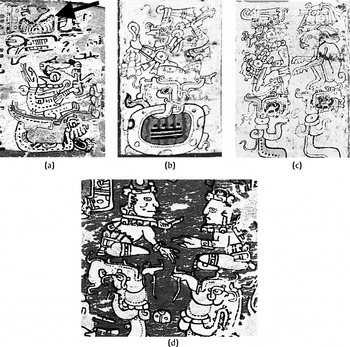
In Maya codices there are many examples of beings poised above or emerging from open-jawed serpents, none of which necessarily indicate devouring; in fact, in the Madrid Codex (Figure 11a) we have the glyphs U LOK’/LUK’ “he emerges” describing the action, a scene repeated in the Dresden Codex (Figure 11b). In the Dresden Codex serpent number pages (Figure 11c), the beings are seen as kneeling and sitting “on the open jaws” (Thompson Reference Thompson1972:80) and “perched in the jaws” (Bricker and Bricker Reference Bricker and Bricker2011:492), and in the Paris Codex (Figure 11d), they seem to hover above the gaping snake jaws.
(a) Madrid Codex (Nojib'sa), p. 19a, first glyph in the text, upper left corner, is LOK’ Cholan, LUK’ Yucatec (Schele and Grube Reference Schele and Grube1997:195, Macri and Vail Reference Macri and Vail2009:40); (b) Dresden Codex (SLUB), p. 61; (c) Dresden Codex (FAMSI), p. 62; (d) Paris Codex (Graz), p. 22.

As with all discussions of Mesoamerican symbolism, there are rarely clear-cut dichotomies and, therefore, the heading of this section perhaps sets up a false opposition. In de la Garza's (Reference de la Garza1984:301–307) classic work on the sacred universe of the serpent among the Maya, she calls attention to the boa that devours and then expels the shamanic initiate in sacred rites, thus showing complementarity of the two acts.
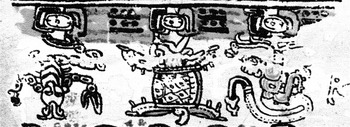
The purpose of this brief discourse on emerging vs. devouring is that “devouring” has been used by many to fortify the “eclipse” interpretation of the “eclipse glyph” (Bricker and Bricker Reference Bricker and Bricker2011:365–366; Closs Reference Closs and Aveni1989; Miller and Taube Reference Miller and Taube1993:84). Showing that the “eclipse glyph” is not necessarily being devoured weakens support for the “eclipse” interpretation. Prominent examples of the gaping jaw motif span the constellation pages of the Paris Codex (Figure 12) where animals pose below “eclipse glyphs.” Are they attacking? Devouring? Considering the comparisons just presented, the answer might be no.
Three constellations with “eclipse glyphs” in the Paris Codex (Graz), p. 24: left to right, Scorpion, Turtle, Rattlesnake.

Mexican Codices
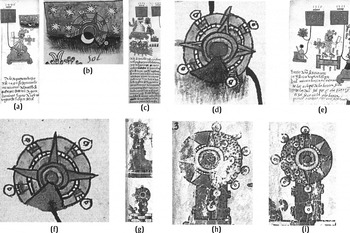
Having traveled far from the Maya heartland in a pan-Mesoamerican look at the open-jawed serpent motif, we might do well to look for eclipses and half-darkened suns in the Mexican codices as well, as in the Codex Telleriano-Remensis (Figures 13a–13f), where we find historical solar eclipses of a.d. 1496, 1507, and 1510 depicted realistically as the moon moving in front of the sun. Artist-scribes painted them in a fashion altogether distinct from the half-darkened sun that appears in other Mexican codices dealing with other cosmological themes.
Historical eclipses in Codex Telleriano-Remensis: (a–b) eclipse of 1496 with detail (Keber Reference Keber1995:84); (c–d) eclipse of 1507 with detail (Keber Reference Keber1995:87); (e–f) eclipse of 1510 with detail (Keber Reference Keber1995:91); (g–i) Vindobonensis, p. 23: half-darkened sun over hill, over plain, and details (Anders et al. Reference Anders, Jansen and Jiménez1992a:274–275).

Whereas solar eclipses were singular events that fall within the pages of Codex Telleriano-Remensis dealing with history, pages dealing with mythology—including the first sun—in the Codex Vindobonensis (Figures 13g–13i) display half-darkened sun images interpreted variously as “day and night” (Caso Reference Caso1996[1977]:Lamina XXII) and “sunrise” (Anders et al. Reference Anders, Jansen and Jiménez1992a:148).
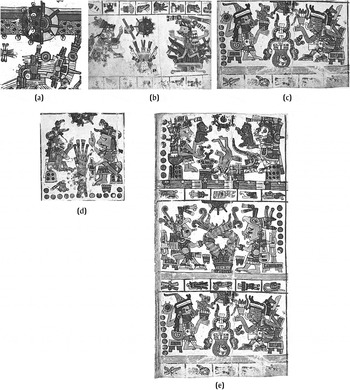
Half-darkened suns appear often in the Borgia Codex but one example is most analogous to the Chahk almanacs in the Maya codices, the scene with Tlaloc poised with upturned head beneath a darkened sun (Figure 14a). In other examples in the Borgia Codex, there are no apparent rain associations, but a half-darkened sun appears among complexities of symbols that are interpreted by Anders et al. (Reference Anders, Jansen and García1993) as dire omens: for example, in the “Lords of the Trecenas” chapter (Figure 14b; using chapter headings of Anders et al.Reference Anders, Jansen and García1993a:68, 73–74; translations by the author) “[t]he sun is darkened or eclipsed: doubt, insecurity, clouded judgment, danger, weakness” (Anders et al. Reference Anders, Jansen and García1993a:333). In the “Six Couples” chapter of the Borgia Codex (Figure 14c; Anders et al. Reference Anders, Jansen and García1993a:57) is a “half sun,” indicated “eclipse: insecurity” (Anders et al. Reference Anders, Jansen and García1993a:306). In the “Prognostications for Marriage” chapter in the Borgia Codex (Figure 14d; Anders et al. Reference Anders, Jansen and García1993a:59), “the sun is darkened or eclipsed: doubt, insecurity, danger” (Anders et al. Reference Anders, Jansen and García1993a:321). Nowotny (Reference Nowotny, Everett and Sisson2005:126–127), it might be mentioned, makes no such interpretations, using instead the descriptive, neutral, and non-interpretive term “half-sun.”
Half-darkened suns in the Borgia Codex: (a) p. 27, one of the manifestations of Tlaloc peering upward at the darkened sun; (b) p. 68, one of the “Lords of the Trecena” pages; (c) p. 57, one image from the “Six Couples” chapter; (d) one of the images in the “Prognostication for Marriage” chapter; (e) three of the six scenes from the “Six Couples” chapter, showing (from top to bottom) moon, sun, and half-darkened sun. All examples from Anders et al. Reference Anders, Jansen and García1993a.

Returning to the “Six Couples” chapter in the Borgia Codex (Anders et al. Reference Anders, Jansen and García1993a:57), there appear celestial phenomena in all six of the matrimonial scenes, of which I have selected three to make a point: from top to bottom we see moon, sun, and half-darkened sun (Figure 14e). John Pohl (personal communication 2012) suggests that he and others may be thinking about these symbols as indicating times of day when certain ceremonies should be performed, in other words “night,” “day,” and “twilight”; a suggestion, as pointed out by Pohl, finding support in the Florentine Codex (Sahagún Reference de Sahagún, Anderson and Dibble.1950–1982:bk. 7, p. 1) in a description of ceremonies “… done four times during the day—when it was dawn; and at noon; and past midday, when already [the sun] hung [low]; and when he entered [his house]—when he set.” Like Tedlock's (Reference Tedlock1999:46) and my (Love Reference Love1994:91–93) aforementioned suggestion that the sun between light and dark fields in the Paris Codex constellation pages might represent the sun at horizon, so too, here in the Borgia Codex, a half-darkened sun could well mean sun at horizon or twilight.
ECLIPSE TABLES AND TEXTS AT XULTUN, PETÉN?
Returning to the Maya heartland, a look at recent discoveries at Xultun, Guatemala is in order, where references to eclipses have been suggested by some (Aveni et al. Reference Aveni, Saturno and Stuart2013; Bricker et al. Reference Bricker, Aveni and Bricker2014; Rossi Reference Rossi2015; Saturno et al. Reference Saturno, Aveni, Stuart and Rossi2012; Zender and Skidmore Reference Zender and Skidmore2012). The tabulation of lunar months or lunations in what is now labeled Text 50 is a sequence of lunar trimesters (177 or 178 days) that is truly revelatory, being a direct Classic-period antecedent to later Postclassic codices, in particular the surviving Dresden Codex, but it does not have the interspersed periods of 148 days that are the hallmark of the Dresden Codex Lunar/Eclipse Table.
One can conclude that the Xultun table is a table of lunations (Zender and Skidmore Reference Zender and Skidmore2012:6–13, for example), but since the lunations are not grouped or bunched into eclipse cycles as they are in the Dresden Codex, the Xultun table is not an eclipse table (Aveni et al. Reference Aveni, Saturno and Stuart2013:3–4; Bricker et al. Reference Bricker, Aveni and Bricker2014). The Xultun lunar table does, however, correspond elegantly with lunar passages in Classic-period monumental inscriptions that record counts of new moons and elapsed times since nearest previous new moons (as pointed out by Bricker et al. Reference Bricker, Aveni and Bricker2014 and Aveni et al. Reference Aveni, Saturno and Stuart2013).
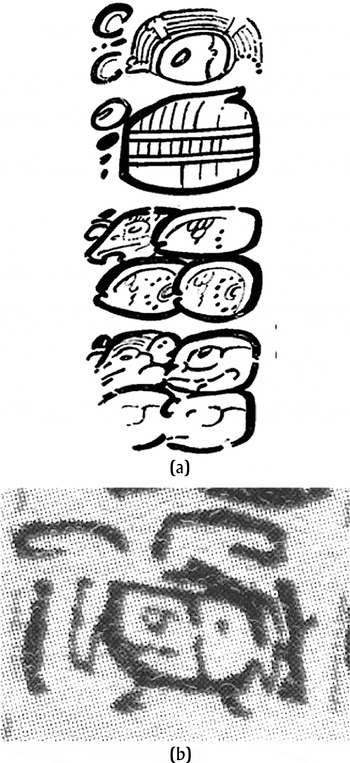
The ring number at Xultun, being an almost exact multiple of “eclipse half-years” (what Rossi [Reference Rossi2015] and I call “eclipse trimesters”), suggests to some that the calendar specialists at Xultun might have been concerned with eclipses (Bricker et al. Reference Bricker, Aveni and Bricker2014:162–165), but the hieroglyphic text does not reference eclipses in my opinion. The glyph compound that starts off the short text (Figure 15a) is neither equivalent to, nor a Classic-period antecedent for, the “eclipse glyph” that appears in Postclassic codices, whose hallmark is the flanking fields.
Comparing a proposed eclipse glyph from Xultun (the upper glyph in the column) to an “eclipse glyph” in the Paris Codex; both share the skeletal moon sign as the central element. (a) Text 47, Area B, Xultun (Rossi Reference Rossi2015:Figure 1.22). Drawing by David Stuart. (b) Paris Codex (Graz), p. 5.

The center element is indeed the death-head glyph for moon, probably read uh, the same moon glyph that appears in the Paris Codex between light and dark fields, but the graphemes surrounding the death head are not equivalent; and, if they were equivalent, it would still not suggest eclipses because the example in the Paris Codex—or so goes the principal thesis of this article—does not refer to eclipses.
The glyph compound at Xultun (Figure 15a, top glyph) consists of three graphemes that can be transcribed ya-?-UH, with the ya indicating possession (the codex “eclipse glyphs” never have prefixes or suffixes). The undeciphered arching element over the UH appears to have bones in it and I suspect the meaning of the glyph compound is something like “death of the moon,” a common phrase for new moon or disappearance of the moon at conjunction (thus the death-head glyph for moon). The Lunar/Eclipse Table in the Dresden Codex are about new moons (death of the moon) and associated weather, with a secondary or auxiliary function of predicting eclipses. This is my current position and the subject of a separate article, in preparation.
IMPOSSIBLE ECLIPSES
The constellation pages of the Paris Codex (Figure 16) show a series of animal constellations, originally 13, tied to an 1820-day table with stations separated by 28 days marking the intervals between successive appearances in the sky of the constellations. In the model that I (Love Reference Love1994:82–102) have proposed, if the constellation Rattlesnake appears on the eastern horizon at sunset on a certain day, then 28 days later the Turtle appears on the horizon, and 28 days later the Scorpion appears, and so on through the 13 constellations, returning to approximately the same location 364 days later.
The Constellation Pages of the Paris Codex, pp. 23–24 (Paris Codex [Graz]; see Love Reference Love1994).

In no way can successive solar eclipses occur 28 days apart, or 13 times in one year, nor has anyone else, to my knowledge, ever explained how the “eclipse glyphs” in the Paris Codex constellation pages could refer to eclipses. Bricker and Bricker (Reference Bricker and Bricker2011:694), for example, mention the “series of solar eclipse glyphs” suspended from the sky bands on these pages, but do not explain their function; if the “eclipse glyph” refers to sun-at-horizon or half-darkened sun, however, its linkage to constellations on the horizon at nightfall makes perfect sense.
Probably the strongest argument against the “eclipse glyph” referring to eclipses is in the codex almanacs, which have as their heart and soul the 260-day tzolk'in, the divinatory sacred round without beginning or end, an ever-repeating cycle of days and nights, each with its portent and omen. A good example is Almanac 61 in the Dresden Codex (using Thompson's [Reference Thompson1972] nomenclature), a double almanac of 520 days (Figure 17).
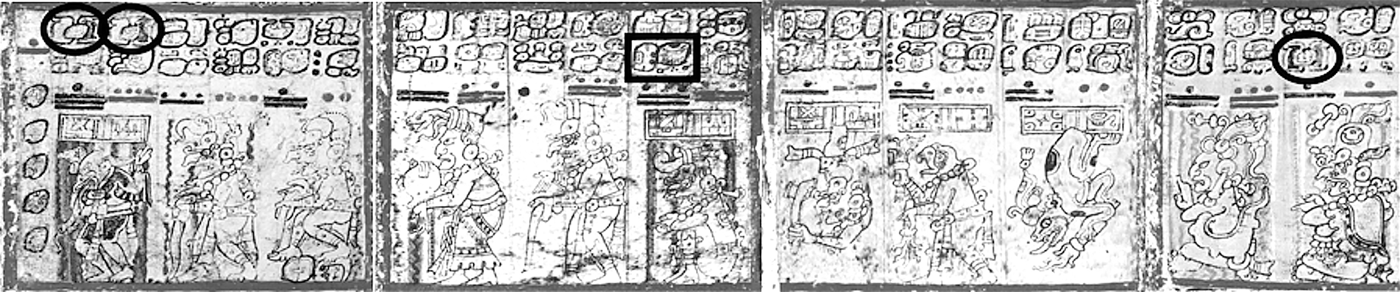
Almanac 61 of the Dresden Codex (FAMSI), pp. 38b–41b: “eclipse glyphs,” circled, associated with pouring rain, occurring at repeating 104-day intervals, impossible eclipse intervals. Graphemes in rectangle are CHAK-HA’-la chak ha'al, “great rain.”

Counting from 6 Kawak at the top of the day-sign column on the left, the reader counts forward 16 days (indicated by the black number 16) to arrive at 9 Lamat in the first t'ol, indicated by the red number 9 (the day-sign Lamat is unexpressed). Here rain pours from a sky band onto a black-clad vulture, and the first two glyphs in the text are the “eclipse glyphs,” one with a sun, one with a moon. Should the reader interpret these signs as eclipses? Since a solar and a lunar eclipse can in fact occur 15 days apart, it is possible to argue that two eclipses could occur during the 16-day stretch of time covered in the first t'ol, from the opening 6 Kawak to the closing 9 Lamat. Counting 88 days forward, however, one arrives at the final t'ol where the “eclipse glyph” once again appears, in this case with a sun sign, at an interval (88 days since the previous “eclipse glyph”) that cannot possibly refer to another solar eclipse. This day is 6 Ak'bal, which brings the reader back to the beginning day-sign column, second position down from the top, 104 days after the initial 6 Kawak, and just 16 days before another encounter with the paired “eclipse glyphs” in the first t'ol.
Each of the five runs across the almanac (eleven t'ols) is 104 days, making a total of 520, the aforementioned double tzolk'in. Like the “eclipse glyphs” at 28-day intervals in the Paris Codex constellation pages, there is simply no way that solar eclipses, much less pairs of eclipses, can occur at 104-day intervals. In fact, the same can be said for all appearances of “eclipse glyphs” in Maya codex almanacs: they cannot refer to eclipses because the cyclical mathematics of the 260-day round and its multiples match no eclipse intervals in real world astronomy, a point, incidentally, made by Thompson (Reference Thompson1971[1950]:272) more than 60 years ago. If the “eclipse glyphs” are not referring to eclipses, to what are they referring? The answer has already been suggested: rain.
“ECLIPSE GLYPHS” AND RAIN
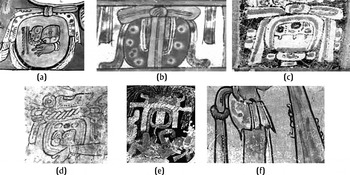
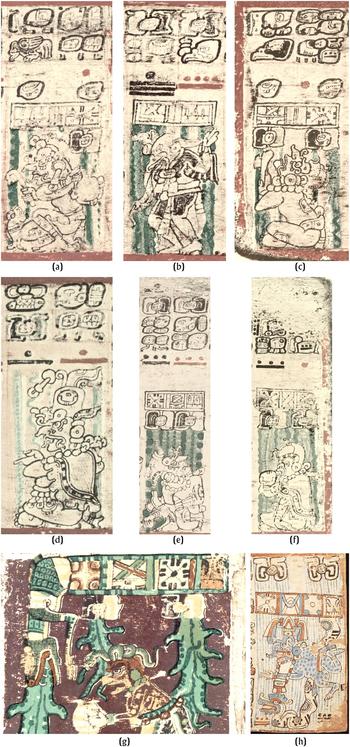
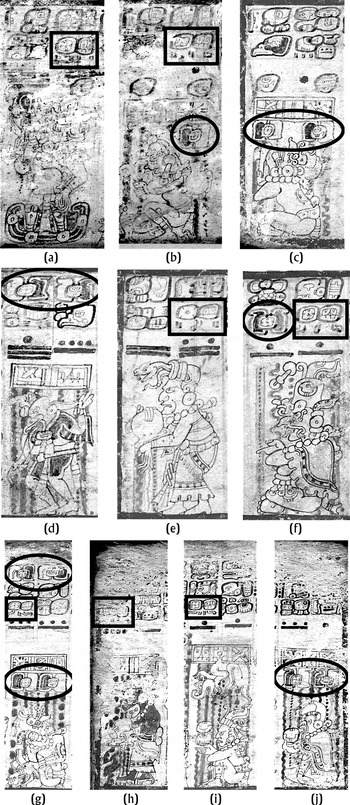
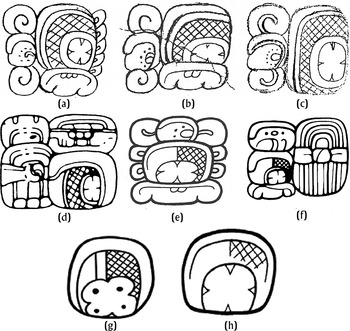
A survey of “eclipse glyphs” in the Dresden Codex finds some 37 examples, of which fully half are clearly and explicitly associated with rain, and for the other half the relationship to rain is at least implicit. The first half occur in the almanacs like the one just discussed, many of which are shown here (Figures 18a–18f), while the others occur in the Dresden Codex lunar/eclipse pages, which are discussed next. For now, a simple display of Dresden Codex almanac t'ols with eclipse glyphs and blue-green torrential rain leaves little doubt as to the association of the signs. In the Madrid Codex there are 10 examples of “eclipse glyphs,” of which eight (80 percent) occur with rain and Chahks (Figure 18h, for example).
“Eclipse glyphs” and rain in the Dresden Codex (FAMSI) and the Madrid Codex [Nojib'sa]. (a) Dresden Codex, p. 37c; (b) Dresden Codex, p. 38b; (c) Dresden Codex, p. 39c; (d) Dresden Codex, p. 41b; (e) Dresden Codex, p. 66a; (f) Dresden Codex, p. 68a; (g) Dresden Codex, p. 74; (h) Madrid Codex, p. 12.

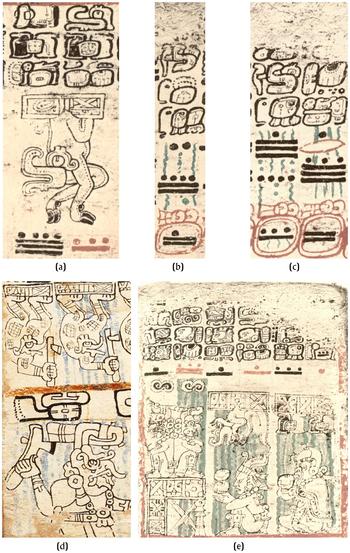
Another example of “eclipse glyphs” in a Dresden Codex almanac occurs in the so-called Mars Table (Figure 19a); I use the modifier “so-called” because I do not believe this almanac refers to the planet Mars. I have argued elsewhere that, apart from the fact that a triple tzolk'in of 780 days matches the synodic revolution of Mars, there is no other compelling evidence that links this almanac to the red planet (Love Reference Love1995; cf. Bricker and Bricker Reference Bricker, Bricker and Andrews1986, Reference Bricker and Bricker1997, Reference Bricker and Bricker2011:367–488). The curl-snouted, deer-hoofed creature is not a Mars beast (in my opinion), but rather a rain-thunder-lighting beast closely aligned with Chahks or Maya Rain Gods. He appears twice in a Dresden Codex almanac (pp. 71–75) with rain iconography (Figures 19b and 19c), rain iconography that is spelled out in the neighboring t'ol on page 72 as CHAC-HA’-la, chac ha'al, “great rain,” a glyph compound we have already seen in Almanac 61 (Figure 17 marked by rectangle), and he appears also in the Madrid Codex (Figure 19d) in torrential rain. Thus, the “eclipse glyphs” that appear in the third t'ol of Almanac 63, the so-called Mars table, relate to rain not eclipses. If they marked actual eclipses, those eclipses would occur at 78-day intervals, another astronomical impossibility.
(a) Deer-hoofed curl-snouted beast and “eclipse glyphs” in Almanac 63 of the Dresden Codex [FAMSI], the so-called Mars Table, third t'ol, pp. 44–45). (b) Axed curl-snouted beast with blue-green falling rain (Dresden Codex [FAMSI], p. 71). (c) Axed curl-snouted beast with rain, next to CHAK HA'-la chak ha'al “great rain” (Dresden Codex [FAMSI], p. 72). (d) Curl-snouted beast with axe and Chahk in torrential rain (Madrid Codex [Nojib'sa], p. 2). (e) Chahks, deer-hoofed curl-snouted beast, and “eclipse glyphs,” (as well as Maize God and God C) in torrential rain, t'ols 10, 11, and 12 in Almanac 69 of the Dresden Codex [FAMSI], p. 68.

Elsewhere in the Dresden Codex (Figure 19e), in another Chahk almanac, we see the same cluster of imagery—Chahk, the curl-snouted beast, “eclipse glyphs,” and torrential rain—which makes the point: “eclipse glyphs,” Chahks, and torrential rain go hand-in-glove, and the curl-snouted beast has nothing to do with Mars.
DRESDEN LUNAR/ECLIPSE PAGES
Finally we come to the Dresden Codex's Lunar/Eclipse Table on pages 51–58, where the notion of “eclipse glyph” was born, first identified in writing by Meinhausen (Reference Meinhausen1913:225; translation by Annette I. Kern): “[t]wo symbols, which depict the sun and the moon between a white and a black area … which I am … compelled to interpret as symbols of solar and lunar eclipses.” This identification has prevailed in the literature now for about a century, although not without some rather prominent detractors, including Thompson (Reference Thompson1971[1950]:272) and Kelley (Reference Kelley1976:52).
Texts About Rain
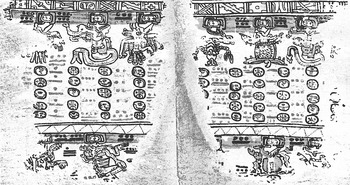
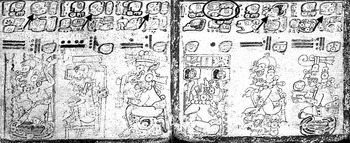
In addition to introductory materials, the Dresden Codex Lunar/Eclipse Table proper consists of 10 sections punctuated by pictures with double columns of glyphs over them. There is little doubt that the table in question deals with eclipses, based on the mathematical intervals of the groups of lunations that coincide with eclipse intervals, but my position is that the eclipse function is secondary. The main purpose of the table is to track new moons—also known as deaths of the moon—and their auguries, particularly in respect to rain, as revealed by a close look at one set of texts.
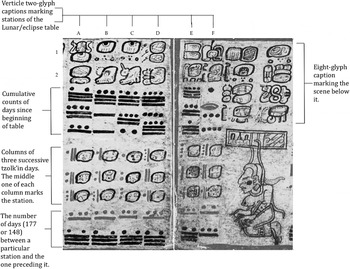
One of ten sections of the Dresden Codex Lunar/Eclipse Table with explanatory captions. Shown are portions of pages 52b and 53b (Dresden Codex [FAMSI]).

In Figure 20 we see the sixth section, which I have chosen to illustrate the preponderance of rain references. The intervals between stations, when read across the bottom of the page, is what clued early investigators to the eclipse function of the table, five distance numbers of 177 days (six lunations) followed by a distance number of 148 days (five lunations), the perfect formula for capturing eclipses; but the two-glyph captions above each station are about water. Reading down we have the following phrases:
A1–A2, SIYAJ-HA’ CHAN-na siyaj ha’ [ti’] chan, “born-of-rain in the sky”
B1–B2, HA’-la “sky animal” ha'al “sky animal,” “rain of sky animal”
C1–C2, HA’-la “sky animal” ha'al “sky animal,” “rain of sky animal”
D1–D2, “Rain” -?- -?- TI’-UH “rain -?- at the moon”
E1–E2, k'i(?)-k'i(?) K'UJUL-OK- ? k'ik'i[l](?) k'ujul ok ?, “blood? of holy -?-”
F1–F2, “Eclipse glyph” K’AK’-“sun” “darkened sun,” k'ak’, “sun deity,” “darkened sun fiery sun deity”
The first three pairs, columns A, B, and C, have the glyphs for water and rain—HA’ ha’; and HA’-la ha'al—coupled with references to the sky. The fourth pair begins with an undeciphered prefix that looks like rain followed below by the glyph for moon. The sixth pair begins with the “eclipse glyph,” which, considering the theme of rain and sky in the previous captions, makes much more sense as a darkened sun (as in hidden behind clouds) than a solar eclipse.
In the picture we see the death of the moon goddess, a metaphor for new moon. As Stone and Zender (Reference Stone and Zender2011:147) say: “[t]he Maya believed that when the moon disappeared at conjunction [new moon], the Moon Goddess had retreated into the water of the cave inside the earth. In this death phase, the moon is conceived as skeletal …” thus the skull variant of the glyph for moon, UH.
Pictures in the Dresden Codex Lunar/Eclipse Table
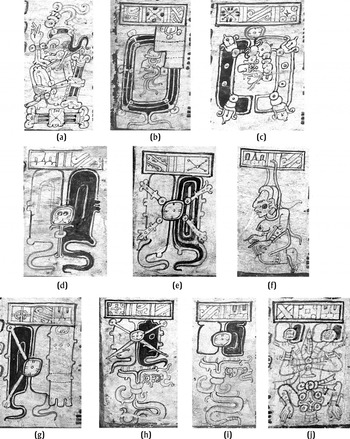
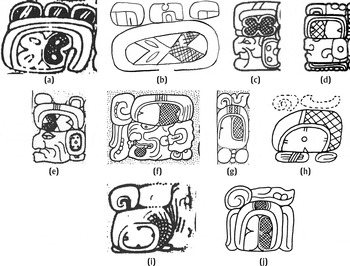
Every two-glyph column in the Dresden Codex Lunar/Eclipse Table lies either six or five lunations from the previous two-glyph column, marks a new moon, and is a potential eclipse station; and interspersed throughout the 69 stations are 10 pictures (Figure 21) that appear, in most cases, to reference solar eclipses (Bricker and Bricker Reference Bricker and Bricker2011:305–320; Thompson Reference Thompson1972:75–77). One can see at a glance that the “eclipse glyph,” or some modified form of it, has influenced the composition of these pictures and that the Sun God or the sun glyph dominates the iconography.
Ten pictures from the Dresden Codex Lunar/Eclipse Table, images probably referring to solar eclipses and their auguries: (a) p. 53a; (b) p. 55a; (c) p. 56a; (d) p. 57a; (e) p. 52b; (f) p. 53b; (g) p. 54b; (h) p. 56b; (i) p. 57b; and (j) p. 58b. All images from Dresden Codex (SLUB).

In these 10 pictures lies the strongest argument for those who see the “eclipse glyph” as a direct referent to actual eclipses, but, of course, it makes perfect sense for the Maya scribes and astronomers to use variants of a glyph that means “darkened sun” to illustrate a sun that is obscured during an eclipse event.
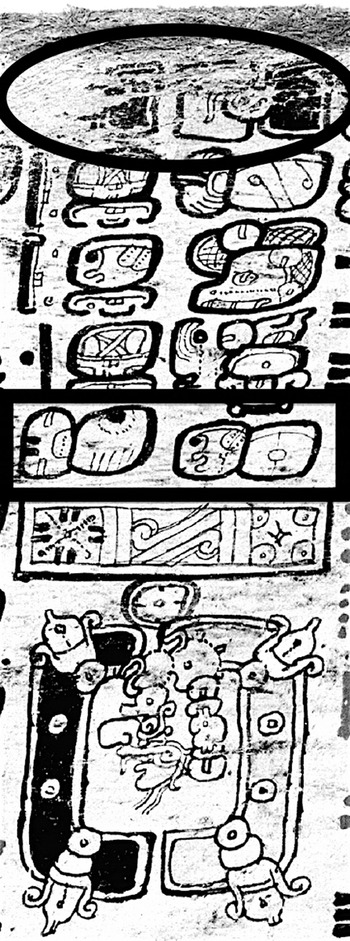
Like the two-glyph columns shown in Figure 20, when “eclipse glyphs” appear in texts that accompany the pictures in the Lunar/Eclipse Table, they are referring to rain, as on page 56 of the Dresden Codex where the 10-glyph caption over the Sun God begins with “darkened sun, darkened moon” and ends with CHAK-HA’-KAB[ba]-CH'EEN chak ha’ kab ch'een, “great rain [on] earth [and] town” (Figure 22). The fact that these glyphs so often occur in pairs with the sun and the moon (or night) between the flanking light and dark fields, of course is strong argument against an eclipse interpretation (as mentioned above) since eclipses of the sun and the moon can never occur on the same day, but “rain all day, rain all night” makes sense as a powerful augury with real-world consequences.
Ten-glyph caption over the Sun God begins with “darkened sun, darkened moon” (marked in oval) and ends with CHAK-HA’-KAB[ba]-CH'EEN (marked in rectangle) chak ha’ kab ch'een, “great rain [on] earth [and] town.”

RAIN ALL DAY, RAIN ALL NIGHT
“Rain all day, rain all night” is a common prognostication in the Dresden Codex Chahk almanacs expressed hieroglyphically with the signs K'IN k'in, “day; AK'BAL ak'bal, “night;” and HA’ ha’, “rain.” When linked to “eclipse glyphs,” they strongly reinforce the interpretation of “darkened sun” and “darkened moon.”
In Thompson's (Reference Thompson1972:103) words, all 20 t'ols in Almanac 66 deal with “activities of the Chacs [sic], principally as rain senders.” In Almanac 66 on page 36c (Figure 23a) we see K'IN, AKBAL, and HA’, perhaps read k'in[il] ha’, ak'ab[il] ha’; “day of rain, night of rain.” Then in the same almanac, on the following page 37c, we again have K'IN, AKBAL, and HA’, this time with the “eclipse glyph” attached below the sky band in pouring rain (Figure 23b). Two pages later on page 39c, the two “eclipse glyphs,” one with moon one with sun, are paired in the picture with pouring rain (Figure 23c).
“Eclipse glyphs” (in ovals) and “rain all day, rain all night” (in rectangles) from Dresden Codex Chahk almanacs: (a) p. 36c; (b) p. 37c; (c) p. 39c; (d) p. 38b; (e) p. 39b; (f) p. 41b; (g) p. 66a; (h) p. 67a; and (i–j) p. 68a. All images from Dresden Codex (SLUB).

Almanac 61 has Chahks or their counterparts in every t'ol. We find paired “eclipse glyphs,” sun and moon, in the hieroglyphic text on page 38b (Figure 23d), followed on the next page with “rain all day, rain all night” (Figure 23e), followed on the almanac's final page 41b with “eclipse glyph” and “rain all day, rain all night” side-by-side (Figure 23f).
For our third example, we look at Almanac 69: on page 66a paired “eclipse glyphs” and “rain all day, rain all night” appear together in the same text (Figure 23g), on page 67a we see “rain all day, rain all night” (Figure 23h), and on page 68a we see “rain all day, rain all night” in the second t'ol (Figure 23i) next to the paired sun and moon “eclipse glyphs” in the third t'ol (Figure 23j).
ETHNOGRAPHIC REINFORCEMENT
I mentioned earlier that the primary function of the Dresden Codex lunar/eclipse table is to register cycles of new moons and the auguries that accompany them. From ethnographic sources we know the Maya watch the moon very closely for indications of rain. Hull (Reference Hull2000:9–10) has documented multiple close associations with the moon and water among contemporary Chorti, including that the moon itself was a pila or basin of water.
In 2012 I interviewed a Maya colleague, Ana López Ramírez, a Mam speaker from San Ildefonso Ixtahuacan, Guatemala. She is a day-keeper and diviner, as well as then-president of the Mam linguistic community for Academia de Lenguas Mayas de Guatemala. I asked her about the moon.
“The moon is the closest to human beings, it relates to human activities. It is what guides men in their tasks, their work; but even more, their relationship with nature. The sun is secondary. When there is no moon, when it disappears, there are not many activities because of the lack of lunar energy. Full moon, babies are born; when there is no moon, babies are not born. Many adults die. The position of the moon is very important—moon over the mountains, moon over water. The moon is related to water. My grandmother says the moon has water. When the moon is new is when it has water.” She drew a thin C-shaped crescent in the air with her finger. “When it tips is when it has water.” When asked about eclipses, she said “My grandmother never mentioned eclipses” (Ana López Ramírez, personal communication 2012).
CLASSIC-PERIOD ANTECEDENTS
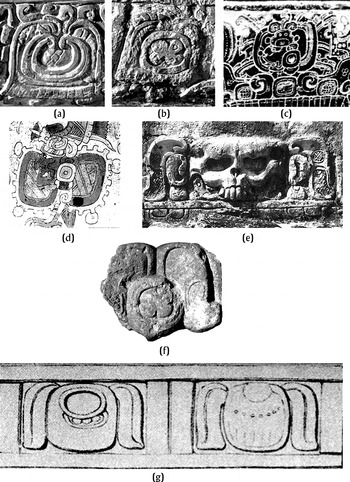
This section explores possible Classic-period antecedents; not that they are “eclipse glyphs” themselves, but their form is reminiscent of later Postclassic “eclipse glyphs” and might be investigated in search of any relationship. We have already looked at cloth iconography and tied bundles on vases, but there are four other examples on vases worth showing and two intriguing sculptural examples from opposite ends of the Maya world, Palenque and Copán (Figures 24a–24g).
Examples of Classic-period iconography reminiscent of the Postclassic “eclipse glyph” from Kerr 2013: Kerr Nos. (a–b) K5197; (c) K6547; and (d) K2027. Images from Kerr Database, © Justin Kerr. (e) Lime plaster sculpture from Temple XII, Palenque (Greene Reference Greene Robertson1991:Figure 226). (f) Carved stone sculpture from Palenque (Martin and Skidmore Reference Martin and Skidmore2012:Figure 3c). Photograph by Linda Schele. (g) Carved images in Monjas East Wing sky band (Maudslay Reference Maudslay, Godman and Salvin1974[1889–1902]:Plate 13a).

Similar Shapes
Figures 24a and 24b (from the same pot) appear to be cloaked or shrouded with a cloth that has a fringe showing across the bottom; Figure 24c seems to be a version of the solar cartouche or perhaps a solar disk in a shiny flinty early-form-of-yax cartouche; and Figure 24d appears to represent yax-like wings with crossbands (for the yax identifications in Figures 24c and 24d, see Houston et al. Reference Houston, Brittenham, Mesick, Tokovinine and Warinner2009:40–41).
Remains of lime plaster sculpture on Palenque's Temple XII show a skeletal head, (identified by Greene [1991:Figure 226] as a rabbit with flanking “ears”) each with cross-hatching, in other words dark or black areas in the “ear” elements (Figure 24e), which appears to be a frontal view of the Palenque emblem glyph variant “skull with death ears” (Macri and Looper Reference Macri and Looper2003:160). The same cross-hatching within flanking lobes appears at Copan (Figure 24f), and we have two examples of glyphs with flanking lobes, although not with cross-hatching, from the Las Monjas sky band at Chichen Itza (Figure 24g).
None of these are “eclipse glyphs,” but they are shown here because they might bear a certain resemblance at first glance. Neither do these examples appear in hieroglyphic texts and, therefore, they are not read in the sense of translating graphemes to spoken Mayan, they are iconographic and semantic in nature, and do not necessarily represent speech; but we do find glyphs with flanking elements that are graphemes in texts—therefore translatable to Mayan—and are highly relevant to this investigation.
They have as their central elements sun signs (occasionally moon signs) that can appear darkened, half-darkened, or undarkened. Specifically, we are talking about Glyph G9, Glyph X, ch'een, and yihk'in. If we examine how the central elements, usually the sun sign, can be blackened or not blackened, how the blackening can occur on the inside or the outside, and how all-black and half-black can sometimes be equivalent, it helps us understand the iconography of the Postclassic “eclipse glyphs.”
Glyph X
Glyph X Variant 4 (so named by Linden [Reference Linden1986]) of the Maya Classic-period lunar series bears a cross-legged element that remains constant across numerous examples but has alternating sun and moon glyphs with and without flanking elements. On Copan Stela E (Figure 25a), the sun sign has flanking elements, while at Cobá on Stela 20 the sun sign has black fields surrounding it (Figure 25b) bearing strong resemblance to a Postclassic “eclipse glyph” and suggesting a darkened sun.
Examples of Glyph X. (a) Copan Stela E (Maudslay Reference Maudslay, Godman and Salvin1974[1889–1902]:vol. 1, Plate 49, glyph 23). Drawing by Annie Hunter. The cross-hatched stripe is a drawing convention for marking eroded areas and does not reflect actual cross-hatching on the stone. (b) Cobá Stela 20 (Graham Reference Graham2004). (c) Piedras Negras Stela 10 (Stuart and Graham Reference Stuart and Graham2003). (d) El Peru Stela 25. Unpublished drawing by Linda Schele. (e) Yaxchilan Lintel 21 (Graham and Von Euw Reference Graham and von Euw1977). (f) Yaxchilan Lintel 29 (Graham Reference Graham1979). (g) Piedras Negras Stela 1 (Stuart and Graham Reference Stuart and Graham2003).

On Piedras Negras Stela 10 and El Peru Stela 25, the sun sign has flanking elements but they are not black (Figures 25c and 25d). A blackened moon skull on Yaxchilan Lintel 21 has its counterpart on Lintel 29 with partially blackened flanking elements and at Piedras Negras on Stela 1 it has flanking elements that are not black (Figures 25e–25g).
In sum, whether the central element is the sun sign or the moon sign, there seems to be a kind of equivalency whether it is blackened or not, and whether its flanking elements, when present, are blackened or not. The readings remain unknown but the substitution between skull moon (Figures 25e and 25f) and the lunar sign (Figure 25g) is worth noting.
Glyph G9
Early Classic versions of Glyph G9 have half-darkened sun signs with a tri-element superfix (Figures 26a and 26b). Later in the Classic period, we see variants where the sun sign is completely darkened or half darkened (Figure 26c–26g, 26j), and, most relevant to our work here, has light and dark areas outside of itself (Figures 26h and 26i).
Examples of Glyph G9 demonstrating interchangeability of darkened sun, half-darkened sun, and sun with light and dark fields outside of itself. (a) Tikal Stela 31 (Jones and Satterthwaite Reference Jones and Satterthwait1982). Drawing by William Coe. (b) Uaxactun Stela 26 A5. Drawing by the author. (c) Quirigua Stela F, A5 (Looper Reference Looper2007:77). (d) Quirigua Stela I, A4 (Looper Reference Looper2007:123). (e) Pusilha Stela O A5 (Prager et al. Reference Prager, Volta, Braswell and Braswell2014:277, Figure 10.18). Drawing by Christian Prager. (f) Naranjo Hieroglyphic Stair, Step V, J3 (Graham Reference Graham1978:2–108). (g) Copan Stela I, A2 (Fash Reference Fash2001:86 Figure 41). Drawing by Barbara Fash. (h) Comitan 1, B4 (Thompson Reference Thompson1971:Figure 34, no. 57). (i) Dos Pilas Stela 5, M1 (Houston Reference Houston1993:82). (j) Palenque Temple of the Inscriptions (Stuart and Stuart Reference Stuart and Stuart2008:171, Figure 54).

Ch'een
In the CH'EEN ch'een, “cave” glyph we find that the sun sign completely surrounded by darkness (Figures 27a–27d) is equivalent to the sun sign with light and dark fields outside of itself (Figures 27e–27h). A cave, of course, is a place of darkness.
Ch'een glyphs showing equivalency of (a–d) sun surrounded by darkness and (e–h) sun surrounded with half light, half dark. (a–c) Cancuen Panel 1, glyph blocks I5, C8, and B1, respectively (Polyukovych Reference Polyukovych2005). (d) Tikal Temple 4 Lintel 3 H4 (Jones and Satterthwaite Reference Jones and Satterthwait1982:Figure 74). (e) Yuknoom Ch'een II (Martin and Grube Reference Martin and Grube2000:108). Drawing by Simon Martin. (f) Tikal Temple I Lintel 3 (Stuart Reference Stuart2005:Figure 63). Drawing by David Stuart. (g) La Rejolla Stela 1 (Helmke Reference Helmke2009:Figure C.1.c). (h) Dos Pilas Hieroglyphic Stair 2 (Helmke Reference Helmke2009:Figure C.1.d).

The foregoing Classic-period examples of dark and light areas become relevant in the following section dealing with a phonetic reading for our “eclipse glyph.”
A PHONETIC READING FOR THE “ECLIPSE GLYPH”
I conclude this article with a search for a phonetic reading of the “eclipse glyph,” but this should not be taken as the main point of the article. The phonetic reading is not secure and should be considered a proposal. Showing that the “eclipse glyph” refers to darkened sun and moon in contexts having nothing to do with eclipses is the principal purpose of this work and the phonetic debate should not detract from that.
Nam/naam
An attempt at phonetic transcription by Prager (Reference Prager2006) suggests nam, or naam, “hide, go out of sight,” for the flanking light and dark fields, and this proposal has begun to appear in print, as in Velaquez's (Reference Velásquez García2016:77–87) commentary on the Dresden Codex (with a cautionary query suitably attached), but the evidence at hand does not support this reading, in my opinion.
Semantically, at least in the Ch'orti’ examples given by Prager, the lexeme nam does appear in words and phrases referring to the setting or disappearing sun and moon, perhaps akin to the darkened sun or moon discussed in this article, but the graphemes na-mu in the text do not substitute for the “eclipse glyph” syntactically.
Looking at the long Chahk almanac where na-mu occurs (Figure 28), Chahk or another rain deity appears in the second position of the text in all the t'ols but one, and there the rain deity is replaced by the graphemes in question, UH-li-na-mu. While these glyphs could somehow be describing the scene below where the “eclipse glyph” does appear, the “eclipse glyph” itself does not appear in the written texts and, therefore, there is no direct substitution between the graphemes na-mu and the “eclipse glyph” that would suggest a phonetic rendering of it.
Dresden Codex (SLUB), pp. 22c and 23c. Graphemes UH-li-na-mu (marked by oval) substitute for Chahk and Vulture, not “eclipse glyph,” in the second position (marked by arrow) of each t'ol.

Prager posits the ma suffix on the Poco Uinic eclipse glyph as supportive, a phonetic complement to naam, but since the Poco Uinic glyph is a different sign altogether (as I hope I demonstrated, above), the three-circled ma suffix at Poco Uinic does not shore up the reading naam for the Postclassic “eclipse glyph.”
Yihk'in
According to a number of epigraphers (Stone and Zender Reference Stone and Zender2011:120; Houston et al. Reference Houston, Mazariegos and Stuart2001:394–395; Mathews Reference Mathews, Houston, Mazariegos and Stuart2001:406–407; Martin and Grube Reference Martin and Grube2000:48), the Classic-period half-darkened sun sign (T545) reads ik'in or ihk'in, “night/darkness” (Figures 29a–29e). Mathews's (Reference Mathews, Houston, Mazariegos and Stuart2001) treatment is particularly interesting because with the prefixed locative ta he reads “at night,” explaining in part how haab and tzolk'in dates can shift owing to their starting at different times of the day.
Half-darkened sun sign as ihk'in, or yihk'in, “night/darkness,” or “it blackens/darkens”: (a) [IHK’]K'IN-ni ihk'in, “night” (Stone and Zender Reference Stone and Zender2011:120; drawing by Marc Zender) or YIHK'IN-ni yihk'in, “it darkens” (Uguku Usdi and Glenn Russell, personal communications 2015); (b) ta-[IHK’]K'IN-ni ta ihk'in, “at night” (Lounsbury Reference Lounsbury and Robertson1980:Figure 2; drawing by Linda Schele) or ta-YIHK'IN-ni ta yihk'in, “at the darkening” (Uguku Usdi and Glenn Russell, personal communications 2015), Palenque Temple of the Foliated Cross L5; (c) ta-yi-[IHK’]K'IN-ni ta yihk'in, “at night” (Montgomery Reference Montgomery, Jones and Jones1990:185; drawing by John Montgomery) or ta-yi-YIHK'IN-ni ta yihk'in, “at the darkening” (Uguku Usdi and Glenn Russell, personal communications 2015); Piedras Negras Throne 1, F’ 3; (d) ta-[IHK’]K'IN-ni ta ihk'in, “at night” (Montgomery Reference Montgomery, Jones and Jones1990:185; drawing by John Montgomery) or ta-YIHK'IN-ni ta yihk'in, “at the darkening” (Uguku Usdi and Glenn Russell, personal communications 2015), Piedras Negras Throne 1, Z1; (e) ta-yi-[IHK’]K'IN-ni ta yihk'in, “at night” (Tate Reference Tate1992:Figure 145b; drawing by Ian Graham) or ta-yi-YIHK'IN-ni ta yihk'in, “at the darkening” (Uguku Usdi and Glenn Russell, personal communications 2015), Yaxchilan Stela 18, A1.

Independently, Uguku Usdi and Glenn Russell (personal communications 2015) have proposed that T545 might transcribe as logographic YIHK'IN because the sign can appear with or without the yi prefix without changing its reading or meaning (compare Figure 29c and Figure 29e to Figures 29a, 29b, and 29d), thereby suggesting that the yi is a phonetic complement, as in yi-YIHK'IN. In their proposal, yihk'in is analyzed as follows:
Morphological Segmentation: y-ihk’-in-ø
Morphological Analysis 1: 3SE-black/dark-INCHOATIVE-3SA
Morphological Analysis 2: ERG-VC-Vn-ABS
The –in (Vn) suffix with the third person singular absolutive pronoun ø is specific to inchoative verbs, which are derived from nouns or adjectives (Kettunen and Helmke Reference Kettunen and Helmke2010:69; Johnson Reference Johnson2013:181–182, 221; Stuart Reference Stuart2006:62) and are verbs of “becoming,” wherein the subject is changed and becomes, or is in the process of becoming, that noun or adjective: for example ajawaan (ajaw-Vn), “he became king” (Kettunen and Helmke Reference Kettunen and Helmke2010:69).
Ihk’ is the adjective “black” or “dark” (Johnson Reference Johnson2013:279; Kettunen and Helmke 2014:106; Stone and Zender Reference Stone and Zender2011:121) so with its third person ergative prefix y- and inchoative suffix –in we have “it becomes black/dark” or more simply “it blackens/darkens.” In cases where the preposition ta precedes the expression, and where the general meaning is “night,” it can be translated “at the blackening/darkening.”
Yihk'in Chan K'awiil
There are at least three examples at Tikal where yihk'in is part of a king's name, Yihk'in Chan K'awiil (Figures 30a–30c), translated by Martin and Grube (Reference Martin and Grube2000:48) as “K'awiil that darkens the sky.” If we take yihk'in as the inchoative form as proposed by Uguku Usdi and Glenn Russell (personal communications 2015), the “darkens” verb is intransitive, so that K'awiil is not darkening the sky, but rather the sky is becoming dark. The phrase yihk'in chan “the sky darkens” or “the darkening of the sky” then becomes an adjective in its own right, describing K'awiil, something like “dark sky K'awiil” or even “nighttime K'awiil.”
Yik'in Chan K'awiil, yi-[IHK’]K'IN-CHAN-K'AWIIL-la, or yi-YIHK'IN-CHAN-K'AWIIL-la: (a) Tikal Temple 4, Lintel 2 (Martin and Grube Reference Martin and Grube2000:48). Drawing by Simon Martin. (b) Tikal Temple 4 Lintel 3 E9 (Jones and Satterthwaite Reference Jones and Satterthwait1982:Figure 74). Drawing by William Coe. (c) Tikal Stela 5 B4 (Jones and Satterthwait Reference Jones and Satterthwait1982:Figure 7a). Drawing by William Coe.

Classic to Postclassic Equivalence
Looking at our examples of Glyph X, Glyph G9, and the glyph for ch'een, we see very interesting substitutions: in Glyph X (Figure 25) we see a medley of shapes and forms of flanking elements that includes one case with two black fields looking very much like the Postclassic “eclipse glyph” (Figure 25b). In Glyph G9 there seems to be free substitution between sun signs all black (Figure 26c), half black (Figures 26a, 26b, 26d–26g, 26j), and with exterior light and dark fields (Figures 26h and 26i). In the glyph for ch'een there is equivalence between all-dark around the sun and half-dark-half-light around the sun (compare Figures 27a–27d with Figures 27e–27h).
In our Glyph G9 example from Palenque (Figure 26j), we find flanking lobes very much in the form of Postclassic “eclipse glyphs,” although both fields are white or undarkened. Based on the precedents we have seen for the interchangeability of darkening inside the sun sign to darkening outside the sun sign, one can easily imagine a small developmental step further with dark and light fields applied to the flanking lobes in the Palenque example (Figure 26j), creating, in effect, via a smooth iconographic transition from Classic-period darkened sun signs to Postclassic “eclipse glyphs” that are also darkened suns, equivalency in form and meaning.
Of course this argument is not air-tight, few in epigraphy/iconography are, but it certainly seems reasonable, and if the reader will allow me to stretch these equivalences one step further, if the half-darkened sun in the Classic period has the phonetic value yihk'in, then the light and dark flanking fields of the “eclipse glyph” in the Postclassic period could also carry the same phonetic value, yihk'in. When the sun or moon signs are infixed between the flanking fields, the hieroglyphic transcription, transliteration, and translation could be YIHK'IN K'IN yihk'in k'in, “darkened sun” and YIHK'IN UH yihk'in uh, “darkened moon.”
CONCLUSION
The so-called “eclipse glyph” in the Postclassic Maya codices represents, in fact, sun and moon darkened due to rainy skies and heavy cloud cover and, when they are paired, as they often are, they forecast “rain all day, rain all night.” The visuals alone are undeniable, “eclipse glyphs” with torrents of water cascading onto prancing Chahks, blue-green streams of life-giving rain, accompanied by hieroglyphic spellings of “great rain.” In some cases, as in the Paris Codex constellation pages, the sun is darkened at the horizon, which seems to find its parallel in the Mexican codices, where half-darkened sun can represent sunrise or sunset.
This glyph's appearance in 260-day almanacs, almanacs that repeat in never-ending cycles, is strong argument against a glyph that records a singular event like a solar or lunar eclipse; and, of course, solar and lunar eclipses can never appear on the same day although the “eclipse glyphs” are often thus paired. So also in the Lunar/Eclipse Table of the Dresden Codex—where the series of lunations and the pictures that go with them do seem to portend solar eclipses—when the “eclipse glyphs” appear on these pages they pertain to darkened skies and the all-so-important rain, ever the most overriding concern for Maya agriculturists and the subject of endless prognostication and prediction.
Examining possible Classic-period antecedents, we see an equivalency between half-darkened suns and suns surrounded by light and dark fields, seeming to substitute rather freely in Glyph G9, Glyph X, and ch'een. I suggest that the Classic-period sun with light and dark fields may be antecedent to the Postclassic “eclipse glyph” with its dark and light fields and that yihk'in may be the reading for the flanking fields (when the sun lies between them we have yihk'in k'in, with the moon in between it is yihk'in uh). While the phonetic reading can only remain a suggestion (perhaps somewhat stronger than a suggestion, let us say a good working hypothesis), until we find phonetic substitutions in hieroglyphic texts, its meaning is just what Thompson said it was in Reference Thompson1950, “sun darkened, moon darkened.”
RESUMEN
El glifo que la mayoría de la gente en nuestro campo se refieren como el “glifo eclipse” no se refiere a los eclipses, pero se está refiriendo al oscurecimiento del sol y de la luna, la oscuridad asociada con fuertes lluvias o cielos oscuros. Mientras que esta posición se encuentra en oposición a los cánones iconológicos bien establecidos en el campo, un análisis cuidadoso de los signos y sus ocurrencias muestra que la actual interpretación de “eclipse” es incorrecta. Este glifo se compone de la muestra del sol o signo de la luna (en ocasiones otros) entre dos campos a ambos lados, por lo general una clara y otra oscura, y se encuentra principalmente en los almanaques adivinatorios Posclásico de los códices mayas. La evidencia de esta propuesta viene de la iconografía, así como textos. La lluvia se vierte desde “glifos de eclipse” en imágenes acompañados de subtítulos jeroglíficos que tratan explícitamente de la lluvia; y aparecen en secuencias de calendario que no podría estar refiriéndose a los eclipses. La aparición de este glifo en almanaques de 260 días, almanaques que se repiten en ciclos interminables, es fuerte argumento en contra de un glifo que registra un evento único como un eclipse solar o lunar; y por supuesto los eclipses solares y lunares nunca pueden aparecer en el mismo día, aunque el “glifos eclipse” a menudo son así emparejado. Incluso en las páginas lunar/eclipse del códice Dresde que se ocupan de los eclipses solares, los textos con los “glifos de eclipse” que acompañan a las imágenes son acerca de la lluvia. La lluvia siempre es la preocupación más primordial de los agricultores mayas, el tema de pronóstico y predicción sin fin. Una búsqueda de antecedentes del Clásico sugiere un valor lingüístico yihk'in “oscurecido” o “oscurecimiento.”
ACKNOWLEDGMENTS
To my anonymous reviewers, especially Reviewer #2, who insisted I include the Xultun material, Prager's naam proposal, a stronger historical background, and several other points that have greatly improved, I trust, my article; to Annette Kern for translating Meinhausen's treatise on the Dresden Codex Lunar Pages, done as a kind favor; Anthony Aveni for sending me a copy of his Xultun article when I needed it in a hurry; Christophe Helmke for sharing with me his dissertation on caves, the source of my ch'een examples; Franco Rossi for sending me a copy of his dissertation; John Pohl for consultation on Mexican codices and astronomical iconography therein; Marc Zender for suggesting that Glyph X may hold a clue; Peter Mathews for taking time to reconstruct his table of glyphs that he reads “night” in the context of a one-day haab shift; Simonetta Morselli Barbieri for sharing her thesis and her knowledge of Yihk'in Chan K'awiil at Tikal; Sven Sorensen for sharing his knowledge of G9 and Yihk'in Chan K'awiil half-darkened sun signs; Uguku Usdi and the In Lak'ech Study Group, Corcoran State Prison, California, for finding every example of the “eclipse glyph” in the Maya codices and creating a table with their contexts and characteristics, for their ongoing collaboration on the Dresden Codex lunar/eclipse pages, which has great relevance to the current work, and most of all for the linguistic analysis leading to the proposed YIHK'IN transcription for the “eclipse glyph”; Weldon Lamb for sending me boxes of old photocopies of inscriptions he has been collecting for decades since the glory days of the Maya Meetings with Linda Schele, from which I was able to find most of the inscriptions I needed to write this article; and finally to my patient colleagues in the field whom I have been pestering about this topic for more than two decades.