INTRODUCTION
Tick-borne diseases are the Cinderella of vector-borne disease (VBD) systems; always beautiful, but for so long over-shadowed by the big ugly sisters of insect-borne malaria, trypanosomiasis, dengue, etc. In traditional happy-ending style, they are now emerging as the princess of VBDs, their full significance appreciated: as important in temperate as tropical regions, as much a veterinary as a medical problem to fit them neatly into the ‘one world, one health’ maxim, and with an exquisite complexity sufficient to keep many a scientist fully occupied over a lifetime. The beauty lies not, of course, in the ticks' bloodthirsty debilitation of livestock productivity or in their over-generous transmission of pathogenic microbes. It lies in the extraordinary strategy of ticks as haematophages, taking just one meal (or very few) per life stage, and the clever tricks by which this apparently disadvantageous design as a vector is turned to good effect by pathogens. Over the past 20–30 years, these adaptations have been uncovered in ever more precise detail, offering greater promise of control by manipulating natural systems, although very few such promises have yet delivered an effective solution to an apparently increasing threat. There is no single molecular, cellular, physiological, anatomical or behavioural feature of ticks that does not affect their role as parasites and vectors. This review, however, aims to be less encyclopaedic and more selective by focusing on some of the more ground-shifting advances of recent decades, particularly those at the molecular and cellular level that illuminate mechanisms underpinning the natural ecology of tick-host-pathogen interactions and the consequent epidemiology of zoonotic infections in humans. I shall also attempt to look forward to the next steps. To develop a more focussed story, many examples are drawn from systems involving Ixodes ricinus, the most important multi-potent vector in Europe.
ADAPTATIONS BY TICKS FOR BLOOD FEEDING, EXPLOITED BY PATHOGENS
At the individual level, the pivotal place in the vector-host-pathogen balance is occupied by vector saliva. Three quite distinct, but intimately intertwined, functions are vital: the fight against the host's haemostatic responses to the vector and against the host's innate and acquired immune responses are both aimed at permitting the vector to feed; thirdly, the immuno-modulation of the skin site into which pathogens are inoculated has an impact on pathogen transmissibility. For various biological and consequent logistical reasons (ticks are big and slow), this jigsaw has been assembled better for ticks than for any other group of vectors.
Achieving a blood meal
All haematophages have to deal with the defences put up by their vertebrate hosts, including haemostasis, inflammation and immune responses. For Ixodid ticks the problems are particularly acute because of the very large meal (several times, even several orders of magnitude, greater than the tick's original volume) taken over a long time (days or even weeks). Sometimes the host wins in either the short or long term by acquiring protective immune and allergic responses after a certain degree of exposure to tick antigens. Building on Trager's original observations (Trager, Reference Trager1939), the idea developed that acquired resistance was a feature of a tick association with non-natural host species (Ribeiro, Reference Ribeiro1989), which was explicitly tested by showing that laboratory mice did, but woodmice (Apodemus sylvaticus) did not acquire resistance and reject feeding ticks (Randolph, Reference Randolph1979). Later, however, differences between species of natural rodent hosts were demonstrated for Ixodes trianguliceps (Randolph, Reference Randolph1994) and I. ricinus (Dizij and Kurtenbach, Reference Dizij and Kurtenbach1995): interestingly, the vole Clethrionomys (now Myodes) glareolus is better able than A. flavicollis to protect itself against tick feeding, but mounts a less effective immune response against tick-transmitted Lyme disease spirochaetes Borrelia burgdorferi s.l. (Kurtenbach et al. Reference Kurtenbach, Dizij, Seitz, Margos, Moter, Kramer, Wallich, Schaible and Simon1994) and piroplasms Babesia microti (Randolph, Reference Randolph1995).
Clearly, the long evolutionary battle between ticks, pathogens and hosts has resulted in a species-specific balance (Humair et al. Reference Humair, Rais and Gern1999) that neatly explains my greatest experimental failure. For 7 years from 1988, as a central (but fortunately not solo) plank to my Royal Society University Research Fellowship, I painstakingly attempted to set up a complete natural tick-borne pathogen system in enclosures in Wytham Woods outside Oxford; the vole populations soon became self-sustaining but I. trianguliceps never did. The laboratory experiments of 1994 (above) showed why; natural cycles of B. microti require both mice and voles to perform complementary roles, one to sustain the tick population and the other to sustain the microbes, and I had relied only on the latter. The need for several host species with these complementary roles is now recognized as commonplace, especially in systems where the adult reproductive tick stage feeds on large hosts, commonly deer or other ungulates, which are typically not competent to transmit the pathogens between ticks; it applies to most I. ricinus-borne pathogens such as B. burgdorferi s.l., tick-borne encephalitis virus (TBEV) and Louping ill virus (Gilbert et al. Reference Gilbert, Norman, Laurenson, Reid and Hudson2001). Because deer are non-competent to transmit pathogens, it has been suggested that they introduce some degree of zoo-prophylaxis (i.e. reduction in the abundance of infected ticks) by wasting infected tick bites (LoGiudice et al. Reference LoGiudice, Ostfeld, Schmidt and Keesing2003), but because the same hosts also contribute to maintaining and enhancing tick populations, this idea needs very careful quantitative analysis of field data, not just models, to be upheld. Hitherto, models suggest that zoo-prophylaxis only occurs at unrealistically high densities of deer (Rosa et al. Reference Rosa, Pugliese, Norman and Hudson2003).
Tick counter-defence mechanisms
The molecular bases for these empirical phenomena – both the tick's ability to complete its blood meal and the pathogen's differential ability to use particular hosts for transmission – have been revealed in increasing detail and variety, as new high-throughput methods to identify large numbers of molecules simultaneously build on the earlier identification, isolation and characterization of tick salivary proteins through classical biochemistry and molecular biology (Anderson and Valenzuela, Reference Anderson, Valenzuela, Bowman and Nuttall2008). cDNA library screening, PCR subtraction and transcriptome analysis have built up lists of salivary proteins, some with assigned putative functions such as anti-coagulant, platelet aggregation inhibitor, anti-microbial defence, anti-haemostatic, anti-platelet, anti-inflammatory, vasodilatory, tick mouthpart maintenance and unspecified housekeeping, but still a great many of unknown function (Anderson and Valenzuela, Reference Anderson, Valenzuela, Bowman and Nuttall2008; Ribeiro et al. Reference Ribeiro, Alarcon-Chaidez, Francishetti, Mans, Mather, Valenzuela and Wikel2006). The increase in the number of sequences of tick salivary protein fragments deposited in GenBank, from 11 before 2000 to over 4500 by 2007, alerts us to the complexity, redundancy and variability of tick salivary gland proteins waiting to be disentangled through functional genomic tools (Anderson and Valenzuela, Reference Anderson, Valenzuela, Bowman and Nuttall2008). Given the complexity of vertebrate immune responses thrown at ticks (Wikel, Reference Wikel1996), it is little wonder that ticks have responded counter-punch for punch (Table 9·1 in Brossard and Wikel, Reference Brossard, Wikel, Bowman and Nuttall2008) as they run the evolutionary arms race in pursuit of both their dinners and their lives (Dawkins and Krebs, Reference Dawkins and Krebs1979). Salivary gland extract (SGE) has now been shown to produce effective counter-measures to 11 classes of host defensive cells or molecules, most of which appear to show a degree of species-specificity, as would be expected from such intense dynamic duelling, but which may complicate the design of new, generic vaccines or therapeutic products.
Amongst the earliest tick salivary proteins submitted to GenBank were 3 immunoglobulin-binding proteins (IGBPs), responsible for a delicate division of labour between tick sexes (Wang et al. Reference Wang, Paesen and Nuttall1998). Some of the host immunoglobulins taken in with the blood meal are not digested, but transported to the salivary glands and then returned to the host in the tick's saliva, retaining the antibody-binding activity (Wang and Nuttall, Reference Wang and Nuttall1995). IGBPs thus act as self-defence against ingested immunoglobulins. While feeding, male Rhipicephalus appendiculatus secrete IGBPs in abundance in their saliva, including specific IGBP-MC protein that is evidently not essential for the male tick's very modest feeding or survival, but does protect his mate attached close by, allowing her to achieve a large blood meal relatively quickly and so presumably produce more of (his) eggs without the cost of her own self-defence (Wang et al. Reference Wang, Paesen and Nuttall1998). This will be even more cost-effective for male Amblyomma variegatum; they not only secrete IGBPs (Wang and Nuttall, Reference Wang and Nuttall1995) but also emit pheromones to attract unfed females to attach close together in feeding groups (Norval and Rechav, Reference Norval and Rechav1979), thereby potentially protecting many mates at once.
Host-specificity: correlation with tick salivary complement inhibitors
A crucial factor in the patterns of tick-borne pathogen (TBP) transmission amongst free-living vertebrates is the degree of host specificity by ticks. Its variability and causes are hotly debated; extensive survey data indicate opportunistic generalism (Cumming, Reference Cumming1998), while intensive observational studies provide evidence of specificity (Horak et al. Reference Horak, Fourie, Novelle and Williams1991). The immuno-battle may play some part. Tick defence against the host alternative complement cascade, that is activated very early against feeding ticks (Wikel and Allen, Reference Wikel and Allen1977), has been shown to be specific to tick-host relationships. Anti-complement activity in SGE taken from I. ricinus, I. hexagonus and I. uriae, for example, differed between host species and was correlated with the reported host range of each tick species (Lawrie et al. Reference Lawrie, Randolph and Nuttall1999). This suggests that different elements in the alternative complement cascade are targeted by the anti-complement activity of each Ixodes species; saliva from both unfed and feeding I. ricinus, the species with one of the most catholic host ranges known, specifically inhibits C3a generation and factor B cleavage (Lawrie et al. Reference Lawrie, Sim and Nuttall2005). Is it this early inhibition near to the start of the alternative complement pathway that confers general host permissiveness to I. ricinus, with such significant vector consequences?
Saliva-assisted transmission
The anti-complement activity of I. ricinus SGE also plays a role in pathogen transmissibility from tick to host: it appears to aid Borrelia spirochaetes in their initial immune evasion and dissemination in vertebrate hosts (Bubeck-Martinez, Reference Bubeck-Martinez2005), and also protects B. afzelii from the borreliacidal activity of calf serum (see below) in vitro in a dose-dependent manner (Kyckova and Kopecky, Reference Kyckova and Kopecky2006). These examples contribute to the growing list of ways in which the general property of tick saliva, its modulation of host immune defences for the sake of blood feeding, is exploited by pathogens for their enhanced transmission (Jones et al. Reference Jones, Hodgson and Nuttall1989). The first observation involved the promotion of Thogoto virus transmission by SGE of R. appendiculatus, since when many TBPs have been shown to benefit from this so-called ‘saliva-activated (now assisted) transmission’ (SAT) (reviewed by Nuttall and Labuda, Reference Nuttall, Labuda, Bowman and Nuttall2008). Direct evidence came from inoculating SGE from partially fed ticks into laboratory hosts alongside Thogoto virus (Jones et al. Reference Jones, Hodgson and Nuttall1989) and TBEV (Alekseev et al. Reference Alekseev, Chunikhin, Rukhkyan and Stefutkina1991; Labuda et al. Reference Labuda, Jones, Williams and Nuttall1993b), and later bacteria such as Borrelia spp. (Pechová et al. Reference Pechová, Stepánová, Kovár and Kopecky2002; Zeider et al. Reference Zeider, Schneider, Nuncio, Gern and Piesman2002) and Franciscella tularensis (Krocova et al. Reference Krocova, Macela, Hernychova, Kroca, Pechova and Kopecky2003); transmission from hosts to nymphal ticks was significantly enhanced compared with pathogen inoculation alone. The proliferation of B. burgdorferi s.s. in hosts when inoculated with (a) I. ricinus SGE, recorded by real-time PCR (Machackova et al. Reference Machackova, Obornik and Kopecky2006), and (b) recombinant I. scapularis saliva protein Salp15, revealed by RNAi techniques (Ramamoorthi et al. Reference Ramamoorthi, Narasimhan and Pal2005), provided even more conclusive direct observation.
Nuttall and Labuda (Reference Nuttall, Labuda, Bowman and Nuttall2008) argue that the mechanism of SAT lies in the interaction of the pathogen with the interface between vector and host that is ‘highly complex, remarkably specific and considerably variable’. The occurrence of SAT depends on the competence of the vector species for the pathogen in question, and even then varies with the particular pathogen. Most compelling in this respect is the observation of SAT for the partnership between B. burgdorferi s.s and I. scapularis but not I. ricinus, and the reverse for B. lusitaniae (Zeider et al. Reference Zeider, Schneider, Nuncio, Gern and Piesman2002). Despite the wide range of tick saliva molecules with immunomodulatory activities (see above), only Salp15 from I. scapularis saliva has so far been identified as a SAT factor for B. burgdorferi s.s. (Ramamoorthi et al. Reference Ramamoorthi, Narasimhan and Pal2005); the potential role of B-cell inhibitory protein (BIP) of I. ricinus (Hannier et al. Reference Hannier, Liversidge, Sternberg and Bowman2004) merits investigation (Nuttall and Labuda, Reference Nuttall, Labuda, Bowman and Nuttall2008). With the battery of molecular screening techniques now available, it seems only a matter of time before more are identified, opening up this transmission-potentiating mechanism as a wider target for vaccines. To date, one of the most exciting results illustrating the transmission-blocking potential of anti-vector vaccines involves 64TRP, a recombinant 15 kDa cement-like protein from R. appendiculatus that also protects mice against I. ricinus (Labuda et al. Reference Labuda, Trimnell, Lickova, Kazimirova, Davies, Lissina, Hails and Nuttall2006). Strong cellular infiltration into the skin of vaccinated mice at tick attachment sites may be the cause of the reduced TBEV transmission effect of this vaccine. Unexpectedly, mice challenged with a lethal infective tick bite also survived better when vaccinated.
TRANSMISSION OF NON-SYSTEMIC INFECTIONS BETWEEN CO-FEEDING TICKS
SAT helped to explain the mechanism behind the equally novel observation of pathogen transmission between co-feeding ticks in the absence of a systemic infection, first for Thogoto virus between R. appendiculatus (Jones et al. Reference Jones, Davies, Steele and Nuttall1987) and later for TBEV (Alekseev and Chunikhin, Reference Alekseev and Chunikhin1990; Labuda et al. Reference Labuda, Jones, Williams, Danielová and Nuttall1993a) and B. burgdorferi s.s. (Gern and Rais, Reference Gern and Rais1996) between I. ricinus. Suddenly the conventional wisdom that systemic infections above a certain threshold level were necessary for transmission, and could therefore be used to assay host competence, was over-turned. Viraemia and even bacteraemia are now seen as an inconsistent, species-specific consequence of infection but not a necessary condition for transmission. Instead, for certain pathogens, the presence of uninfected ticks co-feeding with an infected tick is sufficient for transmission to take place. The route is not through generalized diffusion by the pathogen, because skin biopsies taken from hosts where ticks are not feeding remain negative, while feeding ticks at other sites become infected (Gern and Rais, Reference Gern and Rais1996; Labuda et al. Reference Labuda, Austyn, Zuffova, Kozuch, Fuchsberger, Lysy and Nuttall1996). It seems that TBEV and B. burgdorferi s.s. are recruited preferentially to the skin site of tick feeding. While Borrelia are thought to diffuse relatively slowly using their own inter-cellular motility, TBEV first enters the Langerhans cells at the immuno-suppressed skin site where the infected ticks are feeding. These cells are part of the skin immune system whose role is to migrate to the lymph nodes, and interdigitate with lymphocytes to programme them into skin lymphocytes. The model is that these primed lymphocytes, which may carry virus acquired from the Langerhans cells, migrate to the feeding sites of uninfected ticks in response to their salivary antigens, thereby trafficking the virus quickly and efficiently from infected to uninfected ticks (Labuda et al. Reference Labuda, Austyn, Zuffova, Kozuch, Fuchsberger, Lysy and Nuttall1996; Nuttall, Reference Nuttall1998).
This model for the complete cellular dynamics of this covert route of transmission is so far only partially tested. The role of tick saliva antigens per se in attracting virus-laden lymphocytes or motile Borrelia could be tested using simple intra-dermal needle-inoculation of tick SGE or specific protein components. It is, however, more than a merely theoretical, even a laboratory animal, model. When tested empirically on natural tick hosts, different species varied inversely in the development of viraemia and their ability to support co-feeding transmission: amongst rodents, despite developing the lowest viraemic titres, Apodemus spp. mice showed the highest transmission probability (Labuda et al. Reference Labuda, Nuttall, Kozuch, Eleckova, Williams, Zuffova and Sabo1993c). Furthermore, viraemia itself had a negative impact on transmission potential from tick to tick because it increased host mortality, thereby shortening the overall duration of infectivity and even killing some rodents before the ticks had completed their blood meals. Calculations of relative indices of basic reproduction values (R 0) for viraemic and non-viraemic transmission indicate that absence of viraemia may add 50% to the transmission potential of TBEV, a very significant addition to a system whose conventionally perceived biology up to that point appeared too fragile to permit persistence (Randolph et al. Reference Randolph, Gern and Nuttall1996). Even though this is not sufficient alone (see below), nevertheless if it is the immuno-modulatory property of tick saliva that suppresses the viraemia in certain host species, the feature evolved by ticks to enhance their own feeding success also incidentally promotes both host survival and pathogen transmission.
FROM CELLULAR MECHANISMS TO EPIDEMIOLOGICAL PATTERNS
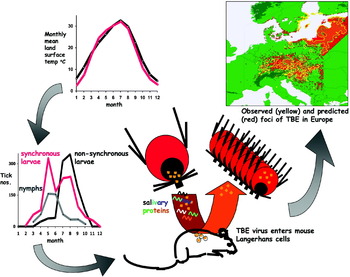
Non-systemic transmission may be seen as liberating for pathogens, permitting additional covert hosts to be exploited and stronger complex webs of transmission routes to be built up. Co-feeding transmission, on the other hand, imposes constraints because it requires the following two essential features of tick ecology. First, the sine qua non of co-feeding by at least two tick stages is synchrony in their highly seasonal activity (Randolph et al. Reference Randolph, Green, Peacey and Rogers2000). The long slow life cycle typical of temperate species of ticks, caused by low temperature-dependent development rates and overwinter diapause, slows the pace of pathogen transmission and should be a limitation. Paradoxically, however, it is actually permissive for pathogens with short-lived infections in vertebrates because it dictates long survival of infected ticks, that de facto become the reservoir hosts, and allows synchrony between stages, but only in certain climatic conditions. As tick phenology is re-set each year by winter conditions (Randolph et al. Reference Randolph, Green, Hoodless and Peacey2002), the critical stages (larvae and nymphs for TBEV) may emerge from diapause in more or less synchrony in the spring, depending on whether temperatures rise sufficiently rapidly to cross the threshold for larval activity (ca.10°C mean daily maximum) soon after the threshold for nymphal activity (ca. 7°C) (Randolph and Šumilo, Reference Randolph, Šumilo, Takken and Knols2007). The variable existence of thermal conditions associated with seasonal synchrony between tick stages has been identified as the key determinant of the focal distribution of TBEV across Europe (Randolph et al. Reference Randolph, Green, Peacey and Rogers2000), allowing the predicted risk of TBE to be mapped using climatic surrogates sensed from space (Randolph, Reference Randolph2000) (Fig. 1).
The chain of causal processes underlying the epidemiology of tick-borne diseases has been best uncovered for tick-borne encephalitis. A slightly greater rate of increase in ambient temperatures in the spring (pink line, top left) permits a greater degree of synchrony in the seasonal activity of nymphal and larval ticks questing for hosts (pink line, bottom left). This in turn allows the transmission of short-lived non-systemic viral infections from an infected nymph via rodent Langerhans cells to many co-feeding larvae, facilitated by a wide variety of proteins secreted in the tick's saliva (bottom centre). Altogether, this results in the persistent zoonotic cycles in predictable foci within the tick's range across Europe (top right). The central cartoon is derived from an original by Lise Gern, Université de Neuchâtel, Switzerland; the predictive map is taken from Randolph (Reference Randolph2000) with permission.

The second requirement is the coincident feeding of infected ticks of one stage, say nymphs, with the more abundant infectible ticks of the previous stage, larvae, on the same individual hosts (Randolph et al. Reference Randolph, Miklisová, Lysy, Rogers and Labuda1999). Persistent cycles of TBPs depend on their being transmitted ‘backwards’ through the tick's life cycle, e.g. from few nymphs to many larvae, to allow the amplification of infected vectors essential to offset the tick's high interstadial mortality (Randolph, Reference Randolph2004). The natural aggregated distribution of many types of parasites amongst their hosts applies equally to ticks, but the quantitative key to TBEV survival in nature is that larvae and nymphs of I. ricinus show coincident, rather than independent, aggregated distributions amongst rodents. In other words, the same ca. 20% of rodents within a population carry most larvae (61%) and most nymphs (74%), close to the ubiquitous host-parasite 20:80 ratio (Woolhouse et al. Reference Woolhouse, Dye, Etard, Smith, Charlwood, Garnett, Hagan, Hii, Ndhlovu, Quinnell, Watts, Chandiwana and Anderson1997). Too many observations to list, dating from at least the 1960s, have identified sexually active male rodents as typically the most highly tick-infested fraction of the population, for which there are many explanations, many of which hinge on high testosterone levels. For example, male sexual maturation in the spring is associated with greater ranging activity and therefore tick-encounter probability (Randolph, Reference Randolph1977). Moreover, experimentally high testosterone levels within natural limits were shown specifically to permit more successful tick engorgement and survival by reducing both innate and acquired resistance (Hughes and Randolph, Reference Hughes and Randolph2001a), and to yield greater transmission potential of Babesia microti (Hughes and Randolph, Reference Hughes and Randolph2001b), presumably through the hormone's immuno-suppressive effects (Grossman, Reference Grossman1985; Barnard et al. Reference Barnard, Behnke and Sewell1994). Given that the proportion of sexually active males in free-living populations is likely to be about 20% for a wide range of organisms, this may help to explain the 20:80 ratio. With the coincident ca. 20:80 pattern of immature stages of I. ricinus, the average number of larvae feeding alongside any potentially infected nymph is doubled, thereby boosting the TBEV transmission potential as measured by the basic reproduction number, R 0 (Randolph et al. Reference Randolph, Miklisová, Lysy, Rogers and Labuda1999). Thus, laboratory experimentation, field observations and quantitative analyses come together to substantiate the essential role played by SAT, non-systemic infections and co-feeding ticks in the maintenance of one of the most threatening vector-borne diseases in Europe. Recently, novel theoretical modelling has corroborated this. Next-generation matrix models (Diekmann et al. Reference Diekmann, Heesterbeek and Metz1990; Diekmann and Heesterbeek, Reference Diekmann and Heesterbeek2000) fitted to the correct biology of TBP systems allowed sensitivity and elasticity analyses of R 0 values of TBEV that confirmed the critical importance of transmission between co-feeding ticks for the establishment of TBE, but not for Lyme borreliosis (Hartemink et al. Reference Hartemink, Randolph, Davis and Heesterbeek2008).
These constraints together impose an ecological specificity determining which vectors can be used by TBEV (Randolph et al. Reference Randolph, Miklisová, Lysy, Rogers and Labuda1999). Only I. ricinus and I. persulcatus appear to contribute substantially to natural TBEV cycles, despite the biological competence of many tick species to transmit this virus in the laboratory. Dermacentor reticulatus, for example, occurs sympatrically with I. ricinus in Slovakia, but completes its life cycle rapidly within a few months, each stage following sequentially from late spring to autumn. This species also feeds more on voles that are less transmission competent than mice. In fact, whether systemic viraemia develops or not, the brief period of infectivity in vertebrate hosts, only a few days, makes co-feeding by ticks essential for TBEV.
The very opposite is true of B. burgdorferi s.l., which utilizes an exceptional diversity of ticks and vertebrates, matching an ever-increasing knowledge of its genetic diversity. Co-feeding tick stages are necessary only for any early non-systemic transmission, but not once the relatively long systemic infections have developed later. Nevertheless, not all Borrelia strains, even within B. burgdorferi s.s., show the same degree of prolonged infectivity in their natural rodent host Peromyscus leucopus (Derdakova et al. Reference Derdakova, Dudioak, Brei, Brownstein, Schwartz and Fish2008; Hanincova et al. Reference Hanincova, Ogden, Diuk-Wasser, Pappas, Iyer, Fish, Schwartz and Kurtenbach2008). Models to predict the differential fitness and persistence of such strains under different degrees of predicted seasonal synchrony of I. scapularis life stages must take account of any differences in pathogen-induced host mortality and transmission coefficients associated with duration of infectivity (Ogden et al. Reference Ogden, Bigras-Poulin, Hanincova, Maarouf, O'Callaghan and Kurtenbach2008), a degree of quantitative detail that is only just emerging.
ECOLOGICAL DIVERSITY FROM SPECIFIC HOST IMMUNE RESPONSES
Tick-borne pathogens are no different from other microbes in having evolved their own defence system against host immune attack. One of the more notable stories to emerge over the past decades involves B. burdgorferi s.l., whose enduring systemic infections are maintained in the face of strong immune responses by the host. In this case part of the battle between host and bacteria occurs within the tick, and apparently plays a significant role in the extraordinary ecological diversity of this system, as follows. Again, the alternative complement system is involved, but here the anti-complement defence is due to the bacteria's own proteins, not those in tick saliva as described above.
Different host species show differential in vivo transmission competence for 4 genospecies within the species complex of B. burdgorferi s.l. (Humair et al. Reference Humair, Peter, Wallich and Gern1995, Reference Humair, Postic, Wallich and Gern1998; Kurtenbach et al. Reference Kurtenbach, Carey, Hoodless, Nuttall and Randolph1998a, Reference Kurtenbach, Peacey, Rijpkema, Hoodless, Nuttall and Randolphb), that is the mirror image of the in vitro susceptibility of each genospecies to the alternative complement activity of host serum (Kurtenbach et al. Reference Kurtenbach, Sewell, Ogden, Randolph and Nuttall1998c). Thus, within Europe, many wild rodent species are competent to develop systemic infections of, and transmit, B. afzelii, B. burgdorferi s.s. and B. garinii OspA serotype 4, while birds do the same for other B. garinii serotypes and B. valaisiana; perissodactyls (horses) and artiodactyls (including deer) appear to be solidly non-competent (Huegli et al. Reference Huegli, Hu, Humair, Wilske and Gern2002; Kurtenbach et al. Reference Kurtenbach, De Michelis, Etti, Schäfer, Sewell, Vbrade and Kraiczy2002a). Resistance to complement is mediated by the species-specific binding of 2 host-derived complement-control proteins by outer surface proteins (CRASPs) of B. burgdorferi s.l. (Kurtenbach et al. Reference Kurtenbach, De Michelis, Etti, Schäfer, Sewell, Vbrade and Kraiczy2002a). These proteins are encoded by erp genes (Stevenson et al. Reference Stevenson, El-Hage, Hines, Miller and Babb2002) thought to be expressed while the spirochaetes are in the mid-gut of the tick (Gilmore et al. Reference Gilmore, Mbow and Stevenson2001). Spirochaetes that survive the host complement delivered in the blood meal then go on to leave the tick mid-gut, invade the salivary glands and be transmitted to the host later in the feeding period. They also survive in the tick to be maintained to the next unfed stage. Susceptible spirochaete genospecies, however, are cleared from the mid-gut; e.g. B. afzelii in ticks feeding on birds are killed by avian serum, and may be replaced by avian-transmitted strains (e.g. B. garinii) if the bird is infected (Kurtenbach et al. Reference Kurtenbach, Schäfer, Sewell, Peacey, Hoodless, Nuttall and Randolph2002b). This may account for the observed segregation of avian- and mammalian-transmitted genospecies in field-collected adult ticks despite the opportunity to generate mixed infections during their two previous meals as larvae and nymphs (Kurtenbach et al. Reference Kurtenbach, De Michelis, Sewell, Etti, Schäfer, Hails, Collares-Pereira, Santos-Reis, Hanincova, Labuda, Bormane and Donaghy2001). Nevertheless, this segregation is not observed to the same extent in all studies (Piesman and Gern, Reference Piesman, Gern, Bowman and Nuttall2008), perhaps due to spirochaetes already safe in the salivary glands before feeding starts in any ticks that are systemically infected (Kurtenbach et al. Reference Kurtenbach, De Michelis, Etti, Schäfer, Sewell, Vbrade and Kraiczy2002a).
This is just one example of the extraordinary advances made in understanding the molecular basis for the complex ecology of this zoonotic spirochaetosis in the short time since it was clinically identified (Steere et al. Reference Steere, Malawista, Snydman, Shope, Andiman, Ross and Steele1977), recognized as a TBP (Burgdorfer et al. Reference Burgdorfer, Barbour, Hayes, Benach, Grunwaldt and Davies1982) and recorded as the most widespread and prevalent vector-borne disease of the temperate northern hemisphere. New genospecies are still being detected, bringing the total associated with I. ricinus in Europe to 7 (Piesman and Gern, Reference Piesman, Gern, Bowman and Nuttall2008), and strain diversity within genospecies demands much more work to expand on the current story based on strains cultured within a few laboratories. The consequences of transmission of non-systemic infections of B. burgdorferi s.s. between co-feeding ticks have not yet been fully explored. Although rodents go on to develop systemic infections (Gern and Rais, Reference Gern and Rais1996), sheep do not and yet can support persistent cycles of B. burgdorferi s.s. solely via the non-systemic, co-feeding route (Ogden et al. Reference Ogden, Nuttall and Randolph1997), making it still the only empirically observed ‘real life’ example of this transmission route for any TBP sufficient to result in local human cases. Evidently the spirochaetes survive the relatively high (ca.45%) borrelicidal effects of sheep serum (Kurtenbach et al. Reference Kurtenbach, Sewell, Ogden, Randolph and Nuttall1998c), raising the possibility that other host species classified as non-competent on this criterion may contribute more than previously thought, with the potential for strain mixing via this route.
BLOOD MEAL IDENTITY
A new avenue of exploration that could help to uncover hidden roles of some of the many hosts of I. ricinus is blood meal identification. This is technically especially challenging for ticks because those collected from the vegetation will have fed at least 3–12 months previously as the preceding stage, so host DNA remaining in the gut after the moult will be degraded. First attempts targeting the cytochrome B gene using PCR (Kirstein and Gray, Reference Kirstein and Gray1996) were improved upon by Reverse Line Blot hybridization of the amplified 18S rRNA gene of vertebrates (Pichon et al. Reference Pichon, Egan, Rogers and Gray2003), but greatest success has come from targeting the 12S rDNA mitochondrial gene, allowing identification of host DNA in 44% of field-collected ticks, including 48% of the Borrelia-infected ticks (Cadenas et al. Reference Cadenas, Rais, Humair, Douet, Moret and Gern2007). The results so far confirm a general association of B. afzelii and B. burgdorferi s.s. with rodents, and B. valaisiana and B. garinii with birds. Larger samples are needed for statistical analysis to test for any unexpected associations. Already, the relatively greater presence of blood meal remains from artiodactyls (31%) than rodents (23%) in nymphal ticks infected with B. burgdorferi s.l., including B. garinii (Cadenas et al. Reference Cadenas, Rais, Humair, Douet, Moret and Gern2007), strengthens the plausibility of a hitherto unrecognized role of deer in the Lyme borreliosis system, perhaps via the co-feeding route without systemic infections (Gern and Rais, Reference Gern and Rais1996; Hu et al. Reference Hu, Cheminade, Perret, Weynants, Lobet and Gern2003). This is also implied by the detection of spirochaetes at skin sites on Sika deer only where clusters of ticks were feeding, and the much higher infection prevalence in ticks taken from these deer than from the vegetation (Kimura et al. Reference Kimura, Isogal, Isogal, Kamewaka, Nishikawa, Ishii and Fujii1995). As more field samples are processed for blood meal identification, these suggestive results may be substantiated; also the differential roles of hosts for the less common but ‘emerging’ TBPs such as Anaplasma, Babesia and Rickettsia spp. will be quantified.
‘EMERGENT’ TICK-BORNE PATHOGENS
Vector-borne diseases were recently identified by 30 European Ministries of Health as the biggest threat arising from environmental change, with the two most prevalent tick-borne diseases in Europe, Lyme borreliosis and TBE, ranked first and second. While I do not happen to agree with this, unless environmental change is defined to include so many factors as to be meaningless, it is nevertheless gratifying to see the implicit promise of further funding for TBPs. If the transformation of ticks from Cinderella to princess were based only on their unwelcome increasing prominence on the public health stage, they would not merit a place in this centenary issue of Parasitology. This is not the case. Chasing the molecular secrets of adaptations that have allowed ticks to pose such a global threat as they already do has contributed generic biological understanding to vector-borne disease systems. Meanwhile, results from efforts to quantify and predict the present and future extent of the threat cast doubt on the alarmist view that environmental change per se will necessarily increase that threat.
There is little doubt that human-induced changes in abiotic (climate, land cover, habitat structure, etc.) and biotic (in this context, distribution and abundance of tick hosts) conditions have occurred over the past few decades, and there is equally indisputable evidence for the increase in recorded human cases of some tick-borne diseases, not only Lyme borreliosis and TBE but also the rarer babesioses (Kjemtrup and Conrad, Reference Kjemtrup and Conrad2000), rickettsioses (Parola et al. Reference Parola, Paddock and Raoult2005) and anaplasmoses (previously called ehrlichioses) (Dumler and Walker, Reference Dumler and Walker2001). The question is, to what extent is the former the cause of the latter; environmental change is, after all, the backdrop for all recent events, with or without any causality. Correct identification of the causes allows more reliable predictions of the future, and more precise targeting of control efforts. Despite the recognition that the increase and geographical spread of deer populations with their attendant tick populations, and the increase in human contact with wildlife habitats, are major relevant environmental change factors (Spielman et al. Reference Spielman, Wilson, Levine and Piesman1985; Barbour and Fish, Reference Barbour and Fish1993; Dumler and Walker, Reference Dumler and Walker2001), the mantra of climate change as the universal villain is hard to shake. For example, it has been correctly pointed out that heightened awareness and better diagnostic practices, more precise molecular characterization and improved cell culture methods, and increased global travel by the general public have all contributed to the emergence of rickettsial illnesses (Parola et al. Reference Parola, Paddock and Raoult2005). Yet the same authors also argue that 1 case of Rickettsia massiliae and 1 case of R. conorii contracted from dog ticks Rhipicephalus sanguineus in the same house in southern France during the unusually warm weather in April 2007, presage an increase in incidence of Rh. sanguineus-transmitted pathogens with global climate trends (Parola et al. Reference Parola, Socolovschi, Jeanjean, Bitam, Fournier, Sotto, Labauge and Raoult2008).
The excellent long-term data on TBE epidemiology since at least the 1970s at fine spatial resolution across Europe (and beyond) have allowed the role of climate change to be tested more rigorously and rejected as an adequate explanation for upsurge in incidence in either Sweden (Randolph, Reference Randolph2001) or the Baltic States (Šumilo et al. Reference Šumilo, Asokliene, Bormane, Vasilenko, Golovljova and Randolph2007). Instead, in most parts of central and eastern Europe, major changes in the agricultural and industrial sectors following the end of Soviet rule resulted in changes in the abiotic and biotic environment and socio-economic conditions that could have caused increases in the abundance of infected ticks and the contact of humans with those ticks. Abandoned agricultural fields became suitable for rodent transmission hosts, and wildlife hosts for ticks increased. Industry collapsed and unemployment and inequality increased to different extents in all countries. Most strikingly, national differences in poverty and in household expenditure on food are both strongly correlated with the degree of upsurge of TBE (Šumilo et al. Reference Šumilo, Bormane, Asokliene, Vasilenko, Golovljova, Avsic-Zupanc, Hubalek and Randolph2008b). Correspondingly, unemployment and low income have been shown in Latvia to be statistically associated with high-risk behaviour involving harvest of wild foods from tick-infested forests, and also with not being protected against TBE by vaccination (Šumilo et al. Reference Šumilo, Asokliene, Avsic-Zupanc, Bormane, Vasilenko, Lucenko, Golovljova and Randolph2008a). These factors, by acting synergistically but differentially between and within each country, can explain the marked spatio-temporal heterogeneities in TBE epidemiology better than can climate change alone, which is uniform across wide areas (Šumilo et al. Reference Šumilo, Asokliene, Bormane, Vasilenko, Golovljova and Randolph2007). Furthermore, dramatic spikes and seasonal patterns in TBE incidence in several, but not all, western and central European countries during the exceptionally warm autumn of 2006 were not matched by greater abundance of ticks (Randolph et al. Reference Randolph, Asokliene, Avsic-Zupanc, Bormane, Burri, Golovljova, Hubalek, Knap, Kondrusik, Kupca, Pejcoch, Vasilenko and Žygutiene2008). Human responses to favourable conditions for outdoor recreational activities and good crops of forest mushrooms and/or berries are the more likely cause. These recent analyses of a wide range of data emphasize that zoonoses in general, and tick-borne disease in particular, are the product of a partnership of two independent halves, risk generated by natural wildlife cycles and human exposure to that risk. Changes in human behaviour in response to natural and human-induced environmental changes, and in response to political and social changes, deserve more consideration as a factor in the transmission of all tick-borne pathogens that depend more on the mobility of humans rather than of vectors for contact.
CONCLUSIONS
The global ubiquity and variety of tick-borne disease systems make ticks appear commonplace as vectors until the extraordinary nature of their biology is appreciated. The equally extraordinary solutions to the paradox of ticks as vectors have unfolded over the past 30 years as novel phenomena were first recognized and then furnished with details of the intricate interplay of specific proteins, according to variable gene expression as ticks seek their meals and pathogens seek to maximize their transmission potential via unexpected pathways. If the promise of molecular manipulation eventually succeeds in minimizing this potential, predictive epidemiology will be essential to direct cost-effective deployment.
The author is partially supported by the EU grant GOCE-2003-010284 EDEN; it is catalogued by the EDEN Steering Committee as EDEN0128 (http://www.eden-fp6project.net/). The contents are the sole responsibility of the authors and do not necessarily reflect the views of the European Commission.