Implications
Frequency and intensity of summer heat waves with hot temperature and high humidity are increasing in temperate areas of the planet due to global warming. Heat might be very stressful for beef cattle finished in intensive indoor systems, impairing their health and welfare, and practical solutions should be developed and tested for its mitigation. The ceiling fan used in this study proved to be effective in reducing the occurrence of clinical signs of heat stress such as panting, and led to a better cleanliness of the bulls through a drier litter in their pens.
Introduction
Due to global warming in the last decades, summers in temperate regions have been characterized by adverse weather events in which heat waves alternate with cold spells that negatively affect beef cattle welfare, productivity and survival (Nardone et al., Reference Nardone, Ronchi, Lacetera, Ranieri and Bernabucci2010; Morignat et al., Reference Morignat, Gay, Vinard, Calavas and Hénaux2015). An alarm for beef cattle farmers in Central and Southern Europe could come from the seasonal dynamics of the temperature humidity index (THI) that showed an increasing trend of 0.73 units in summer values (Segnalini et al., Reference Segnalini, Nardone, Bernabucci, Vitali, Ronchi and Lacetera2010). The THI is a single parameter that combines environmental temperature and relative humidity (RH), and was originally developed to predict heat stress in bovines (Livestock Conservation Incorporated (LCI), 1970). Additional indexes, such as heat load index and accumulated heat load, have been developed and validated for feedlot cattle, accounting also for solar radiation and wind speed, with adjustments for animal (genotype, coat colour, etc.) and management that make them more reliable in guiding farmers towards the best actions to manage heat stress (Gaughan et al., Reference Gaughan, Mader and Holt2008b; Hahn et al., Reference Hahn, Mader and Eigenberg2009). Feedlot cattle on pasture are usually less susceptible to heat stress when shade is available (Van Laer et al., Reference Van Laer, Moons, Ampe, Sonck, Vandaele, De Campeneere and Tuyttens2015) and are able to seek water and air movement to cool themselves (Dewell, Reference Dewell2010). A different scenario is observed for beef cattle reared in intensive fattening units, such as those used in mainland Europe where they are housed indoors on fully slatted floors or on deep litter (Scientific Committee on Animal Health and Animal Welfare (SCAHAW), 2001; Cozzi et al., Reference Cozzi and Gottardo2009). In this rearing system, although beef cattle are protected from direct solar radiation, they can also experience heat stress when exposed to high THI values with no possibility to maintain homeothermy by dissipating heat effectively (European Food Safety Authority (EFSA), 2012). Animals’ heat dissipation efficiency in this scenario depends on barn micro-environmental conditions and the resources provided, such as water, feeding and manure management. Heat mitigation strategies that farmers could implement include changing the feeding regimen (Mader, Reference Mader2003), providing additional drinking water points (Mazzenga et al., Reference Mazzenga, Gottardo and Cozzi2006) and using cooling systems, such as ventilation (Calegari et al., Reference Calegari, Calamari and Frazzi2014), and water sprinkling or misting (Mitlohner et al., Reference Mitlohner, Morrow, Dailley, Wilson, Galyean, Miller and McGlone2001). Demonstrated to be beneficial in feedlot cattle (Davis et al., Reference Davis, Mader, Holt and Parkhurst2003), water sprinkling or misting in indoor housing systems would be negatively offset by the increased slipperiness and consequent risk of injuries for bulls housed on fully slatted floors (Wechsler, Reference Wechsler2011) and the increased wetness and dirtiness of animals on deep litters, with extra costs for bedding material and litter renewal (Gottardo et al., Reference Gottardo, Ricci, Fregolent, Ravarotto and Cozzi2003; Brscic et al., Reference Brscic, Gottardo, Tessitore, Guzzo, Ricci and Cozzi2015). Moreover, the effectiveness of these evaporative cooling systems decreased when RH increased (Brouk et al., Reference Brouk, Smith and Harner2003). The aim of the present study was therefore to assess the effects of a ceiling fan ventilation system on health, feeding, social behaviour and growth response of young bulls kept indoors on deep litter for the finishing period in alert and normal THI conditions.
Material and methods
Experimental groups, housing and management
The study was carried out on a beef cattle farm located in Castelnuovo del Garda in the province of Verona, North-Eastern Italy (45°26'52.6'N 10°45'05.1'E; altitude 105 m a.s.l.). It considered the last part of the finishing phase of 69 Charolais young bulls imported from France 14 weeks before the beginning of the trial. The experimental period lasted 98 days from 5 June to 10 September 2014. At the outset of the study, the bulls were weighed and housed in 12 group pens of five or six animals each located in the same row of the barn (Supplementary Figure S1). Six contiguous pens (three pens of five animals, and three pens of six animals) constituted the Control treatment (Control), and were not provided with ceiling fans as a mechanical ventilation system. Six contiguous pens (of six animals) constituted the ceiling fans treatment (ceiling fans), and were provided with a ceiling fan ventilation system. The pens used for the two treatments were separated by a pen with a vertical metal barrier to prevent air movement from the fans reaching the Control pens. Air circulated in the entire barn through doors open at the sides of the barn, windows above the pens, the ridge on the roof, and the opening on the opposite side of the barn compared with the 12 experimental pens (frontal to the bulls at the manger) (Supplementary Figure S1).
Three ceiling fans (Zefiro Line, patented by CMP Impianti S.r.l., Viadana di Calvisano, BR, Italy) were placed above the six fans pens 2 weeks before the start of the trial and remained switched off until the outset of the study. They were turned on 1 week before the first experimental day in order to allow animal adaptation to the operational system. Each ceiling fan was composed of a central impeller (0.70 m height and 0.30 m width) and five aluminium blades 1.35 m long that created an aerodynamic system 3 m in diameter. Each unit ventilated a surface of 10 m in diameter, and moved an increasing air volume from 42 000 m3/h at THI=60 to 132 000 m3/h at THI=74. Power consumption reported on the technical sheet was 0.3 kW/h. The ceiling fans were controlled by an automatic switching system placed inside the barn that communicated with sensors placed 2 m above the central pens’ floor. Sensors detected barn temperature and humidity and transmitted this data to a computing system that calculated THI values by combining these two variables. Consequently, the ceiling fans were switched on and adjusted according to THI conditions inside the barn. Fan speed was measured using a portable thermo-anemometer (CMM/CFM, STC S.r.l., Grassobbio, BG, Italy), with independent regulation, and ranged from 2.0 to 2.4 m/s at THI=50 and from 6.8 to 7.5 m/s at THI⩾72. Under natural ventilation, air speed at the animals’ level ranged from 0.2 to 1.2 m/s. In this study, the switching system was set to turn on when THI⩾68 and turn at speeds in the range specified in the ventilation system data sheet.
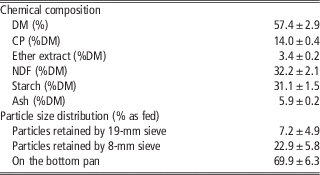
The experimental pens were 3.6 m wide and 6.7 m long with a straw deep litter. Space allowance was 4.0 and 4.8 m2/bull, and manger space was 60 and 72 cm/bull in pens housing six and five animals, respectively. Each pen was equipped with a pressure bowl to supply ad libitum drinking water. During the experimental period, all bulls were fed ad libitum the same total mixed ration (TMR) distributed once a day at 0830 h. The diet was based on maize silage, maize meal, sugar beet pulp, alfalfa hay, maize gluten feed, soybean meal and straw. Dietary samples were collected monthly throughout the experimental period and frozen for chemical and physical analysis. Thawed samples were analysed for dry matter (DM) and CP according to the methods of the Association of Official Analytical Chemists (AOAC, 1990). Analysis of NDF of the same samples was carried out according to Van Soest et al. (Reference Van Soest, Robertson and Lewis1991), while starch content was determined by liquid chromatography (AOAC, 1990). Particle-size distribution of the dietary samples was assessed using the Penn State Forage Particle Separator (Nasco, Fort Atkinson, WI, USA). Chemical composition and feed particle-size distribution of the dietary samples are presented in Table 1.
Chemical analysis and particle-size distribution of the fattening diet (means±SD)

DM=dry matter.
Official climate data and micro-environmental measures
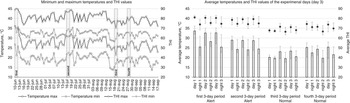
Official climate data regarding black globe temperature (T) and RH for the years 2011 to 2015 were gathered from the regional weather agency (Agenzia Regionale per la Prevenzione e Protezione Ambientale del Veneto, Padova, Italy) and were used to calculate the average THI values using the formula proposed by Kelly and Bond (Reference Kelly and Bond1971): THI=(1.8×T+32)−{(0.55−0.55×RH/100)×[(1.8×T+32)−58]}. Indoor temperature and RH were recorded every 30 min for the entire period using a portable hygro-thermometer (HD2101.2; Delta Ohm S.r.l., Caselle di Selvazzano, PD, Italy) placed 2 m above the floor level of the central pen of the barn. At each time point, THI values were calculated with the above-mentioned equation by Kelly and Bond (Reference Kelly and Bond1971). The recorded minimum and maximum temperatures and calculated minimum and maximum THI values throughout the experimental period are reported in Figure 1; along with the day (0800 to 1959 h), and night (2000 to 0759 h) average temperatures and THI values of the 3 consequent days in which each of the 4 experimental days was included (day 3 in Figure 1). According to LCI (1970), an average daily THI⩽74 measured for 3 consequent days was considered as normal (Normal), between 75 and 78 was considered as alert (Alert), between 79 and 83 was considered as Danger, and ⩾84 was considered as emergency. The first 3-day period (mid-June) included one danger THI day (average THI=79.14) and two alert THI days, and was considered as alert. During the second 3-day period (mid-July), all days had alert THI average values and were therefore considered as alert. The third (mid-August) and fourth (end-August) 3-day periods had normal THI average values and were considered as normal. Pen litter moisture was measured in 24 pool litter samples collected during 2 experimental days (one alert THI – mid-June and one normal THI – mid-August) from different randomized points of each pen. The litter moisture content was calculated by subtracting the DM content (% of moisture=100–% of DM) that was measured according to AOAC (1990).
Indoor minimum and maximum temperatures recorded by the thermo-hygrometer and calculated minimum and maximum temperature humidity index (THI) values throughout the study period (left); and average temperatures and THI values during day (0800 to 1959 h), and night (2000 to 0759 h) of the 3 consequent days in which each of the 4 experimental days (day 3) fell (right).

Bulls’ health and behaviour
Clinical signs of disease, injuries and mortality were monitored and recorded by the farmer throughout the experimental period. Assessments of the animals’ individual health status and cleanliness were carried out during 4 experimental days under two different THI conditions (two alert and two normal). Bulls were visually inspected from the manger corridor by a veterinarian trained in the application of the Welfare Quality® Assessment protocol for cattle (Welfare Quality®, 2009) who recorded bulls with poor body condition, signs of integument alterations, coughing, nasal discharge, ocular discharge, abnormal breathing, bloated rumen, lameness and cleanliness as binary measures (presence/absence).
Behavioural observations at pen level were carried out on the same 4 days of animal health and cleanliness assessments. Each observation started at 0830 h after TMR delivery (T0) and continued until 1730 h (T8). Lying down, eating, ruminating, inactivity, resting, exploring, grooming and other activities (e.g. bull not performing any of above-mentioned behaviours, changing posture, walking to any part of the pen or approaching a pen-mate, etc.) were recorded by four trained observers using the scan-sampling technique with a 5-min interval between scans (Martin and Bateson, Reference Martin and Bateson2007). Data were then expressed in minutes, assuming that each behaviour persisted for the entire 5-min interval (Maekawa et al., Reference Maekawa, Beauchemin and Christensen2002). Drinking behaviour (measured as number of visits to the drinker), social behaviour (mounts and fights), and slipping behaviour were recorded as number of events whenever they occurred during the 8-h observation sessions using the behaviour sampling technique (Martin and Bateson, Reference Martin and Bateson2007). The same observers performed both scan-sampling and behaviour sampling and moved in a rotational manner every 2 h to reduce bias caused by observer effect. Individual cud chewing was recorded between 1000 and 1700 h by an additional trained observer who counted the number of chewing acts per bolus by direct observation of the ruminating animals to estimate rumination (Baumont et al., Reference Baumont, Doreau, Ingrand and Veissier2006). Respiration rate of the bulls was assessed between 1430 and 1700 h by one veterinarian who counted at individual level, from outside the pen, the number of breaths (ribs moving out on inspiration) in 15 s. These data were transformed into panting scores as proposed by Meat & Livestock Australia Research Project (2006), while also considering the notes on the animals’ breathing condition taken by the veterinarian.
Partition of intake and feed selection activity
During the behavioural observation days, the partition of feed intake was also measured at pen level by weighing the diet delivered at T0 and the leftovers present in the manger 8 h (T8) and 24 h (T24) after delivery, as proposed by Cozzi and Gottardo (Reference Cozzi, Brscic and Gottardo2005). Repeated feed samples were taken from each manger at T0, T8 and T24 to assess feed selection activity at pen level. The particle-size distribution of these samples was measured using a modified Penn State Forage Particle Separator (Nasco) made of two sieves with 19 and 8 mm hole sizes, respectively, and a bottom pan. Using the procedure of Lammers et al. (Reference Lammers, Buckmaster and Heinrichs1996), samples were separated into three fractions of particles: (1) >19 mm in length retained by the top screen, (2) between 19 and 8 mm in length retained by the middle screen, (3) <8 mm in length settling down on the bottom pan. Each proportion of particles was weighed and divided by total sample weight to obtain the percentage of three fractions of particles. Selection indexes for the three fractions of particles retained by the separator were calculated for each pen by dividing the value measured in the diet residue at a given time interval by the value at the previous interval (Cozzi and Gottardo, Reference Cozzi, Brscic and Gottardo2005). Index values <1 indicated preferential consumption, >1 indicated selective refusal and 1 indicated no selection.
Bulls’ growth performance
Average daily gain (ADG) of the bulls was assessed by their individual weighing at the beginning of the trial (initial) and 1 week before the expected slaughter day (final). Dry matter intake (DMI) was measured at pen level on a fixed day per week throughout the experimental period by recording the weight of diet delivered to each pen at T0 and subtracting the leftover amount residue 24 h after delivery. Feed conversion ratio was calculated at pen level by dividing the average DMI for the ADG. The pens of the two treatments had a separate water pipeline to allow the monitoring of daily water consumption at treatment level (Control v. ceiling fans). Total water consumption recorded by a flow meter for the six experimental pens was divided by the number of bulls within each treatment.
Statistical analysis
Health status and cleanliness data, recorded as dichotomous variables (presence/absence) at individual level, were analysed by a logistic regression procedure (Proc Logistic of SAS 9.3; SAS Institute Inc., Cary, NC, USA) to test the association between the presence/absence of a given clinical sign and the presence/absence of a treatment using the Wald χ 2 test. Odds ratios (OR) and 95% confidence intervals (CI) were calculated to quantitatively describe this association. In particular, OR greater than 1 indicate that having a given clinical sign (e.g. abnormal breathing) is associated with having a given treatment (ceiling fans) in the sense that not having ceiling fans (Control) raises the odds of having the clinical sign. Odds ratios equal to 1 indicate no association between the two variables (clinical sign and treatment) and OR lower than 1 indicate that having ceiling fans is preventive to having the clinical sign. Panting scores were analysed using Proc Genmod (SAS 9.3; SAS Institute Inc.) in order to obtain the relative risk (RR) and 95% CI to quantify the probability of having a greater panting score with the presence/absence of ceiling fans treatment considering the multinomial distribution of the variable; and the model considering the fixed effects of THI, ventilation system, and their interaction. Normally distributed behavioural data (restricted to pens with six bulls/pen), feed selection indexes, feed intake on the experimental days (total 24 h and partitions in two subsequent daytime intervals), and litter moisture data (Shapiro–Wilk W>0.90) were analysed with a mixed model that considered the fixed effects of THI, ventilation system, and their interaction, with the random effect of the pen within ventilation system (Proc Mixed of SAS 9.3; SAS Institute Inc.) and the Bonferroni’s adjustment. Respiration rate and cud chewing activity (W>0.90) that were measured at individual level were analysed with the same mixed model including also the effect of the animal as repeated option. Exploring activity and slipping events were not normally distributed (W⩽0.90) and were normalized (W>0.90) using the logarithmic transformation (ln(Y+1)) and then analysed with the same model. Mounts had a non-parametric distribution and were analysed using two different one-way non-parametric tests (Proc NPAR1WAY of SAS 9.3; SAS Institute Inc.) considering the effects of THI and ventilation system. Water consumption was also analysed with a GLM that considered the fixed effects of THI, ventilation system, and their interaction. Data regarding growth performance were submitted to a one-way ANOVA with Proc GLM (SAS 9.3; SAS Institute Inc.) considering the effect of the ventilation system. The minimum threshold of statistical significance was set at P⩽0.05.
Results
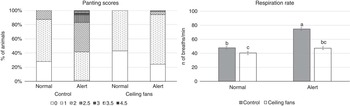
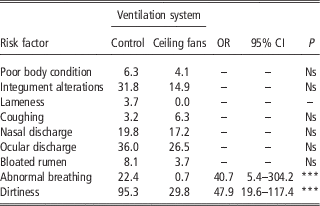
This study was carried out in 2014 during a mild summer with a prevalence of a normal THI condition. The 5-year trend of the climate average THI from early June to mid-September was 70.4, 72.1, 70.8, 68.9 and 72.1 for the years 2011, 2012, 2013, 2014 and 2015, respectively, and the number of days with average THI>75 was 13, 27, 15, 4 and 26 for the same years, respectively. The indoor microclimatic conditions measured by the thermo-hygrometer resulted in an average THI of 71.8 with 14 alert and 1 danger days (Figure 1). All bulls included in the trial completed their fattening except for two animals that were culled early: one belonging to the Control group due to severe lameness and one belonging to the Fans group after an injury due to an overnight thunderstorm. Prevalence of poor body condition, integument alterations, coughing, nasal and ocular discharge, and bloated rumen were not affected by the ceiling fans treatment (Table 2). Lameness was detected in 3.7% of animals of the Control group but in none of the animals of the ceiling fans group. The provision of ceiling fans significantly lowered the prevalence of bulls with abnormal breathing, resulting in an OR greater than 40 for Control bulls compared with ceiling fans bulls (Table 2). Cases of abnormal breathing during alert THI conditions resulted in an OR of 33.7 and a 95% CI of 4.5 to 251.5 (P<0.001) compared with normal THI conditions. The distribution of the percentages of bulls in each panting score unit according to THI condition and treatment is reported in Figure 2. Respiration rates and panting scores of bulls varied according to THI (P<0.001), ventilation system (P<0.001), and THI×ventilation system interaction (P<0.001). When exposed to alert THI conditions, the respiration rate increased in Control bulls but not in bulls provided with ceiling fans (Figure 2). The probability of exhibiting greater panting scores was higher for Control bulls during alert THI than ceiling fans bulls during normal THI conditions (RR=45.9, 95% CI=19.5 to 108.2; P<0.001). Cases of integument alterations differed according to THI conditions, and resulted in an OR of 2.4 and a 95% CI of 1.2 to 4.4 (P<0.001) during alert THI compared with normal THI conditions. The prevalence of dirty bulls did not vary according to THI but was higher in the Control bulls than in bulls provided with ceiling fans, resulting in higher odds when there was no ceiling ventilation system (Table 2). Litter moisture content resulted significantly higher in the Control than in the ceiling fans group (73.0% v. 62.9%; P<0.001) and was not significantly affected by THI or by THI×ventilation system interaction.
Percentage of bulls exhibiting each panting score (left); and effect of temperature humidity index (THI)×ventilation system interaction on bulls’ respiration rate (right) with different letters indicating significant differences for P<0.05.

Effect of the ventilation system treatment on the percentage of bulls with poor body condition, health problems, and dirty coats; estimated odds ratio (OR) and 95% confidence interval (CI) with Control v. ceiling fans pairwise comparison

Ns=P>0.05, *P<0.05, ***P<0.001.
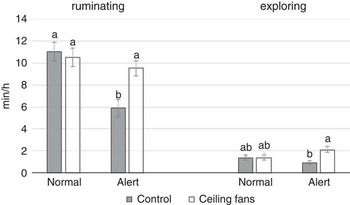
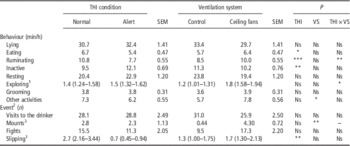
Results of ANOVA of bulls’ behaviour are shown in Table 3. Lying down, resting and grooming did not vary according to the considered effects. When exposed to alert THI conditions, bulls spent less time eating and ruminating, and more time being inactive compared with normal THI conditions. Regardless of THI, the provision of the ceiling fans increased the time spent performing other activities. Rumination and exploring activity varied according to THI×ventilation system interaction (Figure 3). Under alert THI conditions bulls provided with ceiling fans similarly spent more time in ruminating and exploring activities than under normal THI conditions. On the other hand, when exposed to alert THI conditions, Control bulls spent less time ruminating and exploring. Cud chewing activity was on average 52.3±11.6 acts per bolus and did not vary by THI, ventilation system or their interaction (results not shown). The numbers of visits to the drinkers and the number of fights were not affected by any of the effects considered (Table 3). Mounts were more frequent among bulls housed in the ceiling fans pens than those recorded in the Control pens (Table 3). Slipping events were more frequent during normal than alert THI conditions (Table 3).
Effect of temperature humidity index (THI)×ventilation system interaction on bulls’ ruminating and exploring activity. Different letters indicate significant differences for P<0.05 within a given behavioural activity.

Effect of temperature humidity index (THI) condition, ventilation system treatment (VS), and their interaction on bulls’ behaviours and events recorded during the 8 h behavioural observation sessions

1 Data processed after logarithmic transformation using the formula ln(Y+1) and presented as back-transformed average and 95% confidence intervals in brackets.
2 Total number of events performed by all six bulls in the pen in 8 h.
3 Data processed using a one-way non-parametric test considering only the main effects and not their interaction (–=not tested).
Ns=P>0.05, *P<0.05, **P<0.01, ***P<0.001.
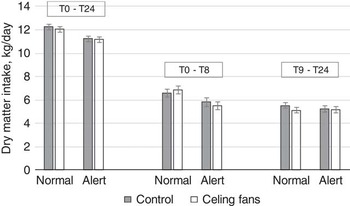
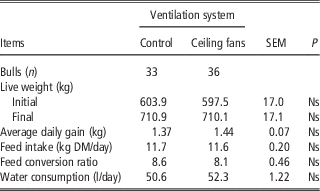
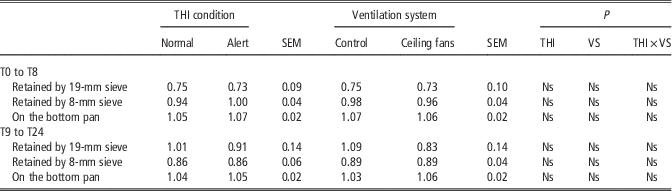
Ceiling fan treatment had no significant effect on bulls’ ADG, feed intake, feed conversion ratio, or water consumption (Table 4). Dry matter intake and its partition in two subsequent intervals measured at the four observation sessions varied according to THI (Figure 4), however. When exposed to alert THI conditions, DMI decreased compared with normal THI conditions (11.2±0.16 v. 12.1±0.16 kg DM/bull; P<0.001) due to a drop in intake during the first 8 h after diet delivery (5.7±0.25 v. 6.7±0.24 kg DM/bull; P<0.001). Daily water consumption also increased in alert compared with normal THI conditions (53.5±1.6 v. 49.7±0.9 l/day; P<0.05). Bulls’ selection activity measured by TMR selection indexes did not show any differences due to THI, ventilation system, or THI×ventilation system interaction (Table 5).
Effect of the temperature humidity index (THI)×ventilation system interaction on bulls’ total dry matter intake (T0 to T24), and on its partition between two subsequent daytime intervals from feed delivery to 8 h after feed delivery (T0 to T8), and from 9 to 24 h (T9 to T24) after. Different letters indicate significant differences for P<0.001 within a given time interval.

Effect of the ventilation system treatment on growth performance of bulls (Lsmeans±SEM)

DM=dry matter.
Effect of temperature humidity index (THI) condition, ventilation system treatment (VS), and their interaction on bulls’ selection indexes for dietary particles during two subsequent daytime intervals (T0 to T8; T9 to T24) after diet delivery

Selection index is the diet portion remaining after 8 and 24 h relative to the diet delivered: <1, selection for a given particle fraction; >1, selection against a given particle fraction; =1 no selection.
Ns=P>0.05.
Discussion
This study was carried out of bulls of a single genotype housed indoors protected from direct solar radiation provided with the same feeding and rearing management except for the provision of ceiling fans. The THI could therefore be considered as representative of the heat stress condition of the animals, even if it is probably not the best indicator because it does not consider the accumulated heat load (Gaughan et al., Reference Gaughan, Mader and Holt2008b). The THI values measured indoors during this study were higher than the official climate values based on black globe temperature and RH despite the fact that the commercial fattening unit was provided with several heat mitigating strategies, such as openings (doors, roof ridge, windows) and green sheer shadow curtains. For this reason, it could be hypothesized that the benefits observed for the ceiling fans bulls might be more apparent under more severe heat stress conditions. This type of convective ventilation system was tested because the Po Valley climate lacks ventilation in summer and a hot, humid environment is created. Under these conditions, the effectiveness of evaporative cooling systems has shown to decrease as RH rises (Brouk et al., Reference Brouk, Smith and Harner2003). Moreover, wetting or sprinkling the animals would be particularly harmful in straw bedded pens because it would be more difficult for cattle to cope with a wet and muddy litter (Mader, Reference Mader2003). The first positive effect of the provision of ceiling fans was the improved physiological status of the bulls in terms of reduced abnormal breathing, respiration rates and panting scores, suggesting their effectiveness in convectively cooling the animals underneath. Control bulls had a worse physiological reaction during the alert THI conditions, given that they showed increased respiration rate as an immediate response to heat stress (Gaughan et al., Reference Gaughan, Mader, Holt and Lisle2008a). Moreover, these animals spent less time ruminating, likely in an attempt to reduce metabolic heat and safeguard their homeothermy (Nardone et al., Reference Nardone, Ronchi, Lacetera, Ranieri and Bernabucci2010). This behaviour was not the result of either a different cud chewing activity or a specific feed selection activity. Different and contradictory changes in feeding regimen of beef cattle as heat stress mitigation strategies are found in literature (Mader, Reference Mader2003; Dewell, Reference Dewell2010; Renaudeau et al., Reference Renaudeau, Collin, Yahav, de Basilio, Gourdine and Collier2011). Results of this study showed that although bulls did not select any specific dimensional fraction of the TMR as an attempt to mitigate heat stress, feed selection activity could have been limited by the ad libitum feeding and/or the high starch content of the TMR. Ad libitum feeding itself, compared with restricted and bunk-feeding, was reported to be used as a heat stress mitigation strategy (Hahn et al., Reference Hahn, Gaughan, Mader and Eigenberg2003). Moreover, in order to alleviate some of the heat load from feed, TMR should be delivered in more than a single daily distribution and mostly in the late afternoon, 2 to 4 h after peak temperature (Dewell, Reference Dewell2010). However, this solution has not shown to be frequently implemented by Italian beef farmers due to cost-related reasons (Mazzenga et al., Reference Mazzenga, Gottardo and Cozzi2006). Another strategy to promote animals’ heat dissipation could be the provision of additional water points during the hot season, given that water requirements increase and water consumption was reported to be the quickest method for cattle to reduce their core body temperature (Dewell, Reference Dewell2010). Results of this study confirmed that animals increased water intake during alert THI conditions without intensifying their visits to the drinkers. The cleanliness of drinkers and quality of water in terms of temperature, chemical and organoleptic characteristics should also be considered for beef cattle welfare purposes (SCAHAW, 2001).
Other important results of this study were the improved integument condition and cleanliness of bulls provided with ceiling fans, probably due to the drier litter of their pens resulting from air movement. This could represent a benefit for both the animals and the farmers. Animals would avoid lying in muddy wet deep litter that negatively affects their cleanliness (Gottardo et al., Reference Gottardo, Ricci, Fregolent, Ravarotto and Cozzi2003; Brscic et al., Reference Brscic, Gottardo, Tessitore, Guzzo, Ricci and Cozzi2015), integument health, hoof health (Borderas et al., Reference Borderas, Pawluczuk, de Passillè and Rushen2004) and overall welfare status (Mader, Reference Mader2003). The advantages for farmers would be reduced need for litter renewal and savings in bedding material and labour, on one hand, and compliance with European Council Regulation 853/2004 (European Council, 2004) that made cattle cleanliness at the slaughterhouse mandatory in order to reduce risks of meat contamination on the other. In the farmer’s opinion, a ceiling fans investment should be repaid by cheaper litter management and improved bull cleanliness at the slaughterhouse, whereas the power consumed by the ceiling fans should be offset by savings in straw for bedding.
A drier deep litter has also shown to provide a better hoof grip, reducing slipping events that were reported to be a frequent risk for beef cattle housed in straw bedded pens (Wechsler, Reference Wechsler2011). In this study, slipping occurrence during the 8-h observations was very low, with less than three events per pen, regardless of ventilation system. Slipping was instead associated with the bulls’ activity because when exposed to alert THI conditions, bulls slipped fewer times because they spent more time inactive. Given the longer time spent performing other activities and the higher number of mounts observed in ceiling fan bulls than in Control bulls, it cannot be fully excluded that the ventilation system made bulls more anxious. In line with results by O’Brien et al. (Reference O’Brien, Rhoads, Sanders, Duff and Baumgard2010), when exposed to alert THI conditions, bulls spent less time eating and ate less due to a drop of intake during the hottest hours of the day (Dewell, Reference Dewell2010). This drop of intake during daylight hours was not compensated in the evening or overnight. Overall daily gain, DMI, and feed conversion ratio did not differ between ventilation system treatments, however, suggesting that when exposed to mild and scattered heat waves, bulls were able to cope with heat stress. In conclusion, it could be stated that despite a summer season characterized by scattered heat waves and cold spells, the ceiling fans tested proved to mitigate some of the negative effects of heat stress on bulls’ physiological and behavioural status. Despite not enhancing bulls’ growth performance, ceiling fans improved bulls’ cleanliness and pen litter management, and therefore beef farmers should be encouraged in using them in light of the climate change induced by global warming.
Acknowledgements
The authors want to thank Avanzi Farm for its willingness to host the study, the Association of Veterinary Practitioners ORUS and Dr. Lanza in particular for their precious help, CMP Impianti S.r.l. for its technical support, and last but not the least, Francesco Gaio and Giulia Gianesini for their skilled recording of behavioural data. This study was partially funded with a grant from the University of Padova within the scientific research funds ‘Quota ex 60%’ prot. 60A08-8310/14.
Supplementary Material
To view supplementary material for this article, please visit https://doi.org/10.1017/S1751731116002482