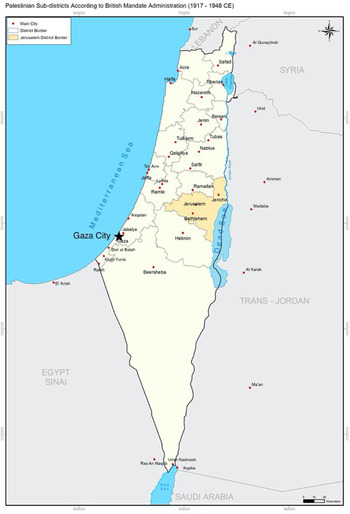



Gaza City, with a population of over half a million residents, is the largest urban center and de-facto capital of the Gaza Strip, which itself has a total population of over 1.8 million.Footnote 1 As of 2018, it is estimated that at least 1.3 million of the residents of the Gaza Strip are Palestinian refugees from other areas in historic Palestine, having fled to Gaza after the creation of the State of Israel in 1948.Footnote 2 These refugee communities originally come from the many historic rural areas that surrounded the Gaza Strip, smaller towns and cities along the Mediterranean coast, as well as areas further afield such as Jaffa, 69 km north of Gaza on the coast, and Bir il-Sab‘, the largest city in the Nagab desert region (see Figure 1). Linguistically, many of these refugee communities are of Palestinian Arabic dialect backgrounds, although varieties of Arabic spoken in the Nagab are classified as originating in the Hijaz area of what is today Saudi Arabia (see Shahin Reference Shahin, Kees, Mushira, Elgibali, Woidich and Andrzej2007 on Palestinian Arabic and Henkin Reference Henkin2010 on Nagab Arabic).
Map of Palestine under the British Mandate (Applied Research Institute of Jerusalem).

As a result of massive refugee migration into the territory, Gaza City Arabic has been, since 1948, in contact with the many Palestinian Arabic varieties spoken by refugees who now live in the area. Additionally, while elderly and middle-aged speakers were at one point able to leave Gaza, often working as laborers in Israel, today this movement is not possible. Since 2006, the Gaza Strip has been under Israeli military blockade. Restrictions on freedom of movement as a result of the blockade have created a situation in which this community on the one hand experiences intense contact with speakers of other Palestinian Arabic varieties who are refugees in Gaza, but on the other hand it is quite isolated from the other Arabic varieties of the area (notably varieties spoken in Israel and the West Bank). At the same time, Gaza’s isolation has made documenting the dialects spoken in the territory a challenge, given its inaccessibility to outside researchers.
As a result, providing a picture of the Arabic variety spoken in Gaza City by the city’s indigenous, non-refugee inhabitants, is challenging.Footnote 3 Primary source data is scarce, with an exception in Bergsträßer (Reference Bergsträßer1915) who provides an early cartographic account of the greater Palestine region, including Gaza City. However, Bergsträßer mentions only a handful of features from the city’s dialect. Later texts collected by Salonen (Reference Salonen1979, Reference Salonen1980)Footnote 4 and Barnea (Reference Barnea1973) contain additional data but on the whole, available textual information is limited. Despite this, recent sociolinguistic fieldwork conducted in Gaza City in 2013 shows that the dialect is clearly situated within the broader grouping of Palestinian Arabic varieties, but contains features that are characteristic of both urban Arabic varieties spoken in other large Palestinian cities (e.g. Jerusalem), and features that are typically described as being of Bedouin provenance (Cadora Reference Cadora1992, De Jong Reference De Jong2000).Footnote 5
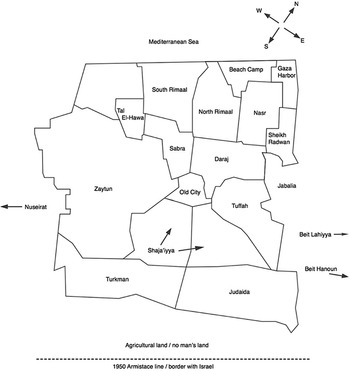
The six speakers whose speech forms the data for this illustration – Nabil (aged 85 years, male), Khadija (78 years, female), Halima (64 years, female), Um Majid (55 years, female), Naji (41 years, male) and Ghassan (21 years, male)Footnote 6 – were interviewed as part of a larger sociolinguistic project carried out by the author in Gaza City in 2013. This larger corpus contains speech from 39 speakers, 32 of whom are from families who form the indigenous community of Gaza City. Three of the speakers analyzed in this illustration were born before, or around the time of the creation of the State of Israel and the concomitant refugee influx into the Gaza Strip. The remaining three speakers were born after the creation of Israel in 1948. They constitute three female and three male speakers, all of whom were born and raised in the Shaja‘iyya neighborhood on the eastern side of Gaza City (Figure 2), and all are speakers of the city’s traditional dialect.
Interviews were typically conducted in speakers’ homes, as well as in community centers and spaces throughout the Shaja‘iyya neighborhood of the city. The author is a proficient, but nonnative, speaker of Palestinian Arabic, and during fieldwork interviews the author was accompanied by three undergraduate students from a local university who acted as research assistants. These three students were all members of the local community and were themselves native speakers of Gaza City Arabic. The recorded text presented below is informal in style, and forms part of a larger narrative story that one of the speakers, Nabil, recalled to the interviewer and research assistants during the course of a sociolinguistic interview.
Consonants
The consonantal inventory of Gaza City Arabic is provided below. Allophonic variation is discussed in greater detail in the remainder of this section.

Map of Gaza City neighborhoods (reproduced from: http://www.semarch.uni-hd.de/).


Given that the data presented in this illustration comes from a corpus of sociolinguistic interviews, as well as the reality that Gaza is almost completely inaccessible to outside researchers, the ability to structure the data in an effort to draw minimal pairs for comparison is limited. As a result, in the examples provided above, wherever possible phonemes are presented in word-initial position and with the same following vocalic environment.Footnote 7
In Gaza City Arabic the majority variant of /ɡ/ in Gaza City is [ɡ]. However, /ɡ/ shows sociolinguistic variation between [ɡ] and [ʔ], which is split along gender lines, with female speakers pronouncing a glottal stop more frequently than male speakers (Cotter Reference Cotter, Youssef and Eric2016a). However, the glottal [ʔ] has not replaced the voiced velar [ɡ] stop, which remains dominant realization in the city dialect, especially in the speech of male speakers who almost categorically use [ɡ].Footnote 8 Interestingly, the earliest source on the dialect describes [ʔ] as being predominant, especially in the speech of Christians (the majority of Gaza’s population are Muslims). In the dialect today the voiced velar, which is typically considered a feature that is characteristic of Bedouin dialects, is by far the more common variant (Bergsträßer Reference Bergsträßer1915; Salonen Reference Salonen1979, Reference Salonen1980; De Jong Reference De Jong2000). Although it is primarily a variant of /ɡ/ in Gaza City, [ʔ] also surfaces phonetically before vowel-initial syllables in some instances.
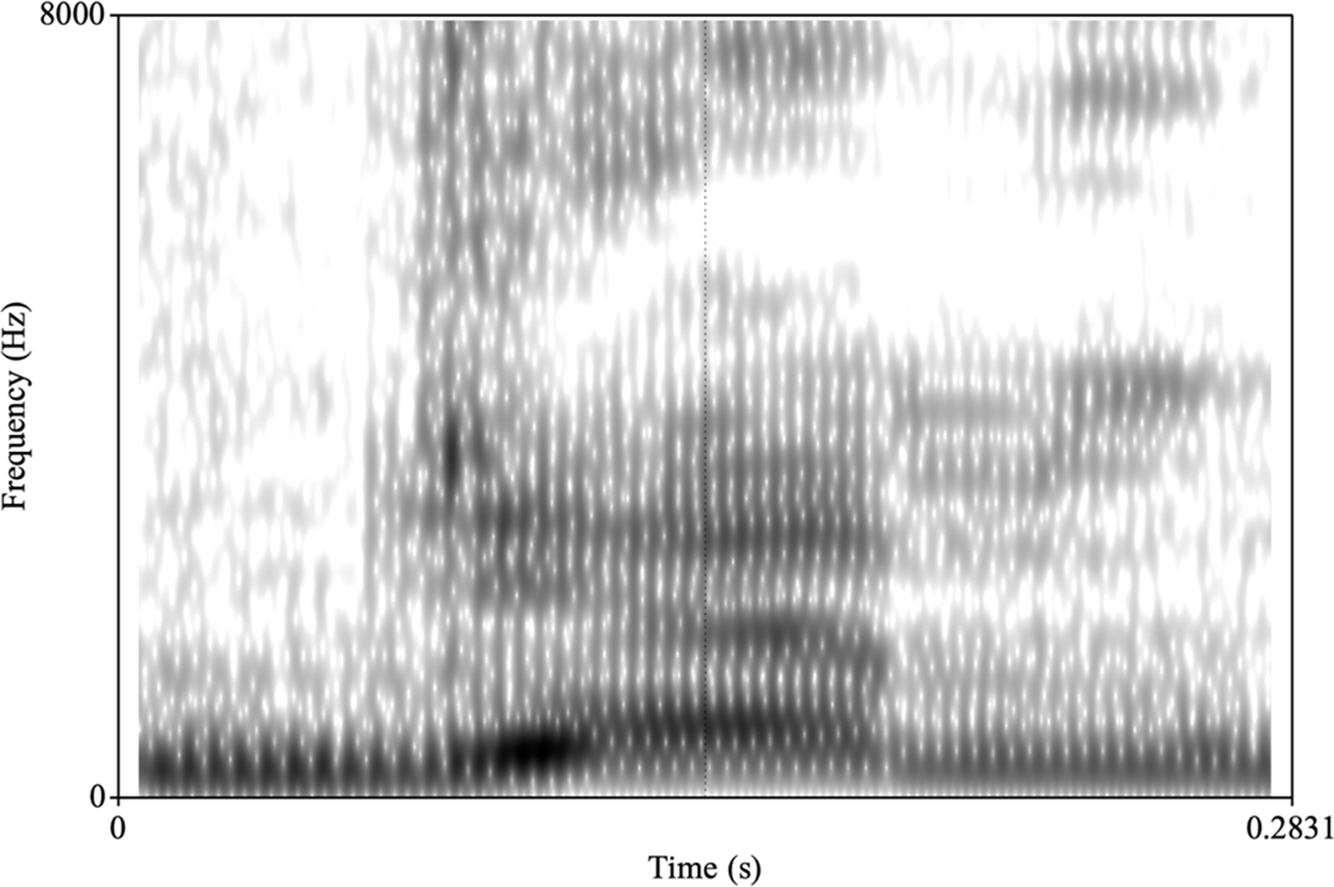
Postalveolar affricate  realization of
 in
 ‘close’.
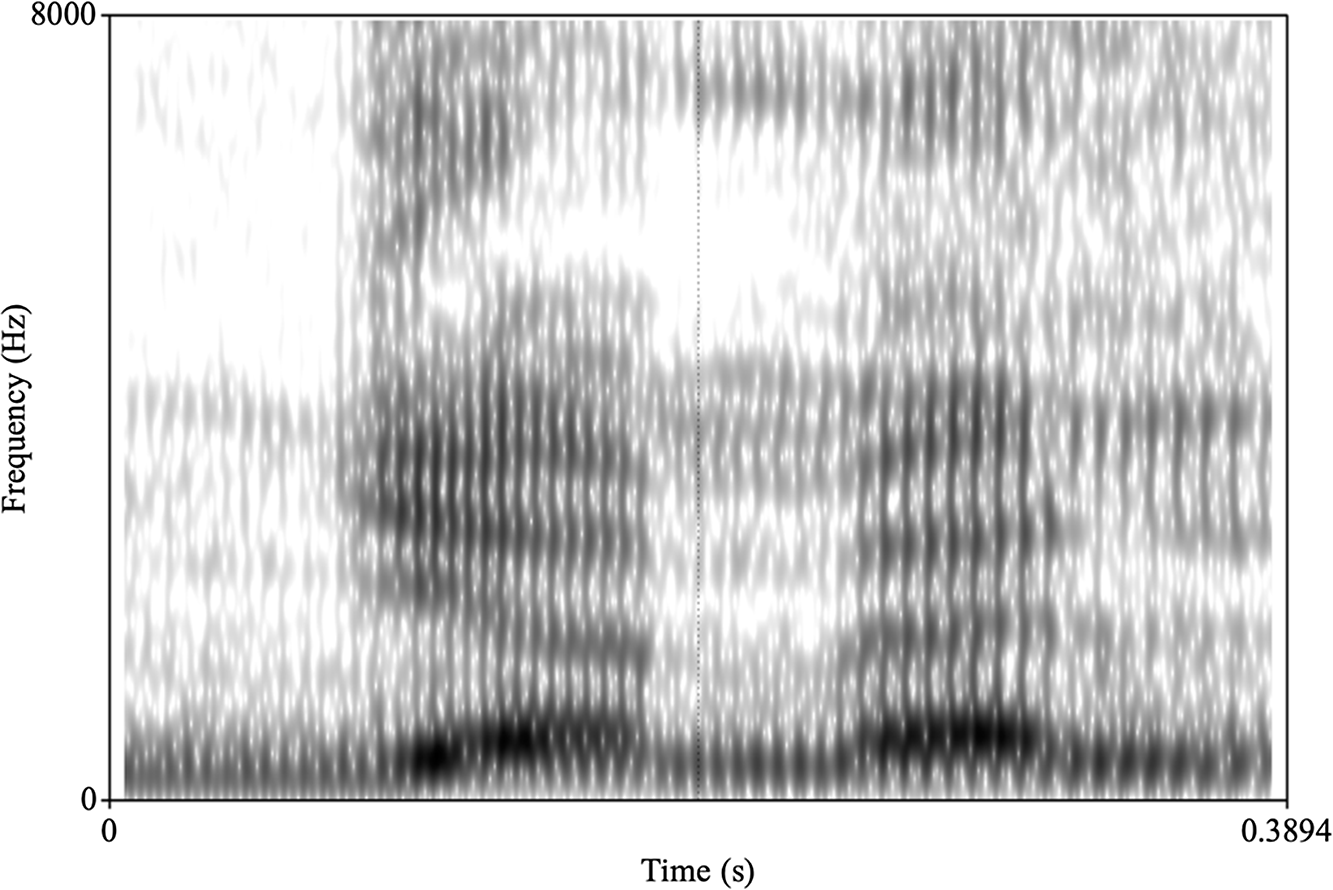
Palatalized velar  realization of
 in
 ‘camel’.
Additionally, in Gaza City Arabic the historic Arabic interdental fricatives /Θ ð ðˤ/ are realized as their plosive counterparts, [t d dˤ] in casual speech. This represents a merger and loss of distinction between these two sets of phonemes (Al-Wer Reference Al-Wer, De Jong, Martine and Kees2003, Reference Al-Wer, Lutz and De Jong2011). This results in examples such as /iktiːrˤ/ ‘a lot’, /haːdɐ ~ haːdi/ ‘this (m/f)’, and /dˤalleːnɐ/ ‘we stayed’. Salonen’s (Reference Salonen1979, Reference Salonen1980) texts on Gaza City Arabic suggested some degree of potential variation between the interdentals and their plosive counterparts (De Jong Reference De Jong2000: 533). However, based on the speech of the speakers discussed here, as well as others in the corpus, the dialect appears to today to only have the plosives, [t d dˤ], which are characteristic of urban Palestinian Arabic varieties (see also Cotter Reference Cotter2016b). In approximations of words from Modern Standard Arabic, the historic interdentals are often realized as sibilants, [s z zˤ].
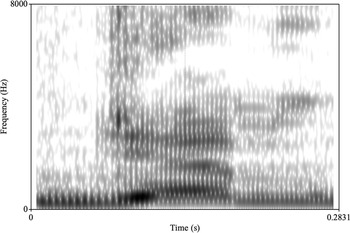
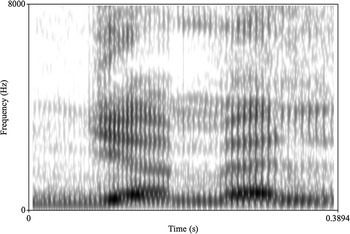
Gaza City Arabic generally realizes the voiced postalveolar affricate /ʤ/ as [ʤ], which is characteristic of both Bedouin and rural Palestinian Arabic dialects (Shahin 199; De Jong Reference De Jong2000: 581). Although this voiced postalveolar realization is common, the dialect also has a unique palatalized velar realization of /ʤ/ that I transcribe as [ɡʲ].Footnote 9 Intra-speaker variation between the voiced postalveolar affricate and palatalized velar can be seen in the examples [ʤɐmb] ‘close’ vs. [ɡʲɐmɐl] ‘camel’ in Figures 3 and 4. Both of these examples were extracted from the interview conducted with Nabil (85 years, male), one of the oldest speakers in the Gaza City corpus. The palatalized velar realization of /ʤ/ is not common in Palestinian Arabic dialects. Its presence in Gaza City Arabic highlights the need for more systematic acoustic investigation across the entire corpus of speakers to determine the full extent of variation in /ʤ/ in the dialect.
/r/ in Gaza City Arabic is realized both as a true trilled [r], as well as a pharyngealized [rˤ]. Pharyngealized [rˤ] generally occurs in the environment of low vowels. Examples of pharyngealized [rˤ] are readily available and can be seen in cases such as [bɐrˤa] ‘outside’. Trilled /r/ can be seen in cases such as [raʤɪl] ‘man’. In connected speech contexts /r/ is also often realized as a tap [ɾ], e.g. [nʊħɾʊt] ‘we farm’.
In Gaza City Arabic /t k/ are both aspirated [tʰ kʰ] while /tˤ/ is unaspirated, this can be seen in examples such as [thaːkʊl] ‘you(m) eat’ and [khɐmaːn] ‘also’. Further, /tˤ sˤ dˤ/ in Gaza City Arabic show strong co-articulatory effects on surrounding vowels. The presence of /tˤ sˤ dˤ/ results in F2 lowering and F1 raising in surrounding vowels, equivalent to lowering and backing in cases where the vowel is adjacent to one of these phonemes. These coarticulatory effects are most clearly visible when /tˤ sˤ dˤ/ are adjacent to [aː]. This process is often referred to as ‘emphasis’, or pharyngealization spread and is a common feature of spoken Arabic varieties (Davis Reference Davis1995; Watson Reference Watson1999, Reference Watson2002; Jongman et al. Reference Jongman, Herd, Al-Masri, Sereno and Combest2011).
Marginal consonants
While /ɡ/ has replaced historic /q/ in Gaza City Arabic, [q] exists as a marginal variant in the dialect in calques or borrowings from more formal varieties of Arabic. However, beyond these limited cases [q] is not a feature of Gaza City Arabic. In addition to /l/, Gaza City Arabic also has a marginal velarized [lˠ] that serves as a variant of /l/ in the dialect. The distribution of this velarized [lˠ] is quite limited, typically being restricted to specific lexical items in the dialect and in the environment of /a/, e.g. [walˠlˠah].
Vowels


The vowels of Gaza City Arabic are listed and illustrated above. As noted earlier in the discussion of consonants, the fact that the data comes from sociolinguistic interviews make it challenging to locate vocalic minimal pairs. As a result, vowels are provided in word-medial position for all of the vowels in the dialect’s vowel system. As the vowel diagram shows, Gaza City Arabic has five long vowels, /iː eː aː oː uː/. Gaza City Arabic lacks underlying diphthongs, and instead has /eː oː/. Examples can be seen in cases such as *baɪt ‘house’ > /beːt/ and *jaʊm ‘day’ > /joːm/.
Mean F1 and F2 values for the vowel space taken from ten tokens of each vowel, from a combination of lexical items in the speech of Nabil (85 years, male), measured at the vowel midpoint and converted to Bark scale measurements.

The short vowels /i a u/ are typically realized as lax [ɪ ɐ ʊ] in comparison to their long counterparts. These lax vowels surface primarily in closed syllables, and when they are adjacent to postvelar consonants. Both /aː/ and /ɐ/ back in the environment of the pharyngealized consonants /tˤ sˤ dˤ/. Gaza City Arabic also often reduces [ɐ] to [ə] in connected speech, particularly in unstressed syllables. In Figure 5, F1 and F2 measurements were taken from ten tokens of each vowel, both long and short, and converted to Bark scale measurements. In all of the cases, F1 and F2 measurements were taken manually in PRAAT (Boersma & Weenink Reference Boersma and Weenink2015) at the vowel midpoint in a combination of naturally occurring lexical items from the interview conducted with Nabil (85 years, male).
Syllable structure
Arabic generally features three syllable weights: light (i.e. CV), heavy (e.g. CVV, CVC), and superheavy (e.g. CVVC, CVCC) (Watson Reference Watson, Marc, Ewen, Elizabeth and Keren2011). Light syllables are always open, whereas CVV heavy syllables are open and CVC syllables are closed. Superheavy syllables are always closed.
Gaza City Arabic allows the following syllable structures:

According to Shahin’s (1995: 13; Reference Shahin, Kees, Mushira, Elgibali, Woidich and Andrzej2007) descriptions of syllable structure in Palestinian Arabic, syllable structure in Gaza City Arabic is in line with that of Palestinian Arabic more generally. However, while Shahin reports CCV and CCVCC as possible syllable types in Palestinian Arabic, examples of these syllable types are unavailable in the corpus data from Gaza City. Similarly, in Gaza City Arabic, examples of vowel-initial syllables in word-final and word-medial contexts are unavailable in the data from Gaza.
Although syllabic nasals are common in other varieties of Palestinian Arabic, the available evidence suggests that they are not present Gaza City Arabic. The two primary examples from the data that would provide potential evidence for their status in Gaza City, [mkɐjjifiːn] ‘having fun’ and [ndˤiːf] ‘clean’, are better treated as examples of initial consonant clusters in superheavy syllables. Similarly, unlike other varieties that allow syllabic /l/ (e.g. Rural Palestinian, Shahin Reference Shahin1995), little support for the syllabic status of /l/ in Gaza City Arabic is available based on the corpus data. The only potential candidate, the definite marker /il/, shows limited evidence of syllabic status, with the [i] vowel being an epenthetic, but in the data, no examples of syllabic /l/ are available.
Additionally, while true CCC clusters are rare in Palestinian Arabic, Gaza City Arabic does allow surface CCC clusters across syllable boundaries in contexts where a CV suffix is added to a superheavy CVCC syllable, e.g. [ɡʊltlu] ‘I said to him’. Although, CCC clusters of this type do surface in some Arabic dialects, as Hellmuth (Reference Hellmuth and Jonathan2013: 12) notes many dialects undergo epenthesis to break up these clusters. As described above, lax vowels typically occur in closed syllables and when they are adjacent to postvelar consonants. This is similar to the situation in Palestinian Arabic more generally.
Stress
As with other spoken Arabic varieties, in Gaza City Arabic primary stress is assigned through a system based on the weights discussed above. Multiple accounts of stress patterning in Palestinian Arabic have been suggested (see Brame Reference Brame1974, Abu-Salim Reference Abu-Salim1986, van der Hulst & Hellmuth Reference van der Hulst, Hellmuth, Harry, Rob and Ellen2010, Hellmuth Reference Hellmuth and Jonathan2013), with Watson (Reference Watson, Marc, Ewen, Elizabeth and Keren2011: 2993) synthesizing the general stress rules for Palestinian Arabic as:
a. Stress a final superheavy syllable: [ba-ˈʃuːf] ‘I see’, [bi-ˈħutˤtˤ] ‘he puts’.
b. Otherwise stress the rightmost non-final heavy syllable: [ba-ˈʃuːf-iʃ] ‘I don’t see’, [kaˈtabti] ‘you(f.sg) wrote’, [ˈmiktaʃif] ‘discovering’.
c. Otherwise stress the first syllable (up to the antepenult): [ˈkatab] ‘he wrote’, [ˈzalama] ‘man’.
Shahin (Reference Shahin, Kees, Mushira, Elgibali, Woidich and Andrzej2007: 528) further notes that prefixal syllables are typically not considered for stress assignment. In cases where a word contains possessive or object suffixes, primary stress shifts to the stem-final syllable. Secondary stress in Palestinian Arabic is rhythmic and falls on alternate syllables on either side of the primary stress.
The corpus data shows that the dialect follows the general stress patterning rules for Palestinian Arabic dialects. In cases where a word contains a final superheavy syllable, that syllable attracts primary stress, e.g. hɐl.ˈɡeːt ‘now’, kɐ.ˈmaːn ‘also’. In other cases, rightmost non-final heavy syllables bear stress, e.g. ˈhaː.dɐ ~ ˈhaː.di ‘this (m/f)’ and ˈjɐʕ.ni ‘I mean’, ˈnʊħ.ɾʊt ‘we farm’. Where those environments are not present in a word, the first syllable is stressed up to the antepenult, e.g. ˈmɐd.rˤa.sɐ ‘school’. Like in Palestinian Arabic generally, prefixal syllables do not appear to attract stress in Gaza City Arabic. In cases where a verb is negated with postverbal -ʃ, stress shifts to the final syllable of the verb.Footnote 11 Lax vowels can occur in both stressed and unstressed syllables, e.g. hɐl.ˈɡeːt, ˈnʊħ.ɾʊt. However, it is not uncommon to see vowel reduction in unstressed syllables. For instance, short /a/ [ɐ] when it occurs in unstressed syllables typically reduces to [ə].
Recorded passage
The passage comes from a sociolinguistic interview conducted with the speaker in his home in Gaza City in 2013. As noted above, the speaker is an 85-year-old male who was born and raised in the Shaja‘iyya neighborhood of Gaza City. This speaker is also illiterate, and in lieu of a reading of North Wind and the Sun, the passage below is a narrative excerpt of a story that the speaker recalled from 1967 over the course of the interview. As the speaker is recalling a narrative story, this facilitates his use of the target dialect under investigation. As Gaza City Arabic has no written standard orthography, the passage is presented below in phonetic transcription with an English translation.
Broad transcription
biguːl leːʃ maːlak eːʃ fiː xawaːʤa, ɡaːlliː intu min weːn asˤlan, lamma ɡult eːʃ fiː ɡultlu asˤlan iħna, haːda l-kalaːm fi sabʕa w sittiːn, fi sabʕa w sittiːn, ɡultlu asˤlan iħna min ɣazza, ɡaːlli eːʃ ʃaɣlitku ɡultlu bnaħrut ʕa ʤamal aw iħmaːr fallaːħiːn, ɡaːlli sˤaħiːħ, ɡaːlli zaraʕtu fi barbara ɡultlu laːʔ, zaraʕtu fi simsim ɡultlu ʤamb il-kabuts, ɡaːli, haːda il-kalaːm fi sabʕa w sittiːn sanat il-arbiʕiːn baɡeːna nuħrut ʤamb il-kabuts aħrut ana bi-ʤʤamal, ɡaːlli ʃaxsˤiːtak dˤaːla fi ʕeːle ʃuftak fi sabʕa, fi sanit il-arbiʕiːn bituħrut ʕa ʤabal ʤamb il-kabuts wa ana baɡeːt muxtaːr lil-kabuts walˠlˠahi ɡaːlli baɡeːt muxtaːr lal-kabuts w-halɡeːt fil-sabʕa w ʕaʃriːn sana ɡalli w-ana ħaːfizˤ sˤuːrtak fi ʕeːni, ɡaːl inta raːʤil w sˤuːrtak matɣajjaratiʃ
English translation
He said, ‘What’s up with you, stranger?’ He asked me where we were from originally, and when I asked him why it mattered, this was in 1967. I said to him that we were originally from Gaza and he asked me what kind of work I did. I told him we farmed on camels or donkeys, we’re farmers. He said, ‘That’s correct,’ he told me ‘you’ve sowed in Barbara.’ And I told him no and he said, ‘You farm in Simsim.’ I told him (we farmed) near the Kibbutz. He said. This was in 1967: in 1940 we farmed near the kibbutz, I farmed on the camel. He said to me, ‘Your personality is etched in me. I saw you in 1940, you farmed on the mountain near the kibbutz and you were the Mukhtar of the kibbutz.’ Really, he told me I was the Mukhtar of the kibbutz, and here we are, twenty-seven years he said and I’ve memorized your image in my eye. He said your face hasn’t changed.
Acknowledgements
I would like to thank a number of people for their feedback on this manuscript and their support. First, I would like to thank Uri Horesh for his many hours of conversation about Palestinian Arabic, including extensive feedback on various iterations of this manuscript. I would also like to thank Enam al-Wer for her feedback and enduring support of my work on Gaza Arabic. Additional thanks are due to Natasha Warner for her extensive feedback and advising, along with Skye Anderson, and Dana Osborne for their comments on earlier versions of this manuscript. I would also like to thank Courtney Cecale for her continued encouragement and support of my work. I also offer my thanks to the two anonymous reviewers for their generous feedback on this work. Finally, I would like to thank the residents of Gaza who shared their time and experiences with me when I conducted fieldwork there in 2013.
Supplementary material
To view supplementary material for this article, please visit https://doi.org/10.1017/S0025100320000134.