Introduction
In the past 50 years, there have been >10,000 reported disasters, affecting 12 billion people and resulting in 12 million deaths.1,2 The impact of disasters is more likely to be felt in developing countries,2,Reference Haddow, Bullock, Haddow and Bullock3 where they are both more likely to occur and their effects may be more pronounced. But, disasters even can occur within developed countries. Despite the preparedness of any country, some large-scale disasters will make it likely that there will be calls for disaster medical assistance and humanitarian aid,Reference Russbach4–Reference Dara, Ashton and Farmer6 which will require the timely mobilization of national and international resources.
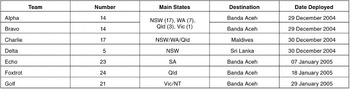
On 26 December 2004, the South East Asia tsunami hit countries in the Indian Ocean rim, killing >250,000 people and affecting millions, with the full impact of the disaster still being assessed years after the event.Reference Bloom7 The South East Asia tsunami was a landmark event in the history of Australian disaster management. This was the first time an organized, civilian-based team from Australia (representing the Australian Government) was deployed internationally. This previously had been the primary responsibility of the Australian Defence Force (ADF). However, Australian civilians had deployed as individuals through non-governmental organizations (NGO), such as the International Red Cross or Médicines Sans Frontiéres (MSF). Following the tsunami, seven civilian teams (Alpha to Golf) were deployed under the Australian Assistance Plan (AUSASSISTPLAN).Reference Templeman8 The disaster medical assistance teams (DMATs) that responded to the South East Asia tsunami are listed in Table 1. The teams came from multiple states, were deployed to a number of different countries, and filled a variety of roles based on needs and the timeline of response. Subsequently, further teams also were deployed following the Yogyakarta earthquake in Java, Indonesia in 2006.
Australian Disaster Medical Assistance Teams deployed following the South East Asia tsunami

(NSW = New South Wales; NT = Northern Territory; Qld = Queensland; SA = South Australia, Vic = Victoria; WA = Western Australia)
Disaster medical assistance teams remain accountable for the standards of care provided by their team members, with the education and training of team members prior to deployment being an essential component of preparedness. The delivery of appropriate education and training for DMAT members requires an understanding of learning needs, preferred learning styles, the effectiveness of existing programs, and the value of experience in preparing team members for deployment.
Much of the literature concerning DMATs, including the Australian DMAT experience,Reference Bridgewater, Aspinall and Booth9–Reference Robertson, Dwyer and Leclercq16 consists of individual team reports, which often are anecdotal. The lack of standards for DMATs also has made in-depth evaluation difficult for external reviewers and team members. Hence, there have been few studies examining DMAT deployments, and few dedicated studies of DMAT members in Australia. The present survey was part of a national program evaluating the Australian DMAT experience, and examining potential models for future use in Australia. The survey was undertaken in order to target the existing Australian DMAT experience base and to explore and identify issues raised by these groups. The experience base primarily includes those individuals actually deployed “on the ground”, and this aspect of the survey explores their education and training related to DMAT deployment.
Methods
All team members associated with Australian DMAT deployments from the 2004 South East Asia tsunami were surveyed via their State/territory jurisdictions. The study protocol was reviewed and approved by the James Cook University Human Research Ethics Committee in 2006 (Approval No. H2464). The support of the national Australian Health Protection Committee (AHPC) also was sought and given for the survey. Representatives of the AHPC, through their State and Territory jurisdictions, identified 118 DMAT personnel from Teams Alpha to Golf and mailed questionnaires on the authors' behalf to preserve anonymity. No follow-ups could be performed.
Data were collected by means of a self-reporting questionnaire, which included an information sheet. The questionnaire was piloted and validated by use of a sample of senior medical staff with disaster deployment experience. The questionnaire was completed anonymously. A reply paid envelope was included for convenience; however other options for return were given, including facsimile. There were no penalties or rewards for participation, and informed consent was implied if team members completed and returned their questionnaires. The education and training component of the survey itself constituted about four A4-sized pages, and comprised the following formats of questionnaire completion: (1) simple tick-box format; (2) ranking; and (3) short answer responses. Data were collected on demographic details as well as education and training issues.
Data were entered into a spreadsheet program and processed using the Statistical Package for the Social Sciences (Version 14.0, SPSS, 2006, Chicago, IL). Descriptive statistics were used, as the sample size was relatively small.
Results
The overall response rate for this survey was 50% (59/118). The majority of DMAT members who responded had deployed to Aceh (39), while seven had been to the Maldives, and one to Sri Lanka. Some had deployed more than once, including to Yogyakarta (8). Team members responded from all states that deployed personnel with highest response numbers from Queensland (22), South Australia (14), and Western Australia (13). Response rates from both New South Wales (6) and Victoria (1) were lower than other states, while overall numbers involved for Northern Territory were low (2). Responses were received from those with medical (24), nursing (11), logistics (6), allied health (3), and command (3) roles, as well as mixed roles consisting of medical/command (2), medical/logistics (1), nursing command (1) and nursing logistics (1).
The majority of team members responding to the survey were 45–55 years of age (31) with 16 25–35 years of age, eight 55–65 years of age, three 25–35 years of age, and one person >65 years of age. This age distribution is consistent with the mean level of clinical experience in their specialty of 21 ± 9 years). Approximately 75% were male (44/59) with 14 females responding, and one response was missing. Of the 59 responses, 15 (25%) had volunteered to go, 36 (61%) had been asked to go, and one person indicated that they had been ordered to go. Seven did not respond to this item.
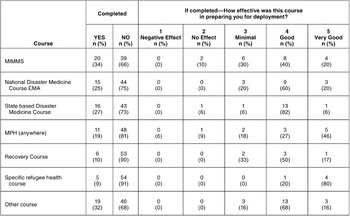
While most respondents had not participated in any specific training or educational program (Table 2), any kind of relevant training was regarded as important for preparing personnel for deployment. Thirty-four percent (20/59) had completed a Major Incident Medical Management Support (MIMMS) course, arguably the most widespread disaster-based teaching program in Australia. Only 27% (16/59) and 25% (15/59) of respondents indicated that they had completed the National Disaster Medicine course, run previously at the Australian Emergency Management Institute by Emergency Management Australia (EMA) and the Department of Health and Ageing, or state-based disaster medicine courses, respectively. Even less had completed formal training in public health (19%, 11/59), recovery (10%, 6/59), or refugee health (9%, 5/59). Twenty-five provided responses about which aspects of these courses provided most help preparing for deployment. The most common response was work experience and training (7), followed by logistics planning (4), mock training (3), and knowledge of tropical disease (2).
Education and training programs completed by Australian Disaster Medical Assistant Teams (DMATs) deployed following the Asian tsunami

(EMA = Emergency Management Australia; MIMMS = Major Incident Medical Management and Support Course; MPH = Master of Public Health)
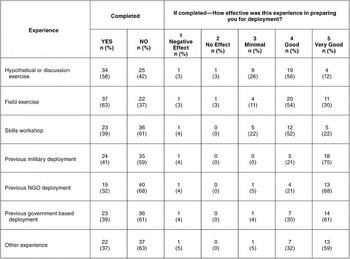
The majority of respondents had experience in disasters (Table 3), ranging from hypothetical exercises (58%, 34/59) to actual military (41%, 24/49), and NGO (32%, 19/59) deployments. Any experience, theoretical or practical, was regarded as effective preparation for DMAT deployments, although actual field experience was preferred. Forty provided responses about which components of these experiences helped most in preparing for deployment, with the the value of experience again evident. Previous emergency experience (23%, 9/40) and previous deployment (20%, 8/40) were the most frequent responses, followed by familiarity with clinical and public health issues (10%, 4/40), being flexible for the conditions (8%, 3/40), knowing what to expect (5%, 2/40), understanding issues and equipment (5%, 2/40), and specific training (5%, 2/40).
Exercises and deployment experiences of Australian DMATs deployed following the South East Asia tsunami

(NGO = non-governmental organization)
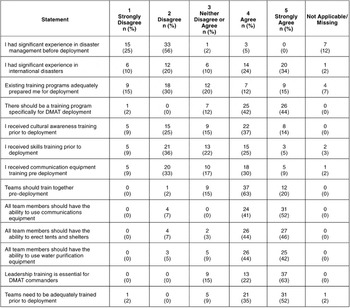
Fifty-eight percent (34/59) had significant experience in international disasters, although only 5% (3/59) felt they had experience in disaster management before deployment (Table 4). Only 27% of respondents felt that existing training programs adequately prepared them for deployment. In contrast, nearly all (88%, 52/59) agreed that teams must be trained adequately prior to deployment, and similar numbers (86%, 51/59) felt that a specific DMAT training program should be developed. Thirty-four percent (20/59) of respondents indicated that they had not received cultural awareness training prior to deployment, while 42% (25/59) indicated that they had not received communication equipment training prior to deployment. Most respondents felt that DMAT members needed to be able to handle practical aspects of deployments, including training as a team (68%, 40/59), use of communications equipment (93%, 55/59), ability to erect tents and shelters (90%, 53/59), and use of water purification equipment (86%, 51/59). Almost all respondents (85%, 50/59) felt that leadership training was essential for DMAT commanders.
Levels of agreement of statements concerning education and training for Disaster Medical Assistance Team members

Discussion
This study represented the first national survey of Australian DMAT members deployed to date. The education and training experiences of these deployed professionals in relation to deployment have been sought, and the findings ideally incorporated as part of future planning and preparedness. This is particularly relevant as the Australian Government recently has launched an Australian Medical Assistance Teams (AUSMAT) program.17
Need for Training
This study of the Australian DMAT experience found that, although team composition was varied, health professional membership was consistent with that described by other authors.Reference Wallace, Hogan and Burstein18 The DMAT members were quite experienced, with 53% of personnel in the 45–55 years age group (31/59) having, on average, >21 ±9 years) experience. Despite this experience level, only 27% of respondents felt that existing training programs adequately prepared them for deployment. Disaster management differs from care of individual patients both qualitatively and quantitatively. It is not just a question of magnitude, with an increase in patient numbers, but also a different type of patient and a system under extreme stress.Reference Quarantelli19 Standard medical and nursing training is unlikely to prepare hospital or community staff adequately for work in complex emergencies or disasters.Reference Birch and Miller20,Reference Garner and Nocera21 Similarly, the military acknowledge that it is unacceptable to send units trained for combat, and hope they quickly adjust to emergency relief practices. These staff, including medical, find they do not have the training necessary for providing humanitarian assistance.Reference Sharp, Wightman and Davis22,Reference DeZee, Berbano and Wilson23
The growing need for disaster relief work and a rapid response has led many organizations to place inexperienced or inadequately trained personnel in the field. Such enthusiastic but inexperienced workers may be of limited usefulness.Reference Russbach4,Reference Campbell24,Reference Moresky, Eliades and Bhimani25,Reference Gaudette, Schnitzer and George28 They even may have a negative impact, as such personnel can threaten the program success, frustrate beneficiaries and donors, provide an additional burden for the local population,Reference Russbach4,Reference Frisch26 and even damage the credibility of the agency.Reference Brennan and Nandy27
Relief teams coming from abroad, whether government–, military–, or NGO-based, must be well-qualified and professionally trained.Reference Russbach4,Reference Gaudette, Schnitzer and George28 Staff trained in basic principles will make more appropriate decisions and fewer mistakes.Reference Moresky, Eliades and Bhimani25,Reference VanRooyen, Hansch and Curtis29 However, there is general acknowledgment that training must be improved across all levels of deployment and from all disciplines.Reference Campbell24,Reference Yamada, Gunatialke and Roytman30 The Pan American Health Organization (PAHO) states that basic training in disaster management should be strengthened at all levels of education31 with a need to develop internal training programs and guidelines.Reference Griekspoor and Sondorp32 There have been efforts by a number of countriesReference Cummings, Della Corte and Cummings33,Reference Fitzgerald, Aitken and Arbon34 and organizations, such as the World Association for Disaster and Emergency Medicine (WADEM), to standardize education in disaster medicine.Reference Seynaeve, Archer and Fisher35 Presently, there is no accepted international standard upon which the education and training of international humanitarian aid or DMATs can be assessed.
Training Completed
In this survey, most respondents had not participated in any specific training or educational program. This is consistent with the international humanitarian aid experience. A survey of NGOs deploying health workers to acute human emergencies found only 34% (18/53) provided classroom teaching or orientation prior to departure, and less than half provided pre-field training in health care.Reference Moresky, Eliades and Bhimani25
Of the respondents in this survey that had completed programs, any kind of relevant training was regarded as important. Courses completed included MIMMS (34%, 20/59), national disaster medicine course (27%, 16/59) and state-based courses (25%, 15/59). The MIMMS was regarded as least helpful of the specific courses, but this should be viewed in context. The MIMMS has a focus on the initial management of mass casualty incidentsReference Sammut, Cato and Homer36 rather than humanitarian aid, and DMATs are unlikely to be deployed in the initial stages. Basic principles, including command structure, are likely to still be beneficial.
Less had completed formal training in public health (18%, 11/59), recovery (10%, 6/59), or refugee health (9%, 5/59). Although the numbers are small, public health and refugee health-based programs seemed to provide significant benefit for team members. Again, this is likely to be consistent with the timeline of response and likely will be DMAT roles.Reference Aitken, Leggat and Robertson37
The Importance of Experience
The importance of experience was a common theme in the participants' responses. The majority of respondents stated they had actual experience in international disasters (58%, 34/59), either through military (41%, 24/49) or NGO (32%, 19/59) deployments. Only 5% (3/59) stated they had experience in disaster management before their DMAT deployment. This actual experience was felt to be beneficial, and provided more help in preparing for deployment than did coursework or other forms of instruction. The value of military, developing country, and remote medical experience also was noted following the Team Charlie deployment to the Maldives.Reference Robertson, Dwyer and Leclercq16
However, preserving an experienced cohort of team members often is problematic. The majority of people responding to humanitarian crises are novices who volunteer for short periods, then return to their normal occupations without passing on their experiences.Reference Birnbaum38 In general, the lack of a career structure for international relief work encourages high turnover and recruitment of inexperienced personnel.Reference Telford, Cosgrove and Houghton39 Moresky et al, Reference Moresky, Eliades and Bhimani25 found that only 18 out of 53 (34%) NGOs surveyed required that personnel had previous international experience. The Tsunami Evaluation Coalition also made note of the shortage of relevant expertise and high turnover of international staff.Reference Telford, Cosgrove and Houghton39 A lack of needed skills also is a major cause of poor employee morale, which may be a reason for the high turnover of staff,Reference VanRooyen, Hansch and Curtis29 while PTSD symptoms in team members has been found to be significantly greater in those with less than three previous disaster experiences.Reference Armagan, Engindeniz and Devay40 This reinforces the need for a structured and adequately trained and supported DMAT program that enables retention of staff and experience.
Specific DMAT Training
Nearly all of the DMAT members that responded to the survey agreed that teams must be adequately trained prior to deployment, and that a specific DMAT training program must be developed. The value of disaster medicine training was noted by Robertson et al Reference Robertson, Dwyer and Leclercq16 and the need for specific training stated by Pearce et al Reference Pearce, Mark and Gray15 in their description of the Western Australia and Southern Australian deployment experience.
Any training and educational program should be based on a set of predefined and established learning objectives. Education and training in disaster medicine is no different. Various training options exist in disaster medicine with no consensus view, however, on which of these methods is most effective.Reference Rutherford41–Reference Tadmor, Morse and Qureshi44 Evaluation of different educational methodologies shows each has its own advantages and disadvantages.Reference Skeff, Berman, Stratos, Edwards and Maher45 The selection of the most appropriate of these educational methodologies, with respect to learning objectives, group characteristics, learning preferences, and available time and money, is an important part of the planning process for any educational session or program.Reference Hotveldt and Laskowski46,Reference Kaufman47 The selected teaching style also must consider the target groups prior knowledge and stage of learning, so that the learner is challenged while still integrating new information with old.Reference Vaugh and Baker48–Reference Hutchinson50
This can be even more challenging when training involves multidisciplinary groups and inter-agency cooperation.Reference Brunet51 Teamwork skills must be addressed specifically during training,Reference Ford and Schmidt52 and training may improve team efficiency and effectiveness of completing key tasks in a crisis situation.Reference DeVita, Schaefer and Lutz53 Only one of the respondents disagreed with the statement that team members should train together. It also is imperative that realistic training is carried out, and training standards and minimum training requirements are established before training commences.Reference Holland and Wooster54,Reference Moore and Blasser55
In addition to these issues, emergency response training poses a number of unique problems. There is a need to retain material learned in training over a long period of time between emergencies, to apply information learned from the training conditions to the unforeseen conditions during the emergency, and to develop effective mechanisms for teamwork.Reference Ford and Schmidt52 For knowledge and skills to be retained, when DMAT deployment is infrequent, requires an ongoing educational and exercise program.
The design of a specific DMAT training program must include a broader focus than clinical care alone. Most of the survey respondents felt that DMAT members needed to be able to handle practical aspects of deployments, such as use of communications equipment (93%, 55/59), ability to erect tents and shelters (90%, 53/59), and use of water purification equipment (86%, 51/59). In this survey, 34% of respondents (20/59) indicated that they had not received cultural awareness training, and 42% (25/59) indicated that they had not received communication equipment training prior to deployment. Almost all respondents (85%, 50/59) felt that leadership training was essential for DMAT commanders.
This is consistent with statements by the US-based National Disaster Medical System (NDMS), that state that teams should be trained in field deployment and living, air-medical conditions, casualty collection and regional evacuation point operations, NDMS organization, structure, and administrative requirements.56 Each team member also must be familiar with all of the equipment and basic load supply, as well as their job function.Reference Wallace, Hogan and Burstein18 They also must be able to use all the equipmentReference Holland and Wooster54,56 and learn the function of the Incident Command System (ICS).Reference Yamada, Gunatialke and Roytman30,56 The three key areas identified by the Swiss that warrant further training and development are rapid assessment, flexibility in assistance, and rapid decision-making.Reference Frisch26 Burkle et al also note that international emergency and disaster medicine increasingly requires a strong knowledge base in health and human rights, logistics, international humanitarian law, international organisational management, negotiation, and mediation.Reference Burkle, Isaac-Renton and Beck57,Reference Leus58
Security courses are available and should be considered;Reference Birch and Miller20 a number of NGOs now offer staff training in security.Reference VanRooyen, Hansch and Curtis29 However, many organizations lack the capacity to train field personnel in areas such as security, management, standardized programs, field educational methods, and cultural sensitivity,Reference Moresky, Eliades and Bhimani25 while existing educational programs need support.Reference Waxman, Guest and Atkinson59 Moresky et al Reference Moresky, Eliades and Bhimani25 found that the majority of organizations used manuals as the primary method of training for workers before going into the field (31/53, 59%), with most (45/53, 85%) also supplying their workers with trip briefings from prior personnel.
There has been a recent increase in the number of training courses available for health workers considering disaster response.Reference Campbell24 These include the International Committee of the Red Cross (ICRC) month-long Health Emergencies in Large Populations (HELP) course designed to prepare medical coordinators in disasters,Reference Russbach4,Reference VanRooyen, Hansch and Curtis29,60 and the Combined Humanitarian Assistance Response Training (CHART) course and others offered by the International Rescue Committee and the Office of Foreign Disaster Assistance.Reference Moresky, Eliades and Bhimani25,Reference VanRooyen, Hansch and Curtis29 A number of Websites and databases list training opportunities with Humanitarian agencies, including the Australian Development Gateway,61 Relief Web, InterAction, and the International Health Exchange.Reference Campbell24,Reference Moresky, Eliades and Bhimani25 However, few of these courses are aimed specifically at staff deploying as part of an international disaster response, and the completion of courses by individuals does not allow team building to occur. An additional resource for self-directed learning is the “Virtual Disaster Library” developed by the WHO and PAHO, which has > 400 scientific and technical documents available both online and as a CD-ROM.62
A more medically-based educational program for disaster relief workers has been developed by the US-based DMATs with a national training program for DMATs proposed.Reference Wallace, Hogan and Burstein18 Training consists of classroom programs and field training, and an annual conference that offers workshops and training courses for members. Ongoing training also helps DMATs to function as a team once deployed. A similar DMAT-specific training program is being developed in Western Australia, with both an initial training program and ongoing participation to maintain currency, but it should be broadened to other States and Territories. Ideally, this would promote standardization of education across state-based teams, and incorporate practical aspects of team deployment, as well as team-based training. Specific leadership for commanders should also be provided.
Additional Target Groups
Education and training should not be restricted to the deployed staff. Training also is needed for the operations room staff, which should address media training, information technology and telephone skills, report log training, press releases, dealing with next of kin, and handling specific requests.Reference Holland and Wooster54 Program managers also need training in management skills, such as project assessment and planning, finance and personnel management, and quality assurance and reporting.Reference VanRooyen, Hansch and Curtis29 If mixed civil–military models are used, then military personnel and NGO staff must train together before deployment. While this may not produce agreement, it can help produce mutual understanding.Reference Hodgetts, Mahoney and Mozumder63–Reference Leggat and Seidl65
This study represented an analysis of data collected on a cross-sectional survey of Australian DMAT members. This group may encounter different challenges to humanitarian aid workers and other groups responding to disasters. In addition, the limited responses from some states, particularly New South Wales and Victoria, suggested coverage concerns. The inability to undertake follow-ups also may have contributed to the poor response in these jurisdictions. This is offset to some degree by the overall response rate, levels of experience among responders, and the representative mix of disciplines. Hence, although generalization and extrapolation of these data will be limited—the data can be useful in developing a more effective response to the deployment health of members of future DMATs.
Conclusions
This study of Australian DMAT members suggests that more emphasis should be placed on the education and training of teams. Prior planning is required to ensure the success of DMAT deployments, and training should include practical aspects of deployment, such as use of communications equipment and water purification systems, ability to erect tents and shelters, and cultural awareness. A few of the respondents had received cultural awareness or communications equipment training prior to deployment. Leadership training was seen as essential for DMAT commanders as was team-based training.
While most respondents had not participated in any specific training or educational program, any kind of relevant training was regarded as important for preparing personnel for deployment. The most commonly completed course related to major incident medical management and support, but seemed to offer less benefit than more generic disaster health courses. Few had completed formal training in public health, recovery, or refugee health. Australian DMAT members, who generally are a highly experienced group of health professionals, felt that existing training programs did not adequately prepare them for deployment. They felt that teams must be adequately trained prior to deployment, and have identified the need for specific DMAT training.
Acknowledgments
The authors thank the AHPC for endorsing and assisting with the survey. They also express their appreciation to all DMAT members who responded to the survey, and acknowledge the support of Dr Frances W. Leggat for her data coding and entry. This research was funded by the Public Health Education and Research Program, Department of Health and Ageing, Commonwealth of Australia. The first author is supported by a Noel Stevenson Fellowship from the Queensland Emergency Medicine Research Foundation.
Dedication
The authors dedicate this research to the thousands of people affected by the South East Asia tsunami and Yogyakarta earthquake.
Conflict of Interests
The authors have no interests to declare.
Abbreviations:
AHPC = Australian Health Protection Committee
DMAT = Disaster Medical Assistance Teams
MIMMS = Major Incident Medical Management and Support Course
NDMS = National Disaster Medical System
NGO = non-governmental organization
EMA = Emergency Management Australia