Introduction
Psoroma sphinctrinum var. microphyllizans Nyl. was described from a Dumont D'Urville collection from New Zealand without further geographical information (Nylander 1863). The taxon was referred to in later studies (e.g. Hue Reference Hue1892; Zahlbruckner Reference Zahlbruckner1925) but, except for a further Charles Knight collection referred to by Nylander (Reference Nylander1888), no new information was added on the taxon for nearly a century until it was recorded from Argentina by Lamb (Reference Lamb1958), and later claimed to be rare in what are now the Chilean regions IX and X by Follmann (Reference Follmann1965). Galloway (Reference Galloway1983) raised the variety to species rank and later (Galloway Reference Galloway1985) treated it as a widespread Australasian phyllidiate counterpart of Psoroma sphinctrinum (Mont.) Nyl. Psoroma microphyllizans (Nyl.) D. J. Galloway was considered to be widespread in parts of Australia by Jørgensen & Galloway (Reference Jørgensen and Galloway1992), who cited five localities and provided an illustration. It was also illustrated by Kantvilas & Jarman (Reference Kantvilas and Jarman1999), who remarked that it was the most common species of Psoroma s. lat. within rainforests in Tasmania.
According to Quilhot et al. (Reference Quilhot, Piovano, Arancibia, Garbarino and Gambaro1989), Psoroma microphyllizans occurs as two chemotypes in Chile; one with vicanicin and pannarin, the other with vicanicin alone, a pattern reiterated for Australia (Jørgensen & Galloway Reference Jørgensen and Galloway1992). The species was included in the checklist of Chilean lichens by Galloway & Quilhot (Reference Galloway and Quilhot1999), and also accepted for Argentina by Calvelo & Liberatore (Reference Calvelo and Liberatore2002), although still maintained by the latter authors at varietal rank. Jørgensen (Reference Jørgensen2001) transferred it to Pannaria, and maintained it as a phyllidiate counterpart of P. sphinctrina (Mont.) Tuck. ex Hue, and this view has prevailed until now (see Galloway Reference Galloway2007). One sample of Pannaria microphyllizans from Australia was sequenced and included in a phylogenetic study by Ekman & Jørgensen (Reference Ekman and Jørgensen2002). This sequence was also used by Passo et al. (Reference Passo, Stenroos and Calvelo2008), who added an additional P. microphyllizans sample from Argentina.
A problem with studying the taxonomy of tripartite species of Pannaria is that type specimens of some taxa are small and fragmentary. This is the case with P. pallida (Passo et al. Reference Passo, Calvelo and Stocker-Wörgötter2004), P. contorta (Passo & Calvelo Reference Passo and Calvelo2006) and also with P. microphyllizans. The holotype of the last is very small and sterile. However, it is now possible to establish that P. microphyllizans is definitely not a member of the P. sphinctrina group, but should rather be compared with the species P. athroophylla (Stirt.) Elvebakk & D. J. Galloway, a topic to be dealt with in a future study.
Pannaria vischii C. W. Dodge is another species that has been associated with the P. sphinctrina complex (Jørgensen Reference Jørgensen2003). Its holotype was searched for in vain, and paratypes were determined as P. microphyllizans by Galloway (Reference Galloway2007). However, the thick perispore included in the protologue describing P. vischii (Dodge Reference Dodge1971) indicates that this problem taxon should also be included in a study of P. microphyllizans s. str. and P. athroophylla, rather than being compared with species in the P. sphinctrina complex.
The P. sphinctrina complex was recently expanded by the descriptions of three new species. Pannaria lobulifera Elvebakk and P. rolfii Elvebakk are locally distributed species in New Caledonia and Chile, respectively (Elvebakk Reference Elvebakk2007, Reference Elvebakk2011b ), and the regionally common species P. phyllidiata Elvebakk is almost restricted to New South Wales (Lumbsch et al. Reference Lumbsch, Ahti, Altermann, de Paz, Aptroot, Arup, Peña, Bawingan, Benatti and Betancourt2011). Pannaria phyllidiata is the first species described to replace what has, in the past, generally been interpreted as P. microphyllizans. The aim of the present paper is to describe two further species in this complex, both of which are widely distributed and very common.
Materials and Methods
This paper is based on material from the herbaria AK, BG, BM, CANB, H, HO, MSC, OTA, PC, S, TROM, UPS and WELT, in addition to a holotype in H-NYL and two specimens to be deposited at NY. Curators at CANU, CHR and FH also searched in vain for holotype material of Pannaria vischii. A total of 345 samples were examined. In microscope sections, iodine+ reactions were tested by adding IKI to mounts pretreated with KOH (Orange et al. Reference Orange, James and White2010). Perispore structures were studied in water mounts and restricted to spores liberated from their asci. Ascospore morphology was studied in detail by drawing sketches of c. 310 single ascospores from 28 collections, including previously unstudied samples of the related species P. sphinctrina and P. phyllidiata. Thin-layer chromatography of acetone extracts followed standardized procedures and used solvents A and C (Culberson Reference Culberson1972; Orange et al. Reference Orange, James and White2010). HPLC analyses were carried out using the methods of Feige et al. (Reference Feige, Lumbsch, Huneck and Elix1993) and Bjerke et al. (Reference Bjerke, Lerfall and Elvebakk2002). Nomenclature of ascospore structures follows Nordin (Reference Nordin1997). The cited localities are indicated within the regional political units of their respective countries, except for isolated islands. Samples without collection numbers are cited by their herbarium numbers.
The Species
Pannaria minutiphylla Elvebakk sp. nov.
MycoBank No: MB801571
Pannariae phyllidiatae similis, sed phyllidiis minoribus, horizontalibus vel semierectis et longi-ellipsoideis ascosporis differt.
Typus: New Zealand, North Island, Wellington: Haurangi (=Aorangi) State Forest Park, Mt. Ross Track, 41°27′S, 175°20’E, on Cassinia, 1 June 1991, B. Polly (WELT L3317—holotypus).
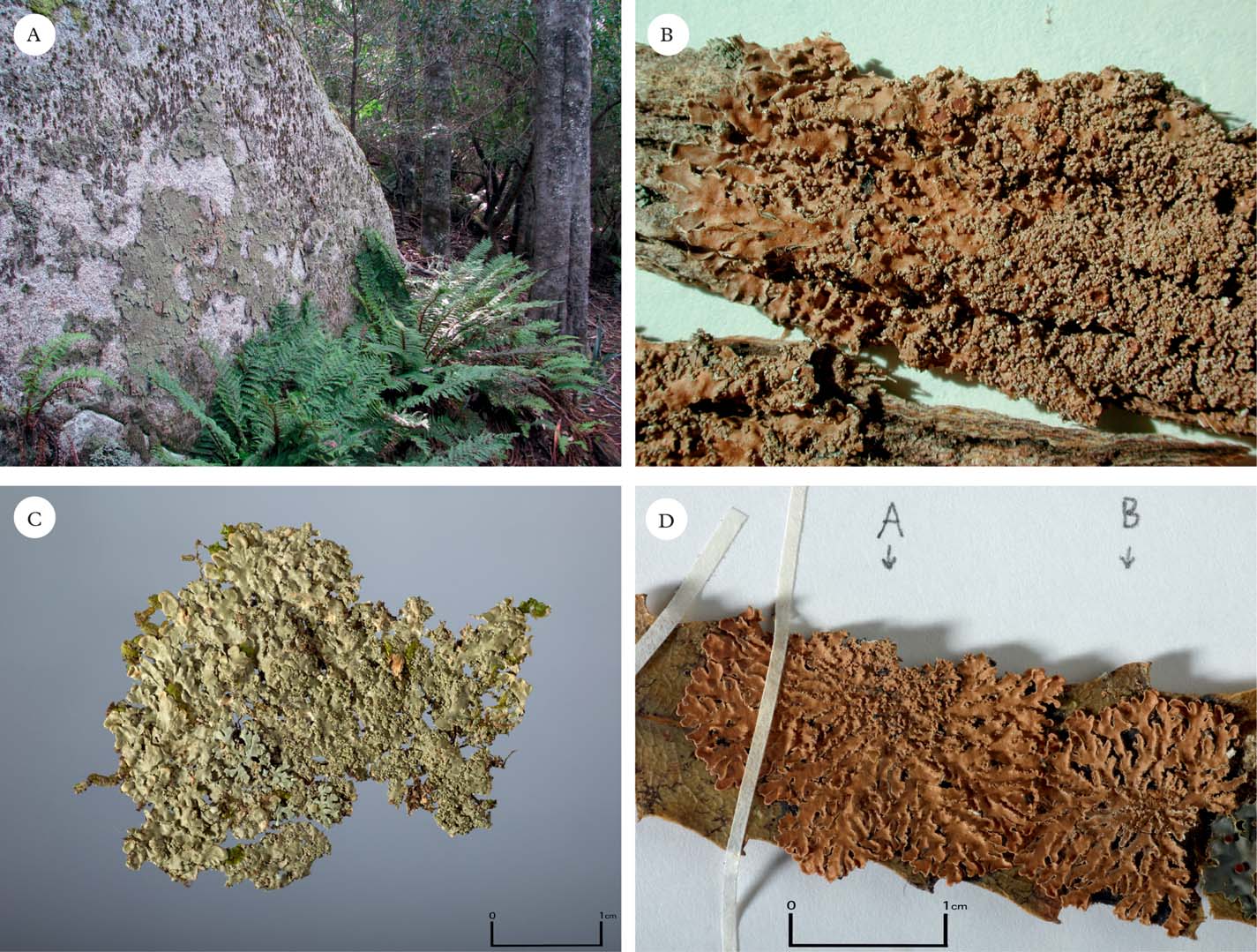
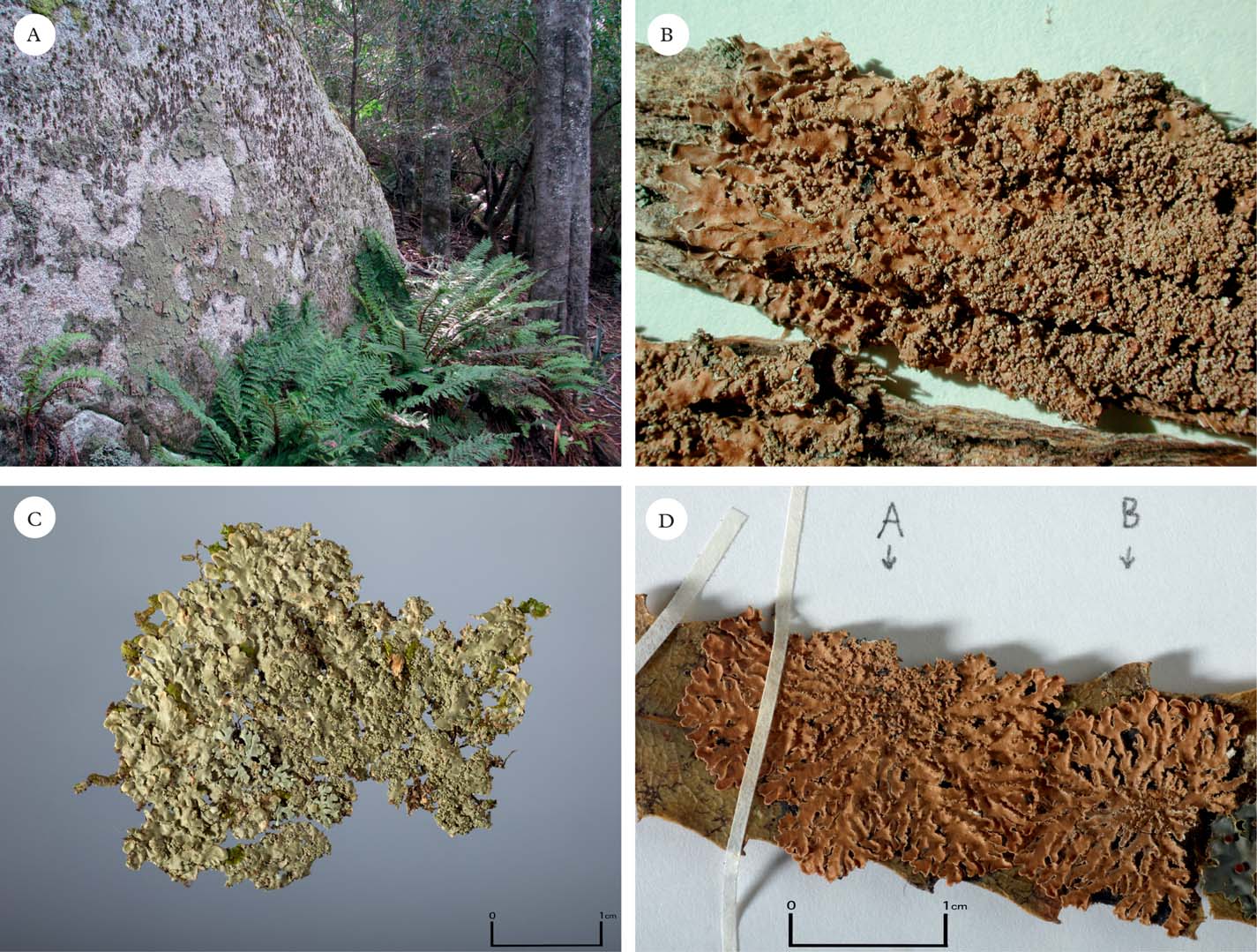
Pannaria minutiphylla. A, habitat, Australia, Victoria, Baw Baw National Park (Elvebakk 08:054); B, part of holotype; C, Australia, Victoria, Morwell National Park (Elvebakk 08-003; D, growing with P. pulverulacea (right) on Knightia excelsa leaf (Wright 9442).
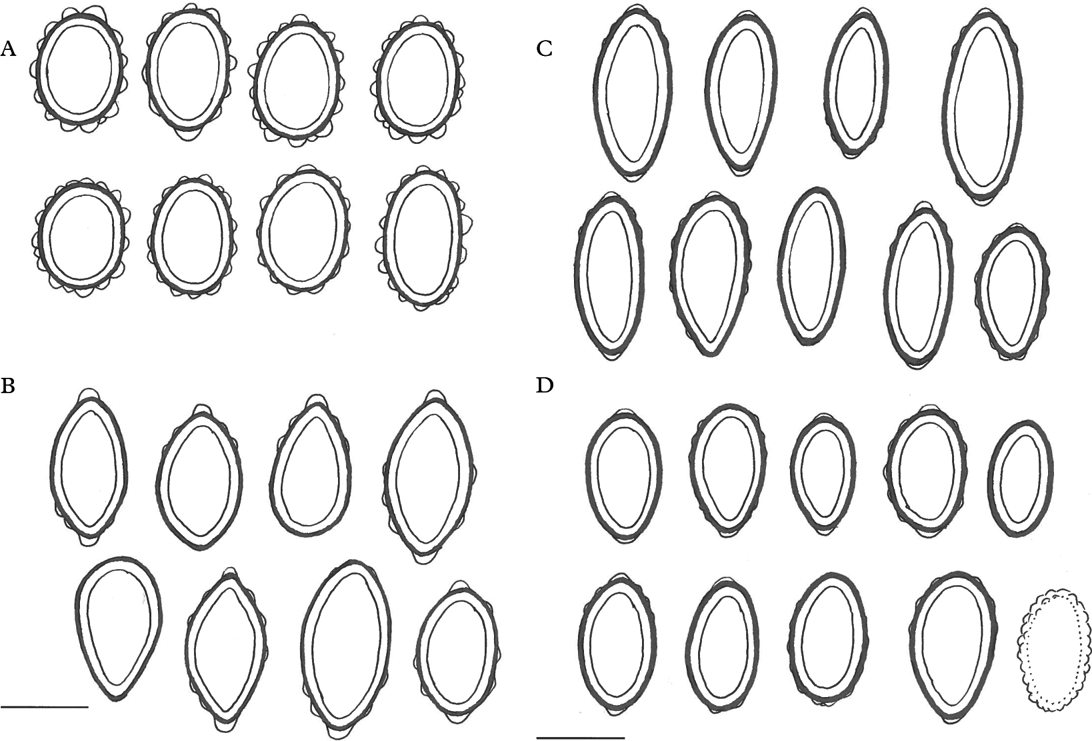
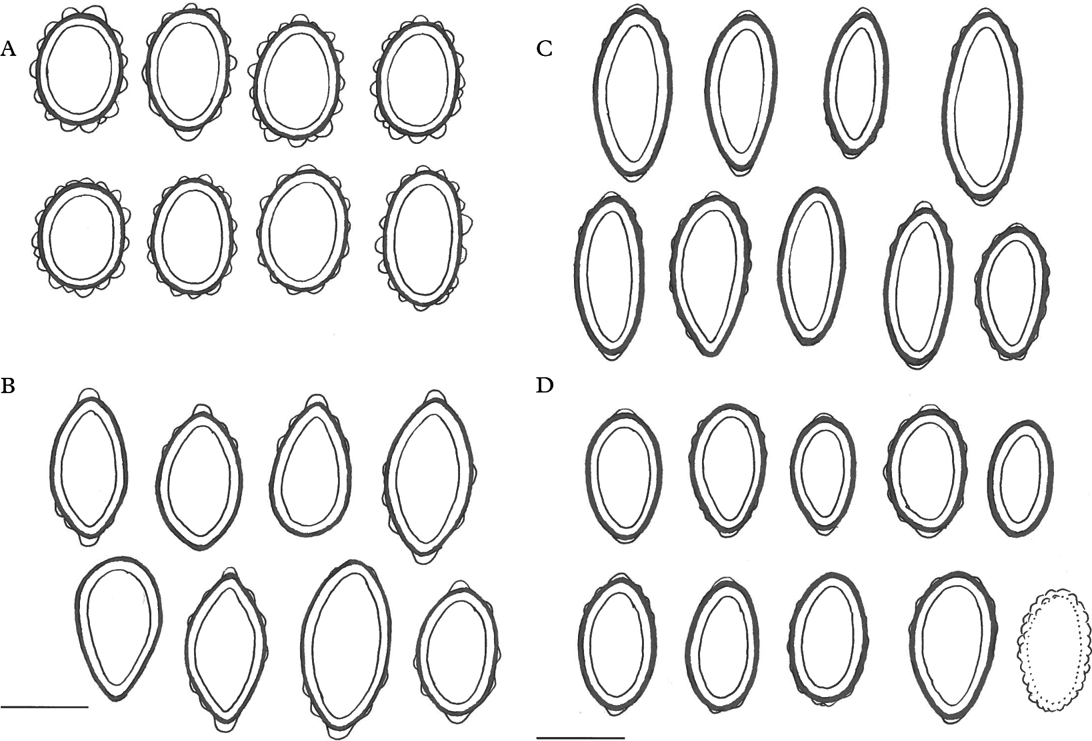
Ascospores. A, Pannaria sphinctrina; B, P. phyllidiata; C, P minutiphylla; D, P. pulverulacea. Scales: =10 µm.
Thallus foliose, corticolous, foliicolous or occasionally saxicolous or on man-made substrata, forming rosettes 3–15 cm diam., closely attached to the substratum unless growing over bryophytes or other uneven substrata. Lobes irregularly to subdichotomously branched, discrete in peripheral parts, imbricate to centrally coalescing, 0·7–1·2 mm wide and up to 10 mm long, 80–140 µm thick, flattened to weakly concave; margins entire, narrowly recurved and thickened; upper surface pale greyish green when fresh and dry, salad-green when fresh and moist, gradually turning chestnut brown after storage, glabrous and glossy. Upper cortex 25–40 µm thick, with the upper third developing brown pigmentation after storage and almost sclerenchymatous near the surface, paraplectenchymatous below, with cell lumina globose to irregularly ellipsoidal, 8–15 µm long, and walls 1·5–3·0 µm thick. Phyllidia common, 0·2–0·3 mm tall, mostly developed along margins, rounded and constricted at base, subhorizontal or semi-erect, upper side corticate, ecorticate on the lower side, sometimes forming coralloid masses and then less conspicuously dorsiventral. Photobiont layer c. 20 µm thick, composed of globose to subglobose cells 5–15 µm diam., comparable to Myrmecia. Medulla 50–60 µm thick, mostly white, dark brown in lower part. Lower cortex lacking. Rhizines common, brown, simple to sparingly branched. Hypothallus felt-like, brown, sometimes forming blackish prothallus to 3 mm wide, particularly when growing on smooth bark or directly on evergreen leaves.
Cephalodia common, laminal on upper surface, globose to subglobose when young, becoming irregularly pulvinate, and finally placodioid-nodulose and to 2 mm diam., occasionally also developed on the hypothallus and the lower surface. Epicortex as in the green-algal thallus, but with lumina 5–10 µm diam. Cyanobiont Nostoc, with cells greyish green, subglobose to irregularly ellipsoidal, 3·0–4·5×4–7 µm diam., arranged within indistinct spherical glomeruli, 20–35 µm diam., lacking visible chain structures.
Apothecia absent, sparse or common, laminal, substipitate, 1–3 mm diam.; disc rufous-brown, plane to weakly concave, often with concentric depressions and granular deposits; thalline margin crenate-striate, often with phyllidia; epithecium pale brown, 10–15 µm tall: hymenium colourless, intensely IKI+ blue, 90–100 µm thick; hypothecium pale brown, c. 80 µm thick, IKI−; paraphyses simple to weakly branched, septate, with slightly swollen apices; asci clavate, 8-spored, 70–90×15 µm, lacking internal IKI+ amyloid structures. Proper ascospores hyaline, non-septate, regularly elongate-ellipsoid, distally obtuse, 6·5–9·0×15–21 µm; perispores long-ellipsoidal, 6·5–9·0×16–22 µm, distinctly verruculose when immature, with a few simply developed verrucae when mature, and with apical, pulvinate extensions present in most spores.
Secondary chemistry
TLC: vicanicin (major), and 3–4 unidentified terpenoids (trace), 4-O′-methylvicanicin in a single sample. HPLC: vicanicin (major), norvicanicin occasionally in trace amounts.
Etymology
The specific epithet refers to the species' numerous small phyllidia.
Distribution and habitat
In Australia, the species is common in Victoria and Tasmania. In New Zealand it is common throughout both North and South Islands, and is currently recorded from 13 of New Zealand's 16 provinces, and from the Auckland Islands and Campbell Island. The first published report was a C. Knight collection from New Zealand by Nylander (Reference Nylander1888, as Psoroma sphinctrinum var. microphyllizans Nyl.).
The species is common on trunks of a range of phorophytes including the following species and genera: Aristotelia serrata, Atherosperma moschatum, Berberis, Cassinia, Coprosma, Dracophyllum, Eucryphia, Fuchsia excorticata, Freycinetia, Halocarpus bidwillii, Hedycarya arborea, Kunzea ericoides, Leptospermum, Libocedrus plumosa, Melaleuca, Metrosideros, Nothofagus, Olearia, Phebalium, Phyllocladus, Pittosporum, Podocarpus (three species noted), Prumnopitys ferruginea and P. taxifolia, Pseudopanax, Pseudowintera colorata, Salix, Tasmannia lanceolata, and Weinmannia. Occasionally it was found growing on rocks or on leaves of Beilschmiedia tawa, Knightia excelsa, Libocedrus plumosa and Hymenophyllum sp. It has an altitudinal range from sea level to 1880 m near Arthur's Pass (on Phyllocladus) in New Zealand (Nelson s. n., WELT L2617)
Illustrations. Pannaria minutiphylla was illustrated from Australia by Jørgensen & Galloway (Reference Jørgensen and Galloway1992: 286) and by Kantvilas & Jarman (Reference Kantvilas and Jarman1999: 130), both as Psoroma microphyllizans.
Additional selected specimens (paratypes) studied (of a total of 124). Australia: Victoria: Baw Baw National Park, 2 km from Erica car park along Mushroom Rock path, 37°53′S, 146°22′E, 2008, A. Elvebakk (TROM). Tasmania: along the Enchanted Walk, near Cradle Mt. Lodge, 41°39′S, 145°57′E, 1990, J. A. Elix 23617 (CANB); Robbins Island Track, just N of Denium Hill, 25 km NW of Smithton, 40°44′S, 144°53′E, 1993, J. A. Elix 402722 & G. Kantvilas (CANB); Sumac Road, spur 2, S of Arthur River, 41°08′S, 145°02′E, 1993, J. A. Elix 40182 & G. Kantvilas (CANB); The Blue Tier Forest Reserve, along track to Mt. Michael from Sun Flats Road, 41°15′S, 148°01′E, 2011, W. R. Buck 58065 (NY); Lake Skinner Track, 42°56′S, 146 42′E, 1980, G. Kantvilas 243/80 (HO); Hellyer River Gorge between Burnie and Waratah, 1968, W. A. Weber & D. McVean (Lich. Exc. Univ. Colorado no. 256) (BG).—New Zealand: Nova Zelandiae, Knight s. n. ( H-NYL 30781). North Island, Northland: Maungataniwha Ecol. District, Herekino, 35°1-′S, 173°1-′E, undated, B. W. Hayward 715 (AK). Auckland: Coromandel Ecol. Region, Mount Maungatawhiri, 36°47′S, 175°44′E, 1974, B. W. Hayward H44.231 (AK); Otorohanga Co., South Kawhia, Lake Koraha, 38°09′S, 174°55′E, 1989, A. E. Wright 9110 (AK). Wellington: Hutt Valley, Kaitoke Reg. Park, Loop Nature Walk, 41°03′S, 175°11′E, 1989, A. E. Wright 9442 (AK); Central Volcanic plateau, Erua, 39°13′S, 175°22′E, 1975–85, J. K. Bartlett s. n. (AK 178950). South Island, Nelson: Wangapeka Ecol. District, Cobb Valley, 41°0-′S, 172°3-′E, 1975–1985, J. K. Bartlett s. n. (AK 204208); Denniston Plateau, 3·5 km S of Denniston, 1980, J. A. Elix 7371 (CANB). Westland: Croesus Track, 46°20′S, 171°19′E, 2000, B. Polly (WELT L006390); Notown, 1927, G. E. & G. Du Rietz 1555a (UPS). Marlborough: D'Urville Island, east ridge to Mt. Maud, 40°52′S, 173°48′E, 1988, B. W. & G. C. Haywarth s. n. (AK-181636). Canterbury: Arthur's Pass summit, 1989, W. A. Nelson (WELT L2617). Otago: Dunedin, Morrison's Creek, 45°49′S, 170°29′E, 1998, B. Polly (WELT L6060); Orokonui Ecosanctuary, Dunedin, 45°46′S, 170°36′E, 2010, A. Knight s. n. (OTA 61751, TROM). Southland: Fiordland National Park, Cavern Track to tributary of Pig Creek, 45°46′S, 167°30′E, 1990, B. Polly (WELT L2742); Catlins State Forest Park, northern Backstream Road, 46° 27′S, 169°21′E, 1990, B. Polly (WELT L2764). Auckland Islands: Main Island, Laurie Harbour, Grey Duck Cove, 1963, P. W. James NZ1003/7 (BM). Campbell Island: disturbed area along road to old Tucker Cove Station, 1969, R. C. Harris 4473 (MSC).
Pannaria pulverulacea Elvebakk sp. nov.
MycoBank No: MB801572
Pannariae minutiphyllae similis, sed vice phyllidiorum parvis et partim corticatis sorediis, etiam sporibus brevi-ellipsoideis instructa est.
Typus: New Zealand, South Island, Marlborough, Clarence Ecological Region, Manakau Ecological District, Fyffe-Palmer Scenic Reserve, 42 20′S, 173 38′E, 330 m, on bark of Fuchsia excorticata in regenerating forest, 29 October 1993, A. E. Wright 12269 (AK 215380—holotypus!).
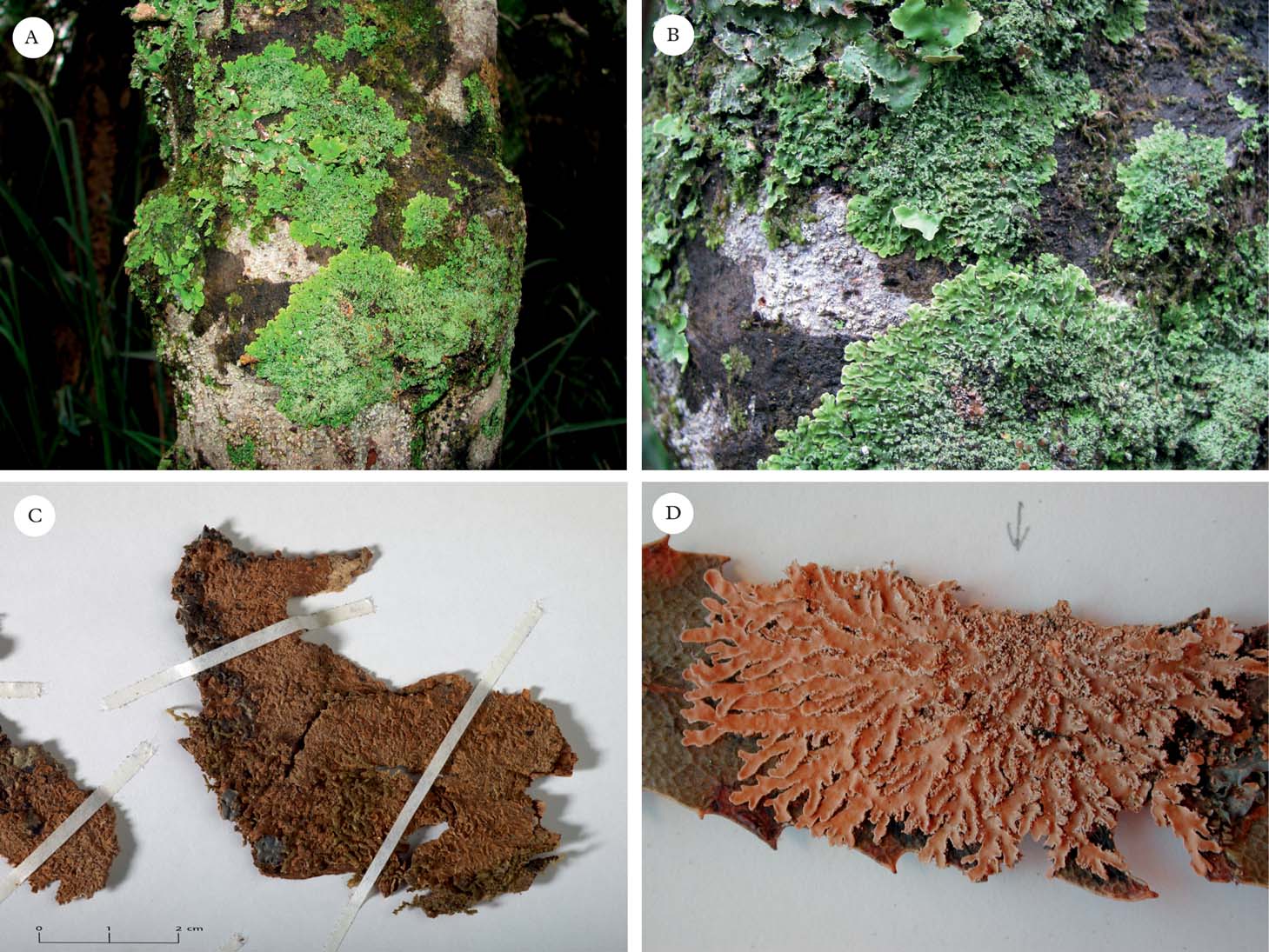
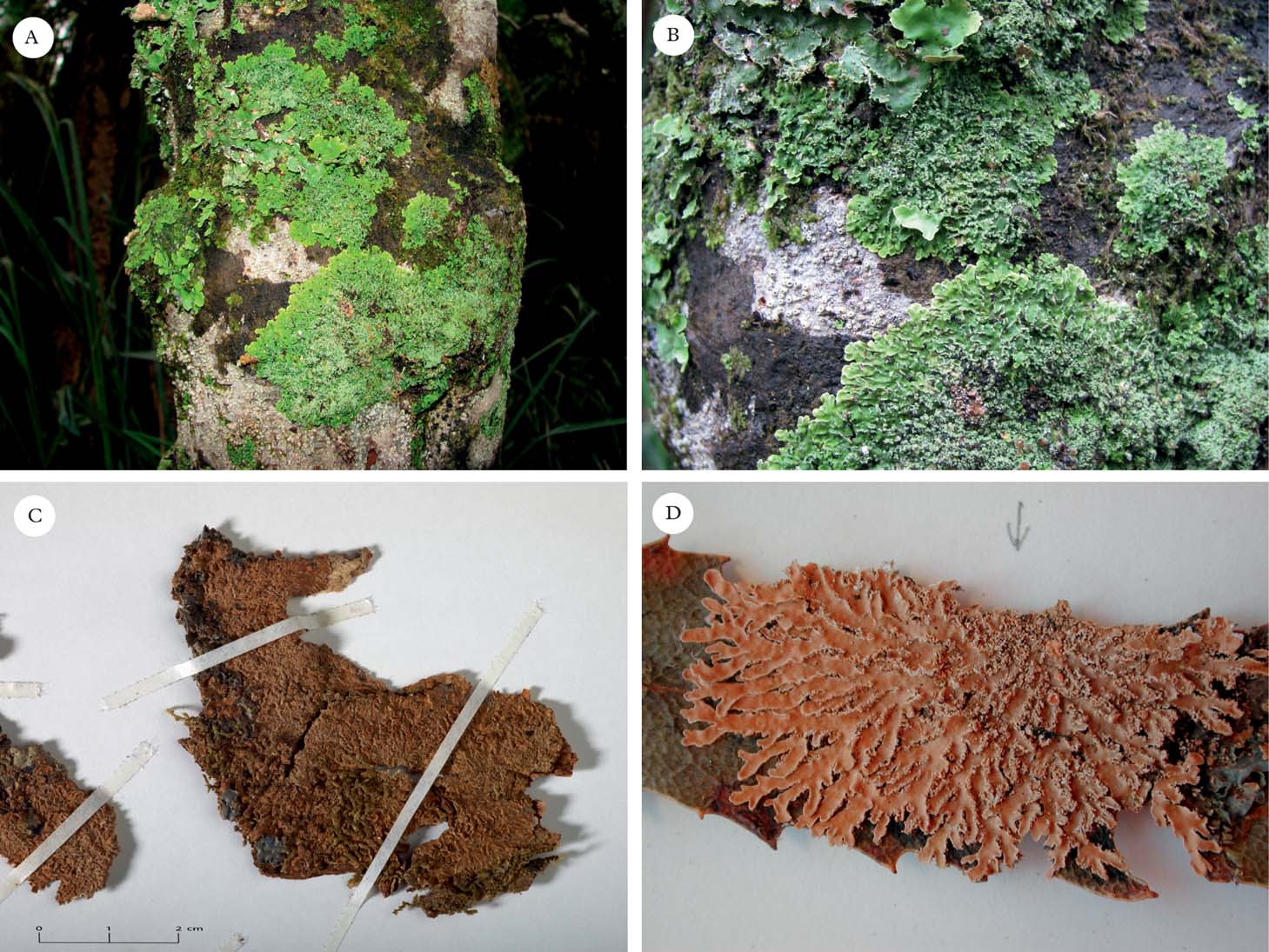
Pannaria pulverulacea. A & B, in the field, Australia, Victoria, Errinundra National Park (Elvebakk 08:112); C, holotype; D, on Knightia excelsa leaf (Wright 9442).
Similar to P. minutiphylla except in the following characters:
Soredia common, 0·06–0·12 µm diam., developed from the exposed medulla along margins or from cracks or eroded parts of the upper surface, almost approaching isidiomorphs, but cortex mostly incompletely developed.
Apothecia scattered, laminal, substipitate, 0·7–2·5 mm diam.; disc rufous-brown, flat; thalline margin crenate-striate, with soredia. Proper ascospores hyaline, non-septate, ellipsoidal, sometimes weakly asymmetrical, 6·5–10·0×13–18 µm; perispores ellipsoidal, sometimes asymmetrical, 6·5–10·0×13·5–20·0 µm, verruculose when immature, verrucae few and poorly developed when mature, with apical, pulvinate extensions present in most spores.
Secondary chemistry
TLC: vicanicin (major), and 3 to 4 unidentified terpenoids (trace), 4-O’-methylvicanicin in some samples. HPLC: vicanicin (major), norvicanicin occasionally in trace amounts.
Etymology
The epithet means ‘small-powdery’, and alludes to the patches of soredia in this species, which has the smallest vegetative propagules within the P. sphinctrina complex.
Distribution and ecology
In Australia this species is common in Victoria and Tasmania. In New Zealand it is known from the northern and southern regions of North Island, is widespread in South Island, and occurs also in Stewart Island, the Auckland Islands and Campbell Island. In Argentina it is common in coastal parts of Tierra del Fuego. In Chile it has isolated occurrences in the cloud forests at Fray Jorge in Region IV and in the Juan Fernández Archipelago, in addition to being common from Region IX and to the southernmost parts, mostly in wet forest areas. The species is common on tree trunks, and is occasionally found on rocks. Phorophytes include the following species and genera: Aextoxicum punctatum, Acacia, Atherosperma moschatum, Berberis, Chiliotrichum, Coprosma, Dracophyllum, Empetrum, Encalyptus, Eucryphia, Drimys winteri, Fuchsia excorticata and F. magellanica, Halocarpus bidwillii, Hebe, Kunzea, Leptospermum, Lomatia, Metrosideros, Myrsine, Nothofagus (eight species noted), Olearia, Ovidia pillo-pillo, Pandorea, Persea lingua, Pilgerodendron uviferum, Pittosporum, Podocarpus, Pomaderris, Prostanthera, Saxegothaea conspicua, Sophora, Trochocarpa, Ugni molinae and Weinmannia. It was collected on leaves of Laureliopsis (Elvebakk 06:522) and Knightia excelsa (with P. phyllidiella), and in Tasmania it was locally common on fences. It has a known altitudinal range from near sea level to 1370 m.
Additional selected specimens (paratypes) studied (of a total of 212). Chemodeme I (without 4-O′-methylvicanicin): Argentina: Tierra del Fuego: Isla Grande, Bahía Buen Suceso, 54°48′S, 65°16′W, 1971, H. A. Imshaug 50142 & K. Ohlsson (MSC); Lago Escondido, 54°40′S, 67°53′W, 1969, H. Roivainen (H); Isla de los Estados, Puerto San Juan, 54°44′S, 63°52′W, 1971, H. A. Imshaug 51894 & K. Ohlsson (MSC); Puerto Celular, 54°47′S, 64°19′W, 1971, H. A. Imshaug 52661 & K. Ohlsson (MSC).—Chile: IV Reg. Coquimbo: Prov. Coquimbo, Loma Frai Jorge, 1917, C. & I. Skottsberg 476 (S). Archipiélago de Juan Fernández: Isla Robinson Crusoe, 1·5 km W of San Juan Bautista along the path to Miradór de Selkirk, 33°38′S, 78°51′W, 2006, A. Elvebakk 06:272A (TROM). Reg. IX Araucanía: Provincia Cautín, Parque Nacional Conguillío Los Paraguas, 38°31′S, 71°44′W, 2002, T. Dahl 02:142 (TROM). Reg. XIV Los Ríos: Lago Riñihue, Riñihue, Cerro Tralcan, 1940, R. Santesson 7108 (S). Reg. X Los Lagos: Parque Nacional Puyehue, Refugio Antillanca, 1969, H. A. Imshaug 42858 (MSC); Chiloé, Cucao, 42°37′S, 74°07′W, 2000, A. Elvebakk 00:498 (TROM); Chiloé, 1872, Hassler (PC). Reg. XI Aysén: Cabañas Fiordo Queulat, near boundary of Parque Nacional Queulat, 44°32′S, 72°32′W, 2006, A. Elvebakk 06:493 (TROM). Reg. XII Magallanes y Antártica Chilena: Reserva Nacional Alacalufes, E side of Isla Juan, 50°39′S, 74°36′W, 1969, H. A. Imshaug 44186 & K. Ohlsson (MSC); Bahía Tuesday, S shore of Caleta San José, 52°51′S, 74°28′W, 1969, H. A. Imshaug 44770 & K. Ohlsson (MSC); Isla Riesco, Península Cordova, E side of Bahía Borca, 53°32′S, 72°30′W, 1969, H. A. Imshaug 45124 & K. Ohlsson (MSC); Parque Nacional Bernardo O'Higgins, Fiordo Peel, N side of Caleta Amalia, 50°56′S, 73°52′W, 1969, H. A. Imshaug 44454 & K. Ohlsson (MSC); Península Brunswick, SE part, Bahía San Nicolás, 53°50′S, 71°04′W, 1969, H. Imshaug 45370 & K. Ohlsson (MSC).—Australia: Victoria: Donna Buang-Healesville Road, 6 km NW of Warburton, 37°42′S, 145°40′E, 1986, H. Streimann 36256 (CANB); 90 km ENE of Melbourne, Cumberland Falls Scenic Reserve, Cora Lynn Falls, 37°32′S, 145°26′E, 1085, G. Thor 6040 (S); Baw Baw National Park, near Mt. Erica Carpark, 37°54′S, 146°21′E, 2008, A. Elvebakk 08:024A (TROM). Tasmania: Lakes Highway, 22 km SSE of Deloraine, 41°43′S, 146°44′E, 1988, J. A. Curnow 2372 (CANB); The Blue Tier Forest Reserve, Goblin Forest Walk, 41°12′S, 148°00′E, 2011, W. R. Buck 57970 (NY); De Witt Island, Maatsuyker Island, 43°35′S, 146°20′E, 1977, A. M. Gray 65 (HO); Arve Valley, Keoghs Creek Forest Walk, 43°09′S, 146°48′E, 2008, A. Elvebakk 08:217 (TROM).—New Zealand: North Island, Northland: Maungataniwha Range, 2380 ft peak, 35°13′S, 173°27′E, 1984, B. W. Hayward s. n. (AK 209483). Manawatu-Wanganui: Tongariro Ecological Region and District, Erua Swamp, 39°13′S, 175°23′E, 1979, J. K. Bartlett s. n. (AK 258141); Central Volcanic Plateau NE, river gorge 7–8 km S of Rangipo, 39°09′S, 175° 46′E, 2002, A. Elvebakk 02:351 (TROM). South Island, Marlborough: Chetwode Islands, Nukuwaiata Island, 40°54′S, 174°04′E, 1984, B. W. Hayward s. n. (AK 182635). Nelson: Nelson Lakes, Rotoiti, Peninsula Walk from Kerr Bay to West Bay, 41°49′S, 172°50′E, 1991, B. Polly (WELT L3023). Westland: Jackson Bay, Wharekai Te Kau Walk, 43°58′S, 168°37′W, 2002, A. Elvebakk 02:476 (TROM). Canterbury: Cass, 1927, G. E. & G. Du Rietz 1462:35 (UPS). Otago: Orokonui Ecosanctuary, Dunedin, 45°46′S, 170°36′E, 2010, A. Knight s. n. (OTA 61722, TROM); Scenic Hills, 5–10 km N of Papatowai, near Matai Falls, 46°30′S, 169°30′E, 2002, A. Elvebakk 02:633 (TROM). Auckland Islands: Main island between Ranui Cove and Maggs Hill, 1962, P. W. James NZ748/1 (BM). Campbell Island: S slope of Mt. Honey above Southeast Harbour, 1970, H. A. Imshaug 47407 (MSC).
Chemodeme with 4-O′-methylvicanicin: Argentina: Tierra del Fuego: Isla de los Estados, Bahia Crossley, slope of hill near Bal. Tte. Palet, 54°48′S, 64°40′W, 1971, H. A. Imshaug 50785 & K. Ohlsson (MSC).—Chile: XII Reg. de Magallanes: Parque Nacional Bernardo O'Higgins, Isla Mornington, Fiord W of Mte. Markham, Puerto Alert, 49°49′S, 75°16′W, 1969, H. A. Imshaug 43934 & K. Ohlsson (MSC); Reserva Nacional Alacalufes, Isla Desolación, Bahía Tuesday, 52°51′S, 74°31′W, 1969, H. A. Imshaug 44688 & K. Ohlsson (MSC); Brunswick Peninsula, Puerto Cutter, between Punta Limit and Monte Condor, 1967, H. A.Imshaug 39623 & R. C. Harris (MSC).—New Zealand: Campbell Island: N slope of Filhol Peak, 1970, R. C. Harris 5579 (MSC); NW of Sorensen Hut, 1970, H. A. Imshaug 47234 (MSC); E slope of St. Col Peak, 1969, H. A. Imshaug 45909 (MSC).
Discussion
The taxonomy of the species in the Pannaria sphinctrina complex is a challenge as they appear to be vegetatively dispersed counterparts of P. sphinctrina s. str., with propagules ranging from soredia to isidiomorphs and from small to large phyllidia. Until recently, distinctions between the different propagules were unclear, and the number of taxa circumscribing this variation remained uncertain. Many specimens are also more abundantly fertile than is normally the case when a primarily fertile species has suppressed its sexual propagation during evolution, and has instead developed dispersal mainly by vegetative propagules. Such species are often referred to as sorediate or isidiate counterpart taxa. After the author visited Australia in 2008 and studied numerous samples in the field and in herbaria there, a pattern emerged, particularly when material previously collected in New Zealand and Chile was included in the study.
Vegetative propagules
The propagules of P. pulverulacea would be classified as soredia by most lichenologists, although they are partly corticate. They are small, only 0·06–0·12 mm diam., and mostly develop from medullary tissue along the thallus margins. In most cases, it is easy to see that their cortex is reduced in thickness in comparison to neighbouring parts of the thallus. They often have an irregular coating of hyphae, and exposed hyphae are often also seen along their lower sides.
This species frequently grows together with P. farinosa Elvebakk & J. Fritt-Rasm., and is easily distinguished from the latter, which has distinctly smaller soredia (in the range 0·04–0·08 mm diam.) which are completely ecorticate. This difference is also clearly seen in old herbarium specimens, where the more distinctly labriform soralia of P. farinosa remain white in contrast to the brown thallus, whereas the corticate soralia of P. pulverulacea develop nearly the same pigmentation after storage as the thallus surface itself. The propagules of P. pulverulacea are intermediate between properly ecorticate soredia and isidiomorphs, the latter being defined as completely corticate propagules that develop from medullary tissue, mostly through a soredium-like young stage. Due to their small size and mostly reduced cortex, P. pulverulacea propagules will be referred to as soredia here.
The phyllidia of P. minutiphylla are much larger than the propagules of P. pulverulacea, mostly in the range 0·2–0·3 mm, and dorsiventral with a completely corticate upper surface. Some specimens of P. minutiphylla develop more corallioid masses of vegetative propagules, where the dorsiventral morphology of the phyllidia is less conspicuous. This is particularly the case in Tasmania, but similar collections were also seen from Victoria and New Zealand. The cortex is, however, well developed, and size and ascospore morphology show that such specimens belong to P. minutiphylla and not to P. pulverulacea.
Phyllidia of P. phyllidiata from New South Wales (Lumbsch et al. Reference Lumbsch, Ahti, Altermann, de Paz, Aptroot, Arup, Peña, Bawingan, Benatti and Betancourt2011) are distinctly larger, 0·3–0·7 mm broad and up to 1 mm tall. They are also more erect than the smaller ones of P. minutiphylla, are often moderately branched, and these two species can be easily separated by thallus morphology alone.
Ascospore and thallus characters
Proper ascospores of Pannaria sphinctrina s. str. are regularly shortly-ellipsoid, and measured in the present study as 8·0–10·5×11–16 µm (Fig. 2A). Dimensions are similar in samples from South America, Australia and New Zealand. Those of P. phyllidiata are slightly narrower but are clearly longer (7–10×14–19 µm), as well as being weakly citriform (Fig. 2B). Proper ascospores of both P. pulverulacea and P. minutiphylla are clearly narrower than those of P. sphinctrina, and distinctly longer (6·5–10·0×13–18 µm and 6·5–9·0×15–21 µm, respectively; Fig. 2C & D). The lengths of the latter hardly overlap with those of P. sphinctrina.
Mature perispores of P. sphinctrina have a continuous cover of high verrucae, whereas those of P. phyllidiata, P. minutiphylla and P. pulverulacea all have few, irregular and low verrucae, mostly near the ends (Fig. 2). Apical extensions of the perispore occur in most spores, but are mainly so low that their shape is best characterized as pulvinate, except in P. phyllidiata, where their shape is mostly nodulose. This indicates that these species are not very closely related to P. sphinctrina. Immature perispores are regularly verruculose and similar in all these species.
Thallus lobes in P. minutiphylla and P. pulveracea are also thinner than those of P. sphinctrina. Most lobes are 100–120 µm thick, whereas lobe thickness in P. sphinctrina is 120–160 µm. This is in contrast with most other foliose tripartite species of Pannaria, such as those of the P. leproloma (Nyl.) P. M. Jørg. and P. pallida complexes, which have lobes generally more than 200 µm thick. Pannaria patagonica (Malme) Elvebakk & D. J. Galloway commonly grows side-by-side with species of the P. sphinctrina complex in southern South America and shares the same major secondary chemistry, but it appears much coarser, with lobes commonly 250–300 µm thick.
Chemistry
Vicanicin is always present as a major compound in all samples. Norvicanicin was detected in a few herbarium samples analyzed by HPLC (J. A. Elix, unpublished data), and also occurred in trace concentrations in some samples analyzed by HPLC for the present study. However, norvicanicin appears to have no taxonomic importance in this group of lichens.
The substance 4-O′-methyl vicanicin was found to be present in minor to major quantities in seven samples from the southernmost and most oceanic distribution area of P. pulverulacea. These collections are held at MSC and were made by H. Imshaug and co-workers at Campbell Island, New Zealand, Isla de los Estados, Argentina, and in the Magellanic archipelago, Chile. Due to this phytogeographic consistency, these samples could hypothetically be considered to represent a separate lineage, distributed by the strong subantarctic winds, although there are no recent collections which can be analyzed genetically. It is treated as a separate chemodeme here, and it co-occurs with samples lacking 4-O′-methyl vicanicin.
The terpenoids appear in most cases to constitute a separate chemosyndrome with compounds characteristic of the P. sphinctrina complex or to species in this complex. This is similar to the situation in the P. leproloma complex (Elvebakk et al. Reference Elvebakk, Fritt-Rasmussen and Elix2007), the genus Xanthopsoroma (Elvebakk et al. Reference Elvebakk, Robertsen, Park and Hong2010) and Pannaria isidiosa Elvebakk & Elix (Elvebakk & Elix Reference Elvebakk and Elix2006), although a detailed investigation is postponed for a later study.
Habitat ecology and distribution
The species with the smallest propagules (P. pulveracea) has the widest distribution, a fact also shown for the Pannaria leproloma complex by Elvebakk et al. (Reference Elvebakk, Fritt-Rasmussen and Elix2007), and for other genera such as Hypogymnia (Elvebakk Reference Elvebakk2011a ) and Menegazzia (Kantvilas Reference Kantvilas2012). Pannaria pulverulacea also occurs in the isolated northern outpost of austral forest in the Fray Jorge National Park at 30°N in northern central Chile, as well as on the Juan Fernández Islands. Further to the south, the species is very common, particularly in moist coastal forests. It is not known from the deciduous eastern forests in the Magellanic Region of Chile. In Argentina it is common only on the southernmost islands, with numerous specimens known from Isla de los Estados. Calvelo & Liberatore's record from the Argentinean province of Chubut (Reference Calvelo and Liberatore2002, as Psoroma sphinctrinum ssp. microphyllizans) probably refers to this species. Both new species are widespread in rainforest areas of Victoria and Tasmania in Australia, and throughout New Zealand, including the southern Auckland Islands and Campbell Island. The only known collection of P. minutiphylla on Campbell Island is from Dracophyllum scoparium, where it is distinct from both P. pulverulacea, growing on stems and twigs of Dracophyllum, Myrsine and Coprosma, and another widespread, saxicolous species which is under study. Pannaria pulverulacea appears to be the more common of the two in all areas where both species occur.
The list of phorophytes for these two new species of Pannaria is very long and includes core species and genera of austral rainforest. In Morwell National Park in Victoria, both species appear to avoid the smooth and probably acidic bark of the locally dominant species Acacia dealbata. It was also less common on species of Eucalyptus, although it does occur on decorticated trunks.
It was surprising to discover that the material of this species complex from New South Wales, Australia, was totally dominated by the distinctly large-phyllidiate species, P. phyllidiata, just marginally occurring outside of this state. This species appears not to overlap geographically with either the small-phyllidiate P. minutiphylla, or with P. pulverulacea: neither of these species extends north of Victoria. This suggests a separate and geographically-limited evolutionary lineage of P. phyllidiata. It also supports the view that species with large vegetative propagules disperse less efficiently than those with smaller ones.
Soredia provide an efficient means of vegetative dispersal. A veritable ‘kindergarden’ of germinating soredia was observed when it grows on a smooth surface, such as evergreen leaves of Laureliopsis in Chile. Soredia are clearly seen to establish themselves by first producing an anchoring black prothallus on the smooth substratum. An illustration of a foliicolous specimen of P. pulverulacea from Chile was also recorded by Lücking et al. (Reference Lücking, Wirth, Ferraro and Cáceres2003, as Psoroma caliginosum). Both P. pulverulacea and P. minutiphylla frequently colonize young stems and pioneer vegetation, as well as man-made substrata such as wooden fences. In humid forests, these taxa behave almost as weeds. This is particularly so with P. pulverulacea, which is the most common tripartite species of Pannaria in moist rainforests throughout the pan-austral area. In areas visited by the author, such as parts of Errinundra National Park in Victoria and Arve Valley in Tasmania, this species was among the most common of all lichens seen.
Conclusions
Pannaria sphinctrina has very distinct ascospores throughout its distribution area. Detailed examination of numerous ascospores made in the present study shows that P. phyllidiata, P. minutiphylla and P. pulverulacea probably belong to a different lineage than P. sphinctrina. Spore variation within each of these three other species is great, and single ascospores overlap in size and/or shape. Even so, these three species may be distinguished by ascospore morphology, with P. minutiphylla having long-ellipsoidal ascospores when compared with P. pulverulacea, and those of P. phyllidiata being weakly citriform with nodulose apical extensions.
Many samples are abundantly fertile. Two collections (Buch 57970 and Elvebakk 08:024A) of P. pulverulacea are as fertile as any well-developed specimens of P. sphinctrina. However, both of these collections also have soralia, albeit less prominently than in primarily sorediate specimens. Specimens of both P. pulverulacea and P. minutiphylla have often been lumped within P. sphinctrina s. lat. in Australian herbaria, probably because of a common high frequency of apothecia. Now that they are shown to be different from P. sphinctrina in more than just the presence of vegetative propagules, one should search for possible primarily fertile counterparts that would be supported by molecular data. Such specimens may have been confused with P. sphinctrina itself. So far no such specimens are known. At present, the species pair concept does not seem to provide a good model for the evolution of the known taxa in the P. sphinctrina complex; see also discussion by Tehler et al. (Reference Tehler, Irestedt, Bungartz and Wedin2009) for Roccella species.
Species with different vegetative propagules have different distributions, although P. minutiphylla and P. pulverulacea frequently grow together without producing intermediates. The geographical distribution of the chemodeme of P. pulverulacea with 4-O′-methyl vicanicin may indicate the presence of a strongly southern oceanic lineage, either explained by more efficient long-distance dispersal at higher latitudes, or by a connection to a previous distribution when Antarctica had a milder climate (see the discussion on the evolution of subantarctic megaherbs of the genus Pleurophyllum by Wagstaff et al. Reference Wagstaff, Breitwieser and Ito2011).
There are still some undetermined specimens from southern South America, as well as others of more locally distributed species, left to be studied before the P. sphinctrina complex can be said to be well understood. A phylogenetic analysis is also intended. Still, this complex has already revealed an unexpectedly high taxon diversity, including five recently described species.
The curators of the herbaria AK, BG, BM, CANB, H, HO, MSC, OTA, PC, S, TROM, UPS and WELT are thanked for the opportunity to study specimens, partly on loan. Curators at CANU, CHR and FH also kindly searched for holotype material of Pannaria vischii. J. A. Elix, the National University of Australia, helped with interpretation of TLC plates, and showed hospitality and company in the field, in addition to G. Kantvilas, Tasmanian Herbarium, and P. M. McCarthy, Australian Biological Resources Study. The author also appreciated the hospitality shown by D. J. Galloway, Landcare Research, and W. Quilhot and C. Rubio, Universidad de Valparaíso, during visits to New Zealand and Chile, respectively. Company in the field from J. W. Bjerke and E. H. Robertsen, University of Tromsø, and E. Domínguez, then at Universidad de Magallanes, was also appreciated, as well as collection permits given by CONAF, Chile and Dept. of Sustainability and Environment in Victoria and the Dept. of Primary Industries, Water and Environment, Tasmania. Tina Dahl, then at the University of Tromsø, kindly carried out the HPLC analyses, P. P. Aspaas, Tromsø University Library, kindly translated the diagnoses into Latin, and photographer M. Karlstad, Tromsø University Museum, prepared three of the illustrations. Thanks to D. J. Galloway and an anonymous referee for numerous valuable comments on the manuscript.