Introduction
Soil-transmitted helminthiasis (STH) and schistosomiasis (SCH) are grouped within the neglected tropical diseases (NTDs); each disease can cause chronic suffering, and in many low- and middle-income countries is often linked to poverty (Hotez et al., Reference Hotez, Ottesen, Fenwick and Molyneux2006). With the announcement of the London Declaration on NTDs and most recently the sustainable development goals, international attention directed at control of these diseases has grown (WHO, 2018). Control of STH and SCH is based upon preventive chemotherapy, typically by mass drug administration (MDA) campaigns, offering donated anthelmintic medicines to children attending school (Weatherhead et al., Reference Weatherhead, Hotez and Mejia2017).
Although STH and SCH infections can be found in the majority of community members, disease control programmes usually examine school age children as an indicator for the wider community to determine the presence or absence of each disease. This in turn directs and informs the control programme for the most appropriate MDA schedule, its frequency and if further disease surveillance is necessary. For intestinal helminths (i.e. STH and Schistosoma mansoni infections), field-based surveillance typically makes use of the Kato–Katz method; a low-cost semi-quantitative fecal concentration method (Katz et al., Reference Katz, Chaves and Pellegrino1972). Owing to its affordability and scalability, the method is recommended by WHO as an operational diagnostic; however, it is an imperfect standard due to lack of sensitivity, and multiple stool samples should be taken; it is not the parasitological method of choice for diagnosis of strongyloidiasis (Kongs et al., Reference Kongs, Marks, Verle and Van der Stuyft2001; Barenbold et al., Reference Barenbold, Raso, Coulibaly, N'Goran, Utzinger and Vounatsou2017; Turner et al., Reference Turner, Bettis, Dunn, Whitton, Hollingsworth, Fleming and Anderson2017).
In line with the need to develop more sensitive detection methods for STH and SCH alongside the continued use of Kato–Katz, alternative biomarkers have been investigated (Stothard, Reference Stothard2009; Stothard et al., Reference Stothard, Stanton, Bustinduy, Sousa-Figueiredo, Van Dam, Betson, Waterhouse, Ward, Allan, Hassan, Al-Helal, Memish and Rollinson2014). These largely rely upon detection of parasite-specific DNA with real-time PCR and TaqMan probes (Meurs et al., Reference Meurs, Brienen, Mbow, Ochola, Mboup, Karanja, Secor, Polman and van Lieshout2015). The need for more sensitive diagnostics is particularly pertinent in light infection intensity and low transmission settings for the Kato–Katz method becomes more misleading than informative due to low sensitivity (Al-Shehri et al., Reference Al-Shehri, Koukounari, Stanton, Adriko, Arinaitwe, Atuhaire, Kabatereine and Stothard2018). Nonetheless novel methods also need to be both practical and cost-effective (Montresor et al.; Savioli et al., Reference Savioli, Fenwick, Rollinson, Albonico and Ame2015). A drawback of multiplex TaqMan probe technology, for example, is the expense per reaction and need for thermal cycling machines with four or more reporting dye detection channels. In more modestly resourced laboratories, such machines are often not available whereas the technology entry standard, a two-dye channel machine, is available.
Here, we present an alternative multiplex real-time PCR assay based on melt-curve analysis, which can detect and discriminate six helminth species within a single reaction using SYBR Green staining.
Methods
Primer design
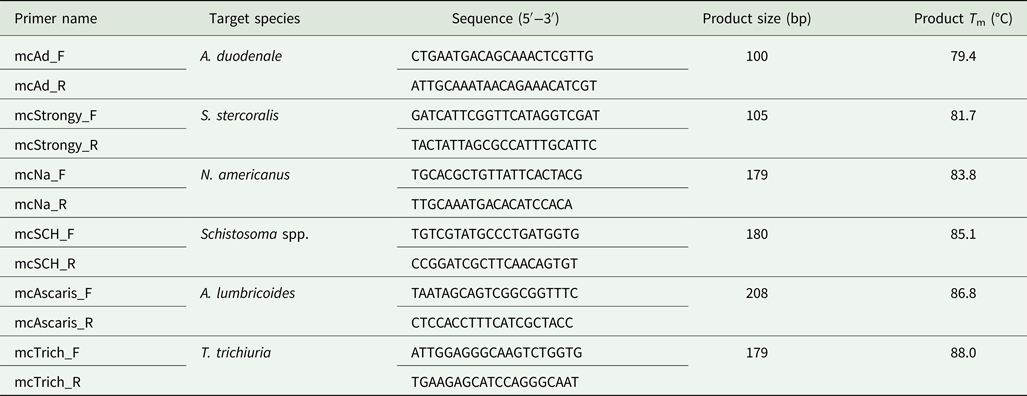
The sequence for the nuclear ribosomal internal transcribed spacer region or small sub-unit (18S) region for Ancylostoma duodenale, Necator americanus, Strongyloides stercoralis, Ascaris lumbricoides, Trichuris trichiuria, Schistosoma haematobium and S. mansoni was downloaded from the NCBI database and aligned on Mega 6 (MEGA). Areas of high variability were then selected and entered into Primer 3 in order to generate primers and products with a specific melting temperature amenable for melt-curve analysis. These primers were then checked for cross-reactivity using NCBI Primer 3 primer design tool. Species-specific primers were designed for each helminth except for S. mansoni and S. haematobium where a generic primer pair was designed. The primers (see Table 1) were checked for specificity using the NCBI Primer 3 tool and cross-checked against the NCBI genomic database.
Final primer selection for each parasite with details of amplicon product size and T m

Optimization and assessment of primers
The primers were optimized using an annealing temperature gradient (Bio-Rad Chromo 4) from 50 to 65 °C, this allowed for the assessment of which temperature the primers performed optimally at, as there may be differences between primers as to which temperatures they can function in. Similarly to the temperature gradient, the efficiency of the primers was assessed using a primer-limiting assay with a primer concentration range of 50, 100, 200 and 300 nm. The importance of establishing the optimum primer concentration to use is based on the possibility that there may be differences in copy number and efficiency between the different primer pairs. The identification of the minimum amount of primer required is essential when running a multiplex reaction to ensure one primer pair does not out-compete others, as the resources in each reaction are finite. The primers were tested and optimized as single plex and later as a multiplex on two qPCR machines, the Chromo 4 (Bio-Rad Technologies) and Rotor Gene (Qiagen). To optimize the primers, clinical samples that had been identified as positive by TaqMan for S. stercoralis, N. americanus and A. duodenale were tested. For A. lumbricoudes, T. trichiuria and Schistosoma s.p., DNA was extracted from the Liverpool School of Tropical Medicine (LSTM) collections of whole worms stored in 100% ethanol. These worms had been previously collected from endemic regions around Lake Albert, Uganda, to supplement the materials used in the teaching department at the LSTM. DNA was extracted by a rapid boil-and-spin method. In brief ~0.2 g of worm tissue was isolated and washed three times in distilled water to remove the ethanol. Following the wash steps, the worm tissue was placed in 200 µl of TE buffer with an addition of 25 µl of proteinase K (20 mg mL−1). The samples were then incubated at 55 °C for 2 h followed by an enzyme denaturation step of 90 °C for 10 min. The samples were vortexed and spun down and approximately 180 µl of supernatant was removed and stored at −20 °C.
Assessment of field samples
Having optimized the high-resolution melt (HRM) primers and tested them in a multiplex assay, they were then tested on the DNA extracts of 32 fecal samples that had been collected in 2017; as part of an ongoing longitudinal study screening for STH and SCH infections in Ghana. As part of the study, the samples had been screened using both Kato–Katz (two slides per fecal sample). Later the samples underwent a specific fecal DNA extraction method that incorporated a bead-beating stage, to mechanically rupture the helminth eggs, allowing for the DNA to be more reliably extracted. This method has previously been described (Cunningham et al., Reference Cunningham, Odoom, Pratt, Boatemaa, Asante-Ntim, Attiku, Banahene, Osei-Atweneboana, Verweij, Molyneux, Stothard and Adams2018). Following the DNA extraction process, the samples underwent a pentaplex TaqMan assay that targeted hookworm (Verweij et al., Reference Verweij, Brienen, Ziem, Yelifari, Polderman and Van Lieshout2007), Schistosoma s.p. (Obeng et al., Reference Obeng, Aryeetey, de Dood, Amoah, Larbi, Deelder, Yazdanbakhsh, Hartgers, Boakye, Verweij, van Dam and van Lieshout2008), S. stercoralis (Verweij et al., Reference Verweij, Canales, Polman, Ziem, Brienen, Polderman and van Lieshout2010), T. trichiuria (Liu et al., Reference Liu, Gratz, Amour, Kibiki, Becker, Janaki, Verweij, Taniuchi, Sobuz, Haque, Haverstick and Houpt2013) and A. lumbricoides (Wiria et al., Reference Wiria, Prasetyani, Hamid, Wammes, Lell, Ariawan, Uh, Wibowo, Djuardi, Wahyuni, Sutanto, May, Luty, Verweij, Sartono, Yazdanbakhsh and Supali2010).
Thermal cycling conditions
Optimization
The following thermal cycle times were used, 95 °C for 30 s followed by 35 cycles of 95 °C for 15 s and a temperature gradient 50–65 °C for 15 s. The melt-curve ramped from 65 to 94 °C, rising by 0.5 °C with a wait of 3 s. The supermix used was the SsoAdvanced™ universal SYBR® Green Supermix from Bio-Rad and the primers were run in a single plex reaction at a final concentration of 250 nm in a 20 µL reaction with 10 µL of supermix and 2 µL of DNA.
Testing of field samples
For the testing of the field samples, the Type-it HRM PCR kit from Bioline was used with an initial melt step of 95 °C for 5 min followed by 40 cycles of 96 °C for 10 s, 60 °C for 30 s and 72 °C for 10 s. The HRM ramped from 60 to 95 °C, rising by 0.1 °C every 2 s. The difference in use of supermix used in the optimization and testing of field samples resulted from the development process whereby the initial intention was to design the primers for use with SYBR green for a two-tube assay. Having optimized them, they were then tested with the Type-it HRM kit to be run as a single-tube assay with the field samples.
Results
Performance of assay
A temperature of 60 °C was chosen as the optimum annealing temperature, during primer-limiting assessment as all primers performed equally well at this temperature. All primers also performed optimally at 200 nm, with the exception of the primers for Schistosoma which were found to be able to operate best at 100 nm. When tested against non-target species, it was found that the primers were highly specific and did not cross-react with non-target DNA.
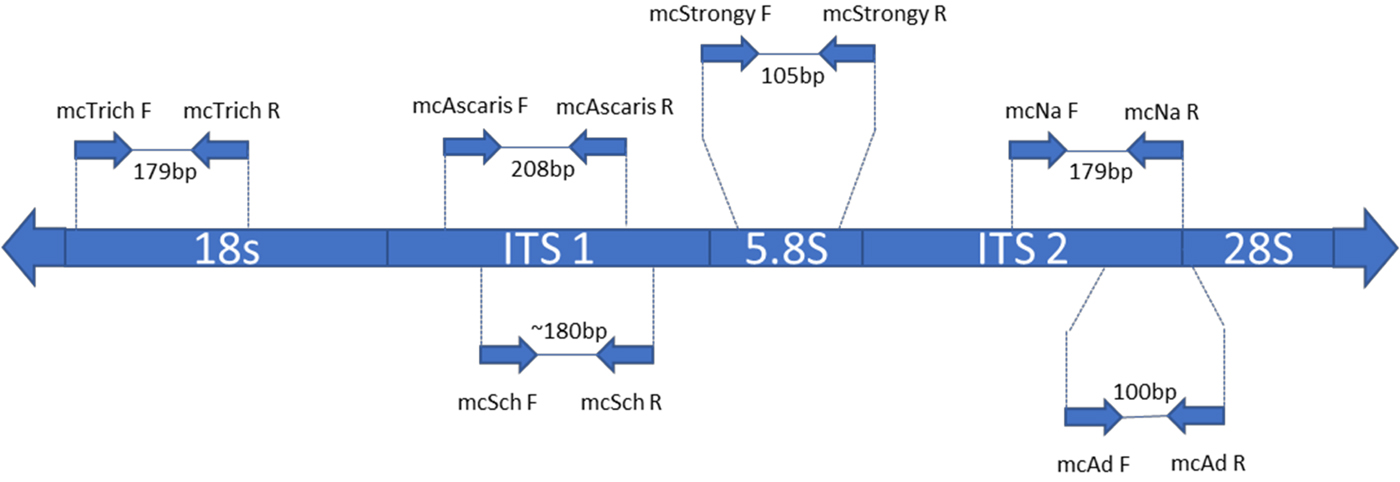
The final primer selection is given in Table 1, alongside their respective T m and product size and melt temperatures. The positions of each primer pair on the nuclear ribosomal DNA of the different target helminths is shown in a diagrammatic form in Fig. 1.
Diagrammatic representation of the positions of the different primer pairs on the ribosomal DNA; ‘mc’ stands for melt curve.

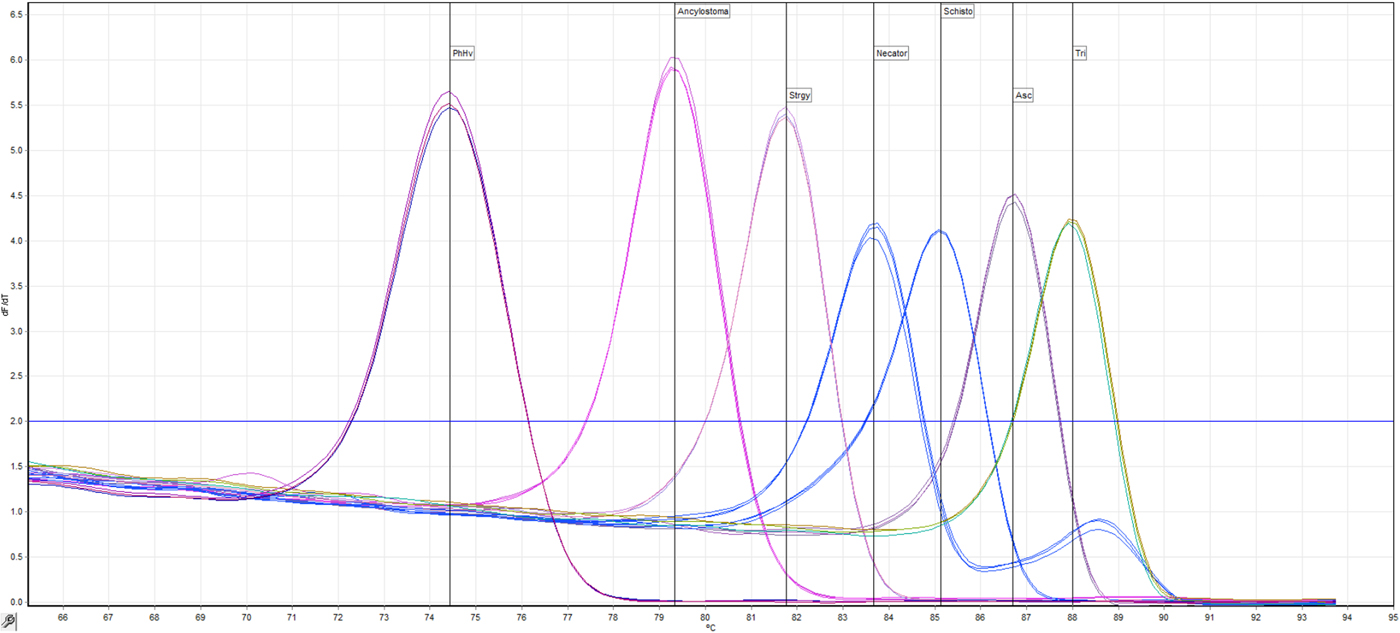
The primers were tested as a multiplex reaction to determine the spread of the different melt peaks with each target DNA tested in triplicate. The distribution of the melt peaks is shown below in Fig. 2. The results show that the products amplified for each helminth species have a distinct T m to allow for separation of amplicons using the melt analysis process. There are also no other non-specific peaks that would indicate cross-reaction between the different primers and non-specific DNA targets.
A representative composite chromatogram of a single multiplex reaction showing the individual melt peaks for each primer pair and target parasite for: An. duodenale (Ad), N. americanus (Na), St. stercoralis (Strgy), As. lumbricoides (Asc), T. trichiuria (Tri) and Schistosoma s.p. (Sch).

Analysis of field samples
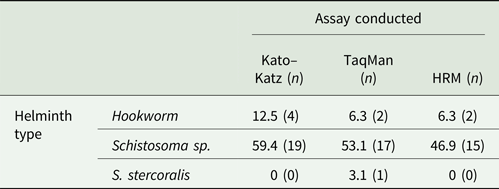
From the field survey, a total of 32 fecal samples were examined using the six-primer pair set, these samples were positive by the TaqMan assay for hookworm, Schistosoma sp. and S. stercoralis; they did not contain positive samples for T. trichiuria and A. lumbricoides. The prevalence of the three helminth types present in the samples is given in Table 2.
Percentage positive results of hookworm, Schistosoma s.p. and S. stercoralis for the following diagnostic assays: Kato–Katz, TaqMan and HRM (n = number)

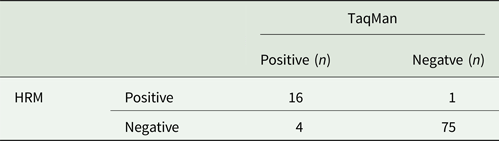
The sensitivity and specificity of the new HRM assay was assessed against the TaqMan assay for all helminth positives, resulting in a sensitivity of 80% and a specificity of 98.6%, (Table 3).
Numbers for sensitivity and specificity of the HRM assay using TaqMan as the gold standard for all helminth positives

Discussion
Here we developed a novel HRM assay for the detection of STH and SCH; our results show that the new primers are capable of discriminating between the different helminth species being targeted.
Developing diagnostic assays appropriate for use in modestly equipped and financed laboratories will expand the outreach of molecular surveillance approaches for STH and SCH. While traditional PCR methods can be both sensitive and specific, they require relatively long post amplification analysis phases (e.g. gel electrophoresis) which increase the risk of cross-contamination. By using real-time PCR detection technology with TaqMan hydrolysis probes, both hurdles are overcome, but although such assays are highly sensitive and specific, they are more expensive in both consumables and in the type of real-time PCR machine required for multiplexing, i.e. an increasing number of light channels receptors. The initial cost of the probes used in the TaqMan assay was a total of £1087, at a concentration of 20 nmol. Depending on the volumes of probe used per reaction, this will equate to an addition of ~18p, per-probe, per-reaction adding a total of ~£1.00 per reaction. In this study, the total cost per reaction for a single-tube assay was £2.13 for a TaqMan reaction and £0.75 for an HRM reaction. If the number of light channels in the qPCR platform is less than six or five, then it would be necessary to run the TaqMan as a two-tube assay, doubling the cost of the reaction buffer required and resulting in a cost of £3.05 per sample. However, it is important to note that the initial cost of the DNA extraction process would remain the same for both assays. The cost of the DNA extraction and purification process exceeds that of either the cost of the TaqMan assay or the HRM assay and equates to approximately £5–£6 per sample.
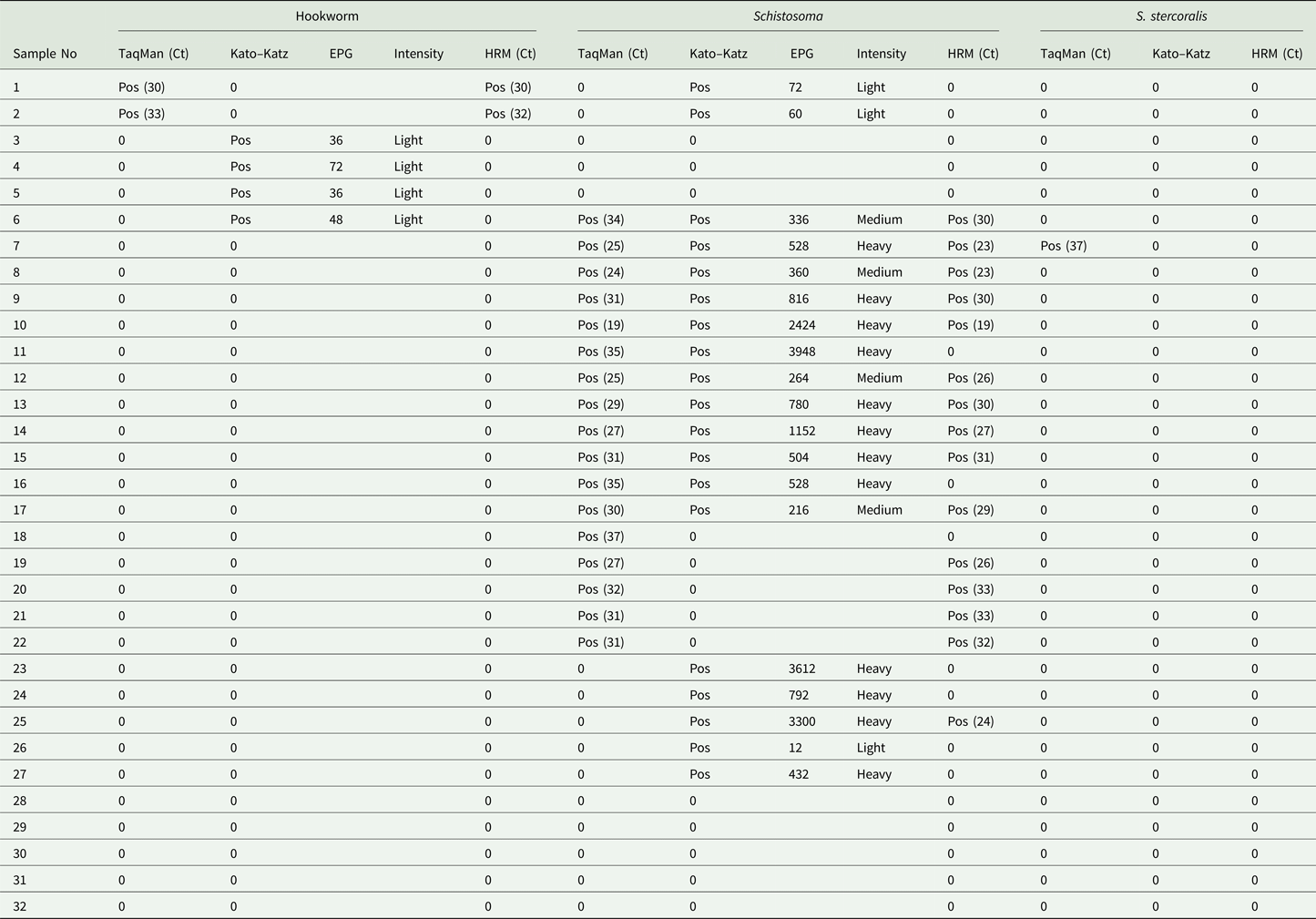
In the present assay, amplicons were designed to have characteristic melt profiles, based on sequence length (i.e. number of bases) and the base-pair composition (i.e. the relative proportion of purine and pyrimidine inter-strand bonding). Since the intercalating dye only fluoresces when bound to double-stranded DNA, the melting point (where the double-stranded DNA disassociates into single strands) is witnessed by a characteristic sharp drop in fluorescence which is detected by the machine and converted into a peak (see Fig. 2). The screening of the fecal samples showed an 80% correlation with the TaqMan method; although four positives identified by TaqMan were not detected with the HRM primers. A very plausable reason for this could be the low levels of target DNA within these samples as the TaqMan Ct values for these four samples ranged from ~35 to 37 which are known to show low reproducibility in a TaqMan assay as well (Appendix Table A1). Both the TaqMan and HRM assays failed to detect the four Kato–Katz hookworm positives, the TaqMan assay also failed to amplify seven of the Kato–Katz SCH positives and the HRM assay failed to detect eight of the Kato–Katz positives. For the hookworm samples, the low number of helminth eggs likely contributed to the two molecular methods failing to detect them. The SCH false negatives are harder to explain as only three samples missed, by both assays, would be considered light infections, the rest are all heavy infections. Failure to amplify DNA due to inhibitors is unlikely to be the reason as the TaqMan assay included an internal positive control that successfully amplified in all samples, within the expected Ct range. The heterogeneity of egg distribution within a fecal sample is a possible cause for the false negatives observed. If the stool sample had not been correctly mixed so as to more evenly distribute the eggs throughout, then it is possible that the ~0.1 g of feces that underwent the DNA extraction process may have contained too few eggs for the assay to detect, despite high egg counts in the Kato–Katz readings.
The approach proposed in this paper capitalizes on the sensitivity and specificity of the real-time PCR platform, but it only operates on a single channel [excitation (nm): ~470 ± 10, detection (nm): ~510 ± 5], and does not require expensive probes. For these reasons, it is much cheaper and can be used on all real-time PCR machines that can detect this spectrum. This assay has been designed for use either with a HRM kit and software or with SYBR Green and a standard melt-curve analysis setting. The use of SYBR would allow for this method to be used on a wider range of machines as not all have HRM capabilities; however, it may require a two-tube assay approach to properly differentiate between the peaks as SYBR has less resolution than the HRM dye (EvaGreen). This new cheaper approach to screen for SCH and STH provides an alternative to the more expensive TaqMan approach which is pertinent to the capacity building of laboratories to screen for NTDs, and could make the adaptation of pre-existing infrastructures towards this aim more feasible.
Limitations of the study
The intention of this manuscript is to describe the initial results of a new diagnostic assay that may prove to be more attractive to molecular laboratories in low-cost settings, due to dispensing with the need to buy expensive TaqMan probes. The assay can also work on less expensive qPCR thermocyclers, as it only requires a single channel to detect up to six target helminths. However, as previously mentioned, the total cost including the DNA extraction protocol will equate to more than £5–£6 per sample, making the use of either qPCR method an expensive option for a diagnostic laboratory. To bring down the overall cost will require the development of a cheaper DNA extraction methodology to complement the cheaper HRM assay. Despite the authors long standing within the field of NTDs, there were limited samples available for assay development resulting in a very limited range of samples being used to run the validation assay. To fully assess the assay described in this paper, a wider range of positive samples will need to be screened to ensure that all target species are represented. This weakness in the study raises the importance of establishing biobanks, particularly for NTDs, whereby samples can be stored and catalogued and made available to research groups. Finally, the method described in this paper is limited to well relatively well-equipped laboratories and requires highly trained technicians to carry out the assay. These factors make the assay unsuitable for use in the field as a point of care test, of which there are already some available for SCH, notably the CCA rapid diagnostic test. Alternatively, more field-friendly molecular assays are also in development, notably the isothermal methods such as loop-mediated isothermal amplification (LAMP) and RPA (recombinase polymerase amplification) have been used for the diagnosis of SCH (Fernandez-Soto et al., Reference Fernandez-Soto, Arahuetes, Hernandez, Aban, Santiago and Muro2014; Rosser et al., Reference Rosser, Rollinson, Forrest and Webster2015). These methods are more field-friendly and depending on the nature of the sample, such as urine over feces, may have simpler DNA isolation protocols. The multiplexing capabilities of these methods are often limited as well as the cost for the RPA assay being relatively higher compared with both LAMP and qPCR (Minetti et al., Reference Minetti, LaCourse, Reimer and Stothard2016).
Conclusion
To conclude we have developed a low-cost, potentially high through-put multiplex DNA assay useful for the detection of STH and SCH. This assay could be an appropriate DNA detection technique in modestly equipped and resourced laboratories. Although current limitations to the study include the high cost of the DNA extraction protocol required and the need for a more comprehensive validation assessment.
Acknowledgements
The authors would like to thank DFID UK, the Liverpool School of Tropical Medicine and the Council for Scientific and Industrial Research, Ghana for their support and contributions as well as Dr Thomas Edwards and Chris Williams for their technical advice.
Financial support
This work was supported by the Department for International Development (DFID) grant number PO 6407.
Conflict of interest
None.
Ethical standards
Not applicable.
Appendix
Results of TaqMan, Kato–Katz and HRM assays for the 32 field samples tested, showing the Ct values (0dp) for the qPCR assays and the eggs per grams (EPG), with corresponding intensity values, for the Kato–Katz results