START (Simple Triage and Rapid Treatment; developed by the Newport Beach Fire and Marine Department and Hoag Hospital, Newport Beach, CA) triage is the most widely used triage protocol by professional and nonprofessional rescuers all over the world during mass casualty incidents (MCIs) and disasters. The protocol is based on the quick and reliable assessment of a few basic parameters, allowing rescuers to identify the level of criticality of disaster or MCI victims. 1
As discussed at the 2000 Consensus Conference “Mass Emergency Management” held in Brussels, it is likely that the early phases of rescue operations during disasters and MCIs are carried out by nonmedical personnel.Reference Guérisse 2 Because disasters and MCIs are infrequent, the triage training of rescuers is often poor and requires condensed review just before the start of rescue operations.Reference Motola, Burns and Brotons 3 The consequences of an incorrect triage decision can lead either to a loss of human life owing to failure to detect life-threatening but treatable injuries or to bottlenecking of the rescue system by overcrowding the emergency room with patients with minor injuries, inappropriately labeled as critical.Reference Lee, McLeod and Van Aarsen 4
In Italy, the majority of ambulance crews involved in the early phase of disaster or MCI relief are composed of volunteers trained in first aid techniques but without any medical professional qualification (ie, RN or MD). (In Italy, emergency medical technicians and paramedics do not exist as in the United States.) The present study aimed to establish whether brief, last-minute training on the START protocol for nonprofessional rescuers would allow them to correctly triage disaster and MCI patients into triage codes and whether, and to what extent, their skill would impact the overall medical management of a major incident.
MATERIALS AND METHODS
The study was a case-control study involving 400 nonprofessional first responders, all of whom had a BLS-D (Basic Life Support-Defibrillation) background. In addition, they were all crew members of BLS (Basic Life Support) ambulances involved either in the daily activities of the Italian Emergency Medical Service and in MCI exercises or in actual disaster relief operations. Each one of the 400 first responders was asked to evaluate 30 patients’ medical records, leading to a grand total of 12,000 triage cases, and to assign each patient a START triage code (black: expectant; red: critically injured; yellow: delayed treatment; or green: minor injuries) within 30 minutes. This time frame was based on the gold standard of the START protocol, which recommends an approximately 1-minute assessment per patient. 1 Each patient could be assigned only one code. Reasons for choosing the triage code had to be specified as well; the respondent had to specify whether they recognized some condition listed within the START protocol or made the decision according to other criteria. Each rescuer evaluated 30 patients, which was based on the average number of disaster/MCI patients that have occurred within Bologna’s territory since 1974 to 2012.
The nonprofessional rescuers were randomly divided into 2 groups of 200. The first group (the non-START group) performed the exercise without any training on the START triage protocol, and a second group (the START group) received a 30-minute training on the START triage protocol immediately before the exercise. During the exercise, the START group members did not have the START protocol available. The timing of the START training (right before the exercise) and its brevity, in addition to the choice of not making available a cheat sheet for the START algorithm, were intentional to simulate the real-time conditions of a disaster or MCI. Patients were selected from the Emergo Train System (ETS; ETS Italy, Bologna, Italy) victims database, a list of fictional clinical cases drawn up according to Advanced Trauma Life Support principles. 5 , Reference Nilsson, Jonson and Vikström 6
Participation was voluntary and participants could drop out at any time. We ensured confidentiality of information, and no financial incentive to participate in the study was offered. Because all data were deidentified and reported in aggregate, the study was deemed exempt from institutional review approval by the local ethics committee.
Every participant examined the same percentage of patients, which consisted of 46% green codes, 18% yellow codes, 26% red codes, and 10% black codes. Such values correspond to the average triage class distribution of disaster/MCI patients according to several studies.Reference Badiali 7
According to this database, each fictional patient is expected to be correctly triaged (and consequently appropriately treated) in due time; otherwise, the patient undergoes a “preventable death” (meaning a patient who would have survived if correctly evaluated and treated in time). The number of “preventable deaths” was used as an indicator of the consequences of a correct or an incorrect triage decision.
Data were analyzed with Stata/IC 10.1 (StataCorp, College Station, TX), and Fisher’s exact test was used to compare groups. Results were considered significant for P values<0.01 in order to have a stronger evidence of data.
Over- and under-triage outcomes were analyzed, including the reasoning for choosing the triage code. Over-triage was defined as a priority code assignment higher than the actual clinical condition of a patient would require (ie, an actual yellow code labeled as a red code), and under-triage was defined as a priority code assignment lower than the actual clinical condition of a patient would require (ie, an actual red code labeled as a green code).
RESULTS
Every participant completed the exercise. The non-START group used all 30 minutes to complete the test, whereas the START group completed it in 15 minutes.
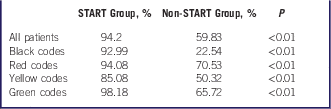
The START group correctly triaged 94.2% of the cases, whereas the non-START group did so in 59.83% of cases (Table 1). The percentage of patients correctly triaged for each triage category is also shown in Table 1. Within the START group, black code priority cases were correctly identified in 92.99% of cases versus 22.54% within the non-START group. Red code priority cases were correctly identified in 94.08% of cases by the START group, whereas the non-START group correctly identified 70.53% of such cases. Yellow code priority cases were correctly identified in 85.08% of cases by the START group versus 50.32% of such cases by the non-START group. Finally, the START group correctly assigned the green priority code in 98.18% of cases as opposed to the 65.72% recorded by the non-START group.
Percentage of Patients Correctly Identified by the START and Non-START Groups

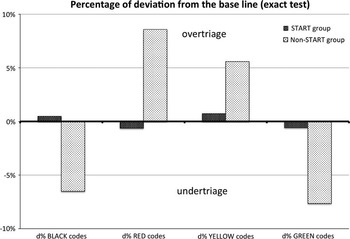
The START group under-triaged the black and yellow codes and over-triaged the red and green codes, whereas the non-START group under-triaged the black and green codes and over-triaged the red and yellow codes. The START group assigned 564 of 599 expected black codes (94.15%), 1598 of 1554 expected red codes (102.83%), 1061 of 1099 expected yellow codes (96.54%), and 2777 of 2748 expected green codes (101.05%). On the other hand, the non-START group assigned 140 of 599 expected black codes (23.37%), 1889 of 1554 expected red codes (121.55%), 1614 of 1099 expected yellow codes (146.68%), and 2357 of 2748 expected green codes (85.77%).
Figure 1 shows how much the various triage codes assigned by both groups deviated from the correctly expected value (exact test). The bold baseline is 100% of the expected correct priority triage. The dark columns show the deviation from baseline observed for each triage category within the START group, and the lightly shaded columns refer to the non-START group.
Assigned Triage Code Percentages in Relation to the Correct 100% Expected Value (Bold Black Line).

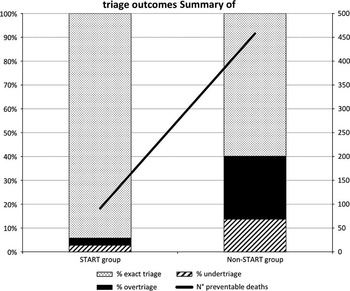
With regard to “preventable deaths,” Figure 2 summarizes the performances of both groups in assigning the triage codes. Not only was the occurrence of over- and under-triage much higher in the non-START group (over-triage, 26.5%; under-triage, 13.67%) than in the START group (over-triage, 3.08%; under-triage, 2.73%), but as a direct consequence, the number of “preventable deaths” was also considerably higher. With 6000 cases, the non-START group had 458 “preventable deaths” because of incorrect triage, whereas on the same number of cases the START group had 91.
Summary of Triage Outcomes. Columns show exact, over-triage, and under-triage recorded by both groups. The dark transverse line shows the pattern of “preventable deaths” due to the percentage of incorrect triage.

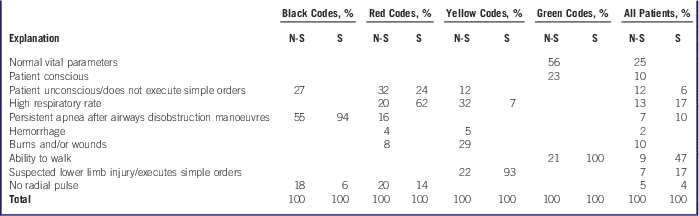
Finally, Table 2 summarizes the explanations used to justify the triage code selection. The non-START group relied on “normal vital parameters” and “patient conscious” as reasons to triage a patient into the green code for 56% and 23% of cases, respectively. However, per the START protocol, patients should only be placed into the green code if they had the “ability to walk.” Only 21% of the non-START group correctly triaged these patients compared to 100% of the START group.
Summary of the Explanations Provided to Justify Triage Code SelectionsFootnote a

a Abbreviations: N-S, non-START group; S, START group.
For the yellow codes, the non-START group assigned patients with a “high respiratory rate” a yellow code; however, per the START protocol, this condition should be a red code. “Wounds and burns” led the non-START group to choose a yellow code in 29% of cases, whereas the START group did not cite this reason because it is not included in the START protocol. The START group correctly identified 93% of yellow codes using the reasoning “unable to walk, but able to execute simple orders,” whereas the non-START group did so for only 22% of the expected yellow codes.
For the red codes, the biggest difference involved “high respiratory rate.” The START group correctly used this explanation to assign a red code in 62% of cases, whereas the non-START group identified it correctly only in 20% of cases. Per the START protocol, “No radial pulse” is a reason for assigning a red code; however, for 18% of cases the non-START group assigned patients with this condition a black code, whereas the START group did the same in only 6% of cases.
Black codes were correctly justified by the START group in 94% of cases because of “persisting apnea after airways disobstruction manoeuvres” and in the remaining 6% because of “no radial pulse,” whereas the non-START group justified such a triage code only in 55% of cases due to “persisting apnea after airways disobstruction manoeuvres,” in 27% due to “unconsciousness/unable to execute simple orders,” and due to the absence of radial pulse in 18% of cases.
DISCUSSION
Triage operations are among the most tricky and crucial aspects in the early management of a disaster or MCI, having a major impact on the effectiveness of the entire medical rescue plan. Because of a shortage of doctors and nurses at the scene, nonmedical personnel should perform early triage operations. This separation would allow the few available doctors and nurses to focus on the treatment of patients in the “zone behind the front” (ie, casualty clearance stations, advanced medical posts, and hospitals). Using this model, scarce qualified resources (ie, medical staff) would be more appropriately allocated, especially during the initial phases of a disaster or MCI relief operation. The best outcomes would be achieved with early triage that is efficient and precise.Reference Lee, McLeod and Van Aarsen 4
The present results revealed that the START group of nonmedical personnel who were provided even a very brief training on the START triage protocol immediately before the exercise more accurately placed their patients into the correct triage color codes, whereas the non-START group exhibited a much higher deviation from the baseline representing an accuracy level of 100% exact triage of all “patients” (Figure 1).
The non-START group tended to assign more patients into the intermediate priority triage classes (red or yellow codes) as a precaution compared with the extreme classes (green or black codes). Paradoxically, these types of triage decisions could heavily jeopardize the success of the entire rescue operation. Over-triaging patients by assigning those who are not in critical condition as in need of immediate medical attention can overwhelm hospital facilities and medical professionals.Reference Lee, McLeod and Van Aarsen 4 , Reference Russo, Galante and Jacoby 8 In this way, scarce resources are not effectively used to benefit patients truly in need of life-saving medical attention. Under-triage jeopardizes the single patient outcome, whereas over-triage risks incapacitating the whole emergency medical system.
Finally, looking at the explanations provided to justify triage code selections, the START group relied on evidence-based data, whereas the non-START group used nonobjective methods, such as personal opinions and values, to triage patients. There are significant ethical implications to using a subjective method to triage patients because many individuals may not receive life-saving treatment in a timely manner.Reference Russo, Galante and Jacoby 8
CONCLUSIONS
As evidenced by this study using the START protocol, the use of simple triage training of nonmedical personnel can result in a more efficient medical emergency system by reducing the number of “preventable deaths” as well as by diminishing the entire workload for all involved personnel.