Implications
The main objective of this 5-year experiment was to describe the dairy cows’ ability to adapt their lactation and reproductive functions to different feeding strategies applied during lactation. These original results provide practical information on breed, feeding system effects and their interaction, and will help advisors and farmers to choose the most efficient systems according to the economic circumstances.
Introduction
In France, the predominant dairy production systems on lowland plains and especially near the Atlantic Arc are based on a feeding system containing grazed grass and maize silage (Le Gall et al., Reference Le Gall, Grasset and Hubert1997). The proportion of grass and maize in the annual feed budget of dairy cows is very variable between farms, and depends on local climatic conditions and the proportion of the total farm area that is accessible for grazing. Apart from the forage system, dairy farmers also choose various feeding strategies that vary in the total quantity of concentrate offered to the cows and, more rarely, the distribution of supplementation during lactation. In addition to this diversity of feed management approaches, the requirements of herds also differ according to breed, genetic potential, the proportion of primiparous cows, age at first calving and the calving pattern. The system objective of synchronizing feed supply and demand is not always achieved and can even be abandoned in more extensive management systems at certain times of lactation for reasons of economic efficiency (Brunschwig et al., Reference Brunschwig, Véron, Perrot, Faverdin, Delaby and Seegers2001).
In a general context of reducing production overheads, and especially feed costs, this wide range of farm practices results in a diversity of production systems, whose effects on animal production and reproductive performance need to be quantified and assessed over the entire lactation. Earlier work carried out at Langhill (Veerkamp et al., Reference Veerkamp, Simm and Oldham1995), as well as the more recent studies summarized in a review by Dillon et al. (Reference Dillon, Berry, Evans, Buckley and Horan2006), underlines the need to assess the adaptability of dairy cows to various levels of feed allowance, based on several criteria and over the long-term. Furthermore, it is desirable to investigate possible interactions between genetics and feeding strategy. Indeed, the selection of animals with high genetic potential for milk production traits has enabled us to effectively increase milk production responses to supplementation (Mayne and Gordon, Reference Mayne and Gordon1995) in most production systems. However, the success of this aggressive genetic selection for production, predominantly within the North American Holstein Friesian genotype, has resulted in increased incidence of nutritional and metabolic problems at the beginning of lactation. More generally, these developments in selection have increased feed requirements of high genetic potential animals throughout their lactation, and resulted in a clear deterioration in other functions such as the capacity to reproduce (Barbat et al., Reference Barbat, Druet, Bonaiti, Guillaume, Colleau and Boichard2005; Mackey et al., Reference Mackey, Gordon, McCoy, Verner and Mayne2007). By contrast, dual-purpose breeds and animals selected on multiple criteria are characterized by lower milk production potential while preserving other zootechnical capacities. In so doing, such animals could develop a greater capacity to adapt to different production systems where feed management is variable, and can be economically advantageous in low supplementary feed input pasture-based seasonal calving systems (McCarthy et al., Reference McCarthy, Horan, Dillon, O’Connor, Rath and Shalloo2007) due to their superior longevity, a lower replacement rate and thus a very satisfactory level of lifetime production.
The objective of the trial described here was to study the consequences of two winter feeding strategies at the beginning of lactation, crossed with two strategies at pasture, to assess direct and delayed effects on the performances of Holstein and Normande dairy cows during their lactation.
Material and methods
The experiment lasted 5 years (2001–05) and took place in Normandy (France) on the INRA experimental farm of Le Pin-au-Haras (48.44°N, 0.09°E). This site, located in a grassland zone on drained clay-loam soil, benefits from an oceanic climate favourable for grass production.
Treatments and experimental design
Two feeding strategies were applied indoors during the winter period (December to March, from calving to turnout). The first strategy (High treatment – H) was designed to obtain a high level of food intake, nutrient supply and milk production per cow using a diet composed of 65% maize silage, 5% hay and 30% concentrate. The second strategy (Low Treatment – L) was based on a diet comprising 45% first cut grass silage, 40% second cut wrapped big-bale silage and only 15% concentrate. The second strategy, being a grass-based system with economical use of concentrate, would be expected to be less favourable for the expression of the milk production potential of the cow. In April, at turnout and during the entire grazing season (April to October), two levels of concentrate were allocated in addition to grazed grass. Half of the animals received 0 kg of gross concentrate (low concentrate – l) while the other half received 4 kg (high concentrate – h). In autumn, after re-entry to the cattle shed (mid November) but prior to the next calving, the grazed grass was replaced by grass silage without modification of the concentrate allocation (0 or 4 kg per cow).
Each year, before calving, 72 dairy cows were assigned in equal numbers to each of the four feeding strategies as a 2 × 2 factorial design. The experimental treatments, therefore, comprised four feeding strategies named High/high, High/low, Low/high and Low/low and were abbreviated to Hh, Hl, Lh and Ll according to the succession of feed allowance levels applied during lactation. The length of the dry period was similar for all animals and was independent of the experimental treatments.
Animals and herd management
In November of each year, the 72 experimental animals were selected from the Le Pin-au-Haras herd and assigned to experimental groups within breed to achieve a similar date of future calving. Allocation was based on the average performance (milk yield, fat and protein content) over the 36 weeks, previous lactation for multiparous cows or dam’s first-lactation for primiparous cows, as well as body weight and body condition score measured in November. After turnout, the allocation of the cows to treatments with 0 or 4 kg concentrate was carried out for each winter feeding group.
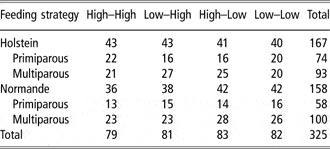
The 325 lactations used for the final analysis of results are composed of 167 Holstein (including 44% primiparous cows) and 158 Normande (including 37% primiparous cows), which corresponds to approximately 80 lactations per feeding strategy (Table 1).
Distribution of 325 lactations according to breed and the lactation rank of the experimental cows (2001–05)

The breeding season started on March 1 and concluded on June 15, in order to obtain a 3.5-month calving pattern indoors during the winter. Thirty cows intended for culling at the end of lactation were not bred during the breeding season. During March, the first artificial inseminations (AI) were performed after heat synchronization (Implant Crestar®; Intervet, Beaucouzé, France) in all maiden heifers and cows calved 50 days or more. These first AIs after synchronization account for 211 out of 295 lactations with inseminations (114 Holstein and 97 Normande) over 5 years. All the other first inseminations carried out in April and May (84 of 295 lactations) and consecutive AIs were practiced on spontaneous heats. The non-pregnant cows were culled at the end of lactation.
Drying off was induced in cows whose milk production was lower than 5 kg milk for 1 week. If not, drying off took place after 44 weeks of lactation with empty cows and approximately 60 days before the next calving with pregnant cows.
Feed and pasture management
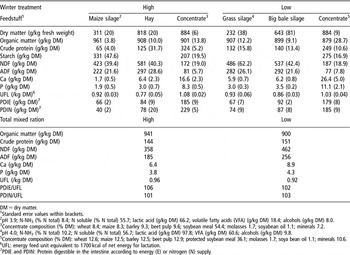
During the winter period, the cows were grouped into their respective batches and received the experimental diet 2 to 3 weeks before calving. To let the animals express their intake capacity, the diets were distributed ad libitum (8% to 10% of refusals) each morning in the form of a total mixed ration (TMR) using self-propeller mixer wagon (RMH Lachish Industries Ltd, Tinténiac, France). Table 2 presents the TMR composition in terms of ingredients, the chemical composition and average nutritive value of feed used in winter. The composition of the concentrates was different between treatments, and was calculated according to the associated forage in order to offer a balanced diet with 105 g of proteins digestible in the intestine (PDI)/UFL (INRA, 1989).
Chemical composition and nutritive value of feed used during the winter

DM = dry matter.
1Standard error values within brackets.
2pH 3.9; N-NH3 (% N total) 8.4; N soluble (% N total) 55.7; lactic acid (g/kg DM) 66.2; volatile fatty acids (VFA) (g/kg DM) 18.4; alcohols (g/kg DM) 8.0.
3Concentrate composition (% DM): wheat 8.4; maize 8.3; barley 9.3; beet pulp 9.6; soybean meal 54.4; molasses 1.7; soyabean oil 1.1; minerals 7.2.
4pH 4.0; N-NH3 (% N total) 10.2; N soluble (% N total) 56.7; lactic acid (g/kg DM) 97.8; VFA (g/kg DM) 60.6; alcohols (g/kg DM) 9.8.
5Concentrate composition (% DM): wheat 12.6; maize 12.5; barley 12.5; beet pulp 12.9; protected soybean meal 36.1; molasses 1.7; soya bean oil 1.1; minerals 10.6.
6UFL: energy feed unit equivalent to 1700 kcal of net energy for lactation.
7PDIE and PDIN: Protein digestible in the intestine according to energy (E) or nitrogen (N) supply.
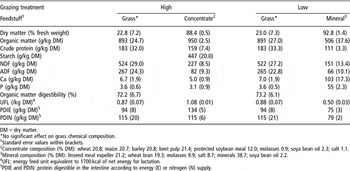
At turnout, the winter diet was gradually reduced and, after 2 to 3 weeks of transition, the animals grazed day and night and had access to automated concentrate feeders and mineral supplement for 1 h after the two daily milkings. The quantities of daily offered supplement were 0 kg of concentrate and 500 g of mineral for the cows of the Hl and Ll groups, and 4 kg of concentrate and 250 g of mineral for the cows of the Hh and Lh groups. Table 3 illustrates the chemical composition and nutritive value of herbage and concentrates offered throughout the grazing season.
Chemical composition and nutritive value of grass offered and concentrates used during the grazing season (average 2001–05)

DM = dry matter.
*No significant effect on grass chemical composition.
1Standard error values within brackets.
2Concentrate composition (% DM): wheat 20.8; maize 20.7; barley 20.8; beet pulp 21.4; protected soybean meal 12.0; molasses 0.9; soya bean oil 2.3; salt 1.1.
3Mineral composition (% DM): linseed meal expeller 21.2; wheat bran 19.3; molasses 9.9; salt 8.7; minerals 38.7; soya bean oil 2.2.
4UFL: energy feed unit equivalent to 1700 kcal of net energy for lactation.
5PDIE and PDIN: protein digestible in the intestine according to energy (E) or nitrogen (N) supply.
At pasture, the cows assigned to the low (Hl and Ll together) and high (Hh and Lh together) concentrate strategies were managed in separate paddocks, on a simplified rotational grazing system (Hoden et al., Reference Hoden, Peyraud, Muller, Delaby and Faverdin1991; Delaby and Peyraud, Reference Delaby and Peyraud2003) based on three to four plots in spring and extended to seven plots in autumn. During each rotation, the same total area was allocated to the two groups to obtain the same average stocking rate of 4.0 cows/ha in spring and 2.2 cows/ha in autumn. The decision to change plot was made according to the evolution of the milk yield profile of the group receiving 4 kg of concentrate. The plot was changed when milk production over the previous 3 days corresponded to 90% of the maximum value observed on the plot (Hoden et al., Reference Hoden, Peyraud, Muller, Delaby and Faverdin1991). The animals without concentrate (Hl and Ll) then also changed plot. This method of simultaneous management of the two batches enabled us to offer the same quantity of grass to the two groups of cows and thus apply more severe grazing conditions for the group without concentrate (Hl and Ll).
The pastures used consisted of 13.8 ha of drained permanent pastures (three plots of 4.6 ha) and 19.6 ha of pastures sown with perennial ryegrass (PRG), either pure or associated with white clover (four plots of 4.8 to 5.2 ha). Half of the area of each different pasture types has been allocated to each treatment for all the grazing seasons. Annual mineral nitrogenous fertilizer input (ammonium nitrate, 33.5% N) was 250 kg N/ha in five applications on permanent pastures and pure PRG pastures, and only 60 kg N/ha in a single application on pastures with clover. Grass surpluses in spring and summer were harvested in the form of grass silage, wrapped big-bale or hay. All plots were topped once between the first and the third cycles of grazing.
Measurements on feed and pastures
During the winter period, the amounts of forage and concentrate offered and refused were batch weighed every day to obtain the ingested quantities by difference. As the TMR was firmly mixed, the animals were unable to feed on selective components, and the refusals have been considered with the same composition as offered. The dry matter (DM) content of the silage and haylage was measured three times per week and that of the concentrates once per week by drying in an oven for 48 h at 80°C. The DM content of silage and haylage was multiplied by 1.05 to take in account the losses of volatile fatty acids during drying (INRA, 1989). A sample of each feed was collected once a week and pooled together at the end of winter for chemical composition analysis.
During the grazing season, the quantities of concentrate and minerals consumed by each cow were recorded every day using the automated feeder. The quantities of grass silage offered during the short periods of drought were weighed and recorded for each batch.
On the grazed paddocks, the biomass before grazing as well as the sward density (expressed in kg DM/cm per ha) was measured by motor scythe cutting during each rotation according to the methodology specified by Delaby and Peyraud (Reference Delaby and Peyraud2003). The sward heights before and after grazing, or after topping, were determined using a plate meter by performing 150 measurements per hectare. At each passage onto the plot, a grass sample was taken, dried in an oven and preserved for chemical analysis.
The quantities of mineral nitrogen fertilizer applied as well as forage harvested were systematically recorded for each plot.
Grazing season details for each plot was recorded to provide a report of pasture management according to the methodology integrated in Pâtur’IN software (Delaby et al., Reference Delaby, Peyraud and Faverdin2001b).
Animal measurements
Flow meters (Metatron 12, Westfalia, Germany) were used to measure individual milk yield every day, from calving onwards, during the two milkings beginning at 0630 h and 1600 h. Milk fat and protein content were measured on individual milk samples taken during six consecutive milkings per week (Tuesdays, Wednesdays and Thursdays). These contents were determined at the LiLaNo laboratory (50008 Saint Lô, France) using an infra-analyzer (Milkoscan; Foss Electric, DK-3400 Hillerod, Denmark).
All cows were weighed each week on a Wednesday, and body condition score was recorded at the beginning of each month on a scale from 0 to 5, with increments of 0.25 point, by two experienced assessors.
A blood sample was taken from the caudal vein of each cow on the 20th and 60th day of lactation to determine the concentrations of non-esterified fatty acid (NEFA), glucose and urea in the blood plasma.
All animal health and reproduction events (heats, inseminations, calvings, etc.) were recorded in a database along with the date of the event.
Chemical and metabolic analyses
After grinding through a 0.8 mm screen, concentrations of ash, total nitrogenous matter (N. Dumas × 6.25), NDF and ADF (Association Française de Normalisation, 1997), calcium and phosphorus were determined for all the feed samples by the Analysis Department Laboratory (LDA, 22440 Ploufragan, France). The organic matter digestibility of herbage offered at each rotation on the plot was calculated from pepsin–cellulase digestibility (INRA, 1989).
The net energy value for lactation (NEL/kg DM) and digestible proteins in the intestine (g PDI/kg DM) were calculated using predictive equations (INRA, 1989).
NEFA, glucose and urea concentrations were determined by enzymatic colorimetry on a multiparameter analyzer (Kone Instruments Corporation, Espoo, Finland).
Calculations and statistical analyses
In winter, the average forage and concentrate DM intakes per cow were calculated from the composition of the total diet, the total quantities ingested by group and the duration of each cow in the batch, which varied between 10 and 21 weeks depending on the dates of calving and turnout.
At pasture, the quantities of herbage removed were estimated from the differences in sward heights measured before and after grazing on the plots, and the sward density measured on each plot according to the methodology suggested by Delaby and Peyraud (Reference Delaby and Peyraud2003).
The individual average milk yield, fat and protein content as well as milk component yields were calculated over three periods: the winter period, the grazing season and the whole of the lactation (with a maximum of 44 weeks). Body weight and body condition change during each period were calculated by difference with the actual values at calving, as well as at turnout, the end of the grazing season and during the last week of lactation. The maximum loss of condition score was calculated by difference between the condition at calving and the minimal score attributed to each cow during lactation.
Reproductive performance was evaluated, firstly, in terms of intervals (between two successive calvings, from calving to the first AI or to conception) and, secondly, using pregnancy rate at insemination, coded in binary format (0/1) according to a negative or positive result. The criterion adopted for evaluating these pregnancy rates was whether or not a calving event occurred during the following year, or the existence of a confirmed pregnancy in culled animals.
The animal health incidents observed and the cows affected were classified into five main categories corresponding to digestive pathologies (acidosis, diarrhoea, etc.), urogenital disorders (caesarean, non-delivery, metritis, etc.), udder (total disorders and effective mastitis, etc.) or leg disorders (lameness, slugs, etc.), as well as miscellaneous other conditions (pulmonary, keratitis and various infections). These incidents were coded in binary format – 0 in the absence of any event and 1 in the case of one or more occurrence of the same problem during lactation.
Pasture results such as the production and utilization of herbage, as well as the chemical composition of the grass offered at the 116 passages onto plots, were treated by variance analysis according to a generalized linear model integrating the effects of year (4 degrees of freedom (df)), plot (6 df), grazing cycle within plot and within year (82 df), level of concentrate (1 df), and the interactions between the effects of the year or plot and the experimental treatment.
The effects of feeding strategy on milk production performance, body weight, body condition score and their variations were evaluated by covariance analysis and Fisher’s test using a model that included the effects of year (4 df), breed (1 df), parity (1 df) and feeding strategy, as well as three interactions between each of year, parity or breed and the feeding strategy. The effect of the feeding strategy was broken down differently according to the period considered, namely the winter feeding treatment alone (1 df) for the winter period, the level of concentrate (1 df), the carryover effect of winter feeding (1 df), and their interaction for the grazing period and the whole of lactation. The cows’ lactation data were the experimental unit. As some cows have been used in different years, in a first step, the effect of the previous lactation treatment was included in the model. For all the variables, this achievable carryover effect was never significant and not included in the definitive model. The covariables integrated into the model correspond to the data used to randomize. Because of the phenotypical differences between breeds (Holstein v. Normande) and between parities (primiparous v. multiparous cows), the data used as covariables were first centred within breed and lactation number.
The metabolic parameters (NEFA, glucose and urea) evaluated at days 20 and 60 of lactation were treated in two distinct variance analyses, including the effects of year, breed, parity and winter feeding strategy, as well as the interactions between the feeding strategy and the three other factors.
Pregnancy rates were analysed using a logistic regression model that included the effects of breed, parity, feeding strategy, heat synchronization and presence of health incidents at calving, these last two factors included in view of their influence on fertility. The intervals between conception, insemination and calving and between successive calvings were analysed according to a variance model that included the effects of year, breed, parity, feeding strategy and health problems at calving.
The occurrence of health disorders belonging to the five categories was studied according to a logistic regression model, which included the effects of breed, parity and feeding strategy.
Results
Consumption of forage and concentrates
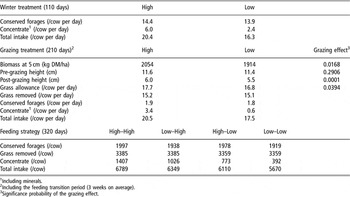
The two winter feeding strategies applied at the beginning of lactation (to 110 days), and then crossed with two concentrate supplementation strategies at pasture (to 210 days), are characterized, above all, by very different levels of concentrate allowance between treatments. In comparison, little difference was observed between quantities of forage consumed, whether offered in the form of silage in winter or as grazed herbage (Table 4). Total concentrate supplementation differed by 1015 kg DM between feeding strategies corresponding to levels of 1407 and 392 kg DM for treatments Hh and Ll, respectively. The Hl and Lh strategies were intermediate with levels of 773 and 1026 kg DM, respectively, and were characterized by a different distribution of intake during lactation with concentrate supplementation accounting for 83% and 25% of the total feed inputs during the winter phase.
Effect of feeding strategy on daily and total intake (kg dry matter (DM)) during various stages of lactation

1Including minerals.
2Including the feeding transition period (3 weeks on average).
3Significance probability of the grazing effect.
The energy content (UFL/kg DM) of the two winter diets differed by 0.04 UFL/kg DM in favour of the High treatment, while the PDIE (protein digestible in the intestine according to energy supply) and PDIN (protein digestible in the intestine according to nitrogen supply) contents were similar. The quantities of maize (High) or grass (Low) silage consumed per cow and per day were 14.4 and 13.9 kg, respectively. On average, during the winter, the difference in overall intake between the two treatments was 4.0 kg DM/cow per day, which included 3.5 kg of concentrate.
During the grazing season, grass allowance to the Low grazing strategy was significantly lower (−0.9 kg/cow per day); both groups consumed similar quantities of grass, thereby resulting in a lower post-grazing sward height for the Low grazing startegy (−0.5 cm; Table 4). Total intake at pasture was 3.0 kg DM/cow per day lower for the Low grazing strategy, of which 2.8 kg of the difference is explained by concentrate.
Milk yield and composition
In winter and then at grazing
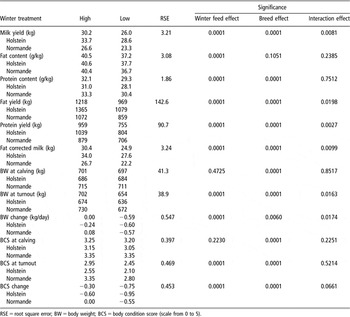
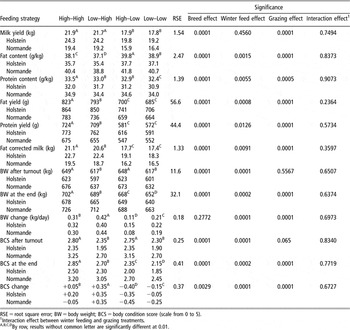
Tables 5 and 6 detail the milk production performance of each experimental group. The high level of feeding applied during the winter period increased milk (+4.2 kg/cow per day; P < 0.001), fat (+249 kg/cow per day; P < 0.001) and protein (+204 kg/cow per day; P < 0.001) yields and resulted in higher fat (+3.3 g/kg; P < 0.001) and protein (+2.8 g/kg; P < 0.001) contents. At pasture, the high level of concentrate resulted in higher yields of milk (+4.0 kg; P < 0.001) and fat (P < 0.001) when compared to the Low treatment. During the grazing period, the group receiving the High treatment had lower fat content (−1.7 g/kg; P < 0.001) and higher protein content (+0.6 g/kg; P < 0.01).
Effects of feeding strategy and breed on the performances of dairy cows during the winter period

RSE = root square error; BW = body weight; BCS = body condition score (scale from 0 to 5).
Effect of feeding strategy on performances of dairy cows during the grazing season

RSE = root square error; BW = body weight; BCS = body condition score (scale from 0 to 5).
1Interaction effect between winter feeding and grazing treatments.
A,B,C,DBy row, results without common letter are significantly different at 0.01.
Over the entire lactation
The entire lactation performance significantly varied between years without any significant interaction with the feeding strategies treatments. In the same way, the interactions between parity and breed were never significant.
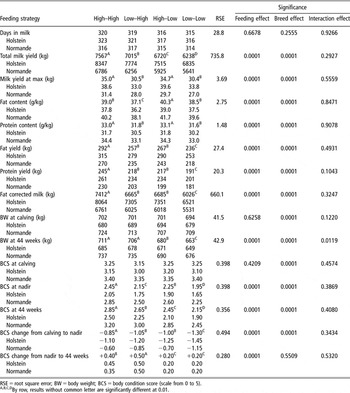
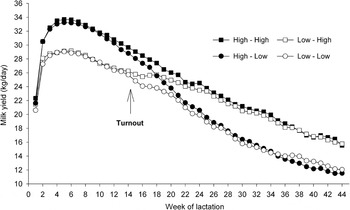
The mean lactation length was 317 days and did not differ significantly between feeding strategies. Total lactation milk yields were 7567, 7015, 6720 and 6238 kg for the Hh, Lh, Hl and Ll treatments, respectively (see Table 7 and Figure 1). Milk fat and protein yields were highest for the Hh group and lowest (P < 0.001) for the Ll treatment. The Lh and Hl treatments achieved similar fat yields, with values significantly different from and intermediate between the two extreme treatments. Milk fat content was significantly higher for the Hl treatment (40.3 g/kg of milk), while the two extreme strategies (Hh and Ll) produced similar milk fat content (39.0 and 38.5 g/kg, respectively). The lowest fat content (37.1 g/kg; P < 0.001) was recorded with the Lh treatment. Average milk protein content varied significantly with the level of winter feed intake, with the highest values (P < 0.001) obtained with the Hh and Hl strategies (33.0 g/kg), while the lowest were observed with the Lh and Ll treatments (31.7 g/kg).
Effects of feeding strategy and breed on the performances of dairy cows during lactation

RSE = root square error; BW = body weight; BCS = body condition score (scale from 0 to 5).
A,B,C,DBy row, results without common letter are significantly different at 0.01.
Effect of feeding strategy on the lactation curve.

As expected, the primiparous cows have always produced less milk (6508 v. 7261 kg; P < 0.001), less fat yield (797 v. 910 g/day; P < 0.001) and less protein yield (669 v. 746 g/day; P < 0.001) than the multiparous cows. The fat content of the primiparous milk was significantly lower (38.3 v. 39.2 g/kg) but the milk protein content was similar between parity. On milk yield only, the range of the strategies’ effects was significantly different between parity. The lowest difference (385 kg) between parity was observed on the feeding treatment Ll. For the three other strategies, the differences between primiparous and multiparous cows were similar with an average of 875 kg of milk.
Carryover effects of winter treatment (Table 6)
At pasture, milk yield of the Holstein and the Normande cows did not vary as a function of the winter treatment (Figure 1), but the fat and protein contents were significantly higher in cows belonging to the winter High-treatment group. Cows on the High treatment in winter achieved higher milk fat (+0.90 g/kg; P < 0.01) and protein (+0.50 g/kg; P < 0.01) contents, whereas the delayed effects observed did not vary significantly with the level of concentrate allowance at pasture (P > 0.10). Consequently, the fat and protein yields at grazing were higher (P < 0.05) in cows fed with the High treatment in winter.
Impact of breed on lactation performances
For a similar lactation length (P > 0.10), the Holstein cows produced significantly more milk (between +1592 and +1194 kg, depending on treatment; P < 0.001), fat corrected milk (P < 0.001), had higher fat yield (P < 0.001) and lower fat (between −1.9 and −2.7 g/kg; P < 0.001) and protein (between −2.5 and −2.8 g/kg; P < 0.001) contents than the Normande cows (Table 7).
The effects of winter and grazing regimes were significant for both breeds. However, the milk, fat and protein yield response to the increase in nutrient intake in winter (Table 5), as well as at pasture (Table 6), was higher (P < 0.001) for the Holstein cows (+4.8 kg milk on average) compared to the Normande ones (+3.5 kg milk on average). Over the entire lactation, no significant interaction was detected between breed and feeding strategies.
Body weight and body condition score
In winter then at grazing
Body weight and the body condition score at calving did not differ significantly between feeding treatments (Table 5). After calving, during the winter period, cows of the High treatment lost less (P < 0.001) weight (0 v. 48 kg) and body condition (−0.30 v. −0.75 point) compared with cows of the Low treatment. During the grazing season, the body weight and condition score of the High-treatment cows were higher (P < 0.001), in particular for body condition change, which was positive (+0.20) for the High group and negative (−0.25) for the Low group (Table 6).
Over the entire lactation
No significant interaction between year, parity and feeding treatments on body weight, body condition score and their variation during lactation have been highlighted.
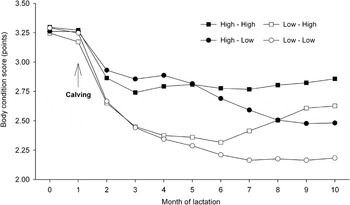
The cows assigned to the four feeding strategies all began their lactation with the same body weight (706 kg) and the same body condition score (3.20 points, see Figure 2). At the end of lactation, the animals assigned to the Hh and Lh treatments were heavier (708 kg) compared to those assigned to the Ll treatment (663 kg). During lactation, the maximum loss of condition varied from −0.85 (Hh) to −1.30 (Ll) between the four feeding strategies. The minimum observed body condition scores were 2.45, 2.25, 2.15 and 1.95 points for strategies Hh, Hl, Lh and Ll, respectively. The recovery of condition at the end of the lactation was more favourable in cows receiving concentrate at pasture (+0.40 and +0.50 for treatments Hh and Lh) in comparison with cows without supplementary feed (+0.20 for treatments Hl and Ll). Finally, body condition score at drying off differed significantly between the four treatments, with a maximum value of 2.85 for the Hh strategy and a minimum value of 2.15 for the Ll strategy (Figure 2).
Effect of feeding strategy on the evolution of body condition score during lactation.

During lactation, the primiparous cows were always significantly lighter than the multiparous ones (−72 kg at calving and −48 kg at the end of lactation; P < 0.001). The body condition scores were higher at calving with 3.50 and 3.00 points (P < 0.001) for the primiparous and multiparous cows, respectively, but did not differ significantly at drying off (2.50 points on average). Consequently, the body condition score loss differed between parity by half a point (−1.00 v. 0.50; P < 0.001).
Carryover effects of winter treatment (Table 6)
During the grazing season, cows assigned to the winter Low treatment gained significantly more weight and body condition (+0.31 kg/day and +0.10 point) than cows on the winter High treatment (+0.21 kg/day and −0.175 point). In spite of this, the negative effects of the Low winter feeding strategy on body weight (−31 kg; P < 0.001) and body condition score (−0.45 point; P < 0.001) observed at turnout remain significant (P < 0.001) at the end of the grazing season. The change of 15 kg in body weight (685 v. 670 kg; P < 0.001) and 0.20 points in body condition (2.60 v. 2.40; P < 0.001) favoured the High winter treatment (Figure 2).
Influence of breed on body weight and body condition score during lactation
During the winter period, the two breeds lost body weight and body condition. On an average, the loss differences between treatments were higher in the Normande breed. However, a significant interaction occurred. On the Low treatment, the two breeds have had very similar changes, whereas on the High treatment, the Normande cows’ loss was very small compared to the Holstein cows. At turnout, the body weight difference between winter feeding treatments was higher for the Normande cows than for the Holstein cows (58 v. 38 kg; P < 0.02).
Throughout their lactation, regardless of feeding strategy, the Normande cows were heavier (+28 kg at calving and +39 kg at the end of lactation) and had a higher body condition score (+0.25 points at calving and +0.65 points at the end of lactation) than the Holstein cows (Table 7). The greatest loss of condition occurred in the Holstein cows, while the recovery of condition between the nadir and end of lactation did not differ between breeds. The only significant interaction between breed and feeding strategy (P < 0.02) relates to body weight at the end of lactation, as the differences between breeds became greater as the cows were assigned to more favourable strategies, particularly at the end of lactation.
Metabolic parameters
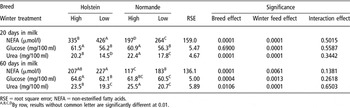
At the beginning of lactation, the NEFA content of blood was higher in cows on the Low treatment, while blood glucose and urea concentrations were lower (P < 0.001). The variability observed between treatments tended to decrease during the course of lactation (Table 8). The Holstein cows always exhibited higher NEFA and lower urea concentrations than the Normande cows, whereas blood glucose did not differ between breeds at day 20 of lactation, but became significantly higher in the Holstein cows at day 60.
Effects of breed and winter feeding strategy on metabolic parameters

RSE = root square error; NEFA = non-esterified fatty acids.
A,B,C,DBy row, results without common letter are significantly different at 0.01.
Reproduction performances
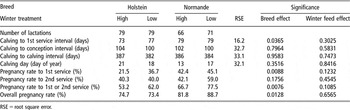
Feeding level at grazing had no significant effect on reproduction performance with the effects of the winter period feeding strategy and breed presented in Table 9. The overall proportion of pregnant cows did not differ between feeding treatments (78% and 81% for the winter High and Low treatments, respectively). The pregnancy rate to first AI was not significantly affected by the winter treatment (P = 0.12) but the cumulated pregnancy rate to first and second AIs tended to be lower in cows of the High group in the winter period (P = 0.10). This effect was more marked in the Holstein cows, whose pregnancy success rate for first AI was only 21.5% in the High treatment, even though there was no significant interaction between breed and the winter level of feeding. Taking cognizance of management in seasonal calvings, the level of winter feed allowance did not significantly modify the intervals between calving and first AI (75 days), between calving and conception AI (101 days) or between two successive calvings (384 days).
Effects of breed and winter feeding strategy on reproductive performance

RSE = root square error.
Breed had a significant effect on reproductive performance. The overall pregnancy rate was higher (P = 0.01) for the Normande (85%) compared to the Holstein (74%). The rate of success for first AI and the cumulated rate of success for first and second AIs were higher in the Normande cows (P < 0.01). By comparison, the interval between calving and first AI was a little bit longer for the Normande (+4 days; P < 0.05), with no significant difference in the interval between successive calvings.
Health incidents during lactation
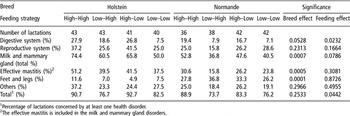
Feeding strategy had significant effects on the occurrence of pathologies of the digestive system and, in a lesser way, pathologies of the udder (Table 10). The cows assigned to High feeding levels, particularly in winter (Hh and Hl), had more digestive disorders. Feeding strategy had no significant effect on pathologies involving the urogenital system or legs. Holstein cows were more sensitive to the risk of pathologies of the udder (primarily effective mastitis; P < 0.001) and, to a lesser extent, the risk of digestive disorders (P = 0.05). In contrast, the Normande cows were extremely sensitive to the risk of pathologies of the legs and in particular the hooves (P < 0.001). Taken together, the occurrence of health disorders was mostly correlated (P < 0.05) with lactations resulting from the High feed treatments at the beginning of lactation (Hh and Hl), without any significant differences between the two breeds.
Effects of breed and feeding strategy on the number of lactations (%) impacted by various health disordersFootnote 1

1 Percentage of lactations concerned by at least one health disorder.
2 The effective mastitis is included in the milk and mammary gland disorders.
Discussion
Over the complete lactation as well as during each successive period, the studied feeding strategies led to considerable variability in nutrient intake. These variations result from the energy density of the diet coupled with a higher total intake obtained owing to higher levels of concentrate allowance in the High treatments. With both breeds and at each stage of lactation, milk and fat yields, as well as the variability of body condition, are sensitive to variability in feed intake. Each feeding strategy produces different lactation or body condition score curves that confirm the capacity for adaptation of the dairy cows. In contrast, reproductive performance varied more between breeds than by feeding treatments and was less sensitive to the feeding strategies than the lactation function.
Lactation performances are sensitive to variations of feeding level
At the beginning of lactation, the reduction of nutritive inputs in cows on the Low group simultaneously reduced the milk yield, limited the risk of mammary gland disorders and increased the mobilization of body reserves. By contrast, cows of the High group produced more milk while mobilizing their reserves slightly less, but with a higher frequency of digestive disorders, particularly within the Holstein breed. During the first 100 days of lactation, the difference in energy inputs between the two treatments equated to 4.6 UFL in favour of the High treatment. Taking into account the observed differences in milk yield (+4.2 kg) and milk fat content (+3.3 g/kg) in favour of the High treatment, the difference in energy balance, calculated by the difference between the supplies and requirements (INRA, 1989), was no more than 1.2 UFL. Approximately 75% of the difference in dietary energy supplies between the two winter strategies ((4.6 − 1.2)/4.6) is compensated by the fall in milk yield, while the remaining 25% corresponds to a greater mobilization of the body reserves in cows belonging to the Low group (−0.45 point). This double adaptation of the dairy cow at the beginning of lactation via the reduction of synthesis by the udder and the mobilization of body reserves has been observed in many trials, such as in the studies of Friggens et al. (Reference Friggens, Emmans, Kyriazakis, Oldham and Lewis1998) as well as, more recently, Roche et al. (Reference Roche, Berry and Kolver2006) and Kennedy et al. (Reference Kennedy, O’Donovan, O’Mara, Murphy and Delaby2007). Finally, the increase in nutritive inputs at the beginning of lactation initially stimulates milk yield, but does not lead to any major improvement in energy balance and only produces a slight reduction in the duration of mobilization of body reserves (Veerkamp et al., Reference Veerkamp, Beerda and van der Lende2003; Berry et al., Reference Berry, Veerkamp and Dillon2006; Faverdin et al., Reference Faverdin, Delaby and Delagarde2007).
In the middle and end of lactation, the response to large inputs of concentrate (+1.25 kg of milk per kg DM of concentrate) at grazing is accompanied by a fall in milk fat content (−1.7 g/kg) and a modest increase in protein content (+0.6 g/kg). This milk response is slightly higher than classically observed (Delaby et al., Reference Delaby, Peyraud and Delagarde2001a; Kennedy et al., Reference Kennedy, Dillon, Delaby, Faverdin, Stakelum and Rath2003a; Horan et al., Reference Horan, Dillon, Faverdin, Delaby, Buckley and Rath2005), also resulting from the more severe pasture management applied to the Low group. Indeed, the response to supplementation is enhanced when the herbage allowance or herbage intake level is restricted (Bargo et al., Reference Bargo, Muller, Delahoy and Cassidy2002). In the High-treatment group at pasture, part of the additional feed intake makes it possible to reconstitute the body reserves mobilized at the beginning of lactation. On the other hand, while the animals of the Low group produce less milk, they continue to mobilize body reserves.
Finally, on the entire lactation, the regular increase in concentrate inputs associated with the four strategies induces a steady increase in milk yield from 1.2 to 1.4 kg of milk per kg DM concentrate. On the other hand, the distribution of inputs varies according to the strategies and modifies the shape of the lactation curves. After the first month of lactation, the lactation curves for treatments Hh and Ll remain parallel, whereas the lactation curve resulting from the Lh treatments is flatter, in contrast to curves for the Hl treatment, where the cows show a poorer level of persistence.
During the trial, the adaptation of the dairy cows to variations of nutritive inputs is further corroborated by the absence of any carryover effect on the milk yield at pasture, as the treatment was applied at the beginning of lactation. Both breeds have reacted in the same way, which indicates that the potential of milk secretion of the mammary gland was not durably altered by the early lactation feeding treatment. The High-treatment cows in winter, as well as those managed without concentrate at pasture, quickly adjusted their dairy production to the levels of nutritive supply allowed at pasture. In contrast, the animals of the Low treatment in winter, which then receive concentrate at pasture, can make use of this additional nutritive input for the production of milk as well as the recovery of body condition. Nevertheless, compared to the cows of the Low treatment, the animals of the winter High group produced higher composition milk at pasture along with a small but steady loss of body condition, which they used comparably less at the beginning of lactation. This loss of condition became all the more important when the cows did not receive concentrate. The higher body condition at turnout (+0.5 point) of the High winter feeding treatment could limit subsequent intake capacity at pasture (Faverdin et al., Reference Faverdin, Delaby and Delagarde2007) and increase the mobilization of available reserves, thus producing milk richer in fat and proteins.
The absence of any delayed effect on milk yield due to feed management at the beginning of lactation, and the weak persistence of its influence on protein and fat content, has already been described in short-term (Nielsen et al., Reference Nielsen, Friggens, Larsen, Andersen, Nielsen and Ingvartsen2007) and longer-term trials (Coulon et al., Reference Coulon, D’Hour, Garel and Petit1996; Friggens et al., Reference Friggens, Emmans, Kyriazakis, Oldham and Lewis1998). In certain trials (Kennedy et al., Reference Kennedy, O’Donovan, O’Mara, Murphy and Delaby2007; Roche, Reference Roche2007), the authors describe a significant carryover effect on milk and fat yield, but its persistence is actually rather limited (1 to 2 months). The amplitude and duration of this delayed effect depend initially on the importance of the main effect of the treatment and the observed duration of the carryover effect (Broster and Broster, Reference Broster and Broster1984).
The degree of sensitivity to variations in nutritive inputs, in other words, the partitioning of the available energy between milk production and mobilization/reconstitution of the body reserves during lactation, also depends on the genetic potential of the cows (Yan et al., Reference Yan, Mayne, Keady and Agnew2006), illustrated here by the presence of Holstein and Normande breeds. At each stage of lactation, whether in winter or at grazing, the response of milk and fat yield is always more marked in Holstein than in Normande cows, despite the fact that, on the entire lactation, the difference between the extreme treatments – Hh v. Ll – is only 350 to 400 kg between breeds. Although the various feeding strategies have had the same effect for the two breeds, the Holstein cows are more reactive, producing more milk and mobilizing their body reserves to a greater extent. The blood NEFA contents, measured on the 20th and 60th days of lactation, were always higher in the Holstein cows, especially when they were assigned to the Low level of winter feeding. At each stage of lactation, irrespective of the feeding strategy, the Normande cows were systematically heavier and in better body condition than the Holstein cows, as described in Dillon et al. (Reference Dillon, Buckley, O’Connor, Hegarty and Rath2003a), and were much more sensitive to the risk of lameness. These milk-yield responses are in agreement with the results of Kennedy et al. (Reference Kennedy, Dillon, Delaby, Faverdin, Stakelum and Rath2003a), but are less marked than those obtained by Horan et al. (Reference Horan, Dillon, Faverdin, Delaby, Buckley and Rath2005). The latter author indeed highlighted a strong interaction between genetic type and supplementation at pasture when comparing types of Holstein cows resulting from American or New Zealand selection schemes. The difference in milk yield between the two levels of extreme nutritive inputs reached +1080 and +405 kg milk in Holstein animals of North America or New Zealand ancestry, respectively, for the same level of concentrate allowance. According to Veerkamp et al. (Reference Veerkamp, Simm and Oldham1995) and, more recently, Kennedy et al. (Reference Kennedy, Dillon, Delaby, Faverdin, Stakelum and Rath2003a), cows of high genetic index are better able to make use of diets richer in concentrate, but do not express all their potential when fed forage-rich diets. As shown by Yan et al. (Reference Yan, Mayne, Keady and Agnew2006), intake increases more with concentrate-rich diets, and the proportion of available energy assigned to milk production is higher in Holstein cows than in the Norwegian breed.
Reproduction performance is not very sensitive to variations of feeding level
Since the various feeding strategies have little effect on the success rates of insemination after synchronization or based on natural heats, the pregnancy rates are similar between strategies. Moreover, these results were very easily repeated from one year to the next. The increase in nutritive supplies at the beginning of lactation, due to supplementation with maize silage and concentrate, did not improve the reproduction results. The reproduction performances observed over the five years of the trial are compatible with results reported in the literature. During experiments aimed at increasing feeding levels early in lactation using concentrate supplementation, Ferris et al. (Reference Ferris, Gordon, Patterson, Murphy and Anderson2003), Kennedy et al. (Reference Kennedy, Dillon, O’Sullivan, Buckley and Rath2003b) and Horan et al. (Reference Horan, Mee, Rath, O’Connor and Dillon2004) failed to detect any favourable effects on reproduction performance.
In fact, the best-fed cows produced the most milk at the beginning of lactation (Holstein – Strategies Hh and Hl), and also showed the poorest rate of success at the first AI (21.5%). By contrast, the rate of success at first AI as well as at first and second AIs tended to be better in the animals of the Low group, who mobilized more body condition and produced less milk. These results seem to be in contradiction with the studies of Pryce et al. (Reference Pryce, Coffey and Simm2001) or Roche et al. (Reference Roche, MacDonald, Burke, Lee and Berry2007), who pointed out an unfavourable relationship between the maximum loss of condition – or the condition at nadir – and reproduction performance, such as the pregnancy rate at first AI or the interval between calving and conception AI. According to these authors (op. cit.), and other studies presented in the review of Berry et al. (Reference Berry, Roche and Coffey2008), major losses of body condition are often associated with the highest peaks of milk yield and/or the higher body condition score at calving. The same applies in the present trial. Once the effect of the feeding strategy alone is isolated, the loss of body condition increases by 0.36 points for each additional 10 kg milk at peak yield, and rises by 0.56 points for each extra body condition point at calving. Thus, during this experiment, we managed to distinguish the maximum milk yield from mobilization at the beginning of lactation, thereby illustrating that cows with the poorest reproduction performance, in particular at first AI, are also those with the highest genetic potential for milk production (Holstein). Such cows express their milk potential more fully with favourable nutritive inputs (Hh), while at the same time mobilizing body reserves. In the winter calving cows in this study, this two-fold condition, which consists of having a high milk potential and expressing it at the beginning of lactation, leads to a stimulating effect on the mobilization of body reserves and a negative effect on reproduction. If one of these two conditions is not satisfied, the fertility observed at first AI seems to be less degraded. Thus, reproduction performance remains better in dual-purpose breeds that are less able to mobilize reserves at the beginning of lactation, such as the Normande (this study; Dillon et al., Reference Dillon, Snijders, Buckley, Harris, O’Connor and Mee2003b), Norwegian (Ferris et al., Reference Ferris, Dale, Mayne, Keady and Kilpatrick2008; Friggens, personal communication) or in the NZ Holstein breed (Kolver et al., Reference Kolver, Roche, de Veth, Thorne and Napper2002; Horan et al., Reference Horan, Mee, Rath, O’Connor and Dillon2004). The practice of once-daily milking limits the expression of milk production potential and the mobilization of reserves without degrading the intake capacity, and has a comparatively favourable impact on reproduction performance (Rémond and Pomiès, Reference Rémond and Pomiès2005). Finally, the rates of success at AI are rather better in cows that do not express their milk production potential (Mackey et al., Reference Mackey, Gordon, McCoy, Verner and Mayne2007) because of insufficient body condition at calving or a lack of feed allocation early in lactation (this study). It is important to improve our understanding of the complex relationship between body condition score at calving, the level of nutritive supply at the beginning of lactation and the expressed milk production potential, as well as the effects on the functions of ‘lactation’ and ‘reproduction’. The role of level of feeding and of the diet composition (grass or maize silage, concentrate proportion) on circulating concentrations of metabolites and hormones on resumption and regulation of oestrus cycles and on fertility has to be considered as well (Garnsworthy et al., Reference Garnsworthy, Sinclair and Webb2008). In cows with high genetic merit, the challenge of one calf per annum involves controlling the body condition score at calving, especially at the end of lactation and at drying off (Roche, Reference Roche2006; Grummer, Reference Grummer2007). Moreover, it is necessary to limit the expression of milk production potential so as to reduce the magnitude and duration of energy deficit in early lactation (Veerkamp et al., Reference Veerkamp, Beerda and van der Lende2003; Garnsworthy et al, Reference Garnsworthy, Sinclair and Webb2008). These two approaches thus make it possible to slow down the mobilization of body reserves and the loss of condition between calving and insemination.
Conclusion
The application of four different feeding strategies on the entire lactation shows the sensitivity of milk yield to variation in feed intake, which incorporates the impact of body reserves in modulating some of the effects of feed intake, and the plasticity of synthesis in the udder in response to variations of nutrient flux. Finally, the four strategies lead to four highly contrasting profiles of milk quantity and quality, particularly in terms of persistence and distribution of production over the year. While the observed effects on production are similar in the two studied breeds, they become exacerbated in Holstein cows. Reproduction performance shows little variation in relation to different feeding strategies. This result illustrates how the fertility problem for seasonal-calving Holstein cows will probably remain unresolved with an increase of the feeding level early in lactation as the additional feed firstly stimulates milk synthesis.
Acknowledgments
The authors thank all the staff of the INRA Borculo farm at Le Pin-au-Haras for their cooperation in the management of the five-year experiment, and for carrying out the associated measurements. The authors also thank M. Carpenter for translation of the paper.