Introduction
Courts have been essential in the resolution of legal disputes throughout history. Even though only a small proportion of all disputes may wind up in formal litigation, the ability of courts to adjudicate effectively is crucial in reducing the degree of uncertainty and the loss of welfare in social interaction and market exchange. The manner in which courts resolve disputes is also important because of its implications for economic change and sustainable economic growth, as noted long ago by Weber and in more recent scholarship on legal origins, law and finance, and comparative analysis of legal traditions.Footnote 1 As Ma and van Zanden (Reference Ma and van Zanden2011) have argued, however, much of the recent literature has focused narrowly on western European legal systems and devoted little attention to systematic analysis of non-Western legal traditions. Particularly rare has been quantitative analysis of dispute resolution in Islamic courts.
The modern academic literature on Ottoman courts developed to a significant extent in reaction to the Weberian notion of “kadijustiz,” which portrayed the operations of Islamic courts as arbitrary and unpredictable (Weber Reference Weber1978: 891–92, 897, 976). The Weberian characterization of the Islamic courts remained dominant in Western scholarship until the second half of the twentieth century (Jennings Reference Jennings1978; Peters Reference Peters2005: 70; Powers Reference Powers2002: ch. 1). Most, if not all, modern students of Ottoman courts, however, emphasized the predictable nature of the court and the general fairness of its operations.
We contribute to this literature a quantitative analysis of dispute resolution in Ottoman courts. Drawing insights from the recent law and economics literature on dispute resolution, we develop a novel quantitative method for analyzing court outcomes, one that emphasizes the relationship between the plaintiff and the defendant. We use data from the court records (sicils) of the town of Kastamonu in northern Anatolia, from the late seventeenth and the eighteenth centuries. Ottoman court records typically give detailed information about the nature of each case considered, including its result, and the identities of litigants. Using this information, we examine the basic characteristics of court participants, such as their distribution according to gender, religious status, and socioeconomic characteristics. We use regression analysis to determine the factors that contributed to the likelihood of the case being ruled in favor of the plaintiff.
The issues raised in this article about the operations of Ottoman courts are closely related to those studied in the broader theoretical and empirical literature on dispute resolution.Footnote 2 A key question in the law and economics literature on trials has been to determine the factors affecting the plaintiff's chances of winning the suit. In a seminal article on the topic, Priest and Klein (Reference Priest and Klein1984) formulated the hypothesis that under certain conditions plaintiff win rates at trial should tend toward 50 percent as the fraction of cases that go to trial approaches zero. This is based on a simple selection effect that follows from the observation that cases that go to trial are not a random selection of all suits. Rational litigants would likely settle cases in which one side is likely to be a clear winner, and they would go to trial only in difficult and uncertain cases for which there is greater disagreement. As a result, the cases that go to trial would likely be “toss up” ones that are won about half the time by the plaintiff and half by the defendant.
Bridging the gap between the largely qualitative literature on Ottoman courts and the theoretical and empirical literature on dispute resolution in law and economics, we provide a quantitative analysis of Ottoman litigations that aims to identify the conditions affecting the plaintiff's chances of success at trial.Footnote 3 If the plaintiff's chances depended on systematic conditions, this would support those arguments made in the recent literature about the predictable nature of Ottoman courts, because they would indicate that far from being arbitrary, the judges’ decision followed regular patterns. According to our results, trial outcomes followed systematic patterns in the Kastamonu court, specifically in the way differences in gender, elite status, religion, and religious markers of litigants affected the plaintiff's chances of success at trial. More important, these effects followed patterns that have been commonly observed in modern courts, indicating that in resolving disputes the Ottoman courts did not function any differently than their counterparts in modern societies.
Justice in Ottoman Courts
Although the quantitative analysis presented in the article is new in the context of Middle Eastern history and Ottoman legal studies, the questions that we address are not entirely novel. In fact, generalized assertions about the nature and quality of the court's operations are fairly common. Many students of Ottoman court records have emphasized the relative impartiality of the courts’ operations. For example, Ronald Jennings (Reference Jennings1975: 96) observed the “fair speedy justice” of the court in seventeenth-century Kayseri (located in central Anatolia), which, he claimed to have attracted large numbers of villagers as well as the townspeople. Similarly, Haim Gerber (Reference Gerber1994: 56–57) argued that whereas in colonial America a court may be used mainly
by the aristocracy [sic] to regulate and control the lower classes, this was definitely not so in the case under study (i.e., in Ottoman courts), where the court was used mainly by common people themselves simply to smooth the flow of their daily lives. . . . Thus, the shari‘a court in the area under study cannot be said to have been a tool of the upper class. On the contrary, it seems more proper to view it as a means for people of the lower classes to defend themselves against possible encroachments by the elite.
More recently, Reem Meshal (Reference Meshal2010: 212) has suggested that the courts operated “as equitable venues where ‘a woman or a slave’ could win rulings against amirs . . . where dhimmis preferred to have their cases heard.” According to other historians, the relative fairness of the court's operations could explain the political and administrative legitimacy of the Ottoman government: the early modern court, which functioned almost as a semi-independent branch of the government, was instrumental in keeping the provincial power holders and nonjudiciary state functionaries in check and limiting their exploitative tendencies (Barkey Reference Barkey1994, Reference Barkey2008; Cohen Reference Cohen1994; Gerber Reference Gerber1988, Reference Gerber1994; Hanna Reference Hanna and Hanna1995; İslamoğlu-İnan Reference İslamoğlu-İnan1994). By doing so, the legal system guaranteed the welfare of the common men and women and, thus, ensured their beliefs in the justice and legitimacy of the Ottoman system of government (İnalcık Reference İnalcık1986, Reference İnalcık1988; Jennings Reference Jennings1978, Reference Jennings1979; Singer Reference Singer1994).
Although the preceding characterization of the Ottoman court's operations is still prevalent, the last decade or so also witnessed the emergence of studies that have pointed out the in-built power differentials in the legal system. For example, Fatma Müge Göçek (Reference Göçek2005: 56) suggested in a study on the court of eighteenth-century Galata (in Istanbul) that the court “privileged the societal status of male Muslims over non-Muslim males, and female Muslims over non-Muslim females.” Similarly, Leslie Peirce suggested that in sixteenth-century Aintab, “the law was not a level playing field” (Reference Peirce2003: 6) for all socioeconomic, religious, ethnic, and gender groups, and “it was not an ideal of the premodern Ottoman legal system that its justice be blind” (Reference Peirceibid.: 143). Most recently, Fariba Zarinebaf (Reference Zarinebaf2011: 160) argued that “social status, religion, and gender were important factors in gaining better access to judicial authorities.”
Using these concerns about differential performance in Ottoman courts as our starting point, we make two methodological contributions. First, we adopt a theoretical perspective from the law and economics literature, one that has been largely neglected by researchers on Ottoman courts (cf. Coşgel and Ergene Reference Coşgel and Ergene2013; Kuran and Lustig Reference Kuran and Lustig2012). Second, we examine court participants and outcomes quantitatively. In general, the scholarship on the Ottoman court boasts sophisticated examples of textual and legal analyses of highly complex, legal documents in court records. The works that constitute this literature have contributed immensely to our understanding of the court's operations and its place in the Ottoman society. It is clear that we owe our knowledge of the sociolegal categories and the legal processes of Ottoman courts utilized in this article to the previous studies of the archival material. To go beyond impressions based on microanalysis of specific cases, however, we need a comprehensive analysis of court records quantitatively. True, quantitative analyses, just like qualitative ones, suffer from shortcomings, such as the difficulties involved in quantifying the factors that might have influenced legal outcomes and in identifying meanings of the categories that might have shifted over time. But, viewing qualitative and quantitative approaches as being complementary, we adopt a more quantitatively ambitious approach in this article to explore general patterns of dispute resolution in Ottoman courts.Footnote 4
Ottoman Court Processes and Records
The litigations studied in this article are found in the court registers of Kastamonu, an Ottoman town located in north-central Anatolia, covering the period between 1084/1673 and 1221/1806.Footnote 5 The town was the administrative center of the Kastamonu subprovince (sancak). The court's jurisdiction included about 40 quarters in the town as well as the 75 or so surrounding villages.Footnote 6 Early nineteenth-century European travelers put the population of the town around 12,000 (Heywood Reference Heywood1978), which suggests that Kastamonu was a small- to medium-sized urban center according to contemporary standards. The population of the town and surrounding villages was predominantly Turkish-speaking Muslims; according to our sources, the share of the non-Muslims (primarily Christians) did not exceed 15 percent of the population. The town was not a major commercial center in the eighteenth century. Its main economic activity was agricultural production and animal husbandry. Sources also indicate the existence of a variety of manufacturing activities, although none of these, perhaps with the exception of copper-ware production, are particularly noteworthy (Ergene Reference Ergene2003).
The court enforced the Hanafi interpretation of the Islamic law, which was the official legal school in the Ottoman Empire, as well as the sultanic law codes (sing. kanunname). The magistrates (sing. kadı) were usually not native to the region; they were appointed for twelve- to sixteen-month terms in order to limit the possibility for them to establish strong and potentially corrupting relationships with the inhabitants of their jurisdictions. However, other court functionaries, such as deputy magistrates (sing. naib), scribes (sing. katib), or summon servers (sing. muhzır), were often recruited from the local community. Furthermore, the names of a select group of individuals appear in the court records as “witnesses to proceedings” (şuhudülhal), although they do not seem to be the only ones to serve in that capacity.
The court was presided by the kadı, whose responsibility was to interpret the law and pronounce verdicts. He did not usually investigate the disputes but based his decisions on the statements of and evidence provided by the litigants. One of the critical functions of the kadı in the litigation process was to decide who bore the burden of proof. This was generally the party whose contention was contrary to the initial legal presumption about the natural state of human affairs and interaction. The burden of proof could be placed on the plaintiff or the defendant based on the nature of their claims and responses. It could also shift between parties during the trial (Coulson Reference Coulson2013).
The following case entry is an example of the case entries that constitute the source material of this study:
Mustafa Ağa ibn (son of) Elhac Hüseyin Ağa of Kübceğiz quarter made the following statement against Ali Beşe ibn Mehmed: “Four days ago, Saime bint (daughter of) Ali, who is currently present in the court, agreed to sell me her house located in Kübceğiz quarter in return for 180 guruş. Yet when I now try to give 180 guruş to Saime and occupy the aforementioned house, Saime resists and the aforementioned Ali Beşe objects. I want them to be questioned and their intrusion be stopped.”
Upon questioning, Ali Beşe denied the agreement (between Mustafa Ağa and Saime) and made the following statement: “At that time, the purchase agreement was not legally concluded. Subsequently, I purchased the house for 180 guruş. Hence, the house in question is my property. This is why I object to Mustafa Beşe's attempts to occupy it.”
When Mustafa Beşe was asked to provide evidence of his purchase of the aforementioned house, he introduced to the court as witnesses Tayyib Ali Efendi ibn Yahya Efendi and Mehmed Efendi ibn İsmail. They testified as follows: “Four days ago, Saime agreed in our presence to sell her house to Mustafa Efendi for 180 guruş. Mustafa Efendi also agreed to purchase the house and [after the mutual agreement] left [Saime] to get the money. While he was away, Saime sold the house to Ali Beşe. We are witnesses to the fact that Saime had agreed to sell her house to Mustafa Efendi before she agreed to sell it to Ali Beşe.”
After the court inspected and confirmed the reputations of the witnesses, it instructed Saime to accept Mustafa Efendi's 180 guruş and ordered Saime and Ali Beşe not to interfere with Mustafa Efendi's occupation of the house.
? Şevval 1148 / February (or March) 1736
Witnesses…Footnote 7
As seen in this record, court registers provide detailed information about the identities of litigants, the evidence presented in court, and the trial outcome. Consisting of abbreviated descriptions of the litigations heard and decided in court, they typically begin by identifying the litigants through their full names, honorary titles, and other distinguishing markers attached to their names, religious identities, and places of origin. If the litigants were related to each other, this information is also provided. Afterward, the records reveal the nature of the dispute, typically in the form of a direct quote by the individuals who approached the court, followed by their opponents’ responses to the accusations directed at them. Next, the entries disclose the evidence submitted to court by the litigants, such as the full names and testimonies of the witnesses, and show how the court decided on the dispute. Case records always contain the dates of the hearings and the names of the witnesses to proceedings.
Litigant Categories
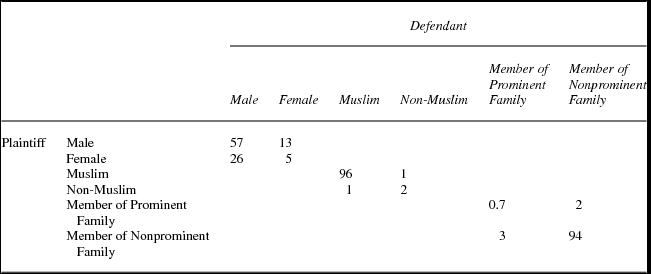
We use all available information about the identities of litigants recorded in proceedings to determine the relative frequencies of various plaintiff-defendant combinations that came to court to resolve disputes in Kastamonu during this period. The data set used in this study consists of 590 litigations heard in court.Footnote 8 The characteristics of litigants that are the easiest to determine are gender and religion. The names of litigants make it easy to distinguish males from females, and court records similarly note the religious affiliation of non-Muslims in a way that makes it easy to identify them. Based on this information, table 1 shows the proportions of various plaintiff-defendant combinations according to gender and religion. As seen in the table, in a majority of cases (57 percent) the litigants were both male, and females brought suit against males in about twice as many cases (26 percent) than the other way around (13 percent). The proportions of disputes involving non-Muslims was small (about 3–4 percent), particularly noteworthy given that non-Muslims constituted about 15 percent of the population.
Proportions of cases according to the gender, religion, and family affiliation of litigants (percent)

Source: Court records (sicils) of Kastamonu. See p. 189 for definitions of categories.
Court records also include information about family affiliation, which allows us to determine if a litigant was related to an established and prominent family. The names of these families appear frequently in court records, and litigants affiliated with them are identified with the suffix “zade.” For example, Kıbrısi-zade Ahmed Efendi was a member of the prominent Kıbrısi extended family, who played important roles in the judicial and administrative affairs of the region. Although there are no published studies on the economic characteristics of these families, our own unpublished analysis of eighteenth-century probate inventories indicate that individuals who belonged to them were significantly wealthier than the rest of the society.Footnote 9 As seen in table 1, only a small proportion (about 5–6 percent) of cases involved members of prominent families. We explore in the following text whether this affiliation gave them an advantage in court.
Going beyond differences in gender, religion, and family affiliation, we can make creative use of some of the information included in court records to make inferences about other characteristics of litigants. One of the asymmetries between litigants that could affect their chances of winning in court is socioeconomic status. Although we do not have direct information on the incomes, occupations, or educational backgrounds of all litigants, court records include the honorary titles and religious markers of litigants, which can be utilized as indicators of socioeconomic status.
Honorary titles appear in court records as parts of men's names and they help to distinguish individuals according to their affiliation with the provincial administrative structure and relative positions within the community. They may signify individuals who possessed specific types of professional training or education, performed various sorts of military/administrative or judicial/religious functions, and enjoyed the socioeconomic privileges associated therewith. In addition to exemption from taxation, these benefits included economic compensation for specific services as well as varying degrees of communal influence due to their involvement in the provincial administration or service.
Based on honorary titles, we can determine not just whether a man belonged to the military/administrative establishment (seyfiyye, in Ottoman Turkish) or the judicial/religious one (ilmiyye) but also whether he belonged to the elite group within each category.Footnote 10 For example, Ağas were the wealthiest, most prestigious, and highest-ranking members of the military/administrative establishment, and Efendis had the same status in the judicial/religious establishment (Ergene and Berker Reference Ergene and Berker2008).Footnote 11 These groups included individuals who collectively managed the official affairs of the town and its environs in different capacities, played communal leadership roles, and also took advantage of the economic opportunities available in their locations.
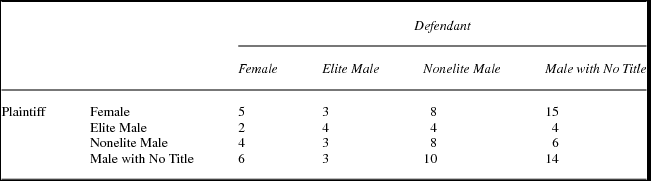
Using titles as indicators of socioeconomic status, we thus divided litigants into four groups. Because titles were recorded exclusively for men, we separated female litigants into the first category. We divided male litigants into three groups based on whether they had honorific titles and whether their title indicated membership in the elite category. So the second category of plaintiffs is the “elite males,” consisting of Ağas as elite military/administrative titleholders and Efendis as elite religious/judicial titleholders. The third category consists of “males with nonelite titles,” and the fourth are the category of men recorded in court proceedings without titles. Although “males with nonelite titles” were not necessarily wealthier than title-less men we attribute a relatively higher social status to the first group, based on their public functions, professional affiliations, and networks of association (Reference Ergeneibid.). Table 2 shows the proportions of plaintiffs and defendants in each category.
Gender, honorary titles, and elite status of litigants (percent of all cases)

Source: Court records (sicils) of Kastamonu. See p. 190 for definitions of elite status based on honorary titles.
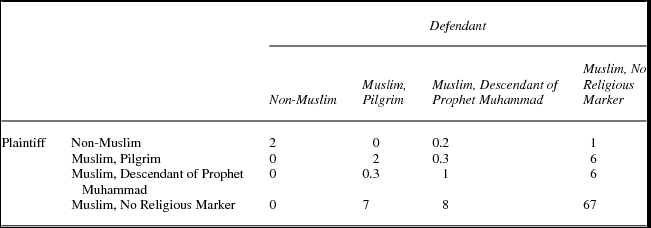
In addition to identifying Muslims and non-Muslims, we can further distinguish among Muslim litigants according to their religious markers. These markers, also parts of litigants’ names, demonstrate if individuals claimed descent from Muhammad (sing. seyyid for men, şerife for women) or made the pilgrimage to Mecca (sing. elhac or hacı for men, hace or haciye for women). These markers indicate elevated socioreligious status, though they should not be confused with religious/judicial titles. Indeed, men with military/administrative and religious/judicial titles, as well as the title-less men, are often identified in the court records as pilgrims and descendants of Muhammad. Previous research also demonstrated that the epithet pilgrim was associated with wealth in eighteenth-century Kastamonu (ibid.), which is not surprising given the cost of conducting pilgrimage to the Hijaz from Anatolia.Footnote 12 Table 3 shows the distribution of litigants according to religious markers.
Religion and religious markers of litigants (percent)

Source: Court records (sicils) of Kastamonu. See p. 190–91 for definitions of religious markers.
As seen in table 3, about 30 percent of all cases involved an individual with a religious marker, and a high proportion of those were against litigants who did not carry such a title. We explore in more detail in the following text whether and why these characteristics were likely to affect the plaintiff's chances of winning at trial.
Determinants of Plaintiff Win Ratio
We now turn our attention to trial outcomes and combine insights from the law and economics literature with information from Kastamonu records to examine the factors that could influence the plaintiff's chances of success in Ottoman courts. The basic presumption in this literature is that litigants act rationally and trial outcomes depend on judicial procedures and case characteristics. Studying plaintiff win rates in various data sets, researchers have found that actual rates can vary systematically from the hypothesized limiting case of 50 percent.Footnote 13 These results may still be consistent with the underlying selection hypothesis because the variation across cases could simply be caused by violation of the assumptions behind the simple model.
Siegelman and Waldfogel (Reference Siegelman and Waldfogel1999) have extended empirical analysis of plaintiff win rates by identifying three characteristics of the litigation environment that can explain the observed trial outcomes. These characteristics are the parties’ ability to estimate the quality of their cases, the degree of stake asymmetry across parties, and the decision standard. By operationalizing these characteristics in the litigation environment of Ottoman courts we can explain variations in the plaintiff win rates in Kastamonu in the eighteenth century.
Consider first the difference in the parties’ ability to estimate the quality of their cases. In general, parties may differ in their abilities to estimate their chances at trial if they have asymmetric information about the law governing a case or about the facts of a dispute. This could be the case if, for example, one of the litigants was more experienced or better prepared than the other, such as in trials involving large firms versus single parties or involving educated versus uneducated individuals. In such trials, the selection effect would result in a higher chance of success for the more sophisticated party. To see this, consider a class of trials in which the defendants have greater ability to determine their chances of success. This would mean that the defendants with relatively worse chances at trial would more likely to settle and those with relatively good chances would more likely go to trial. Consequently, the pool of defendants who go to trial rather than settle would likely consist of those with a good chance of success, resulting in a higher than 50 percent chance rate of success for them at trial.
To see how the selection effect could affect chances of success in an Ottoman court, consider the difference between the elites and others in estimating the quality of their cases. As noted, court records typically identified individuals with elite status through their honorary titles (e.g., Efendi). Based on our knowledge of differential access of elites and others to education and economic resources in premodern Islamic settings, we would expect individuals with elite titles to have greater ability to estimate the quality of their cases because they would be more likely than others to either possess the pertinent knowledge about legal rules and facts of a dispute or have the means to acquire it from others.Footnote 14 All else being the same, this would mean that among those litigants with low chances of success the elites would be more likely to settle than others, resulting in a pool of litigants that includes elites who have a disproportionately higher chance of success at trial than others who choose to go to trial. As a result, faced with each other in court, on average the elites would be more likely than others to win at trial.
Consider next the role of asymmetric stakes on the plaintiff's chances of success at trial. Asymmetric stakes arise when one or both of the parties to a case derive some cost or benefit from the outcome that is not captured entirely by the amount of the damages to be paid by the defendant to the plaintiff in this case. This may happen, for example, if one of the parties has higher reputational concerns about the trial outcome than the other, such as when a prominent member of a society faces a relatively unknown individual. In situations of asymmetric stakes, we would expect parties with greater stakes to have a higher chance of success in litigation because of a selection effect that raises the proportion of strong cases that go to trial. By altering the total cost and benefit of court outcomes, asymmetric stakes make settlement more likely in otherwise “toss-up” disputes. Because the party with greater stakes would have more to lose from litigation, he or she would be more likely to settle the dispute by making an acceptable offer to the party with lesser stake than to risk a larger loss at trial. As a result, the cases that go to trial would likely be the ones in which the party with higher stakes has a greater chance for success than would be if the stakes were the same.
To see how asymmetric stakes can affect the plaintiff win ratio in Kastamonu courts, consider the difference among litigants in their family status, which can be determined through the presence of the suffix “zade,” typically entered in court records for individuals from prominent families. All else being the same, the prominent members of the society would be expected to have greater stakes in a dispute than individuals from nonprominent families because of their concern to protect their reputations and family honor. With higher stakes at trial, individuals from prominent families would thus be more likely than others to settle a dispute than go to court. Such a selection effect would consequently mean a higher expected chance of success for prominent individuals who choose to go to trial.
The final parameter of the litigation environment identified by Siegelman and Waldfogel (Reference Siegelman and Waldfogel1999) as a basic determinant of the trial and plaintiff win rates is the decision standard of the subject category. Because it is the decision standard that selects the winners and losers in court cases, the standard applicable to a category of cases can affect the plaintiff win rate in that category significantly. To see this, consider differences among case types according to subject categories. Here we focus not so much on the specific identities of litigants but on the nature of the incident or behavior that led to dispute. For example, modern courts generally make a clear distinction between criminal and civil cases. Whereas the decision in the former category concerns determining whether the accused has committed a crime, the decision in civil cases is to determine whether the defendant is liable for the plaintiff's alleged injuries. Typically the latter category further consists of a variety of subcategories, such as contracts, real property, worker injury, and product liability. The distribution of disputes and the applicable decision standard may vary significantly across these categories.Footnote 15
Differences among subject categories suggest that the plaintiff's chances of success might vary accordingly. Studying the proportions of plaintiff victories in civil cases tried in Cook County, Illinois, between 1959 and 1979, Priest and Klein (Reference Priest and Klein1984: 38) have shown that the plaintiff win rate was very close to 50 percent in some categories (common carriers, property injuries, and dram shop cases), but it was significantly different from this benchmark in other categories (worker injury, product liability, and malpractice). Kessler et al. (Reference Kessler, Meites and Miller1996: 238–41) and Waldfogel (Reference Waldfogel1995: 240) have similarly found systematically different win rates among case types in their empirical analysis of court outcomes.
In the Ottoman context as well it is possible to identify common characteristics in some litigations that distinguish them clearly from others. For a systematic categorization of cases heard in Kastamonu courts, we classify them into three groups according to the case type and family relationship among the litigants. More specifically, we divide them into the categories of (1) criminal cases (all involving unrelated parties), (2) civil cases among related parties (through family ties), and (3) civil cases among unrelated parties. We separated cases that involved related parties from unrelated ones because the effect of individual characteristics on court outcomes may depend on familial relationship between litigants. Our sample does not include criminal litigations involving related parties.
A Quantitative Analysis of Court Trials in Kastamonu
As noted, our data set consists of 590 litigations (in which both the plaintiffs and defendants were individuals) heard in the Kastamonu court during the period between 1684 and 1790. The largest group of litigations (354) involves civil disputes among unrelated parties, which largely includes contentions over money and property (debt, ownership of property, commercial disputes, etc.). The second group consists of civil disputes among related parties. There are 169 such litigations in our sample, and they are largely disputes over money and property among kin and/or family members. The last group is criminal disputes (67), consisting primarily of contentions over acts of assault (sexual and otherwise), robbery, and usurpation.
It is interesting that plaintiffs won 45 percent (standard deviation 0.50) of all cases in our sample, somewhat lower than the rate of 50 percent hypothesized by Klein and Priest.Footnote 16 The rate varied significantly, however, across the three subject categories. Whereas the plaintiff win ratio was 54 percent (σ = 0.50) in criminal cases, it was 46 percent (σ = 0.50) in civil disputes among unrelated parties and 38 percent (σ = 0.49) in those among related parties.
Because factors representing asymmetric stakes, differential abilities, and case types likely influenced the plaintiff win ratio simultaneously, we need to use regression analysis to isolate the individual effect of each factor. The dependent variable in this analysis represents the decision, a dummy variable that takes the value of 1 if the case was won by the plaintiff. We use the probit model for estimation.
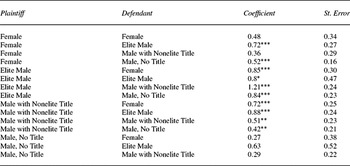
To determine factors affecting the plaintiff win ratio, we included in the analysis five categories of explanatory variables. The first three categories represent various plaintiff-defendant combinations corresponding to differences in gender and honorary titles, religion and religious markers, and family status. Each of these is a dummy variable that takes the value of 1 if the plaintiff-defendant combination is as stated, 0 otherwise. For example, the dependent variable “Female, Female,” included in the “Gender and Honorary Titles” category listed in table 4a takes the value of 1 when the plaintiff and the defendant are both female, 0 otherwise. As noted in table 4a, the plaintiff-defendant combination with the highest proportion of the total in each category has been omitted to avoid multicollinearity, so the coefficient of each combination needs to be interpreted as the differential effect from the omitted one. The coefficient of “Female, Female,” for example, shows the differential effect of this combination of litigants on the plaintiff's chance of success relative to the omitted category of “Male, No Title; Male, No Title.”
Probit analysis of influences on plaintiff's chances of success at trial: Gender and honorary titles

Source: Court records (sicils) of Kastamonu.
Notes: See p. 189–91 for definitions of variables. The dependent variable takes the value of 1 if the case was won by the plaintiff. Standard errors have been adjusted for clustering on case type and time period. The omitted category is “Male with No Title, Male with No Title.” See Table 4b for other variables in the regression equation, sample size, and measures of goodness of fit.
*** indicates significance at 1 percent, ** at 5 percent, and * at 10 percent for a two-tailed test.
The fourth group of variables shows the effect of case type on the plaintiff's chance of success. We used dummy variables to distinguish between criminal cases, civil cases among related parties, and civil cases among unrelated parties. We omitted the variable “civil cases among unrelated parties” in the regression equation to avoid multicollinearity.
Finally, we included a group of variables to control for the effect of possible unobserved changes in the decision standard over time. Our sample includes observations from three roughly equal subperiods as follows:
-
(1) 1095/1684—1107/1696
-
(2) 1148/1735—1156/1743
-
(3) 1195/1781—1204/1790
The first period is slightly longer than the other two because of missing documentation for some years. The number of litigations heard in court is 162 in the first period, 188 in the second period, and 240 in the third period.
Differences among clusters of case types and periods suggest the possibility of correlation of the observations within these clusters. Criminal cases in the first period, for example, could be correlated with each other because of shared characteristics in legal procedures and regulations. To correct for the possibility of correlated data, we divided observations into nine clusters (based on the three case types and three time periods that were defined previously) and used clustered robust standard errors in regression analysis.
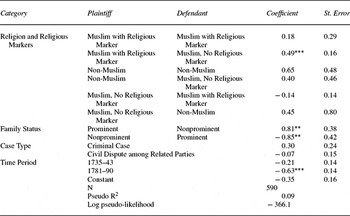
The results of regression analysis, displayed in tables 4a and 4b, show how differences in the abilities of parties to estimate the quality of their cases, the degree of stake asymmetry, and decision standard affected the plaintiff's chances of winning at trial (compared to those in the omitted categories) in Kastamonu during this period. Although we included all depended variables in a single regression equation, we separate the results into two tables for clearer presentation. As stated in the notes to the tables, we omitted one of the variables in each group as the reference category. We also dropped some variables from the analysis because they predicted success or failure perfectly.
Probit analysis of influences on plaintiff's chances of success at trial: Religion, family, case, and period characteristics

Source: Court records (sicils) of Kastamonu.
Notes: See p. 189–91 for definitions of variables. The dependent variable takes the value of 1 if the case was won by the plaintiff. Standard errors have been adjusted for clustering on case type and time period. The omitted variables are “Muslim with No Religious Marker, Muslim with No Religious Marker” in the Religion and Religious Markers category; “Nonprominent, Nonprominent” in the Family Status category; “Civil Dispute among Unrelated Parties” in the Case Type category; and “1684–96” in the Time Period category. In addition, “Muslim with Religious Marker, Non-Muslim” is omitted because it predicts success perfectly; “Non-Muslim, Muslim with Religious Marker” is omitted because it predicts failure perfectly; and “Prominent, Prominent” is dropped because it predicts success perfectly. See Table 4a for other variables in the regression equation.
*** indicates significance at 1 percent, ** at 5 percent, and * at 10 percent for a two-tailed test.
The results generally confirm the argument that the trial outcomes in Kastamonu courts followed systematic patterns and that these patterns were basically consistent with the theoretical insights and empirical findings of the law and economics literature. Take the influence of gender and honorary titles on the plaintiff's chances of success, presented in table 4a. The results generally show that the plaintiff's chances rose when he or she had greater stakes in trial outcome and greater ability to estimate chances of success at trial than the defendant. For example, whereas the plaintiff's chances of success did not change significantly when the plaintiff and defendant were both females (compared to the reference category of “Male with No Title, Male with No Title”), the coefficient increased and became more significant when asymmetries grew larger. In the same vein, when the plaintiff was an “Elite Male,” his chances at trial increased and became more significant as the asymmetries with the defendant grew as, for example, the defendant changed from “Elite Male” to “Female” or from “Elite Male” to “Male with No Title.”
As seen in table 4b, differences between litigants in religion and religious markers generally had insignificant effects on the plaintiff's chances of success at trial, other than for the litigant match between “Muslim with Religious Marker” and “Muslim with No Religious Marker.” Recall that religious markers in question are for Muslim pilgrims and descendants of Prophet Muhammad. So this result is also consistent with the arguments made earlier about the effect of stake asymmetries on plaintiff success, because one would expect individuals with religious markers to have greater stakes from the trial outcome than others. Our results thus indicate that religious markers raised the plaintiff win ratio when they favored the plaintiff, as one would expect. Our results also show that other differences in religion and religious markers did not affect trial outcomes significantly. One has to be careful in generalizing the results with non-Muslims, however, because the number of observations with them as litigants is very low.
The variables in the third category show the effect of family affiliation, more specifically whether asymmetric membership in prominent families affected trial outcomes. The results show that plaintiff's chances at trial rose significantly when he or she belonged to a prominent family and went to trial against a defendant who did not have such family affiliation (compared to cases that involved members of nonprominent individuals as litigants). Conversely, chances at trial decreased significantly when the plaintiff was not a member of a prominent family and went to trial against a defendant who had family prominence. These results are consistent with our argument about the effects of asymmetric stakes and asymmetric abilities to estimate case quality. One would expect a member of a prominent family to be more concerned than others about reputational stakes from a trial, and our results are consistent with this expectation. Similarly, if members of prominent families had higher education or more sophisticated legal knowledge than others, one would also expect them to have greater abilities to estimate the quality of their cases. In both cases, they would be more likely than others to settle weak cases and go to trial only when they are sufficiently confident of their chances to win. Consequently, they would be more likely than others to win at trial, either as plaintiffs or defendants, as our results show.
The variables in the final two categories show the effects of variations in standards over time and across case categories. Interestingly, the coefficients of differences in case types are generally insignificant, indicating that all else being the same plaintiff win ratios did not vary significantly among cases. This seems contrary to the expectation, based on the differential standards of proof observed between civil and criminal cases in modern legal systems, that win rates should vary between case types. Perhaps the standards of proof did not vary as significantly in Ottoman courts as they do in modern courts. In the final category, we control for possible structural shifts in trial outcomes over time, and our results show significant changes in the third period.
The Impact of Islamic Evidentiary Process on the Results
Our results reveal an interesting pattern about the way the significance of coefficients changed between litigant pairings when certain privileged parties acted as plaintiffs but not as defendants. This happened when elite and nonelite title holders went to trial against title-less men, and parties with religious markers faced those with no such markers. In the same vein, while female plaintiffs dominated litigations against title-less male defendants, pairings composed of title-less male plaintiffs and female defendants produced insignificant results. Because female litigants in the sample constitute an undifferentiated group, including women affiliated with affluent and influential families, this finding likely reflects a similar tendency.
This pattern could be related to the Islamic evidentiary procedures. As discussed, Islamic law requires the kadı to assign the responsibility to provide evidence, and the burden of proof could be placed either on the plaintiff or the defendant based on the nature of their claims and responses.Footnote 17 Procedurally, the kadı would be expected to rule for the party who assumed the burden of proof without further investigation, if this party could submit to court credible and sufficient evidence (Bayındır Reference Bayındır1986: 106–11; Berki Reference Berki1986: articles 1816–23, 1631–33; Coulson Reference Coulson2013). Our observations in court records confirm that this procedure was generally followed in practice. In other words, once the kadı assigned the burden of proof, he did not have to give a chance to their opponents to provide counterevidence that might support their own positions. This procedure could clearly give a significant advantage to those who were assigned the responsibility of providing evidence.Footnote 18 In our sample, the litigants who were asked to provide proof won about 77 percent of the cases.Footnote 19 Because the plaintiffs assumed this responsibility in most cases (two out of three),Footnote 20 they had a potential advantage over the defendants.
The results suggest that in cross-group litigations the privileged parties (elite title holders, parties with religious markers, etc.) were relatively successful in taking advantage of Islamic evidentiary standards. In the position of plaintiffs, they often assumed the responsibility of providing proof. When this happened, they effectively supplied credible evidence and won their cases. However, as defendants, privileged parties had less chance to assume the burden of proof, which is why they failed to dominate litigations.Footnote 21 This is clearly an important issue that needs to be studied systematically, and we leave it to further research to understand the full impact of Islamic evidentiary processes on trial results.
Conclusion
We offer a quantitative analysis of court cases from the late seventeenth- and eighteenth-century Ottoman Kastamonu to determine how gender and elite status, religion and religious markers, and temporal and categorical variations in the decision standard influenced the results of cases heard and decided in an Islamic court. To put our analysis in context, we used insights from the law and economics literature, specifically arguments about the way selection effects govern the relationship between case characteristics and trial outcomes. Interpreting individual characteristics as indicators of differential abilities in estimating the quality of suits and the degree of stake asymmetry between litigants, we show that elite males generally had high chances of success as plaintiffs against females and against other males with no titles or nonelite titles, and that members of prominent families did similarly well against other individuals. Overall these results indicate that affluent and socially prominent litigants, presumably more informed than others about legal rules and procedures and who faced greater stakes from trial outcomes, performed well against their poorer and less prominent opponents, when the former group acted as plaintiffs. The results were more balanced when privileged groups faced less advantaged ones as defendants, which we believe might be related to the evidentiary standards followed in trial proceedings. Our results also show that women as plaintiffs were likely to win against elite males and men with no titles, indicating that the trial outcome was influenced more by asymmetric stakes between males and females than the gender gap in education.
Our results challenge some of the widely held presumptions about dispute resolution in Ottoman courts. Contrary to claims that the judges’ decisions were far from arbitrary and unpredictable, Kastamonu judges made decisions that can be grasped by the tools and concepts of modern scholarship on dispute resolution, and their decisions displayed systematic patterns that are consistent with those identified by quantitative analysis of court outcomes in modern societies. The litigants in Kastamonu courts in the seventeenth and eighteenth centuries did not seem to have faced systemic uncertainty or extraordinary arbitrariness. The results also challenge the widely shared perception in Ottoman legal scholarship that the court may have subscribed to an egalitarian legal ideology. Contrary to presumptions, based largely on impressionistic observations, that judges protected or favored the interests of the poor and the underprivileged, trial outcomes were neither impartial to the individual characteristics of litigants nor did they systematically favor the women or the title-less or nonelite men against the more privileged elites.