1. Introduction
Due to the excellent performance of permanent magnet synchronous motor (PMSM), it has been widely used in the field of aerospace, robotics, electric vehicles, and others [Reference Ping, Li, Song, Huang, Wang and Lu1, Reference Jiang, Huang, Li and Li2]. The high-precision control of PMSM system is a time-varying, highly coupled, and multi-variable non-linear system that requires precise system parameters in conventional control methods [Reference Chen3, Reference Corless4]. However, structural uncertainties such as system parameter changes, inadequate system modeling, and non-structural uncertainties such as load torque disturbance, diversity of control targets may affect the servo performance of PMSM system [Reference Gao, Wu, Wang and Chen5, Reference Ping, Ma, Wang, Huang and Lu6]. Therefore, the effective method to solve the system uncertainty is to improve the dynamic performance and robustness of the PMSM system.
In the past decades, the study of non-linear systems has gained a lot of attention and great progress has been made in the study of motor dynamic control algorithms. In ref. [Reference Hernández-Guzmán and Orrante-Sakanassi7], based on the guaranteed cost of PMSM position tracking, a robust iterative learning control is proposed. In ref. [Reference Moreno and Sandoval8], a robust cascade control is applied in PMSM speed control, which damages the disturbance observer. In ref. [Reference Qin and Gao9], the PMSM’s performance of robust sensor-fault-tolerant control was studied by using two sliding mode observers for position and speed estimation. For high-precision speed control of PMSM, ref. [Reference Zhao and Fu10] employs an adaptive robust speed control depending on an artificial neural network, sliding mode control [Reference Islam and Liu11–Reference Fallaha, Saad, Kanaan and Al-Haddad13], predictive control [Reference Avanzini, Zanchettin and Rocco14, Reference Sun, Cao, Lei, Guo and Zhu15], H
 $\infty$
control [Reference Hu, Jing, Wang, Yan and Chadli16, Reference Rubaai, Ofoli and Cobbinah17], adaptive controls [Reference Zou and Schueller18–Reference Chen, Yao, Ren, Wang, Zhang and Jiang21] are some of the strategies offered by researchers to accomplish high-performance control of PMSM systems. Khorashadizadeh et al. [Reference Khorashadizadeh and Sadeghijaleh22] merged the electrical and mechanical equations of the robotic system, transferred the uncertainties associated with the dynamics of the manipulator to the voltage equation of the PMSMs, and applied the control law to an articulated manipulator. Moreno-Valenzuela et al. [Reference Javier, Yajaira, Regino and Luis23] proposed a new method for compensating electrical and mechanical dynamics using adaptive control and present a rigorous closed-loop system stability analysis based on Lyapunov theory. Ciabattoni et al. [Reference Ciabattoni, Corradini, Grisostomi, Ippoliti, Longhi and Orlando24] proposed a variable structure sensorless control scheme for PMSM drivers and conducted experiments using discrete-time variable structure control on commercial PMSM drivers. Furthermore, ref. [Reference Sun, Hu and Lei25] improves the steady-state and dynamic performance of PMSM drives. Ref. [Reference Sun, Wu and Lei26] suggests an optimal control method for PMSM, while refs. [Reference Do, Choi and Jung27, Reference Huang, Xian, Zhen and Sun28] proposes an improved deadbeat predictive control algorithm that may reduce the influence of inductance, resistance, and flux linkage parameter mismatches.
Among the non-linear control methods we mentioned above, robust control has always been a research hotspot in solving system uncertainty and realizing robust and high-performance PMSM control. It is particularly suitable for the control system, and it prioritizes stability and dependability because the dynamic characteristics of the process are known, the range of uncertainties can be predicted, and it does not require an exact process model. As a result, robust control is suited to systems with a wide range of uncertainty and a little stability margin. The steady-state accuracy of the robust control system, on the other hand, is low because it does not operate in the ideal condition.
Traditional model-based PD (MPD) or PID control (MPID) is a kind of motion-based control technology. It has excellent performance and is easy to implement. However, MPD control and MPID control cannot meet the control requirements of complex non-linear mechanical systems, because they do not consider the dynamics and coupling of the system. The most popular H-infinity controller today suffers from the problem of excessive order. The sliding mode control method has strong robustness to systems with parameter changes and disturbances, but there are also serious disadvantages such as jitter. The larger range of the controlled quantity is, the more obvious the jitter will be. In the field of aerospace, which requires high precision, this kind of jitter is absolutely intolerable. When designing a control system, special measures must be taken into account to eliminate jitter. Predictive control has been widely used in production process control because it can deal with constraints and has loosed requirements for model form. However, the disadvantages are shown as follows: first of all, this is a first-order system, which means when the control error reaches zero, the input of the system must still be located in a certain position and cannot return to zero. Secondly, the latency of the system is enormous. The control frequency of the control system should not be less than 10 Hz so that the system can break in time. But if the acceleration is slow, we need to adjust the speed substantially. Adaptive control is suitable for unknown mathematical models of the controlled object or process. Its characteristics are similar to fuzzy control, which has strong robustness and is suitable for solving non-linear, strong coupling, time-varying, and delay problems in process control. Moreover, it also has a high fault-tolerance capability, allowing it to adapt to changes in the dynamic quality, environmental factors, and dynamic conditions of the controlled object. The disadvantage is that the design is not systematic. The fuzzy processing of simple information will decrease the control accuracy and deteriorate the system’s dynamic quality. So it is impossible to define the control objectives.
The controller proposed (MPDP) in this paper is a novel control technology composed of MPD control and a component with upper limit
 $\rho$
, which has the advantages of high efficiency and practicality. In addition, by using the controller in a PMSM, it is easier to adjust the parameters appropriately and get a more excellent experimental effect. The response of the motor will be more agile and the accuracy will be improved to a higher degree. At the same time, the trajectory tracking is more accurate, and the experimental results of steady-state response and transient response are remarkable. Compared with H
 $\infty$
control [Reference Rubaai, Ofoli and Cobbinah17], the controller we designed is based on model construction and has better accuracy for high-speed/high-precision tracking control. Compared with adaptive control [Reference Zou and Schueller18, Reference Hayat, Leibold and Buss19], the control method proposed by us has low hardware requirements, simple structure, easy adjustment process, and few parameters. DSP2000 series and STM32 series chips widely used at present can be applied as the hardware carrier of the control algorithm. Adaptive control strategy needs to design and adjust adaptive law, which requires high computing power of hardware and processor.
To summarize, the following are the main contributions of this paper. (1) A practical robust control method is presented, which is easy to adjust parameters. It can achieve excellent results in steady-state response and transient response. (2) We conduct abundant experiments on PMSM to compare the control effect of PID controller, MPD controller, and the novel robust controller. (3) We examine the results, which reveal that the proposed controller has a significant control effect.
The following is mainly divided into four parts. The second section describes the dynamic model of PMSM. The design of robust controller is presented in the third section. The stability of the developed controller is then examined. The simulation and experimental results in the fourth section demonstrate the effectiveness of the proposed method. The work is summarized in the fifth section.
2. Dynamical modeling of PMSM
With reference to ref. [Reference Javier, Yajaira, Regino and Luis23], we obtain the mathematical model of PMSM as follows:
 \begin{equation} \left \lbrace \begin{aligned} &\dot{i_{d}}=-\frac{R}{L_{d}}i_{d}+\frac{L_{q}}{L_{d}}n_{p}\dot{q} i_{q}+\frac{u_{d}}{L_{d}} \\[5pt] &\dot{i_{q}}=-\frac{R}{L_{q}}i_{q}-\frac{L_{d}}{L_{q}}n_{p}\dot{q} i_{d}-n_{p}\dot{q} \frac{\psi _{f}}{L_{q}}+\frac{u_{q}}{L_{q}} \\[5pt] &\ddot{q}=\frac{T_e}{J}-\dot{q} \frac{B}{J}-\frac{T_{l}}{J} \end{aligned} \right. \end{equation}
Here,
 $u_{d}$
,
 $u_{q}$
,
 $i_{d}$
,
 $i_{q}$
,
 $L_{d}$
, and
 $L_{q}$
represent the stator voltage, stator current, and stator inductance on the
 $d$
and
 $q$
axis.
 $q$
,
 $\dot{q}$
, and
 $\ddot{q}$
represents the angular displacement, velocity, and acceleration of the rotor,
 $n_{p}$
stands for the pole pairs number,
 $\psi _{f}$
is the rotor flux linkage,
 $R$
is the stator resistance. The inertial moment, viscous friction coefficient, electromagnet torque, which is the output torque of the PMSM, and load torque are represented by
 $J, B, T_{e}$
, and
 $T_{l}$
, respectively.
Decompose Eq. (1) to obtain:
 \begin{equation} T_{e}=\frac{3}{2}n_{p}i_{p}[\psi _{f}+(L_{d}-L_{q})i_{d}] \end{equation}
In a PMSM drive system, the Field-Oriented Control (FOC) technique is the most commonly utilized technique. Control the three-phase stator current synthesis vector
 $i_s$
on the
 $q-axis$
to make
 $i_d$
zero,
 $i_q = i_s, i_d = 0$
, according to the FOC principle. This allows the electromagnetic torque to be regulated directly by the control
 $i_q$
, resulting in improved dynamic performance due to separate torque management. The mathematic model based on interior PMSM is described by Eqs. (3) and (4); however, the surface-mount PMSM used in experiments is described by
 $L_d = L_q = L$
. As a result, the following is the mathematical model for surface-mount PMSM:
 \begin{equation} \begin{cases} \dot{i_d}=0 \\[5pt] \dot{i_q}=-\dfrac{R}{L_{q}}i_{q}-n_p{\dot{q}}{\dfrac{{\Psi }_f}{L_q}+\dfrac{u_d}{L_d}}\\[12pt] \ddot{q}=\dfrac{T_e}{J}-{\dot{q}}\dfrac{B}{J}-\dfrac{T_L}{J} \end{cases} \end{equation}
The electromagnetic torque Te is:
 \begin{equation} T_e ={\frac{3}{2}}n_pi_q\psi _f=K_{t}i_{q} \end{equation}
where
 $K_t={\dfrac{3}{2}{n_p}{\psi _f}}$
represents the torque coefficient.
The dynamic equation of surface-mounted PMSM can be obtained using Eq. (3):
 \begin{equation} J{\ddot{\theta }} = T_{e}-T_{L}-B{\dot{\theta }} \end{equation}
In fact, the above-mentioned mathematical mode and dynamic equation are acquired under ideal conditions. The uncertain factors which exist in the PMSM system, such as system parameter variations, inadequate system modeling, friction force, load disturbance, and the variety of control objectives, will affect the PMSM servo performance. To improve control performance and compensate system uncertainties, we propose MPDP strengthen the robustness and the servo performance of the PMSM system.
Write the kinetic equation of PMSM in the form of Lagrangian kinetic equation as follows, which are completely described in ref. [Reference Javier, Yajaira, Regino and Luis23].
 \begin{eqnarray} \begin{split} H(q)\ddot{q}+C(q,\dot{q}){\dot{q}}+G(q)+F({q},\dot{q},t)=u \end{split} \end{eqnarray}
Since our research object is a single PMSM, which is a mechanical system with one degree of freedom, the variable here is one-dimensional. Since the axis of PMSM only rotates,
 $G(\!\cdot \!)$
is zero.
 \begin{eqnarray} \begin{split} &q=\theta,{\dot{q}={\dot{\theta }}},{\ddot{q}}={\ddot{\theta }},u=i_q\\[5pt] & H(q)={\frac{J}{K_t}}\\[5pt] & C(q,{\dot{q}})={\frac{B}{K_t}}\\[5pt] & G(q)=0\\[5pt] & F({q},\dot{q},t)=\frac{T_L}{K_t} \end{split} \end{eqnarray}
We wish the PMSM system follows a specific trajectory
 $q^d(t)$
, with the specific velocity
 $\dot{q}(t)$
and acceleration
 $\ddot{q}$
as specified by
 \begin{eqnarray} \begin{split} &{q}^d(t)={\theta }^d={\frac{\pi }{3}}\sin\!\left(\frac{\pi }{2}t\right)\\[5pt] & \dot{q}^d(t)=\dot{\theta }^d={\frac{{\pi }^2}{6}}\cos\!\left(\frac{\pi }{2}t\right)\\[5pt] & \ddot{q}^d(t)={\theta{q}}^d=-{\frac{{\pi }^3}{12}}{\sin\!\left(\frac{\pi }{2}t\right)} \end{split} \end{eqnarray}
By using
 $q=e+{q^d}$
,
 $\dot{q}=\dot{e}+{\dot{q}^d}$
,
 $\ddot{q}=\ddot{e}+\ddot{q}^d$
. So the Eq. (6) can be written as
 \begin{eqnarray} \begin{split} &C(e+q^d,\dot{e}+\dot{q}^d)({\dot{e}+\dot{q}^d})+F(e+q^d,\dot{e}+\dot{q}^d,t)\\[5pt] &+H(e+{q^d})\ddot{e}+H(e+{q^d})\ddot{q}^d=u \end{split} \end{eqnarray}
Since inertia matrices of mechanical systems are uniformly positive definite and bounded, the inertia matrix
 $(H(q))$
in Eq. (6) has the following inequality:
 \begin{equation} 0\lt\underline{\sigma } I\le H(q)\le \overline{\sigma } I\quad \forall q \in \mathbf{R}^n \end{equation}
where
 $\underline{\sigma}$
,
 $\overline{\sigma }$
¿0.
Theorem 1.
The matrix
 $\dot{H}(q)-2C(q, \dot{q})$
for all
 $q$
,
 $\dot{q}$
is skew-symmetry property [Reference Slotine and Li29]. So, we have
 \begin{eqnarray} \xi ^{T}\{\dot{H}(\theta )-2C(\theta, \dot{\theta })\} \xi =0 \end{eqnarray}
where
 $\xi$
is any vector.
3. The proposed robust controller
3.1. Robust controller design
Our objective is mechanical system will track our given trajectory
 $(q^d(t),t\in{[t_0,t_1]})$
at the eager speed
 $({\dot{q}}^{d}(t)$
, assuming
 $q^d(t)\;:\;[t_0,\infty ]\rightarrow{R^n}$
is continuous second-order derivable and
 $q^d(t),\dot{q}^d(t),\ddot{q}^d(t)$
is uniformly bounded.
Assume,
 \begin{equation} e(t)=q(t)-q^d(t) \end{equation}
Assume,
 $\dot{e}(t)=\dot{q}(t)-\dot{q}^d(t),\ddot{e}=\ddot{q}(t)-\ddot{q}^d(t)$
, let,
 \begin{equation} \underline{e}(t)=[e(t) \dot{e}(t)]^T \end{equation}
The following equation is the matrix form of the most popular Lagrange equation in mechanical system dynamics, which are completely described in ref. [Reference Khorashadizadeh and Sadeghijaleh22].
 \begin{equation} \begin{split} H(q(t))\ddot{q}(t)+V(q(t),\dot{q}(t))+G(q(t)) +F(q(t),\dot{q}(t),t)=u(t) \end{split} \end{equation}
where
 $t{\in }R$
stands for time and
 $q(t){\in }R^{n}$
stands for generalized coordinate,
 $\dot{q}(t){\in }R^n$
is the generalized velocity,
 $\ddot{q}(t)$
is the generalized acceleration, the inertial matrix is represented by the
 $H(q(t))$
,
 $V(q(t),\dot{q}(t))$
stands for the offset acceleration and centrifugal force matrix,
 $G(q(t))$
represents the gravity matrix, the Coulomb and viscous friction and exterior disturbance is represented by the symbol
 $F(q(t),\dot{q}(t),t)$
, and the generalized control force is represented by the
 $u(t)$
.
 $V(q(t),\dot{q}(t))$
can be written as follows:
 \begin{equation} V(q(t),\dot{q}(t))=C(q(t),\dot{q}(t))\dot{q}(t) \end{equation}
With regard to modeling, there may be uncertainties or difficulties in many practical cases, so accurate
 $H$
,
 $C$
,
 $G$
, and
 $F$
cannot be obtained. Uncertainties include some friction parameters and effective load mass. We assume that the uncertainty of the model is bounded.
Equation (14) can be written as:
 \begin{equation} \begin{split} &H(e(t)+q^d(t))(\ddot{e}(t)+\ddot{q}^d(t))+G(e(t)+q^d(t))+ F(e(t)+q^d(t),\dot{e}(t)+\\[5pt] & \dot{q}^d(t),t)+C(e(t)+q^d(t),\dot{e}(t)+\dot{q}^d(t))(\dot{e}(t)+\dot{q}^d(t))=u(t) \end{split} \end{equation}
Our choice is the nominal matrix
 $\hat{H},\hat{C},\hat{G},\hat{F}$
, uncertain terms related to
 $\sigma$
. Then, given the matrix
 $S=diag{[s_i]_{n\times{n}}},s_{i}\gt{0}$
, choose (so we know the size of this function) a scalar function
 ${\rho }\;:\;{R^n}\times{R^n}\times{R^n}{\rightarrow }_{+}$
, as follows:
 \begin{equation} \rho (e,\dot{e},\sigma,t)\geq{\parallel \phi (e,\dot{e},\sigma,t)\parallel } \end{equation}
where
 \begin{align} &\phi (e,\dot{e},\sigma,t)=(\hat{H}(e+q^d,\dot{e}+\dot{q}^d,t)-H(e+q^d,\dot{e}+ \nonumber \\[5pt] &\dot{q}^d,\sigma,t)) (\ddot{q}-S\dot{e})+\hat{G}(e+q^d)-G(e+q^d,\sigma,t)+ \nonumber \\[5pt] &(\hat{C}(e+q^d,\dot{e}+\dot{q}^d,t)-C(e+q^d,\dot{e}+\dot{q}^d,\sigma,t))(\dot{q}^d-Se) \nonumber \\[5pt] &+\hat{F}(e+q,\dot{e}+\dot{q}^d,t)-F(e+q,\dot{e}+\dot{q}^d,\sigma,t) \end{align}
 $\phi (e,\dot{e},\sigma,t)$
is the aggregates of uncertainty,
 $\rho (e,\dot{e},\sigma,t)$
is the upper bound of uncertainty. For a given
 $\epsilon \gt 0$
(usually choose a smaller number) and
 $k_{pi},K_{vi}\gt 0,i=1,2,\ldots,n$
. The controller is designed as:
 \begin{equation} u=\hat{H}(\ddot{q}^d-S\dot{e})+\hat{C}(\dot{q}-Se)+\hat{G}+\hat{F}-K_pe-K_{v}\dot{e}+p(e,\dot{e},t) \end{equation}
where
 \begin{equation} p(e,\dot{e},t)=\left \{\begin{array}{r@{\quad}c@{\quad}l} -\dfrac{\mu (e,\dot{e},t)}{\parallel{\mu (e,\dot{e},t)}\parallel } &,{\parallel{\mu (e,\dot{e},t)}\parallel }\gt \epsilon \\[12pt] -\dfrac{\mu (e,\dot{e},t)}{\epsilon } &,{\parallel{\mu (e,\dot{e},t)}\parallel }\leq{\epsilon } \end{array}\right .\\[5pt] \end{equation}
 \begin{equation} \mu (e,\dot{e},t)=(\dot{e}+Se)\rho{(e,\dot{e},t)} \end{equation}
 \begin{equation} K_p=diag\{[k_{pi}]_{n\times{n}}\} \end{equation}
 \begin{equation} K_v=diag\{[k_{vi}]_{n\times{n}}\} \end{equation}
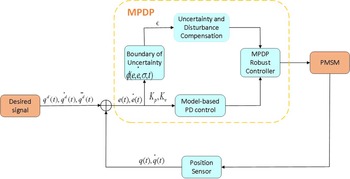
In order to describe the function of the MPDP controller better, the block diagram is given as follows Fig. 1.
Block diagram of the MPDP.

3.2. Stability analysis
Theorem 2.
The
 $\tilde{e}(t)$
of the PMSM system (6) is rendered uniformly bounded and uniformly ultimately bounded by the controller (19). An appropriate
 $\epsilon$
can be chosen such that the size of the final bounded ball is small as expected.
-
(1) Uniform boundedness: There exists a
 $\underline{d}(\gamma )\lt \infty$
such that
$||q(t)\leq d(\gamma )||$
for any
$\gamma \gt 0$
with
$||q(t_0)||\leq \gamma$
, and
$\forall t \geq t_0$
.
-
(2) Uniform ultimate boundedness: For any
$\gamma \gt 0$
with
$||q(t_0)||\leq \gamma$
, there exists a
${d}\gt 0$
such that
$||q(t)||\geq \overline{d}$
for all
$\overline{d}\gt \underline{d}$
as
$t\geq t_0+T(\overline{d},\gamma )$
, and
$T(\overline{d},\gamma )\lt \infty$
.




Proof:
We use Lyapunov’s second method to prove the stability of the closed-loop system. The
 $d(r)$
and
 $\overline{d}$
functions are provided to ensure that the system satisfies consistent bounded and consistent ultimately bounded, respectively. Finally, the closed-loop system converges to the required error range in finite time.
Choose the Lyapunov function given by
 \begin{equation} \begin{split} V(t,\underline{e})=\frac{1}{2}(\dot{e}+Se)^TH(\dot{e}+Se)+\frac{1}{2}e^T(K_p+SK_v)e \end{split} \end{equation}
Our goal is to prove that
 $V$
is globally positive definite and decreased in order to demonstrate that
 $V$
is a typical Lyapunov function candidate for any mechanical system. According to Eq. (10),
 \begin{equation} \begin{split} V(t,\underline{e})&\geq{\frac{1}{2}}\underline{\sigma }{\parallel{\dot{e}+Se}\parallel }^2+\frac{1}{2}e^{T}(K_p+SK_v)e \\[5pt] &={\frac{1}{2}}\underline{\sigma }\sum _{i=1}^{n}({\dot{e_i}^2}+2s_{i}{\dot{e_i}{e_i}}+{s_i}^2{\dot{e_i}^2})+{\frac{1}{2}}\sum _{i=1}^{n}(k_{pi}+s_ik_{vi}){e_i}^2 \\[5pt] &={\frac{1}{2}}\sum _{i=1}^{n}[e_i \ \dot{e_i}]\underline{\psi _i} \begin{gathered} \begin{bmatrix} e_i \\[5pt] \dot{e}_i \end{bmatrix} \end{gathered} =\underline{W}(e) \end{split} \end{equation}
where
 \begin{equation} \underline{\psi _i}=\begin{gathered} \begin{bmatrix}{\underline{\sigma }{s_i}^2+k_{pi}+s_ik_{vi}} &\underline{\sigma }s_i \\[5pt] \underline{\sigma }s_i &\underline{\sigma } \end{bmatrix} \end{gathered} \end{equation}
Since
 $\psi _{i}\gt 0$
, Obviously,
 $V$
is a positive definite function.
And
 $e_i$
,
 $\dot{e}_i$
are the i-th term of
 $e$
and
 $\dot{e}$
, respectively.
 \begin{equation} \begin{split}\underline{W}(e)=\frac{1}{2}{\sum _{i=1}^{n}}{\lambda _{\min}}(\underline{\psi _i})({e_i}^2+{\dot{e_i}^2})\geq{\frac{1}{2}{\underline{\lambda }}}{\parallel{\underline{e}}\parallel }^2 \end{split} \end{equation}
where
 \begin{equation} \begin{split}\underline{\lambda }=\min{\lambda _{\min}(\underline{\psi _i})},i=1,2,\ldots,n,{\underline{\lambda }}\geq{0} \end{split} \end{equation}
According to Eq. (10),
 \begin{equation} \begin{split} V(t,\underline{e})&\leq \frac{1}{2}\overline{\sigma }\parallel \dot{e}+Se\parallel ^{2}+\frac{1}{2}e^{T}(K_{p}+SK_{v})e\\[5pt] &=\frac{1}{2}\begin{bmatrix}e &\dot{e}\end{bmatrix}\overline{\Psi }\begin{bmatrix}e\\[5pt] \dot{e}\end{bmatrix} =\overline{W}(e) \end{split} \end{equation}
where
 \begin{equation} \overline{\Psi }\;:\!=\;\begin{bmatrix} \begin{bmatrix}{\overline{\sigma }{s_i}^2+k_{pi}+s_ik_{vi}} & \overline{\sigma }s_i \\[5pt] \overline{\sigma }s_i & \overline{\sigma } \end{bmatrix} \end{bmatrix} \end{equation}
 \begin{equation} \overline{W}(e)=\frac{1}{2}{\sum _{i=1}^{n}}{\lambda _{\max}}(\overline{\psi _i})({e_i}^2+{\dot{e_i}^2})\leq{\frac{1}{2}{\overline{\lambda }}}{\parallel{\overline{e}}\parallel }^2 \end{equation}
where
 \begin{equation} \begin{split} \overline{\lambda }=\max{\lambda _{\max}(\overline{\psi _i})},i=1,2,\ldots,n,{\overline{\lambda }}\geq{0} \end{split} \end{equation}
we get
 \begin{equation} \begin{split} V(t,\underline{e})&\leq{\frac{1}{2}{\overline{\lambda }}}{\parallel{\overline{e}}\parallel }^2 \end{split} \end{equation}
Therefore,
 $V$
is a qualified Lyapunov function.
The time derivative of
 $V$
along the trajectory direction is
 \begin{equation} \begin{split} \dot{V}&=(\dot{e}+Se)^T(u-H{\ddot{q}^d}-C({\dot{e}}+{\dot{q}^d})-G-F+HS{\dot{e}})\\[5pt] & +\frac{1}{2}(\dot{e}+Se)^T{\dot{H}(\dot{e}+Se)}+e^{T}(K_p+SK_v){\dot{e}}\\[5pt] & =(\dot{e}+Se)^T(u-H(\ddot{q}^d-S\dot{e})-C({\dot{q}^d}-Se)-G-F)\\[5pt] & -(\dot{e}+Se)^T{C(\dot{e}+Se)}+\frac{1}{2}(\dot{e}+Se)^T{\dot{H}(\dot{e}+Se)}\\[5pt] & +e^{T}(K_p+SK_v){\dot{e}} \end{split} \end{equation}
By Eq. (19) and using Eq. (34),
 \begin{equation} \begin{split} \dot{V}&=(\dot{e}+Se)^T[(\hat{H}-H)({\ddot{q}^d}-S{\dot{e}})+(\hat{C}-C)(\dot{q}^d-Se)\\[5pt] & +\hat{G}-G+\hat{F}-F+p]-{\dot{e}^TK_v{\dot{e}}}-{e^T}SK_pe\\[5pt] & =(\dot{e}+Se)^T{\phi }+(\dot{e}+Se)^Tp-{\dot{e}^T}K_v{\dot{e}}-{e^T}SK_p{e} \end{split} \end{equation}
If
 ${\parallel }{\mu }{\parallel }\gt{\epsilon }$
, then
 \begin{equation} \begin{split} (\dot{e}+Se)^T{p}=\frac{(\dot{e}+Se)^T(\dot{e}+Se){\rho }}{{\parallel }{\mu }{\parallel }}=-{\parallel }{\mu }{\parallel } \end{split} \end{equation}
If
 ${\parallel }{\mu }{\parallel }{\leq }{\epsilon }$
, then
 \begin{equation} \begin{split} (\dot{e}+Se)^T{p}=\frac{(\dot{e}+Se)^T(\dot{e}+Se){\rho }}{\epsilon }{\rho }\\[5pt] =-\frac{{\parallel{\dot{e}+Se}\parallel }^2{\rho }^2}{\epsilon }=-\frac{{\parallel{\mu }\parallel }^2}{\epsilon } \end{split} \end{equation}
Therefore, by Eqs. (21), (36), and (37), we get,
 \begin{equation} \begin{split} (\dot{e}+Se)^T{\phi }+(\dot{e}+Se)^T{p}{\leq }{\parallel{\mu }\parallel }+(\dot{e}+Se)^T{p} \end{split} \end{equation}
If
 $||\mu ||\gt{\epsilon }$
, applying (36), We can obtain:
 \begin{equation} (\dot{e}+Se)^Tp+(\dot{e}+Se)^T\phi \leq 0. \end{equation}
If
 $||\mu ||\leq{\epsilon }$
, applying (37), We can obtain:
 \begin{equation} \frac{\epsilon }{4} \geq ||\mu ||-\frac{||\mu ||^2}{\epsilon } \geq (\dot{e}+Se)^T\phi +(\dot{e}+Se)^Tp. \end{equation}
Eventually, when
 $\epsilon \gt 0$
, inequality (40) is always valid for all
 $\epsilon$
. By using Eq. (40) in Eq. (35), we can get the following form:
 \begin{equation} \begin{split}{\dot{V}}{\leq }{-{\underline{\lambda }_1}{\parallel{\underline{e}(t)}\parallel }}^2+\frac{\epsilon }{4} \end{split} \end{equation}
For all
 $(\underline{e}(t),t){\in }{R^{2n}{\times }{R}}$
, here,
 \begin{equation} \begin{split}{\underline{\lambda }_1}=\min\{{\lambda }_{\min}(K_v),{\lambda }_{\min}(SK_p)\} \end{split} \end{equation}
The following Eq. (43) represents the uniform boundedness performance. That is,
 $\forall{r}\gt 0$
,
 $\parallel{\underline{e}(t_0)\parallel }{\leq }{r}$
, where
 $t_0$
means the initial time. A function
 $d(r)$
is represented as follows,
 \begin{equation} d(r)=\left \{\begin{array}{r@{\quad}c@{\quad}l} \begin{gathered}{r}{\begin{bmatrix}{\dfrac{2(\overline{\lambda }_0+{\overline{\lambda }_1}r+\overline{\lambda }_2r^2)}{\underline{\lambda }}} \end{bmatrix}}^{\dfrac{1}{2}},r\gt R\\[5pt] {R}{\begin{bmatrix}{\dfrac{2(\overline{\lambda }_0+{\overline{\lambda }_1}R+\overline{\lambda }_2R^2)}{\underline{\lambda }}} \end{bmatrix}}^{\dfrac{1}{2}},r{\leq }R \end{gathered} \end{array}\right. \end{equation}
 \begin{equation} R=\begin{gathered}{\begin{bmatrix}{\dfrac{\epsilon }{4{\underline{\lambda }_1}}} \end{bmatrix}}^{\frac{1}{2}} \end{gathered} \end{equation}
such that
 $\forall{t}{\geq }{t_0}$
,
 ${\parallel{\underline{e}(t)}\parallel }{\leq }{d_{(r)}}$
. It can also prove the ultimate boundedness of consensus. No matter what values the
 $\overline{d}$
choose,
 \begin{equation} \overline{d}\gt \begin{gathered}{R}{\begin{bmatrix}{\dfrac{2(\overline{\lambda }_0+{\overline{\lambda }_1}R+\overline{\lambda }_2R^2)}{\underline{\lambda }}} \end{bmatrix}}^{\frac{1}{2}} \end{gathered} \end{equation}
for
 $\forall{t}{\geq }{t_0+T(\overline{d},r)}$
,then
 ${\parallel{{e}(t)}\parallel }{\leq }{\overline{d}}$
,with
 \begin{equation} T(\overline{d},r)=\left \{\begin{array}{r@{\quad}c@{\quad}l} \begin{gathered}{0},r{\leq }{\overline{R}}\\[5pt] {\frac{\overline{\lambda }_0{r^2}+{\overline{\lambda }_1}{r^3}+\overline{\lambda }_2{r^4}-{\frac{1}{2}{\underline{\lambda }{\overline{R}^2}}}}{\underline{\lambda }_1{\overline{R}^2}-{\frac{\epsilon }{4}}}},r{\geq }{\overline{R}} \end{gathered} \end{array}\right. \end{equation}
 \begin{equation} {\overline{R}}={\gamma _2}^{-1}\left(\frac{1}{2}{\underline{\lambda }}{\overline{d}^2}\right) \end{equation}
 \begin{equation} {\gamma _2}(\xi )={\overline{\lambda _0}{\xi }^2}+{\overline{\lambda _1}{\xi }^3}+{\overline{\lambda _2}{\xi }^4} \end{equation}
Therefore, when
 $||\underline{e}(t)||\leq \overline{q}$
, for all
 $t\geq t_0+T(\overline{d},r)$
. By choosing the appropriate
 $\epsilon$
, the uniform bounded spherical domain
 $\overline{d}$
can be set arbitrarily small.
4. Numerical simulations and experimental results
The effectiveness of the robust resilient control approaches will be evaluated using numerical simulations and experimental results.
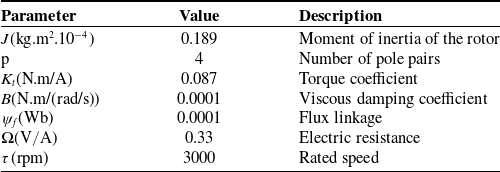
The relevant parameters of PMSM, as shown in Table I. Substitute the above parameters into Eq. (7) to obtain the matrix in Eq. (14) and conduct numerical simulation.
Symbols defined for parameters and variables depicting PMSM.

4.1. Numerical simulations
In order to show the position tracking control effect between the PID control, the MPD control, and the MPDP control, we use the step and the sinusoidal signal as the tracking source to observe the experimental effect.
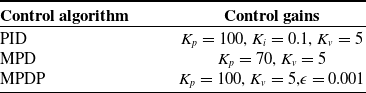
Parameters of three control algorithms.

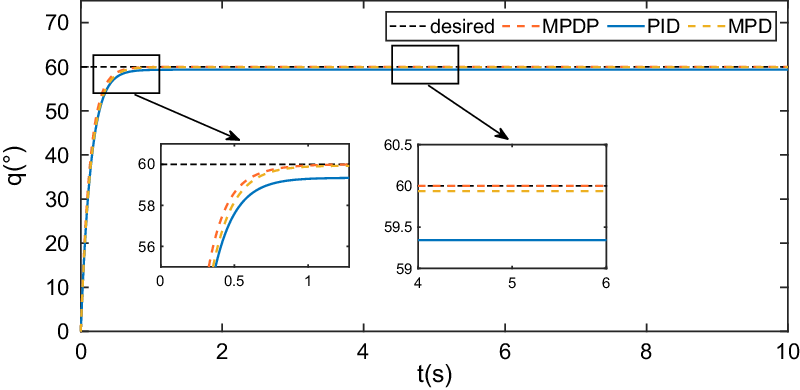
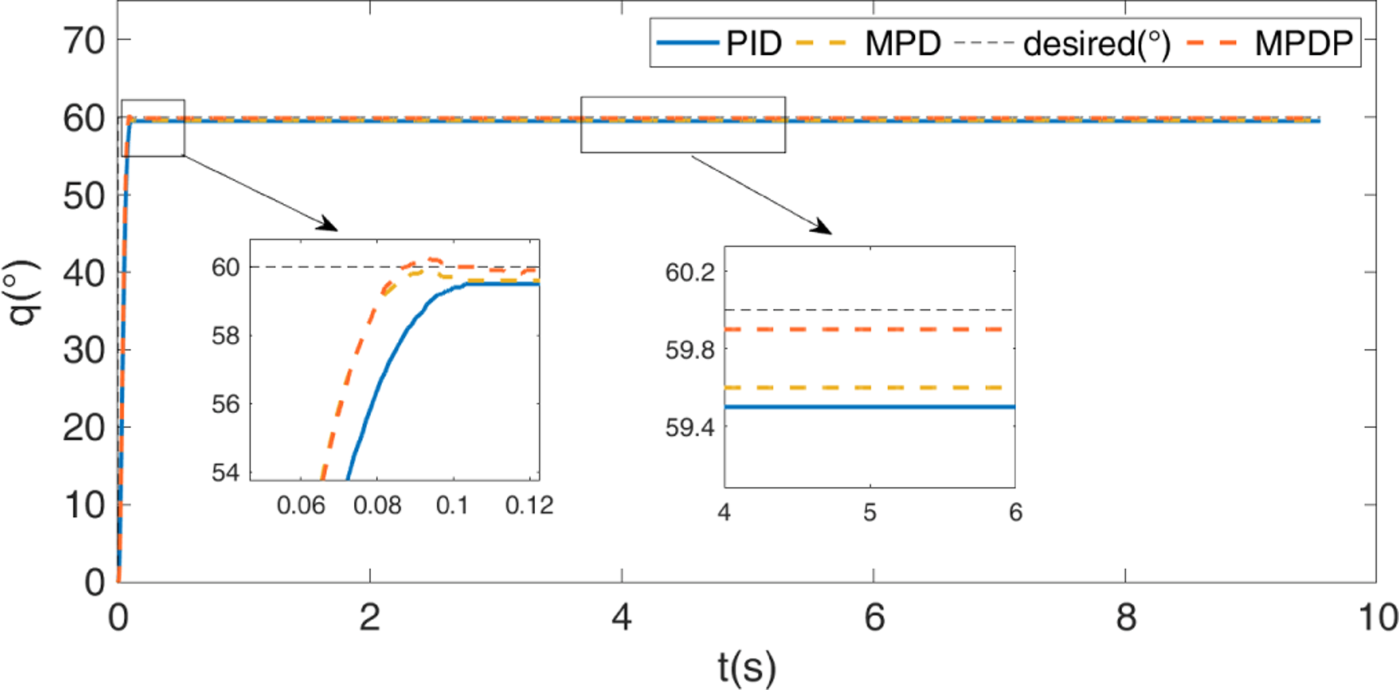
Simulation results of PMSM position step response.

The control parameters of these three algorithms are tested repeatedly for a somewhat fair comparison, and the optimal settings are obtained after attaining a satisfactory tradeoff between the steady performance and dynamic property of the system. The optimal PID parameter are as follows Table II:
 $P= 100$
,
 $I=0.1$
and
 $D=5$
, the optimal MPD parameters are finally determined
 $K_{p}=70$
and
 $K_{v}=5$
and the optimal MPDP parameters are finally determined
 $K_{p}=100$
,
 $K_{v}=5$
and
 $\epsilon =0.001$
. For numerical simulation with MPDP control, we found that it was hard to influence the effect of PMSM if we used the cosine function as the uncertainty. But if the sine function (compared with the square wave) was exerted on the PMSM as the interference term, we could see a significant effect, and that is the reason why we choose the equation
 $\hat{F}=0.5+0.01*sin(5t)$
as the final uncertainties of the PMSM. Choose the initial condition
 $e(0) =0$
. As for the sampling period
 $h$
, we select a consistent 0.001(s) to be the experimental parameter.
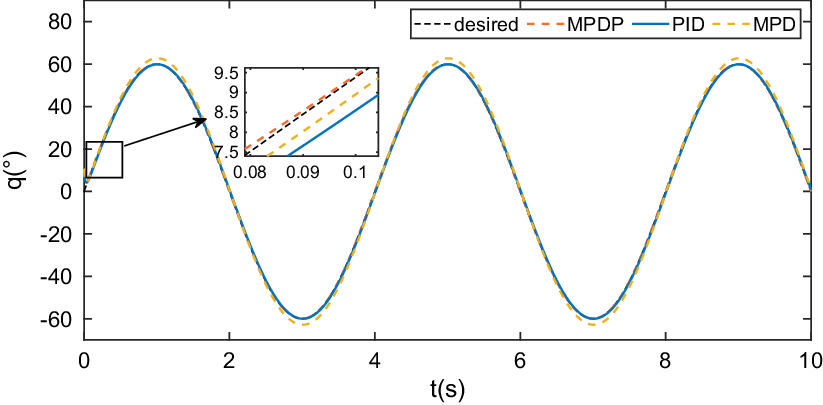
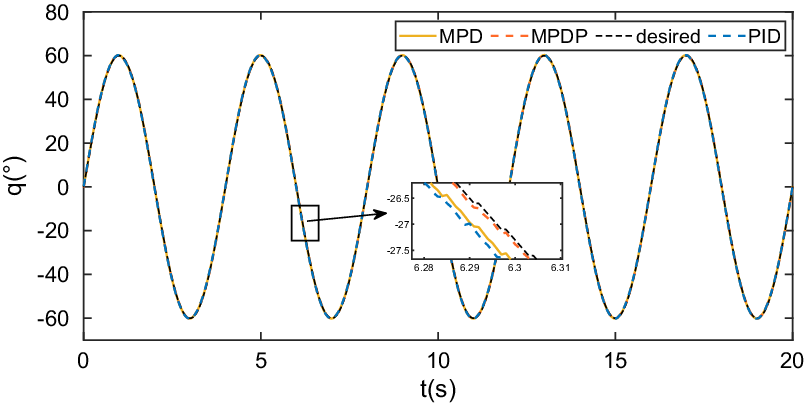
PMSM position sine tracking simulation results (
 $T = 4\,{\rm s}$
).

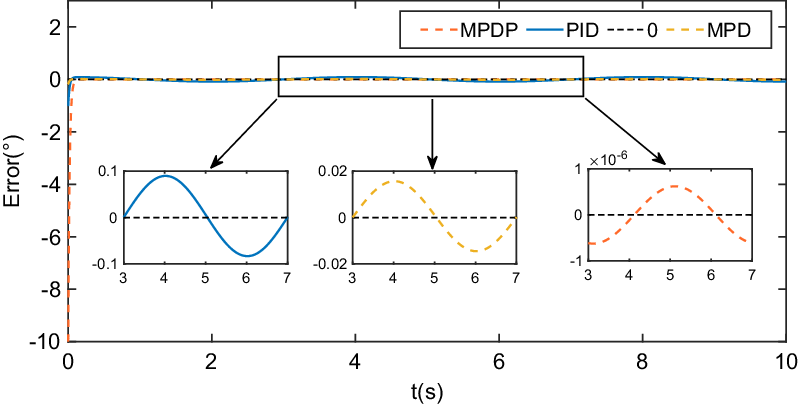
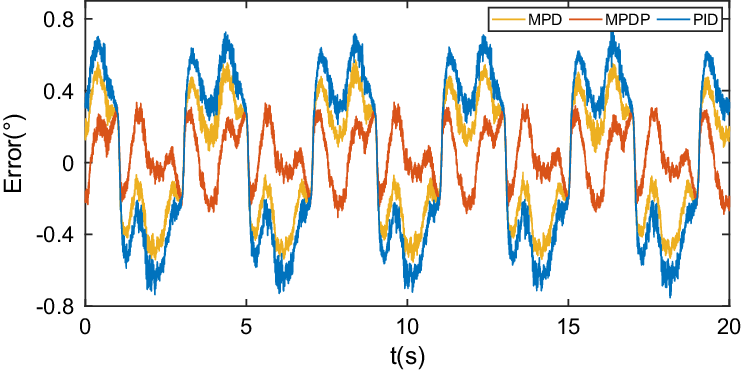
PMSM position sine tracking error (
 $T = 4\,{\rm s}$
).

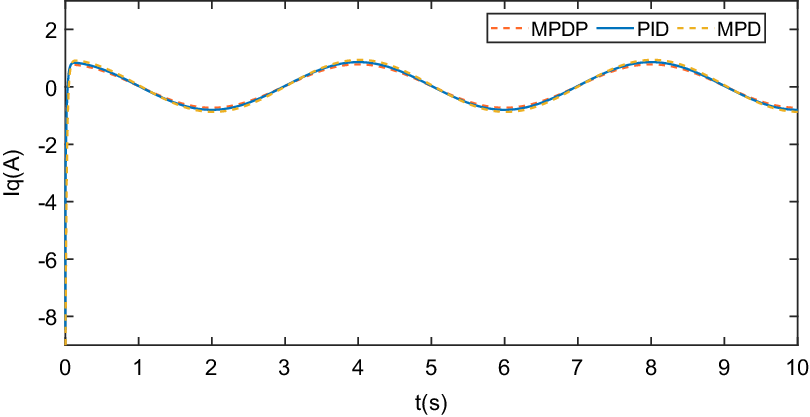
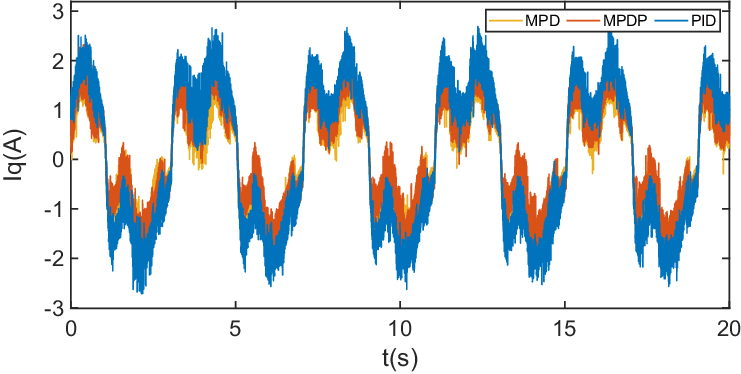
PMSM electric current simulation results (
 $T = 4\,{\rm s}$
).

(1) Step response: The results of commanding the PMSM axis to track the reference step signals
 $60^{\circ }$
are presented in Fig. 2. It can be found that the MPDP controller can reach the desired trajectory faster than the PID controller and the MPD controller without overshooting.
(2) Tracking a sinusoid signal: Assume that the sinusoidal signal is the reference path:
 \begin{equation} q^{d}(t)= (\pi/3) \sin \!\left( \frac{\pi }{2}t \right) \end{equation}
The effect and error of trajectory tracking are depicted in Fig. 3. The results show that the three controllers all have a good experimental effect. However, it can also be observed from Fig. 4 that PMSM can get a better tracking effect by using the MPDP controller. In addition, the control inputs of the three controllers are almost the same, as shown in Fig. 5. That is to say, the steady-state error can be decreased obviously by using the proposed control method, which can get a good tracking effect.
4.2. Experimental result
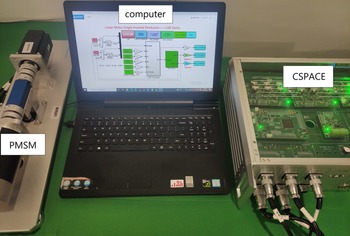
Experiments based on PMSM are conducted to further investigate the availability of the control algorithm. As shown in Fig. 6, the experimental equipment comprises computer and cSPACE upper-computer software, cSPACE control system, and a PMSM in a modular joint of collaborative robot, among other things. By using the 2500 line incremental value encoder, we collect the PMSM’s motor position and in the simulation, the parameters are set all the same [Reference Huang, Xian, Zhen and Sun28].
Experimental platform of PMSM in modular joint of collaborative robot.

The experimental results comparison without load (step response).

There are three steps in our designed experiment: (1) The motor position input is collected by the incremental value encoder and transmitted back to the controller. (2) Considering the proposed control method, the cSPACE, which is made up of the digital signal processor, will receive the sent data and do the work of computing. (3) The motion of PMSM is accomplished by increasing the control signal to drive the motor.
(1) Transient performance
PMSM is ordered to refer to the
 $60^{\circ }$
step signals by the simulation. Figure 7 shows the experiment control effect of the MPDP method on PMSM. The experimental results indicate that one can conclude that although the MPDP controller is slightly inferior to the PID controller and the MPD controller in the convergence speed, the MPDP controller has higher control accuracy than that of the other two and significantly reduces the steady-state error. MPDP algorithm has fast convergence performance than PID controller and MPD controller. Regarding the steady-state error, the MPDP controller is superior to both the PID controller and MPD controller for
 $e$
.
Comparisons of the closed-loop system’s dynamic performance under the step response.

The experimental results comparison without load (sinusoidal tracking).

The experimental results comparison without load (tracking error).

The experimental results comparison without load (electric current).

Table III presents comprehensive dynamic performance indicators (the rise time
 $t_r$
(s), adjustment time
 $t_s$
(s), and under step response) to make comparing the dynamic property of the system under different controllers easier. It can be concluded from the table that the designed algorithm has about 25% and 15% improvement compared with the traditional PID algorithm and MPD algorithm, respectively.
The experimental results comparison with payload 0 N.m (sinusoidal tracking).

The experimental results comparison with payload 0 N.m (electric current).

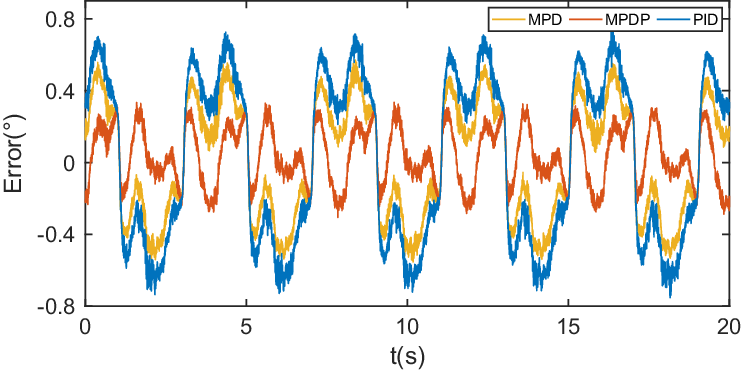
The experimental results comparison with payload 2 N.m (sinusoidal tracking).

(2) Steady-state performance
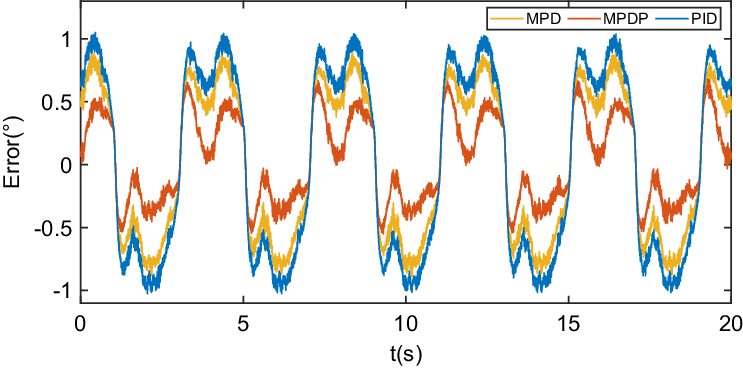
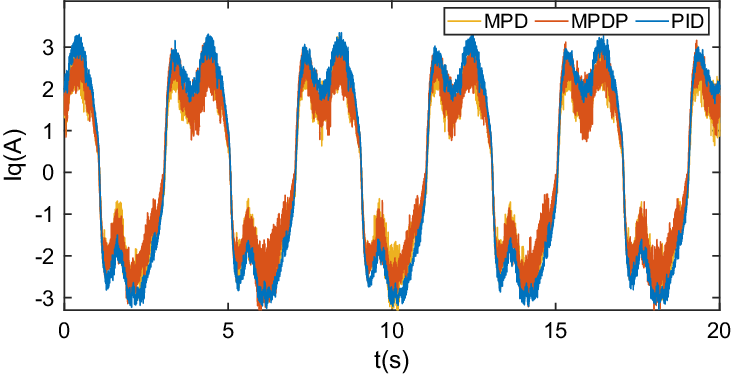
Figure 8 shows the sinusoidal tracking experiment result with these three control approaches. As demonstrated in Fig. 9, the performance of the MPDP control is superior to both the PID algorithm and the MPD algorithm, which is in line with the simulation results. In addition, the maximum tracking errors will show up when the velocity of PMSM is close to zero. These errors are the result of the imprecision of the position sensor and the Coulomb friction. Figure 10 shows the control current of the three methods in the sine tracking experiment. The experimental results show that the three methods have little difference in the control current.
(3) Robustness in the face of friction and mass variations
The load variation is one of the primary uncertainties in our proposed experiment; external loads alter parameters such as friction and system dynamics. Thus, the changing load,
 $F_{L}$
= 0 N.m, 2 N.m, 4 N.m which is mounted on the axis of PMSM, can show the closed-loop performance.
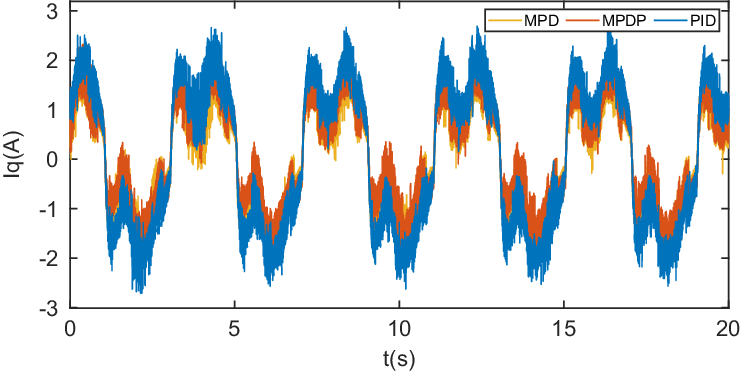
The experimental results comparison with payload 2 N.m (electric current).

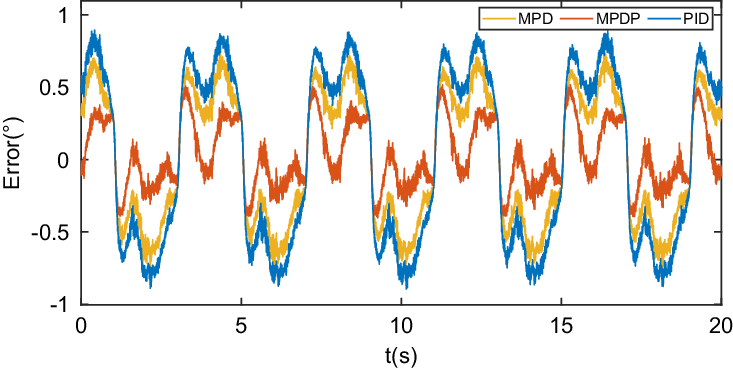
The experimental results comparison with payload 4 N.m (sinusoidal tracking).

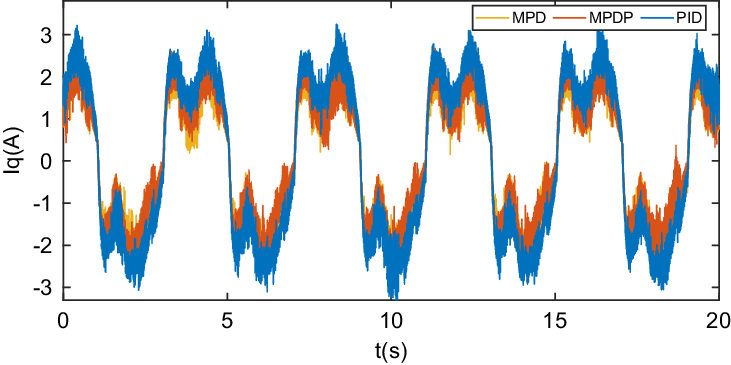
The experimental results comparison with payload 4 N.m (electric current).

Due to the external load, the
 $e$
has a reasonably enhanced amplitude, as seen in Figs. 11, 13, 15. However, the error size of MPDP is obviously smaller than that of the other two methods, and the increase is also obviously smaller than that of the other two methods, which shows that MPDP has good robustness under the uncertainty of load change. From Figs. 12, 14, and 16, we can see that amplitude of the control current will also increase with the change of external load, but the control current of the three methods is not much different, and MPDP is slightly smaller than the other two methods.
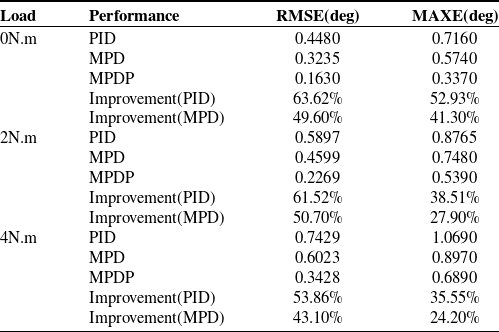
The foregoing experimental results are summarized and compared in Table IV, where (RMSE) and (MAXE) stand for root mean square displacement error and maximum displacement error, respectively:
 \begin{equation} \begin{aligned} &M A X E=\max \left (\left |e_{i}\right |\right )\\[5pt] &R M S E=\sqrt{\frac{1}{n} \sum _{i=1}^{n} e_{i}^{2}} \end{aligned} \end{equation}
 $n$
stands for the number of samples, and
 $e_i$
is the sampled tracking error for
 $i$
-th. It can be concluded from the data in the table that the maximum error and maximum square root error of the designed controller in the process of tracking the sinusoidal signal are 40% and 25% higher than those of the PID and MPD methods, respectively, and the improvement is 50% and 40% higher when there is less external interference load. In the case of load change, the designed controller still has stable improvement on RMSE and MAXE compared with the other two controllers, which shows that the designed controller has better robustness under uncertainty such as load change.
Comparisons of steady-state performance of PMSM with different payload.

5. Conclusions
The control strategy, based on the PMSM dynamical model, consists of a robust component and a PD feedback component. The robust component represents the upper bound of all parameter uncertainties with scalar
 $\rho$
. With the Lyapunov minimax approach, the controller is shown to be stable. We conduct experimental verification by using the experimental platform of PMSM. The experiment compares the PID controller and MPD controller with the robust controller. The results show that the designed controller can decrease the influence of system parameter and load change on trajectory tracking effects, as well as increase PMSM operation accuracy. The proposed robust controller could also tackle the control design problem of similar uncertain mechanical systems, as we emphasize.
Author contributions
Shengchao Zhen, Yangyang Li, and Xiaoli Liu conceived and designed the study. Jun Wang and Feng Chen conducted data gathering. Xiaofei Chen performed statistical analyses. Shengchao Zhen, Yangyang Li, and Xiaoli Liu wrote the article.
Financial support
The research is supported in part by Key Laboratory of Construction Hydraulic Robots of Anhui Higher Education Institutes, Tongling University (Grant No.TLXYCHR-O-21ZD01), and in part by Robot Research Laboratory Construction Project of West Anhui University (Program No. 21AT01046807142), and in part by The University Synergy Innovation Program of Anhui Province under Grant (Grant No.GXXT-2021-010) and (Grant No.GXXT-2022-050).
Conflicts of interest
None.
Ethical approval
None.