Implications
N-3 long-chain polyunsaturated fatty acids (LCPUFAs) are known to be beneficial for human development and health, explaining the increasing interest in promoting their deposition in the bovine muscles, leading to healthier meats. The higher n-3 LCPUFA content of the muscles from Charolais steers, depending on the type of diet (grass) or of the muscle (metabolism), did not seem to be mediated through the gene expression of proteins involved in n-3 LCPUFA biosynthesis or cellular uptake. This finding is important to decipher the molecular mechanisms underlying the regulation of n-3 LCPUFA content in the muscles as a means of enhancing the nutritionally functional properties of beef for consumers.
Introduction
Ruminant meat suffers from a negative health image related to the nature of its lipid fraction rich in saturated fatty acids (SFA) and trans-fatty acid, which are associated with an increased risk of coronary heart disease in humans (Williams, Reference Williams2000). Therefore, for the past decade, there has been an increasing interest in manipulating fatty acid composition of meat to improve product quality, health status and to reduce the risk for some diseases (Scollan et al., Reference Scollan, Hocquette, Nuernberg, Dannenberger, Richardson and Moloney2006). In contrast to SFA and trans-fatty acid, polyunsaturated fatty acids (PUFA) are recognized as being beneficial to health, leading to nutritional guidelines recommending a PUFA/SFA ratio of 0.7 or higher and an n-6/n-3 ratio of 4 in food. Among PUFA, the n-3 LCPUFA subfamily, notably eicosapentaenoic acid (EPA, 20:5n-3), docosapentaenoic acid (DPA n-3, 22:5n-3) and docosahexaenoic acid (DHA, 22:6n-3) have received a considerable and increasing amount of attention as they are essential for cell development, retina and brain function, and for the prevention of chronic diseases such as cardiovascular and inflammatory disorders, depression, Parkinson's and Alzheimer's, and some cancers (Anderson and Ma, Reference Anderson and Ma2009).
Beef fatty acid composition is influenced by several factors including both animal genetic and environmental factors (Wood et al., Reference Wood, Enser, Fisher, Nute, Sheard, Richardson, Hughes and Whittington2008). Of particular interest is the use of pasture feeding to increase beef n-3 PUFA levels. It is well documented that feeding cattle with fresh grass or grass silage versus cereal-based concentrate diet or maize silage-based diet leads to a significant enrichment of muscle n-3 PUFA, including not only α-linolenic acid (ALA, 18:3n-3) provided by grass, but also EPA, DPA n-3 and DHA (Scollan et al., Reference Scollan, Hocquette, Nuernberg, Dannenberger, Richardson and Moloney2006). These results suggest that, once absorbed by the small intestine, ALA is endogenously converted to n-3 LCPUFA. Metabolic studies on rodents have shown that the conversion of ALA to DHA consists of alternating desaturation and elongation steps followed by a final peroxisomal β-oxidation step. This mainly involves activities of two desaturases (Δ5 and Δ6 desaturases), two elongases (elongases 2 and 5) and of enzymes of the peroxisomal β-oxidation (Ferdinandusse et al., Reference Ferdinandusse, Denis, Mooijer, Zhang, Reddy, Spector and Wanders2001; Nakamura and Nara, Reference Nakamura and Nara2004; Jakobsson et al., Reference Jakobsson, Westerberg and Jacobsson2006). Moreover, several studies on rodents have recently shown that the main regulators of these enzymes are transcription factors such as SREBP-1c, RXR, LXRs and PPARs (Nakamura and Nara, Reference Nakamura and Nara2004; Jakobsson et al., Reference Jakobsson, Westerberg and Jacobsson2006). This biosynthesis could occur directly in the muscles of cattle or in other tissues and/or organs, newly synthesized n-3 LCPUFA then being secreted in the blood and taken up by the muscle. This muscle uptake could be regulated by membrane-associated fatty acid-binding proteins such as CD36/FAT, FABPpm, FATP1-6 (Hajri and Abumrad, Reference Hajri and Abumrad2002), which are generally recognized to facilitate and regulate, in a tissue-specific manner, the cellular fatty acid uptake (Hajri and Abumrad, Reference Hajri and Abumrad2002).
In this context, the present study aimed at understanding whether the significant enrichment of the bovine muscles in n-3 LCPUFA with grass feeding, already described in the literature, could be explained by variations in the gene expression of proteins involved in n-3 LCPUFA biosynthesis or cellular uptake. For this purpose, we quantified the mRNA abundance of these proteins in two muscles (Rectus abdominis (RA), a mixed predominantly oxidative muscle; and Semitendinosus (ST), a mixed predominantly glycolytic muscle) of Charolais steers fed grass- or maize silage-based diets.
Material and methods
Experimental animals, diets and sampling
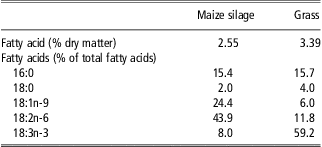
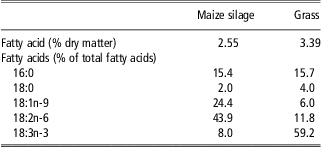
The experiment was conducted according to the national legislation on animal care (Certificate of Authorization to Experimentation on Living Animals no. 7740, Ministry of Agriculture and Fisheries). The experimental design has been previously described by Faulconnier et al. (Reference Faulconnier, Ortigues-Marty, Delavaud, Dozias, Jailler, Micol and Chilliard2007). Briefly, 12 Charolais steers castrated at 9 months of age were randomly assigned into two treatment groups (the maize silage group (MZ group) and the grass forage group (GF group)), for a 23-month experimental period. Animals of the MZ group were fed maize silage ad libitum, with a minimum of wheat straw and rapeseed meal. Animals given the GF diet were fed grass silage from a permanent pasture of perennial rye-grass ad libitum supplemented with a commercial concentrate and/or rapeseed meal during the winter season. During the summer season, these animals rotationally grazed on a perennial rye-grass pasture without supplementation. Fatty acid composition of maize silage and grass used in diets is given in Table 1. Animals were slaughtered at the same final age (31 to 32 months) and at an average body weight of 809 and 802 kg (standard error of means, s.e.m. = 16.3) for MZ and GF groups, respectively, in the INRA experimental abattoir (Saint-Genès Champanelle, France). Representative samples (∼50 g) of the RA and ST muscles were collected within 30 min, immediately frozen in liquid nitrogen and stored at −80°C until analysis.
Fatty acid content and composition of maize silage and grass used in diets given to steers
Lipid analysis
Samples of the RA and ST (∼50 g) muscles were ground into a fine homogeneous powder in liquid nitrogen with a mixer mill (Retsch, MM 301, Haan, Germany) and stored at −80°C until analysis. Total lipids were extracted at room temperature according to the method of Folch et al. (Reference Folch, Lees and Sloane-Stanley1957) by mixing the tissue powder with chloroform–methanol mixture (2/1 vol/vol) and their level was determined by gravimetry. Fatty acid transmethylation into fatty acid methyl esters (FAME) was performed by successive sodium methylate and BF3-methanol (14%) incubations (20°C) for 2 × 20 min, as previously described by Bauchart et al. (Reference Bauchart, Gladine, Gruffat, Leloutre and Durand2005). FAME analysis was achieved by gas-liquid chromatography using a Peri 2100-model chromatograph (Perichrom Society, Saulx-les-Chartreux, France) fitted with a CP-Sil 88 glass capillary column (Varian, USA) (length: 100 m; diameter: 0.25 mm). For the separation of fatty acids, the following temperature programme was applied with hydrogen as carrier gas at a flow rate of 1 ml/min: 70°C for 30 s; from 70 to 175°C at 20°C/min; 175°C for 25 min; from 175 to 215°C at 10°C/min; 215°C for 42 min. Total fatty acids were quantified by using 19 : 0 as the internal standard. Identification and calculation of the response coefficient of each individual FAME was obtained by using the quantitative C4-C24 Fame mix (Supelco, Bellafonte, USA, Cat. No. 18919-1AMP).
RNA extraction and cDNA synthesis
Total RNA was extracted from the muscle powder (500 mg) by using Trizol reagent (Invitrogen, Life Technologies, CA, USA, Cat. No. 15596-018), according to the manufacturer's recommendations. Total RNA was then purified using NucleoSpin® mini kit columns combined with a DNA digestion on NucleoSpin® membranes, according to the manufacturer's protocol (Machery-Nagel, PA, USA, Cat. No. 740955.50). Tissue RNA was quantified using a Nanodrop ND-1000 Spectrophotometer (Nanodrop Technologies, Wilmington, DE, USA). The RNA concentration was about 0.4 mg/g and 0.35 mg/g of fresh tissue for the RA and ST muscles, respectively. The quality and integrity of RNA were examined by the RNA Integrity Number (RIN) determined by using an RNA 6000 Nano Assay (Cat. No. 5067-1511) on a 2100 bioanalyzer (Agilent technologies, Palo Alto, CA, USA). Only samples displaying a RIN ⩾8.0 and an A260/280 >1.8 were considered. The corresponding cDNA was synthesized by reverse transcription from 2.5 μg of total RNA using 100 U of Superscript II reverse transcriptase (Invitrogen, Life Technologies, Cat. No. 18064014) and 0.5 μg of oligodT in a final volume of 50 μl. RNA and cDNA samples were stored at −80°C until analysis.
Quantitative real-time PCR (qPCR)
A total of 24 genes involved in n-3 LCPUFA biosynthesis (16) and muscle PUFA uptake (8) were studied and three genes were used as reference genes (Supplementary Table S1). The StepOnePlus system (Applied Biosystems, Foster City, CA, USA, Cat. No. 4376598) was used for qPCR from a cDNA dilution of 1/25 (for all genes involved in n-3 LCPUFA biosynthesis, for transcription factors and for FATP1 and SCARB1) and 1/50 (for CD36, LPL, LDLr, VLDLr, ABCA1 and FABP3). The results are expressed as the mRNA copy number of each gene of interest (three repetitions/sample) relative to the geometric mean of three housekeeping genes TOP2B, TBP and RPLPO to account for variations in RNA integrity, RNA quantification and cDNA synthesis, as previously described by Bonnet et al. (Reference Bonnet, Bernard, Bes and Leroux2013).
The mRNA abundance of LPL was quantified in triplicate using fluorescent TaqMan® methodology (Applied Biosystems) using specific primers and probes as previously described by Bonnet et al. (Reference Bonnet, Leroux, Faulconnier, Hocquette, Bocquier, Martin and Chilliard2000). The PCR was performed in 20 μl reaction volume by incubating 5 μl of 50-fold diluted LPL cDNA samples with 1 μl of forward/reverse primers (10 pmol/μl), 0.5 μl of probe (10 pmol/μl) and 10 μl of TaqMan® Universal PCR master mix (Applied Biosystems, Cat. No. 4304437) in sealed MicroAmp Optical 96-well reaction plates (Applied Biosystems, Cat. No. 4316813). Quantification was determined from a calibration curve prepared by amplifying various copy numbers of a recombinant plasmid. The mRNA abundance of the other genes was quantified in triplicate using the fluorescent SYBR® Green methodology (Applied Biosystems) and specific primers. The PCR was performed in 20 μl reaction volume by incubating 5 μl of 25- or 50-fold diluted cDNA samples with 1 μl of each forward/reverse primers (10 pmol/μl) and 10 μl of SYBR® green PCR master mix (Applied Biosystems, Cat. No. 4367659) in sealed MicroAmp Optical 96-well reaction plates (Applied Biosystems, Cat. No. 4316813). The qPCR conditions were as follows: 95°C/10 min, 40 cycles of 95°C/15 s (denaturation), 58°C-60°C/45 s (annealing), and 95°C/15 s (extension). Quantification of cDNA was performed from calibration curves generated from serial dilutions using a cDNA pool prepared from tissue. For the SYBR® Green methodology, following amplification, the dissociation cycle conditions started at 95°C/15 s, then 60°C/1 min, followed by an increase by 0.6°C/15 s up to 95°C. The specificity of primers was confirmed by dissociation curve analysis and by electrophoresis of PCR products on 2% agarose gel stained with ethidium bromide.
For the 24 genes, irrespective of the methodology (TaqMan®v. SYBR® Green), similar amplification efficiencies were calculated from calibration curves, according to the equation E = 10(−1/slope). Efficiency ranged from 90% to 100% (recommended by guidelines) allowing the comparison of the results from both methodologies.
Statistical analysis
Values are expressed as means from six animals with s.e.m. Comparison of data between the diet and type of muscle was analysed according to a split-splot design, using the MIXED procedure of SAS (Cary, NC, USA) in which diet and tissues were accepted as fixed factors and animals as a random factor. Statistical significance was set at P < 0.05.
Results
Fatty acid composition of muscles
Effects of dietary conditions
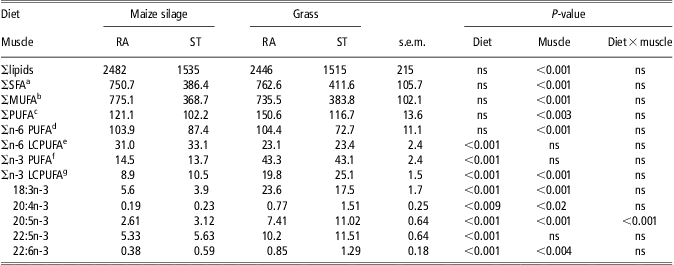
The GF diet had no effect on total lipid content (mg/100 g of tissue) of either the RA or ST muscles (Table 2) when compared with the MZ diet. In the same way, no differences were observed in muscle total SFA, monounsaturated fatty acid (MUFA), PUFA and n-6 PUFA contents between diets. However, averaged across the two muscles, GF diet led to a significant (P < 0.0002) decrease in n-6 LCPUFA content of around 25% to 30% to the benefit of total n-3 PUFA content, mainly ALA content (4.3-fold higher, P < 0.0001) and of n-3 LCPUFA such as EPA, DPA n-3 and DHA (3.2-, 2.0- and 2.1-fold higher, respectively, P < 0.0002).
Concentration (mg/100 g of fresh tissue) of fatty acids in total lipids of Rectus abdominis (RA) and Semitendinosus (ST) muscles of Charolais steers fed a maize silage- or a grass-based diet

SFA = saturated fatty acids; MUFA = monounsaturated fatty acids; PUFA = polyunsaturated fatty acids; LCPUFA = long-chain polyunsaturated fatty acids; ns = non significant.
aΣSFA = 12:0 + 14:0 + 15:0 + 16:0 + 17:0 + 18:0 + 20:0 + 22:0 + 23:0 + 24:0.
bΣMUFA = 14:1 + 15:1 + 16:1 + 17:1 + 18:1 + 20:1.
cΣPUFA = n-6 PUFA + n-3 PUFA.
dΣn-6 PUFA = 18:2n-6 + 18:3n-6 + 20:2n-6 + 20:3n-6 + 20:4n-6 + 22:2n-6 + 22:4n-6 + 22:5n-6.
eΣn-6 LCPUFA = 20:2n-6 + 20:3n-6 + 20:4n-6 + 22:2n-6 + 22:4n-6 + 22:5n-6.
fΣn-3 PUFA = 18:3n-3 + 20:3n-3 + 20:4n-3 + 20:5n-3 + 22:5n-3 + 22:6n-3.
gΣn-3 LCPUFA = 20:3n-3 + 20:4n-3 + 20:5n-3 + 22:5n-3 + 22:6n-3.
When expressed as centesimal distribution (% of total fatty acid), the relative proportions of SFA, MUFA and PUFA were also unchanged by diet (Supplementary Table S2). However, averaged across the two muscles, the relative proportion of n-3 PUFA was 2.7-fold higher (P < 0.0001) with the GF diet compared with the MZ diet, mainly owing to the increase in the proportion of ALA (4.0-fold, P < 0.0001). In the same way, the centesimal proportion of n-3 LCPUFA was 2.1-fold higher (P < 0.0001) in the GF compared with the MZ diet. This was mainly related to the increase in the relative proportions of EPA and DPA n-3 (1.5- and 3.7-fold, respectively, P < 0.0001) with no effect on DHA proportion.
Effects of muscle type
Total lipid content of the RA muscle, averaged across the two diets, was 1.6-fold higher than that of the ST muscle (P < 0.0001) (Table 2), associated with a higher content of SFA, MUFA and PUFA (1.9-, 2.0- and 1.2-fold, respectively, P ⩽ 0.003). The higher content of PUFA in the RA muscle was associated with a higher content of total n-6 PUFA (1.3-fold, P < 0.0008) with no difference in n-6 LCPUFA between the muscles. In contrast, total n-3 LCPUFA content was 1.2-fold higher in the ST muscle than in the RA muscle (P ⩽ 0.0003), the ST muscle having the highest content in EPA and DHA (1.4- and 1.5-fold, respectively, P < 0.004).
Expressed as centesimal composition (Supplementary Table S2), SFA proportion in total fatty acids was stable between the muscles, whereas, averaged across the two diets, MUFA proportion was higher in the RA muscle compared with that in the ST muscle. In contrast, the PUFA proportion was 1.5-fold lower in RA than in the ST muscle (P < 0.0001), as a result of a higher proportion of n-6 and n-3 PUFA. Thereby, relative proportions of ALA, EPA, DPA n-3 and DHA were 1.3-, 2.6-, 2.1- and 3.8-fold lower, respectively, in RA than in the ST muscle (P < 0.0001).
Gene expression of proteins involved in muscle n-3 LCPUFA biosynthesis and uptake
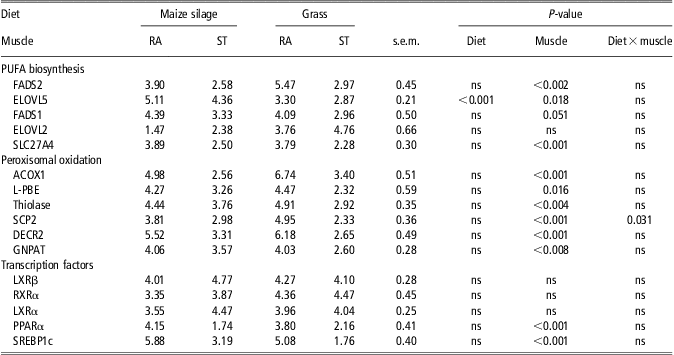
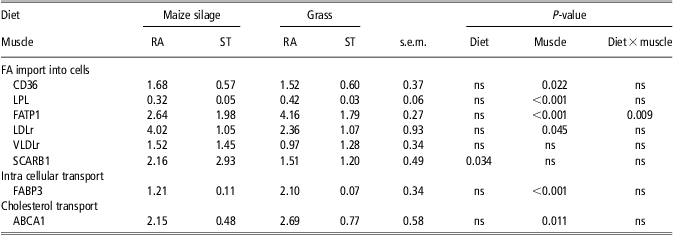
Genes encoding for proteins involved in n-3 LCPUFA biosynthesis and its regulation (Table 3) and in n-3 LCPUFA cellular uptake (Table 4) were all expressed in both the muscles, irrespective of the diet.
The mRNA abundance (arbitrary unitsa) of genes known to be involved in n-3 LCPUFA synthesis and its regulation in the Rectus abdominis (RA) and Semitendinosus (ST) muscles of Charolais steers fed maize silage- or grass-based diet
LCPUFA = long-chain polyunsaturated fatty acids; PUFA = polyunsaturated fatty acids; FADS2 = fatty acid desaturase 2; ELOVL5 = elongation of very long chain fatty acids protein 5; FADS1 = fatty acid desaturase 1; ELOVL2 = elongation of very long chain fatty acids protein 2; SLC27A4 = solute carrier family 27 member 4; ACOX1 = acyl-coenzyme A oxidase 1; L-PBE = L-bifunctional protein (enoyl-coenzyme A = hydratase/3-hydroxyacyl coenzyme A deshydrogenase); Thiolase =3-oxoacyl-coenzyme A thiolase; SCP2 = sterol carrier protein 2; DECR2 = 2,4-dienoyl CoA reductase 2; GNPAT = glyceronephosphate O-acyltransferase; LXRβ = liver X receptor β; RXRα = retinoid X receptor α; LXRα = liver X receptor α; PPARα = peroxisome proliferator activated receptor α; SREBP-1c = sterol regulatory element binding protein 1c; ns = non significant.
Values are means, with standard errors of the means.
aAmounts of mRNA were expressed in arbitrary units determined as their relative abundance to the geometric mean of three reference genes (TOP2B, TBP and RPLPO).
.
The mRNA abundance (arbitrary unitsa) of proteins involved in the cellular uptake of n-3 LCPUFA in the Rectus abdominis (RA) and Semitendinosus (ST) muscles of Charolais steers fed a maize silage- or grass-based diet
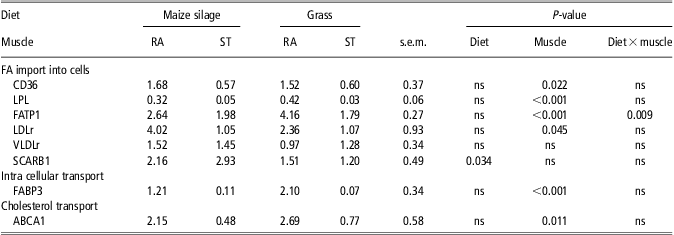
FA = fatty acids; CD36 = cluster of differentiation 36; LPL = lipoprotein lipase; FATP1 = fatty acid transport protein 1; LDLr = low-density lipoprotein receptor; VLDLr = very low-density lipoprotein receptor; SCARB1 = scavenger receptor class B member 1; FABP3 = fatty acid binding protein 3; ABCA1 = ATP-binding cassette transporter member 1; ns = non significant.
Values are means, with standard errors of the means.
aAmounts of mRNA were expressed in arbitrary units determined as their relative abundance to the geometric mean of three reference genes (TOP2B, TBP and RPLPO).
Effects of dietary conditions
mRNA abundance of the majority of genes involved in n-3 LCPUFA biosynthesis and in their cellular uptake was not affected by diets, except for elongase 5 (Table 3) and SCARB1 genes (Table 4). Abundance of mRNA encoding for ELOVL5 and SCARB1 was 35% (P < 0.0001) and 47% (P = 0.0034) lower, respectively, in both the muscles of steers, given the GF diet compared with the MZ diet.
Effect of muscle type
The expression of all genes involved in n-3 LCPUFA biosynthesis, except for ELOVL2, differed significantly between the two muscles (Table 3), the level of expression being 1.2- to 2.0-fold higher in RA compared with the ST muscle (P ⩽ 0.051). In the same way, gene expression of PPARα and SREBP1c was 2.0- and 2.2-fold higher in the RA compared with the ST muscle (P ⩽ 0.0005), respectively, whereas mRNA abundance of the other transcription factors tested was similar between the two muscles (Table 3). Similarly, the gene expression of CD36, LPL, FATP1, LDLr, FABP3 and ABCA1 was 1.8- to 18-fold higher in the RA than in the ST muscle (P < 0.05), whereas VLDLr and SCARB1 gene expression was similar between the two muscles (Table 4).
Discussion
In the present study, the GF compared with the MZ diet beneficially affected n-3 PUFA levels (mainly ALA) in the muscles of steers, in agreement with previous findings on meat bovine species (Nuernberg et al., Reference Nuernberg, Dannenberger, Nuernberg, Ender, Voigt, Scollan, Wood, Nute and Richardson2005; Scollan et al., Reference Scollan, Hocquette, Nuernberg, Dannenberger, Richardson and Moloney2006). Indeed, grass forages contain a high proportion of ALA (50% to 75% of total fatty acid), as a precursor of n-3 LCPUFA (Scollan et al., Reference Scollan, Hocquette, Nuernberg, Dannenberger, Richardson and Moloney2006). Furthermore, the ST muscle had higher n-3 LCPUFA content and proportion than the RA muscle, confirming previous observations reported by Cuvelier et al. (Reference Cuvelier, Dotreppe, Cabaraux, Dufrasne, Istasse and Hornick2005). It is known that the oxidative muscles (the RA muscle, here) contain more phospholipids (the preferential lipid class for esterification of n-3 LCPUFA) than the glycolytic muscles (the ST muscle, here), but that this difference would not explain much of the differences in fatty acid composition between the muscles (De Smet et al., Reference De Smet, Raes and Demeyer2004). On the other hand, Itoh et al. (Reference Itoh, Johnson, Cosgrove, Muir and Purchas1999) reported that higher concentrations of SFA and MUFA and lower concentrations of most of the PUFA, including 20 : 5n-3 and 22 : 5n-3, were found in the phospholipids with increasing levels of intramuscular fat, results which could explain the differences in n-3 LCPUFA contents between the RA and ST muscle in the present study.
Considering the extensive biohydrogenation, isomerization and degradation of dietary fatty acids by ruminal microbiota (Scollan et al., Reference Scollan, Hocquette, Nuernberg, Dannenberger, Richardson and Moloney2006), major mechanisms underlying the obtained changes in fatty acid profiles seem to be an affected fatty acid biosynthesis and/or uptake by bovine tissues via shifted expression of corresponding genes. Accordingly, the present study aimed at determining whether the differences in beef n-3 LCPUFA content, depending on diet (GF v. MZ) or muscle type (RA v. ST), were mediated through the gene expression regulation of proteins involved in n-3 LCPUFA biosynthesis or cellular uptake.
First, both the RA and ST muscles expressed all-known genes encoding for proteins and transcription factors involved in n-3 LCPUFA biosynthesis or cellular uptake. These results are in disagreement with our previous data (Cherfaoui et al., Reference Cherfaoui, Durand, Bonnet, Bauchart, Thomas and Gruffat2012) reporting undetectable elongase 5 mRNA and protein in the ST muscle of Limousin bulls. Several explanations could be proposed to explain these discrepancies. Physiological status of animals chosen in the two experiments was very different by the age (30 to 32 v. 15 to 18 months old), the breed (Charolais v. Limousin) and the presence or absence of sexual hormones (castrated v. entire animals). To the best of our knowledge, there are no data on the effect of age on the gene expression of enzymes involved in n-3 LCPUFA biosynthesis and very limited information on the effect of breed. No effect of breed was observed on desaturase or elongase gene expression in the Longissimus thoracis (LT) muscle of Angus, Limousin and Blond d'Aquitaine bulls (Gruffat et al., 2013). In the same way, the levels of Δ5 and Δ6 desaturase proteins were similar in the Semimembranosus muscle of Limousin and Angus cattle (Ward et al., Reference Ward, Woodward, Otter and Doran2010). Taken together, these results suggest that elongase 5 gene expression is not regulated by bovine breeds. However, race and age can influence the lipid content of the muscles and therefore the myocyte/adipocyte ratio, with these cells differing in gene expression spectra. Lipid content in the ST muscle of Limousin bulls (Cherfaoui et al., Reference Cherfaoui, Durand, Bonnet, Bauchart, Thomas and Gruffat2012) was not significantly different than that of Charolais steers (data not shown). Therefore, a greater number of adipocytes in the muscle of steers compared with bulls could not explain the difference in elongase 5 gene expression. Finally, the effect of testosterone on n-3 LCPUFA levels and synthesis has been a little more investigated, in particular in rats and humans. Giltay et al. (Reference Giltay, Gooren, Toorians, Katan and Zock2004) reported that n-3 LCPUFA contents of human plasma vary inversely with circulating concentrations of testosterone. Moreover, testosterone administration to rats strongly depresses tissue Δ5 and Δ6 desaturase activities (Marra and De Alaniz, Reference Marra and De Alaniz1989). Therefore, significant abundance of elongase 5 mRNA in the RA and ST muscles of Charolais steers in the present study could be linked to the lack of testosterone in these animals. However, further investigations are necessary to verify this hypothesis.
Effects of dietary conditions on the expression of genes involved in n-3 LCPUFA biosynthesis and uptake
Despite the net effect of GF diet on n-3 LCPUFA content in the muscles, no significant changes in the expression of genes involved in n-3 LCPUFA biosynthesis and cellular uptake were observed in our study. In the same way, previously published data show either no significant change or an inhibitory effect of ALA-enriched diets (namely linseed or grass) on gene expression of Δ5 and Δ6 desaturases and elongases 2 and 5 in rats (Tu et al., Reference Tu, Cook-Johnson, James, Mühlhäusler and Gibson2010), and on gene expression of desaturases in piglets (Missotten et al., Reference Missotten, De Smet, Raes and Doran2009) and in bulls (Herdmann et al., Reference Herdmann, Nuernberg, Martin, Nuernberg and Doran2010a; Hiller et al., Reference Hiller, Herdmann and Nuernberg2011). Similarly, for genes involved in n-3 LCPUFA uptake, Kronberg et al. (Reference Kronberg, Barceló-Coblijn, Shin, Lee and Murphy2006) reported no significant change in mRNA level of FABP3 in the LT muscle of bovines given a diet enriched in flaxseed compared with those given a control diet. Therefore, the increase in muscle n-3 LCPUFA of steers fed the GF diet in the current study did not seem to be related to a stimulation of the expression of genes involved in their biosynthesis and/or uptake. However, it is important to be aware that the snap-shot approach of the present study addressed functional genomic relationships discontinuously, not dynamically, during tissue development and maturation. Moreover, the current study reported only mRNA abundance of genes involved in n-3 LCPUFA synthesis and uptake. Thus, a possible effect of the dietary treatment on protein concentrations and/or activities cannot be ruled out and further studies are required to investigate this possibility. Three hypotheses can be proposed to explain the lack of stimulation of gene expression by dietary grass. First, other genes than those measured here may be involved in these pathways. Second, MZ diet was rich in n-6 PUFA, whereas GF diet was rich in n-3 PUFA. It is well recognized that linoleic acid (LA, 18 : 2n-6) and ALA follow a similar bioconversion pathway catalysed by the same enzymes (Barceló-Coblijn and Murphy, Reference Barceló-Coblijn and Murphy2009). In the current study, the equivalent level of expression of enzymes for the two diets could reflect a comparable magnitude of LCPUFA synthesis but a competition between n-3 and n-6 PUFA in using the similar bioconversion pathway. Third, we hypothesized at the beginning of this study that the uptake of n-3 LCPUFA by the muscles would involve a protein-facilitated transfer. However, passive diffusion of muscle n-3 LCPUFA across the lipid bilayer cannot be ruled out. Indeed, data in the literature have provided evidence for the existence of these two distinct processes in cellular uptake of n-3 LCPUFA. The occurrence of a protein-facilitated transfer of fatty acids has been proposed in a variety of cells, including adipocytes, hepatocytes, cardiac myocytes (Sorrentino et al., Reference Sorrentino, Robinson, Kiang and Berk1989) and skeletal muscle membrane vesicles (Bonen et al., Reference Bonen, Dyck, Ibrahimi and Abumrad1999). In contrast, strong evidence has been provided over the last decade supporting the hypothesis that n-3 LCPUFA would cross the blood–brain barrier by a simple diffusion process (Ouellet et al., Reference Ouellet, Emond, Chuck, Julien, Bourasset, Oddo, LaFerla, Bazinet and Calon2009). Thus, we could hypothesize that the higher n-3 LCPUFA content in the muscle may arise from an increased passive transfer of n-3 LCPUFA previously synthesized either in the liver or in the adipose tissue. Indeed, these organ/tissue contain significant amounts of n-3 LCPUFA (Bauchart et al., Reference Bauchart, Chantelot and Gandemer2008; Herdmann et al., Reference Herdmann, Martin, Nuernberg, Wegner, Dannenberger and Nuernberg2010b; Hiller et al., Reference Hiller, Herdmann and Nuernberg2011; Cherfaoui et al., Reference Cherfaoui, Durand, Bonnet, Bauchart, Thomas and Gruffat2012); however, Herdmann et al. (Reference Herdmann, Martin, Nuernberg, Wegner, Dannenberger and Nuernberg2010b) suggest a preferential synthesis of n-3 LCPUFA in liver because the latter has the highest relative amount of n-3 LCPUFA.
Effects of muscle type on expression of genes involved in n-3 LCPUFA biosynthesis and uptake
Unlike the higher n-3 LCPUFA content in the ST compared with the RA muscle, the majority of genes involved in n-3 LCPUFA biosynthesis and cellular uptake were more expressed in the RA than in the ST muscle. These results on gene expression are consistent with the higher oxidative capacity of the RA muscle compared with the ST muscle (Jurie et al., Reference Jurie, Cassar-Malek, Bonnet, Leroux, Bauchart, Boulesteix, Pethick and Hocquette2007), as this muscle preferentially uses fatty acids for energy production. Thus, fatty acid transport rates are greater in such muscles than in the glycolytic muscles because more fatty acid transporters are expressed, as previously demonstrated in rats (Bonen et al., Reference Bonen, Dyck, Ibrahimi and Abumrad1999) and in cattle (Hocquette et al., Reference Hocquette, Graulet and Olivecrona1998; Jurie et al., Reference Jurie, Cassar-Malek, Bonnet, Leroux, Bauchart, Boulesteix, Pethick and Hocquette2007). In the same way, compared with the glycolytic muscles, the oxidative muscles are characterized by greater β-oxidation pathway enzyme activity associated with oxidative nutrient catabolism (Jurie et al., Reference Jurie, Cassar-Malek, Bonnet, Leroux, Bauchart, Boulesteix, Pethick and Hocquette2007). This is in agreement with the higher expression of genes involved in peroxisomal β-oxidation observed in the RA compared with the ST muscle in our experimental conditions.
All these results demonstrated that changes in n-3 LCPUFA content, depending on the type of muscle (ST > RA), could not be related to the increased biosynthesis and/or cellular uptake of these fatty acids in the ST compared with the RA muscle. As previously discussed, one hypothesis could be a post-transcriptional regulation of genes or the involvement in these pathways of other genes than those measured in the present study. Further studies are therefore required to investigate this possibility. Another hypothesis could be a higher capacity of the RA muscle to catabolize n-3 LCPUFA in relation to its oxidative metabolism. Thus, n-3 LCPUFA would be more synthesized and/or taken up by this muscle than by the ST muscle but, in parallel, even more catabolized to produce energy. Thus, the RA muscle turnover may be much faster than that of the ST muscle. As a result, this suggests that there is less possibility to imprint n-3 LCPUFA on the oxidative muscle.
In conclusion, our study showed for the first time that the higher n-3 LCPUFA content of the muscles from Charolais steers, depending on the type of diet or of muscle, did not seem to be mediated through the gene expression of proteins involved in n-3 LCPUFA biosynthesis or cellular uptake. The most likely hypothesis to explain the lower n-3 LCPUFA content in the RA muscle (compared with that in the ST muscle) was probably related to the oxidative metabolism of RA and, consequently its high capacity to catabolize n-3 LCPUFA. In contrast, in the present state of our knowledge, it is very difficult to decide among the proposed hypotheses regarding the higher n-3 LCPUFA content in the muscles of cattle fed a grass-based diet. Further investigations are required to explain these variations.
Acknowledgements
The authors are grateful to Dominique Dozias and the experimental installations of INRA (SEA Le Pin au Haras-61310 Exmes) and the abattoir of INRA (UERT-Clermont-Ferrand/Theix) for the management of experiments. We sincerely thank Didier Micol for his implication in the management of the research programme. They thank Isabelle Cassar-Malek for helpful discussions. They also thank Geneviève Gentes, Christiane Legay and Agnès Thomas for her excellent technical support, as well as Sébastien Bes for his technical advice.