INTRODUCTION
In amnestic mild cognitive impairment (aMCI), individuals with normal daily functioning and intact general cognitive ability have lower than expected memory abilities for their age and education on formal testing (Petersen et al., 1999). This objective memory impairment is typically accompanied by subjective complaints of forgetfulness as well (Petersen et al., 1999). Amnestic MCI may represent the transitional cognitive state between normal aging and early Alzheimer's disease (AD) because individuals diagnosed on the basis of these criteria convert to AD at a rate of 12% per year, compared to a rate of 1–2% for adults with fully intact cognitive functioning (Petersen et al., 2001).
Clinically, individuals with aMCI perform more poorly than healthy controls on tests of immediate and delayed free and cued recall (Jack et al., 1999; Petersen et al., 1999). They also consistently demonstrate a particular vulnerability in learning episodic associations (Collie & Maruff, 2000). For example, they require more trials than healthy controls to learn paired associates, especially for unrelated word pairs (Amieva et al., 2000). Similarly, individuals with aMCI experience selective difficulty in learning associations between novel or abstract stimuli, which has been attributed to pathologic changes in the hippocampal formation (Collie et al., 2002). Learning and retention of word pairs require increased controlled processing compared to single word learning and for unrelated or novel associations compared to those supported by preexisting associations. Thus, deficits in paired associate learning in aMCI may be due to deficient controlled processing (Amieva et al., 2000) and/or to early hippocampal changes.
Associative learning performance also serves as a sensitive predictor for subsequent progression to dementia (Fowler et al., 1997; Linn et al., 1995; Swainson et al., 2001). For example, Fowler et al. found that among individuals with questionable dementia, baseline performance on the paired associates learning test of the Cambridge Neuropsychological Test Automated Battery was a better predictor of decline 6 and 12 months later than were the Wechsler intelligence or memory scales. Similarly, in a 13-year prospective study, Linn et al. found that Paired Associates Learning and Logical Memory retention were the most sensitive neuropsychological measures of early changes in the preclinical phase of AD.
Lowenstein et al. (2004) found that susceptibility to semantic interference is an early cognitive feature of both aMCI and AD. In that study, ten common objects were presented and recalled over three learning trials, followed by presentation of ten semantically related objects. Semantic interference was evidenced by recall of the related distractors when subsequently attempting to recall target items. After controlling for overall memory impairment, mildly demented AD patients demonstrated the greatest amount of semantic interference, followed by individuals with aMCI, and then healthy controls. Given these group differences, vulnerability to semantic interference may be useful for staging the progression of memory deficits in aMCI. Susceptibility to semantic interference has also been related to entorhinal cortex and hippocampal damage (Hasslemo & Wyble, 1997; Peinado-Manzano, 1994), which have been implicated in the pathology of aMCI (Jack et al., 1999) and early AD (Braak et al., 1993).
Considering these difficulties, we sought to identify a form of cognitive support that would improve associative learning among individuals with aMCI, even under situations where potential for semantic interference may be increased. In a paradigm known as subject-performed tasks (SPTs), participants perform a series of single-step commands (e.g., “Sniff the flower”) in response to verbal instructions, and then recall the commands. The control condition is typically a verbal task (VT) in which participants either listen to or read aloud the commands without enacting them. Studies consistently demonstrate superior memory following SPT relative to VT encoding (Bäckman & Nilsson, 1984, 1985; Cohen & Stewart, 1982; Engelkamp & Zimmer, 1984; Nyberg et al., 1992), a phenomenon termed the SPT or enactment effect (Cohen, 1981). According to Engelkamp and Zimmer (1984, 1985), SPTs improve item-specific encoding because they provide multimodal elaboration in a relatively noneffortful manner that is incidental to the planning and execution of motor programs. According to Kormi-Nouri (1995), this elaboration may serve to integrate or unitize the object and action command components into a single (or closely connected) memory unit(s). Unitization reduces memory load and improves the likelihood that memory of an object or action will lead to retrieval of the entire association.
SPTs should be particularly effective for improving associative learning among individuals with aMCI precisely because they facilitate episodic integration without requiring the generation and/or maintenance of effortful strategies. Previous studies have shown that SPTs benefit memory in severely memory-impaired populations such as AD (Herlitz et al., 1991; Karlsson et al., 1989; Lekeu et al., 2002) and alcoholic Korsakoff's syndrome (Mimamura et al., 1998). However, these studies examined the effects of SPT encoding using only related object-action commands (i.e., those that are supported by preexisting semantic associations). Given the particular difficulty in learning unrelated associations among individuals with aMCI, we were interested in the effectiveness of SPTs for improving such learning. Recall of semantically unrelated commands requires recollection of the episodic association, which involves more controlled processing than does recall of related commands and is impaired in aMCI (Amieva et al., 2000).
Previous studies have found a larger SPT effect for strong compared to weak associations (Knopf, 1991; Kormi-Nouri, 1995; Mohr et al., 1989; Nilsson et al., 1995). However, unfamiliar associations typically contain low frequency objects and/or actions in these studies, which confounds associative strength and familiarity of the individual item or object components. Thus, reductions in the SPT effect might be due to poorer memory for the less familiar items themselves. In contrast, Mangels and Heinberg (2006) varied the familiarity of the association, while keeping familiarity of the objects and actions constant, by breaking the associations between semantically integrated pairs and re-pairing the units to form new pairs. These unrelated “crossed pairs” could feasibly be carried out but are semantically meaningless (e.g., “Pet the compass”). Whereas semantically related pairs are supported by preexisting knowledge, the same knowledge may actually create semantic interference for crossed pairs by activating associations between object and action components from different pairs on the list. Both young and old adults exhibited poorer recall and recognition for crossed relative to semantically integrated object-action pairs following VT encoding. Conversely, memory was equivalent for crossed and related pairs following SPT encoding. Thus, SPTs improved memory disproportionately for unrelated relative to related pairs by helping to reduce the semantic interference inherent in the crossed lists. Moreover, the magnitude of this effect was equivalent for both age groups.
In this study, we expected individuals with aMCI to show a standard SPT effect for related object-action associations, as found with other patient populations. We also expected to replicate the findings of Mangels and Heinberg (2006) by showing reduced semantic interference following SPT relative to VT encoding among healthy older adults. Assuming both of those findings, the primary aim of this study was to determine whether SPT encoding would benefit individuals with aMCI in facilitating a particularly vulnerable type of memory, namely memory for unrelated associations in the context of semantic interference. To our knowledge, the benefit of SPT encoding for improving memory for unrelated object-action associations has not been examined in a memory-impaired population. The use of an interference paradigm in which preexisting semantic associations compete for memory may help to identify specific information-processing deficits in aMCI. We were also interested in partial recall responses, in which participants recall only one component of the object-action pair correctly. If SPTs increase episodic integration of the paired associates as intended, then fragmented memories should occur more often following VT than SPT encoding. Considering their associative learning deficits, we also expected individuals with aMCI to make more partial recall responses as a proportion of total responses than would healthy controls.
METHOD
Research Participants
Study participants included 26 individuals with aMCI matched individually within 5 years of age and 4 years of education to 26 healthy elderly controls. The aMCI participants responded to newspaper advertisements soliciting individuals with memory problems or were recruited from memory clinic referrals. Data for 20 controls were obtained from Mangels and Heinberg (2006), and 6 additional controls were recruited from newspaper advertisements.1
Data from 20 of the 30 older adults in the Mangels and Heinberg (2006) sample were used. That particular subset included individuals who were within 5 years of age and 4 years of education of the aMCI participants in this study. Because the remaining 10 participants were not demographically matched to the aMCI participants, 6 additional controls were recruited. One-sample t-tests comparing the 20 controls from Mangels and Heinberg to the 6 new controls revealed no differences in demographic or neuropsychological variables.
Classification of aMCI was made by the consensual judgment of two neuropsychologists using Petersen et al.'s (1999) criteria: (a) impaired performance for age on one or more memory measures (i.e., Memory subtest of the Dementia Rating Scale, DRS; Mattis, 1988; Immediate or Delayed Paired-Associates subtests of the Wechsler Memory Scale–Revised; Wechsler, 1987); (b) normal performance on all nonmemory DRS subscales and scores > 30 on the Telephone Interview for Cognitive Status (TICS; Brandt et al., 1988); (c) independent instrumental activities of daily living; and (d) subjective memory complaint as measured by the Frequency scale of the Memory Assessment Clinic, Self-Rating Scale (Crook & Larrabee, 1992). The possibility that the memory impairment could be attributed to anxiety or depression was ruled out by excluding participants with a score of 8 or higher on either subscale of the Hospital Anxiety and Depression Scale (Zigmond & Snaith, 1983). Table 1 presents mean performance on the diagnostic indexes for the aMCI group and mean depression and anxiety scores. Controls had to perform within the normal range for their age on all measures in the diagnostic test battery. Patients and controls were compared to the Mayo Older Adult Normative Sample (Ivnik et al., 1992; Lucas et al., 1998). The two groups did not differ in age [healthy controls (HC): M = 75.88, SD = 5.66; aMCI: M = 75.65, SD = 6.29], t(50) = 0.139, p = .890, education (HC: M = 15.19, SD = 2.90; aMCI: M = 13.85, SD = 3.51), t(50) = 1.509, p = .138, or sex distribution (HC; 16 women, 10 men; aMCI; 12 women, 14 men), χ2 = 1.24, p = .266. Informed consent was obtained for all participants, and a stipend of $10 per hour was provided.
Age-corrected cognitive test scores (M and SEM) for individuals classified as aMCIa

Materials
We used the same 80 physically dissimilar, easily manipulable objects and 80 actions used by Mangels and Heinberg (2006). Four 20-item lists of semantically integrated object-action pairs were created using the objects in familiar ways (e.g., “Sign your name with the pen”). The objects and actions from each integrated list were then re-paired to form four 20-item lists of semantically crossed commands, in which objects were used in unfamiliar ways (e.g., “Sign your name with the duster”). For example, “Put money in the wallet” was broken and re-paired with components from two other integrated commands (“Fold the napkin in half” and “String a thread through the needle”) to form two semantically crossed commands (“Put money in the napkin” and “String a thread through the wallet”). Actions and objects were never “double-crossed.” Two different random orders of list commands were created, counterbalanced within and across groups.
A total of 200 recognition objects, including the 80 study items and 120 distractors, were photographed against a white background, adjusted digitally for brightness, contrast, and color fixing for optical clarity, and mounted on 5.5 × 7.5 inch pieces of white card stock. The 120 distractors were easily manipulable, common household objects equivalent in size and monetary value to the study items. Of these, 80 were semantically similar to the study items (e.g., ice cream scoop for ice cream cone; washcloth for towel) or were a physically different version of a target item (e.g., electric fan for hand-held fan). These distractors were divided into two 40-item subsets, with 10 items from each study list related to Set A, and the remaining half of each study list related to Set B. An additional 40 distractors were semantically and physically unrelated to the original list objects. Two recognition tests containing the 80 study items, 40 related distractors (Set A or Set B), and all 40 unrelated distractors were then created. The order of the 160 recognition items was randomized once and fixed across participants, with Set B distractors replacing Set A distractors for half the participants (counterbalanced within and across groups).
Four action choices were created for each recognition object: two that are commonly performed with the object and two that are not. For the target objects and the related distractors, the integrated and crossed actions used in the study lists (one of which had been presented for a given participant) served as two of the answer choices, along with one new integrated and one new crossed action. Two semantically meaningful and two semantically crossed action choices were created for the unrelated distractors as well. Across the action recognition test, correct actions appeared an equal number of times in each of the four choice positions.
Design and Procedure
Following a telephone screening consisting of the TICS (Brandt et al., 1988) and a general health questionnaire, eligible participants completed the diagnostic tests. Those who met diagnostic criteria completed the experimental and neuropsychological tests in a separate 90-minute session approximately one week later.
Participants were seated across from the experimenter, and objects from the study lists were placed one at a time midway between them. Lists 1–4 were always presented in order, but the assignment of encoding condition (VT integrated, VT crossed, SPT integrated, SPT crossed) to list was counterbalanced within and across groups. In the VT condition, participants were instructed to look at the object placed before them, listen to the command carefully, and then repeat the command clearly and accurately. In the SPT condition, participants looked at the object, listened to the command, and then performed the command with the object as accurately as possible before placing it back on the table. Participants did not verbally repeat the command in the SPT condition. Objects were in view for 8 seconds each in both conditions.
Immediately following presentation of a given list, participants counted backwards by 3s from a specified three-digit number for 60 seconds and then recalled as many of the object-action commands as possible in any order, which the experimenter manually recorded verbatim. After 2 minutes, participants were prompted for additional items and encouraged to report isolated actions or objects if they could not remember both components of a pair. Only complete object-action pairs were scored as correct; components recalled alone or with an incorrect associate were scored as partial recall errors.
Neuropsychological tests were interspersed between study-test trials as distractors and for additional analyses not reported here. These included, in order: verbal fluency measures, Digit Span subtest of the WAIS-III (Wechsler, 1997), Digit-Symbol Substitution subtest of the WAIS-III, Stroop Test (Comalli et al., 1962), and the Information subtest of the WAIS-III. Once the experimental trials and neuropsychological tests were completed, participants were given an incidental, self-paced, recognition test in which they were shown photographs of objects one at a time and asked to make old/new recognition judgments. For objects identified as old, participants selected the action (from among four choices) that had been paired with the object at study. “Old” responses were scored as hits for targets and as false positives for distractors.
Analysis
Statistical analyses for free recall and recognition were conducted with mixed-design analyses of variance (ANOVAs). The between-subject factor was group (healthy controls vs. aMCI), and the within-subject factors were encoding task (SPT vs. VT) and list type (semantically integrated vs. semantically crossed). Free recall (number of correct object- action pairs), object recognition accuracy (discrimination) and action recognition percentage correct (for items correctly recognized) served as the primary dependent measures. False positive and partial recall responses were also analyzed.
RESULTS
Free Recall of Object-Action Associations
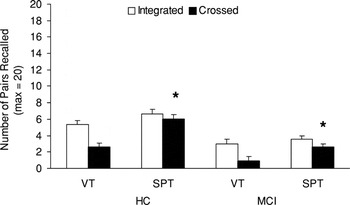
The mean number of object-action pairs correctly recalled is displayed in Figure 1 as a function of group, encoding task, and list type. The ANOVA revealed better recall among healthy controls than the aMCI group [F(1,50) = 21.00, p < .001, η2 = .296], for SPT relative to VT encoding [F(1,50) = 34.63, p < .001, η2 = .409], and for semantically integrated compared to crossed lists [F(1,50) = 34.913, p < .001, η2 =.411]. However, these main effects are qualified by interactions. As shown in the figure, there was an interaction between encoding task and list type [F(1,50) = 8.55, p = .005, η2 = .146]. Planned pairwise comparisons confirmed the visual impression that the difference between the integrated and crossed lists was greater in the VT [t(51) = 6.30, p < .001, η2 = .437], than the SPT condition [t(51) = 2.08, p = .043, η2 =.078]. This is consistent with Mangels and Heinberg's (2006) finding that SPT encoding reduces the semantic interference from the crossed lists. There was also a marginally significant interaction between group and encoding task [F(1,50) = 3.76, p = .058]. Although both groups showed an SPT effect, the effect was somewhat larger in the healthy control group [t(25) = 5.99, p < .001, η2 =.545], than the aMCI group [t(25) = 2.60, p = .015, η2 =.213]. Contrary to our expectation that the aMCI group would be disproportionately affected by the crossed lists, there was no group by list type interaction. Importantly, there was no significant three-way interaction between encoding task, list type, and group [F(1,50) = .82, p = .37], which indicates that SPTs were equally effective in reducing the interference created by crossed object-action pairs in the two groups.

Mean number of intact object-action pairs recalled as a function of group, encoding task, and list type. In this and all subsequent figures, error bars show the SEM. There was an interaction between encoding task and list type, in which the difference between the integrated and crossed lists was greater in the VT than the SPT condition. There was also a marginally significant interaction between group and encoding task. Although both groups showed an SPT effect, the effect was somewhat larger in the healthy control group than the aMCI group. (HC = healthy controls; aMCI = amnestic mild cognitive impairment; VT = verbal task; SPT = subject-performed task).
Partial Recall Responses
Partial recall responses are direct evidence of associative memory failures due to fragmentation of the object-action association. To evaluate the nature and extent of this fragmentation, we analyzed partial recall responses according to the component correctly recalled. For example, participants may have recalled an object in isolation (i.e., without the originally paired action), with a semantically related (but incorrect) action (e.g., “wipe” instead of “sweep”), or with an unrelated action. Conversely, participants may have remembered an action alone, with a semantically related object (e.g., “dropper” instead of “baster”), or with an unrelated object. Responses that did not resemble any of the presented items were scored as true intrusions. Mismatches, which would refer to recall of an object-action pair that had not actually been paired together in the list, did not occur. Given the group difference in recall of the pairs, we calculated partial recall responses as a proportion of total responses for a given list (i.e., recall of the correct object-action pair, partial recall responses, and true intrusions).
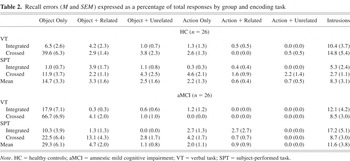
Table 2 shows the mean percentage of each type of partial recall response made as a function of encoding task, list type, and group. Because of the low numbers of individual partial recall response types and to avoid floor effects, the six different types of partial recall responses were collapsed into two categories for subsequent statistical analysis. The three types of correct action recall with incorrect or missing object described earlier were summed (Partial Recall-Action responses) as were the three types of correct object recall with incorrect or missing action (Partial Recall-Object).
Recall errors (M and SEM) expressed as a percentage of total responses by group and encoding task

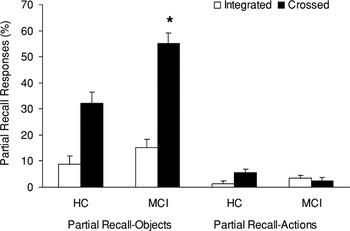
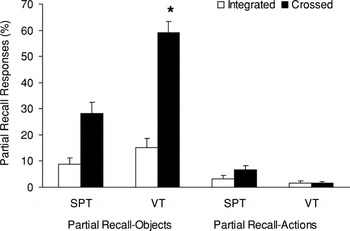
A 2 (Group) × 2 (Encoding Task) × 2 (List Type) × 2 (Partial Recall Type) ANOVA revealed significant three-way interactions between group, list type, and partial recall type [F(1,50) = 10.74, p = .002, η2 = .177] and between encoding task, list type, and partial recall type [F(1,50) = 17.38, p < .001, η2 = .258]. To explore these interactions, we performed a group by list type ANOVA as a function of partial recall type, displayed in Figure 2, and an encoding task by list type ANOVA for each partial recall type (see Figure 3). As shown on the left side of Figure 2, both groups made more Partial Recall-Object responses for crossed than integrated lists, but this difference was more pronounced in the aMCI group, as evidenced by a group by list type interaction [F(1,50) = 7.89, p = .007, η2 = .136]. There was also a group by list type interaction for Partial Recall-Action responses [F(1,50) = 5.90, p = .019, η2 = .106], which cannot be interpreted due to floor effects (see right side of Figure 2). As shown in the left side of Figure 3, more partial recollections of the object were made with the crossed than the integrated lists overall, and this difference was especially pronounced in the VT relative to the SPT encoding condition [F(1,51) = 15.07, p < .001, η2 = .228], as expected. The encoding by list type interaction obtained with the Partial Recall-Action responses cannot be interpreted due to floor effects (see right side of Figure 3).

Percentage of partial recall responses as a function of group, list type, and partial recall type, collapsed across task. Both groups made more Partial Recall-Object responses for crossed than integrated lists, but this difference was more pronounced in the aMCI group (see left side of figure). There was also a group by list type interaction for Partial Recall-Action responses, but this cannot be interpreted due to floor effects (see right side of figure). (HC = healthy controls; aMCI = amnestic mild cognitive impairment).

Percentage of partial recall responses as a function of task, list type, and partial recall type, collapsed across group. As shown in the left side of this figure, more partial recollections of the object were made with the crossed than the integrated lists overall, and this difference was especially pronounced in the VT relative to the SPT encoding condition. There was also an encoding by list type interaction with the Partial Recall-Action responses, but this cannot be interpreted due to floor effects (see right side of figure). (VT = verbal task; SPT = subject-performed task).
Recognition Accuracy (Discriminability)
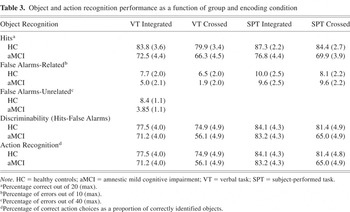
Table 3 displays hits, false alarms, and discriminability scores on the object recognition test. A 2 (Distractor type) × 2 (Group) ANOVA revealed that both groups were more likely to make false alarms to related than to unrelated distractors [F(1,50) = 20.08, p < .001, η2 = .287]. There was no main effect of group (p = .403), nor a group by distractor type interaction (p = .741). Because related distractors were matched to targets in the lists, we examined related false alarms as a function of the encoding task and the list type in which their yoked target had been presented. This analysis revealed a significant main effect of encoding task [F(1,50) = 12.78, p = .001, η2 =.204] and a marginally significant interaction between encoding task and group [F(1,50) = 3.50, p = .067, η2 =.066]. Planned pairwise comparisons revealed that the aMCI group made more than twice as many related false alarms in the SPT (M = 9.6%) than the VT (M = 3.5%) condition [t(25) = 3.33, p = .003, η2 = .308]. In contrast, the healthy controls made an equivalent number of false alarms in the two conditions (SPT: M = 9%; VT: M = 7.1%) [t(25) = 1.48, p = .153, η2 =.080].
Object and action recognition performance as a function of group and encoding condition

Discriminability was defined as the hit rate for items presented at study minus the false positive rate (for related and unrelated distractors combined), represented as a proportion of total items presented in each condition. An ANOVA performed on this variable revealed significant main effects of group (healthy control > aMCI) [F(1,50) = 5.21, p = .027, η2 = .094], encoding task (SPT > VT) [F(1,50) = 9.62, p = .003, η2 = .161], and list type (semantically integrated > semantically crossed) [F(1,50) = 16.79, p < .001, η2 = .251]. There were no interactions involving group. In contrast to the free recall results, there was no interaction of encoding task and list type for item discrimination.
An ANOVA performed on the data from the action recognition test (i.e., the proportion of actions correctly recognized for objects identified as old) revealed superior recognition among healthy controls compared to individuals with aMCI [F(1,50) = 6.420, p = .014, η2 = .114], for enacted compared to verbalized actions [F(1,50) = 12.88, p = .001, η2 = .205], and for semantically integrated compared to semantically crossed commands [F(1,50) = 7.18, p = .010, η2 = .126]. There was also a marginally significant interaction of group by list type [F(1,50) = 3.79, p = .057, η2 =.070]. Whereas the controls were equally likely to recognize actions from crossed pairs [M = 78.17, standard error of the mean (SEM) = 3.78] as from integrated pairs (M = 80. 81, SEM = 3.5) [t(25) = .674, p = .507, η2 = .018], individuals with aMCI had much worse action recognition for crossed (M = 60.58, SEM = 4.7) than for integrated (M = 77.23, SEM =3.4) pairs [t(25) = −2.76, p = .011, η2 = .233]. This underscores the particular difficulty in forming new associations experienced by individuals with aMCI, consistent with expectations. There was no significant interaction between group and encoding condition. Thus, although the healthy controls demonstrated a larger SPT advantage than the aMCI group on free recall, the two groups benefited to the same extent from SPT relative to VT encoding on recognition. Contrary to expectations, the encoding by list type interaction observed in free recall did not emerge on the action recognition test.
DISCUSSION
The present study was motivated by the view that enactment unitizes object and action command components, which should reduce memory load and thereby increase the likelihood of successful retrieval relative to verbal encoding (Kormi-Nouri, 1995). As expected, despite deficits in associative learning following verbal encoding relative to healthy controls, individuals with aMCI exhibited significant gains in free recall of the object-action pairs, item recognition, and action recognition performance, as well as a corresponding reduction in overall partial recall responses following enactment. However, although the magnitude of the SPT effect was equivalent for the aMCI and control groups on recognition memory, it was marginally reduced in the aMCI group on free recall. Floor effects in free recall for the VT condition in the aMCI group may have precluded identification of the true magnitude of the SPT effect on this task. In any case, reduced SPT effects relative to healthy controls have been observed in both schizophrenia (Daprati et al., 2005), where it was attributed to problems with procedural learning resulting from basal ganglia dysfunction, and AD (Lekeu et al., 2002), attributed to poor encoding of the enacted events.
As expected, the encoding instruction by list type interaction found by Mangels and Heinberg (2006) with healthy young and older adults was replicated in healthy older adults here and extended to individuals with aMCI. Specifically, free recall of semantically crossed pairs was significantly worse than recall of integrated pairs following basic VT encoding, but was equivalent for the two list types following enactment. This interaction confirms the protective effect of enactment against the deleterious effects of semantic interference; moreover, the magnitude of the benefit is equivalent for individuals with aMCI and healthy controls. This is an important finding given recent data indicating increased vulnerability to semantic interference among individuals with aMCI relative to healthy controls (Lowenstein et al., 2004). This finding is also consistent with the view that enactment focuses attention on item-specific encoding of individual object-action units rather than on relational processing amongst units (e.g., Engelkamp & Zimmer, 2002).
The fact that the aMCI group made more than twice as many false alarms to semantically related distractors following SPT than VT encoding suggests that enactment increased their ability to extract semantic gist. The aMCI group also made more free recall intrusions and object + related partial recall responses following SPT than VT encoding. Interestingly, increases in semantically related intrusions during recall of semantically associated lists and high levels of false alarms on recognition also occur in mild-to-moderate amnesia (Melo et al., 1999). However, when amnesia is severe and/or accompanied by frontal lobe dysfunction, patients may actually show fewer intrusions and false alarms because insufficient information has been encoded from which to extract gist (Melo et al., 1999; Schacter, 1996). Thus, mild reductions in medial temporal lobe function in aMCI may result in weakened episodic memory traces that can still be strengthened by the encoding support of enactment, which not only increases free recall of object-action pairs, but also supports gist memory when recall is incomplete.
Mangels and Heinberg (2006) found disproportionately impaired free recall of crossed relative to integrated lists for healthy elderly compared to young adults. Given that group by list type interaction and literature suggesting a pervasive associative learning deficit in aMCI, we expected a similar interaction in this study, yet did not observe one. It may be, however, that a floor effect obscured the interaction, as both groups demonstrated very poor performance in the semantically crossed VT condition. The fact that the floor effect was so pronounced in the aMCI group in that condition underscores their great difficulty in forming novel associations, which requires effortful processing. When performance was above floor, as in the action recognition test, the expected interaction did emerge. Moreover, the aMCI group made a disproportionate number of partial recall-object responses for crossed associations. That is, rather than simply forgetting both components of crossed associations, the aMCI group remembered many objects for which they were not able to retrieve the appropriate action. These findings are also consistent with clinical observations of deficits in associative learning among these individuals.
Most studies of aMCI focus on diagnosis and classification rather than specific cognitive components underlying their verbal learning deficits. Indeed, the classification of aMCI continues to be the source of debate among different researchers. The fact that participants in this study may have been impaired on only one of three measures of memory may limit the generalizability of our results to other samples of aMCI. In any case, if aMCI represents a transitional phase between healthy aging and AD (Petersen et al., 2001), one might expect that it would be characterized by an encoding deficit with relative sparing of retrieval processes. Indeed, there was evidence of an encoding problem in the aMCI group. Specifically, the additional retrieval cues provided by the multiple-choice format of the action recognition test eliminated the advantage of semantically integrated relative to crossed lists in controls, yet this difference persisted among individuals with aMCI, which suggests that the information was not learned well in the first place. On the other hand, there was also evidence of retrieval difficulties in the aMCI group. Specifically, the magnitude of the SPT effect was marginally larger for the control compared to the aMCI group on free recall, but was equivalent for the two groups on both recognition measures. Performance gains on recognition compared to free recall are often considered to represent problems in strategic retrieval.
In summary, this study provides novel evidence that enactment helps to improve associative learning and reduce semantic interference among individuals with aMCI, both of which are important given their particular difficulties in these domains (Collie et al., 2002; Lowenstein et al., 2004). Although SPT encoding did not eliminate the difficulty these individuals have with associative learning, having multiple routes (e.g., visual, semantic, kinesthetic) to facilitate episodic integration of object-action pairs increases the likelihood of successful retrieval for individuals with aMCI, as well as controls. We are currently examining whether the protective effect of SPTs against semantic interference will generalize to other disadvantaged learning situations, such as divided attention. If the SPT effect is mediated by episodic integration, then enactment should require fewer processing resources than verbal encoding, which should produce an encoding by attention interaction similar to the encoding by list type interaction observed here.
ACKNOWLEDGMENTS
This research was supported in part by grants to the second author from the Natural Sciences and Engineering Research Council and from York University. We thank Tobi Lubinsky, Jennifer Hilborn, and Aileen Heinberg for assistance with data collection. Nicole Anderson and Howard Chertkow assisted in patient classification, and both Nicole Anderson and Susan Murtha provided helpful discussions of the study results.
This article is based on the masters thesis of Stella Karantzoulis, submitted to York University. Portions of these data were presented at the annual meeting of the International Neuropsychological Society, February 2004, Baltimore, Maryland, the biennial Cognitive Aging Conference, April 2004, Atlanta, Georgia, and the midyear meeting of the International Neuropsychological Society, July 2004, Brisbane, Australia.