Implications
Understanding how and why herbivores utilize the landscape has implications for sustainable management of environmentally sensitive grazing environments and for optimizing herbivore production. This paper reviews field-based methods that may be used to understand plant/herbivore interactions. Most grazing intake work has been completed in low plant diversity systems with small numbers of animals. Emerging telemetry systems provide the opportunity for detailed data to understand plant/herbivore interactions over seasons and across diverse heterogeneous landscapes. The shift in focus from small-scale, short-term experiments to large-scale, long-term experiments, while maintaining the frequency at which data are recorded, provides the opportunity to move from nutritional physiology to nutritional ecology.
Introduction
The science of domesticated herbivore nutrition, especially ruminants, is well established and is based on detailed studies of nutritional physiology (Poppi and McLennan, Reference Poppi and McLennan2010). Nutritional models that have been developed to predict production outcomes for domesticated herbivores generally work satisfactorily (Fox et al., Reference Fox, Tedeschi, Tylutki, Russell, Van Amburgh, Chase, Pell and Overton2004), although predicting growth rates in tropical forage systems has proven to be more challenging (Poppi and McLennan, Reference Poppi and McLennan1995). Most of the models have been developed from empirical relationships based on large numbers of detailed studies where known diets have been correlated with detailed measurements of animal performance (Fox et al., Reference Fox, Tedeschi, Tylutki, Russell, Van Amburgh, Chase, Pell and Overton2004). Experiments that have measured feeding intake, respiration, live weight, oesophageal and rumen contents, blood, milk, faecal and urine samples have all provided detailed data to link specific diets to specific physiological outcomes. These physiological outcomes have then been related to gross production via the two major drivers of production – energy and protein (Fox et al., Reference Fox, Tedeschi, Tylutki, Russell, Van Amburgh, Chase, Pell and Overton2004). Mechanistic modelling, describing detailed nutritional pathways, has also been used to predict herbivore nutritional outcomes (Mills et al., Reference Mills, Dijkstra, Bannink, Cammell, Kebreab and France2001). In all cases, the single most important factor that determines an accurate prediction of a production response to a given feeding regime is an accurate and detailed knowledge of the quantity and quality of the diet that the herbivore has eaten. Despite significant efforts, accurate intake measurements for free-grazing domesticated herbivores continue to challenge field-based nutrition research, particularly under more extensive grazing systems (Undi et al., Reference Undi, Wilson, Ominski and Wittenberg2008).
Controlled pen-fed studies provide information on the physiological potential and limits of herbivores livestock but largely fail to capture important behavioural choices that an animal makes when it is in a free-grazing environment. Nutritional ecology considers the broader environmental context for grazing motivation and learning and the impact this has on nutritional demands and outcomes (Day et al., Reference Day, Kyriazakis and Rogers1998). Physiological drivers such as stage of pregnancy and lactation underpin nutritional demands, which in turn direct behavioural choices (Cook et al., Reference Cook, Johnson, Cook, Riggs, Delcurto, Bryant and Irwin2004). In the context of a free-grazing environment, monitoring behaviour provides a proxy for a physiological demand function, although innate behavioural responses can also mask physiological responses such as stress (Careau et al., Reference Careau, Thomas, Humphries and Réale2008).
Although the term ‘nutritional ecology’ has been in use for a number of years, Parker et al. (Reference Parker, Barboza and Gillingham2009) succinctly defined the topic as ‘the science of relating an animal to its environment through nutritional interactions’. There has been recent interest in developing a unifying framework for nutritional ecology (Raubenheimer et al., Reference Raubenheimer, Simpson and Mayntz2009); the proposed framework considers the nutritional needs of an organism within an ecological context. Nutritional ecology for herbivore studies considers the behavioural grazing preferences of free-ranging herbivores where behavioural preferences are determined by an individual's need to fulfil physiological processes. These physiological needs are met within the context of a hierarchy of nutritional choices that are constantly variable over both space and time. Nutritional ecology therefore recognizes that behavioural preferences largely reflect physiological needs (Parsons et al., Reference Parsons, Newman, Penning, Harvey and Orr1994; Provenza, Reference Provenza1995). However, dietary changes associated with limited availability of familiar food items results in herbivores exploring and learning; this learning phase can result in physiologically inadequate selection preferences (Provenza et al., Reference Provenza, Villalba, Dziba, Atwood and Banner2003).
Over the last decade, there has been a rapid development in automated telemetry that is able to monitor a number of different aspects of free-ranging herbivores (Cooke et al., Reference Cooke, Hinch, Wikelski, Andrews, Kuchel, Wolcott and Butler2004; Zerger et al., Reference Zerger, Rossel, Swain, Wark, Handcock, Doerr, Bishop-Hurley, Doerr, Gibbons and Lobsey2010). Researchers who are interested in nutritional physiology have explored opportunities to use these technologies to determine energetics and grazing selection (Brosh et al., Reference Brosh, Henkin, Ungar, Dolev, Orlov, Yehuda and Aharoni2006). Despite the efforts of researchers to develop and integrate telemetry technologies, they have not been able to provide a reliable method to accurately predict intake of free-ranging herbivores (Undi et al., Reference Undi, Wilson, Ominski and Wittenberg2008).
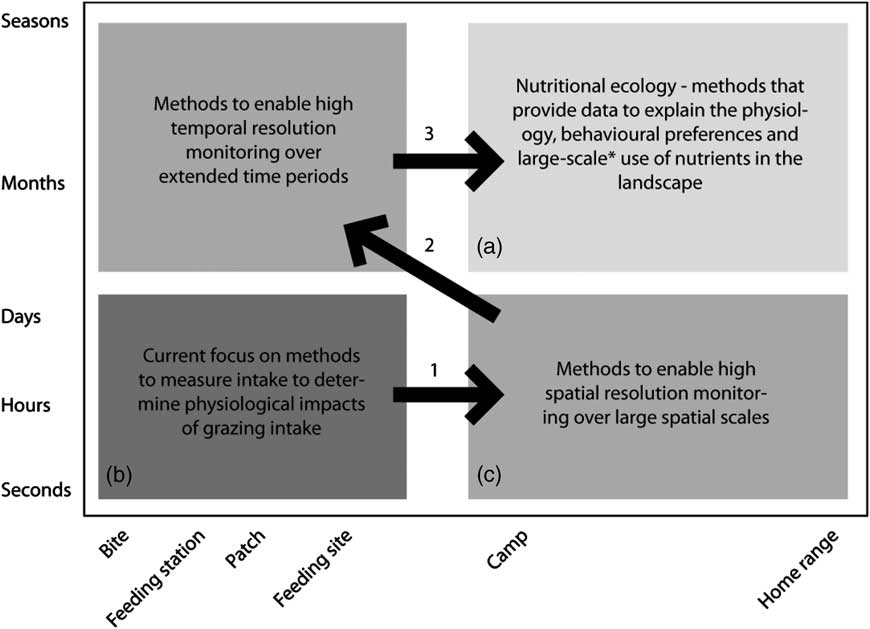
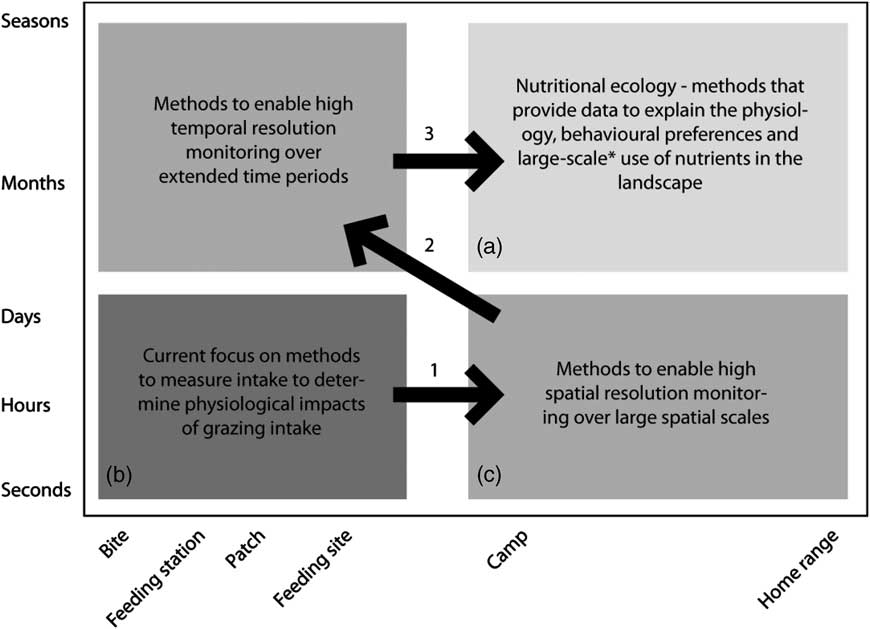
The spatial and temporal framework for field-based herbivore nutrition research has focused efforts on short-term and small-scale intake within intensive low plant diversity grazing systems. Nutritional ecology is concerned with large-scale, long-term nutritional interactions. In the context of deriving data to inform large-scale nutritional studies, we review the methods that have been used for small-scale field-based nutritional research. We suggest there is evidence that the research methods are progressing from short-term, small-scale to short-term, large-scale interactions (see Figure 1, arrow 1). The question of large and small scale is open to interpretation; however, the motivation for this paper is research opportunities to study the nutrition of domesticated ruminant herbivore (predominantly cattle) in extensive production systems such as the grazing systems found in northern Australia. These grazing systems are broadly classified as rangeland, with stocking rates of several hectares per adult cow to 50 hectares per cow or more. Cattle in these systems can have access to paddocks of several hundred square kilometres, and may only be mustered once a year. With advances in automated monitoring (using telemetry), there are greater opportunities for long-term, large-scale nutritional studies (see Figure 1, arrows 2 and 3). This paper reviews a theoretical framework for nutritional ecology (Figure 1, box a) and considers how the development of modelling techniques can be used to inform experimental methods. We review the current field-based methods that are used to estimate intake (Figure 1, box b) and consider their limitations in the context of landscape scale studies. Finally, we consider how emerging telemetry solutions (Figure 1, box c) might be able to support a behavioural-based approach to studies of free-grazing domesticated livestock and provide examples from recent studies. The paper does not aim to explicitly address causality, but rather within the context of nutritional drivers it aims to evaluate methods that might be used to better understand domesticated herbivore nutrition at the landscape scale.
A spatial and temporal framework for herbivore nutrition (adapted from Bailey et al., Reference Bailey, Gross, Laca, Rittenhouse, Coughenour, Swift and Sims1996). The progression towards long-term, large-scale nutrition studies is following the transition of methods to enable studies to maintain the spatial and temporal detail associated with short-term, small-scale studies. *The terms long and short refer to temporal scaling and large and small to spatial scaling.
A framework for nutritional ecology
The optimal foraging theory concerns foraging behaviour in environments that have patchy distributions of food (Wiens, Reference Wiens1976; Nonaka and Holme, Reference Nonaka and Holme2007). The behavioural choices individuals make are linked to physiological outcomes (Illius and Jessop, Reference Illius and Jessop1996). Foraging choices are driven by behavioural preferences that aim to optimize a fitness function (MacArthur and Pianka, Reference MacArthur and Pianka1966; Charnov, Reference Charnov1976). Successful foraging outcomes are determined by the effect that nutritional currencies (e.g. energy) have on the survival and reproductive capacity of individuals (Parsons et al., Reference Parsons, Newman, Penning, Harvey and Orr1994). This paper does not provide a detailed review of optimal foraging theory, and we recognize that there have been a number of different approaches that might provide a framework for a field-based nutritional ecological approach. The principles of optimal foraging theory, however, have progressed through increasingly sophisticated behavioural-based modelling methods, and this modelling framework provides direction for field-based experiments that fall under the general area of nutritional ecology. Matching experimental methods with advances in modelling provides the opportunity to test the outputs from emerging nutritional ecology theories. Recent developments in optimal foraging modelling also provide direction for telemetry-based herbivore nutrition studies (Nonaka and Holme, Reference Nonaka and Holme2007).
Early modelling and experimental work exploring ideas associated with optimal foraging were based on predator–prey systems (MacArthur and Pianka, Reference MacArthur and Pianka1966; Krebs et al., Reference Krebs, Ryan and Charnov1974). Deterministic models that use differential equations to describe population-level outcomes assume that all individuals have the same foraging behaviour and that food choice decisions are not constrained by spatial dynamics. An example of this approach is the marginal value theorem (MVT) used to describe foraging behaviour (Charnov, Reference Charnov1976; McNair, Reference McNair1982). Foraging behaviour in the MVT models is determined by the energy available in the local patch; movement to a new patch occurs when the local energy intake rate for the current patch falls below the average rate of energy available all other patches (Charnov, Reference Charnov1976). In practice, population-level foraging and associated nutritional outcomes are determined by a collection of individual behaviours (Skorka et al., Reference Skorka, Lenda, Martyka and Tworek2009). The variability in individual behaviours reflects individual preferences within spatially constrained environments (Pyke, Reference Pyke1984; Nonaka and Holme, Reference Nonaka and Holme2007).
The emergence of more powerful computer processing capabilities has enabled the development of agent-based simulation modelling to describe herbivore-grazing systems; these models have become increasingly spatial and incorporated individual behavioural preferences (Beecham and Farnsworth, Reference Beecham and Farnsworth1998; Marion et al., Reference Marion, Smith, Swain, Davidson and Hutchings2008). Scales of interaction are an important determinant of the behavioural descriptions that are used within individual models (Taylor, Reference Taylor1976; Gustine et al., Reference Gustine, Parker, Lay, Gillingham and Heard2006; Owen-Smith et al., Reference Owen-Smith, Fryxell and Merrill2010). Stochastic methods have been used to describe behavioural variation (Stephens and Charnov, Reference Stephens and Charnov1982; Marion et al., Reference Marion, Swain and Hutchings2005). Schwinning and Parsons (Reference Schwinning and Parsons1999) developed a behavioural-based model that used bite scale patches and variable grazing intervals. Choice was determined randomly, however, irrespective of the patch state or location. Spatial constraints are important determinants of grazing selection (Grünbaum, Reference Grünbaum1998). Marion et al. (Reference Marion, Swain and Hutchings2005) used a spatially explicit rule-based model where grazing animals made a two-stage decision based on visual cues that were used to determine patch selection and olfactory cues to determine bite selection. These modelling approaches have an implicit assumption that nutritional physiology can be captured through behavioural modelling. Spatially explicit behavioural-based optimal foraging modelling indicates that measuring detailed herbivore movement in field-based nutritional studies helps to determine herbivore nutritional drivers.
Existing methods used to directly estimate intake and diet selection in free-grazing experiments
Physical methods
Erizian (1932, cited in (Minson, Reference Minson1990)) first estimated the quantity of herbage eaten by weighing animals before and after grazing. The weight change approach is only useful for estimating intake in short-term studies, as it requires fitting a harness to the experimental animal to collect urine and faeces, and is subject to many sources of error (Penning and Hooper, Reference Penning and Hooper1985).
Measurement of the time spent grazing, average bite size and bite rate can be used to provide an estimate of intake (Spedding et al., Reference Spedding, Large and Kydd1966). Estimates of average bite size were determined by recording the number of bites associated with short-term weight gain (Rutter et al., Reference Rutter, Champion and Penning1997). Such approaches require animals to be fitted with equipment to measure the number of bites taken (Stobbs and Cowper, Reference Stobbs and Cowper1972; Stobbs, Reference Stobbs1973; Rutter et al., Reference Rutter, Champion and Penning1997; Ungar and Rutter, Reference Ungar and Rutter2006), as well as measuring time spent grazing. These methods are most suited to estimating intake over relatively short time periods, and they are not suitable for longer-term studies because of the invasive nature of the equipment.
Measuring herbage mass (kg dry matter per hectare) before and after grazing has been widely used to estimate the intake at the plot or paddock scale. Woodward (Reference Woodward1936) first reported the estimated intake of dairy cows after cutting grazed and adjacent ungrazed plots over two- to four-day grazing periods. Errors in the estimates of herbage mass, and the growth or loss (senescence) of herbage during the grazing period (usually estimated through exclusion cages) can affect the validity of the intake estimates and require detailed estimates of pasture mass. The growth rate error increases in significance with longer the grazing periods and lower stocking rates, and thus the approach is better suited to strip-grazing with short grazing periods (Van der Kley, Reference Van der Kley1956; Undi et al., Reference Undi, Wilson, Ominski and Wittenberg2008) rather than extensive situations.
Estimating intake based on diet digestibility and faecal output
Indirect methods used to estimate grazing intake rely on also estimating the digestibility of the consumed diet. Total faecal collection from grazing herbivores can be used to calculate forage intake if the digestibility of the forage is known. Errors arise if the digestibility of forage differs from what the animals consume. Surgical modification of animals can be used to directly access grazed forage material (Langlands, Reference Langlands1975 and Reference Langlands1987), however, these methods are not practical in extensive cattle systems and raise ethical concerns (Jones and Lascano, Reference Jones and Lascano1992). Furthermore, measures of in vitro digestibility (usually by the Tilley and Terry (Reference Tilley and Terry1963) method) of selected diets may be different to in vivo estimates of digestibility, introducing error to intake estimates.
Individual digestibility estimates can be made if the concentration of an indigestible marker (or at least a marker whose faecal recovery is known) can be measured in feed and faeces (Minson, Reference Minson1990), although even this approach assumes all animals have selected the same diet. Many different markers have been suggested and evaluated, although issues relating to measuring these and in particular recovery in faeces has limited the widespread use of many of these (Dove and Mayes, Reference Dove and Mayes1996).
Many different indigestible markers have been used to estimate faecal output (for reviews, see Kotb and Luckey, Reference Kotb and Luckey1972; Langlands, Reference Langlands1975), with chromium sequioxide being the most popular. Dove and Mayes (Reference Dove and Mayes1991) discuss sources of error relating to diurnal variation in faecal concentration of the marker, whereas Dove and Mayes (Reference Dove and Mayes1996) argue that an even greater source of error for the resulting intake estimate is the calculation of a single value for digestibility, which is then applied to all animals.
Naturally occurring n-alkanes, present in plant cuticular wax, have been widely used to estimate feed intake since it was first reported by Mayes et al. (Reference Mayes, Lamb and Colgrove1986). The method relies on dosing a grazing animal with a known amount of even-chain length alkane (usually C32) to estimate faecal output and using an internal odd-chain alkane to estimate digestibility (Dove and Mayes, Reference Dove and Mayes1991). The n-alkanes are present in a wide range of plants and are relatively easy to measure (Dove and Mayes, Reference Dove and Mayes1996), making their use widely applicable. However, the synthetic alkane needs to be administered once or twice daily or via controlled release devices (Dove and Mayes, Reference Dove and Mayes1996). The accuracy of the alkane method relies on collecting herbage samples that are similar to those being selected by the grazing animal. The alkane profile of individual plant species is unique (Dove and Mayes, Reference Dove and Mayes1996) and the method can be used to determine the botanical composition of the selected diet, which can in turn be used to improve the intake estimate. The method relies on abundant plant alkane profiles, and many tropical forage species have low level of alkanes (Laredo et al., Reference Laredo, Simpson, Minson and Orpin1991), limiting its usefulness for estimating intake of these species. The procedure requires daily faecal sample collection, and as such will not suit studies that are carried out in remote locations.
Near infrared spectroscopy (NIRS) measurement of forage and faeces has been shown to be unsuitable for accurate intake estimates (Norris et al., Reference Norris, Barnes, Moore and Shenk1976; Minson et al., Reference Minson, Butler, Grummitt and Law1983; Decruyenaere et al., Reference Decruyenaere, Lecomte, Demarquilly, Aufrere, Dardenne, Stilmant and Buldgen2009); however, NIRS spectra have been shown to give more accurate predictions of dry matter digestibility (R 2 > 0.9 and a standard error of cross-validation of less than 0.025 digestibility units; (Decruyenaere et al., Reference Decruyenaere, Lecomte, Demarquilly, Aufrere, Dardenne, Stilmant and Buldgen2009)). As with all NIRS procedures, the calibration equations need to cover the range of feed components ingested by the animals. NIRS analyses of polyethylene glycol in the faeces of dosed goats have been used to estimate faecal output (Landau et al., Reference Landau, Friedman, Devash and Mabjeesh2002), and provided an estimate of digestibility can be obtained intake can be estimated. One of the major problems with using NIRS to estimate nutritional factors is the need to have a reliable calibration curve based on known intake measurements across the full range of diets the animal might encounter.
Estimating diet selection
Oesophageal-fistulated (OF) animals have been used to estimate the botanical composition of the consumed diet (Coates et al., Reference Coates, Schachenmann and Jones1987; Salt et al., Reference Salt, Mayes, Colgrove and Lamb1994), but this approach rests on a number of assumptions (most significantly that OF animals select a diet similar to non-OF animals) that were questioned by Mayes and Dove (Reference Mayes and Dove2000). Microhistological procedures are used to identify the plants that an animal has selected and grazed. Microhistology has also been used to identify plant material in stomach contents and faeces (Holechek et al., Reference Holechek, Vavra and Pieper1982). The major limitation with microhistology is the difficulty in identifying all plant components. For animals with access to both C3 and C4 plants, differences in the ratio of the stable isotopes 13C and 12C in OF extrusa or faeces can be used to determine the broad dietary selection preferences (Jones et al., Reference Jones, Ludlow, Troughton and Blunt1979).
A number of authors have attempted to determine the botanical composition of consumed diets through faecal NIRS (see reviews by Landau et al., Reference Landau, Glasser and Dvash2006 and Dixon and Coates, Reference Dixon and Coates2009). The NIRS approach has been shown to be useful for determining the presence of a specific dietary component, but its use in field studies is constrained by the availability of calibration equations (Landau et al., Reference Landau, Glasser and Dvash2006). The n-alkanes have been widely used to estimate diet composition, based on marked differences between species alkane profiles (Dove and Mayes, Reference Dove and Mayes2005). Although it is theoretically possible to discriminate up to 15 different components in the diet (the number of available alkanes to act as markers), in practice the number of individual dietary components that can be discriminated is much less (Dove and Mayes, Reference Dove and Mayes2005). The number of dietary components that can be reliably discriminated limits the usefulness of the alkane technique in diverse grasslands. Other individual plant wax marker groups (alkenes, long-chain fatty acids and long-chain fatty alcohols) can be used to estimate diet composition. The best estimates of diet composition, however, were obtained when several marker groups were used together (Ali et al., Reference Ali, Mayes, Hector, Verma and Ørskov2005).
The review of field-based diet selection and intake methods demonstrates that although a number of tools have been developed, most of them are suited to experiments with small numbers of animals that run for short periods of time within small-scale paddocks. The opportunity for nutritional ecology concerns long-term landscape and population-level interactions (Figure 1).
Inference methods to estimate diet selection
Integrating information about herbivore behaviours across scales shifts the emphasis away from nutritional physiology via intake towards nutritional ecology, which derives data to describe the hierarchy of behavioural choices that a grazing animal makes (Raubenheimer et al., Reference Raubenheimer, Simpson and Mayntz2009). This shift in focus is similar to the shift in focus for optimal foraging modelling that was described earlier. Nutritional outcomes result from a complex interaction of factors; Bailey et al. (Reference Bailey, Gross, Laca, Rittenhouse, Coughenour, Swift and Sims1996) highlighted how patch selection incorporates the interaction of physiological and environmental factors across multiple scales. These interacting physiological and environmental factors result in a final grazing decision and the selection of a grazing patch. Nutritional factors determine behavioural choice associated with selecting a grazing site. Behavioural choices result in nutritional outcomes, which can be quantified by measuring outcomes such as growth rate, body condition or reproductive success (Côté and Festa-Bianchet, Reference Côté and Festa-Bianchet2001; Cook et al., Reference Cook, Johnson, Cook, Riggs, Delcurto, Bryant and Irwin2004; Tollefson et al., Reference Tollefson, Shipley, Myers, Keisler and Dasgupta2010). Practical constraints limit what can be measured in grazing livestock found in extensive highly heterogeneous grazing environments. The monitoring limitations are influenced by the effect the monitoring has on cattle behaviour and the frequency of access to retrieve data from the cattle. Telemetry data provide the opportunity to correlate behavioural states with location information.
Estimating location
In the early 1960s, wildlife biologists started to successfully track wildlife using very-high-frequency radio devices (Cochran and Lord, Reference Cochran and Lord1963). Radio tracking devices rely on an animal being fitted with a radio transmitter; researchers then determine location using a receiver. The frequency and accuracy of radio tracking location data is constrained by the need for the operator to be in the field. There have been a number of automated radio tracking systems, however, that can provide automated location data using a series of fixed-base station receivers (e.g. Taggle http://www.taggle.com.au/). The low power requirement of the transmitters means that the devices can be relatively small, and depending on the battery power available and the required time interval between data points the devices can last for several years. Radio tracking has been widely used in wildlife studies, in particular where animals range over large geographical areas and the interval between locations is less important.
Although telemetry devices such as global positioning systems (GPS) have provided advances in monitoring animal location (Trotter et al., Reference Trotter, Lamb, Hinch and Guppy2010), these technologies are not without their problems. Developments in automated animal monitoring technology have resulted in larger and more accurate behavioural data sets (Cooke et al., Reference Cooke, Hinch, Wikelski, Andrews, Kuchel, Wolcott and Butler2004; Zerger et al., Reference Zerger, Rossel, Swain, Wark, Handcock, Doerr, Bishop-Hurley, Doerr, Gibbons and Lobsey2010). Animal location data have been recorded at intervals greater than four times per second, with a spatial accuracy of <5 m (Swain et al., Reference Swain, Wark and Bishop-Hurley2008). In a recent review, Hebblewhite and Haydon (Reference Hebblewhite and Haydon2010) urged caution when using GPS telemetry data. Although the location information collected automatically has become more refined, these data do not always result in greater biological insight. The telemetry technology needs to provide data that can reliably be used to inform where an animal is in relation to the available food resources, and its grazing behaviour.
Herbivore location and movement information derived from telemetry devices and linked to measurements of the spatial arrangement of food resources can be used to determine nutrient selection preferences (Ganskopp and Bohnert, Reference Ganskopp and Bohnert2009). Uncertainty associated with spatial errors and varying sampling intervals affects the accuracy of resource (nutrient) selection functions (Visscher, Reference Visscher2006). Although emerging real-time kinematic GPS can provide location accuracy of <50 cm, potentially enabling individual plant-level nutrient selection functions, these technologies have not been used in herbivore nutrition studies (Lee et al., Reference Lee, Alchanatis, Yang, Hirafuji, Moshou and Li2010). Differentially corrected GPS provide location data with an accuracy of between 2 and 5 m, enabling patch-level nutrient selection functions based on herbivore selection of a collection of plants (Buerkert and Schlecht, Reference Buerkert and Schlecht2009). Depending on the spatial arrangement of vegetation, ordinary GPS with location accuracy of ∼5 m can provide sufficient detail to enable patch-level nutrient selection functions in extensive rangeland environments (Buerkert and Schlecht, Reference Buerkert and Schlecht2009). If the vegetation comprises a mosaic of small patches, however, as is found with clumping grasses, then 25 m2 patches may be too large to derive meaningful nutrient selection information. Location data collected using telemetry devices provide a snapshot of movement, and the less frequently a location point is collected the less likely that it represents a herbivore's movement (Nams, Reference Nams2006b) or nutrient selection preferences (Schick et al., Reference Schick, Loarie, Colchero, Best, Boustany, Conde, Halpin, Joppa, McClellan and Clark2008; Montgomery et al., Reference Montgomery, Roloff, Ver Hoef and Millspaugh2010). The accuracy of location estimates is also determined by the speed at which an animal moves; faster movement between recorded locations creates greater uncertainty (Nams, Reference Nams2005 and Reference Nams2006a). High sample rate GPS data (a location collected four times per second) demonstrated that if individual plant selection preferences were the goal, the sample interval needed to be less than once per second (Swain et al., Reference Swain, Wark and Bishop-Hurley2008).
Estimating behaviour and metabolic rate
Using telemetry technology to infer behaviour provides one of the greatest opportunities for future nutritional ecology studies. Correlating location information with nutrient selection requires data that can be used to derive grazing behaviour. The hierarchy of herbivore foraging behaviour spans spatial and temporal scales from bites per second through to regional migration occurring over years (Bailey et al., Reference Bailey, Gross, Laca, Rittenhouse, Coughenour, Swift and Sims1996; Owen-Smith et al., Reference Owen-Smith, Fryxell and Merrill2010). A number of studies have attempted to use location information derived from GPS data to determine herbivore behaviour (Ungar et al., Reference Ungar, Henkin, Gutman, Dolev, Genizi and Ganskopp2005; Buerkert and Schlecht, Reference Buerkert and Schlecht2009; Ganskopp and Bohnert, Reference Ganskopp and Bohnert2009). Broad-scale classification between walking quickly, resting and walking slowly/possibly grazing is possible. However, subdividing between slow walking and grazing has not been achieved (Ungar et al., Reference Ungar, Henkin, Gutman, Dolev, Genizi and Ganskopp2005). There is little evidence in the literature to suggest location measures alone will be able to provide data that can be used to infer behaviours that directly relate to nutritional questions. A number of studies have used additional sensor data to derive grazing behaviour, using movement sensors (head up/down and left/right), pedometers, bite meters, acoustic recorders and three-axis accelerometers to record data that represent grazing events. Pedometers have been used to monitor livestock movement and estimate distance travelled (Walker et al., Reference Walker, Heitschmidt and Dowhower1985). More recently, Ungar et al. (Reference Ungar, Schoenbaum, Henkin, Dolev, Yehuda and Brosh2011) combined GPS data with pedometers to estimate behavioural activity. The synchronized data were recorded at 5-min intervals and included head location and movement information measured using Lotek GPS collars (Lotek wireless Inc., Newmarket, Ontario, Canada). The combined Lotek collar and IceTag pedometer data were able to classify grazing, resting (standing or lying) and walking with 90% accuracy. Monitoring mouth movements using bite meters and acoustic recorders have been used to successfully determine grazing and ruminating events (Rutter et al., Reference Rutter, Champion and Penning1997; Ungar and Rutter, Reference Ungar and Rutter2006). The invasive and complex nature of these devices means that although they provide valuable data they are not practical for long duration rangeland grazing studies. Although lateral and vertical count sensors or inclinometers that measure rotation angles have been used to infer periods of activity (Ungar et al., Reference Ungar, Henkin, Gutman, Dolev, Genizi and Ganskopp2005; Thomas et al., Reference Thomas, Wilmot, Alchin and Masters2008), there have been few studies that have derived detailed behavioural algorithms that can reliably predict detailed ruminant herbivore behavioural events. Guo et al. (Reference Guo, Poulton, Corke, Bishop-Hurley, Wark and Swain2009) used high sample rate GPS and accelerometer data within a statistical model to determine patterns of behaviour in cattle grazing tropical pastures; these were correlated with resting, foraging and movement. The statistical model did not determine the accuracy of the behavioural classification but considered whether the high sample rate data could determine distinct and consistent patterns. The reliability of the statistical model was validated to determine whether the patterns in the data were consistent between data sets; however, the data were not tested to determine how reliably they could predict behavioural events. Studies that have used high sample rate accelerometer data to monitor the behaviour of housed cattle have demonstrated promising results. Refining the behavioural classification to a feeding event was more difficult (Martiskainen et al., Reference Martiskainen, Järvinen, Skön, Tiirikainen, Kolehmainen and Mononen2009; Robert et al., Reference Robert, White, Renter and Larson2009). The literature provides evidence that inclinometers or high sample rate accelerometers combined with GPS provide an opportunity to derive more accurate behavioural classifications; however, the classification algorithms for cattle in extensive grazing environments need to be refined and validated. Further work needs to be done to determine the best accelerometer settings (e.g. epoch) and to identify the best position to fit the device to the cow to derive the most reliable behavioural classification.
In a recent review, Green (Reference Green2011) considered research that used heart rate data to determine metabolic rates. Understanding how metabolic rate is linked to behaviour is a key component of nutritional ecology. Retrieving data from an automated heart rate monitor is an issue; however, networking and surgically implanting the device provides opportunity for more widespread use of heart rate data in studies of free-ranging animals. The review identified a growing need for calibration data that correlate heart rate data with metabolic rates for individuals, allowing for species differences and determining errors based on simple measures such as body mass and phylogeny.
Behavioural classification provides the greatest challenge and opportunity for free-grazing studies that use telemetric technology. Recent studies indicate that the accuracy of behavioural classification can be improved by combining data from a number of sensors. Classification of behavioural states using high sample rate accelerometer data is showing some promise (Guo et al., Reference Guo, Poulton, Corke, Bishop-Hurley, Wark and Swain2009; Martiskainen et al., Reference Martiskainen, Järvinen, Skön, Tiirikainen, Kolehmainen and Mononen2009; Robert et al., Reference Robert, White, Renter and Larson2009); however, these states need to be validated before they can be more widely used. The integration of physiological measures such as heart rate has the potential to provide greater knowledge of the drivers of foraging behaviour.
The application of telemetry techniques
Aside from the difficulty of fitting devices to livestock in extensive grazing systems and ensuring that the devices remain functional for prolonged periods of time, which is not insignificant, the major challenge for telemetry-based studies is the power to sample ratio; battery life limits either the length of time an experiment can be run or the intensity of data that can be collected (Swain et al., Reference Swain, Friend, Bishop-Hurley, Handcock and Wark2011). Although increasing the sample interval will increase the length of time a given device can be deployed, there are trade-offs with spatial accuracy. The power that is available to run field experiments requires decisions on sampling frequency and duration; for example, is it better to run a short-duration high-sample frequency experiment or long-duration low-sample frequency experiment? A previous review highlighted the importance of ensuring that the sample frequency that is used is determined by the experimental question (Swain et al., Reference Swain, Friend, Bishop-Hurley, Handcock and Wark2011). If herbivore movement is to be reliably mapped onto the spatial distribution of nutrient resources, then higher sample rate location data will be required to ensure sufficient spatial accuracy for smaller-scale interactions (Schick et al., Reference Schick, Loarie, Colchero, Best, Boustany, Conde, Halpin, Joppa, McClellan and Clark2008; Montgomery et al., Reference Montgomery, Roloff, Ver Hoef and Millspaugh2010). Within herbivore studies, there has been an overwhelming focus on patch- and bite-level nutrient selection preferences (Owen-Smith et al., Reference Owen-Smith, Fryxell and Merrill2010); there are significant opportunities to explore large-scale (regional and over several years) nutrient selection preferences within extensive livestock production systems (Hebblewhite and Haydon, Reference Hebblewhite and Haydon2010; Owen-Smith et al., Reference Owen-Smith, Fryxell and Merrill2010).
It is beyond the scope of this paper to provide a detailed review of vegetation assessment methods. However, there have been a number of recent studies that have integrated detailed spatial on-ground assessments with herbivore location data to derive preference indices and they demonstrate potential future research direction. Ganskopp and Bohnert (Reference Ganskopp and Bohnert2009) studied landscape nutritional patterns and the effect this had on the distribution and grazing preferences of cattle in rangeland pastures. The study provided a detailed assessment of the spatial distribution of nutrients by using point samples on a gridded sampling regime. The detailed vegetation mapping combined with the location and behavioural information for the cattle determined how the forage nutrients affected landscape behavioural selection. Using a relative preference index to describe how a particular nutritional feature in the landscape was used relative to its overall availability, preferential selection for those areas that contained higher nutrients was demonstrated. In particular, those areas in the paddock that had higher forage nutrient quality (>8.5% CP) were preferentially selected. Although the areas in the paddock that had poorer quality pasture (<8.5% CP) represented a greater proportion of the overall paddock, these areas were preferentially avoided. The cattle preferentially selected areas in the paddock that had lower standing crop (<250 kg ha−1). The cattle were optimizing nutrient intake and combined their selective preferences based on forage quality. Potentially higher intake might have been achieved in areas with more standing crop but the increased intake would have been at the expense of quality.
The study carried out by Ganskopp and Bohnert (Reference Ganskopp and Bohnert2009) provides an example of the integration of behavioural preferences measured using telemetry data with an on-ground assessment of vegetation parameters. Measuring detailed spatial vegetation parameters over large geographical areas is time consuming. The distance between sample points also limits spatial detail. Handcock et al. (Reference Handcock, Swain, Bishop-Hurley, Patison, Wark, Valencia, Corke and O'Neill2009) used SPOT-5 (10 m pixels) satellite remote sensing data to explore selection preferences of cattle that were fitted with GPS collars. By looking at remote sensed pixels that were separated on the basis of their normalized difference vegetation index (NDVI) values, it was possible to determine which NDVI values the cattle were preferentially selecting. Similar to Ganskopp and Bohnert (Reference Ganskopp and Bohnert2009), Handcock et al. (Reference Handcock, Swain, Bishop-Hurley, Patison, Wark, Valencia, Corke and O'Neill2009) determined preferential selection using a landscape preference index that considered the relative numbers of visits to a site in relation to the contribution of that site in to the NDVI pixel classification and the relative proportion of the total area of that pixel. These studies provide examples of the practical application of nutritional ecology. The aim of these studies was to incorporate spatial detail within a landscape framework (Ganskopp and Bohnert, Reference Ganskopp and Bohnert2009) and to refine the spatial detail within a smaller paddock (Handcock et al., Reference Handcock, Swain, Bishop-Hurley, Patison, Wark, Valencia, Corke and O'Neill2009). In both cases, the experimental focus used telemetry tools to retain the detailed monitoring while simultaneously increasing the scale (spatial and/or temporal) of the experiment.
Conclusions
Raubenheimer and Boggs (Reference Raubenheimer and Boggs2009) recognized the difficulty of defining nutritional ecology and indicated that a problem may have arisen because the discipline has developed on a broad front and has lacked necessary focus and cohesion. If nutritional ecology has emerged from the integration of field-based studies that describe the nutritional landscape with studies that describe animal phenotypes, then this can be viewed as linking animal demands (nutrition) with landscape supply (ecology). This paper has reviewed research progress and direction in determining nutritional preferences of free-grazing herbivores. Knowing where a herbivore is and what it is doing is only part of the story; this needs to be supported by more detailed information on what the animal is doing within the nutritional landscape (Owen-Smith et al., Reference Owen-Smith, Fryxell and Merrill2010).
Although current field-based intake methods provide opportunities to test the effect of experimentally imposed treatments on intake and the nutritional status of grazing herbivores in relatively simple grazing systems over short time periods, in more complex systems understanding behavioural preferences and adaptation is the basis for understanding the nutritional environment. The integration of a broader range of environmental and behavioural factors in the context of herbivore nutrition is characterized by a shift from a focus on nutritional physiology to nutritional ecology. The integration of telemetry techniques provides the opportunity to address nutritional ecology at the landscape scale.
Acknowledgements
The authors thank two anonymous reviewers for providing detailed and valuable feedback on an earlier version of the manuscript.