INTRODUCTION
Indo-pacific originated alien species are abundant on the shallow coasts of the eastern Mediterranean. Some of these species have also entered the Aegean Sea (Meriç et al., Reference Meriç, Avşar and Yokeş2008; Koukousioura et al., Reference Koukousioura, Dimiza and Triantaphyllou2010). The hot water submarine springs found all over the eastern Aegean coasts enable these thermophilic species to spread towards the north (Meriç et al., Reference Meriç, Yokeş, Avşar and Bircan2010a, Reference Meriç, Yokeş and Avşar2011). An increase in the number of alien species recorded on the Turkish Aegean coast in recent years is very prominent (Meriç et al., Reference Meriç, Avşar, Barut, Yokeş, Taş, Eryılmaz, Dinçer and Bircan2009, Reference Meriç, Yokeş, Avşar and Dinçer2010b).
The alien species which have been recorded on the Turkish Aegean coast until 2008, were Edentostomina cultrata (Brady), Spiroloculina cf. angulata Cushman, S. antillarum d'Orbigny, Articulina alticostata Cushman, Amphisorus hemprichii Ehrenberg, Sorites orbiculus Ehrenberg, Pyramidulina perversa (Schwager), Astacolus insolitus (Schwager), A. sublegumen (Parr), Acervulina inhaerens Schultze, Planogypsina acervalis (Brady), P. squamiformis (Chapman) and Amphistegina lobifera Larsen (Meriç et al., Reference Meriç, Avşar and Yokeş2008). In the framework of the studies conducted between 2008 and 2010 new alien species were identified: Iridia diaphana Heron-Allen and Earland, Haddonia sp., Nodopthalmidium antillarum (Cushman), Spiroloculina antillarum d'Orbigny, Hauerina diversa Cushman, Quinqueloculina sp. C, Triloculina affinis d'Orbigny, T. fichteliana d'Orbigny, Triloculina sp. A, Euthymonacha polita (Chapman), Coscinospira acicularis (Batsch), Amphisorus hemprichii Ehrenberg, Peneroplis arietinus (Batsch), Sorites orbiculus Ehrenberg, S. variabilis Lacroix, Pyramidulina catesbyi (d'Orbigny), Brizalina simpsoni (Heron-Allen and Earland), Cymbaloporetta plana (Cushman), C. squammosa (d'Orbigny), Acervulina inhaerens Schultze, Amphistegina lessonii d'Orbigny and A. lobifera Larsen (Meriç et al., Reference Meriç, Avşar, Barut, Yokeş, Taş, Eryılmaz, Dinçer and Bircan2009, Reference Meriç, Yokeş, Avşar and Dinçer2010b).
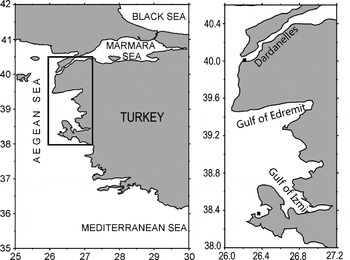
Polymorphina fistulosa (Cushman) is recently observed in the foraminiferal assemblage collected around a hot water submarine spring in Ilıca Bay (Çeşme, Turkey). It is also found in one sediment sample collected from the western entrance of the Dardanelles (Çanakkale, Turkey). These records constitute the first record of this Pacific originated species in the Aegean Sea (Figure 1).
Sampling locations on the Aegean coast of Turkey.

MATERIALS AND METHODS
Sediment samples were manually collected by skin diving between 1 and 4 m depths around a submarine spring found in Ilıca Bay (0444185E 4240949N, Çeşme, Turkey). A recent sediment sample was collected by using a Van Veen grab sampler at depth of 62 m (40°01.31E 26°13.0N) in the western enterance of the Dardanelles (Çanakkale, Turkey). The samples were air-dried. Five grams were weighed from each sample and treated with 10% H2O2 for 24 hours. The samples were washed over a 0.063 mm sieve with pressurized water and oven-dried at 50oC. The samples were then sieved over different mesh sizes of 2.00, 1.00, 0.500, 0.250, 0.125 mm. The foraminiferal content was identified with a binocular stereoscope.
RESULTS
SYSTEMATICS
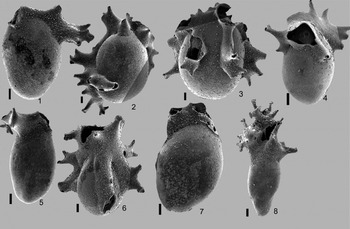
Polymorphina fistulosa specimens found in this study. 1–7 from the Dardanelles and 8 from Çesme. Scale bar: 100 µm.

DESCRIPTION
Test is elongated and fusiform, with circular cross-section. The wall is calcareous and perforated. Oral portion of the test is covered with tubular outgrowths of the shell material, aperture is terminal and radiate, test surface is smooth (from Yassini & Jones, Reference Yassini and Jones1995).
REMARKS
Polymorphina fistulosa (Cushman) was first observed in the North Pacific and identified as Polymorphina ovata d'Orbigny form fistulose (Cushman, Reference Cushman1914; p. 87, pl. 40, figure 4a–c). It has also been found on the north-west coast of Australia (Yassini & Jones, Reference Yassini and Jones1995; figures 690–691). Loeblich & Tappan (Reference Loeblich and Tappan1994) have given the record of this species from the Timor Sea as Polymorphina sp. (p. 83; pl. 147, figures 1–4). Cimerman & Langer (Reference Cimerman and Langer1991) have reported Polymorphina sp. from Vulcano Island, north-east Sicily, Italy (pl. 56, figure 2). Globulina gibba d'Orbigny given by Hottinger et al. (Reference Hottinger, Halicz and Reiss1993) from the Gulf of Aqaba (Red Sea) showed the same morphological features with Polymorphina fistulosa (Cushman) (Cushman, Reference Cushman1914; p. 79, pl. 91, figures 6–12), indicating that Polymorphina fistulosa (Cushman) is widely distributed in the Indo-West Pacific.
CONCLUSIONS
Only a single Polymorphina fistulosa (Cushman) individual was found in the 38 sediment samples collected from Ilıca Bay. On the other hand, seven individuals were found in one grab sample from the Dardanelles, indicating that it is well colonized in the Dardanelles.
Polymorphina fistulosa (Cushman) is not abundant on eastern Aegean coasts, but its presence in two distant locations (Figure 1) suggests that it is widely distributed along the Turkish Aegean coastline. The temperature of the surface waters in the Aegean Sea is cool for Indo-Pacific originated thermophilic alien species. However, there are numerous hot water submarine springs along the Turkish coast which sustain a stable warm environment all through the year. The water temperature of the submarine spring in Ilıca Bay was measured as 28.4°C (recorded on 6 November 2011). There are several fault lines around the Dardanelles (Şaroğlu et al., Reference Şaroğlu, Emre and Kuşçu1992). Thus, there may also be submarine outlets in the Dardanelles which are locally active at a small scale, enabling the colonization of Polymorphina fistulosa (Cushman).
ACKNOWLEDGEMENTS
We thank Dr Tansel Tekin and Physist Tuğrul Tüzüner (T.P.A.O. Research Center, Ankara) for their support in scanning electron microscope microphotography (Jeol. JSM-6490 LV).