As psychedelic-assisted therapy (PAT) moves closer to clinical implementation internationally, attention has increasingly shifted from questions of efficacy towards questions of governance, regulation, and service delivery (Dutton et al. Reference Dutton, Schwenn, Mitchell, Hoffmann, Bailey, Fitzgerald, Lagopoulos and Can2026; Nutt et al. Reference Nutt, Spriggs and Erritzoe2023). Unlike conventional psychopharmacological treatments, therapeutic outcomes in PAT are understood to be influenced not only by the pharmacological effects of the substance itself, but also by contextual factors such as psychological state, interpersonal support, and physical environment, often described as “set and setting” (Hartogsohn Reference Hartogsohn2016). With this in mind, emerging Irish scholarship has highlighted the need to carefully consider appropriate service design, workforce development, and governance structures in anticipation of potential future implementation (Kelly et al. Reference Kelly, Sheridan, Iusan, Coakley, Burke, Brennan, MacDonald, Ivers, Trepel, Tormey and Finnegan2026). As regulatory and policy discussions evolve internationally, understanding how informed Irish stakeholder groups conceptualise the delivery of PAT may help inform early-stage planning regarding implementation within the Irish context.
A national Irish multidisciplinary psychedelic research conference, Imbas 2025, took place in Trinity College Dublin on October 31st and November 1st 2025. The conference programme included presentations from internationally recognised clinicians and researchers addressing therapeutic applications, ethics, implementation challenges, and policy developments relating to PAT. An anonymous online survey was distributed electronically to all registered attendees (n = 371) to explore how informed stakeholders believe PAT could be implemented within the Irish public health system. Survey items explored attitudes towards PAT, preferred service settings, professional roles, governance, ethical readiness, and perceived implementation challenges. Quantitative data were analysed descriptively using frequencies and percentages, while free-text responses were reviewed to identify recurring themes relevant to implementation and service design. Ethical approval was granted by the Tallaght University Hospital/St James’s Hospital Joint Research Ethics Committee.
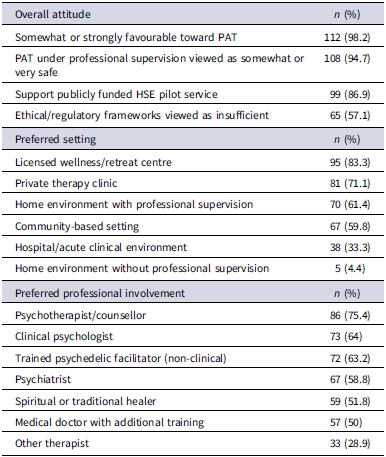
A total of 114 responses were received (response rate 30.7%). Respondents represented a range of professional backgrounds, including psychotherapists (n = 30, 26.3%), psychiatrists (n = 15, 13.2%), researchers (n = 12, 10.5%), allied health professionals (n = 8, 7%), other therapists (n = 9, 7.9%), trainee psychotherapists (n = 5, 4.5%), clinical psychologists (n = 3, 2.7%), pharmaceutical industry (n = 2, 1.8%), and members of the public with an interest in psychedelic research (n = 19, 16.7%). Reported previous personal experience with psychedelic substances was high (80.7%). Overall attitudes towards PAT were highly favourable, with 98.2% reporting somewhat or strongly favourable views and 94.7% considering professionally supervised PAT to be somewhat or very safe. Most respondents also supported the establishment of a publicly funded Health Service Executive (HSE) pilot service (86.9%). However, respondents clearly distinguished between governance and treatment setting. Licensed wellness or retreat centres, considered for the purposes of this survey as purpose-built, non-hospital therapeutic environments operating under recognised regulatory governance, were preferred over acute hospital environments (83.3% vs 33.3%), as were private therapy clinics (71.1%), and community-based settings (59.8%). While home-based delivery with professional supervision was supported by 61.4% of respondents, only 4.4% opted for home environment without supervision (Table 1).
Attitudes toward psychedelic-assisted therapy and implementation preferences*

Long description
The table presents data on attitudes and preferences towards psychedelic-assisted therapy (PAT) among respondents. It is divided into three main sections: Overall attitude, Preferred setting, and Preferred professional involvement. Each section lists specific categories with corresponding percentages and counts. The Overall attitude section includes categories such as somewhat or strongly favourable toward PAT, PAT under professional supervision viewed as somewhat or very safe, support for publicly funded HSE pilot service, and ethical/regulatory frameworks viewed as insufficient. The Preferred setting section lists settings like licensed wellness/retreat centre, private therapy clinic, home environment with professional supervision, community-based setting, hospital/acute clinical environment, and home environment without professional supervision. The Preferred professional involvement section includes categories like psychotherapist/counsellor, clinical psychologist, trained psychedelic facilitator (non-clinical), psychiatrist, spiritual or traditional healer, medical doctor with additional training, and other therapist. Each category is accompanied by a percentage and count of respondents. Notable trends include a high percentage of respondents favouring PAT and preferring licensed wellness/retreat centres and psychotherapists/counsellors.
* Respondents could select multiple options; percentages therefore do not sum to 100.
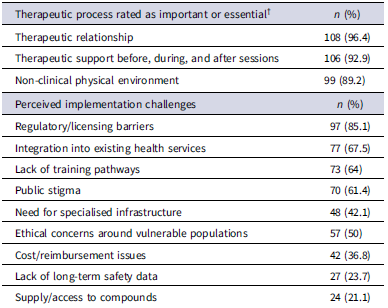
Respondents consistently emphasised that successful implementation would depend on therapeutic context as much as governance. The therapeutic relationship (96.4%), structured preparation and post-session integration (92.9%), and a non-clinical physical environment (89.2%) were rated as important or essential by almost all respondents. Multidisciplinary delivery was strongly endorsed, with psychotherapists or counsellors (75.4%), trained psychedelic facilitators (63.2%), and psychiatrists (58.8%) all viewed as appropriate contributors to service delivery. Perceived barriers to implementation included regulatory and licensing requirements (85.1%), integration within existing mental health services (67.5%), lack of training pathways (64%), and public stigma (61.4%) (Table 2). Free-text responses reinforced these findings, frequently highlighting the importance of therapeutic environment, clinical governance, therapist training, and long-term follow-up. Representative comments included: “A space for controlled facilitation,” “That there are preparation and integration sessions as part of the service,” and “Clinical governance would be essential.”
Therapeutic priorities and implementation challenges*

Table 2. Long description
A table with two main sections: Therapeutic process rated as important or essential and Perceived implementation challenges. The table has two columns: n (%) and the specific therapeutic process or challenge. The first section lists therapeutic processes with their respective importance ratings. The second section lists perceived implementation challenges with their respective frequencies. Row 1: Therapeutic relationship, 108 (96.4 percent). Row 2: Therapeutic support before, during, and after sessions, 106 (92.9 percent). Row 3: Non-clinical physical environment, 99 (89.2 percent). Row 4: Regulatory/licensing barriers, 97 (85.1 percent). Row 5: Integration into existing health services, 77 (67.5 percent). Row 6: Lack of training pathways, 73 (64 percent). Row 7: Public stigma, 70 (61.4 percent). Row 8: Need for specialised infrastructure, 48 (42.1 percent). Row 9: Ethical concerns around vulnerable populations, 57 (50 percent). Row 10: Cost/reimbursement issues, 42 (36.8 percent). Row 11: Lack of long-term safety data, 27 (23.7 percent). Row 12: Supply/access to compounds, 24 (21.1 percent).
* Respondents could select multiple options; percentages therefore do not sum to 100.
† Likert scale responses were collapsed, with ratings of 4 and 5 combined.
These findings suggest that respondents distinguished between public governance and therapeutic setting when considering future implementation of PAT in Ireland. Although respondents expressed limited preference for hospital or acute clinical environments, community-based models incorporating appropriate medical oversight may represent a more acceptable implementation pathway. Respondents placed strong emphasis on therapeutic processes, including preparation, integration, the therapeutic relationship, and the physical environment in which therapy is delivered. These findings align with literature highlighting the importance of “set and setting” in shaping both safety and therapeutic outcomes. Together, they suggest that PAT is conceptualised not primarily as a pharmacological intervention, but as a complex therapeutic process in which psychological support and therapeutic context are central components of care. Emerging work examining the integration of PAT within public health systems, including proposed NHS-based models (Smith et al. Reference Smith, Harcourt and Cipriani2026), similarly highlights the importance of multidisciplinary delivery within appropriately designed therapeutic environments. Pilot programmes may provide an opportunity to evaluate feasibility, safety, acceptability, and resource requirements while allowing governance and regulatory frameworks to evolve in parallel.
This study has several limitations. Participants were recruited exclusively from a national psychedelic research conference and therefore represented a highly self-selecting group with substantial pre-existing interest in psychedelic research, reflected by the high proportion reporting previous psychedelic experience. The professional composition of the sample may also have influenced responses. Psychologists, psychotherapists, and counsellors comprised the largest professional group, and some respondents may have had prior experience of psychedelic therapy in retreat or private clinical settings, or may themselves work in these settings. These factors may have influenced preferences regarding therapeutic environment and service delivery. In addition, the survey was descriptive, response rates were modest, and no inferential analyses were undertaken. Nevertheless, these findings provide an early snapshot of how an informed group of Irish stakeholders conceptualise the implementation of PAT at a formative stage of national policy development. As Ireland considers future regulatory pathways, these findings may help inform the design of pilot services that integrate robust governance with therapeutic environments suited to the distinctive characteristics of PAT.
Data availability statement
The data that support the findings of this study are available from the corresponding author upon reasonable request.
Funding statement
This research received no specific grant from any funding agency, commercial, or not-for-profit sectors.
Competing interests
The authors were members of the organising committee for the Imbas 2025 conference at which the survey was distributed.
JRK is principal investigator (Dublin, Ireland) on COMPASS and CYBIN sponsored clinical trials. JRK and AH have received grant funding from the Health Research Board (ILP-POR-2022-030, DIFA-2023-005, HRB KTA-2024-002).
Ethical standards
The authors assert that all procedures contributing to this work comply with the ethical standards of the relevant national and institutional committee on human experimentation and with the Helsinki Declaration of 1975, as revised in 2024.
Ethical approval for this study was granted by the Tallaght University Hospital/St James’s Hospital Joint Research Ethics Committee. Participants completed an anonymous voluntary online survey and provided informed consent electronically prior to participation.