This article traces the parameters of variation and change in what we call correlative constructions in the history of English. The term correlative is usually reserved for constructions in which the relation between two clauses is explicitly marked by some pronominal or adverbial form (Bhatt & Pancheva, Reference Bhatt, Pancheva, Everaert and Riemsdijk2006; Lipták, Reference Lipták and Lipták2009). We focus on a well-known and robustly attested type of correlative in Old English (OE)Footnote 1 (and older Germanic languages; Auer and Lindström [Reference Auer, Lindström, Auer and Pfänder2011]; Van den Nest [Reference Van den Nest, Van Linden, Verstraete and Davidse2010]) involving an initial adverbial or conditional subclause. Its correlative character is rendered by a resumptive adverb as the initial element of the subsequent main clause. Some OE examples are given in (1):
-
(1)
-
a. Þa1 he ϸa3 in ϸӕt ealond cwom, ϸa2 getimbrede he ϸӕr mynster
then he then in that island came, then built he there monastery
‘On coming to that island, he erected a monastery there.’
Bede_4:4.272.28.2779
-
b. ac ϸonne1 heo mӕg hi fram hyre lare geӕmtigan, ϸonne2 sӕnde ic eow word.
but then she may she from her learning be at leisure, then send I you word.
‘But when she can find leisure from her learning, then I will send you word.’
ApT:21.21.457
-
c. Gif1 he ðonne3 sie idӕges dead, ðonne2 sitte sio scyld on him.
if he then is on the same day dead, then sit the guilt on him.
‘If he should be dead that same day, the guilt rests on him.’
LawAfEl:17.44
-
The adverbial or conditional subclause has þa as a conjunction in (1a), þonne in (1b), and gif in (1c) (numbered with subscript 1). It presents backgrounded information, bringing to the fore the (temporal or conditional) setting, commenting on the action and providing the necessary backdrop (Enkvist, Reference Enkvist, Kastovsky and Szwedek1986; van Kemenade & Los, Reference Kemenade, Los, Kemenade and Los2006). The subsequent main clause is introduced by a corresponding resumptive adverb (numbered with subscript 2) and followed by the finite verb in second position (Verb Second, V2). The resumptive adverb is what crucially renders the correlative character of the construction. Its specific semantic contribution is to resume the previous clause as backgrounded and to structure the discourse by foregrounding the action/event or consequence in the main clause; resumptive adverbs remind the reader/listener to pay attention (Baker, Reference Baker and Baker2007:99; Enkvist, Reference Enkvist, Kastovsky and Szwedek1986; van der Horst, Reference Horst1981:39–41, Reference Horst2008:538–539; van Kemenade & Los, Reference Kemenade, Los, Kemenade and Los2006; Wårvik, Reference Wårvik2013).
The examples in (1) also illustrate the dual use of þa and þonne as conjunction and (resumptive) adverb. The correlative impact may be given further rhetorical relief by a third use of þa/þonne: that of a modal particle.Footnote 2 The modal particle use is illustrated by (1a) and (1c) and is marked with a subscript 3. The effect of stacking conjunction and particle and/or resumptive adverb is one of emphasis: correlatives, especially those with a modal particle, emphasize the temporal narrative sequentiality in examples such as (1a); in conditionals such as (1c), adding a particle emphasizes the condition that has to be met.
The key property of correlatives is the adverbial resumption in the main clause (the prime reason for the term correlative), but the resumptive adverb is not obligatory: correlatives are a subset of what we call potentials, which include constructions with several alternative ways of expressing a similar relation between an initial adverbial or conditional subclause followed by a main clause. It is important to note that adverbial resumption, correlating with characteristics such as the use of a modal particle, only occurs when the subclause introduces the construction, not when it follows the main clause. The properties of correlatives are thus part of a larger set of characteristics of the clausal prefield. A puzzling peculiarity of this type of correlative is that it flourished in OE and largely and relatively abruptly disappeared in the transition from Old to Middle English.
The first aim of this article is to identify the properties of correlatives as a subset of the potentials in OE (building on Mitchell [Reference Mitchell and Mitchell1985]), against the backdrop of an analysis of the clausal prefield of OE that addresses functional properties such as the discourse function of correlatives, the role of V2 in main clauses, and the role of resumptive adverbs. The second aim is to provide a coherent account for how correlatives were lost. The main research questions thus are the following: What are the properties of correlatives in OE and which factors promote the use of a resumptive adverb, that is the use of a correlative over a noncorrelative potential? How do noncorrelative potentials and correlatives develop in relation to each other and over time? and How can we relate the properties of correlatives in early English and their subsequent loss to what we know about the historical development of the clausal prefield in English?
The article is organized as follows. The next section presents the correlative constructions investigated here, focusing primarily on their status in OE and summarizing the results for subsequent periods. The section following outlines the methodology of the data analysis. We then turn to the properties of correlatives used as predictors in the logistic regression analysis modeling resumptive adverb use in the complete set of potentials, presenting the results and analysis before concluding.
THE STRUCTURE AND PROPERTIES OF OE CORRELATIVE CLAUSES
We first consider the structure of correlative constructions, starting from example (1a), which is repeated here for convenience:
-
(1)
-
a. Þa1 he ϸa in ϸӕt ealond cwom, ϸa2 getimbrede he ϸӕr mynster
then he then in that island came, then built he there monastery
‘On coming to that island, he erected a monastery there.’
Bede_4:4.272.28.2779
-
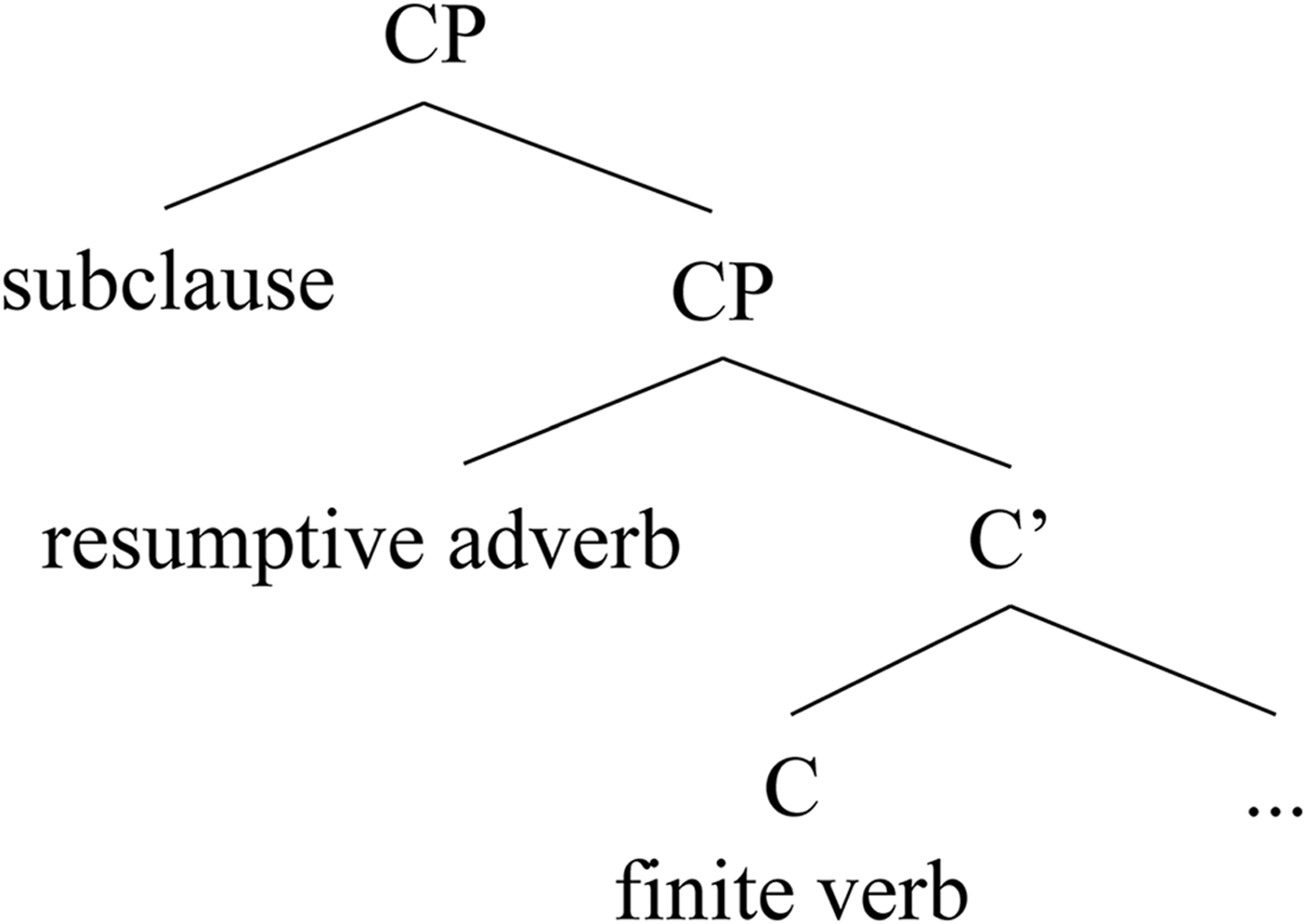
The first thing to note is that the main clause þa getimbrede he þær mynster is itself a complete clause featuring V2 placement of the finite verb, and a resumptive adverb that indicates that the subclause is external to the main clause, as in Figure 1. Our analysis of V2 is the generally accepted one for the parallel phenomenon in present-day West-Germanic languages (e.g., Den Besten [Reference Den Besten and Abraham1983] and, specifically for OE, Fischer, van Kemenade, Koopman and van der Wurff [Reference Fischer, van Kemenade, Koopman and van der Wurff2000] and van Kemenade [Reference Kemenade1987]), and indeed for questions in present-day English. Regardless of basic subject-verb-object (SVO) or SOV word order, some constituent (in this case the resumptive adverb) can appear in Spec(ifier), CP, and the finite verb in C(onjunction) (CP here stands for Conjunction Phrase).Footnote 3
Structure of Old English correlative and noncorrelative potentials.

Figure 1 represents an essentially paratactic structure, along the lines of Kiparsky (Reference Kiparsky, Battye and Roberts1995), in the sense that the subclause is adjoined to the main clause. It is on a par with left dislocation constructions such as (2), in which the left dislocate is adjoined to CP (parallel to the subclause in potentials), and the resumptive pronoun is in Spec, CP:
-
(2) Đone đe Drihten lufađ. þone he đreađ.
[Topic [CP object demonstrative [S S V … ]]]
Him who God loves, him he chastises
‘God chastises those he loves.’
ÆCHom II, 21:188.247
The examples in (1) illustrate the most frequent representatives of correlatives under study here, but they by no means exhaust them—a further instance is exemplified in (3): a correlative with swa … swa.
-
(3) Sona swa1 he hit gedruncen hӕfde, swa2 aras he instepe
as soon (as) he it drunk had, (swa) arose he instantly
‘As soon as he had drunk it, he got up at once.'
Bede_5:5.398.3.3973
We emphasize once more that the key property of correlatives is the adverbial resumption. There are several types of potentials that are noncorrelative (without a resumptive adverb): they form the (low frequency) alternatives to correlatives, but they fit the same structure in Figure 1. The first type is exemplified by (4), in which the initial subclause is immediately followed by the finite verb. Spec, CP seems to be empty. We dub this type verb-initial:
-
(4) Þa he onweg adrifen wæs, cwom he to Cent,
then he away driven was, came he to Kent,
‘When he was driven away, he came to Kent,’
Bede_2:5.112.25.1063
The occurrence of (4) raises the question whether the subclause could be in Spec, CP rather than adjoined, but this would imply that it is the subclause that triggers V2 placement in C. This is an unwarranted assumption for OE; V2 placement in C is triggered by specific types of first constituent, namely initial question constituents and preverbal negatives, labeled V2 other here, as exemplified by the noncorrelative potentials in (5a) and (5b) and the demonstrative (resumptive) adverbs as in (1) (cf. Fischer et al., Reference Fischer, van Kemenade, Koopman and van der Wurff2000).
-
(5)
-
a. Gif ðonne se sacerd bið ungerad ðӕs lareowdomes, hwӕt forstent ðonne his gehlyd?
if then the teacher is unskilled in instruction what avails then his cry?
‘But if the priest is unskilled in instruction, what avails his cry?'
CP:15.91.25
-
b. gif we hit forsuwiað ne bið us geboregen.
if we it keep silent not is us secure
‘If we kept it in silence, we would not be secure.’
+ACHom_I,_3:205.186.620
-
Given that the subclause is not a V2 trigger, we assume that the subclause in (4) is adjoined, and that there is a null resumptive adverb in Spec, CP, triggering V2 placement (see also Zwart [Reference Zwart2011] for a similar account for Dutch).
The second type of noncorrelative potentials consists of a variety of initial constituents in the main clause, exemplified by (6) with an initial preposition phrase and in (7) by an initial subject. These are labeled here XP-initial non-V2 and subject-initial.
-
(6) Ðonne he oferstæled bið, & him gereaht bið ðæt he oðrum mæg nytt bion
then he convinced is and him explained is that he others may useful be
on ðam ðe him mon ðonne bebeodeð, mid his mode he hit sceal fleon
on that that him man then commands with his mind he it must flee
‘When he is convinced and it is shown to him that he may be useful to others in the post which is offered to him, he should flee it in his mind, [ … ]’
CP:6.47.16.265
-
(7) Gif ða earmscancan beoð begen forade, sio bot bið XXX scillinga.
if the arm-bones are both broken the compensation is 30 shillings.
‘If both bones in the arm are broken, the compensation to be paid shall be 30 shillings.’
LawAf_1:55.173
The two categories of the second type have in common that, while it is reasonable to assume that the initial constituent is in Spec, CP (see van Kemenade, Reference Kemenade, Hickey and Puppel1997), they do not involve V2 placement in C, but rather in a position lower in the clause (see, e.g., Fischer et al., Reference Fischer, van Kemenade, Koopman and van der Wurff2000; Haeberli, Reference Haeberli and Lightfoot2002).Footnote 4
Finally, there are correlatives in which the resumptive adverb does not trigger V2 placement in C, especially in later stages, as in ‘If we heare the voice of the Lord our God any more, then we shall die’ (authold-e2-p2). These are very rare in OE; they are labeled resumptive adverb non-V2 here. They have the resumptive adverb in Spec, CP, without V2 placement in C.
The structure in Figure 1 thus applies to all cases of potentials, including correlatives. The use of correlative constructions (and left dislocates) finds its niche in OE in the availability of a CP-adjoined position, in addition to the V2 structure, as in Figure 1.
The transition to Middle English and later periods
The early Middle English (ME) period shows a rather dramatic decline of correlative use, even though noncorrelative potentials continue to thrive. If-conditionals persist, and when-clauses take over from temporal potentials with þa and þonne, but the use of resumptive adverbs is vanishingly rare from the earliest ME onward. The primary reason for this appears to be the loss of þa and þonne as resumptive adverbs (and as modal particles, cf. van Kemenade, Reference Kemenade, Hinterhölzl and Petrova2009; van Kemenade & Los, Reference Kemenade, Los, Kemenade and Los2006), as part of the general decline of the OE demonstrative pronouns and adverbs (Los & van Kemenade, Reference Los, van Kemenade, Schlachter and Veenstrain press), which heralded a shift in the system of clause-linking markers. The function of these older clause linkers was taken over by wh-adverbs and wh-pronouns (Fischer, Reference Fischer and Blake1992:352–353). Thus, when-clauses came to express temporal potentials. In the rare cases with a resumptive adverb, this came to be then, which derives historically from þonne (OED). In terms of our structure for potentials in Figure 1, the loss of resumptive adverbs removed the trigger for V2 placement in C, which had so far been the resumptive adverb, a clausal operator. The inevitable result of this was that the main clause was recast as a subject-initial clause from early ME onward, with low-frequency alternative options. On the face of it, this suggests that the loss of correlatives goes hand in hand with the loss of V2, but this is not the case: V2, especially in clauses with initial adverbs such as (nonresumptive) then, continues to thrive up to the end of the ME period (van Kemenade, Reference Kemenade, Nevalainen and Traugott2012; van Kemenade & Westergaard, Reference Kemenade, Westergaard, Meurman-Solin, López-Couso and Los2012). The loss of resumptive adverbs, essentially a case of lexical/functional loss in the transition from OE to ME, is therefore a crucial step in the loss of correlatives, and forced these constructions to become early adopters of the SV structure that became the default after the actual loss of V2, which was several centuries later (cf. Fischer et al., Reference Fischer, van Kemenade, Koopman and van der Wurff2000).
The functions of potentials and correlatives in Old and Middle English
In OE, þa and þonne correlatives such as (1a) and (1b) are used to express a temporal relation. They often indicate a change in narrative (Traugott, Reference Traugott and Hogg1992), locating the backgrounded subclause event in time or discourse, and relating the follow-up, foregrounded event that carries the narrative forward in the second clause (Enkvist, Reference Enkvist, Kastovsky and Szwedek1986, Reference Enkvist1972, as cited in Mitchell, Reference Mitchell and Mitchell1985; van Kemenade & Los, Reference Kemenade, Los, Kemenade and Los2006; Wårvik, Reference Wårvik2013).
Þa potentials and especially þa correlatives such as (1a) describe completed actions in the past (Mitchell, Reference Mitchell and Mitchell1985). Both are predominantly used in narrative texts. Þa has therefore been analyzed by Brinton (Reference Brinton and Brinton1996:9–12, Reference Brinton, Kemenade and Los2006:314–315) and Enkvist (Reference Enkvist, Kastovsky and Szwedek1986) as a pragmatic marker, more specifically an action/episodic marker foregrounding the main clause event in correlatives. It divides the discourse into narrative units and indicates the temporal sequencing of events regarding the main storyline (Enkvist, Reference Enkvist, Kastovsky and Szwedek1986; Wårvik, Reference Wårvik2013). The latter function is further supported by the order subclause-main clause that most accurately depicts the iconical sequence of events. Þa loses its foregrounding function in ME, and its successor becomes a simple sequencer (Brinton, Reference Brinton, Kemenade and Los2006:314). Wårvik (Reference Wårvik2013) argued that the foregrounding role of þa in OE narratives is evidenced in its tendency to occur with participants that are information structurally given in the narrative, represented by pronouns, definite noun phrases and proper nouns. Þa as a foregrounding device thus keeps track of major participants and continues the narrative.
Þonne potentials and correlatives often refer to frequentative acts in the past, present, or future, or to a single act yet to be completed at some indefinite time (Mitchell, Reference Mitchell and Mitchell1985). They often indicate temporal narrative sequence (Traugott, Reference Traugott and Hogg1992:260), similar to ϸa correlatives, but can also have a more causal, concessive, or conditional sense (meaning “whenever” and retaining some temporal significance), especially with subjunctive verbs (Mitchell, Reference Mitchell and Mitchell1985), as in example (8). The possibility of a conditional reading for þonne constructions makes sense from the perspective of Lipták (Reference Lipták and Lipták2009:26–29), who showed that conditionals and correlatives often share the same markers of subordination. Þonne potentials occur in a wider range of text genres than ϸa correlatives and potentials do; these genres include narrative, biblical, and moral texts.
-
(8) ðonne þis tacen þislic þe tocyme, þonne gemyne þu þas tide uncres gespreces
whenever this token such you come then remember you that time our conversation
‘When this token comes to you in this wise, then remember the time of our conversation,'
Bede_2:9.130.12.1242
The discourse functions of the OE temporal potentials and correlatives are taken over by when in ME, following the loss of þa. When potentials are mostly temporal, like example (9), denoting repeated actions and habits (Fischer, Reference Fischer and Blake1992:352–353), but conditional when potentials (and correlatives) can be found as well, such as (10). Like ϸonne in OE, when potentials occur in a wider variety of text types, including narrative, moral, and biblical texts.
-
(9) When he hauid funden it, sa fain he was;
when he had found it, so happy he was;
‘When he found it, he was very happy’
Cmbenrul 22.763
-
(10) hwen hit alles kimeð forð ϸenne is hit geoleu atter.
when/if it all comes out then is it yellow poison.
‘When it all comes out, it is yellow poison.’
Ancrene Riwle II.70.790
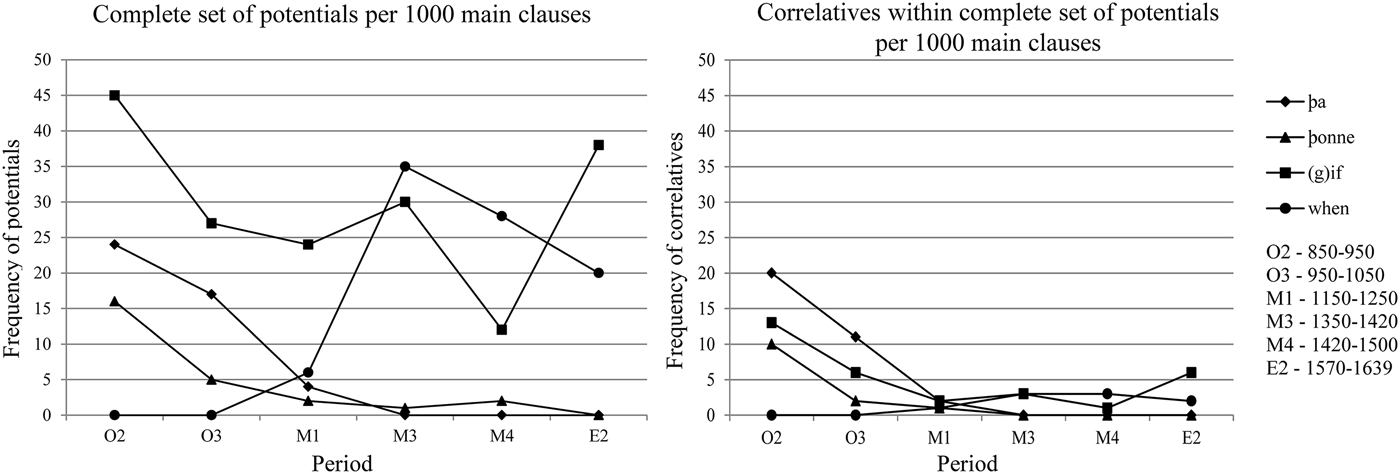
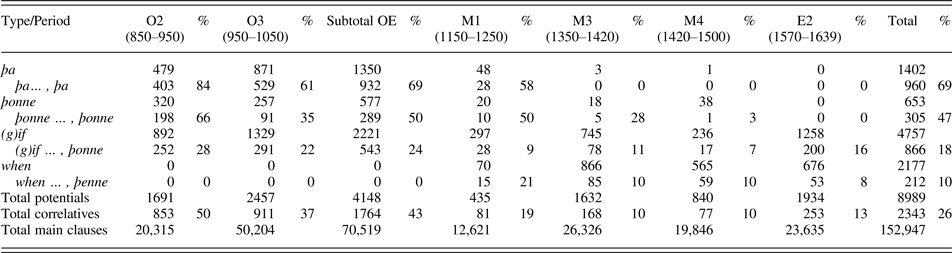
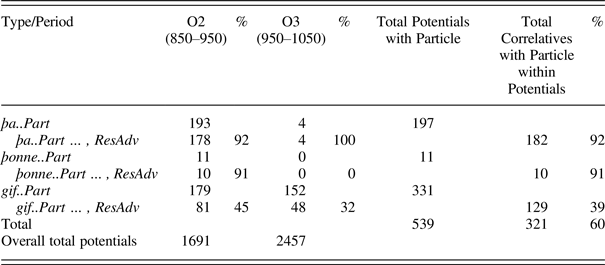
Gif correlatives are conditionals with a biclausal structure similar to that of the other potentials: the protasis (or conditional subclause) in conditionals is adjoined to the apodosis (or main clause) when it is introduced by a resumptive adverb, as in (11). This biclausal structure in which the subclause can be (CP-)adjoined persists into present-day English (Haegeman, Reference Haegeman2003, Reference Haegeman2012; Quirk, Greenbaum, Leech & Svartvik, Reference Quirk, Greenbaum, Leech, Svartvik, Quirk, Greenbaum, Leech and Svartvik1985). Resumptive adverb use persists longer in gif correlatives compared to other constructions (see Table 1 and Figure 2), especially in those conditionals where the connection between condition and result is inferential (Huddleston & Pullum, Reference Huddleston and Pullum2002:757–758). Gif potentials are mostly found in moral, science, biblical, and law texts.
-
(11) Gif Sodome hira synne hӕlen, ðonne ne syngodon hi na buton ege,
If the men of Sodom their sins conceal, then not sinned they not without fear,
‘If the men of Sodom had concealed their sins, they would not have sinned without fear’
CP:55.427.29.3008
Normalized frequencies of potentials and correlatives within potentials in earlier English.

Absolute frequencies of potentials and correlatives per type per period

The use of ϸonne—rather than þa—as both resumptive adverb and (optional) particle in gif conditionals may reflect a special status for þonne. Resumptive adverb/particle þonne is typically used in rhetorical (correlative) questions (as in (5a)), as well as in conditionals, which are both negative polarity contexts (Giannakidou, Reference Giannakidou1997; Postma, Reference Postma, Barbiers, Beukema and van der Wurff2002; van der Wouden, Reference Wouden1997). This may suggest that the word þonne comprises a negative element -ne (Postma, personal communication) and would account for the choice of þonne over þa as a resumptive adverb in conditional contexts.
DATA
To trace the development of correlative constructions introduced by the conjunctions ϸa, ϸonne, gif, and when, we extracted all potentials from six subperiods of three corpora, selecting prose texts that are unambiguous in their periodization.Footnote 5 York-Toronto-Helsinki Parsed Corpus of Old English Prose (YCOE; Taylor, Warner, Pintzuk, & Beths, Reference Taylor, Warner, Pintzuk and Beths2003)
-
O2 (850–950)—291,481 words
-
O3 (950–1050)—573,828 words
Penn-Helsinki Parsed Corpus of Middle English, second edition (PPCME2; Kroch & Taylor, Reference Kroch and Taylor2000)
-
M1 (1150–1250)—195,494 words
-
M3 (1350–1420)—385,994 words
-
M4 (1420–1500)—260,116 words
Penn-Helsinki Parsed Corpus of Early Modern English (PPCEME; Kroch, Santorini, & Delfs, Reference Kroch, Santorini and Delfs2004)
-
E2 (1570–1639)—628,463 words
We searched the texts for initial subclauses followed by a main clause that can optionally start with a resumptive adverb (i.e., potentials) using XQuery in CorpusStudio (Komen, Reference Komen2009, Reference Komen, Tyrkkö, Kilpiö, Nevalainen and Rissanen2012), a program that allows extraction of user-adaptable features from the corpora. Annotation differences between the corpora required different queries for each corpus. YCOE was searched for IP-* with an initial CP-ADV (adverbial CP) dominating a preposition (P) containing ϸa, ϸonne or gif, followed by an IP-SUB (subclause Inflection Phrase) on the same level as P. The PPCME2 and PPCEME corpora were searched for IP-* as well, but with an initial prepositional phrase (PP) dominating a P containing ϸa, ϸonne, gif, or when, followed by a CP-ADV on the same level. For all corpora, the initial ϸa, ϸonne, gif, or when clause had to be followed by a main clause attached to the same level as the CP-ADV (YCOE) or PP (PPCME2, PPCEME) containing the initial adverbial subclause. Spelling variants of the conjunctions were included in the search. The results were automatically labeled by means of scripts (user defined XQuery functions using the available metadata and tagging in the corpora) in CorpusStudio for the variables listed in Table 3. The results were converted into three Cesax databases (Komen, Reference Komen2011, Reference Komen, Tyrkkö, Kilpiö, Nevalainen and Rissanen2012), one for each language stage, which allow the data to be viewed, edited, and prepared for (statistical) processing. The databases were checked manually to see whether the automatic labeling had been carried out correctly. Nonpotential examples were deleted, and adjustments to the features were made as necessary. The three databases were converted to Excel format for further analysis by means of pivot tables to diagram the impact of several independent variables on the dependent variable, that is, the variable that distinguishes correlatives from noncorrelative potentials: the absence or presence of a resumptive adverb in the main clause.
The larger Excel database also formed the input for statistical testing across all periods using IBM SPSS Statistics Data Editor version 22. A logistic regressionFootnote 6 was used to determine the impact of several independent variables predicted to affect the use of resumptive adverbs (dependent variable).
QUANTIFYING THE FORMAL AND FUNCTIONAL CHARACTERISTICS OF CORRELATIVES IN OLDER ENGLISH
OE is the period in which the (morphosyntactic) properties of correlatives with þa and þonne as resumptive adverbs initiating the V2 clause identify them as distinct from the set of potentials. The very frequency of correlatives in OE will allow us to draw robust and statistically quantifiable generalizations about the factors determining the use of a resumptive adverb.
Frequencies and general characteristics
Table 1 and Figure 2 give an initial overview of our data.Footnote 7 The potentials in Table 1 are listed according to the conjunction of the adverbial/conditional subclause. The subsequent row indicates the absolute frequency of correlatives (labeled as þa … , þa, etc.) and as a percentage of the complete set of the potentials. Note that although the resumptive adverb is given as þa, þonne, or þenne, these in fact comprise the whole range of spelling variants for the resumptive adverb with the meaning then. Likewise, þa, þonne, (g)if, and when include all spelling variants, for example, conjunction (g)if comprises both gif in OE as well as yf/if in later periods.Footnote 8
Figure 2 shows the use of both potentials and correlatives normalized to their occurrence per 1000 main clauses.Footnote 9 The frequency of both is highest in period O2 and declines over time. In the course of OE, but especially in the transition to ME, their use decreases, but þa and þonne correlatives decline at a faster rate than their potential counterparts and have disappeared by period M3. The timing of these observations is in line with earlier findings on the declining use of ϸa and ϸonne as conjunctions, resumptive adverbs, and modal particles (Fischer, Reference Fischer and Blake1992:252–253; van Kemenade & Los, Reference Kemenade, Los, Kemenade and Los2006; van Kemenade & Milicev, Reference Kemenade, Milicev, Jonas, Whitman and Garrett2011). The discourse functions of þa and þonne potentials and correlatives are taken over by when from (early) ME onward. For (g)if conditionals, the conjunction remained the same (if) after OE.
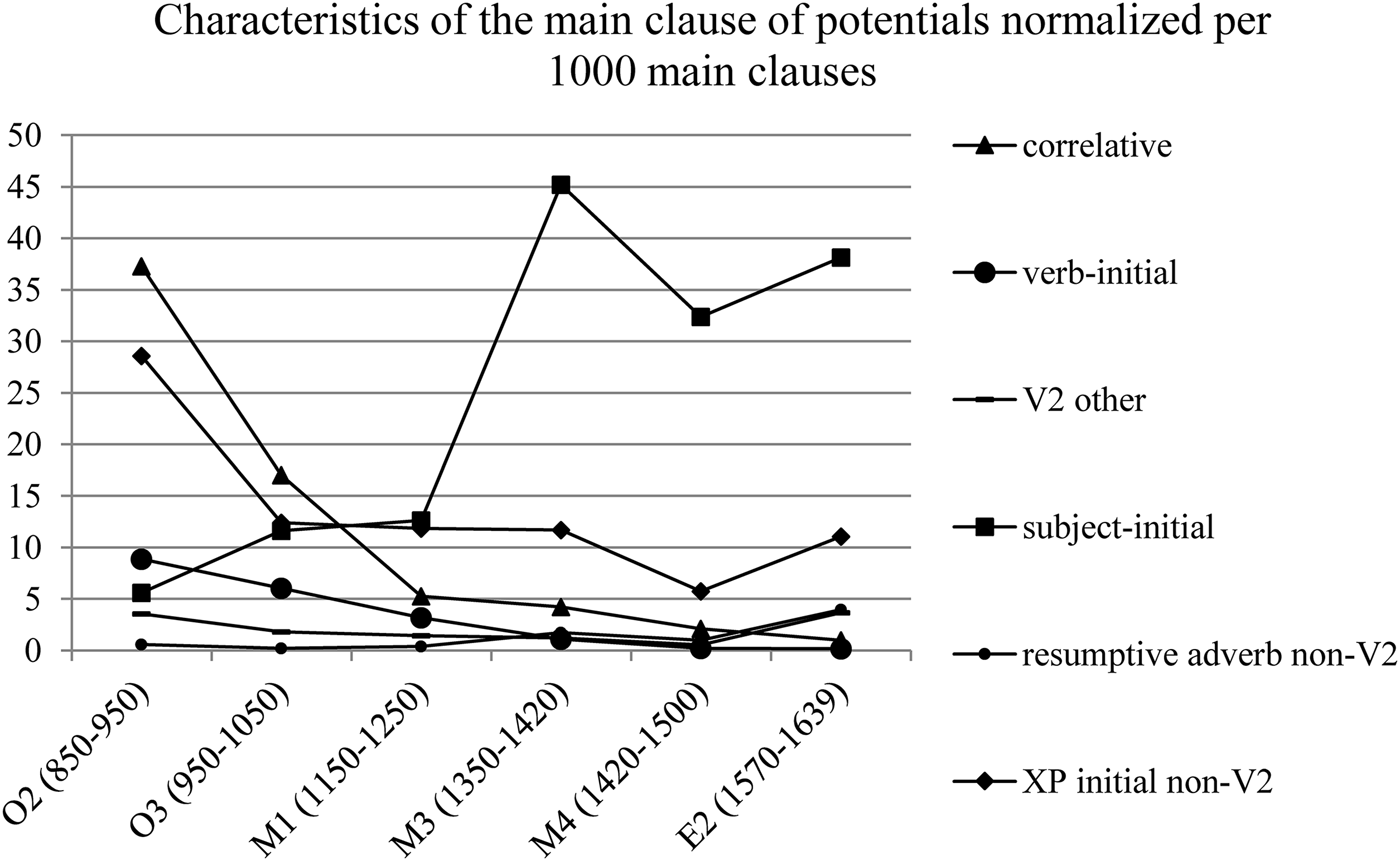
Normalized frequencies for the main clause characteristics of potentials in earlier English.

Resumptive adverbs can still be found after the OE period although at a much lower rate. According to Fischer (Reference Fischer and Blake1992:252–253), þa and þonne as resumptive adverbs were lost as a result of their multifunctionality and the tendency to develop dissimilar forms in correlatives to avoid ambiguity. Figure 3 shows that potentials with subject-initial main clauses such as (12) are used more and more frequently from the O2 period onward.
-
(12) When he came in and saw such a place, he was amazed,
armin-e2-h 43.270
When resumptive adverbs do occur in ME and early Modern English, they seem to follow relatively long subclauses, hardly have any interpretive contribution (Bhatt & Pancheva, Reference Bhatt, Pancheva, Everaert and Riemsdijk2006) and do not lead to subject-verb inversion as in OE, as in (13). These developments reinforce the question of which features influence resumptive adverb use in OE and the later periods.
-
(13) If we heare the voyce of the Lord our God any more, then we shall die.
authold-e2-h 5.20D.503
Motivating the properties of correlatives as factors influencing resumptive adverb use
The key property that distinguishes correlatives from noncorrelative potentials is the use of a resumptive adverb. Resumptive adverb use will therefore be the dependent variable against which we assess all other independent variables (the factors influencing resumptive adverb use) in the logistic regression. We motivate these independent variables in the following subsections.
Resumptive adverb use (dependent variable)
Resumptive adverbs in correlative constructions resume the initial subclause, thereby foregrounding the main clause event, in correlatives introduced by temporal þa and þonne; in conditionals, they foreground the main clause, which expresses the consequence that applies when the proposition in the if-clause is (not) satisfied. Resumptive adverbs thus also establish textual cohesion (Los, Reference Los2009) and associate discourse continuity with the syntactic structure of OE V2 main clauses introduced by ϸa/ϸonne (van Kemenade & Los, Reference Kemenade, Los, Kemenade and Los2006).
The highest incidence of resumptive adverbs in OE is found in þa constructions, probably because the strong foregrounding function of resumptive adverbs is primarily visible in narrative texts (Enkvist, Reference Enkvist, Kastovsky and Szwedek1986; Wårvik, Reference Wårvik2013), the genre favored by þa correlatives. Resumptive adverb þonne is used in both gif and þonne correlatives and in a broader set of genres. Then, the descendent of þonne (OED), became the default resumptive adverb in (g)if and when constructions in later language stages.
Mood
The choice of conjunction, correlating with the resumptive adverb, is robustly related to the mood of both clauses in the correlative pair: ϸa correlative constructions almost always have indicative mood in both clauses (Mitchell, Reference Mitchell and Mitchell1985).
Earlier research on þonne correlative and noncorrelative (mostly temporal) potentials reports that the prevailing mood in both clauses is indicative (Mitchell, Reference Mitchell and Mitchell1985), but the present study finds that this is only the case in þonne correlatives, whereas þonne potentials show much more variation in mood in both clauses. The use of subjunctive mood in the subclause of þonne potentials and correlatives expresses uncertainty, but the optional conditional reading for þonne does not by default result in the subjunctive (Mitchell, Reference Mitchell and Mitchell1985). An example of a þonne correlative with subjunctive mood is (8), repeated here as (14). (Unfortunately, no such observations can be made for the when correlative and noncorrelative potentials taking over the discourse functions of þa and þonne in ME and early Modern English, as the annotation for mood in the PPCME2 and PPCEME does not distinguish between indicative and subjunctive mood.Footnote 10 )
-
(14) ðonne þis tacen þislic þe tocyme, þonne gemyne þu þas tide uncres gespreces
whenever this token such you come then remember you that time our conversation
‘When this token comes to you in this wise, then remember the time of our conversation,'
Bede_2:9.130.12.1242
For gif conditionals, it has often been observed that these favor the subjunctive in the subclause (cf. Mitchell, Reference Mitchell and Mitchell1985), but our results show that gif potentials allow variation in mood in both clauses. Mitchell (Reference Mitchell and Mitchell1985) observed that the conjunction of the subclause expresses the modality sufficiently, rendering specification of mood unnecessary. The main clause of gif conditionals favors indicative mood.
To test the relation between mood and resumptive adverb use, both subclause and main clause mood have been added as independent variables in the logistic regression.
Subclause-internal particles
The particle use of þa and þonne has been identified by van Kemenade (Reference Kemenade, Minkova and Stockwell2002, Reference Kemenade, Hinterhölzl and Petrova2009), van Kemenade and Los (Reference Kemenade, Los, Kemenade and Los2006), and van Kemenade and Milicev (Reference Kemenade, Milicev, Jonas, Whitman and Garrett2011) as a word order diagnostic, partitioning the subclause into a domain for discourse-given subjects (and pronominal objects) and a domain for subjects that are new, generic, or focused. We assume that þa and þonne are also modal particles. Modal particles generally express the speaker's attitude toward the utterance, and their interpretation is highly context-dependent (cf. Bayer & Obenaurer, Reference Bayer and Obenaurer2011; Cardinaletti, Reference Cardinaletti2011; Coniglio, Reference Coniglio2011; Struckmeier, Reference Struckmeier2014; Zimmermann, Reference Zimmermann, Portner, Maienborn and von Heusinger2011). The use of particle þonne in gif conditionals with resumptive adverbs emphasizes the condition that must be met before the consequence expressed in the main clause can obtain, while the use of particle þa in þa correlative constructions emphasizes the temporal sequentiality of subclause and main clause, backgrounding the subclause as a prior event, and foregrounding the main clause as a follow-up event, as we discussed previously. There is thus a clear relation between the use of particles and resumptive adverbs.
Table 2 lists the potentials with a subclause-internal particle according to the conjunction of the adverbial/conditional subclause, for example þa..Part, where the first þa is the conjunction and Part represents particle þa. The subsequent row indicates the number of correlatives within that set of potentials with particles and gives its percentage, for example þa..Part … , ResAdv, where ResAdv represents þa. Table 2 shows that subclause-internal particles occur mostly in ϸa and gif potentials and correlatives and only sporadically in þonne potentials and correlatives. The vast majority of þa constructions with a particle in period O2 also have a resumptive adverb, such as (1a), but particle þa is hardly used in period O3. This may be due to the absence of those text types in period O3 that contain many þa potentials and correlatives with particles in period O2, namely historical (Bede and Orosius) and philosophical (Boethius) texts. Gif constructions with a particle are used frequently, but correlatives with both a particle and a resumptive adverb are less frequent than their þa counterparts: 45% in O2 and 32% in O3 of the examples with a particle also have a resumptive adverb.
Absolute frequencies of potentials and correlatives with subclause-internal particles per period

Negation
Typical negative polarity item contexts such as gif conditionals and correlative questions (Giannakidou, Reference Giannakidou1997; Postma, Reference Postma, Barbiers, Beukema and van der Wurff2002; van der Wouden, Reference Wouden1997) often use resumptive adverb þonne. This raises the question of whether the presence of a negative element has an effect on resumptive adverb use, in particular for þonne in þonne correlatives and gif conditionals. For this reason, we included the general effect of negation as a variable.
Subject type main clause and subclause
Wårvik (Reference Wårvik2013) found for þa clauses generally that the role of (resumptive) adverb þa as a main clause foregrounding device (cf. the section on functions of potentials and correlatives in Old and Middle English) in OE narrative texts is evidenced in its tendency to occur with participants that are contextually given. This includes pronouns and definite noun phrases, as well as proper nouns, which may introduce referents or reactivate them in the narrative. The relation between þa and discourse-given subjects might be epiphenomenal and could be a measure of foregroundedness more than anything else, or it could be genuinely related to the discourse status of the subject. On the latter assumption, we might postulate the reverse hypothesis, that noncorrelative potentials are favored by discourse-new subjects. We therefore include the discourse status of the main clause subject as an independent variable, extending Wårvik's observation to the resumptive adverb þonne.
By the hypothesis of a relationship between resumptive adverbs and discourse-given subjects, we might further expect subclauses to display similar tendencies. Van Kemenade (Reference Kemenade, Hinterhölzl and Petrova2009); van Kemenade and Los (Reference Kemenade, Los, Kemenade and Los2006); van Kemenade and Milicev (Reference Kemenade, Milicev, Jonas, Whitman and Garrett2011); and van Kemenade, Milicev, and Baayen (Reference Kemenade, Milicev, Baayen, Gotti, Dossena and Dury2008) show that the position of the subject in OE subclauses is related to its information status, which is visible when the subclause contains þa/þonne as a modal particle. Our results indicate that resumptive adverb use is higher when a particle is used in the subclause. We therefore include the discourse status of the subject of the subclause as well to test a potential effect.
The two variables regarding the discourse status of the subject position are each divided into four categories: Given, New, Other, and Proper. The category Other contains those examples without a subject or with subjects without a clear referent (for example, it or there). Proper nouns such as Dauid or Higa are a separate category as their discourse status can be new or given.
Weight of the subclause
Subclause length influences resumptive adverb use in the sense that longer subclauses are more often followed by a main clause with a resumptive adverb. We can make sense of this on the basis of the well-established psycholinguistic effect whereby the length of utterances (in this case subclauses) forms a processing burden on the brain (e.g., Arnold, Losongco, Wasow, & Ginstrom, Reference Arnold, Losongco, Wasow and Ginstrom2000). As the length of the subclause increases, a resumptive adverb can lighten the processing pressure and function as a placeholder. We therefore include Subclause weight as a variable influencing resumptive adverb use.
Subclause length, or its weight, can be measured both in the number of words and in terms of syntactic complexity, that is, the number of complex constituents. A complex constituent is defined here as a phrase with more than one child, for example a noun phrase that consists of both a determiner and a noun. Szmrecsányi (Reference Szmrecsányi, Purnelle, Fairon and Dister2004) noted that all numerical measures of calculating weight are highly correlated, showing that the most economic method—counting length in words—is as accurate as other methods. The data used here show a significant relationship between subclause length in words and syntactic complexity in correlative constructions, r = .976, p (one-tailed) ≤ .01. Subclause weight (i.e., subclause length in words) shares 95.26% of variation with No constituents in subclause. This indicates that the two measures can be used interchangeably. We discuss only the variable Subclause weight in the logistic regression results as it is the most economical measure.
Text type
There are clear genre differences between the various types of potentials and correlatives: ϸa correlatives, for instance, occur most frequently in historical (Bede and Orosius) and philosophical (Boethius) texts. The genres listed in the Helsinki corpora were therefore regrouped into seven categories (Law, Narrative, Moral, Science, Ego document, Bible, and Spoken) and added as a factor potentially influencing the use of a resumptive adverb.
Translation
A closer look at the OE correlatives shows that 69% are found in texts translated from Latin. Although we must keep in mind that translated texts make up 65% of all the OE data, two questions still arise: Are we dealing with a genuine OE construction here? To what extent does translation influence resumptive adverb use, that is, do we find an increased use of resumptive adverbs in translated texts? Wårvik (Reference Wårvik2013) pointed out that OE þa had no parallel in Latin, but Mitchell (Reference Mitchell and Mitchell1985) showed that correlatives in translated texts, especially those with þa, often have a Latin counterpart starting with cum, although this correspondence is not absolute. Inspection of the Latin source text for the Heptateuch, Ælfric's Treatise of the Old and New Testament, shows that although the Latin originals indeed often start with a subordinate cum(que) clause, as in (15), their main clauses have a different structure from those in OE and lack resumptive adverbs. Since the main clauses in OE correlatives employ the characteristics of OE in a way that cannot be found in Latin, we conclude that the construction and resumptive adverb use are genuine features of OE, especially since both translated and untranslated correlative constructions share the same structural characteristics as can be seen in the example (16) from the untranslated text Ælfric's Lives of Saints.
-
(15) Cumque obduxero nibibus cӕlum, apparebit arcus meus in nubibus:
ϸonne ic oferteo heofonana mid wolcnum, ðonne ӕteowað min boga on ðam wolcnum.
‘And when I obscure the sky with clouds, my arc will appear in the clouds.'
Gen:9.14.390
-
(16) Þa ϸa se sunu ϸӕt geseah, ϸa gesohte he ϸӕs preostes fet,
then when the son that saw, then sought he that Priest's feet
‘When the son saw that, he sought the priest's feet.'
ÆLS_[Sebastian]:303.1396
Variables determining resumptive adverb use
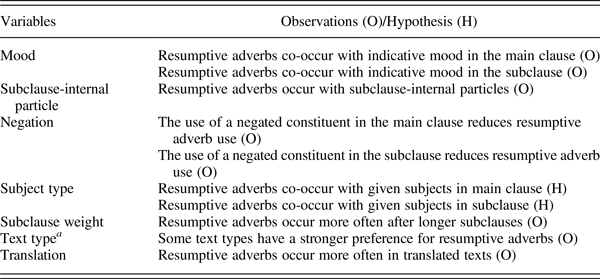
Table 3 sums up the variables discussed in the previous subsections. Remember that our dependent variable is the presence or absence of a resumptive adverb, as we take this to distinguish correlatives from the set of potentials and to show whether the adverbial/conditional subclause is paratactically adjoined to the main clause (see Figure 1).
Variables hypothesized to influence resumptive adverb use

Note: a The genres as listed in the Helsinki corpora (YCOE, PPCME2, and PPCEME) have been regrouped in the following manner to facilitate the logistic regression: Law—charters and wills, law(s), proceedings trial; Narrative—biography life saint, biography other, biography lives, fiction, history, romance; Moral—homilies, religious treatise, rule, sermon; Science—educational treatise, handbook astronomy, handbook medicine, handbook other, philosophy, science, science medicine, science other, science astronomy; Ego document—biography auto, diary private, letters nonprivate, letters private, travelogue; Bible; and Spoken—drama comedy.
RESULTS OF THE LOGISTIC REGRESSION AND ITS INTERPRETATION
A logistic regression analysis was executed on the combined data samples of all three corpora to predict the use of resumptive adverbs in three models, each representing a language stage.Footnote 11 We entered all independent variables into the model simultaneously (Enter method), as dummy coding was required for some variables (Field, Reference Field2009). Dummy coding (using one category within an independent variable as a reference against which all others are assessed in terms of their influence on the dependent variable) was used to determine the influence of those independent variables that contained more than two categories (Field, Reference Field2009), here, Subject type and Text type.
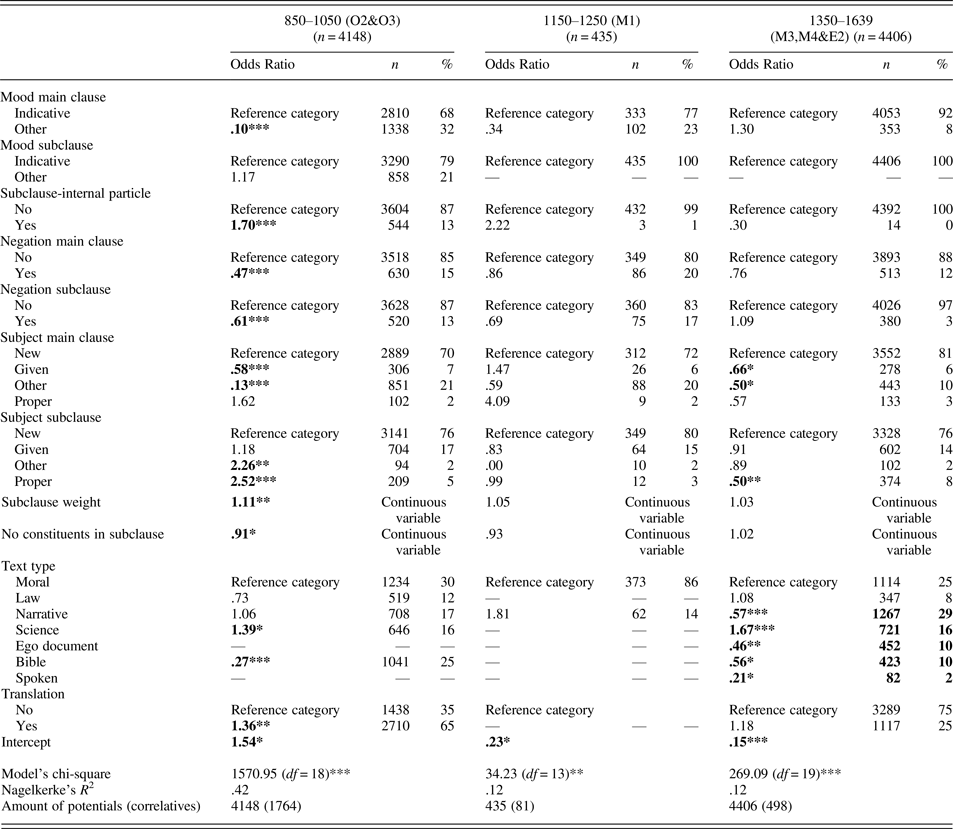
In Table 4, the first column presents the predictor variables used in the model. The following columns return the Odds ratios for each language stage. Odds ratios reflect the size of the effect an independent variable has on the dependent variable investigated (Burns & Burns, Reference Burns and Burns2008; Field, Reference Field2009; Hinrichs & Szmrecsányi, Reference Hinrichs and Szmrecsányi2007:459). When a parameter estimate is positive and has an odds ratio >1, the odds are predicted to increase by the odds ratio: the variable Subclause-internal particle, for example, has an odds ratio of 1.70 in period O2&O3, indicating that the probability of using a resumptive adverb is predicted to increase by 70% when a subclause-internal particle is used in the same construction. Likewise, when a parameter estimate is negative and has an odds ratio <1, the odds are predicted to decrease by the given odds ratio: the variable Negation subclause (O2&O3) is predicted to lower the odds of using a resumptive adverb by 1.64 or 64% (1/.61 = 1.64). Significant variables are in bold, with asterisks indicating the level of significance. Subsequent columns give the number of observations corresponding to the category out of the complete dataset for that language stage, followed by its percentage. Also reported are the model's chi-square and Nagelkerke's R 2, which assess model fit.
Logistic regression estimates: Individual resumptive adverb predictors, in three language stages

Note: Predicted odds are for the use of a resumptive adverb. Bold values are statistically significant. *p < .05, **p < .01, ***p < .001.
Table 4 shows that a comparison of the full model with predictors and an intercept-only model was statistically significant for all three models, indicating that the predictor variables as a group can be used to distinguish between the presence and absence of a resumptive adverb in the main clause. Table 5 provides the percentages of correctly predicted outcomes. The decreased percentage for period M1 and the minimally improved percentage for period M3,M4&E2 indicate that those variables that are highly significant in period O2&O3 are no longer operative in later periods.
Predicted outcomes

Note: Values are percentages.
As most of the predictors are only significant in period O2&O3 (850–1050), we will primarily discuss the OE results, including significant predictors from the later periods to track diachronic developments where applicable (most notably Subject main clause, Subject subclause, and Text type). The fact that the bulk of significant effects is attested in period O2&O3 is unsurprising since most predictors are related to OE syntax, which later underwent substantial changes, including the decline of resumptive adverbs, as shown in Figure 3. We will start with the construction-internal variables, followed by the construction-external variables Text type and Translation.
Mood: Mitchell (Reference Mitchell and Mitchell1985) observed that þa and þonne correlatives favor indicative mood in both clauses, contra the widely held belief that conditionals (both potentials and correlatives) have a preference for the subjunctive, at least in the subclause. The results of the logistic regression confirm that resumptive adverbs are more frequent in indicative main clauses, but no (significant) effects were found for Mood subclause. The use of a nonindicative mood in the main clause is predicted to lower the odds of resumptive adverb use by 10 (1/.10) in O2&O3. The relation between indicative mood and resumptive adverb use follows from the observation that both represent factual information. The absence of an effect for the later periods may be related to the fact that the part-of-speech (POS-) tagging for mood in the PPCME2 and PPCEME corpora is limited to imperative and indicative, the latter also including subjunctives.
Subclause-internal particles: The observed relation between subclause-internal particles and the use of resumptive adverbs in terms of absolute frequencies in Table 2 is confirmed by the logistic regression: resumptive adverb use is predicted to increase by 70% in O2&O3 when the subclause contains particle þa/þonne. We recall that the use of the particle emphasizes the temporal sequentiality of the two clauses in correlative constructions that also contain a resumptive adverb of the same type, especially in gif correlatives where particle þonne emphasizes the condition that has to be met. The fact that we find an effect only for the OE period can be attributed to the fact that the use of þa and þonne in all three functions (conjunction, particle, and resumptive adverb) declines in the transition to ME (van Kemenade & Los, Reference Kemenade, Los, Kemenade and Los2006).
Negation: The presence of a negative element does not promote the use of resumptive adverbs; it significantly lowers the probability of resumptive adverb use by 2.13 in main clauses and by 1.64 in subclauses in period O2&O3. It seems that the use of a negated element neutralizes the emphasis function of resumptive adverbs, reducing the occurrence of resumptive adverbs. Negation and resumptive adverb use thus seem to be conflicting strategies in potentials. No significant effects were found for the later periods.
Subject type: The inclusion of Subject main clause as a predictor was based on Wårvik's observation (Reference Wårvik2013) that þa as a foregrounding device in main clauses in narratives often co-occurs with discourse-given subjects. As there are more than two categories, dummy coding (Field, Reference Field2009) is required. The decision to use New subjects as the reference category is based on the hypothesized relation between the use of þa and given subjects. The logistic regression shows significant results for period O2&O3 and M3,M4&E2, but not for period M1. In period O2&O3, the probability of a resumptive adverb decreases by 1.72 for Given and by 7.69 for Other subjects. No effect was found for the category Proper. Resumptive adverbs thus occur more often with New subjects, contra Wårvik's observation for þa in a smaller dataset (n = 267 in various types of þa constructions). To see whether these results do hold up for þa correlative and noncorrelative potentials only (the basis for Wårvik's observation), we ran a chi-square analysis that further indicated that there is no significant relation (χ2 (1) = 2.7499, p ≥ .05) between resumptive adverbs and New/Given subjects. The use of resumptive adverbs with New subjects is often attested in presentational constructions that introduce a new referent, which is then picked up as a given participant in the subsequent discourse, as in (17) for the new subject an eald mon, or simply introduced and not continued, as with neddran in (18). These subjects occur in a lower position than subjects in V2 inversion; the fact that they are new subjects in non-subject-initial main clauses (like correlatives) is in line with earlier observations for OE regarding subject placement (cf. Biberauer & van Kemenade, Reference Biberauer and van Kemenade2011; Warner, Reference Warner2007).
-
(17) þa Scipia hiene hamweard wende of þæm lande, þa com
then Scipia him homeward turned of that land then come
him to an eald mon, se was Numentisc. þa frægn
him to an old man that was Numantine then ask
Scipia hiene an hwy hit gelang wære þæt Numentiæ swa
Scipio him in what it depending were that Numantie as
raðe ahnescaden, swa hearde swa hie longe wæron.
soon became weak as hard as she long was
‘When Scipio turned himself homeward from that land, then came to him an old man, who was a Numantine. Scipio asked him why Numantie became weak so quickly as she had long been strong.’
Or_5.3.117.16.2461/62
-
(18) gif mon hine on fyr deþ, þonne fleoþ þær neddran onweg.
if man him on fire put then flees there serpents away
‘If one puts it into the fire, it drives away serpents’
Bede_1:0.26.15.195
The same observations hold for period M3,M4&E2, where the probability of a resumptive adverb decreases by 1.52 for Given subjects and by 2 for Other subjects. Although differential subject positions in non-subject-initial main clauses were presumably lost (though see, e.g., van Kemenade, Reference Kemenade, Pintzuk, Tsoulas and Warner2000; Kiss, Reference Kiss1995), constructions with lower New subjects have been retained (Biberauer & van Kemenade, Reference Biberauer and van Kemenade2011).
The hypothesis for the Subject subclause (dummy coded using New subjects as the reference category) is likewise not borne out: the probability of using a resumptive adverb increases by 2.26 with Other subjects and by 2.52 for Proper subjects in period O2&O3. In period M3,M4&E2 the probability of resumptive adverb use decreases by 2 for Proper subjects. No effect was found for Given and Other subjects. All findings for Subject subclause are post hoc, as we had no specific hypotheses for the categories Other and Proper. Closer inspection of the data did not lead to new insights. Both categories seem to be able to represent given and new information. It might have seemed desirable to exclude both subject categories, but a substantial amount of data would have been lost.
Subclause weight: The logistic regression confirms that longer subclauses raise the probability of using a resumptive adverb by 11% in period O2&O3. An independent t-test shows that subclauses in potentials indeed contain more words when a resumptive adverb is used (mean = 8.9, SE = .126) than when no resumptive adverb is used (mean = 7.8, SE = .101). This difference was significant t(3627.057) = −6.677, p (one-tailed) < .001, albeit with a very small effect size r = .11. This effect confirms our hypothesis in the section on weight of the subclause. Finally, although it seemed that longer subclauses were more often followed by a resumptive adverb in the later periods as well, this observation is not confirmed here.
Text type: The variable Text type was dummy coded using Moral texts as the reference category. This choice follows from the observation that moral texts occur in almost all subperiods in the dataset and contain all subtypes (þa, þonne, gif, and when) and therefore may not be strongly associated with one type of potential/correlative. The results indicate that for period O2&O3 the probability of using a resumptive adverb increases by 39% for Science texts compared to Moral texts. Resumptive adverb use in Moral texts is 3.7 times higher than in Bible texts. No significant effect was found for Narrative and Law texts. The observation that resumptive adverb use increases in Science texts suggests that the strong rhetorical/argumentative character of philosophical texts and the instructive nature of handbooks and instructions is supported by resumptive adverbs, which may clarify arguments and elucidate discourse organization. The higher probability of resumptive adverb use in Moral texts likewise seems to be related to their strong rhetorical character. Furthermore, both Science and Moral texts are (often) translated texts showing a higher use of resumptive adverbs in OE, which might reflect “audience-designed overcoding” by the translator.
No significant effects were found for period M1, but the results for period M3,M4&E2 show that the probability of using a resumptive adverb in Science texts is 67% higher than in Moral texts. The same argument seems to apply here: the strong rhetorical/instructive character of Science texts facilitates resumptive adverb use. On the other hand, the likelihood of resumptive adverb use in Moral texts is 1.75 times higher than in Narrative texts, 1.79 times higher than in Bible texts, 2.17 times higher than in Ego documents, and 4.76 times higher than in Spoken texts (plays). Again, the use of resumptive adverbs can be related to the argumentative nature of the text where less argumentative/more descriptive texts, such as Ego documents, use fewer resumptive adverbs. No significant effect was found for Law texts.
Translated texts: When a potential is found in a translated text, resumptive adverb use is predicted to increase by 36% in period O2&O3, which can be attributed to the fact that 65% of all OE data (and even 69% of the OE correlatives) comes from translated texts. The fact that resumptive adverbs and thus correlatives in OE are used more frequently in translated texts (χ2 (1) = 17.58, p < .01) does suggest, in our view, that correlatives are used to reinforce the temporal and/or conditional sequentiality of the construction. Using a resumptive adverb (and in addition optionally a particle as well), progressively renders this sequentiality more explicit, a kind of “audience-designed overcoding” that may be the result of a translator's aim to increase the “Englishness” of the text. No effects were found for the later periods.
CONCLUSION
This study aimed to identify the properties of correlatives in OE and to present a coherent account for how correlatives were lost. We argued that OE correlative constructions and their noncorrelative potential counterparts find their niche in the availability of a CP-adjoined position, in addition to the V2 structure of OE (van Kemenade, Reference Kemenade, Los, Kemenade and Los2006; Kiparsky, Reference Kiparsky, Battye and Roberts1995; Los & van Kemenade, Reference Los, van Kemenade, Schlachter and Veenstrain press; Mitchell, Reference Mitchell and Mitchell1985). The use of resumptive adverbs is what distinguishes correlatives from noncorrelative potentials. The key properties of OE correlative constructions represent a phenomenon typical of the left periphery of main clauses, on a par with that of left dislocation constructions and V2 constructions.
Most of the correlations regarding resumptive adverb use are only valid for OE. The results of the logistic regression show that resumptive adverb use correlates with main clause-internal properties (Mood, Subject type, and Negation). In addition, length and the presence of a subclause-internal particle promote resumptive adverb use as well. The simultaneous use of subclause-internal particles and resumptive adverbs needs further investigation in light of what is known about OE subclause-internal particles in general, but seems to emphasize the temporal narrative sequentiality or condition that has to be met. Resumptive adverb use is furthermore related to the clause-external variables Text type and Translation. Especially in the later periods, the use of resumptive adverbs seems to be related to genre-internal preferences in which writers opt to establish explicit discourse relations.
Resumptive adverbs became increasingly rare in the later periods. The loss of resumptive adverbs, which happened largely in the transition from OE to ME, removed the trigger for V to C movement, which had so far been the resumptive adverb, a clausal operator. The main clause thus increasingly became subject-initial, and potentials became early adopters of the SV structure that became the default option after the loss of V2 (cf. Fischer et al., Reference Fischer, van Kemenade, Koopman and van der Wurff2000; Haeberli, Reference Haeberli and Lightfoot2002; van Kemenade & Westergaard, Reference Kemenade, Westergaard, Meurman-Solin, López-Couso and Los2012; Los, Reference Los2009, Reference Los, Meurman-Solin, López-Couso and Los2012). This change is reflected in the increase of subject-initial potentials in the transition from OE to ME and onward, as seen in Figure 3, and predates the loss of V2 by several centuries, especially in clauses with initial adverbs such as (nonresumptive) then, which are not lost until the end of the ME period (van Kemenade, Reference Kemenade, Nevalainen and Traugott2012; van Kemenade & Westergaard, Reference Kemenade, Westergaard, Meurman-Solin, López-Couso and Los2012). A crucial step in the loss of correlatives thus is the loss of resumptive adverbs in the transition from OE to ME resulting in the loss of typical V2 correlatives. This is why one would expect that the loss of correlatives would go hand in hand with the loss of V2, but what happened in fact is that the loss of resumptive adverbs removed a V2 trigger from correlatives. Concurrently, the use of þa and þonne as conjunctions (introducing the subclause) were lost. These essentially lexical losses make up the loss of correlatives, we claim. It was thus the morphosyntactic expression articulated by resumptive adverbs and modal particles that was lost, but the underlying relation between the two clauses does not seem to have undergone much change. This is also confirmed by Haegeman (Reference Haegeman2003, Reference Haegeman2012) and Quirk et al. (Reference Quirk, Greenbaum, Leech, Svartvik, Quirk, Greenbaum, Leech and Svartvik1985), who argued that what we call conditional and temporal potentials here are still paratactic in present-day English.