Stenting of the arterial duct has become the standard transcatheter palliation for infants with ductal-dependent pulmonary blood flow. Two recent large multicentre series have demonstrated duct stenting to be as safe a palliation as the surgical alternative, the modified Blalock–Taussig shunt, Reference Bentham, Zava and Harrison1,Reference Glatz, Petit and Goldstein2 with early and long-term survival advantage. Reference Bentham, Zava and Harrison1 Patent arterial duct stenting has fewer procedural complications, shorter length of stay in the cardiac ICU, and better and more symmetrical pulmonary arterial growth at follow-up compared to modified Blalock–Taussig shunts. Reference Glatz, Petit and Goldstein2
The standard access for duct stenting is the femoral artery. Reference Bentham, Zava and Harrison1 While this approach is satisfactory for horizontal ducts originating from the upper descending aorta, engaging and cannulating a vertical duct originating from the undersurface of the aortic arch can be challenging from the femoral arterial approach. Furthermore, in small babies, there is a risk of pulse loss and vascular injury following insertion of larger than 4F sheaths into the femoral arteries for duct stenting. Reference Glatz, Petit and Goldstein2
Hence, alternative accesses to the duct, via axillary or carotid artery and transvenous femoral vein approach, have been described. Reference Glatz, Petit and Goldstein2,Reference Justino and Petit3,Reference Alwi4
We sought to evaluate the immediate and early results of hybrid arterial duct stenting via a surgical carotid cutdown at our institution.
Materials and methods
This is a retrospective single centre cohort study. At our institution, stenting of the arterial duct is preferred over surgical aorto-pulmonary shunts to augment pulmonary blood flow, where the anatomy is amenable to stenting. In January 2020, we changed our institutional policy to use hybrid carotid access as the preferred approach for stenting vertical ducts, from the earlier preference of femoral arterial, femoral venous, or axillary arterial access. Between January 2020 and February 2021, all patients who underwent hybrid duct stenting at our institution with surgical carotid cutdown access were included. From hospital medical records, details regarding the patient’s age, weight, cardiac diagnosis, procedure, post-stenting cardiac ICU stay, hospital stay and follow-up, and the patency of the carotid access site were transcribed.
Procedural details
For patients who were on prostaglandin prior to the procedure, the infusion was generally stopped 6 hours prior to shifting the patient to the catheterisation laboratory for stenting, to allow for mild ductal constriction so that an appropriate-sized stent could be positioned securely. In patients with borderline saturations where the duct appeared small on echocardiography despite prostaglandin, the infusion was continued till the time of the procedure.
Flip technique for neonatal ductal stenting
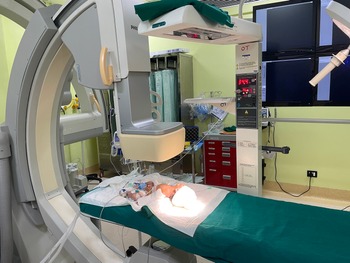
The “Flip technique” Reference Bauser-Heaton, Qureshi, Goldstein, Glatz and Petit5 (Fig 1) was employed for all patients in this study. This position entails rotating the patient 180°, thereby flipping the baby’s head to the foot-end of the catheterisation-lab table after intubation. This allows use of the length of the Cath-lab table for long catheters and permits better maneuverability of catheters and wires. The catheter-lab settings are changed by selecting the rotated patient position on the console. Thereafter, the C-arm rotation compensates for the flipped patient position, and all angulations are automatically adjusted in relation to the patient’s position, rather than the operator’s position. For example, in left anterior oblique – cranial angulation with flipped position, the C-arm angulation will appear like a conventional right anterior oblique – caudal angulation, to account for the patient’s position.
“Flip Technique” – Patient’s position is flipped after intubation.

With the Flip technique, we avoided use of the lateral C-arm and worked predominantly in the antero-posterior view and/or slight left anterior oblique angulation, to have better access to the small patient and to avoid crowding of the work area.
Technique of surgical carotid cutdown
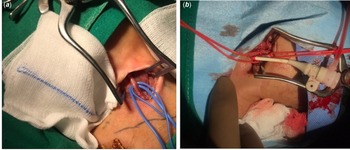
The side of carotid cutdown was chosen to get the most direct route into the vertical patent arterial duct. For example, in a patient with left arch with a vertical duct arising from the distal arch, we preferred a left common carotid cutdown. Similarly, for a child with right arch, mirror image branching, with duct from distal arch, we would choose a right common carotid cutdown. A small transverse or oblique incision was made at the midpoint of the anterior border of the sternocleidomastoid. Sternocleidomastoid and omohyoid muscles were retracted to expose the carotid sheath and the chosen carotid artery was exposed (Fig 2a). Once the site of puncture was selected, proximal and distal snares were placed. Depending on the diameter and exposed length of the common carotid artery, 6-0 or 7-0 polypropylene longitudinal shaped purse strings were sometimes additionally placed for better control and haemostasis. Under direct vision, the carotid artery was punctured with a 20G peripheral cannula (through the purse-string, if placed). The needle was then withdrawn, and a short guidewire was introduced through the cannula. With the guidewire in position, the cannula was withdrawn, and a short introducer sheath was introduced over the wire. Under fluoroscopic guidance, the sheath was tracked over the wire till the level of the aortic arch, and the wire and dilator were removed (Fig 2b).
( a ) Common carotid artery is exposed with surgical cutdown. ( b ) 5F Introducer sheath is inserted into the common carotid artery.

Post-procedure, the proximal and distal snares around the introducer sheath were tightened, the sheath was removed, the puncture site was repaired with 7-0 polypropylene, and the snares were then released to confirm pulsatility of carotid flow distal to the repaired puncture site. After confirming haemostasis, the wound was closed with absorbable sutures without any drain.
Technique of stenting of the patent arterial duct
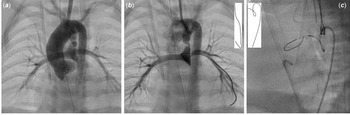
With the introducer sheath in position with its tip at the aortic arch, an arch angiogram was performed in antero-posterior or left anterior oblique 20° (for left-sided arches) view to demonstrate the ductal origin, morphology, and course (Fig 3a). Ductal tortuosity on this angiogram was classified into three types as described by Qureshi et al. Reference Qureshi, Goldstein and Glatz6
( a ) Sheath angiogram after access to delineate the vertical PDA and branch pulmonary arteries. ( b ) There is straightening of the PDA with the coronary wire placed across the PDA into the left pulmonary artery. Inset: Schematic diagram of wire course in carotid access. ( c ) Vertical PDA engaged with cut pigtail catheter from femoral arterial access for comparison. Inset: Schematic diagram of wire course in femoral artery access.

A 4F Judkins right coronary catheter was then taken over an angled tip Terumo glidewire (Terumo Medical Corporation, Somerset, NJ, United States of America) to the arch, and the catheter tip was positioned at the PDA origin. A 0.012” workhorse coronary guidewire was then passed through the Judkins right catheter to engage and negotiate the PDA, and the wire tip was positioned in the distal left or right pulmonary artery (Fig 3b). This first wire was used as the landmark and “buddy wire”. A second 0.012” Balance Middle Weight wire (Abbott Vascular, Santa Clara, CA, United States of America) was then taken alongside the first wire and positioned in the distal branch pulmonary artery. With both coronary wires in position, the Judkins right catheter was removed, and the introducer sheath was advanced to the ductal origin. From the side arm of the introducer sheath, a hand injection was done for ductal angiography to delineate the duct (now straightened by the coronary wires) and branch pulmonary arteries. Based on this angiogram, with the arterial duct straightened by the coronary wires placed across, an appropriate-sized coronary stent was chosen, and taken directly through the introducer sheath over the Balance Middle Weight wire, positioned and deployed under fluoroscopy guidance. Prior to stent deployment, the “buddy wire” was withdrawn to prevent entrapment by the stent.
For patients with a left vertical duct with significant left pulmonary artery origin stenosis, we positioned the coronary guidewires into the distal right pulmonary artery and placed the pulmonary end of the stent across the right pulmonary artery origin, to ensure covering the entire ductal tissue with potential for constriction.
Stent length was chosen to ensure covering both ends of the straightened PDA, and diameter was chosen based on the child’s weight, upsizing slightly compared to the weight. Hence, a 3.5 mm stent was used in children weighing 3–3.4 kg, while a 4 mm stent was used for children weighing 3.5–3.8 kg. Stents used for patients in this study were primarily coronary stents such as the BioMimeTM Sirolimus Drug Eluting Coronary Stent (Meril Life Sciences Pvt. Ltd., Vapi, India) and the XIENCETM Everolimus Drug Eluting Stent (Abbott Vascular, Santa Clara, CA, United States of America) due to their easy availability.
Post-stenting, our institutional protocol was to continue overnight ventilation and low dose norepinephrine infusion to maintain diastolic blood pressures above 20 mmHg. Unfractionated heparin infusion was used for anticoagulation, maintaining activated clotting time around 200 seconds, for 24–36 hours post-procedure. Dual anti-platelet therapy with aspirin (3–5 mg/kg/day) and clopidogrel (1 mg/kg/day) was instituted simultaneously once enteral feeding was restarted, and this anti-platelet regimen was continued till the next surgery. Post-stenting oxygen saturation of greater than 80% on room air was considered adequate for patient discharge.
The time required for the procedure was divided into three components: cutdown access time (time from skin incision to insertion of the introducer sheath in the common carotid artery), interventional procedure time (time from sheath insertion to completion of stenting), and “haemostasis and suture time” (time taken by the surgeon from removal of sheath to completion of skin suturing).
Statistical analysis
Statistical analysis was done using Microsoft Excel version 16.49 (Microsoft Office 365, Microsoft Corporation, United States of America). Categorical variables were expressed as numbers and percentages. Continuous variables were expressed as median with interquartile range or mean with standard deviation depending upon normality of the data.
Results
In the study period, duct stenting was attempted in 11 patients with the hybrid approach. In one patient (patient 11) with a tortuous-type III duct, optimal wire positioning could not be achieved due to looping of the coronary wires within the main pulmonary artery stump. Hence, the duct did not straighten with the coronary wires and passage of the stent was not possible. This patient was referred for surgery and underwent tetralogy of Fallot repair. He was excluded from subsequent analysis of procedural variables.
The remaining 10 patients underwent successful ductal stenting.
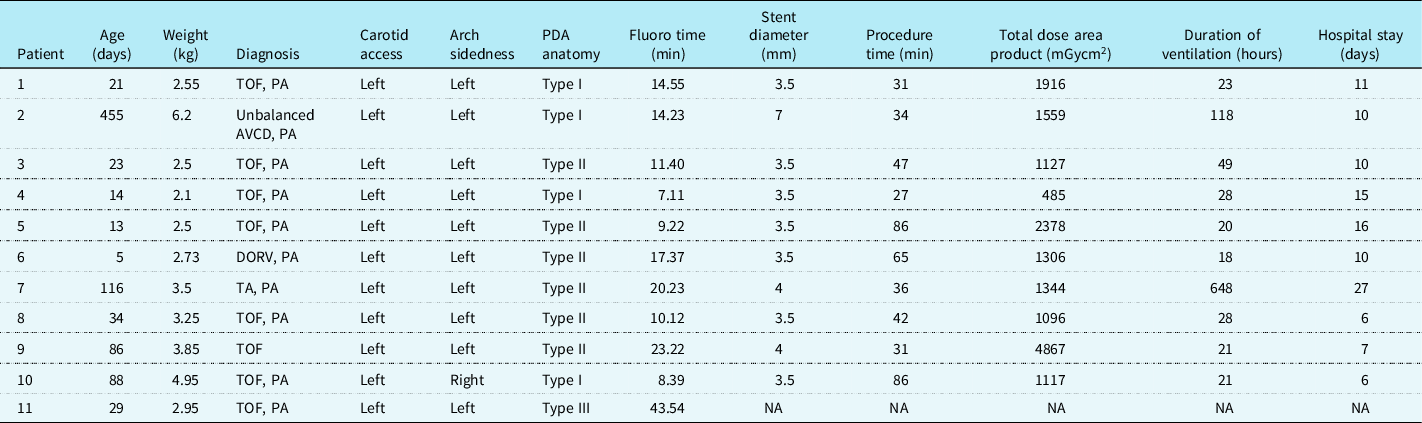
Patient and procedural details are summarised in Table 1. The median age of patients was 29 days (interquartile range 17.5–87) with mean weight of 3.37 ± 1.23 kg. Ten patients had pulmonary atresia with patent arterial duct as the sole pulmonary supply. One patient (patient 9) had tetralogy of Fallot with a doubly committed ventricular septal defect, which precluded right ventricular outflow tract stenting. Ductal stenting was done for low saturations and cyanotic spells at 86 days age. Patient 2 had single ventricle physiology with a diffusely hypoplastic right pulmonary artery and an adequate left pulmonary artery, where duct stenting was done as a final palliation at 455 days age. This patient had a baseline saturation of 45–50%, which improved to 75–80% after the stenting. Patient 10 had tetralogy of Fallot and pulmonary atresia with non-confluent pulmonary arteries supplied by right and left ducts. As the left duct was restrictive, this child was taken for left ductal stenting, with a plan for subsequent unifocalisation and complete repair after a few months. The baseline saturation for this patient was 65–70%, which improved to 90% after duct stenting.
Ten of the 11 patients had left arch with normal branching. The left common carotid artery was cannulated in all. 5F introducer sheaths were used in 10 (91%) patients and 4F in one. Type II was the commonest morphology of ductal tortuosity, seen in six (55%) patients.
Mean fluoroscopy time was 13.58 ± 5.35 minutes and mean procedure time was 48.50 ± 22.5 minutes. The mean radiation dose (total dose area product) was 1719.5 ± 1217.6 mGycm2. For the surgical carotid access, mean cutdown time was 9.9 ± 2.4 minutes and mean time for haemostasis and suturing was 25.3 ± 11.0 minutes.
Median duration of ventilation post-stenting was 26 hours (interquartile range 21–43.75). The median ICU stay post-procedure was 5 days (interquartile range 4–7.25) and mean hospital stay was 12 ± 6.3 days.
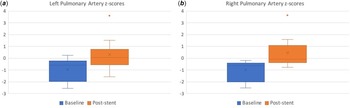
The mean follow-up duration was 3.4 ± 2.8 months. All patients had adequate flow across the ductal stents with good flow into the distal branch pulmonary arteries on echocardiography during follow-up visits. There was an increase in the left and right pulmonary artery diameter z scores following ductal stenting on follow-up in all patients (Fig 4). Carotid patency was confirmed in all patients by direct visualisation of distal pulsatility by the surgeon immediately after repair of the puncture site, and again on each follow-up, by the cardiologist with colour Doppler flows across the carotid artery. No intravascular thrombi, occlusions, narrowing, haematomas, or aneurysms were noted during the procedure or on follow-up.
Box and whisker plot of the z scores of left and right pulmonary artery diameters at baseline and on follow-up after PDA stenting.

There was one early mortality in this cohort, 27 days post-stenting (patient 7). This child had tricuspid atresia, pulmonary atresia, and a restrictive patent foramen ovale, with small confluent branch pulmonary arteries which were unfavourable for bidirectional Glenn at initial presentation. The patient underwent ductal stenting with balloon atrial septostomy with a satisfactory initial result. However, there was reappearance of flow acceleration across the patent foramen ovale and inability to wean from ventilation for the next 10 days, prompting surgical atrial septectomy. Subsequently, the baby developed sepsis and succumbed 27 days post-stenting.
On follow-up, one patient underwent tetralogy of Fallot repair 8.5 months post-stenting, and the remaining patients are awaiting surgical repair.
Discussion
With increasing operator experience and long-term follow-up data from multicentre series, ductal stenting has become widely accepted as a safe and effective alternative to the modified Blalock–Taussig shunt. Reference Bentham, Zava and Harrison1,Reference Glatz, Petit and Goldstein2 Ductal morphology in duct-dependent pulmonary circulation can be extremely variable, ranging from a straight horizontal duct to a vertical duct arising from the undersurface of the aortic arch, with or without complex tortuosity. Reference Alwi4,Reference Sivakumar and Butera7 Ductal tortuosity can be classified into three types based on a tortuosity index recently proposed by Qureshi et al, Reference Qureshi, Goldstein and Glatz6 with type I having a relatively straight course, type II having a single turn, and type III having multiple turns.
Vertical ducts are often associated with increased tortuosity. With retrograde femoral arterial access, while engaging the ductal origin of vertical ducts may be possible with a Judkins right or cut pigtail catheter, in our experience, negotiating the turns and achieving stable wire position to enable satisfactory positioning of a coronary stent across the duct is challenging and time-consuming (Fig 3c). In a sick, cyanosed baby, this can increase procedural time and thus risks of hypothermia, acidosis, and poor outcomes.
Operators have demonstrated good results with antegrade transvenous femoral access to engage the vertical patent arterial duct via the right ventricle, ventricular septal defect, and ascending aorta. Reference Alwi4 However, this approach requires compatible intracardiac anatomy to allow the catheter course and may be associated with haemodynamic instability in small babies with the guiding catheter or long sheath stenting the heart as it crosses from the right ventricle to the ascending aorta. Similarly, Breatnach and colleagues have reported good results of ductal stenting with the percutaneous axillary approach. Reference Breatnach, Aggarwal and Al-Alawi8 In a cohort of 20 patients, the authors reported four (20%) procedure-related complications, two procedure conversions (to femoral approach and surgical Blalock–Taussig shunt, respectively) and no procedure-related deaths. Dissection, haematoma, bleeding, and pseudoaneurysms have been described with this approach. The authors postulated that the angulation of the subclavian artery into the aortic arch increases risk of dissection of the subclavian artery, Reference Breatnach, Aggarwal and Al-Alawi8 which is also our personal observation with this approach.
The ipsilateral carotid artery approach overcomes many of the limitations of the other approaches to accessing the vertical duct. Reference Justino and Petit3 The downward direction of force on the coronary guidewire along the direction of ductal flow allows easier and quicker negotiation of the turns of the PDA and optimal distal wire positioning (Fig 3b). Furthermore, in infants, the common carotid artery diameter is greater than the femoral artery, thus allowing safe passage of a larger sheath without damaging the vessel. Reference Justino and Petit3
Previous operators have observed that highly tortuous ducts can be challenging to stent or may even be unsuitable for stenting. Reference Alwi4,Reference Qureshi, Goldstein and Glatz6 In our experience, highly tortuous ducts with multiple turns (type III) which do not straighten even after passage of two coronary wires across generally are unsuitable for stenting due to difficulty in the passage of the stent across the turns, even with the ipsilateral carotid approach. We faced this challenge in patient 11, who was taken for surgery after an unsuccessful attempt at ductal stenting, and underwent early intracardiac repair.
Percutaneous carotid access versus surgical carotid cutdown
Percutaneous carotid puncture has previously been reported by Choudhry et al in infants younger than 3 months age. Reference Choudhry, Balzer, Murphy, Nicolas and Shahanavaz9 In this cohort of 18 patients, 2 (11%) had post-procedural complications with development of carotid artery pseudoaneurysms requiring surgery. Post-procedure carotid patency was documented by either angiography, magnetic resonance angiography, or vascular ultrasound, with no documented arterial occlusions.
Justino et al have reported excellent outcomes with ductal stenting via a percutaneous carotid approach Reference Justino and Petit3 and have demonstrated normal carotid patency in 40 out of 42 (95%) patients on follow-up imaging. Vascular complications were reported in six patients (14%) in their cohort: three developed carotid thrombosis detected within 24 hours of the catheterisation (two complete occlusions and one partial non-occlusive thrombus), requiring treatment with subcutaneous low-molecular-weight heparin. Two of these three patients had mild luminal narrowing on follow-up and the third had restoration of normal carotid flows. Reference Justino and Petit3 Two additional patients had haematomas which resolved spontaneously and one had a carotid pseudoaneurysm requiring surgical intervention. Reference Justino and Petit3 Similarly, in a single centre study from Turkey, Polat described Doppler findings following percutaneous carotid artery access. Reference Polat10 In this series of 36 patients, 7 (19%) had vascular complications on Doppler within 24 hours of the procedure: 2 non-occlusive thrombi, 1 mild luminal narrowing caused by a small tissue flap at the puncture site, 1 carotid pseudoaneurysm, 2 mild haematomas at the puncture site without carotid flow disturbance, and 1 large haematoma causing respiratory distress secondary to upper airway compromise. The patients with non-occlusive thrombi required anticoagulation with low molecular weight heparin for 1–2 weeks following which vessel patency was partially restored. Two patients required surgical intervention in this series, for the pseudoaneurysm and large haematoma, respectively. Reference Polat10
Our primary concern with percutaneous carotid approach is the direct compression over the puncture site required for haemostasis, which might predispose to vessel thrombosis, occlusion, and pseudoaneurysm. Importantly, in patients post-ductal stenting, wherein anticoagulation needs to be initiated soon to ensure stent patency, the balance between carotid haemostasis, carotid bleeding, and prevention of stent thrombosis is a fine one. Hybrid surgical access of the carotid, in our experience, required around 10 minutes from incision to positioning of the introducer sheath. In comparison, in Justino’s report, time required for percutaneous ultrasound-guided carotid access from first needle attempt to sheath placement was 5.5 ± 5.3 minutes. Reference Justino and Petit3 In the hybrid approach, repair of the carotid puncture site after sheath removal can be done under direct vision, ensuring distal carotid perfusion. The time required from removal of the sheath to skin closure was around 25 minutes in our cohort. In comparison, in Justino’s report of percutaneous carotid puncture, haemostasis was achieved by manual compression for a mean duration of 12.2 minutes after sheath removal (median, 10; range, 4–45 minutes). Reference Justino and Petit3
Surgical carotid cutdown for transcatheter interventions has previously been described as an alternate approach for balloon aortic valvotomy and balloon dilation of coarctation, Reference Fischer, Ettedgui, Park, Siewers and del Nido11,Reference Maeno, Akagi and Hashino12 with no complications reported secondary to the cutdown. In a multicentric retrospective study, Robinson and colleagues described their results with balloon aortic valvotomy with carotid artery cutdown in 95 patients. Reference Robinson, Brzezinska-Rajszys and Weber13 One patient had carotid artery dissection requiring repair, and another preterm baby required ligation of the carotid artery post-procedure. Patency of the carotid artery was evaluated in 64 patients on follow-up with magnetic resonance angiography, Doppler, or ultrasound. The artery was patent in 57 (89%), narrowed in 5 (8%), thrombosed in 1 (2%), and had been ligated in 1 (2%). The authors concluded that this approach had a lesser incidence of vascular complications compared to femoral approach. Reference Robinson, Brzezinska-Rajszys and Weber13 In our cohort, none of the patients developed vascular complications related to the carotid cutdown on early follow-up. From these above studies and our own experience, we can surmise that although the time required for the surgical cutdown and subsequent haemostasis is slightly more than percutaneous carotid puncture, vascular complications are less frequent, making the hybrid approach an attractive alternative.
This study has a few limitations. This is a small cohort of patients with short-term follow-up. Although the early results with this hybrid approach are encouraging, follow-up of the carotid cutdown site in this study was done by cardiologists clinically and with colour Doppler imaging along with echocardiography. Formal imaging of the carotid artery with magnetic resonance angiography or vascular ultrasound interpreted by a radiologist to specifically identify or rule out aneurysms, haematomas, vascular narrowing and thrombi (partial or occlusive), and longer-term follow-up would help objectively compare hybrid versus percutaneous carotid approach.
In conclusion, in our early experience, hybrid ductal stenting with surgical carotid cutdown access and use of the flip technique has greatly simplified a complex and challenging intervention, with good immediate and early outcomes.
Patient and procedural data

AVCD = atrioventricular canal defect; DORV = double outlet right ventricle; NA = not applicable; PA = pulmonary atresia; TA = tricuspid atresia; TOF = tetralogy of Fallot.
Acknowledgements
The authors would like to thank Ms Poonam Parmar for her help in data collection for the manuscript.
Financial support
This research received no specific grant from any funding agency, commercial, or not-for-profit sectors.
Conflicts of interest
None.
Ethical standards
Ethical approval was waived by the Ethics Committee of SRCC Children’s Hospital in view of the retrospective nature of the study and as all the procedures being performed were part of the routine clinical care of the patients.