

Introduction
Obsessive–compulsive disorder (OCD) is characterised by recurrent and distressing intrusive thoughts and urges (obsessions) and repetitive behaviours or mental acts that aim to neutralise distress (compulsions; APA, 2013). OCD can cause high levels of functional impairment and some studies have estimated that only 50% of patients benefit from first-line treatments (Fisher & Wells, Reference Fisher and Wells2005; Foa et al., Reference Foa, Liebowitz, Kozak, Davies, Campeas, Franklin and Tu2005; Öst, Havnen, Hansen, & Kvale, Reference Öst, Havnen, Hansen and Kvale2015). A more nuanced understanding of the factors that contribute to the development and maintenance of OCD symptoms may improve treatment outcomes.
Individuals with OCD frequently report obsessions and compulsions that have sexual, aggressive, or religious themes, and are experienced as morally repugnant (Fernández de La Cruz et al., Reference Fernández de La Cruz, Landau, Iervolino, Santo, Pertusa, Singh and Mataix-Cols2013; Moulding, Aardema, & O'Connor, Reference Moulding, Aardema and O'Connor2014; Pinto et al., Reference Pinto, Greenberg, Grados, Bienvenu, Samuels, Murphy and Hoehn-Saric2008). The moral nature of such obsessions and compulsions has led researchers to question whether individuals with OCD are more prone to experiencing guilt and shame. Some studies have reported a positive association between the tendency to experience guilt and obsessive–compulsive symptoms (Basile, Mancini, Macaluso, Caltagirone, & Bozzali, Reference Basile, Mancini, Macaluso, Caltagirone and Bozzali2014; D'Olimpio et al., Reference D'Olimpio, Cosentino, Basile, Tenore, Gragnani and Mancini2013; Inozu, Karanci, & Clark, Reference Inozu, Karanci and Clark2012; Stewart & Shapiro, Reference Stewart and Shapiro2011). However, other studies have found that guilt was not associated with OCD symptoms after accounting for anxiety and depression (Fergus, Valentiner, McGrath, & Jencius, Reference Fergus, Valentiner, McGrath and Jencius2010) or disgust propensity (Melli, Chiorri, Carraresi, Stopani, & Bulli, Reference Melli, Chiorri, Carraresi, Stopani and Bulli2015).
Alternatively, some researchers have found that individuals with OCD are more prone to experiencing shame and have proposed that shame motivates compulsions (Fergus et al., Reference Fergus, Valentiner, McGrath and Jencius2010; Weingarden & Renshaw, Reference Weingarden and Renshaw2015). While guilt is evoked as a feeling of condemnation in response to a particular behaviour the person engaged in, shame is a more persisting emotional state whereby the person perceives themselves to be ‘bad’, flawed, or inadequate in the eyes of themselves or others (Tangney & Dearing, Reference Tangney and Dearing2002). However, guilt in OCD has been more widely researched and may have a stronger conceptual link to compulsions, as many compulsive behaviours appear to reflect a sense of responsibility or remorse (Reuven, Liberman, & Dar, Reference Reuven, Liberman and Dar2014; Zhong & Liljenquist, Reference Zhong and Liljenquist2006). For this reason, researchers have also raised the question of whether responses to guilt in OCD might maintain obsessions and compulsions. Specifically, a fear of guilt might motivate compulsive behaviours (Chiang, Purdon, & Radomsky, Reference Chiang, Purdon and Radomsky2016; Mancini & Gangemi, Reference Mancini and Gangemi2004c).
Researchers have found that aversive emotions such as guilt may serve as stimuli that are perceived as uncontrollable or intolerable across different disorders, which is thought to lead to avoidant processing and attempts to control these emotions (Campbell-Sills, Barlow, Brown, & Hofmann, Reference Campbell-Sills, Barlow, Brown and Hofmann2006a, Reference Campbell-Sills, Barlow, Brown and Hofmann2006b; Wieser, Pauli, Weyers, Alpers, & Mühlberger, Reference Wieser, Pauli, Weyers, Alpers and Mühlberger2009). Compulsions may be motivated and reinforced by such attempts to avoid or control feelings of guilt. Individuals may place excessive importance on guilt or evaluate it as extremely aversive; Chiang et al. (Reference Chiang, Purdon and Radomsky2016) argued that these are the cognitive components of fear of guilt. Individuals may also engage in compulsions to compensate for current feelings of guilt or to prevent future feelings of guilt; these are the behavioural components of fear of guilt (Chiang et al., Reference Chiang, Purdon and Radomsky2016). Such compulsions may be reinforced by their momentary success in alleviating guilt and prevent individuals from confronting and reducing their fear of experiencing guilt.
There is emerging evidence that fear of guilt may be related to obsessions and compulsions. Experimental studies of non-clinical samples have found that guilt inductions led to increased OCD-like cognitions and behaviours, including cleaning, checking, and risk-aversion (D'Olimpio & Mancini, Reference D'Olimpio and Mancini2014; Mancini & Gangemi, Reference Mancini and Gangemi2004c; Zhong & Liljenquist, Reference Zhong and Liljenquist2006). However, it was unclear whether this effect was due to fear of guilt, as the construct was not directly induced or measured.
A small number of studies have directly induced or measured fear of guilt while attempting to examine its association with obsessive–compulsive tendencies. Mancini and Gangemi's (Reference Mancini and Gangemi2004b, Reference Mancini and Gangemi2006) studies found that fear of guilt inductions led to increased perseveration, doubts, and a ‘prudential hypothesis testing approach’. The latter has been observed in individuals with OCD and refers to the process of focussing on one's hypothesis of danger, searching for evidence to confirm this hypothesis, and discounting falsifying evidence as insufficient (Mancini & Gangemi, Reference Mancini and Gangemi2004a). However, fear of guilt had not been properly defined or validated at the time, reflecting theoretical and methodological limitations in the fear of guilt literature.
Chiang et al. (Reference Chiang, Purdon and Radomsky2016) addressed this limitation by developing a self-report Fear of Guilt Scale (FOGS). Factor analyses indicated two fear of guilt subscales: punishment and harm prevention. The punishment subscale captured the urge to punish oneself to compensate for feeling guilty and the belief that guilt means one is bad or flawed. The harm prevention subscale captured the drive to prevent harm or other causes of guilt, and the belief that guilt reflects one's failure to be their ideal self. Scores on the punishment subscale of the FOGS were positively associated with OCD symptom severity, controlling for guilt, inflated responsibility, neuroticism, depression, and anxiety (Chiang et al., Reference Chiang, Purdon and Radomsky2016). Furthermore, Chiang and Purdon's (Reference Chiang and Purdon2019) experiment examined whether inducing fear of guilt effected decision-making parameters, and participants in the fear of guilt condition reported higher doubts in their decision-making abilities. Additionally, self-reported scores on the FOGS punishment subscale were negatively associated with satisfaction and confidence when making decisions, increasing the possibility of further checking behaviours in these participants (Chiang & Purdon, Reference Chiang and Purdon2019). These studies suggest that fear of guilt is associated with, and may even cause, cognitions and compulsive behaviours observed in OCD. However, the mechanism reinforcing compulsions in OCD must also be considered when examining the importance of fear of guilt.
The momentary relief provided by compulsive behaviours in OCD may be negatively reinforcing by increasing the likelihood of further engagement in compulsive behaviours (Dollard & Miller, Reference Dollard and Miller1950; Neziroglu, Henrickson, & Yaryura-Tobias, Reference Neziroglu, Henrickson and Yaryura-Tobias2006). This could also apply to the relief of feelings of guilt among people with OCD who have a prominent fear of guilt and perform compulsions in response to this fear. Indeed, two experimental studies have provided some evidence that excessive cleaning behaviours, which are common compulsions in OCD, alleviate self-reported feelings of guilt (Reuven et al., Reference Reuven, Liberman and Dar2014; Zhong & Liljenquist, Reference Zhong and Liljenquist2006). This effect was stronger in individuals with a diagnosis of OCD (Reuven et al., Reference Reuven, Liberman and Dar2014). Therefore, it appears that compulsive rituals may be reinforced by their temporary success in alleviating guilt, and this is particularly true in individuals with OCD.
An examination of the research on fear of guilt in relation to OCD symptom reveals a number of limitations to be addressed in future studies. Firstly, fear of guilt has only recently been clearly defined, and future research may benefit from independent studies examining Chiang et al. (Reference Chiang, Purdon and Radomsky2016)'s FOGS to clarify its association with obsessive–compulsive symptoms over and above conceptually related factors such as inflated responsibility, guilt, shame, and symptoms of anxiety and depression. Additionally, Salkovskis (Reference Salkovskis1985) proposed that an inflated sense of responsibility may contribute to obsessive–compulsive tendencies, and there is some evidence to support this theory (Arntz, Voncken, & Goosen, Reference Arntz, Voncken and Goosen2007). Therefore, further research differentiating fear of guilt from these similar constructs may clarify its role in OCD symptoms.
Additionally, demographic factors may limit the generalisability of the previous research. The majority of research into fear of guilt has been conducted on undergraduate students residing in Italy (Mancini & Gangemi, Reference Mancini and Gangemi2004c, Reference Mancini and Gangemi2006) and Canada (Chiang et al., Reference Chiang, Purdon and Radomsky2016; Chiang & Purdon, Reference Chiang and Purdon2019). It is possible that factors specific to these samples influenced results. For instance, in contrast to community samples, student samples typically have a restricted age range and are more homogeneous in other respects (Peterson, Reference Peterson2001).
Addressing the limitations of previous studies may enable an enhanced theoretical and empirical understanding of the association between fear of guilt and OCD symptoms. This understanding may in turn lead to changes in treatment approaches and ultimately to improved treatment outcomes for individuals experiencing the debilitating disorder.
The aim of the current study was to examine whether fear of guilt was associated with obsessive–compulsive symptoms in a non-clinical adult population. Specifically, the study aimed to explore whether scores on Chiang et al.'s (Reference Chiang, Purdon and Radomsky2016) FOGS would be associated with obsessive–compulsive symptoms, controlling for individuals’ sex, age, and levels of guilt, shame, inflated responsibility, generalised anxiety, and depression. This study was thus an independent replication of previous findings, which also sought to extend previous research through inclusion of key conceptually related variables, such as shame and inflated responsibility. The inclusion of these variables allowed a more adequate evaluation of the relationship between fear of guilt and OCD symptoms.
The first hypothesis was that each dimension of fear of guilt would be positively correlated with OCD symptoms, but that the relationship for the Fear of Guilt Harm Prevention subscale would be relatedly small in magnitude, consistent with Chiang et al. (Reference Chiang, Purdon and Radomsky2016). The second hypothesis was that the Fear of Guilt-Punishment subscale, but not the Harm Prevention subscale, would show a unique, statistically significant and positive association with OCD symptoms when controlling for sex, age, state guilt, trait guilt, shame, inflated responsibility, generalised anxiety, and depression symptoms. If this were the case, it would support the notion that the punishment domain of fear of guilt has a specific relationship with OCD symptoms and is potentially worthy of further research consideration as a variable to be targeted in treatments for OCD.
Method
Participants
One hundred and ninety-two adults were recruited via the Prolific online research platform as part of a broader study of OCD symptoms and post-traumatic stress disorder symptoms. Online platforms enable researchers to recruit a diverse sample consisting of various age groups and cultural backgrounds (Wright, Reference Wright2005). Participants were not required to have a diagnosis of OCD to participate in the study. Current theories and data suggest that OCD symptoms vary on a continuum, and individuals without a diagnosis of OCD scoring high on OCD symptoms reliably report similar experiences to those with a diagnosis (Burns, Formea, Keortge, & Sternberger, Reference Burns, Formea, Keortge and Sternberger1995; Rachman & Hodgson, Reference Rachman and Hodgson1980; Salkovskis, Reference Salkovskis1985).
Measures
Measures of demographic variables, fear of guilt, OCD symptoms, responsibility for harm, guilt, shame, generalised anxiety, and depression were used in the current study. Two measures of OCD symptoms were used to allow the researchers to compare the pattern of results across different measures.
Demographics
Participants answered questions about their age, sex, relationship status, education level, employment, country of birth, and mental and physical health history.
Fear of guilt
Chiang et al.'s (Reference Chiang, Purdon and Radomsky2016) FOGS was included to measure fear of guilt. As mentioned previously, the scale consists of two factors: punishment (the drive to punish oneself because of feelings of guilt and the belief that guilt means that one is a bad person) and harm prevention (behaviours aiming to prevent guilt and the belief that guilt means that one has failed to be their ideal self) (Chiang et al., Reference Chiang, Purdon and Radomsky2016). The scale requested participants to indicate their agreement with 17 statements on a Likert scale from 1 (strongly disagree) to 7 (strongly agree). Previous research has indicated that the scale has strong internal consistency and convergent, divergent, and concurrent validity (Chiang et al., Reference Chiang, Purdon and Radomsky2016). Cronbach's alpha for the FOGS harm prevention subscale was 0.83 and for the FOGS punishment subscale was 0.84 in the current study.
Guilt
The Guilt Inventory (GI; Kugler & Jones, Reference Kugler and Jones1992) subscales were included to measure participants’ trait guilt (tendency to experience guilt), state guilt (current experience of guilt), and moral standards (rigidity of moral beliefs). The measure asked participants to indicate their agreement with 45 statements on a Likert scale from 1 (strongly disagree) to 5 (strongly agree). The measure has demonstrated acceptable reliability and validity in previous research (Jones, Schratter, & Kugler, Reference Jones, Schratter and Kugler2000). Cronbach's alpha values for the GI in the present study were 0.87, 0.70, and 0.90 for the state guilt, moral guilt, and trait guilt subscales, respectively.
Shame
The Shame Proneness subscale of the Test of Self-Conscious Affect version 3 (TOSCA-3; Tangney, Dearing, Wagner, & Gramzow, Reference Tangney, Dearing, Wagner and Gramzow2000) was included to measure participants’ tendency to experience shame. The scale asked participants to rate the likelihood of experiencing shame responses to 16 hypothetical scenarios on a Likert scale from 1 (not likely) to 5 (very likely). The shame subscale of the TOSCA-3 has demonstrated acceptable reliability and validity in previous research (Rüsch et al., Reference Rüsch, Corrigan, Bohus, Jacob, Brueck and Lieb2007). Cronbach's alpha for the shame proneness subscale of the TOSCA-3 was 0.87 in the current study.
Obsessive–compulsive symptoms
The Obsessive–Compulsive Inventory Revised (OCI-R; Foa et al., Reference Foa, Huppert, Leiberg, Langner, Kichic, Hajcak and Salkovskis2002) was administered to measure participants’ obsessive–compulsive symptoms. The OCI-R required participants to rate how much they were bothered or distressed by obsessive–compulsive symptoms on a Likert scale from 0 (not at all) to 4 (extremely). The OCI-R has six subscales: washing, checking, ordering, obsessing, hoarding, and neutralising (Foa et al., Reference Foa, Huppert, Leiberg, Langner, Kichic, Hajcak and Salkovskis2002). A total score can also be derived by summing all items (Foa et al., Reference Foa, Huppert, Leiberg, Langner, Kichic, Hajcak and Salkovskis2002). Previous research has demonstrated that the OCI-R is reliable and valid (Foa et al., Reference Foa, Huppert, Leiberg, Langner, Kichic, Hajcak and Salkovskis2002). Cronbach's alpha for the OCI-R was 0.93 in the current study.
The Dimensional Obsessive–Compulsive Scale (DOCS; Abramowitz et al., Reference Abramowitz, Deacon, Olatunji, Wheaton, Berman, Losardo and Hale2010) was also administered to measure participants’ obsessive–compulsive tendencies on four subscales: contamination, responsibility for harm, symmetry and ordering, and unacceptable thoughts. The DOCS required participants to indicate their responses to 20 items (rated from 0 to 4) which measured the severity and interference of obsessions and compulsions. Research has demonstrated that the DOCS is reliable and valid (Abramowitz et al., Reference Abramowitz, Deacon, Olatunji, Wheaton, Berman, Losardo and Hale2010). Cronbach's alpha for the DOCS was 0.94 in the current study.
Responsibility for harm
The five-item responsibility for harm subscale of the DOCS was utilised in the current study to capture obsessions and compulsions related to participants’ inflated sense of responsibility for causing harm. Cronbach's alpha for the responsibility for harm subscale was 0.92 in the current study.
Generalised anxiety symptoms
The Generalized Anxiety Disorder 7-item (GAD-7; Spitzer, Kroenke, Williams, & Löwe, Reference Spitzer, Kroenke, Williams and Löwe2006) scale was administered to measure participants’ symptoms of generalised anxiety. The scale required participants to rate the frequency that they experience anxiety symptoms on a Likert scale from 0 (not at all) to 3 (nearly every day). The scale has demonstrated reliability and validity in previous research (Löwe et al., Reference Löwe, Decker, Müller, Brähler, Schellberg, Herzog and Herzberg2008; Spitzer et al., Reference Spitzer, Kroenke, Williams and Löwe2006). Cronbach's alpha for the GAD-7 was 0.92 in the current study.
Depressive symptoms
The Patient Health Questionnaire (PHQ-9; Kroenke, Spitzer, Williams, & Kroenke, Reference Kroenke, Spitzer, Williams and Kroenke2001) was administered to measure participants’ depressive symptoms. The scale asked participants to rate the frequency with which they experienced depressive symptoms on a Likert scale from 0 (not at all) to 3 (nearly every day). The scale has demonstrated reliability and validity in previous studies (Arroll et al., Reference Arroll, Goodyear-Smith, Crengle, Gunn, Kerse, Fishman and Arroll2010; Kroenke et al., Reference Kroenke, Spitzer, Williams and Kroenke2001). Cronbach's alpha for the PHQ-9 was 0.91 in the current study.
Attention checks
Three attention checks were included in the questionnaire to determine the quality of participants’ responses. Attention check items instructed participants to select particular responses, for example ‘Respond with “a lot” for this item’. Participants’ responses were deemed to be unreliable if participants failed two or more attention checks, and were excluded from data analyses.
Procedure
The Human Research Ethics Committee of the University of Technology Sydney granted ethics approval for the current study (ETH20-4718) and all participants provided informed consent. All participants were recruited from Prolific and directed to Qualtrics to complete the questionnaire online. Participants were required to be over 18 years old and to live in Australia, New Zealand, the United Kingdom, Ireland, the United States of America, or Canada to participate in the study. Participants took approximately 30 min to complete the questionnaires. They were reimbursed at an average rate of 5 GBP per hour for their time.
Data Analysis
The proportion of overall missing data points was 0.7% for this sample. Therefore, the data were analysed using a list-wise approach, which is thought to be relatively free of bias when less than 5% of data are missing (Schafer, Reference Schafer1999). Pearson zero-order correlations between dependent and independent variables were inspected to examine relationships between variables. A simultaneous regression analysis was conducted to test whether subscales of the FOGS contributed to the prediction of OCI-R scores controlling for gender, age, guilt subscales, responsibility for harm, shame, general anxiety, and depression. Two-tailed significance tests were evaluated at a 0.05 level of significance. Statistical analyses were conducted in SPSS 26. Responses of 6 (3.3%) of 192 participants were deemed to be unreliable because they failed two or more attention checks, and their data were excluded from analyses. Therefore, the final sample size was 186.
Results
Results are presented in three sections. The first and second sections report demographic variables and correlations between independent and dependent variables, respectively. Finally, findings of a multiple regression analysis examining the association between fear of guilt and obsessive–compulsive symptoms controlling for age, sex, guilt, shame, responsibility for harm, anxiety, and depression, are reported in the third section.
Demographic Variables
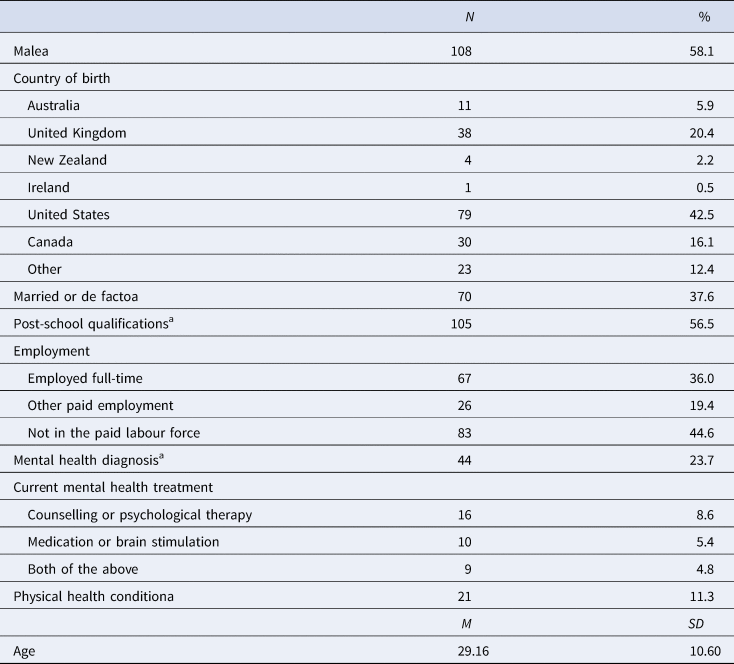
The demographic characteristics of the sample are outlined in Table 1. The majority of participants were male (58.1%), single (62.4%), had post-school qualifications (56.5%), and did not have a mental health diagnosis (76.3%) or a physical health condition (88.7%). A large portion of the sample was born in the United States (42.5%) and was not in the paid labour force (44.6%).
Demographic Variables

a Reflects the number and percentage of participants answering ‘yes’ to this question.
Correlations Between Independent and Dependent Variables
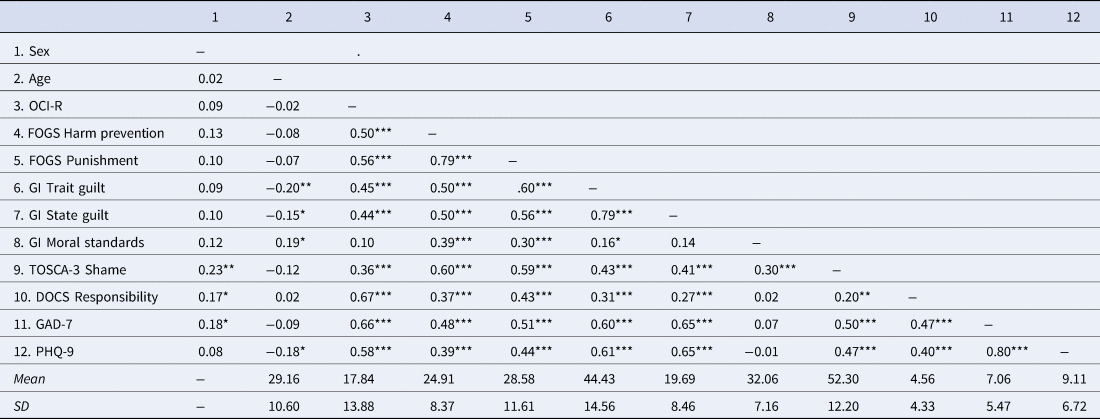
Bivariate Pearson correlations between dependent and independent variables are reported in Table 2. A conservative rejection rate of p < .001 was used to adjust for multiple comparisons. All key variables demonstrated moderate to strong associations with each other, with the exception of GI Moral Standards.
Correlations Between Independent and Dependent Variables

*p ≤ .05, **p ≤ .01, ***p ≤ .001.
Association Between Fear of Guilt and OCD Symptoms
A simultaneous multiple regression analysis was conducted to investigate the association between subscales of the fear of guilt and obsessive–compulsive symptoms, controlling for extraneous variables. Sex and age were included as control variables due to potential sex and age differences on several variables (Christensen et al., Reference Christensen, Jorm, Mackinnon, Korten, Jacomb, Henderson and Rodgers1999; Else-Quest, Higgins, Allison, & Morton, Reference Else-Quest, Higgins, Allison and Morton2012; Labad et al., Reference Labad, Menchon, Alonso, Segalas, Jimenez, Jaurrieta and Vallejo2008; McLean & Anderson, Reference McLean and Anderson2009). Depression, anxiety, state guilt, trait guilt, shame, and responsibility for harm were included as control variables due to their previous associations with obsessive–compulsive symptoms (Arntz et al., Reference Arntz, Voncken and Goosen2007; Fergus et al., Reference Fergus, Valentiner, McGrath and Jencius2010; Goodwin, Reference Goodwin2015; Stewart & Shapiro, Reference Stewart and Shapiro2011; Weingarden & Renshaw, Reference Weingarden and Renshaw2015).
The assumptions of linear regression were examined in SPSS 26 prior to conducting a multiple regression. While most independent variables were moderately to strongly correlated, collinearity statistics were within accepted limits. Bivariate scatterplots indicated linear relationships between the dependent and independent variables. The assumption of independence was met through sampling procedures. A plot of standardised residuals against standardised predicted values indicated that the assumption of homoscedasticity was met. The Shapiro–Wilk test indicated that residuals were not normally distributed (p < .05). Therefore, bootstrapping was performed on the data using 5000 samples, as bootstrapping provides estimates that are robust to violations of normality (Field & Wilcox, Reference Field and Wilcox2017).
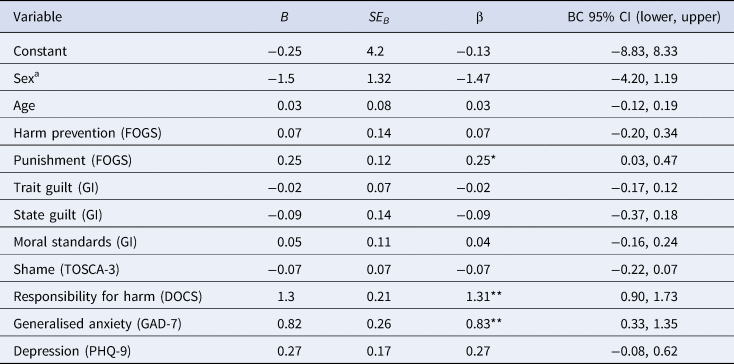
Table 3 displays the results of the bootstrap regression analysis including all variables. The punishment FOGS subscale was significantly positively associated with obsessive–compulsive symptoms (assessed via OCI-R) controlling for all other variables in the model (β = 0.25, 95% CI = 0.03, 0.47). Responsibility for harm (β = 1.31, 95% CI = 0.90, 1.73) and generalised anxiety (β = 0.83, 95% CI = 0.33, 1.35) were also significantly positively associated with obsessive–compulsive symptoms. Sex, age, harm prevention, trait guilt, state guilt, moral standards, shame, and depression were not significantly associated with OCD symptoms in the model.
Bootstrap Regression for Variables Associated with Obsessive–Compulsive Symptoms (OCI-R)

*p ≤ .05, **p ≤ .01.
a Female = 1, male = 0.
An additional post-hoc regression analysis was conducted to investigate whether FOGS subscales were associated with total scores on the DOCS, controlling for sex, age, state guilt, trait guilt, shame, generalised anxiety, and depression. This analysis was conducted to examine whether the pattern of results was similar across OCI-R and DOCS as different measures of OCD symptoms. It should be noted that due to potential conceptual overlap, the DOCS responsibility for harm subscale was not entered as a predictor in this analysis. The fear of guilt punishment factor was significantly positively associated with DOCS total scores controlling for all other variables in the model (β = 0.35, 95% CI = 0.10, 0.61; see Supplementary Table S1). It is noteworthy that generalised anxiety (β = 1.11, 95% CI = 0.57, 1.69) and shame (β = −0.28, 95% CI = −0.46, −0.10) were also significant predictors in the model.
Discussion
The aim of the current study was to examine whether domains of fear of guilt were associated with obsessive–compulsive symptoms in a non-clinical adult population. The current study is the first independent study of Chiang et al.'s (Reference Chiang, Purdon and Radomsky2016) fear of guilt measure and its association with OCD symptoms. Consideration of the factors associated with obsessions and compulsions is particularly important given that approximately half of the patients who commence first-line treatments for OCD do not see significant improvements (Fisher & Wells, Reference Fisher and Wells2005; Foa et al., Reference Foa, Liebowitz, Kozak, Davies, Campeas, Franklin and Tu2005; Öst et al., Reference Öst, Havnen, Hansen and Kvale2015). A more nuanced understanding of the role of guilt in OCD may lead to more targeted and effective treatments for the disorder.
Our first hypothesis was confirmed and results replicated the finding of Chiang et al. (Reference Chiang, Purdon and Radomsky2016): harm prevention and punishment as fear of guilt subscales were moderately correlated with OCD symptoms, indicating that individuals who scored higher on OCD symptoms endorsed a greater fear of guilt. This adds to the evidence base suggesting that it may be important to understand fear of guilt in relationship to OCD.
Correlational analyses also indicated that punishment and harm prevention were highly related, and both factors demonstrated a similar pattern of correlations with other variables. Punishment and harm prevention both demonstrated moderate to strong positive correlations with trait guilt, state guilt, moral standards, shame, and inflated responsibility. These findings suggest that fear of guilt is related to but conceptually distinct from guilt, shame, and inflated responsibility. Fear of guilt subscales were also moderately positively correlated with generalised anxiety and depression. It is possible that fear of guilt is one of many factors explaining the overlap between OCD, generalised anxiety disorder, and depression (Goodwin, Reference Goodwin2015). Future studies may be able to clarify the role of fear of guilt in anxiety and mood disorders.
The second hypothesis was that the FOGS-Punishment subscale would show a unique and statistically significant positive association with OCD symptoms after controlling for sex; age; state and trait guilt; shame; inflated responsibility; generalised anxiety; and depressive symptoms. This hypothesis was confirmed. Punishment was significantly positively associated with OCD symptoms when controlling for all other predictors in the model, while harm prevention was not a significant predictor in the model. This finding demonstrates that the punishment component of fear of guilt significantly adds to our understanding of OCD beyond an inflated sense of responsibility, guilt, or shame.
The punishment fear of guilt factor captured the belief that guilt means one is bad or immoral and the drive to punish oneself to atone for feelings of guilt (Chiang et al., Reference Chiang, Purdon and Radomsky2016). Researchers have proposed that individuals who experience high levels of distress perceive certain emotions to be highly aversive and intolerable. This intolerance may lead to unsuccessful attempts to control or suppress emotions (Campbell-Sills et al., Reference Campbell-Sills, Barlow, Brown and Hofmann2006a, Reference Campbell-Sills, Barlow, Brown and Hofmann2006b; Wieser et al., Reference Wieser, Pauli, Weyers, Alpers and Mühlberger2009). This theory might help explain the findings of the current study. The belief that guilt means one is ‘bad’ might contribute to aversion to guilt and motivate compensatory punishing behaviours. These compensatory behaviours might reduce guilt in the short-term, but prevent individuals from confronting the feeling of guilt and learning to tolerate it long-term. More experimental research is required to explore this possibility.
The association between punishment and OCD symptoms is consistent with experimental findings that fear of guilt inductions led to increased cognitions and behaviours observed in OCD (Chiang & Purdon, Reference Chiang and Purdon2019; Mancini & Gangemi, Reference Mancini and Gangemi2004a, Reference Mancini and Gangemi2004b, Reference Mancini and Gangemi2006). While the findings of these studies are preliminary, they provide some evidence that fear of guilt might cause an increase in obsessions and compulsions. The finding of the current study is also consistent with Chiang et al.'s (Reference Chiang, Purdon and Radomsky2016) finding that punishment was significantly associated with OCD symptoms above and beyond depression, anxiety, guilt, and inflated responsibility.
Importantly, the current study found that while trait guilt and state guilt were positively correlated with OCD symptoms, they were not significant predictors of OCD symptoms when accounting for fear of guilt and other variables. This finding suggests that fear of guilt is a more important factor in accounting for OCD symptoms than guilt itself. Therefore, OCD symptoms might be driven by particular reactions to guilt rather than an increased tendency to experience guilt or the actual experience of guilt. The importance of fear of guilt may explain contradictory findings in the literature regarding the association between guilt and OCD symptoms (Basile et al., Reference Basile, Mancini, Macaluso, Caltagirone and Bozzali2014; D'Olimpio et al., Reference D'Olimpio, Cosentino, Basile, Tenore, Gragnani and Mancini2013; Fergus et al., Reference Fergus, Valentiner, McGrath and Jencius2010; Inozu et al., Reference Inozu, Karanci and Clark2012; Melli et al., Reference Melli, Chiorri, Carraresi, Stopani and Bulli2015; Stewart & Shapiro, Reference Stewart and Shapiro2011).
The current study extended upon Chiang et al.'s (Reference Chiang, Purdon and Radomsky2016) findings by controlling for shame, an emotion that is considered distinct but conceptually related to guilt. The findings of the current study imply that fear of guilt is distinct from the experience of shame and may be more important in explaining OCD symptoms.
Conversely, harm prevention was not significantly associated with OCD symptoms after controlling for other factors. This finding is consistent with Chiang et al.'s (Reference Chiang, Purdon and Radomsky2016) finding that harm prevention was not a significant predictor of OCD symptoms after controlling for other variables. There are a number of potential explanations for these findings. It is possible that punishment, which appears to be a reaction to present experiences of guilt, is more pertinent in OCD than harm prevention, which appears to be more future-focussed. It is also possible that the current study did not capture the pathological nature of harm prevention concerns that might be observed in a clinical OCD sample. Chiang et al. (Reference Chiang, Purdon and Radomsky2016) described harm prevention as the belief that guilt equates to one's failure to be their ideal self, and the drive to minimise harm or other causes of guilt. Interestingly, this belief, and the items which comprise the harm prevention subscale, might conceivably be more closely associated with compulsions than obsessions. For instance, items of the harm prevention subscale focus on atonement and urge to prevent harm after a perceived guilty act (e.g. ‘It is not right to relax and/or enjoy myself if I have not completely atoned for something for which I feel guilty’). Thus, these items might only show a weak association with overall OCD symptoms when obsessions are also considered. Future studies among clinical samples might clarify whether harm prevention is implicated in both obsessions and compulsions.
Consideration of the current study's limitations may inform future directions for research. First, the current study used a non-clinical sample and therefore may not have captured the relationship between fear of guilt and OCD in individuals diagnosed with the disorder. It should be noted that the use of a non-clinical sample ensured that there was not a restricted range of scores on OCD symptoms. However, specific research among clinical OCD samples will enable targeted exploration of the importance of fear of guilt among this population. Second, the current study used a culturally and linguistically restricted sample. Nonetheless, the sample was large and participants were recruited from multiple developed English-speaking countries. Third, online research platforms have a number of limitations, including self-selection bias and potentially unreliable results from participants with fast response times (Peer, Brandimarte, Samat, & Acquisti, Reference Peer, Brandimarte, Samat and Acquisti2017; Wright, Reference Wright2005). The current study excluded participants who failed more than one attention check, which has been previously shown to improve the reliability of responses (Peer et al., Reference Peer, Brandimarte, Samat and Acquisti2017). Future studies will benefit from the ongoing use of attention check questions to detect unreliable responses. Fourth, we did not include a measure of disgust propensity. Melli et al. (Reference Melli, Chiorri, Carraresi, Stopani and Bulli2015) found that guilt was not associated with OCD symptoms after controlling for disgust propensity, leaving it possible that our identified relationships may be explained in part by participants’ disgust propensity.
Additionally, the current study relied on self-report measures, which are subject to the effects of response biases. For example, observed correlations between variables may be inflated if responders tend to provide consistent answers to questions that are otherwise not related (Chan, Reference Chan, Lance and Vandenberg2009). Furthermore, directional and causal inferences cannot be made about the association between fear of guilt and OCD symptoms due to the associational nature of the current study. Future studies may address the limitations of self-report and correlational designs by conducting experimental research aiming to induce fear of guilt and measure its effect on OCD symptoms. These limitations inform directions for future research on the role of fear of guilt in OCD.
The findings of the current study may have a number of implications for the treatment of OCD. Cognitive strategies may be required to shift clients’ beliefs that feeling guilty equates to being bad and therefore deserving of punishment. Given that experiential avoidance is thought to maintain aversive emotional states, imaginal exposure may be used to increase individuals’ propensity to tolerate guilt without engaging in compensatory behaviours (Campbell-Sills et al., Reference Campbell-Sills, Barlow, Brown and Hofmann2006a, Reference Campbell-Sills, Barlow, Brown and Hofmann2006b; Wieser et al., Reference Wieser, Pauli, Weyers, Alpers and Mühlberger2009). Exposure with response prevention has previously been shown to reduce emotions such as disgust and may therefore be useful in helping clients to reduce feelings of guilt (van den Hout, Engelhard, Toffolo, & van Uijen, Reference van den Hout, Engelhard, Toffolo and van Uijen2011). Ideally, clinicians might ask clients to rate guilt and fear of guilt during such sessions and future research should determine whether changes in fear of guilt precipitate changes in guilt during exposure and response prevention.
The findings of the current study provide evidence that fear of guilt is associated with OCD symptoms above and beyond other factors. Specifically, the belief that guilt means that one is bad and the urge to punish oneself when feeling guilty may be implicated in the disorder. Admittedly, this construct appears to focus on only one interpretation of one's guilt — that one is bad and therefore deserves punishment — so therapists may need to ensure that this is indeed the interpretation held by their clients before proceeding with therapy. Nonetheless, when present, this fear of guilt appears to be more important in explaining OCD symptoms than the experience of guilt itself, which has implications for treatment. Future experiments and research among clinical populations may further clarify whether fear of guilt contributes to the development and maintenance of OCD symptoms. Overall, a better understanding of reactions to guilt in OCD may improve treatment outcomes for those who experience the debilitating disorder.
Supplementary material
The supplementary material for this article can be found at https://doi.org/10.1017/bec.2022.14.
Funding
This research received no specific grant from any funding agency, commercial or not-for-profit sectors.
Conflict of interest
The authors declare there is no conflict of interest.