Introduction
Worldwide the general public is concerned about the potential impacts of agriculture, particularly those related to pesticides, on human health and the environment. These concerns seem to be increasing, as dissemination of information through the Internet and social networks is easy and amplifies very quickly. Therefore, it is becoming more frequent for people who are not necessarily experts on a subject to express their thoughts and to spread misinformation that affects public perception. Pesticides seem to be among the trending topics.
Therefore, it is important to communicate that pesticides (herbicides, insecticides, fungicides, and other products used for crop protection) only reach the market after going through a series of rigorous scientific studies that demonstrate their safety when used as intended. Pesticide regulation occurs worldwide, with each country having its own regulatory system. It is the same in South American countries. The regulatory process, especially during the last 70 yr, had a great impact on the pesticides allowed for use in agriculture. Accordingly, today we use safer pesticides, and in lower quantities, to obtain the same or even better biological effects compared with products used in the past. For example, inorganic salts were used as pesticides in the 1900s and heavy metals were present, or were the primary component, in formulations applied to crops not long ago. The slow dissipation and high toxicity of inorganic salts used in the past would not be accepted in pesticides used today.
As a dynamic process, further regulation or reevaluation of approved pesticides, which may lead to restriction or even banning, are performed by the regulatory agencies in the region. Here we present the regulatory framework for pesticides in some South American countries and the current situations of restricted and banned herbicides. We discuss where the pressure for further regulation is coming from, and what can be done to improve public perception and ensure the correct use of herbicides within the context of agriculture in the region.
Overview of Agriculture in Major Agricultural Countries of South America
South America is an important global agricultural region. Because the region encompasses a range of landscapes and climates, a great diversity of cropping systems exists among the 13 countries. The largest agricultural gross domestic products (GDPs) belong to Brazil, Argentina, and Colombia, and in countries like Uruguay, the majority of export income is from agriculture (Duff and Padilla Reference Duff and Padilla2015). These four countries will be discussed as a representation of South America.
In Brazil, which is by far the largest country in South America with 851 million hectares of land, agriculture is the primary driving force of the economy. A recent report from the IBGE (Brazilian Institute of Geography and Statistics) states that there are more than 5 million farms in Brazil occupying 350 million hectares (IBGE 2017). Within this acreage, seasonal cropping systems take place on 55 million hectares, and of those, roughly 33 million hectares (60%) are under a no-till system. No-till consists of seeding directly into previous crop residue or cover crop without disturbing the soil through tillage to maintain soil coverage during the whole year and reduce the potential for soil erosion (Bragachini et al. Reference Bragachini, Vélez, Casini, Sánchez, Méndez, Villarroel, Scaramuzza, Urrets Zavalía, Álvarez and Basanta2017). Production without tillage has been impacting Brazilian agriculture positively, allowing soil preservation and yield gains and, what is most important, the growing of two summer crops in a single year in the north of Brazil. Therefore, herbicides used for burndown of vegetation are a key component of no-till systems, providing control of weeds and cover crops and setting up favorable conditions for crop establishment. Brazil is continually increasing the adoption of the no-till system, including in regions with seasonal rainfall distribution (dry and wet seasons) like the savanna region known as the Cerrado.
In Argentina, adoption of no-till agriculture has been even greater than in Brazil. Argentina has around 32 million hectares under extensive agricultural production and more than 90% of that area is cultivated under no-till systems (Aapresid 2018). In Argentina, starting in the mid-1990s, the adoption of no-till combined with the introduction of transgenic crops had unprecedented results. Eight years after the introduction of transgenic soybean [Glycine max (L.) Merr.] in 1996, almost 100% of the soybean planted in Argentina was transgenic (Trigo Reference Trigo2011). In 2017 to 2018, almost all of the ~18 million hectares of soybean, 97% of the ~5.4 million hectares of maize (Zea mays L.), and almost all the 0.3 million hectares of cotton (Gossypium hirsutum L.) planted were transgenic (Bolsa de Cereales de Buenos Aires 2018). The adoption of these technologies greatly modified the production systems. As there is no mechanical tillage in no-till systems, there is one less weed management tool, so weed management is almost solely by herbicides. It is worth mentioning that, as the area under extensive agriculture in Argentina is not covered by snow during winter, weed management occurs year-round, and summer crops can be followed by winter crops or cover crops. Another characteristic particular to Argentina’s agriculture is that a large proportion of the area, around 60% (Schenzle Reference Schenzle2014), is rented by farmers on short-term contracts, which challenges long-term planning regarding crop rotations, and, in particular, weed management. Besides soybean and maize, other main crops in Argentina’s extensive agriculture are wheat (Triticum aestivum L.), sunflower (Helianthus annuus L.), barley (Hordeum vulgare L.), and sorghum [Sorghum bicolor (L.) Moench ssp. bicolor].
In Uruguay, crop production developed in a system that traditionally rotated pastures and crops. However, the adoption of no-till in Uruguay, which began in the 1990s, shifted agricultural production systems from crop–pasture rotations to continuous cropping. Double cropping under no-till systems is now a common practice in Uruguay, with wheat, barley, oat (Avena sativa L.), and, in recent years, canola (Brassica napus L.) as the major winter crop options; and sorghum, corn, and soybean are the main summer crops (DIEA 2015; Franzluebbers et al. Reference Franzluebbers, Sawchik and Taboada2014). Rice (Oryza sativa L.) is also an important summer crop, but it is grown under flood irrigation and is still typically rotated with perennial pastures of grasses and legumes. On average, in the period 2007 to 2015, wheat and barley represented 80% and 20% of total area of winter crops, and soybean, rice, maize, and sorghum represented 72%, 14%, 8%, and 5% of total area of summer crops, respectively.
Colombia is different, because no-till is not a common practice. Agriculture represented 6.2% of the country’s GDP in 2018 (Banco Mundial 2019). According to the National Agricultural Survey, in 2017 approximately 6 million hectares were cultivated, and the crops with the greatest production were agro-industrial crops (34.7%) such as coffee (Coffea arabica L.), oil palm (Elaeis guineensis Jacq.), sugarcane (Saccharum officinarum L.), cacoa (Theobroma cacao L.), and soybean, followed by cereals (17.5%) like rice and corn and forest plantations (13.2%) (DANE 2019). The crop with the largest area was coffee with ~815,000 ha, followed by rice with ~597,000 ha, and oil palm with ~518,000 ha (DANE 2019). Colombia represents a potential expansion of agriculture, because only 26% of the total arable area (22 million hectares) is planted. In a study carried out to evaluate the potential increase of the agricultural area (without affecting the natural forest area) Colombia ranked 25th out of 223 countries (DANE 2019).
When considering the countries evaluated here, the overall importance of no-till is very apparent. It is also clear that, as in the rest of the world, there is pressure to produce more on less area using the best genetics available and the best and most efficient technology for crop protection. This challenging goal cannot be achieved at a large scale without the use of pesticides as one tool within an integrated crop protection system.
Pesticide Registration Framework
Each South American country has its own regulations for registration and use of herbicides in agriculture and other systems. Here we summarize the pesticide registration frameworks of Argentina, Uruguay, Brazil, and Colombia.
Pesticide Registration in Argentina
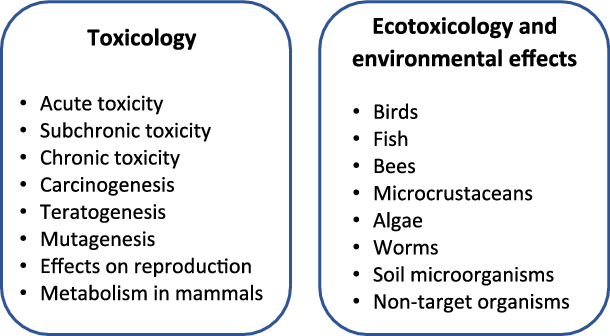
The agency that regulates and approves crop protection products in Argentina is the SENASA (National Agrifood Health and Quality Service), which conducts an evaluation of the information submitted. Pesticide approval is based on the evaluation of multiple studies aimed at assessing the impact of these technologies on human health and the environment. Studies required to evaluate toxicity, ecotoxicity, and environmental fate (Figure 1), as well as to characterize product chemistry, are detailed in Resolution 350/99 (SAGPyA 1999). These studies are conducted according to international guidelines (Organization for Economic Cooperation and Development) and in compliance with good laboratory practices (GLP) to ensure the integrity of the data generated and the repeatability of the results. In addition, efficacy of the formulation and residue of the active ingredient on treated crops is evaluated under local conditions. Confidential information regarding composition, analytical methods, justification of impurity formation, and details of the manufacturing process is also submitted to the agency by the applicants.
Summary of analyses required for pesticide evaluation and approval in Argentina. Similar analyses are required in other South American countries.

Local studies to evaluate the formulated product efficacy must be performed in three agroecological regions defined by the regulatory agency. Also, local studies to assess residues on treated crops must be performed in these three agroecological areas under GLP principles. The results are used to set the maximum residue limits in Argentina.
All approved pesticides are listed in the National Registry of Crop Protection products maintained by the SENASA. Authorized uses and recommendations, at the national level, are detailed in the pesticide label. In some cases, regional, state, or municipal decisions could result in use restrictions or even banning of a pesticide, because each province can add its own regulation for product use and environmental protection, in which case, the province is responsible for enforcement. Counties are allowed to generate further regulations and restrictions.
Pesticide Registration in Uruguay
Pesticide registration and use in Uruguay is regulated by the MGAP (Ministry of Livestock, Agriculture and Fisheries) through one of its agencies, the DGSA (General Direction of Agricultural Services). For a pesticide product to be commercialized in Uruguay, the manufacturer, importer, or distributor of the product must register each individual formulation following the procedures detailed in Decree 149/977 (DGSA 1977).
The registration process is based on three main aspects of the candidate product: chemical quality, toxicology, and agronomic efficacy. The registrant must provide all data related to physical and chemical properties of the formulation, and these properties are corroborated by the DGSA lab. Physical and chemical requirements must follow Food and Agriculture Organization of the United Nations (FAO) and/or European Union (EU) standards, whichever is the stricter for a given parameter.
Toxicological information of the active ingredient is analyzed by the CIAT (Toxicological Information and Advice Center), which depends on the College of Medicine of the National University. The CIAT establishes the toxicological category of the product and first aid measures. Information on the efficacy and selectivity of the product must be included in the dossier, and local field experiments, which are regularly inspected by DGSA officers, must be performed to corroborate this information. Harvest waiting times (preharvest intervals) are set by DGSA for the maximum residue limits to comply with the Codex Alimentarius, a set of guidelines and standards to ensure food quality and safety.
These are the main considerations when generating the first draft of the label, which, after revisions by the DGSA, will constitute the final approved and legal label. The MGAP, Ministry of Public Health, and MVOTMA (Ministry of Housing, Territorial Planning and Environment) are currently reviewing the pesticide registration process in Uruguay through a project partially founded by the FAO. The draft of a new proposal suggests the incorporation of the MVOTMA in the registration process and greater emphasis on the revision of possible environmental impacts and fate of the pesticides that enter the registration process.
Pesticide Registration in Brazil
In Brazil, three agencies are responsible for pesticide registration: the ANVISA (Brazilian Health Regulatory Agency), which is responsible for analyses of the toxicological brief; IBAMA (Brazilian Institute of the Environment and Renewable Natural Resources), which analyses the environmental aspects of a given molecule; and MAPA (Ministry of Livestock Agriculture and Supply), which analyses the agronomic aspects of the candidate molecule. The MAPA also analyses all reports and issues the approval and label brief. Registration is permanent if no health, environmental, or agronomic concern is observed. The norms that indicate all the information that is required to achieve registration are detailed in Act 4074/2002 (Planalto 2002).
Pesticide Registration in Colombia
In Colombia, the ICA (Colombian Agricultural Institute) is the national authority that issues resolutions corresponding to the procedures and requirements for registration of pesticides for agricultural use. The ICA is responsible for ensuring the compliance of the technical manual related to Decision 436 of the Andean Community. The technical manual, issued by the Andean Community, harmonizes the rules for pesticide registration and control in Bolivia, Colombia, Ecuador, and Peru to ensure that the pesticides approved for production and for use in agriculture have agronomic efficacy and protect the environment and human health (Comunidad Andina 2002). The ICA is authorized to issue special permits in cases of active ingredients or formulated products not registered in Colombia but needed for research or sanitary emergencies (ICA 2003).
To begin the process of pesticide registration in Colombia, manufacturers, formulators, importers, exporters, packers, and distributors must be registered at ICA and must comply with the provisions and obligations demanded by the national authority (ICA 2003). The ICA is responsible for establishing the technical registration requirements, including information on both the technical active ingredient and the formulated product. Information requested corresponds to the properties of the active ingredient, its toxicological effects on mammals and other species, metabolites produced after their degradation and activity, and its effects on the environment.
Likewise, the registration process must include efficacy tests carried out by technical departments registered with the ICA (ICA 2003) to ensure the usefulness of the product. These tests are the basis for providing objective information on the ability of the pesticide to produce the effects against the pest as indicated on the label, based on studies carried out under local conditions (Comunidad Andina 2002). The evaluation must consider the risk of evolution of resistance, either referenced by national or international studies, and must establish strategies for resistance detection and management (Comunidad Andina 2002). Registration is granted when the results of the evaluation demonstrate that the benefits outweigh the risks involved in the use of the pesticide (ICA 2003).
The South American countries discussed here have very strict requirements for their pesticide regulation systems. In all cases, human and animal health and potential impact on the environment are evaluated and considered, together with agronomic efficiency, during the process of approval of new pesticides or reevaluating old ones.
What Is the Source of the Pressure to Ban Herbicides?
Today there is very high pressure worldwide from public audiences regarding the use of crop protection products in agriculture. Some environmental groups, organic crop growers, public figures (actresses, actors, soccer players, musicians), law regulators, bloggers, region leaders, and nonprofit organizations, among other voices, and the general media are calling for the banning or restriction of pesticides in general and some herbicides in particular. Glyphosate is the single most-debated herbicide and is most often targeted for banning. The messages from these various groups or individuals are often weakly or not all backed up by scientific data. These messages with confused, misleading content or wrongly interpreted data are amplified by media and social networks. Once a topic or fear is established, it is very difficult to debunk it. Also, more and more often this topic is used in political campaigning.
Concerns are centered on possible impacts of some products on the environment, human health, pollinators, and animals. Concerns arise mainly from claims of pesticide presence, most of the time below the safety limits, in food, water (rivers, lagoons, etc.), cotton fibers, and urban areas and drift to residential areas or school buildings. These concerns should not be underestimated, because public perception and general opinions influence policy makers and, therefore, registration and regulation of pesticides. These concerns should be addressed, because raising unfounded or irrational fears among the population and promoting herbicide bans that are not based on scientific data could create more serious problems, which is not good for anyone.
The public does not trust the regulatory system nor are they fully aware of what the regulatory system does and the data that are reviewed to regulate pesticide registration. The general population’s lack of trust in the regulatory system can lead to a reduction of the tools currently available for weed control and force the production system to use old techniques that can be less environmentally friendly. One example of this is the need to go back to tilling because of the banning of key herbicides for weed management. It is one thing to propose reevaluation of a substance based on real problems and then rely on the reevaluation results to be confident of its safety, but it is another thing to reject the reevaluation results and persist with arguments that have been proven wrong. Therefore, it is critical to institute outreach efforts that communicate with the general public and educate people about the strict procedures that are in place in the different agencies worldwide to regulate, authorize, and reevaluate the technologies used to produce safe and nutritious food to feed an increasing world population.
Approved Pesticide Review Process
Each pesticide regulation agency has its own procedures for addressing concerns related to an approved product. There are well-defined and specific steps that need to be followed in reviewing a product. The review could end the continuous approval given for a pesticide’s use, place restrictions on use under certain conditions, ban the product, or support its current registration.
Approved Pesticide Review in Argentina
In Argentina, Resolution 350/99 (SAGPyA 1999), chapter 18, mentions the conditions that could trigger a process of cancellation or modification of a registration already granted when the authorized use may cause unacceptable adverse effects on human health or the environment.
The competent authority, currently the SENASA, will not initiate a risk analysis of a plant protectant product already registered until it has sufficient background to justify this procedure. Once the need for a risk analysis of a product is established, it is officially communicated to the companies that manufacture or sell the product, informing them of the existence of evidence that justifies implementation of a risk analysis review.
The competent authority will establish the information and the studies to be conducted by all affected companies, with the distribution of tasks and costs being the responsibility of the companies. The competent authority will only accept one presentation per affected product, and all the companies that have registered that product have to accept the competent authority´s decision.
At the end of the risk analysis process, the SENASA decides if the registration of a plant protection product is cancelled, if some uses of the product are cancelled, if the product is reclassified according to risk, if the application methods are restricted, if certain formulations are cancelled, if there is any other type of modification in the product registration, or if no changes are required.
Approved Pesticide Review In Uruguay
In Uruguay, there are two main reasons for a herbicide, or other pesticide, to be placed in reevaluation: 1) international (mainly EU) dispositions that prohibit the use or limit to zero the allowed residue on food and grains of a specific pesticide; and/or 2) detection of pesticides on food or in water that exceed the acceptable concentration verified by tests that government official laboratories perform regularly.
Approved Pesticide Review In Brazil
In Brazil, Resolution 4074 (Planalto 2002) established that MAPA, ANVISA, and IBAMA are the government entities responsible for reevaluating pesticides and their components when there is evidence of risks from the use of the pesticide or when the country is alerted by signatory international organizations of potential risks associated with food, health, and the environment.
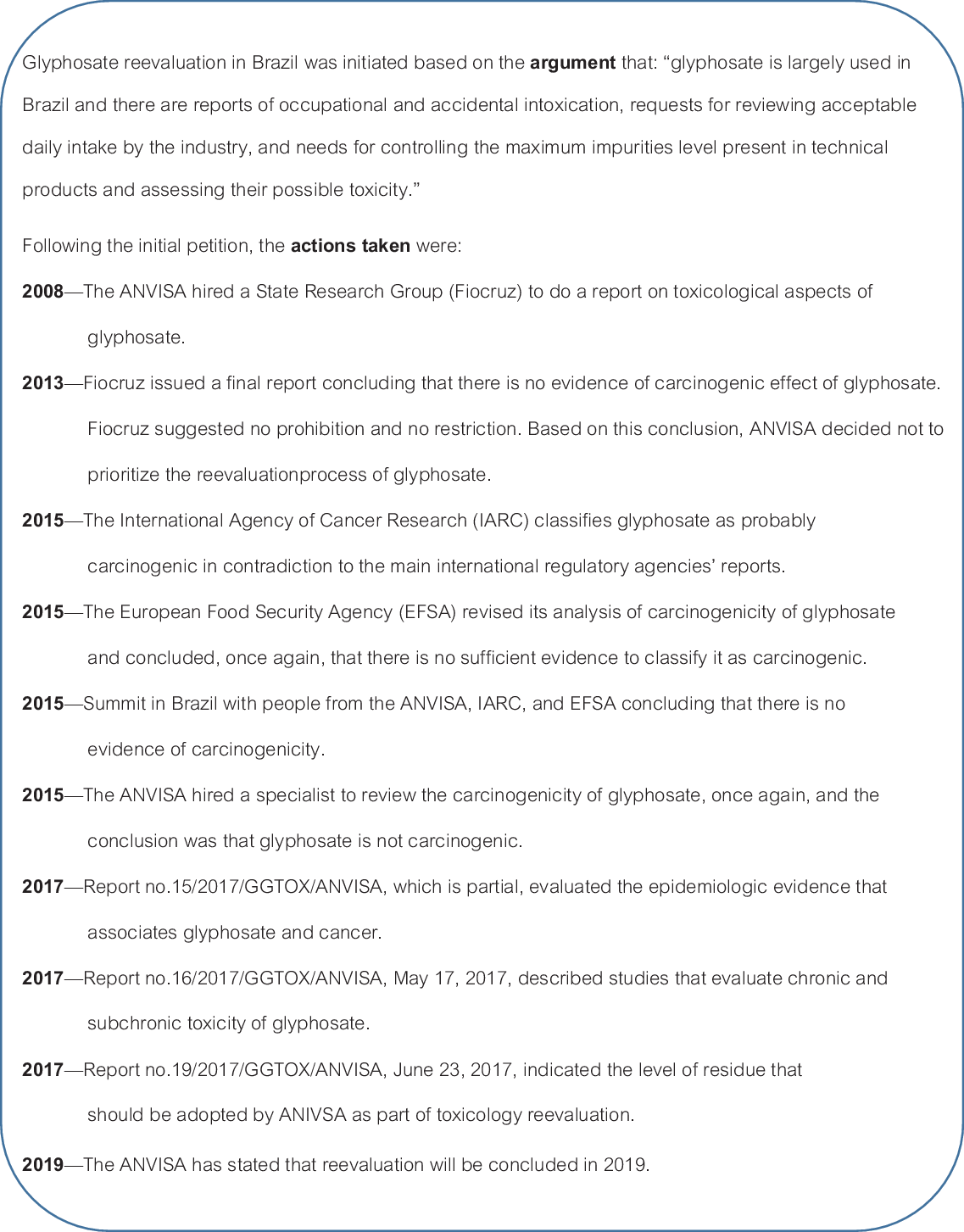
The herbicide lactofen went through a reevaluation that was concluded in 2016, and its registration was maintained without change. Glyphosate is currently under review in Brazil in a process that started in 2008 (RDC Anvisa 2008) (Figure 2).
Timeline of events surrounding the glyphosate reevaluation process in Brazil.

Approved Pesticide Review in Colombia
ICA’s Resolution No. 03759 (December 16, 2003) determines the regulations regarding the registration and control of pesticides for agricultural use in Colombia, complementing Decision 436 and its technical manual (ICA 2003). The registration of each pesticide is valid indefinitely; however, the ICA on its own or at the request of third parties could initiate follow-up studies. The data generated in the studies could result in relevant measures of suspension, cancellation, or modification of the original conditions (ICA 2003). Article 31 of this resolution and Resolution 3497/2014 describe the procedures for the reevaluation of chemical pesticides for agricultural use registered before Decision 436.
There is pressure from environmental groups to restrict or regulate the use of some herbicides, due to the ecotoxicological effects that they may have, as in the case of paraquat and glyphosate; however, there are no documents developed in Colombia that support such proposals for these herbicides.
Herbicide Use Restrictions and Bans in South America
Herbicide Use Restrictions and Bans in Argentina
In Argentina, as of December 2019, the only herbicide with its use restricted by the SENASA is aminotriazol (SENASA 2019a) for use in tobacco (Nicotiana tabacum L.), but currently there are no formulated products with this active ingredient registered in the National Registry of Crop Protection Products.
Some provinces have restrictions in place for spraying certain 2,4-D ester formulations within the whole territory of the province or in some specific areas and during periods of the year when certain weather conditions occur, such as high temperatures and low relative humidity. Some restriction examples are: La Pampa, prohibited all year (La Pampa 2019); Santa Fe, prohibited all year (Santa Fe 2015); Córdoba, restricted from August to March (Córdoba 2016) and all year in some areas of the province; Buenos Aires, restricted from October to March (Buenos Aires 2016); and Tucumán, restricted all year for certain volatile formulations (Tucumán 2017).
The herbicides banned by the SENASA in Argentina through December 2019 are: 2,4,5-T, allyl alcohol, dinoterb, DNOC, and mercury phenyl acetate (SENASA 2019a), none of which is currently in the National Registry of Crop Protection Products. Products formulated with butyl and isobutyl esters of the active substance 2,4-D will be prohibited from commercialization and use in Argentina starting April 25, 2021 (SENASA 2019b, 2019c).
Although there are some cities that banned glyphosate use within city limits, glyphosate can still be used for agricultural production in Argentina. There is only one ban that we are aware of, effective June 4, 2019, that goes beyond urban limits. This ban covers Chubut Province in the Patagonia region where there is no extended agriculture (Chubut 2019).
One area where many resolutions and restrictions are taking place in Argentina pertains to buffer zones for applications. At a national level, the Ag-Industry Ministry recommends leaving 100 m and 200 m from urban areas for terrestrial and aerial applications, respectively (Ministerio de Agricultura, Ganadería y Pesca de la Nación 2013). Distances could be reduced by an agronomist under optimum weather conditions. However, provinces and counties can set their own application distances from urban areas, which generates a complex compendium of regulations, most of them summarized in the CREA legal map (CREA 2019).
Herbicide Use Restrictions and Bans in Uruguay
In Uruguay, paraquat is the only herbicide that needs a professional prescription for agricultural use. Use of paraquat and possible banning of this product are being discussed by the DGSA and the crop protection companies, as paraquat is recommended for listing in Annex III of the Rotterdam Convention (VanDorn Reference VanDorn1999).
Auxinic herbicides are not under restricted use, and two ester formulations of 2,4-D are currently registered. However, the use of ester formulations of 2,4-D is extremely rare in Uruguay, while the dimethylamine salt of 2,4-D is widely used.
In May 2019, the city government of the Uruguayan capital, Montevideo, banned the use of glyphosate or other synthetic herbicides for the maintenance of public green spaces. However, the only herbicide banned for agricultural use is atrazine.
Herbicide Use Restrictions and Bans in Brazil
Paraquat was reevaluated in Brazil from 2008 to 2017, because several studies showed high acute and chronic toxicity. In 2017, after the review was concluded, paraquat was temporarily banned. This ruling caused immediate reaction from producers, researchers, producer cooperatives, farmer associations, and congressional leaders, as the herbicide is widely used to manage herbicide-resistant weeds. Because of this intense opposition to the ban, the ruling was reviewed and a use restriction was issued from September 22, 2017, to September 22, 2020, when paraquat will be permanently banned (ANVISA 2017). Paraquat can be used exclusively for burndown applications on annual crops. Paraquat can no longer be used in avocado (Persea americana Mill.), pineapple [Ananas comosus (L.) Merr.], asparagus (Asparagus officinalis L.), beet (Beta vulgaris L.), cacoa, coconut (Cocos nucifera L.), cabbage (Brassica oleracea L.), forage crops, peach [Prunus persica (L.) Batsch], pear (Pyrus communis L.), sorghum, rubber tree [Hevea brasiliensis (Willd. ex A. Juss.) Müll. Arg.], or vineyards. Paraquat can no longer be sold in small containers, and applications must be performed using a tractor. Aerial and manual applications and use of open-cab tractors are not allowed.
The 2,4-D ester formulation was banned in early 2000 because of volatility and its effects on sensitive crops. Currently, there are discussions pertaining to the release of new technologies of 2,4-D and dicamba, especially in the Rio Grande do Sul region, and the potential effects of auxinic herbicides on sensitive and high-value crops.
Herbicide Use Restrictions and Bans in Colombia
In Colombia there are only two prohibitions, aerial application of paraquat (Resolution 3028 of 1989 ICA) and the use of 2,4,5-T and 2,4,5-TP (Resolution 749 of 1979 ICA).
Opportunities for Better Handling and Herbicide Use
It is key to communicate pesticide best management practices (BMPs). It is also important to provide training for applicators. Public and private institutions in Argentina, many of them grouped under the BMP network (Red BPA 2019) are providing pesticide application training, led by the CASAFE (Chamber of Agricultural Health and Fertilizers), to applicators, growers, consultants, teachers, and the general public. Field days are frequently organized to demonstrate and train attendees on how to properly calibrate a terrestrial or aerial sprayer and the appropriate weather conditions for spraying. In addition, some provinces have ongoing programs for certified applicators. There is also media presence with the message of responsible pesticide use and BMPs. Actions like the ones mentioned here are also being conducted in Brazil and other countries in the region.
In addition, the use of herbicide prescriptions, not yet a general practice in Argentina, would contribute to better awareness of the products used. Finally, the CASAFE and other members of the BMP network in Argentina were actively engaged in advocating for the empty pesticide container law promulgated in 2016 (Argentina 2016) and are also working to promote the creation of a national law regarding urban applications.
Private and public institutions in Argentina are trying to effectively communicate to society that the crop production sector is committed to caring for the environment, using BMPs that include the responsible use of pesticides prioritizing human and environmental health. More communication is needed to help the general public understand how food is produced, especially those living in big cities. The messages need to be based on scientific evidence in language that is understandable and not too technical.
Similarly, in recent years Uruguay has enforced and implemented some actions and requirements oriented to ensure proper herbicide usage, including:
1. The need for a professional prescription to acquire some crop protection products. Currently, paraquat is the only herbicide included in the list. To prescribe these products, an agronomist needs to be registered in the online DGSA system. To obtain the prescription, an online form must be completed with information on the product, doses, and a georeference for the field to be sprayed.
2. Companies that offer spraying services must be registered in the Single Registry of Operators of the DGSA.
3. Each piece of equipment used in spraying (terrestrial or aerial) needs to be registered and authorized by the DGSA.
4. Each company must register the sprays performed each day in a central spraying registry.
5. A resolution from the MGAP (currently in the process of being implemented) states that companies that offer spraying services must install a monitoring device in each sprayer. This device must transmit in real time to a government database information for each spraying operation, including: geolocalization, signaling that the equipment is spraying, speed at which the sprayer is running, and flow rate of the spraying. This information is linked to the nearest weather station available. All this information can be used in case of complaints about pesticide misuse. DGSA has a system for entering and processing complaints.
6. Each person who performs a pesticide application must have a certified pesticide applicator license, which is granted after approval of an applicators course organized by DGSA.
In Brazil, similar to some of the points mentioned above, 100% of the pesticides bought by a farmer must have a pesticide prescription written by an agronomist. Also, Brazil is a world leader in empty container recycling, which reduces the potential impact of residues on the environment. Training of farmers and technicians is constantly conducted by researchers, cooperatives, companies, and others involved with agriculture. Perhaps the greatest challenge is to educate agricultural workers on the importance of their job in protecting themselves, the environment, and human health. Opportunities for training are not the problem. The problem is the consistency of how things are done on the daily basis during handling and application of herbicides. It is critical to show and educate the nonagricultural population the importance of agriculture and the responsibility that they have in being well informed.
Final Remarks
It is clear that pesticide use is a growing concern for the public, and this concern cannot and should not be ignored. On the other hand, pesticides are a key component of production systems and, in some cases, they contribute to more environmentally sound production systems such as no-till, which contributes to preserving soil. Each country has its own pesticide regulatory framework, and they all work toward ensuring that the pesticides approved for use in agriculture are effective controlling the targeted pests and are also safe for humans, animals, and the environment. There are opportunities that allow for reevaluation of pesticides when there are reasonable concerns. Therefore, trust in regulatory systems is imperative.
It is important to keep providing training for pesticide handlers and applicators and communicating about the importance of adopting BMPs. On the user side, it is key to follow label instructions and dispose of pesticide containers in a responsible way. After all, we are all aiming for the same goal, increasing production using our resources in the most efficient way while protecting our environment. For the general public, it is key to understand that there is a regulatory framework in place that ensures the safety of products used in agriculture. The conversation needs to take place based on science while considering the emotions and concerns of the general public.
Acknowledgments
The authors would like to thank Carol Mallory-Smith for reviewing and providing feedback during the manuscript preparation. No conflicts of interest have been declared. This research received no specific grant from any funding agency or the commercial or not-for-profit sectors.