Persistent pleural effusion soon after the modified Fontan procedure continues to represent the key morbidity that prolongs stay in the intensive care unit and in hospital. Although the mechanism of pleural effusion remains somewhat obscure, many investigators have found that the inflammatory response at least partially contributes to the development of pleural effusion.Reference Gupta, Daggett, Behera, Ferraro, Wells and Starnes1–Reference Mainwaring, Lamberti and Hugli4 We previously reported that an open anastomosis technique using vacuum-assisted venous drainage at the insertion of an extracardiac conduit for total cavopulmonary connection simplifies the surgical procedure.Reference Aeba, Yozu, Morita and Matayoshi5 We postulated that this technique could reduce inflammatory response activation with minimal dissection of the mediastinum and shorten the cardiopulmonary bypass run. This study therefore determines whether open anastomosis helps to decrease pleural effusion in patients after the modified Fontan procedure.
Methods
Study design and patient population
The local institutional review board has approved the study. Individual consent for the study was waived. A single surgeon (R.A.) performed 33 modified Fontan procedures between January, 1999 and December, 2008 at Keio University Hospital. Inclusion criteria for this study were total cavopulmonary connection completion after a previous bidirectional cavopulmonary shunt without additional pulmonary blood flow; use of an extracardiac conduit with a polytetrafluoroethylene tube graft (GORE-TEX® Stretch Vascular Graft, W. L. Gore and Associates, Flagstaff, Arizona, United States of America) between the inferior vena cava and the ipsilateral branch pulmonary artery; with or without other minor concomitant procedures, such as a prophylactic atrial wall isthmus anti-arrhythmic blockade for basis and enlargement of an atrial septal defect that required only a short period, less than 10 minutes, of cardiac arrest; and use of a 0.1-millimetre polytetrafluoroethylene membrane (PRECLUDE® Pericardial Membrane, W.L. Gore & Associates, Flagstaff, Arizona, United States of America) at the previous bidirectional cavopulmonary shunt procedure on the anterior aspect of the heart and great vessels to prevent sternal adhesion. Exclusion criteria were concomitant time-consuming procedures at the total cavopulmonary connection such as Damus–Kaye–Stansel anastomosis, pulmonary arterial augmentation, and atrioventricular valve repair; addition of a fenestration; previous hemi-Fontan procedure; individual hepatic vein drainage to the atrium; the presence of aortopulmonary collateral vessels; and repeated Fontan procedure, such as total cavopulmonary connection conversion after atriopulmonary connection. Sixteen patients satisfied the above criteria for participation in this study.
Surgical details
After intravenous administration of methylprednisolone (30 milligrams per kilogram), a repeated midline sternotomy was applied to all of the patients. The femoral or axillary vessels were not exposed. The previously positioned substernal polytetrafluoroethylene membrane was removed.Reference Jacobs, Iyer and Weston6 The cannulae for cardiopulmonary bypass were placed in the ascending aorta and both the superior and inferior vena cavae. Rectal temperature was maintained at equal to or higher than 33°C in all patients during the cardiopulmonary bypass run. Pump flow and haematocrit were maintained at 3 litres per minute per square metre and higher than 20%, respectively. Dilutional and modified ultrafiltrations were applied during and after the cardiopulmonary bypass run, respectively. The criteria for using donor blood and vasoactive agents did not change throughout this study.
The anastomosis was closed in six patients (closed group) who were operated on between 1999 and 2003. Dissection was extensive in the pericardial cavities and fully circumferential in both the superior and inferior vena cavae, and over the entire length of the intrapericardial ipsilateral branch pulmonary arteries. The inferior vena cava was snared with tape during the anastomosis. The veins were similarly drained for cardiopulmonary bypass as in other open cardiac procedures. The pulmonary artery and/or superior vena cava was clamped during anastomosis of the pulmonary arterial incision on the inferior aspect and conduit.
Open anastomosis was applied to the remaining 10 patients (open group) who were operated on between 2004 and 2008. Pericardial dissection was limited to the anterior aspect of the right atrial wall, the cannulation sites for the aorta and both the cavae, and to a limited extent over the length of the inferior aspect of the right branch pulmonary artery. Both the cavae were left unsnared using surgical tapes. Direct caval cannulation was achieved using multi-hole venous cannulas (Flexmate TWN, Toyobo, Co. Ltd, Osaka, Japan), and aggressive vacuum-assisted venous drainage was applied during cardiopulmonary bypass.Reference Aeba, Yozu, Morita and Matayoshi5 A minimal negative pressure was adjusted between minus 40 and minus 80 millimetres of mercury to achieve a bloodless operative field. All the stitches for both anastomoses of the conduit were completed during the open method using vacuum-assisted venous drainage.
Post-operative management
The standardised protocol included intravenous furosemide (1 milligram per kilogram) every 6 hours until the chest tube was removed, unless an electrolyte imbalance or renal malfunction developed. After weaning from mechanical ventilation, 2 litres per minute of supplemental oxygen were delivered via a nasal cannula as a pulmonary vasodilator, regardless of systemic saturation. Chest tubes were removed when drainage decreased to 100 millilitres per day.
Data acquisition and statistics
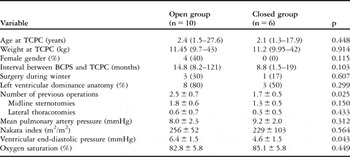
Patient demographics and perioperative data were retrospectively collected (Table 1). Pre-operative cardiac catheterisation data were obtained for all of the patients. Continuous variables are presented as means with standard deviation of the mean for normally distributed data, and as medians (range) for non-normally distributed data. Dichotomous variables are presented as counts and ratios (%). Categorical variables were compared using Fisher’s exact test. Continuous variables were compared using Student’s t-test or the analysis of variance with repeated measures for normal distribution data when appropriate. Otherwise, the Mann–Whitney U-test was applied.
Baseline characteristics.

BCPS = bidirectional cavopulmonary shunt; TCPC = total cavopulmonary connection
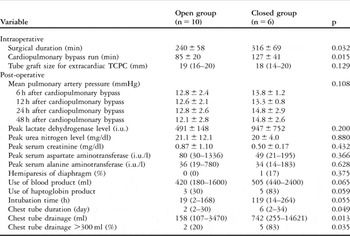
Table 2 shows a comparison of the operative and early post-operative endpoints of the open and closed groups. Correlation between the surgical duration and chest tube drainage duration was assessed using Spearman’s non-linear regression analysis. We evaluated pleural effusion using two surrogates: days and total amount of chest tube drainage. A greater amount of pleural effusion was defined if the total volume of chest tube drainage was more than 300 millilitres. Independent risk factors were identified using stepwise logistic regression with backward selection.
Operative and early post-operative results.

TCPC = total cavopulmonary connection
All statistical calculations were performed using the statistical package SPSS for Windows version 13 (SPSS Inc., Chicago, Illinois, United States of America).
Results
Table 1 shows the baseline characteristics of the 12 male and four female patients. The median age and weight were 2.3 years, with a range from 1.3 to 27.6 years and 11.4 kilograms, with a range from 9.7 to 43 kilograms, respectively. The median duration between the previous bidirectional cavopulmonary shunt and total cavopulmonary connection was 12.6, with a range from 1.5 to 121 months.
The underlying disease for these patients included double-inlet ventricle, tricuspid atresia, pulmonary atresia with intact ventricular septum, and heterotaxy syndrome. Baseline variables did not significantly differ between the two groups except for the number of previous operations (p = 0.025) and pre-operative ventricular end-diastolic pressure (p = 0.043), which were potentially beneficial for the closed group.
No re-entry injuries occurred during repeat sternotomy and the sternum was closed in all patients. The cardiopulmonary bypass run and surgical duration were significantly shorter in the open than in the closed group (p = 0.013 and p = 0.033, respectively).
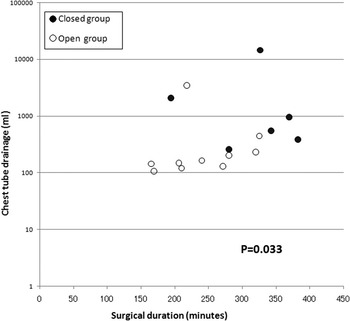
The post-operative pleural effusion results were better in the open than in the closed group, as represented by chest tube duration (p = 0.049), total amount of chest tube drainage (p = 0.013), and the ratio of patients having more than 300 millilitres of chest tube drainage (p = 0.035). None of the patients required chest tube re-insertion for residual or recurrent pleural effusion. Correlation analysis demonstrated a significant relationship between the amount of pleural effusion and surgical duration (correlation efficient, 0.535; p = 0.033) as shown in Figure 1. Logistic regression revealed that the closed group (odds ratio 20.0; 95% confidence interval 1.4–283; p = 0.027) was an independent risk factor for chest tube drainage of more than 300 millilitres.
Relationship between surgical duration and post-operative chest tube drainage. Surgical duration was longer in the closed group (closed circle) than the open group (open circle), which was associated with more chest tube drainage.

Marginally less blood and haptoglobulin products were used and intubation time was marginally shorter in the open group. Mean pulmonary arterial pressure during the first 48 hours after cardiopulmonary bypass was similar in both groups. Laboratory markers of haemolysis and hepatic/renal function, such as lactate dehydrogenase, aspartate aminotransferase, alanine aminotransferase, urea nitrogen, and creatinine, were also similar in both groups. No neurologic complication developed after surgery in both groups.
Follow-up catheterisation was performed in 15 out of 16 patients (94%) 6–23 months after the Fontan procedure. No patients showed the pressure gradient across the anastomosis site of greater than 1 millimetre of mercury.
Discussion
This study demonstrated that the open anastomosis technique using vacuum-assisted venous drainage for cardiopulmonary bypass was associated with a reduction in both the amount and duration of pleural effusion drainage.
Pleural effusion continues to represent early morbidity after the Fontan procedure. Risk factors for prolonged pleural effusion identified by others include longer cardiopulmonary bypass duration,Reference Gupta, Johann-Lian, Sison, Quaegebeur and Friedman2 younger age of the patient at the Fontan operation,Reference Gupta, Daggett, Behera, Ferraro, Wells and Starnes1 no fenestration,Reference Lemler, Scott, Leonard, Stromberg and Ramaciotti7 associated aorto-pulmonary collateral vessels,Reference Spicer, Uzark, Moore, Mainwaring and Lamberti8 surgery scheduled during the winter,Reference Fedderly, Whitstone, Frisbee, Tweddell and Litwin9 ventricular diastolic dysfunction,Reference Garofalo, Cabreriza and Quinn10 lower pulmonary vascular compliance,Reference Yun, Im and Jung11 and a hypoplastic left cardiac syndrome anatomy.Reference Gaynor, Bridges and Cohen12
Although the mechanism of pleural effusion in patients undergoing a modified Fontan procedure can be multi-factorial, it can be partly explained as pro-inflammatory cytokine activation.Reference Gupta, Johann-Lian, Sison, Quaegebeur and Friedman2–Reference Mainwaring, Lamberti and Hugli4 Prolonged surgical duration should affect pro-inflammatory factors, which indeed were associated with increased duration and amount of chest tube drainage in our series. A shorter surgical duration per se might be an important factor to attenuate this morbidity. Our open anastomosis technique shortens surgical duration, because intra-pericardial superior vena cava, inferior vena cava, and the right branch pulmonary artery are not extensively dissected in a circumferential manner. It is arguable that surgical duration might no longer be a risk factor for prolonged pleural effusion among non-Fontan surgical patients. However, extended surgical duration for patients undergoing a modified Fontan procedure might upset the delicate balance required for adequate flow through the circuit with unique circulation during the early post-operative period. A marginally shorter intubation time in the open group may be another possible explanation for less pleural effusion, because positive-pressure ventilation on the pulmonary blood flow passively driven in Fontan circulation gives a negative haemodynamic effect.Reference Lofland13
Open anastomosis in the present series shortened the cardiopulmonary bypass run, which is a known activator of pro-inflammatory cytokines.Reference Kawahira, Uemura and Yagihara3 Anastomosis of the inferior vena cava is easier and faster because the inferior vena cava stump is not crumpled. The open technique also helps to shorten pulmonary artery anastomosis because the vascular wall is often thin and fragile, and a wide open vascular lumen can allow generous and delicate suture handling and minimise suture drag that causes a needle hole. Many studies have shown that a shorter duration or even total avoidance of cardiopulmonary bypass during the modified Fontan procedure results in less pleural effusion accumulation, although the effect has been subclinical in more recent series with more sophisticated perioperative management. Another finding in our series is that our vacuum-assisted venous drainage for cardiopulmonary bypass does not cause haemolysis, which is a potential complication.
The important limitations of this study are its non-randomised, retrospective nature, and the relatively small numbers of patients in the surgical groups. The small sample limited the statistical power to detect differences in donor blood use and post-operative ventilation time, which might be significant in a larger group. This was a consequence of sacrificing sample size to maximise homogeneity in the patient populations of both groups, including the primary surgeon, surgical technique for the modified Fontan procedure, absence of fenestration, presence of staging, and the absence of technically unfavourable or physiologically unique anatomic characteristics. The two groups had surgery during different time periods with the open group more recently. Although the protocols and treatments did not change significantly, this study cannot account for some learning curves in the early post-operative management. Our study is a retrospective observation of clinical outcome and we have no laboratory values for pro-inflammatory cytokines that might support our hypothesis.
The study population consisted of only a few of the patients who underwent the Fontan procedure. We currently use the open anastomosis technique in many different modified Fontan operations, including intra-atrial conduits, the lateral tunnel procedure, and redo total cavopulmonary connection conversion at our institute. Moreover, in patients undergoing combined extracardiac conduit total cavopulmonary connection and other intracardiac repair, snare tapes for the cavae are loosened only during the conduit anastomosis.
Although the effect of open anastomosis on post-operative pleural effusion in these heterogeneous procedures is difficult to prove, it should be positive. Our open anastomosis technique is also useful for the acquisition of a better surgical field at some other types of systemic venous route reconstruction, such as pulmonary artery repair after cavopulmonary connection, repair of partial anomalous pulmonary venous connection with Scimitar syndrome and high superior vena cava connection, and rerouting of the left superior vena cava for coronary sinus unroofing syndrome. Corno et alReference Corno, Horisberger, David and von Segesser14 advocated the unsnaring of the inferior vena cava in an extracardiac Fontan procedure to facilitate the surgical technique using a self-expandable cannula through the femoral vein cannulation. We share the usefulness of the open anastomosis with them, and applied an other anastomosis to the pulmonary artery using vacuum-assisted drainage, which should further minimise the pericardial dissection.
In conclusion, this study confirmed that open anastomosis with vacuum-assisted venous drainage for the Fontan operation shortens the cardiopulmonary bypass run and surgical duration, both of which might be associated with the attenuation of pleural effusion development soon after the procedure.
Acknowledgements
The authors have no disclosures, including no relationships with pharmaceutical companies, biomedical device manufacturers, or other corporations whose products or services are related to the subject matter of this article.