INTRODUCTION
The quality and quantity of suspended solids (SS) found in marine and estuarine environments are important for the fitness of suspension feeders. Under low quantity conditions, suspension feeders may not be able to survive because of low food supply. High levels of SS would contain sufficient food particles, but these particles may cause death as they can clog feeding organs or cause physical damage (Rhoads & Young, Reference Rhoads and Young1970; Cranford & Gordon, Reference Cranford and Gordon1992; Chauvauld et al., Reference Chauvaud, Thouzeau and Paulet1998; Lorrain et al., Reference Lorrain, Paulet, Chauvaud, Savoye, Nezan and Guerin2000). It is therefore important that suspension feeders select habitats with an optimal SS condition for their survival and growth, and the amount of SS (i.e. turbidity) can often be a factor determining the distribution of suspension feeders (e.g. Murphy, Reference Murphy1985, Ellis et al., Reference Ellis, Cummings, Hewitt, Thrush and Norkko2002).
However, most suspension feeders including bivalves, barnacles, polychaetes and ascidians are less mobile, and the opportunity for habitat selection is fundamentally restricted to the planktonic larval stages. Turbidity can vary greatly both spatially and temporally in estuaries. After settlement, suspension feeders may encounter conditions with unfavourable turbidity for feeding and survival either temporarily or permanently. In several estuaries, suspension feeders can experience up to 500 mg/l SS due to tidal resuspension (e.g. Navarro Widdows, Reference Navarro and Widdows1997). Suspension feeders should, therefore, have evolved some physiological and/or morphological ability to cope with a range of turbidity conditions other than habitat selection.
In suspension-feeding bivalves, controlling particle intake is the main tactic for coping with variations in turbidity. Particle intake is an interactive process of particle capture by the gills and subsequent particle selection by the labial palps and/or gills. Many bivalve species regulate their particle intake depending on the quality and/or quantity of particles: they control particle capture by altering clearance rate, and then sort out a part of the captured particles as pseudofaeces, using their pallial organs (reviewed in Ward & Shumway, Reference Ward and Shumway2004). Functional abilities are often related to the size of the pallial organs, and size variations in pallial organs based on habitat turbidity have been identified in several bivalve species including the Pacific oyster Crassostrea gigas (Barillé et al., 2000; Honkoop et al., Reference Honkoop, Bayne and Drent2003), the mussel Mytilus edulis (Theisen, Reference Theisen1982), the zebra mussel Dreissena polymorpha and the Asian clam Corbicula fluminea (Payne et al., Reference Payne, Lei, Miller and Hubertz1995).
Scapharca kagoshimensis (synonymous with S. subcrenata) is an arcid bivalve with homorhabdic filibranch gills that has no syphon and lives buried in the surface sediment to approximately 5-cm depth. In the inner part of Ariake Bay, Japan, S. kagoshimensis is a dominant species with high biomass in this area (Yoshino et al., Reference Yoshino, Yamamoto, Hayami, Hamada, Kasagi, Ueno and Ohgushi2007, Reference Yoshino, Yamamoto, Hayami, Hamada, Yamaguchi and Ohgushi2009) and it is commercially important. In Ariake Bay, S. kagoshimensis are distributed mainly at the edges of the intertidal to subtidal zones with a muddy bottom about 5-m deep. They also inhabit areas where the bottom consists of a fine sandy substrate (e.g. Yoshino et al., Reference Yoshino, Yamamoto, Hayami, Hamada, Kasagi, Ueno and Ohgushi2007, Reference Yoshino, Yamamoto, Hayami, Hamada, Yamaguchi and Ohgushi2009) where levels of turbidity are lower than areas with a muddy bottom.
In this study, we aimed to determine how S. kagoshimensis exploits such a wide range of habitat substrates. We compared the shell morphology and several pallial organs of individuals collected from areas with muddy and sandy bottoms that differed in turbidity. Individuals from a muddy bottom may have to actively select particles (i.e. produce pseudofaeces) captured by the gills using the labial palps, leading to the development of larger palps. The large adductor muscle may also be needed for the quick action of shell opening and closing to efficiently eject pseudofaeces. Conversely, smaller gills may be an advantage in avoiding clogging or particle overloading. We therefore specifically focused on whether palps and adductor muscle are larger, but gills are smaller in populations from muddy bottom than from sandy bottom. We also observed whether the foot is larger in sandy bottom than in muddy bottom, because sediment hardness differs between muddy and sandy bottoms, and burrowing into sandy bottoms is probably more difficult.
MATERIALS AND METHODS
Study site
Ariake Bay is located on the west coast of Kyushu Island, Japan, and the inner part forms an estuarine environment with large sand and mudflats because of the deep tide (~6 m). Chikugo River, which is the largest river in the Kyushu area, is located in the north-east, and riverine organic matter and nutrient input are mainly derived from the river. The western area has a muddy bottom and is characterized by high turbidity, occasionally reaching 1000 mg/l SS (Koh et al., Reference Koh, Khim, Araki, Yamanishi, Mogi and Koga2006). The eastern area has a sandy bottom and is relatively less turbid than the western area. We chose two sampling stations located in the subtidal zone at approximately 5-m depth in the inner part of Ariake Bay. One was an area with a muddy bottom substrate (Station A; N33°07′17.1′′ E130°10′44.2′′) and the other an area with a sandy bottom (Station B; N33°05′32.0′′ E130°17′20.0′′).
Sample collection of S. kagoshimensis
Grab sampling (Smith–McIntyre grab: 22.5 × 22.5 cm) was performed at both stations on 28 April 2010. The spawning season of this species is between July and August, although gonad development begins in April (Yurimoto et al., Reference Yurimoto, Mori, Ito and Maeno2008). The sampled sediment was sieved with a 1-mm mesh. Sampling was repeated until about 50 individuals were collected. All S. kagoshimensis individuals were fixed with 80% ethanol and brought to the laboratory. Twenty specimens of each station were dissected under a microscope after measuring the shell length (SL) and shell height (SH) with a calliper to the nearest 0.01 mm. We matched the size-range of individuals to ensure no differences between specimens taken from muddy (SL 24.5–35.2 mm) and sandy bottoms (SL 24.8–34.1 mm). The left inner and outer labial palps, left gills, posterior adductor and pedal muscles were separated from the soft parts. Foot was defined as the section from the byssal opening to the constricted section of the soft parts and these were removed with scissors for measurement. The size of the ascending lamella of the inner demibranch and the inner labial palp were measured by tracing them on paper; we estimated their size by weighing the paper of the traced part. Since bivalves have a pair of gills composed of 4 demibranchs and a pair of labial palps with inner and outer lamellae, we calculated the total size of the gill and labial palps by multiplying the value for one by 8 and 4, respectively. All separated tissues were also wet-weighed with an electric balance to the nearest 0.001 g, and then dried in an incubator at 60°C for 24 hours. The dried tissues were then weighed again. We also took 15 new specimens from the two stations, respectively, and measured shell width (SW) in addition to the SL and SH. Similarly we matched the size-range of the specimens between the two stations and calculated the shell morphological index (MI = [SH × 100]/[(SL × SW)/2]).
Sequencing of 18S rDNA and COI mtDNA
Although areas with muddy bottom contain only S. kagoshimensis, areas with fine sandy bottom can often contain a closely related species, S. inaequivalvis. While S. inaequivalvis can be discriminated from S. kagoshimensis by a large size asymmetry in the right and left shells, it was difficult with the present smaller size-range to differentiate the two species by morphological characteristics alone. Hence to confirm that the shells from both bottom substrates were all S. kagoshimensis, we sequenced 18S rDNA from three specimens newly collected from each of the muddy and sandy bottoms. We also sequenced the cytochrome c oxidase subunit I gene (COI) of mitochondrial DNA (mtDNA) because the sequences of this region for both S. kagoshimensis and S. inaequivalvis have been previously submitted to the DDBJ database by Matsumoto (Reference Matsumoto2003). COI was sequenced in 10 specimens from the sandy bottom and 5 specimens from the muddy bottom.
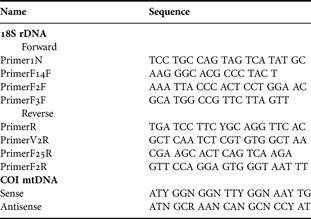
Template DNA was extracted from the foot of the frozen samples according to the spin column protocol of the Qiagen kit. Focal sequences were amplified by polymerase chain reaction (PCR) using several primers of each region (Table 1). The primers used for COI have been previously described by Matsumoto (Reference Matsumoto2003). Reaction volumes for 18S rDNA included 25 µl Taq DNA polymerase premixed with dNTP and buffer (Takara Ex Taq Version 2.0; TAKARA BIO INC, Japan), 0.5 µl each of the forward and reverse primers, and 1–5 µl template DNA, adding up Milli-Q water to 50 µl. Thermal cycling consisted of 5-minutes denaturing at 95°C, followed by 28 cycles of 10 seconds denaturing at 98°C, 1.5-minutes annealing duration at 59°C, 2 minutes elongation at 72°C, with a final elongation of 15 minutes at 72°C. PCR of COI mtDNA was also performed in a 50-μl reaction volume including 25 µl of Taq DNA polymerase premixed with dNTP and buffer, 1.5–3.0 µl of each primer, 1–2 µl template DNA and Milli-Q water. Thermal cycling for COI consisted of 3 minutes at 94°C, followed by 40 cycles of 30 seconds at 94°C, 1.5 minutes of annealing at 52–55°C and 2 minutes of elongation at 72°C, with a final elongation of 10 minutes at 72°C. All PCR products were purified using a Qiagen purification kit and sequenced. For the COI fragments, we investigated the percentage homology with the sequences of S. kagoshimensis (Accession no. AB034692) and S. inaequivalvis (Accession no. AB076937) in the DDBJ database using the BLAST program.
Primers used for sequencing of 18S rDNA and COI mtDNA of Scapharco kagoshimensis.

Physical condition of sampling stations
We used grab sampling to collect three sediment samples from each station on 9 September 2010. We evaluated the silt content and median particle size (phi notation, Md φ). Silt content was measured by dry sieving with a 63-μm mesh. Md φ analysis was performed by sieving sediment from the sandy bottom samples, and by using a laser diffraction analyser (SALD 3100; Shimadzu Co Ltd.) for the muddy bottom samples. We also collected five water samples from high to low tide using a Van Dorn sampler and brought these to the laboratory. The turbidity of the water samples was measured with a turbidity metre (Kasahara Chemical Instruments Co Ltd.). The water samples were also filtered on pre-weighed and -combusted (at 550°C for 4 hours) GF/F glass fibre filters (Whatman Co Ltd). The filters were dried at 60°C for 24 hours and the amount of SS was measured by weight gain after filtration. We measured the carbon and nitrogen content of the suspended substance on the filter together with their stable isotope values with a mass spectrometer (ANCA-GSL, Sercon Inc.) after removing carbonates by a 24-hours exposure to a 12-N HCl fume in a closed container. Stable isotope values were denoted δ, a measure of the amount of the heavier isotope in a sample relative to known standards, which were calculated as δ13C or δ15N = (Rsample/Rstandard−1) × 1000 (‰), where R indicates 13C/12C or 15N/14N, respectively. The standards for C and N were PeeDee belemnite and atmospheric nitrogen, respectively.
RESULTS
DNA sequence
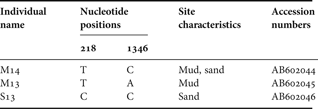
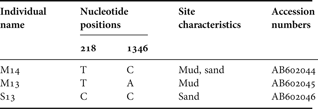
We found three haplotypes of 18S rDNA with a single nucleotide polymorphism in 1761 base pairs from 6 specimens (Table 2). Two haplotypes were distributed in each station (two individuals of M14 sequence and one individual of M13 sequence in the muddy bottom; two individuals of M14 sequence and one individual of S13 sequence in the sandy bottom). As a result, no difference was found between the two stations in nucleotide diversity, the values of which were 0.00038% in both stations.
Locations of individual-specific nucleotides in Scapharca kagoshimensis collected from different sites in the inner part of Ariake Bay. Numbers correspond to the nucleotide positions in the Barbatia barbata AF207646.
The length of the COI region sequenced satisfactorily was approximately 500 to 650 base pairs. The BLAST search demonstrated that the full sequences showed 100% homology with that of S. kagoshimensis but only 86–87% homology with that of S. inaequivalvis in all specimens (5 for Station A and 10 for Station B). This indicated that all of the sequenced specimens were S. kagoshimensis.
Physical conditions at the two sampling stations
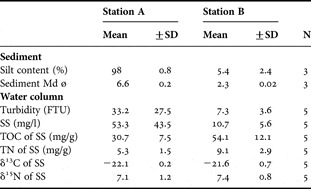
Table 3 summarizes the physical conditions at the two sites. Station A was an area with a muddy bottom and 98% silt content with a median particle diameter (Md φ) greater than 6, whereas Station B was an area with a fine sandy bottom, 5% silt content and a Md φ of 2.3. Turbidity was always higher at Station A compared with Station B during ebb tide, and the concentration of SS ranged from 17.8–126.8 mg/l at Station A and from 4.9–17.7 mg/l at Station B. Moreover, we detected significantly higher levels of total organic carbon (analysis of variance, F1,8 = 13.5, P = 0.006) and total nitrogen (F1,8 = 6.88, P = 0.031) per SS from Station B compared with Station A. However, the carbon and nitrogen isotopic signatures of the SS did not differ between the two stations (both F1,8 < 2.78, P > 0.13).
Sediment and hydrographic conditions of the two stations.

N, sample size; SD, standard deviation; SS, suspended solids; TOC, total organic carbon; TN, total nitrogen.
Morphological differences between the two sites
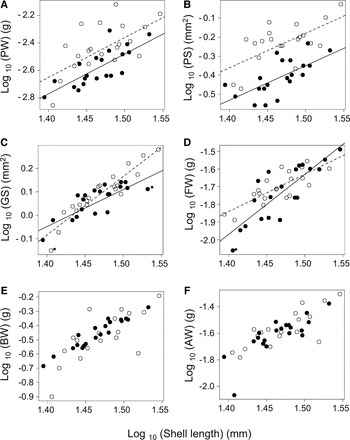
The dry weight and size of the labial palp was significantly larger at Station A compared with Station B (analysis of covariance after log-transformation with SL as a covariate, both F1,37 > 13.5, P < 0.0001; Figure 1A, B). No significant interactions between SL and stations was found (both F1,36 < 0.07, P > 0.78). While there was no significant difference in the dry weight of the gill between the two stations (F1,36 = 1.77, P = 0.19) and no significant station by SL interaction (F1,36 = 0.07, P = 0.79), there was a significant effect of station by SL interaction in terms of gill size (F1,36 = 6.62, P = 0.014; Figure 1C). However, this interaction was not found after the elimination of two influential data points (F1,34 = 1.5, P = 0.23), and no significant difference in gill size was found between the two sites (F1,35 = 2.7, P = 0.11). Similarly, we found a nearly significant interaction in the dry weight of the foot (F1,36 = 3.57, P = 0.067; Figure 1D). However, this trend disappeared after the elimination of one influential data point (F1,35 = 1.98, P = 0.17), and no significant difference in foot weight was found between the two stations (F1,36 = 1.82, P = 0.19). Hence, we could say that the size of the gill and the weight of the foot did not differ substantially between the two stations. The total dry weight of the soft body parts (Figure 1E) and the adductor muscle (Figure 1F) was not significantly different between the two stations (both F1,37 < 1.61, P > 0.16) or for the station by SL interaction (F1,36 < 0.64, P > 0.43). The shell morphological index (F1,28 = 0.83, p = 0.37) and a multivariate analysis of variance using shell height, length and width as dependent variables (Pillai's trace = 0.11, df = 3, 26; P = 0.40) did not identify any differences in shell morphology between the two stations.
Morphological variation in Scapharca kagoshimensis at the two stations: (A) dry weight of labial palps (PW); (B) labial palp size (PS); (C) gill size (GS); (D) dry foot weight (GS); (E) dry weight of total soft body parts (BW); (F) dry weight of posterior adductor muscle (AW). Open circles (with dashed lines) denote the muddy bottom station, closed circles (with solid line) the sandy bottom station. Asterisks indicate influential data points. Labial palp is significantly larger and heavier in the muddy bottom than in sandy bottom (P < 0.0001).

DISCUSSION
Although they were not full sequences, we could not find differences in nucleotide diversities between the two stations in the 18S rDNA sequences. The nucleotide diversity was less than 0.0005% among 1761 base pairs, although the sample size was small. Analysis of the COI fragments revealed that all of the sequenced samples were S. kagoshimensis at 100% homology. Moreover, the shell morphology of S. inaequivalvis tended to be more square-like shape than that of S. kagoshimensis, which has a longer shell length (H. Fukuda, personal communication). However, shell morphology did not differ between the two populations. Therefore, the arc shell populations at the two stations are considered to be S. kagoshimensis. Even if S. inaequivalvis specimens were mixed in the samples obtained to analyse pallial organs in the area with a sandy bottom, there would be two individuals at most, and the effect on the present study results would not be significant.
The size of the labial palp was significantly larger in samples from the area with a muddy bottom substrate compared with those from the area with a sandy bottom. This difference could not be attributed to the difference in meat content of individuals in the two populations because the total body weight of the soft parts did not differ between the two populations. As the size of labial palp is positively correlated with particle selection efficiency (Kiørboe & Møhlenberg, Reference Kiørboe and Møhlenberg1981), the difference in the palp size likely represents a response to the differing turbidity conditions in the two areas. A similar trend in palp size in response to turbidity has also been found in the Pacific oyster C. gigas (Barillé et al., 2000; Honkoop et al., Reference Honkoop, Bayne and Drent2003), the mussel M. edulis (Theisen, Reference Theisen1982), the zebra mussel D. polymorpha and the Asian clam C. fluminea (Payne et al., Reference Payne, Lei, Miller and Hubertz1995).
Gill size generally tends to decrease with increasing turbidity (Theisen, Reference Theisen1982; Payne et al., Reference Payne, Lei, Miller and Hubertz1995; Barillé et al., Reference Barillé, Haure, Cognie and Leroy2000). However, the gill size of S. kagoshimensis did not differ between the high and low turbidity stations. Similar results were found for the zebra mussel D. polymorpha in the lower Mississippi River (Payne et al., Reference Payne, Lei, Miller and Hubertz1995) and C. gigas from Bourgneuf Bay (Dutertre et al., Reference Dutertre, Barillé, Haure and Cognie2007, Reference Dutertre, Barillé, Beninger, Rosa and Gruet2009). The lack of difference in gill size may be due to the functional significance of gills in particle selection. In C. gigas, the gills are plicate and heterorhabdic with a strong particle-sorting ability (Ward et al., Reference Ward, Newell, Thompson and MacDonald1994, Reference Ward, Levinton, Shumway and Cucci1998; Cognie et al., Reference Cognie, Barillé, Massé and Beninger2003; Beninger et al., Reference Beninger, Cannuel and Jaunet2005; Dutertre et al., Reference Dutertre, Barillé, Haure and Cognie2007). Dutertre et al. (Reference Dutertre, Barillé, Beninger, Rosa and Gruet2009) suggest that the particle-selection ability of the heterorhabdic gills of C. gigas results in no clear association between gill size and differing turbidity (Dutertre et al., Reference Dutertre, Barillé, Haure and Cognie2007). Although S. kagoshimensis have non-plicate homorhabdic gills (Oliver & Holmes, Reference Oliver and Holmes2006), the gills may have sorting ability. In fact, S. kagoshimensis gills have a ventral ciliated tract that directs materials away from the mouth and serves a particle-sorting function (K. Yoshino, personal observation), similar to many other arcids (Atkins, Reference Atkins1937a, Reference Atkinsb; Lim, Reference Lim1966; Ward, Reference Ward1996). Similarly, Baker et al. (Reference Baker, Levinton and Ward2000) demonstrated that the homorhabdic gills of D. polymorpha have sorting ability from the observation of particle movement in the gills.
Another, but not a mutually exclusive, explanation for the lack of difference in gill size is the difference in SS quality. The carbon and nitrogen isotope signatures of the SS were about −22‰ and 7‰, respectively, at both stations, suggesting that the SS content was mainly derived from phytoplankton (Fry & Sherr, Reference Fry and Sherr1984). However, the carbon and nitrogen content of the SS was lower in samples from the area with a muddy bottom compared with those from the area with a sandy bottom, indicating that SS in the area with the muddy bottom contained more inorganic material. Under conditions of low food value, a strategy of high filtration along with high particle selection and pseudofaeces production can be adaptive in terms of energetic consequences (Iglesias et al., Reference Iglesias, Navarro, Alvarez Jorna and Armentia1992; Urrutia et al., Reference Urrutia, Igresias and Navarro1997). Since gill size is related to the maximum pumping rate (Meyerhöfer, Reference Meyerhöfer1985; Riisgård, Reference Riisgård1988; Jones et al., Reference Jones, Richards and Southern1992; Dutertre et al., Reference Dutertre, Barillé, Haure and Cognie2007), a smaller gill may not be an advantage in areas with lower concentrations of organic particle such as the muddy-bottom sites, leading to no difference in gill size between the two stations.
Behavioural adaptation might also be related to the differences in the size of pallial organs between the two populations. Many bivalves can adjust their clearance rates depending on seston load (Theisen, Reference Theisen1977; Wilson, Reference Wilson1983; Cranford & Gordon, Reference Cranford and Gordon1992; Barillé et al., Reference Barillé, Prou, Heral and Bougrier1993; Navarro & Widdows, Reference Navarro and Widdows1997) or can control gill porosity (Palmer & Williams, Reference Palmer and Williams1980; Cranford & Gordon, Reference Cranford and Gordon1992) to avoid overloading under high SS conditions. Hence, if S. kagoshimensis could decrease the clearance rate depending on seston loads, they will be able to avoid overloading of SS and to decrease the production and ejection of pseudofaeces without decreasing gill size. The lack of differences in both gill and adductor muscle sizes between the two sites might also be explained from such behavioural adjustment of S. kagoshimensis, though it has to be clarified in future. Alternatively, turbidity of our site may not be so high as to cause such negative effects for S. kagoshimensis.
Sediment grain size can affect the burrowing ability of bivalves (e.g. Alexander, Reference Alexander1993; Alexander et al., Reference Alexander, Stanton and Dodd1993; Nel et al., Reference Nel, McLachlan and Winter2001), and this could also be a factor determining bivalve distribution (Alexander et al., Reference Alexander, Stanton and Dodd1993). It was therefore surprising that we could not find a difference in S. kagoshimensis foot size between the two stations. Grain size affects bivalve burrowing speed, which is important for the fitness of Donax species that have to avoid tidal erosion (Nel et al., Reference Nel, McLachlan and Winter2001). However, the burrowing speed may not be important for the fitness of S. kagoshimensis provided burrowing is possible.
In summary, morphological variation was detected only for the labial palps. The present response of the labial palps can be ascribed to developmental plasticity or selection after settlement. In other bivalves, both plasticity (e.g. Honkoop et al., Reference Honkoop, Bayne and Drent2003) and a genetic basis (e.g. Theisen, Reference Theisen1978; Drent et al., Reference Drent, Luttikhuizen and Piersma2004) have been reported to be associated with morphological variation in pallial organs. Scapharca kagoshimensis may have high flexibility or a natural variation in the size of the labial palps to cope with a wide range of turbidity environments. We cannot strictly discriminate between plasticity and selection at present. In either case, however, the observed variation in palp size is a reasonable response to different turbidity conditions, and this could be a reason that enables this species to successfully exploit a wide range of bottom substrates in the inner part of Ariake Bay.
ACKNOWLEDGEMENTS
We thank K. Fujii, H. Fujii and M. Ukon for helping with field sampling and boat work. H. Fukuda advised a difference in morphology between the two arcid species and also kindly provided a sample for extracting DNA. Y. Kameda and M. Kawane made technical and valuable suggestions for DNA analyses. We also thank two anonymous referees. Their invaluable comments and suggestions greatly helped improve the manuscript. This study was partly supported by the Japan Society for the Promotion of Science (grant number 21780179).