INTRODUCTION
The family Paramunnidae has a global distribution but its diversity is remarkably high in the temperate cold waters of the southern hemisphere (Wilson, Reference Wilson1980). A systematic revision of this family was carried out by Just & Wilson (Reference Just and Wilson2004, Reference Just and Wilson2006, Reference Just and Wilson2007); these authors established new genera and redefined the previous ones. More recently, additional genera within Paramunnidae were erected by Just (Reference Just2009a, Reference Justb), Shimomura (Reference Shimomura2009) and Doti et al. (Reference Doti, Choudhury and Brandt2009).
In the South-west Atlantic, between 35°–56°S and 53°–72°W, paramunnids have proved to be the most diverse family among asellotes (Doti et al., Reference Doti, Roccatagliata and López Gappa2014). These authors recognized a total of 42 species of Paramunnidae (including some undescribed species), distributed in 16 genera. Of these species, only six have been recorded off Buenos Aires Province (35°–41°S); the southern part of the Argentine Sea being much more diverse than the northern part.
In this study, three new species of Paramunnidae are described: Pentaceration pleonarietis sp. nov., Neasellus argentinensis sp. nov. and N. bicarinatus sp. nov., all of them collected off Buenos Aires Province (37°–39°S), the last one also collected off Chubut Province (around 45°S). Pentaceration pleonarietis sp. nov. represents the first record of this genus from the Argentine Sea. Neasellus argentinensis sp. nov. and N. bicarinatus sp. nov. represent the first report of this genus after its erection by Beddard (Reference Beddard1886); therefore, the diagnostic characters of the genus are revised.
MATERIALS AND METHODS
The material studied was collected in three surveys on board the RV ‘Puerto Deseado’. Specimens of Pentaceration pleonarietis sp. nov. and Neasellus bicarinatus sp. nov. were obtained off Buenos Aires province, during the ‘Mejillón II’ expedition, in September 2009. Specimens of N. bicarinatus sp. nov. were also collected off Chubut province, during the ‘COPLA II’ expedition, in June 2010. In both surveys the material was collected using a Rauschert sledge, equipped with a net of 1 mm mesh size. Specimens of Neasellus argentinensis sp. nov. were taken at the Mar del Plata submarine canyon (off Buenos Aires province), during the ‘Talud Continental 2012’ expedition, in August 2012. This material was obtained using an epibenthic sledge, equipped with a net of 1 mm mesh size. Additional specimens of N. argentinensis sp. nov. were collected on board the Uruguayan fishing vessel ‘Maxal II ’ (Leg. Fabrizio Scarabino, Museo Nacional de Historia Natural Montevideo, MNHNM).
In all cases, the specimens were sieved with a 250 µm mesh, fixed with 10% seawater buffered formalin and transferred to 70% ethanol. Some specimens of Neasellus argentinensis sp. nov. were also fixed directly in ethanol 96%, for later DNA analysis.
The described specimens were stained with Chlorazole black E®, the appendages were dissected and temporarily mounted in glycerin. Drawings of the whole animal and dissected appendages were prepared using a Carl Zeiss (Axioskop) compound microscope equipped with a camera lucida. Line drawings were rendered in digital format using a Wacom tablet and the Adobe Illustrator program after Coleman (Reference Coleman2003). For SEM photographs, the specimens were cleaned with 0.5% non-ionic detergent Triton® X100 and ultrasound. After that, they were dehydrated through a graded series of ethanol ending in 100%, critical point dried, gold-palladium sputter coated, and examined with a Philips XL30 TMP microscope.
The total length of the body, the width and length of the head, and the length of the pereonites, free pleonite and pleotelson, were measured according to Just & Wilson (Reference Just and Wilson2004, Reference Just and Wilson2006); measurements of the Pentaceration specimens follow Just (Reference Just2009a, Reference Just2011). The descriptions were prepared using the DELTA database (Dallwitz, Reference Dallwitz1980; Dallwitz et al., Reference Dallwitz, Paine and Zurcher2000a, Reference Dallwitz, Paine and Zurcherb). The ‘Implicit Attributes’ herein considered are those listed by Just & Wilson (Reference Just and Wilson2007).
The material collected by the RV ‘Puerto Deseado’ has been deposited in the invertebrate collection of the Museo Argentino de Ciencias Naturales ‘Bernardino Rivadavia’ (MACN-In). The specimens collected by the Uruguayan fishing vessel ‘Maxal II’ belong to the Museo Nacional de Historia Natural Montevideo (MNHNM).
SYSTEMATICS
Order ISOPODA Latreille, 1817
Suborder ASELLOTA Latreille, 1802
Family PARAMUNNIDAE Vanhöffen, 1914
Genus Pentaceration Just, 2009
Pentaceration Just, 2009. — Just, Reference Just2009a: 37; 2011: 2. Kaiser & Marner, Reference Kaiser and Marner2012: 173.
Janirella? sp. – Gamó, 1987: 44.
Type species: Pentaceration bassiana Just, 2009 (original designation).
Species included: P. bassiana Just, 2009, P. bifficlyro Kaiser & Marner, Reference Kaiser and Marner2012, P. bifida Just, Reference Just2011, P. bovicornis Just, Reference Just2011, P. curvicornis Just, Reference Just2011, P. denticornis Just, Reference Just2011, P. dentifera Just, Reference Just2011, P. epipedos Just, Reference Just2011, P. globopleonis Just, Reference Just2011, P. kermadecia Just, Reference Just2011, P. lancifera Just, Reference Just2011, P. magna Just, Reference Just2011, P. megalomos Just, Reference Just2011, P. novaezealandia Just, Reference Just2011, P. omalos Just, Reference Just2011, P. pleonarietis sp. nov., P. rihothalassa Just, Reference Just2011, P. serrata Just, Reference Just2011, P. setosa Just, Reference Just2011, P. simplex Just, Reference Just2011, P. spinosissima Just, 2009, P. tasmaniensis Just, Reference Just2011.
DIAGNOSIS (EMENDED AFTER JUST, 2009)
Head frontal margin between antennulae with 1 median forward pointing spine and 2 lateral spines pointing forward-outward at ~60° angle to the head midline. Eyestalks elongate, spine-like or distally rounded, with or without ommatidia. Coxae not visible in dorsal view. Pereonites with lateral spines of varying length, pereonite 1 often rounded laterally; width of pereonite 4 reduced compared with 3 and 5. Pleotelson lateral margins serrate. Mandible palp present, stubby with bean-shaped article 3, molar process triturative, distally flared. Pereopod I carpus with 2 straight robust setae on posterior margin; propodus with robust and simple setae on margin opposing carpus. Uropods inserted dorsally just inside pleotelson margin, uniramous or biramous, protopod recessed.
DISTRIBUTION
The genus is distributed exclusively in the southern hemisphere, from the equatorial tropic to the cold temperate waters. Of the 22 species described to date, 20 were found around Australia and New Zealand; Pentaceration pleonarietis sp. nov. is the first described species of the genus from the South-west Atlantic, although an undescribed species from the deep waters off Brazil has been previously found (personal communication). Another undescribed species identified as Janirella sp.? by Gamô (Reference Gamô1987) was collected from the Flores Sea (Tropical West Pacific). Pentaceration also displays a broad vertical distribution, from shallow waters to the edge of the hadal zone.
REMARKS
According to Just (Reference Just2011) the species included in Pentaceration exhibit a considerable morphological variation, especially in the presence or absence of slender upright dorsal spines and in the shape of the pleotelson. For this latter feature three different morphs have been observed, viz: 1, pleotelson with lateral margins diverging distally with distolateral corners curved inward in acute hook-like denticle (P. rihotalassa Just, Reference Just2011 and P. bassiana Just, 2009); 2, pleotelson with an elongate distal projection, length 0.5 or longer than the entire pleotelson (P. spinosissima Just, 2009, P. omalos Just, Reference Just2011, P. denticornis Just, Reference Just2011, P. lancifera Just Reference Just2011, P. bifficlyro Kaiser & Marner, Reference Kaiser and Marner2012); 3, pleotelson with distal projection short, less than 0.5 pleotelson length (all the remaining species of the genus). The new species described below, P. pleonarietis, exhibits a fourth pleotelson morph, which is with 2 antero-lateral processes curved backwards. This kind of pleotelson is unique even among paramunnids, thus this species may require a new genus. However, taking into account that P. pleonarietis shows the typical three frontal spines of Pentaceration, and considering the morphological variation present among the pleotelsons of the species included in the genus, I have decided not to make such a decision.
Pentaceration pleonarietis sp. nov.
(Figures 1–5)
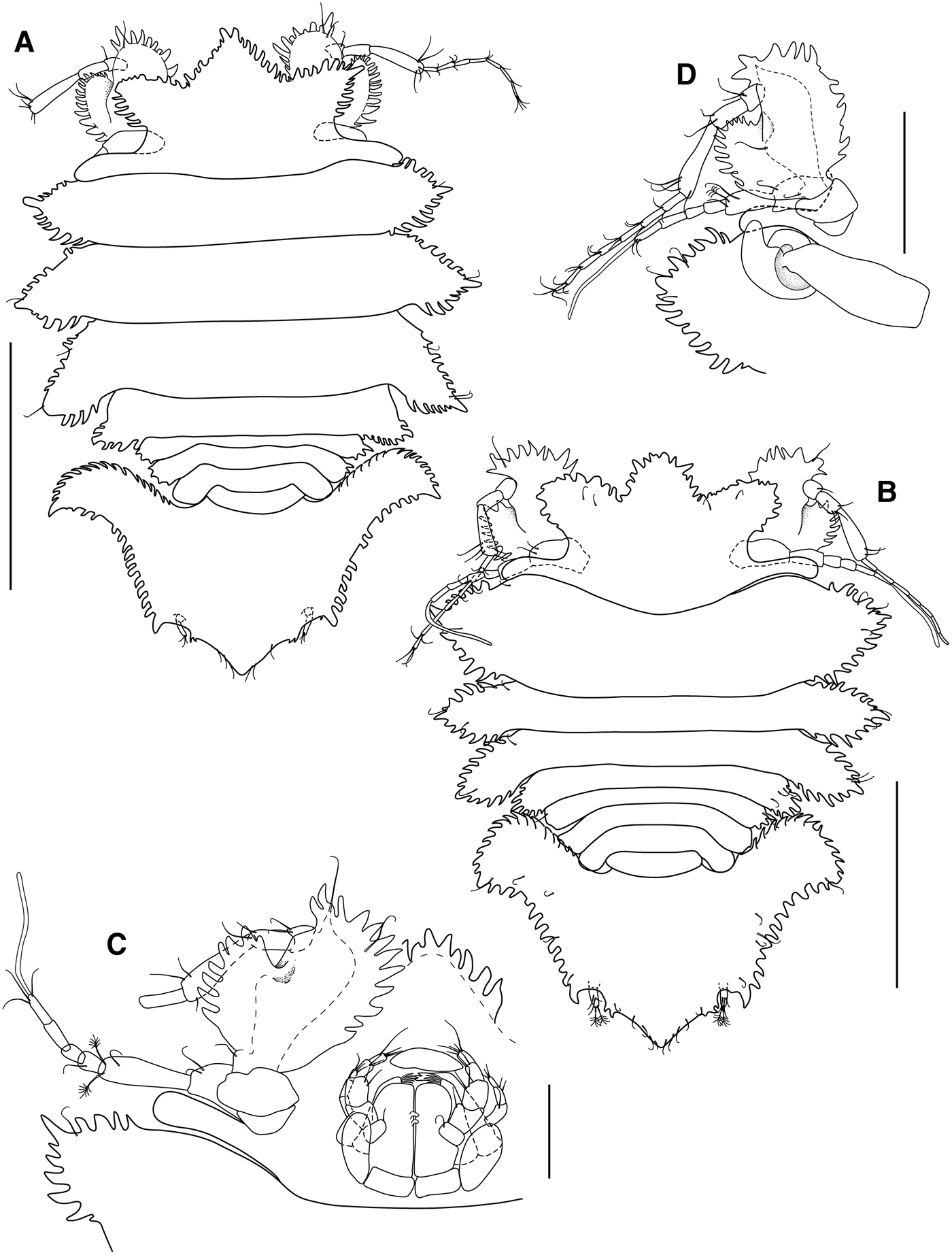
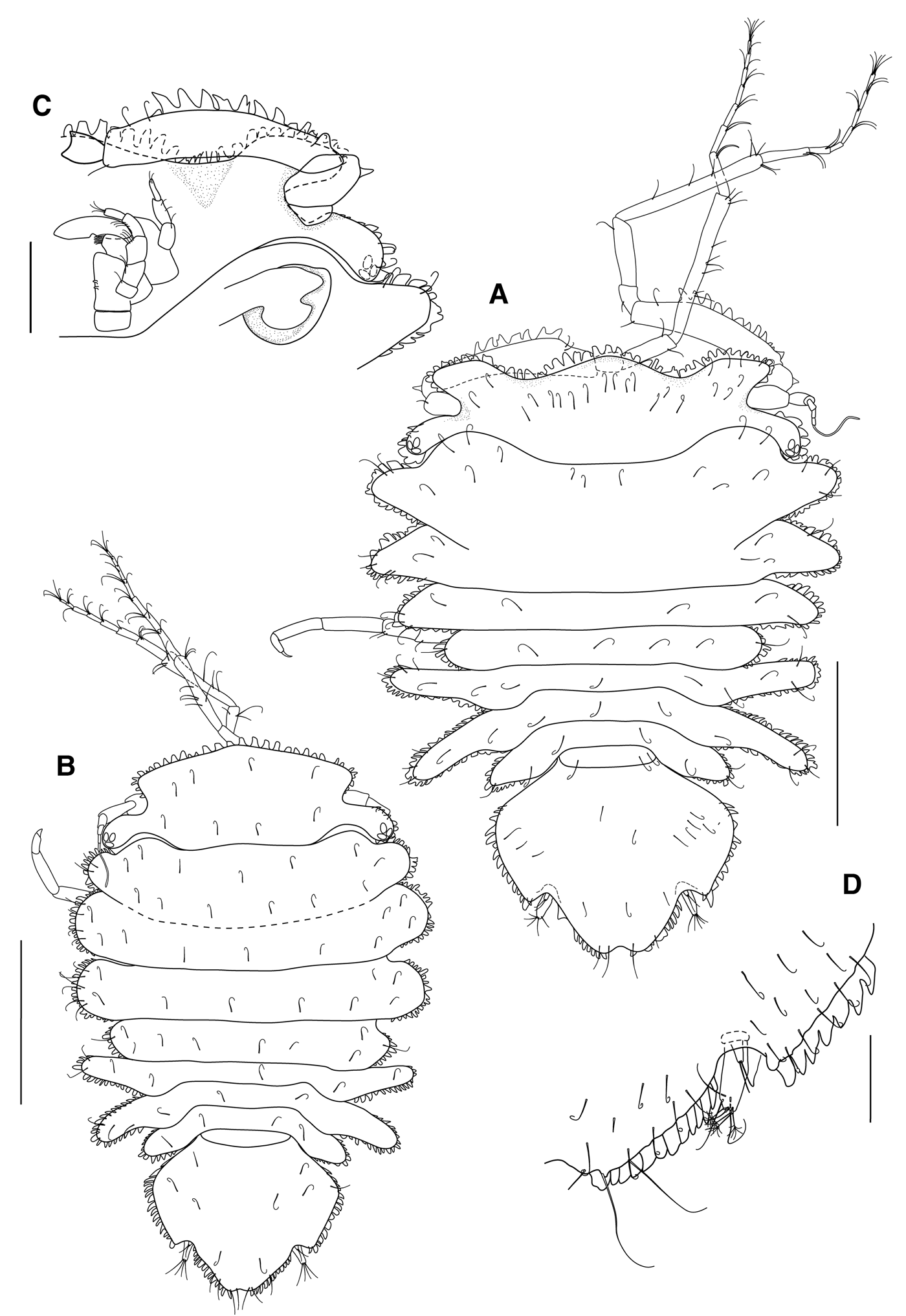
Pentaceration pleonarietis sp. nov. Holotype female, MACN-In 40405: (A) habitus in dorsal view. Paratype male, MACN-In 40406-a: (B) habitus in dorsal view; (D) detail of the insertion of antennae and pereopod I in ventral view. Paratype female, MACN-In 40406-b: (C) head in ventral view. Scale bars: A, 0.5 mm; B and D 0.2 mm; C, 0.1 mm.

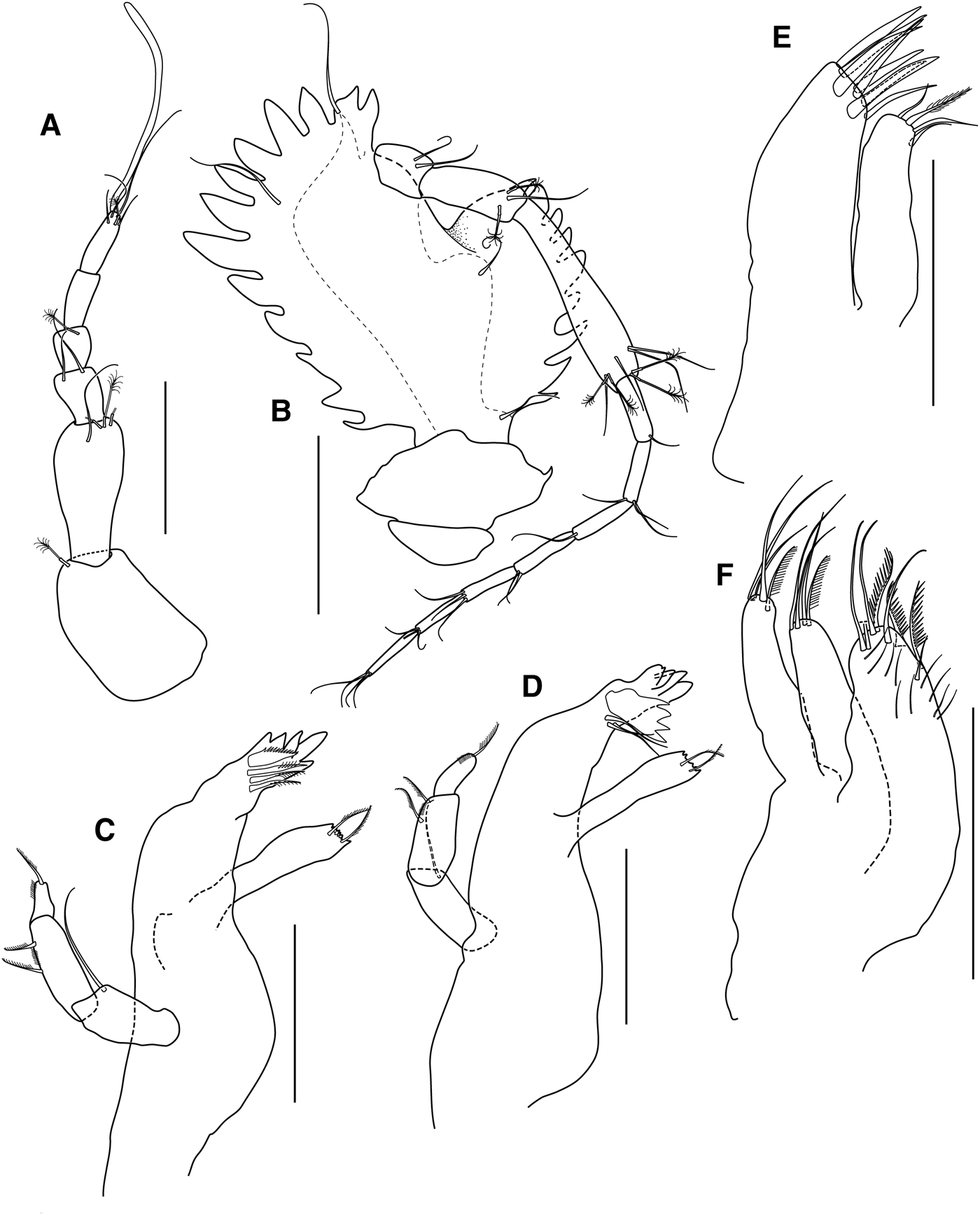
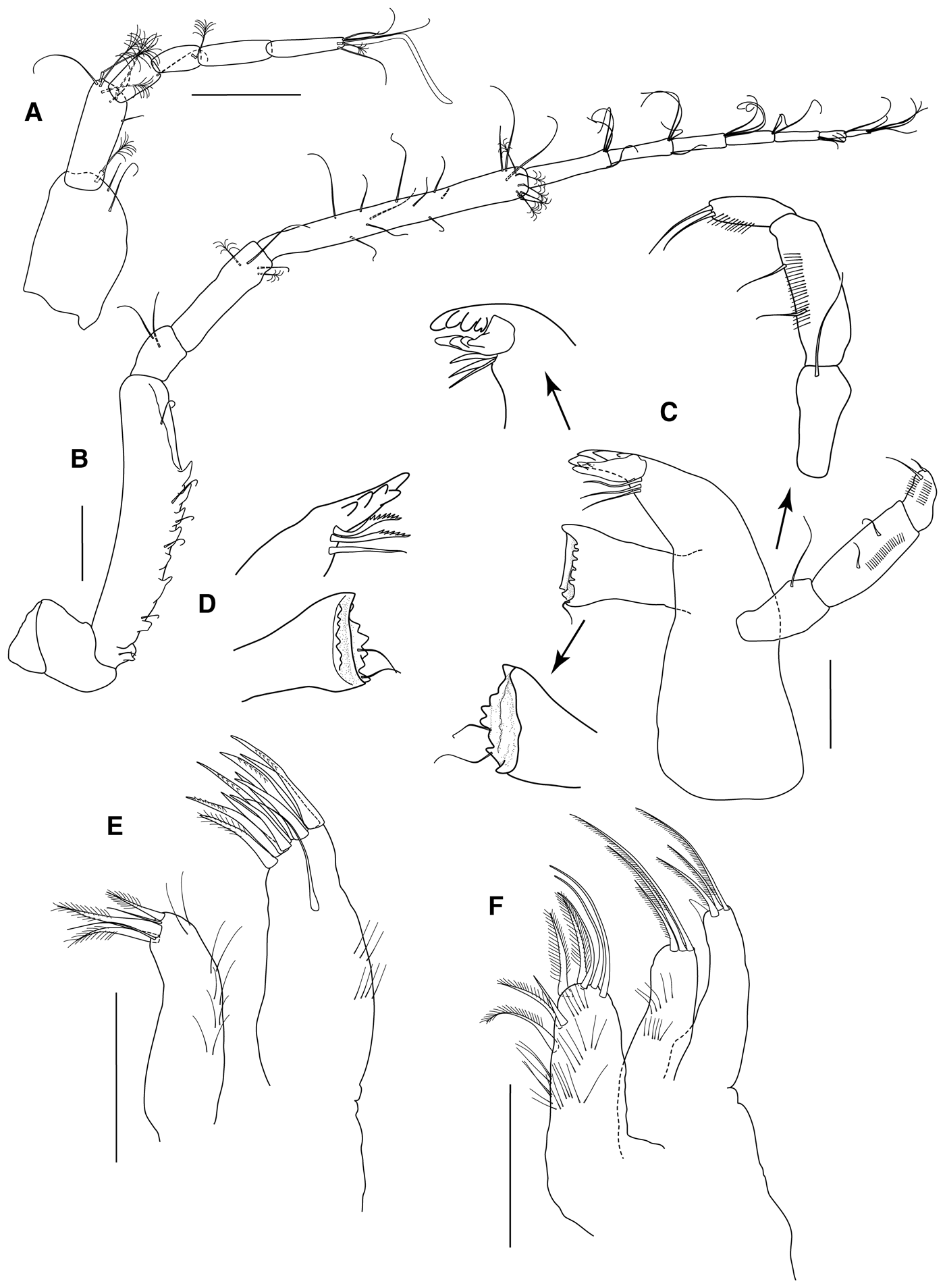
Pentaceration pleonarietis sp. nov. Paratype female, MACN-In 40406-b: (A) antennula; (B) antenna; (C) right mandible; (D) left mandible; (E) maxillula; (F) maxilla. Scale bars: A and B, 0.1 mm; C–F, 0.05 mm.

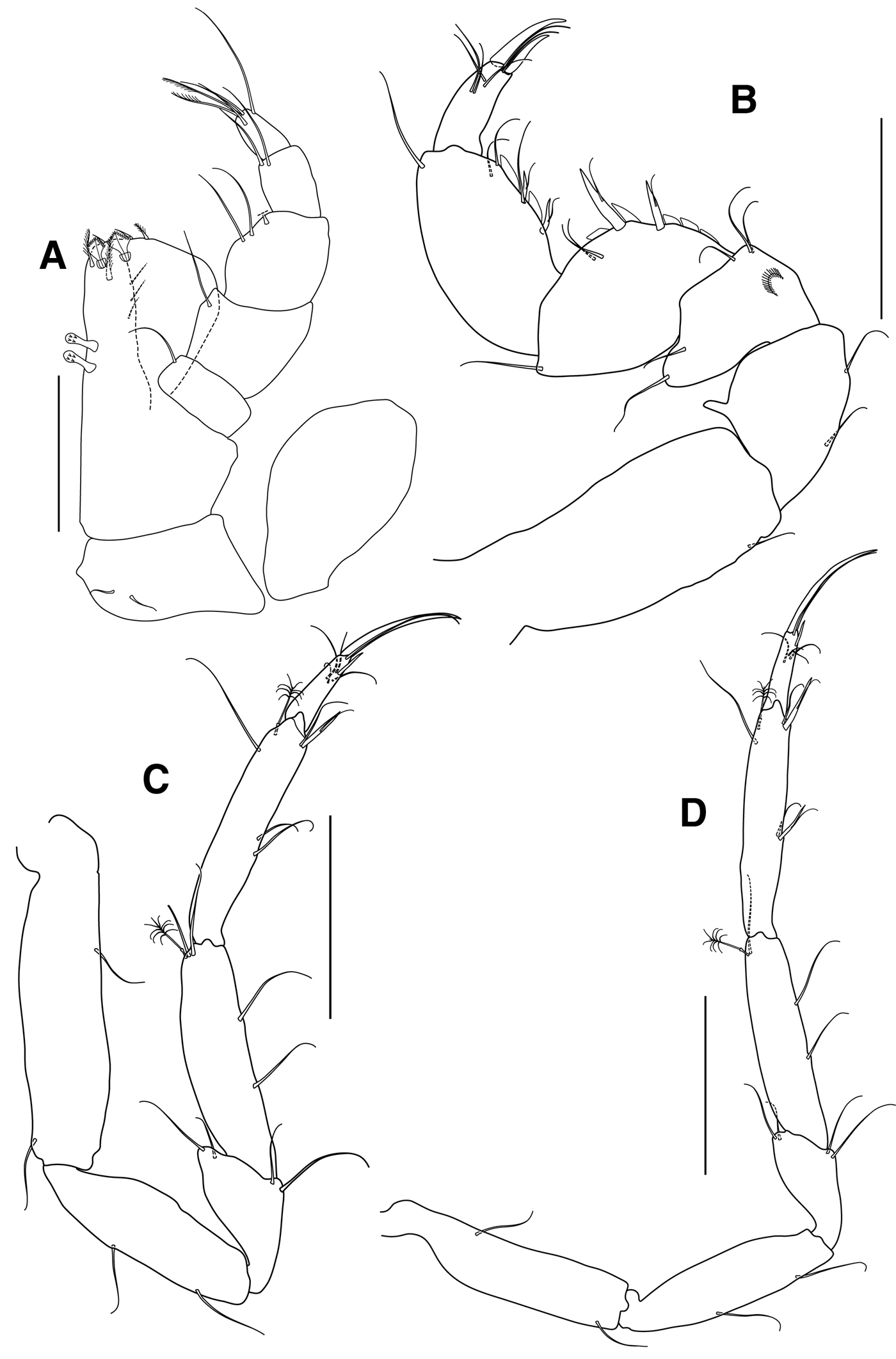
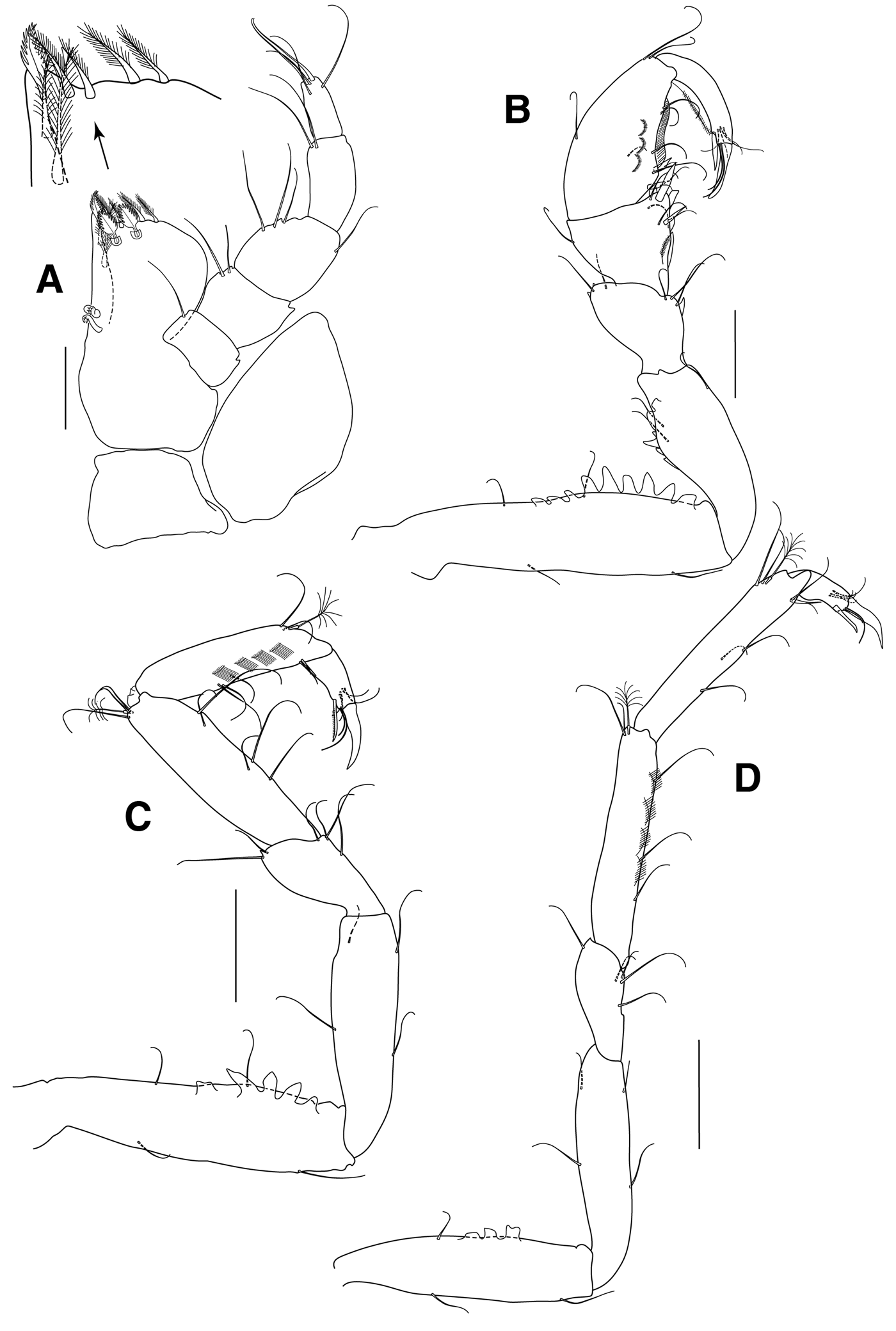
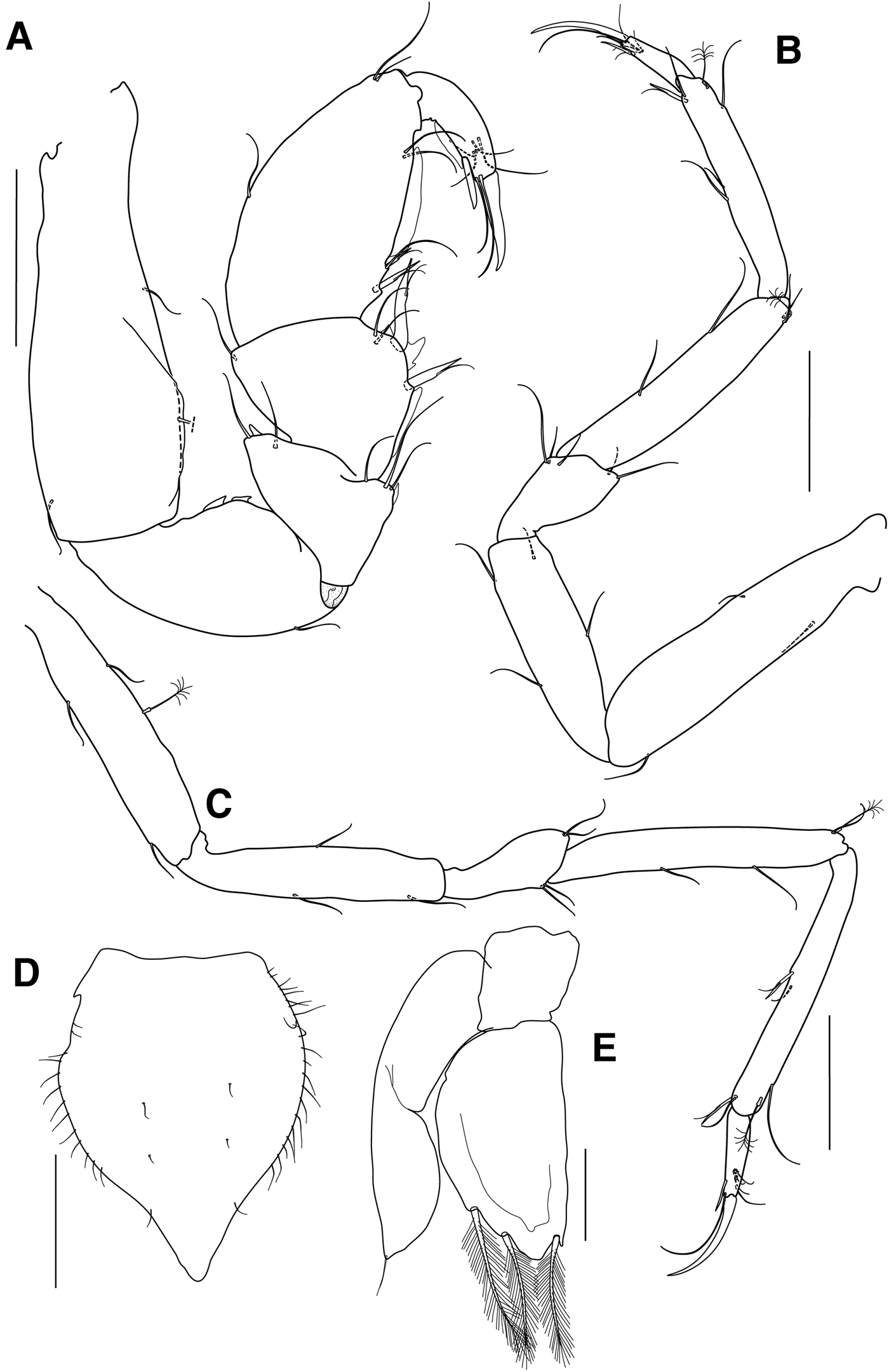
Pentaceration pleonarietis sp. nov. Paratype female, MACN-In 40406-b: (A) maxilliped; (B–D) pereopods I, II and VII, respectively. Scale bars: A, 0.05 mm; B–D, 0.1 mm.

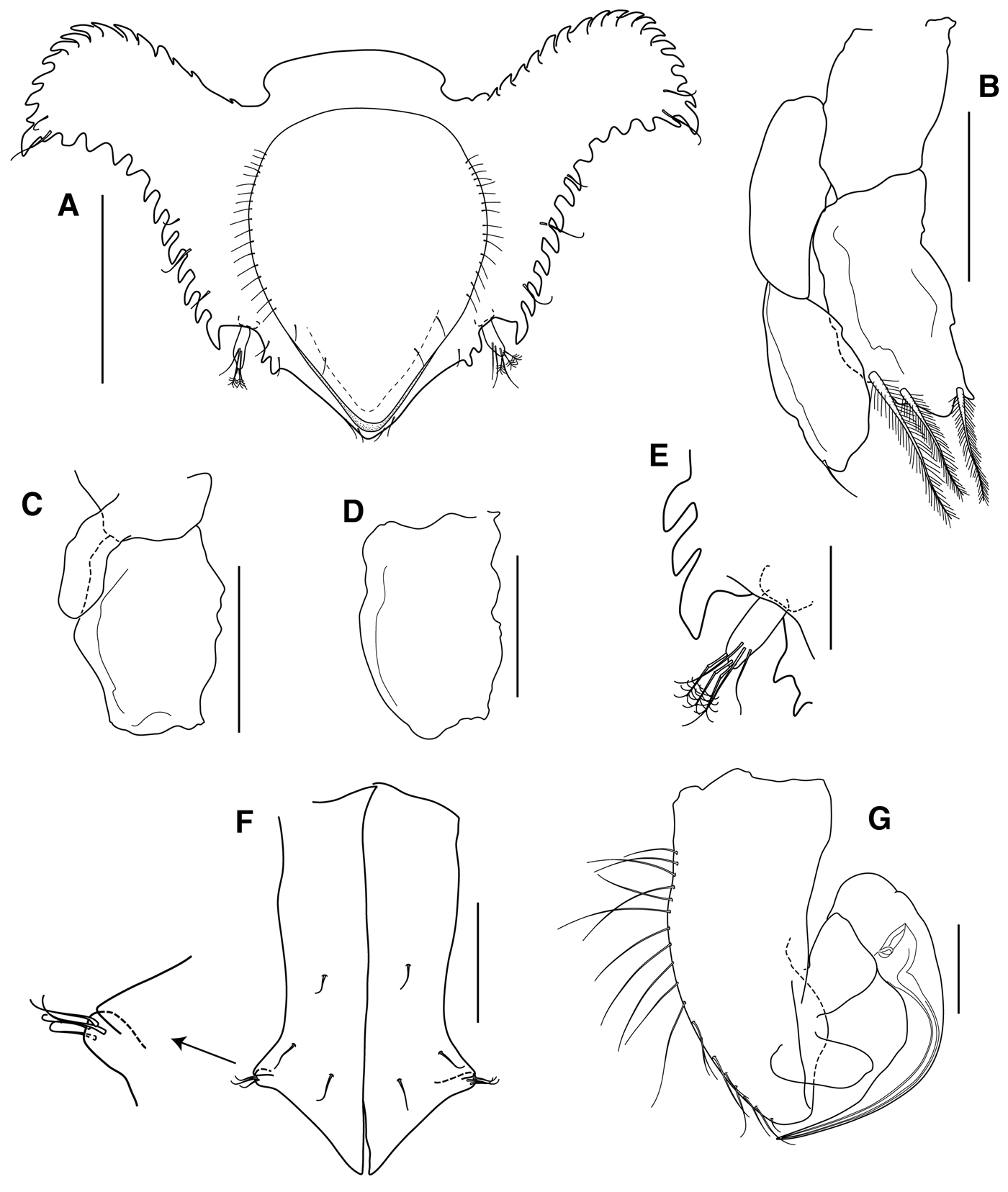
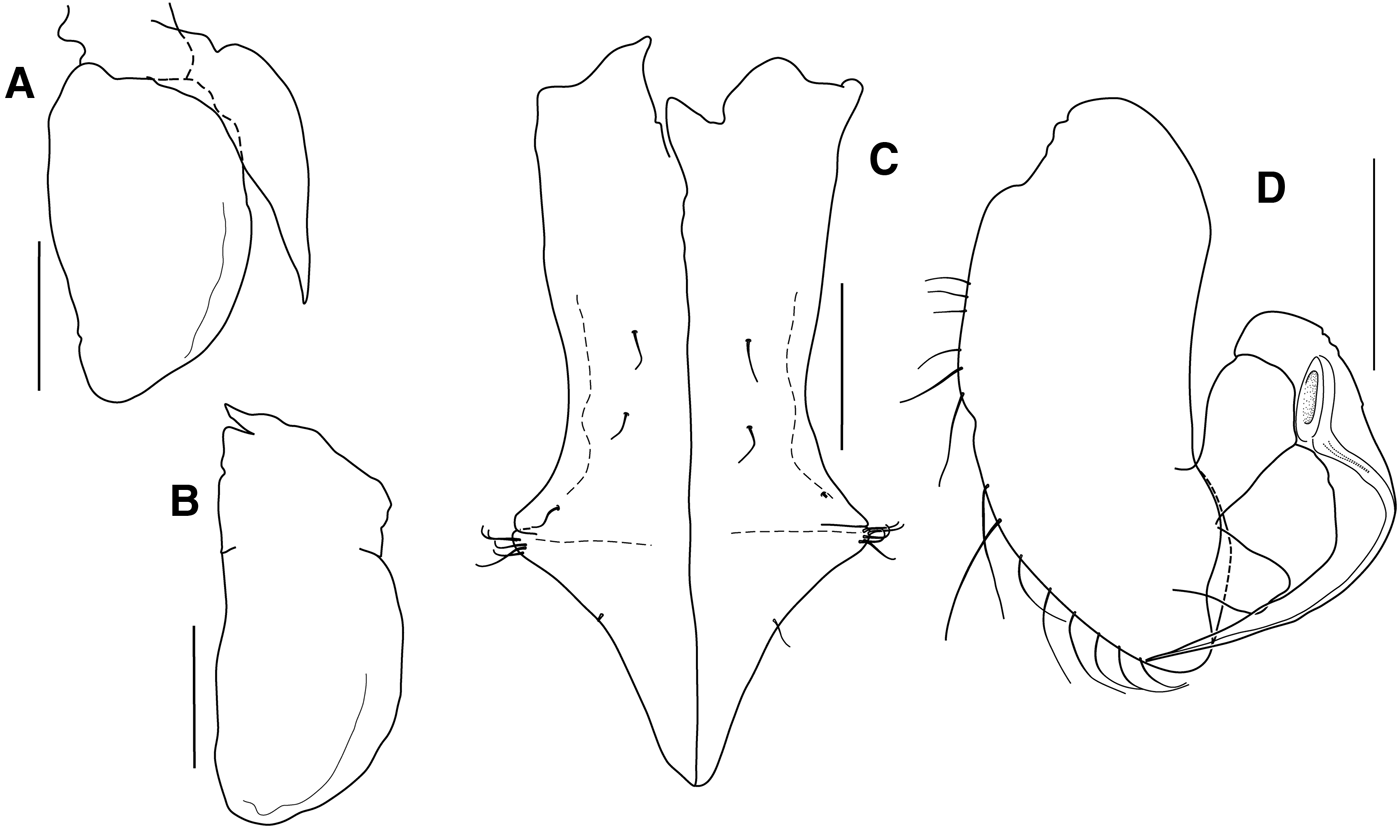
Pentaceration pleonarietis sp. nov. Paratype female, MACN-In 40406-b: (A) pleotelson in ventral view; (B–D) pleopods III–V, respectively; (E) uropod. Paratype male, MACN-In 40406-c: (F) pleopod I with detail of the lateral lobe; (G) pleopod II. Scale bars: A, 0.2 mm; B–D and F, 0.1 mm; E and G, 0.05 mm.

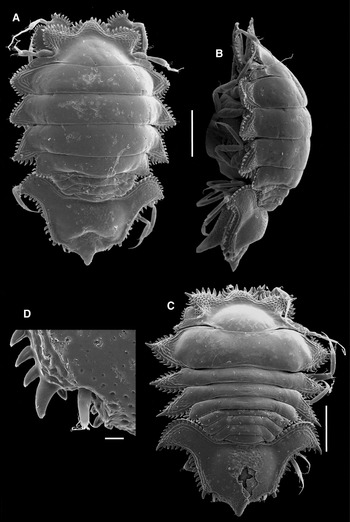
Pentaceration pleonarietis sp. nov. SEM photos. Paratype female, MACN-In 40406-d: (A and B) habitus in dorsal and lateral views, respectively. Paratype male, MACN-In 40406-e: (C) habitus in dorsal view; (D) uropod. Scales bar: A–C, 200 µm; D, 20 µm.

TYPE MATERIAL
Holotype: ovigerous female, 1.3 mm, Mejillón II Expedition, RV ‘Puerto Deseado', Station 10(2), coordinates: 39°04.33′S 58°02.76′W, water depth: 75 m; coll. Ignacio Chiesa, 12 September 2009 (MACN-In 40405).
Paratypes: 66 ovigerous females, 70 females, 84 males, 5 juveniles and 32 individuals broken, same data as holotype (MACN-In 40406).
ETYMOLOGY
The epithet is derived from the Latin ‘arietis’ (=ram), and refers to the antero-lateral processes of the pleotelson that resemble the horns of a ram.
DIAGNOSIS
Head, frontal margin mid-spine and lateral spines subequal in size and shape, lateral spines diverging at 110°, all three spines with denticulate margins. Eyestalks not surpassing the lateral margins of pereonite 1, pointing laterad, distally rounded, without ommatidia. Pereonites 1–4 laterally pointed and projecting, pereonites 5–7 laterally rounded; lateral margins of all pereonites denticulate. Pleotelson with 2 antero-lateral processes curved backwards, lateral margins denticulate, apex pointed. Antenna article 3 flat and rounded, with large denticles all along the margin, distolateral margin with a concavity beside the insertion of article 4.
DESCRIPTION
Body tapering posteriorly; width 0.46 length in female (0.49 in male), widest between pereonites 2 and 3 in female (between pereonites 1 and 2 in male).
Head length 0.28 width; length posterior to eyestalks 0.17 anterior length in female (0.65 in male). Frontal margin with single middle spine projecting anteriorly and two lateral spines; all spines subequal in size, straight and triangular with broad base. Lateral spines diverging at ~110°. Frontal margin with denticles. Eyes absent, without structures in eye region. Eyestalks length 2.8 width in female (3.6 in male), lateral apex rounded with few denticles, pointing laterad.
Pereonites 1–4 lateral margins angular and distinctly projecting, 5–7 rounded, not projecting; all pereonites marginally denticulate; coxae not visible in dorsal view. Pereonites 2–3 lateral spines diverging from each other at ~40–45°. Pereonite 1 sagittal length 1.21 midline length in female (1.34 in male).
Pleon length 0.46 width in female (0.54 in male). Pleonite 1 width 0.7 distance between uropods, length 0.2 width. Pleotelson with 2 antero-lateral processes curved backwards; lateral margins concave and denticulate, with 25–31 denticles per side; dorsal surface smooth. In ventral view pleotelson anterior length 0.14 total pleotelson length. Posterior margin apex pointed, forming 90° angle from vertex to uropod insertions, set apart from lateral margins by concavity at level of uropods, with few denticles laterally, 2–3 denticles on each side, none on posterior apex.
Antennula articles 1–2 combined extending beyond eyestalk apex; article 1 tubular, length subequal to 2, broader than 2; article 2 distal margin with 1 simple and 3 broom setae; articles 5–6 of subequal length, longer than article 3; article 4 slightly shorter than 3.
Antenna article 2 lateral margin with single spine; article 3 flat and rounded, marginally denticulate, distolateral margin with a concavity beside the insertion of article 4, width 0.76 length; article 5 only slightly longer than article 4; flagellum with 7 articles, proximal article subequal to more distal articles.
Mandible molar process distally truncate, triturative surface cylindrical.
Pereopod I, basis anterior margin smooth, length 2.36 width; ischium anterior margin with 1 blunt spine; carpus triangular, distal width 0.68 posterior margin length, posterior margin with translucent flanges proximal to robust setae, in between and posterior to them; propodus narrowing distally to insertion of dactylus, with 2 robust setae and translucent flanges. In male, pereopod I coxa with short straight anteriorly directed spine visible in ventral view. Pereopod II carpus posterior margin with simple setae only; propodus posterior margin with 1 distal robust seta; dactylus dorsal claw thin, longer than dactylus; ventral claw much shorter than dorsal claw.
Male pleopod I lateral lobes only moderately projecting from midlateral margin, width 0.3 distance to midline, with a bluntly triangular sublobe, distal sublobe partly overlapped by proximal sublobe; distal projection length 0.26 pleopod total length, forming obtuse angle, with bluntly pointed apices. Female operculum ovoid, width 0.75 length.
Uropods dorsal and directly adjacent to lateral margin of pleotelson, recessed into simple cuticle fold; protopod hidden; exopod absent.
SIZE RANGE
Ovigerous females 1.1–1.3 mm, females 0.9–1.2 mm, males 0.9–1.2, juveniles 0.8–0.9 mm.
DISTRIBUTION
Only known from type locality (39°04.33′S 58°02.76′W, 75 m), off Buenos Aires province.
REMARKS
Pentaceration pleonarietis sp. nov. can be distinguished from all the remaining species of the genus by the antero-lateral processes of the pleotelson and by the flat and rounded article 3 of the antenna, marginally denticulate. These two characters are unique not only among the members of the genus, but also within the family.
Genus Neasellus Beddard, Reference Beddard1886
Neasellus Beddard, 1886. – Beddard, Reference Beddard1886: p. 33; Wilson, Reference Wilson1980: 220–221, 231–232; Just, Reference Just2009a: p. 46.
Type species: Neasellus kerguelensis Beddard, Reference Beddard1886 (by monotypy).
Species included: Neasellus argentinensis sp. nov.; N. bicarinatus sp. nov.; N. kerguelensis Beddard, Reference Beddard1886; N. oculatus (Schultz, Reference Shimomura1977) comb. nov.
DIAGNOSIS
Head, frontal margin sinuous (with 2 dorsolaterally projecting rectangular lobes in N. bicarinatus sp. nov.). Eyestalks not surpassing lateral margins of pereonite 1, club-shaped, curved backwards in distal half, with or without ommatidia. Coxae not visible in dorsal view. Lateral margins of pereonites 1–3, 5 and 6 projecting into rounded spatulate processes. Pereonite 4 lateral margins recessed from lateral margins of pereonites 3 and 5, pereonite 7 lateral margins recessed from lateral margins of pereonite 6. Pleotelson, posterior margin broadly rounded (pointed in N. bicarinatus sp. nov.). Mandible palp present (elongate in N. oculatus comb. nov.), molar process triturative distally flared. Pereopod I, carpus triangular with 2–3 robust setae. Uropods inserted in a deep notch between lateral and posterior margins, biramous, protopod recessed or absent.
DISTRIBUTION
The genus Neasellus has been found in the cold temperate waters of the southern hemisphere, in a depth range from 110 to 1373 m.
REMARKS
The genus Neasellus was established by Beddard (Reference Beddard1886) to include N. kerguelensis, a species collected in the Kerguelen Island; this species, however, was also reported from off Buenos Aires Province by the same author (Station 320, Challenger Expedition). According to Beddard (Reference Beddard1886) the specimens obtained at this latter station, were found upon two species of sponges Mycale (Mycale) lapidiformis (Ridley & Dendy, 1886) and Haliclona (Gellius) carduus (Ridley & Dendy, 1886). Moreover, regarding the material from off Buenos Aires, Beddard (Reference Beddard1886) stated that ‘The specimens agreed very closely with the type described above [N. kerguelensis], the only difference being that in one individual there were traces of eyes in the shape of two crystalline cones, together with the corresponding pigmented retinal cell’. The extremely wide distribution reported for N. kerguelensis by Beddard (Reference Beddard1886) and the difference he observed in the absence or presence of eyes between the specimens from Kerguelen and those from off Buenos Aires, suggest that he was probably dealing with two different species very similar morphologically, the latter specimens most likely being conspecific with the new species described below as N. argentinensis. It is worth noticing, that the specimens collected by the fishing vessel Maxal II (see Additional material) were also found attached to sponges (Fabrizio Scarabino, personal communication).
Until now the genus Neasellus was monotypic, although Wilson (Reference Wilson1980) stated that ‘Pelagogonium oculatum Schultz (Reference Schultz1977), recently described from a single individual taken in a midwater trawl, should be placed in Neasellus’. Moreover, the diagnosis of the monotypic genus Pelagogonium presented by Schultz (Reference Schultz1977) does not include any character that allows a differentiation with the genus Neasellus. Therefore, considering that the shape of the head and the pleotelson, and the arrangement of the pereonites present in Pelagogonium oculatum are as those present in the genus Neasellus, a new combination for this species is proposed.
Neasellus argentinensis sp. nov.
(Figures 6–10)
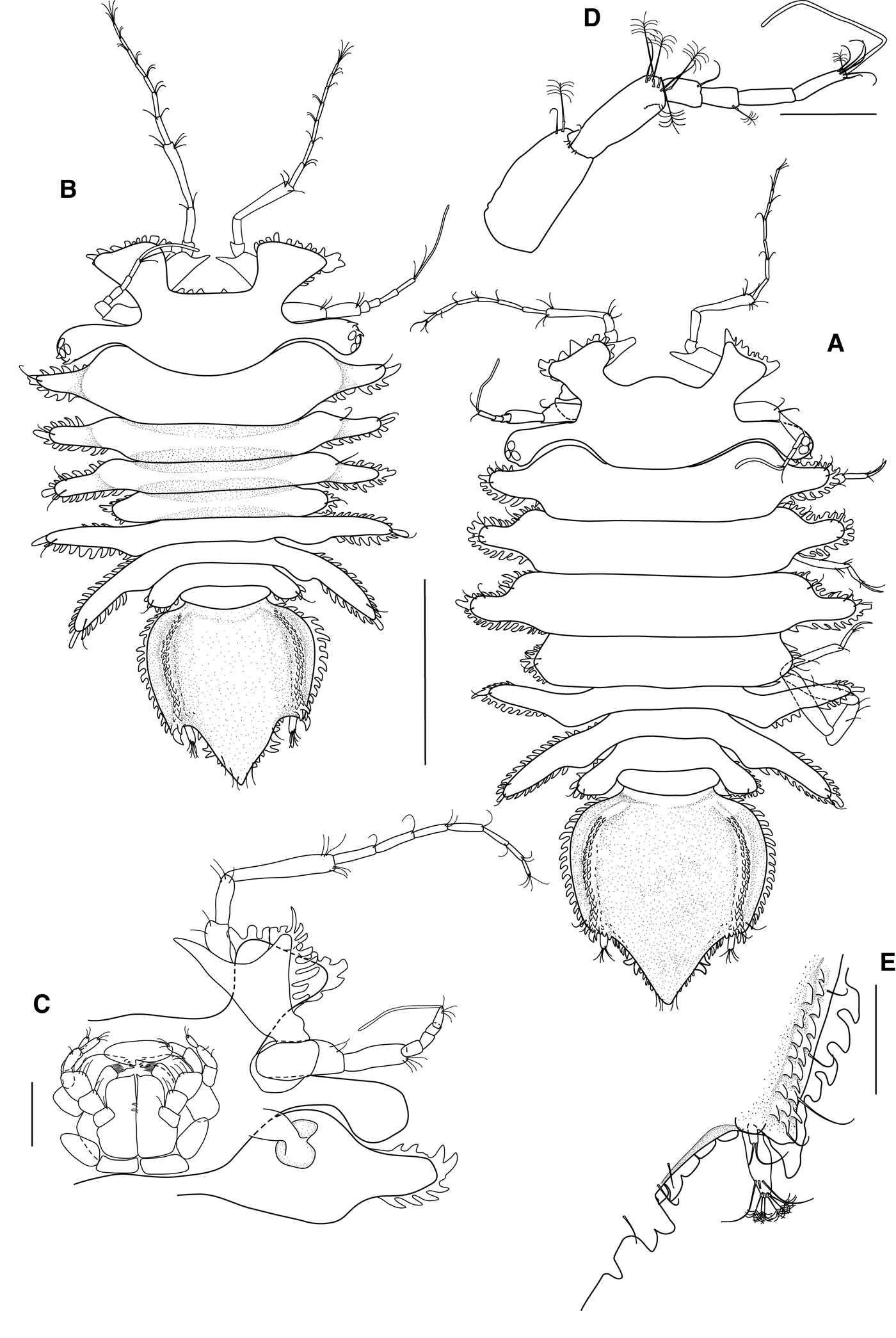
Neasellus argentinensis sp. nov. Holotype male, MACN-In 40407: (A) habitus in dorsal view; (C) head in ventral view. Paratype female, MACN-In 40408-a: (B) habitus in dorsal view. Paratype male, MACN-In 40408-b: (D) uropod. Scale bars: A and B, 0.5 mm, C, 0.2 mm; D, 0.1 mm.

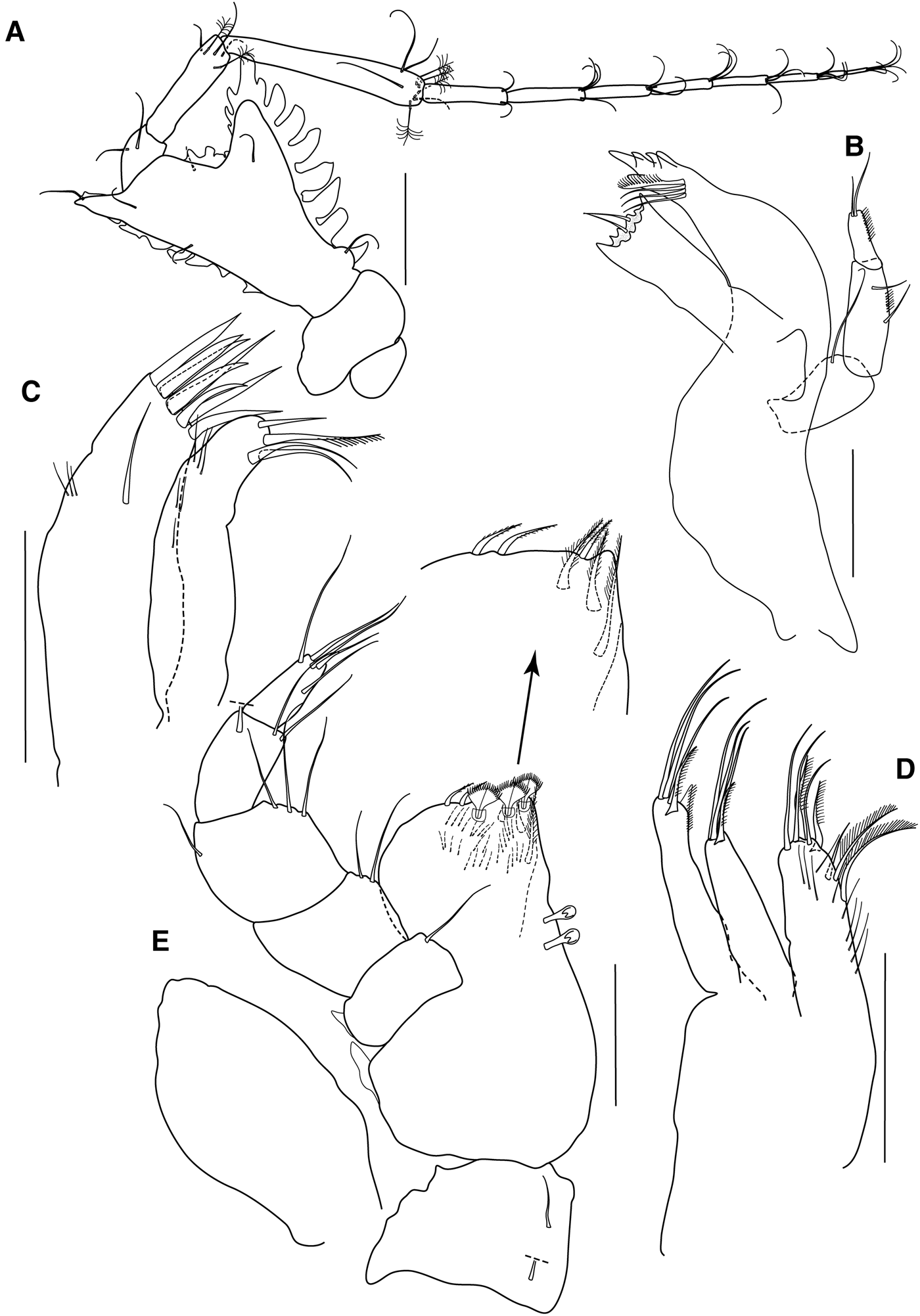
Neasellus argentinensis sp. nov. Paratype male, MACN-In 40408-b: (A) antennula; (B) antenna; (C) left mandible with details of palp, incisor and molar processes; (D) detail of incisor and molar processes of right mandible; (E) maxillula; (F) maxilla. Scale bars: A and B, 0.1 mm; C, E and F, 0.05 mm.

Neasellus argentinensis sp. nov. Paratype male, MACN-In 40408-b: (A) maxilliped with detail of endita (fan setae not drawn in the detail); (B–D) pereopods I, II and VII, respectively. Scale bars: A, 0.5 mm; B–D, 0.1 mm.

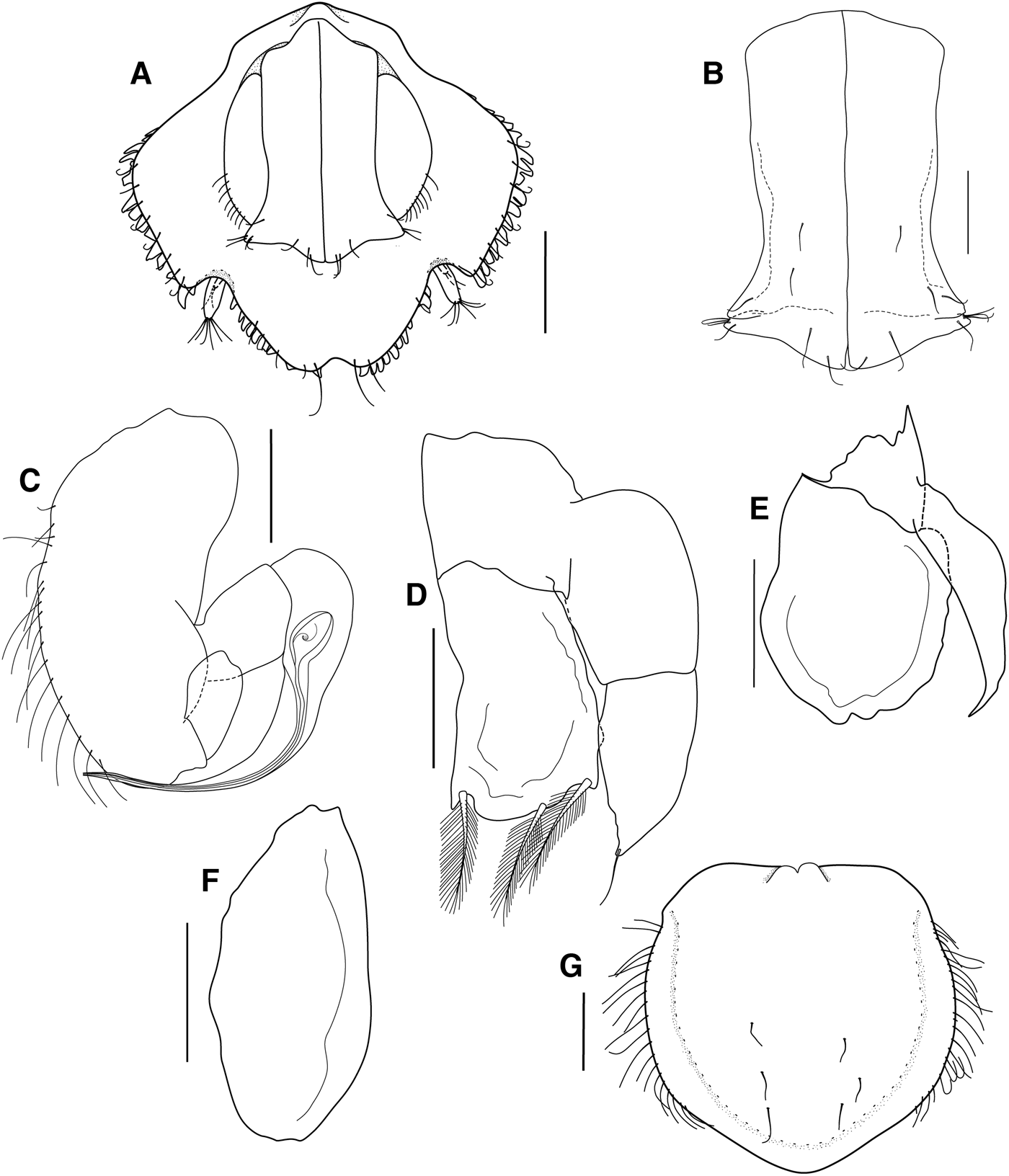
Neasellus argentinensis sp. nov. Paratype male, MACN-In 40408-b: (A) pleotelson in ventral view; (B–F) pleopods I–V, respectively. Paratype female, MACN-In 40408-c: (G) operculum. Scale bars: A, 0.2 mm; B–G, 0.1 mm.

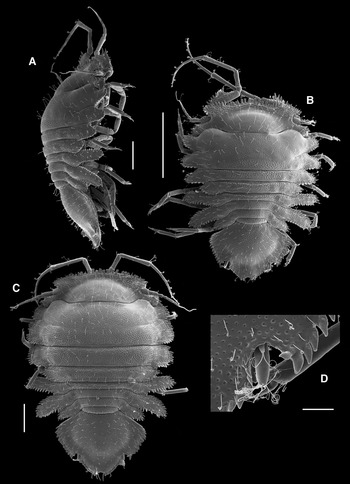
Neasellus argentinensis sp. nov. SEM photos. Paratype male, MACN-In 40408-e: (A and B) habitus in lateral and dorsal views, respectively; (D) uropod. Paratype female, MACN-In 40408-d: (C) habitus in dorsal view. Scale bars: A and C, 200 µm; B, 500 µm; D, 50 µm.

TYPE MATERIAL
Holotype: terminal male, 1.8 mm, Talud Continental 2012 Expedition, RV ‘Puerto Deseado', Station 12, coordinates: 37°57.91′S 54°31.92′W, water depth: 1140 m; coll. Ignacio Chiesa, 11 August 2012 (MACN-In 40407).
Paratypes: 2 terminal males, 4 males, 18 ovigerous females, 5 females and 8 juveniles, same data as holotype (MACN-In 40408).
ADDITIONAL MATERIAL
Four terminal males, 16 males, 3 ovigerous females, 18 females, Fishing vessel ‘Maxal II', coordinates: ~37°00′S 53°59′W, water depth: 500 m, associated to a sponge entangled in a crab trap; coll. Sebastián Horta & Ebol Rojas; leg. Fabrizio Scarabino, 17 December 2006 (MNHNM w/n).
ETYMOLOGY
The epithet is a toponym referring that the species was collected off the coast of Argentina.
DIAGNOSIS
Head, frontal margin sinuous, convex at midline and concave laterally (in female broadly convex, not sinuous), marginally denticulate. Eyestalks not surpassing lateral margins of pereonite 1, club-shaped, curved backwards in distal half, apex rounded with few ommatidia, marginally denticulate. Fused pereonites 1 and 2 as long as pereonites 3–6 combined. Head and body dorsally covered by scattered long setae. Pereonite 4 lateral margins recessed from lateral margins of pereonites 3 and 5 in both sexes. Antenna, article 3 longest, lateral margin with denticles on proximal half, bulge with 1 seta and 1 denticle.
In terminal males sexual dimorphism is present not only in the enlarged pereonite 1 but also in the anterior margin of the head (see above), and in the shape of the lateral margins of pereonites 1–3 which are projected in males and rounded in females.
DESCRIPTION
Body tapering posteriorly, dorsal surface with scattered long simple setae; width 0.65 length in female (0.79 in male), widest at pereonite 2.
Head sexually dimorphic in the shape of the anterior margin, not in the size of the head, length 0.30 width; length posterior to eyestalks 0.3 anterior length in female (0.64 in male). Frontal margin sinuous, convex at midline and concave laterally in male (broadly convex, not sinuous, in female), marginally denticulate, with angular lateral margins adjacent to antennae. Eyestalks length 2 width in female (2.2 in male), lateral apex rounded with few denticles, shaft axis curved backwards in distal half.
Pereonites 1–2 fused at midline, articulation only visible laterally. Pereonites 1–3 lateral margins projecting as a rounded spatulate process in male (rounded, not projecting, in female); pereonite 4 laterally rounded, recessed from lateral margin of pereonites 3 and 5; pereonites 5 and 6 lateral margins distinctly projecting as a long spatulate process; pereonite 7 slightly projecting, recessed from lateral margin of pereonite 6. Pereonite 1 sagittal length 1.2 midline length in male. All pereonites lateral margins denticulate.
Pleon length 0.86 width in female (0.83 in male). Pleonite 1 width 0.63 distance between uropods, length 0.2 width. Pleotelson dorsal surface smooth; proximal margin length subequal to lateral margin length; forming 55° angle with medial axis of pleon; in ventral view anterior length 0.05 total pleotelson length; lateral margin nearly straight and denticulate, with 12–15 denticles per side; posterior margin apex broadly rounded with a notch at midline, forming 80° angle from vertex to uropod insertions, set apart from lateral margins by concavity at level of uropods, with large denticles laterally all of approximately same size, 8–10 denticles each side, none on the distal notch.
Antennula articles 1–2 combined reaching eyestalk apex; article 1 tubular, longer and broader than 2; article 2 distal margin with 3 broom and 3 simple setae. Antennula articles 5–6 of subequal length, longer than articles 3–4.
Antenna article 3 tubular, width 0.20 length, with 8 denticles, article 5 distinctly longer than article 4; flagellum with 7 articles, proximal article distinctly longer than more distal articles, proximal article 1.4 length of second article.
Mandible molar process distally flared, triturative surface oval-shaped. Maxilliped palp articles 1 and 2 with lateral spine.
Pereopod I basis anterior margin with row of blunt spines, length 3.85 width; ischium anterior margin with row of spines; merus anterior margin with 2 minute denticles, posterior margin with 1 spine; carpus triangular, distal width 0.97 posterior margin length, posterior margin with translucent flanges proximal to robust setae and between robust setae; propodus narrowing distally to insertion of dactylus, with 2 robust setae and translucent flange; dactylus with translucent flange on posterior margin. Pereopod II basis anterior margin with a row of spines; carpus posterior margin with simple setae only; propodus posterior margin with 1 distal robust seta; dactylus dorsal claw robust, longer than dactylus, ventral claw pectinate, shorter and much thinner than dorsal claw.
Male pleopod I lateral lobes distinctly projecting from midlateral margin, width 0.4 distance to midline, with bluntly triangular distal sublobe partly overlapped by proximal sublobe; distal projection length 0.13 pleopod total length, forming obtuse angle, with rounded apices. Female operculum nearly circular, width subequal to length.
Uropods on margin of pleotelson; protopod hidden.
SIZE RANGE
Ovigerous females 1.4–1.7 mm, females 1.2–1.5 mm, terminal males 1.6 –1.8 mm, males 1.1–1.3, juveniles 0.9–1.1 mm.
DISTRIBUTION
Only known from off Buenos Aires province, from 500 to 1140 m.
REMARKS
Neasellus argentinensis sp. nov. is very similar to N. kerguelensis Beddard, Reference Beddard1886; the new species, however, can be distinguished by the deep notch between the frontal margin of head and the eyestalks, article 1 of antennula inserts in that notch; the presence of few ommatidia on the eyestalks; and by the scattered long setae on the dorsum of head and body. The width/length ratio of the head also distinguished these two species, being 3.7 in N. argentinensis sp. nov. and 2.9 in N. kerguelensis. Sexual dimorphism in the head and in the first three pereonites is present in N. argentinensis sp. nov., whereas females of N. kerguelensis are still unknown.
Neasellus bicarinatus sp. nov.
(Figures 11–15)
Neasellus bicarinatus sp. nov. Holotype female, MACN-In 40409: (A) habitus in dorsal view; (C) head in ventral view. Paratype male, MACN-In 40410-a: (B) habitus in dorsal view. Paratype female, MACN-In 40410-b: (D) antennula; (E) uropod. Scale bars: A and B, 0.5 mm; C–E, 0.1 mm.

Neasellus bicarinatus sp. nov. Paratype female, MACN-In 40410-b: (A) antenna; (B) right mandible; (C) maxillula; (D) maxilla; (E) maxilliped, with detail of endita (fan setae not drawn in the detail). Scale bars: A, 0.1 mm; B–E, 0.05 mm.

Neasellus bicarinatus sp. nov. Paratype female, MACN-In 40410-b: (A–C) pereopods I, II and VII, respectively; (D) operculum; (E) pleopod III. Scale bars: A–C, E, 0.1 mm; D, 0.2 mm.

Neasellus bicarinatus sp. nov. Paratype female, MACN-In 40410-b: (A and B) pleopods IV and V, respectively. Paratype male, MACN-In 40410-a: (C and D) pleopods I and II, respectively. Scale bars: 0.1 mm.

Neasellus bicarinatus sp. nov. SEM photos. Paratype female, MACN-In 40410-c: (A) habitus in dorsal view; (B) detail of pereonite 6 to pleotelson in dorsal view; (C) uropod. Scale bar: A, 500 µm; B, 200 µm; C, 50 µm.

TYPE MATERIAL
Holotype: ovigerous female, 1.7 mm, COPLA II Expedition, RV ‘Puerto Deseado', Station 3, coordinates: 38°41.05′S 55°56.93′W; water depth: 208 m; coll. Brenda Doti & Natalia Alberico, 5 June 2010 (MACN-In 40409).
Paratypes: 8 ovigerous females, 4 males, 3 juveniles and 1 specimen broken, same data as holotype (MACN-In 40410).
ADDITIONAL MATERIAL
COPLA II Expedition, RV ‘Puerto Deseado', coll. Brenda Doti & Natalia Alberico: 1 female and 1 male, Station 2, coordinates: 39°31.29′S 55°48.28′W, water depth: 168 m; 5 June 2010 (MACN-In 40411). One female and 1 juvenile, Station 11, coordinates: 42°19.99′S 58°24.96′W, water depth: 284 m; 6 June 2010 (MACN-In 40412). Six ovigerous females, 3 males and 10 juveniles, Station 16, coordinates: 45°13.63′S 60°38.57′W, water depth: 110 m; 19 June 2010 (MACN-In 40413). Mejillón II Expedition, RV ‘Puerto Deseado', coll. Ignacio Chiesa: 1 ovigerous female, 3 females and 3 males, Station 8(2), coordinates: 38°49.42′S 55°39.18′W, water depth: 113 m; 11 September 2009 (MACN-In 40414).
ETYMOLOGY
The epithet is derived from the Latin ‘bi’ (=two) and ‘carina’ (=ridge) in reference to the two dorso-lateral ridges of the pleotelson.
DIAGNOSIS
Head, frontal margin with 2 dorsolaterally projecting rectangular lobes, marginally denticulate. Eyestalks not surpassing lateral margins of pereonite 1, club-shaped, curved backwards in distal half, apex rounded with 3 ommatidia. Pereonites 1–3, 5 and 6 produced laterally into single processes; pereonites 4 and 7 laterally rounded. All pereonites marginally denticulate. Pleotelson with two dorso-lateral ridges, composed by two rows of denticles each; posterior margin pointed. Antenna article 3 triangular, marginally denticulate, distal margin with a deep concavity beside the insertion of article 4.
DESCRIPTION
Body tapering posteriorly; width 0.61 length in female (0.70 in male), widest at pereonite 3 in female (at pereonite 1 in male).
Head length 0.30 width; length posterior to eyestalks 0.7 anterior length in female (1.1 in male). Frontal margin with 2 dorsolaterally projecting rectangular lobes, each lobe projecting well beyond anterior apex, marginally denticulate; anterior rim dorsoventrally thin in lateral view. Eyestalks length 2.3 width in female (2.1 in male), lateral apex rounded with few denticles, shaft axis curved backwards in distal half, shaft before apex constricted proximally, long axis angling forward at ~25° in female (30° in male).
Pereonites 1–3 lateral margins projecting as a rounded spatulate process; pereonite 4 laterally rounded, recessed from lateral margins of pereonites 3 and 5; pereonites 5 and 6 distinctly projecting as a long spatulate process; pereonite 7 laterally rounded, not projecting; recessed from lateral margins of pereonite 6. Pereonite 1 sagittal length 1.46 midline length in female (1.33 in male). Pereonites 5 and 6 proximo-posterior margin with lobe. All pereonite lateral margins denticulate.
Pleon length 1.20 width in female. Pleonite 1 width 0.76 distance between uropods, length 0.24 width. Pleotelson dorsal surface with two dorso-lateral ridges, composed by two rows of denticles each; proximal margin length shorter than lateral margin length; forming 60° angle with medial axis of pleon; lateral margins denticulate, with 19–20 denticles per side; posterior margin apex pointed, forming 90° angle from vertex to uropod insertions in female (85° in male), set apart from lateral margins by concavity at level of uropods, with denticles on entire margin all of approximately same size, plus 2 large diverging denticles at midlength of posterior margin, with 11–12 denticles each side.
Antennula articles 1–2 combined reaching eyestalk apex; article 1 tubular, longer and broader than 2, with 2 small denticles distomedially; article 2 distal margin with 4 broom and 2 simple setae; articles 5–6 of subequal length, longer than articles 3–4.
Antenna article 3 triangular, marginally denticulate, width 0.77 length, distal margin with a deep concavity beside the insertion of article 4, distomedially with pointed projection; article 5 distinctly longer than article 4; flagellum with 8 articles, proximal article distinctly longer than more distal articles, proximal article 1.1 length of second article.
Mandible molar process distally flared, triturative surface oval-shaped. Maxilliped palp article 1 with lateral spine.
Pereopod I basis anterior margin with a smooth ridge, length 2.97 width; ischium anterior margin with 2 short spines; merus anterior margin with 1 spine, posterior margin with 1 spine; carpus triangular, distal width 0.83 posterior margin length, posterior margin with translucent flange proximal to robust setae, 2 denticles between robust setae and 1 denticle distal to robust setae; propodus narrowing distally to insertion of dactylus, with 2 robust setae and translucent flange; dactylus posterior margin with translucent flange. Pereopod II carpus posterior margin with simple setae only; propodus posterior margin with 1 distal robust seta; dactylus dorsal claw thin, longer than dactylus, ventral claw much shorter than dorsal claw.
Male pleopod I lateral lobes width 0.4 distance to midline, distal sublobe partly overlapped by proximal sublobe; distal projection length 0.32 pleopod total length, forming acute angle, with bluntly pointed apices. Female operculum distal part tapering with concave distolateral margins, width 0.75 length.
Uropods on margin of pleotelson, recessed into simple cuticle fold; protopod absent; exopod vestigial.
SIZE RANGE
Ovigerous females 1.4–1.7 mm, males 1.1–1.3 mm, juveniles 0.7–0.9 mm.
DISTRIBUTION
From off Buenos Aires province (38°S 55°W) to Chubut province (45°S 60°W), in a depth range from 110 to 284 m.
REMARKS
The frontal margin of the head, the antenna article 3 and the pleotelson distinguish Neasellus bicarinatus sp. nov. from the remaining species of the genus. In fact, the combination of characters present in N. bicarinatus have made difficult the decision of in which genus it should be placed. The head projections resemble those present in the genus Paramunna, but the arrangement of the lateral margins of the pereonites are clearly as those present in the Neasellus species. The antenna with a triangular article 3 and the pleotelson with two dorsolateral ridges are unique features even among the family; because of these features, the new species could require a new genus. Considering that other genera within the family also include some morphological variation among species, I prefer to provisionally include this species in Neasellus until a phylogenetic analysis of these genera is carried out.
DISCUSSION
In the south-west Atlantic, between 35° and 56°S, the species richness of asellote isopods is remarkably high south of 47°S (Doti et al., Reference Doti, Roccatagliata and López Gappa2014). The three new species described herein were found at lower latitudes (37°–45°S), Pentaceration pleonarietis sp. nov. was found at 75 m depth, while Neasellus bicarinatus sp. nov. and N. argentinenesis sp. nov. were collected deeper than 100 m. Based on the biodiversity patterns of the different invertebrate groups two biogeographic provinces have been recognized in the Argentine Sea, viz: the Argentine Biogeographic Province and the Magellan Biogeographic Province (ABP and MBP, respectively) (Doti et al., Reference Doti, Roccatagliata and López Gappa2014; and references therein). An exact limit between these two provinces is difficult to ascertain, Roux et al. (Reference Roux, Bastida, Lichtschein and Barreto1988) studying the distribution of molluscs and echinoderms found that off Mar del Plata (38°–39°S) the transitional area between the ABP and the MBP occurs at a depth of around 76–81 m. Thus, N. argentinensis and N. bicarinatus could be considered as members of the magellan assemblage whereas P. pleonarietis could be part of any of the two assemblages since it was found in the transitional area of both biogeographic provinces.
ACKNOWLEDGEMENTS
I am particularly grateful to Dr Pablo Penchazadeh (MACN) and Dr Guido Pastorino (MACN) for leading the expeditions Mejillón II and Talud Continental 2012, respectively; and to Dr Ignacio Chiesa (MACN) who collected the samples in those expeditions. I greatly appreciate help from Dr Natalia Alberico (IBBEA) during the COPLA II expedition. I also would like to thank the crew of the RV ‘Puerto Deseado’ for their assistance during all the surveys. Fabrizio Scarabino (MNHNM) is also thanked for kindly lending me the material collected aboard the FV ‘Maxal II’. I am also indebted to Dr Jean Just (Museum of Tropical Queensland) and Dr George Buz Wilson (Saugatuck Natural History Laboratory) for sharing with me their knowledge on paramunnids, Buz is also thanked for his help on the use of the DELTA program. The two anonymous reviewers whose comments greatly improved this manuscript are also thanked.
FINANCIAL SUPPORT
This study was partially supported by the CONICET (PIP 11220130100434CO) and the UBA (UBACyT 20020130100711BA).