Derechos humanos y seguridad son los términos de una misma ecuación …
Former Argentine president Cristina Fernández de KirchnerFootnote 1Introduction
How do policy fields arise? In particular, how does a field with an illegitimate, authoritarian past reinvent itself to generate consensus in a democracy? Policy fields define significant areas of governance involving distinct actors, ideas and institutions that develop in response to public problems such as health, housing, education or security.Footnote 2 A new policy field may materialise during a crisis, as ‘sensitising events’ open up room for debate on policy solutions regarding a public good.Footnote 3 In turn, fields of policy connect through regional and transnational policy networks – constellations – focusing on common problems and similar solutions.Footnote 4 This article draws on these concepts to map the transformation of security from a symbol of authoritarian government into an object of consensus with democratic credentials ascribed to it by Argentine political and policy elites, as part of a broader security constellation connecting national, regional and global securitisation (referred to as ‘macrosecuritisation’ by Barry Buzan and Ole Wæver).Footnote 5
During the Cold War, the National Security Doctrine was used by authoritarian regimes across Latin America to justify turning their own citizens into security threats and to target and kill them outside the law.Footnote 6 Brutal repression, forced disappearances, extrajudicial killings and death camps made National Security a signifier for state terror in the region, which was resisted with demands for democratisation and human rights.Footnote 7 In 1983, emerging from an Orwellian regime, Argentines placed human rights at the centre of their recovered democracy. Yet starting in the 1990s, rising fear of crime led Argentine security advocates to challenge democratic politics conceived in terms of rights. Over the subsequent years, a discursive policy consensus developed across the major political parties, conflating security and human rights into a new field of policy – democratic or citizen security. In what follows, we reconstruct the trajectory of securitisation in democratic Argentina, showing how the well-documented political responses to rising fear of crime generated a new democratic/citizen security policy field through a series of sensitising events. That policy field was reflected in and shored up by an emerging discursive consensus.Footnote 8
Though local and in some respects unique, the rising democratic security field and securitising consensus in Argentina connected to a new, hybrid global policy constellation. Bringing together tropes of post-Cold War neoliberal hegemony with those of the US-sponsored global War on Terror, the terms of this constellation seem well captured by former New York City mayor Rudolph Giuliani in a 2007 Foreign Affairs piece where he advocates for advancing ‘idealistic’ values of freedom, human rights and democracy through ‘realistic’ means. Security, Giuliani notes as he traces parallels between New York City zero tolerance policies and the War on Terror, is key to restoring normal life, both in ‘conflictive zones’ within cities and at the global scale, in ways that call for ending legal restrictions on surveillance, interrogation and policing methods.Footnote 9 In this context, the case of Argentina illustrates a global trend toward securitisation in which local and global forces shape national-level security fields with distinct accents.
Discourse matters.Footnote 10 As David Mosse acknowledges, ‘[t]he critical analysts of policy discourse rightly argue that power lies in the narratives that maintain an organization's definition of the problem’.Footnote 11 State elites in particular, by giving issues visibility and articulating solutions, have the power to turn their narratives into policies and to discursively legitimise ad hoc policy choices. Networks connecting those in the government with think tanks and special interests influence policy-making with new ideas and agendas.Footnote 12 Thus relatively small groups with privileged access to resources, knowledge and government influence have significant leverage in designing and implementing policies – such as zero tolerance policies in public security. Policy discourse does not translate perfectly into policy practices on the ground, often just serving ‘to mobilize and maintain support, that is to legitimize rather than to orient practice’, as Mosse puts it;Footnote 13 yet in the case of public security policy certain metaphors are conducive to practices – such as the deployment of militarised border patrols in poor neighbourhoods – that might undermine democracy. In Argentina, we argue, the discursive consensus that arose around security as a right has legitimised particular security practices while obscuring the role of neoliberal policies in creating the conditions these practices are meant to address.
As a country with one of the strongest traditions of human rights activism, Argentina offers a privileged scenario for examining the ways in which discourse structures policies and institutions, illuminating legacies of the National Security State shared across Latin America as well as the vulnerability of human rights agendas to co-optation. If the Mothers of the Plaza de Mayo and other movements’ courageous resistance to state terror under the military dictatorship (1976–83) made Argentina a global ‘trailblazer’ in matters of human rights, as Kathryn Sikkink and Carrie Booth Walling put it, concerns with crime and feelings of insecurity in the 1990s made mano dura (iron fist) policies and punitive populism a staple of recent Argentine politics.Footnote 14 We argue that two distinct discursive and policy traditions, human rights and mano dura, converged over time in response to a series of events, resulting in an elite consensus portraying security as a right. In examining the rise of new forms of securitisation, we draw on complementary methodological traditions that help us shed light on discursive and political shifts. Together with speeches, laws, and other public documents, interviews with policy-makers and politicians offer unique insight and allow us to identify decisive events, representative policy positions and the rise of a discursive consensus among political elites.Footnote 15
Identifying rising policy fields calls for mapping dominant ideas and their interaction, especially following a crisis or other sensitising events.Footnote 16 In the first part of the article we reconstruct ‘sensitising events’ and discursive shifts leading to the rise of democratic security in Argentina as we trace the positions of security elites and their practices starting with the 1983 democratic transition.Footnote 17 Our interpretive approach benefits from the addition of computer-aided content analysis to overcome biases in the selection and interpretation of evidence and to improve validity.Footnote 18 In the second part of the article we use computer-aided content analysis of interviews with Argentine officials linked to public security to locate their positions along two key dimensions or axes – law and order and crime prevention. Together with the interpretive analysis of the constitution and transformation of public security narratives, our computer-aided analysis maps the rise of a democratic security field tied to a new discursive consensus with features peculiar to the country's populist, authoritarian and human rights legacies, while illuminating its relationship to a broader international security constellation.
Between Security and Rights: The Emergence of a New Field
Security constellations result from macrosecuritisations involving arguments with broad appeal. Cold War-driven macrosecuritisation is a typical example. The US-led fight against ‘Communism’ rallied a wide variety of actors, who adapted their narrative to meet regional and local concerns. This was the case with Latin American elites, Buzan and Wæver note, whose definition of threats ‘had nothing to do with the Soviet Union and often little with communism’ and who still eagerly aligned themselves with the United States.Footnote 19 That such a National Security constellation resulted in widespread state terror policies does not form part of Buzan and Wæver's discussion, but it is central to ours. In the 1970s, in countries such as Argentina, National Security was the mantra that military dictatorships invoked to carry out tens of thousands of forced disappearances.
Following the end of the Cold War, macrosecuritising frameworks mixed what Buzan and Wæver describe as competing ‘universalisms’ centred on human rights with the ‘universalisms’ aligned with the neoliberal tenets of the Washington Consensus.Footnote 20 This hybrid, reconfigured post-Cold War security constellation accompanied new ‘democratic’ securitising modalities, as the case of Argentina shows. While neoliberal market reforms dismantled economic safety nets for the needy and security became ‘enmeshed with neoliberalization’, as John Edward Deukmedjian notes,Footnote 21 scholars and practitioners across Latin America advocated for public security reforms to make security peaceful, civic, citizen-oriented and democratic.Footnote 22
In Argentina the rise of democratic/citizen security allowed for the rhetorical elision of the contradictions between (neo)liberalism and democracy and human rights. Historically, liberalism was embraced by traditional, landed elites in order to counter the initiative of the popular classes. With the return of democracy in 1983, amidst hyperinflation and the debt crisis in subsequent years, ‘[a] positive link between (neo)liberalism and democracy, however, was still not obvious and had to be constructed’, Guillermina Seri argues.Footnote 23 Security provided a way to articulate and talk about everyday problems, experienced as threats, without putting into question their root causes. Long after the collapse of neoliberal experiments in the region, security remains relevant as it perpetuates ‘hegemonic representations of the individuals at the margins of society’, Carmen Ferradás observes, portraying migrants and the poor as security threats associated with illicit economic activity and terrorism.Footnote 24 Securitisation then spread through media-driven simplifying schemes and dichotomies that cast socially and geographically marginalised citizens as lawless, dangerous subjects.Footnote 25
From the start, the constitution of the field of democratic security in Argentina was delineated by competing demands and by scandals and crises. Eric Massey and Dave Huitema have noted how demands, agendas and dominant issues tend to ‘evolve into a field’ as the legitimacy of existing institutions weakens during a crisis.Footnote 26 Initially raised by groups preoccupied with crime, concerns with public security soon gained ground across the political spectrum. Contending definitions of threats, and of legitimate public safety agents and procedures, represented a debate not just about ideas but also about formal and informal practices, with consequences for lives and liberties.
Through the 1990s, the rise of mano dura rhetoric and tough-on-crime policies worried activists, pundits and common citizens, who saw police abuses linked to securitisation as a furtive reincarnation of the military dictatorship and a threat to democracy. From 1983, human rights standards inspired the monitoring of police practices, including testimonies of witnesses, victims and survivors in annual human rights reports. In 1995, the Coordinadora contra la Represión Policial e Institucional (the Coordinator against Police and Institutional Repression, CORREPI), a human rights organisation devoted to addressing police and institutional violence, came into existence. Together with the Centro de Estudios Legales y Sociales (Centre for Legal and Social Studies, CELS) and human rights lawyers and activists, they confronted police abuses with awareness campaigns, protests, prosecutions and policy recommendations to protect the rights of vulnerable citizens and those accused of crimes.
Conservative politicians and pundits such as Juan Carlos Blumberg who were concerned with a perceived rise in crime often labelled such ideas, and the reforms they inspired, garantista. At times rallied by opportunistic politicians, some of them with links to the military dictatorship, these groups questioned what they saw as excessive human rights protections for criminals. Mano dura arguments converged with US zero tolerance peddled by consultants including Giuliani and William Bratton.Footnote 27 Demands to minimise legal restraints in the governance of crime, support for vigilante justice and overt state violence against criminal suspects, and campaigns for reinstating the death penalty, lowering the age of criminal responsibility, and increasing prison sentences for minor crimes all became part of the mano dura repertoire.Footnote 28
From the mid-2000s, human rights and security were progressively brought together and represented as synonyms. Positions shifted from initially antagonistic mano dura and garantista on the Right and Left sides of the political spectrum into hybrid combinations conflating rights and security – ultimately leading to a consensus portraying citizen security as a human right. A turning point in this direction was President Cristina Fernández de Kirchner's 2010 Human Rights Day speech referenced in the epigraph. Following this shift, previously opposed political camps converged, at least rhetorically, on crime prevention strategies. Here we reconstruct the evolution of the public security field in four key formative periods, linking elite narratives to events, debates and policy shifts. We consider both the causes of the rise and evolution of the field and its effects on security practices in our discussion.
Until 1992: National Security vs. Human Rights
In 1983, Raul Alfonsín won the presidential election on a platform highlighting democratic values and human rights. Human rights stood as the antithesis of the murderous National Security Doctrine, as the scope of state terror and killings carried out by the military dictatorship became known.
At his inauguration, speaking before Congress, Alfonsín noted how security had been used ‘to prevent the free, sincere, fresh and spontaneous life of our people’.Footnote 29 As the investigations of the Comisión Nacional sobre la Desaparición de Personas (National Commission on the Disappearance of Persons, CONADEP) documented tens of thousands of forced disappearances and hundreds of death camps, President Alfonsín questioned the notion of security that had turned the state against its own citizens in the past. ‘Thousands of people were illegally deprived of their liberty, tortured and killed as a result of the application of procedures inspired by the Totalitarian National Security Doctrine’, reads Executive Decree No. 158/83, which initiated the historic Trial of the Military Juntas.Footnote 30
Thus, in the first years of the return to democratic life, the word ‘security’ became associated with the legacies of the dictatorship's terror, known police involvement in past repression and threats of military uprisings that overshadowed the newly restored democracy. With four so-called ‘Carapintada’ military uprisings between 1987 and 1990, the armed forces remained the main threat to Argentina's democracy. As the dictatorship had placed all police and security forces under military leadership, demilitarisation turned into a policy priority. The 1988 National Defence Law (No. 23,554) reflected these concerns by drawing a clear line mandating the military to ‘protect the life and freedom of its people’ from ‘external aggressions’ alone. Nevertheless, the law still included the Gendarmería (border police) and the Prefectura Naval (coast guard) in the national defence system.
Rise of the Field: Competing Discourses: Mano Dura vs. Garantismo
Attempting to democratise the security apparatus, the 1991–2 Law of Internal Security (No. 24,059) defined security as the protection of the Constitution and individual rights, and established an Internal Security Council composed of the president, provincial governors, relevant ministers and the police and security forces. Within these parameters, a heated confrontation emerged in the following years between mano dura public figures, who demanded tough-on-crime measures with little regard for the law, and others, garantistas, who were concerned with rights and individual guarantees and who voiced socially progressive positions.
With concern over crime and demands for protection dominating the media, ‘new’ forms of state violence gained visibility in the form of gruesome murders committed by the police. Scandals and media coverage of police abuse, killings and corruption showed that state abuses could not simply be coded as a legacy of the military dictatorship, resulting in increased public awareness of the risks posed by the domestic security apparatus and encouraging legislators to pursue reforms.
As room opened up for alternative discourses and for public security reforms, the prosecutions linked to the murder of 17-year-old Walter Bulacio by members of the Federal Police led to the abolition of edictos policiales (police decrees) in the city of Buenos Aires in 1996, and neighbourhood councils were given authority to monitor public security.Footnote 31 Sensing a shift in the political tide, erstwhile mano dura governor of Buenos Aires province, Eduardo Duhalde, described the trigger-happy provincial police force as maldita (‘cursed’) and brought in former national Justice Minister León Arslanián, a progressive proponent of political control over the police, to reform the ‘Bonaerense’, as the force is popularly known. Administrative decentralisation, the purge of thousands of police officers accused of crimes, a more accountable ‘proximity’ police force, and citizen forums became Arslanián's trademarks. Other provinces such as Santa Fe, Mendoza and Neuquén joined in efforts to reform their police, emphasising citizen participation and higher training standards for police officers.Footnote 32
At the national level, a Federal Crime Prevention Plan sought to lead the democratic redesign of policing and of the public security system. First presented in 1997, re-launched in 2000 by the Alianza government of President Fernando de la Rúa and then again under Peronist President Néstor Kirchner in 2003, the plan was intended to enable ‘a constant self-critique’ and flexibility in crime prevention, the ‘democratisation’ of the police, citizen participation, and a ‘new culture’ of ‘urban security’. If innovative and avoiding ‘nostalgic’ tough-on-crime thinking, as Máximo Sozzo notes, in practice the plan degenerated into clientelistic demand-making (rather than problem-diagnosing) exercises which privileged the type of situational crime prevention measures linked to New York City style ‘broken-windows’ policing.Footnote 33
Conservatives objected that reformers were concerned with protecting only ‘the (human) rights of criminals’ rather than those of ‘la gente’ – a central trope separating in their view those worthy of protection from (potentially) threatening individuals. In this perspective, exemplified by Luis Patti – a former police officer and mayor of Escobar in the northern Buenos Aires metropolitan area – neither too many laws and guarantees nor the involvement of the military were advisable in public security, which should be best left to ‘those who know’: the police.Footnote 34 On the other side of the spectrum, portrayed by the media as the face of garantismo, Eugenio Zaffaroni (who later became a member of the Supreme Court) objected to ‘media shows’ promoted by mano dura figures and voiced his support for Arslanián's reforms while noting that increased efforts should have gone into creating more judicial positions and raising wages for the police.Footnote 35
In the face of criticisms from high-profile mano dura figures such as Patti, as elections approached Governor Duhalde halted the reform of the Bonaerense. In 1999, his rival, fellow Peronist Carlos Ruckauf, won the governorship after campaigning on a promise to ‘fill the criminals with bullets’.Footnote 36 Mano dura policies took the lead and Aldo Rico, a former seditious Carapintada military leader, was designated as the provincial security minister. Soon, however, it became clear that tough repressive measures did not prevent a rise in crime, and the evident failure of the mano dura policy in the province weakened its legitimacy.
With Arslanián's and other provincial reforms abandoned half-way and mano dura proponents exposed as having no better policy solutions than their rivals, in late 2001 the country experienced a major economic crisis. As the value of the currency collapsed, unemployment skyrocketed, and formerly middle-class families edged toward poverty, demonstrators shut down major cities and the police alternated between using fatal force (over three dozen protesters were killed) and failing to intervene. The presidency changed hands three times in less than three weeks, and eventually Argentina emerged from the December 2001 crisis with institutions, plans and laws that gave security definitive democratic legitimacy, as we document in the following section.
Tensions and Fusion: SeguridadFootnote 37 and Human Rights
‘A country with memory, truth and justice must be deeply committed to the defence of the rights of man’, President Néstor Kirchner told Congress in 2004. Kirchner was elected president in 2003, succeeding his Peronist rival Eduardo Duhalde's interim presidency. In 2004, Kirchner supported the designation of Arslanián as the provincial security minister in Buenos Aires; his tenure resulted in the purge of corrupt police leaders and the strengthening of local policing and citizen forums. Yet, despite the central role given to human rights in speeches and laws, ambivalence characterised public security policies during the Kirchner era.Footnote 38 While adopting a human rights agenda and forcing the resignation of suspect members of the Federal Police, Kirchner, probably influenced by opinion polls, contradictorily embraced harsh tough-on-crime measures, known as the Blumberg Laws.Footnote 39
In this atmosphere of a perceived rise in violent crime, scholars documented growing public demands for protection that combined support for increased police powers and resources for public security forces with concern over police abuse and impunity.Footnote 40 The official reaction to these conflicting demands is illustrated by the Kirchner government's 2003 National Anti-Impunity Programme, which was ‘led by relatives of victims of both police violence and common crime’.Footnote 41 Here we see the beginning of the conflation of tropes previously represented by garantismo and mano dura approaches in response to new citizen demands.
In 2004, the kidnapping for ransom followed by murder of university student Axel Blumberg gave rise to the ephemeral but influential leadership of his father. Over the following year, Juan Carlos Blumberg rallied hundreds of thousands in dramatic public demonstrations demanding government protection in terms that echoed mano dura agendas. Kirchner invited Blumberg to the governmental palace and rashly embraced his proposals. Enacted as the ‘Blumberg Laws’, these norms introduced harsh imprisonment terms alien to the Argentine legal system, in defiance of international law and the government's own human rights agenda.Footnote 42
In parallel, reformer activists, scholars and policy-makers became closer to the Kirchner administration and advocated for progressive policy responses to crime and interpersonal violence. A widespread view among reformers from 2003 emphasised the need to subject the police and the security forces to the ‘political’ authorities. Left to themselves, the argument went, autonomous police forces tend to fall back into authoritarian, abusive and corrupt patterns.Footnote 43 Placing civilians in charge of police organisations and keeping a strict, hierarchical control over police forces were seen instead as the most effective strategies for aligning policing with democratic values and preventing crime (including crimes committed by the police and those fomented by police corruption).
This solution, offered by academic and technical experts, gained salience under the tenure of reformers like León Arslanián and the academic Marcelo Saín and gave rise to the creation of the Aeronautical Police (initially headed by Saín) and federal intervention and police reform in the province of Santiago del Estero. It also became the language of human rights groups close to the government, such as CELS, the Instituto Latinoamericano de Seguridad y Democracia (Latin American Institute of Security and Democracy, ILSED), and of new groups such as the Acuerdo para la Seguridad Democrática (Accord for Democratic Security), which in 2009 started collaborating with the government of Cristina Fernández de Kirchner. In its foundational document, the Acuerdo called for ‘democratic security’ and noted that mano dura policies ‘had not reduced crime, did increase violence, and on occasion even threatened democratic governability’. The government, the group stated, had ‘the responsibility to exercise the civil and strategic direction of the police forces’ with ‘full control’ over the police.Footnote 44
Rather than directly addressing demands for the governance of security, however, both Néstor Kirchner and Cristina Fernández de Kirchner continued to emphasise the centrality of human rights. Their governments were praised for prosecuting those responsible for forced disappearances during the 1970s military dictatorship, despite the trend of not investigating ongoing human rights violations by the police and the security forces – unless they took place in jurisdictions governed by opposing political parties.Footnote 45 By the end of 2010, the government had opted for institutional responses that obscured any tensions between security and rights.
Toward a Policy Consensus: Seguridad = Human Rights
A crisis and the ensuing debate forced changes to public security discourse and policy in December 2010, following the occupation of the Parque Indoamericano by thousands of squatters. After violent repression by members of the police and security forces left three dead and several wounded, President Cristina Fernández de Kirchner announced, on 10 December (Human Rights Day), the creation of a federal Security Ministry. According to the president, this represented the fusion of human rights and public security, which she presented in the speech referenced in the epigraph as two terms of ‘the same equation’. The president designated a politician with a progressive past, former Defence Minister Nilda Garré, to preside over the new office. Backed by a number of reformers, the new ministry epitomised the government's attempt to merge the two old contending agendas and gain (at least rhetorical) control over the new security field.
Minister Garré portrayed personal safety as a basic right. ‘The fundamental ingredient of democratic security’, she noted, was adopting ‘strong public policies that allow us to guarantee the right to security’.Footnote 46 Recoded as protection, public security could then be portrayed in harmony with the human rights tradition. Although recognising the new ministry as a positive step for the governance of security, a long-time consultant with ties to Arslanián noted there was ‘no message about police reform. The message was just “civilian control over security”.’Footnote 47 Indeed, in the name of human rights the security brief was increasingly taken out of the hands of the police.
Human rights tropes in government speeches increasingly coexisted with rising harsher policing and the militarisation of public security on the streets. In its various modalities across countries, militarisation involves the – formal or informal – adoption of techniques, tactics, or weapons used by military forces for purposes of policing, whether by civilian police forces, the military, or ‘intermediate’ forces such as border patrols. Whereas in the United States the organisation of Special Weapons and Tactics (SWAT) and other police elite teams explicitly incorporates practices developed in war scenarios, recent militarisation in Argentina involves the use of border patrols (the Gendarmería) and of the coast guard (Prefectura Naval) in the policing of protests and of poor neighbourhoods. While formally not part of the military, the Gendarmería defines itself as ‘a security force, of military nature’, with a mission that fuses ‘internal security, national defence and support for foreign policy’;Footnote 48 in turn, Prefectura officials can be given ‘military status’ in critical situations related to internal security.Footnote 49 These hybrid, ‘intermediate’ militarised forces both integrate the ‘system of national defence’, as established by the 1988 National Defence Law, and perform domestic security and intelligence functions, as defined by the 1991–2 Internal Security Law, in ways that make their use in policing citizens a step toward militarisation.
After 2010, through programmes such as Cinturón Sur and Operativo Centinela, both the Gendarmería and the Prefectura were routinely sent to patrol shantytowns and other poor areas of Buenos Aires, while military formations were sent on ‘social missions’ to the poorest districts.Footnote 50 The use of the border patrols for policing, their confrontations with protesters, the incorporation of military personnel in tasks of public security, and media leaks on Project X – a plan of widespread spying on social and political activists – stand in contradiction to the officially proclaimed centrality of human rights. Ironically, with measures such as turning to the Prefectura and the Gendarmería in the name of protecting human rights, the government took a controversial step toward militarisation while failing to address the abuses of the police.
Dissenting voices, particularly CORREPI, exposed systematic abuses by the police and the security forces under the Kirchners’ governments and objected to the reforms as cosmetic. CORREPI documented 3,123 murders by the police and the security forces during the Kirchner administrations, representing over 60 per cent of recorded fatal victims of state violence since 1983.Footnote 51 Except for CORREPI and a few organisations on the Left, however, by 2010 all political forces and even human rights organisations like CELS had converged on their positions, and their security proposals suggested a consensus.
The increasing role of security forces in policing has led to a relative loss of visibility of the police, with their institutional traditions and practices. The creation of the Metropolitan Police in the capital city of Buenos Aires in 2010 by Mayor Mauricio Macri of the conservative Propuesta Republicana (Republican Proposal, PRO) party took power away from the Federal Police. In turn, the intervention of members of both the Federal and the Metropolitan forces in the bloody repression in the 2010 Parque Indoamericano episode discredited both.
This trend accelerated after the police in at least eight provinces went on strike in December 2013 demanding better salaries and labour conditions. Accusing the police of trying to destabilise the government, the authorities portrayed the use of the security forces and the military as more ‘democratically’ reliable, yet little progress was made toward asserting effective political control to curb police abuses. By the time of the 2015 presidential election, the use of border patrols in policing seemed incontrovertible, as both of the main presidential candidates proposed increasing their use in regular policing tasks. During the campaign, it was announced that Fernández de Kirchner's ally Daniel Scioli would continue deploying military units at the nation's borders, to ‘triplicate, in four years, the number of gendarmes and prefects’, and to create an ‘urban Gendarmería’ to police the cities.Footnote 52
In the final period of Fernández de Kirchner's government, the rise of a securitising hegemony was intertwined with emphases on human rights and democracy. By early 2014, the legitimation of security through human rights allowed Security Secretary Sergio Berni, a military officer, to personally lead a group of Federal Police officers to disrupt a street protest like those that a decade earlier the Kirchner administration had celebrated as an expression of democracy.Footnote 53
Growing increasingly powerful, Berni subsequently led similar interventions – a large number of protesters were arrested and prosecuted, and critics and human rights organisations repeatedly voiced their concerns. In October 2014, echoing mano dura tropes, Berni characterised Argentina as ‘infected by a virus of foreign criminals’.Footnote 54 Foreigners come to Argentina ‘to commit crimes because of our judicial laxity’, the secretary told journalists while expressing support for laws that facilitated deportations.Footnote 55 Tension arose between Berni and those within the government aligned with human rights.Footnote 56 Former Security Minister Garré, for example, warned about the xenophobic risks of stigmatising foreigners as criminals. Berni openly confronted Garré, noting the contrasts between their ‘totally different views’ on security, with Garré’s ‘strong commitment to the rights of criminals’ and his own concerns with ‘the rights of society’.Footnote 57
The government's adoption of a tough-on-crime agenda conflated the mano dura vs. human rights debates of the past, as The Buenos Aires Herald noticed how Secretary Berni voiced the government's attempt ‘to outflank the opposition from the right’.Footnote 58 Different surveys showed strong acceptance of Berni among voters in both the province and the city of Buenos Aires. With increasing official support for militarising policing and criminalising protests, and the rising celebration of plurality and diversity on the part of former mano dura advocates such as Macri's allies, the amalgamation of security and human rights blurred differences between policy paradigms and former adversaries.
Following the Kirchner governments’ treatment of security as one more human right, conservatives and reformers increasingly converged in discourses fusing rights and security. Sergio Massa, a right-of-centre legislator and presidential candidate, pictured with former New York City Mayor Rudolph Giuliani, reintroduced ‘zero tolerance’ ideas to new generations of Argentines. Asked about the closeness of ‘zero tolerance’ to mano dura, Massa noted that ‘society needs to be more intolerant of crime and respectful of the law’, stressing that ‘to defend the people's security is to defend life’.Footnote 59 None of the most popular presidential candidates in 2015 – Daniel Scioli, Mauricio Macri, or Sergio Massa – contested these tropes, as old alliances and securitising formulas returned, albeit cloaked in a discourse celebrating diversity and pluralism, as with support for egalitarian marriage or diverse gender identities.
Their convergence into a consensus seemed clear in the final debate of the 2015 presidential election between candidates Macri and Scioli. Echoing security tropes, Peronist Scioli contended that voting for him would ‘prevent’ a return to an insecure past (harkening back to the dark days of the early 2000s), while Macri claimed that his Cambiemos (‘Let's Change’) coalition was a step toward ‘recovering tranquillity and peace’ (presumably lost during the 2001 crisis).Footnote 60 There was no mention on any side of a possible conflict between deploying border patrols in policing, or of other intrusive security policies proposed by each candidate, and the rights of citizens.Footnote 61
Securitisation excludes dissenters and the poor in new ways. When security becomes a human right, groups perceived as criminal may be repressed in the name of democratic security. As Michelle Bonner observes, the increased focus on policing poor neighbourhoods is linked to the reframing of the ‘other’ in such a way that police violations of human rights can be ‘justified by arguing that those targeted are actual or “potential” criminals, especially if they are poor racialized youth’.Footnote 62 Contrary to Néstor Kirchner's 2003 promise that his government would never criminalise social protest, at least 21 protesters were killed and hundreds arrested and brought to trial between 2003 and 2015.Footnote 63 A 2011 Argentine anti-terrorist law, similar to laws passed in the European Union, Ecuador, and other Latin American countries, has the potential to criminalise legitimate protests, allowing citizen acts intending to ‘force’ the government to do or not to do certain things to be treated as terrorism.
In light of the human rights convergence with security, claims by scholars and practitioners that a Latin American consensus has been reached linking ‘the concept of security to democratic values … opposed to those of national security’ needs to be qualified.Footnote 64 The subtle but persistent militarisation of public security led by a government that claimed to be progressive overlapped with the development of a group within the neoliberal Right that distanced itself from the overt mano dura positions of the 1990s. By the time of the presidential election run-off at the end of 2015, the antagonisms of the late 1990s appeared softened and redefined, converging, at least rhetorically, into a policy field framed in terms of rights, as we show next.
Mapping the Field: Evaluating Public Security Policy Positions
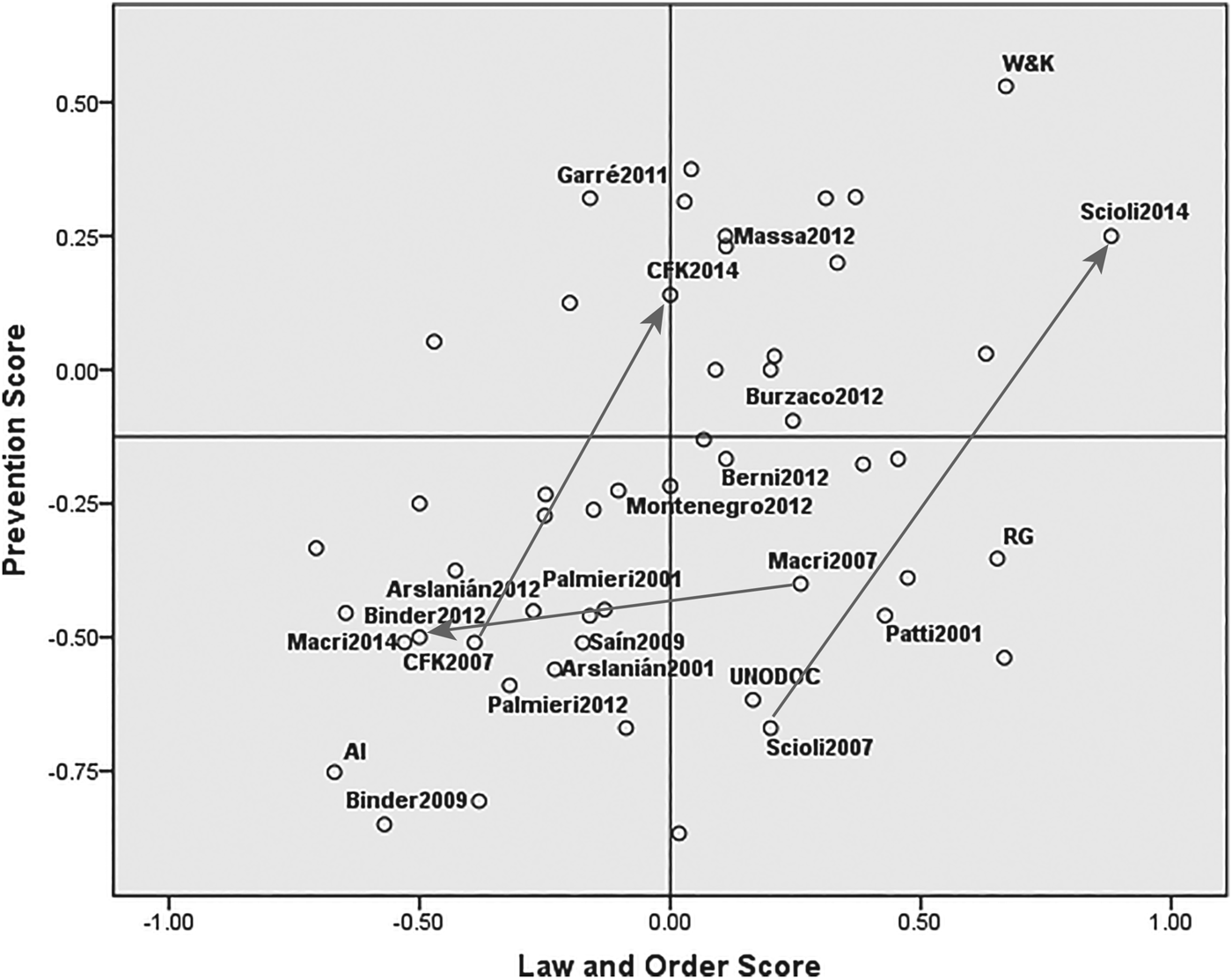
To better evaluate what we identified as the emergence of a new security field and a policy consensus, we conducted a content analysis of a non-random, purposive sample – constructed to best represent policy positions in Argentina – of 46 elite interviews using the open-source Yoshikoder software.Footnote 65 Following examination of our texts we identified two distinct public security dimensions: law and order and crime prevention. We then built dictionaries that allowed us to use computer-aided content analysis to generate a score for each dimension and to plot the results (Figure 1).Footnote 66 This quantitative mapping exercise supplements the qualitative mapping exercise in the previous section, giving a visual sense of the spread of the field with identifiable, though fluid, clusters and revealing rhetorical differences and tensions behind apparently converging security discourse and practices.
Map of the Argentine Security Field

Identifying Policy Positions
Following the convention within political science that the identification of policy positions should use bipolar categories, we focused our analysis on two axes: law and order (with ‘conservative’ and ‘progressive’ poles) and crime prevention (with ‘situational’ and ‘structural’ poles).Footnote 67 The law and order dimension captures views of public security and insecurity ranging from representations of safety as order maintenance threatened by individuals deemed state enemies (conservative/mano dura) to, on the other hand, representations of safety as the protection of individual and collective rights and guarantees (progressive/garantista). The second dimension captures diverging views on crime prevention measures. Some experts emphasise the importance of a tactical, technological approach to dissuade criminals (as with the use of security cameras or the deployment of police agents with modern weapons), which we refer to as situational prevention – a position associated with New York City zero tolerance policies. Others stress the importance of structural factors such as a good education, stable and supportive families, or the elimination of social and economic exclusion, which we refer to as structural prevention – in the literature this is often referred to as a ‘social’ prevention approach. In Argentina, Máximo Sozzo observes, social prevention tropes allowed for the continued use of Peronist ‘social’ discourse in a neoliberal context.Footnote 68
To define standards for analysis and situate our interviewees within the broader macrosecurity constellation, we selected authoritative ‘model texts’ representing alternative security policy doctrines worldwide. Because our interview corpus was in Spanish, we needed model texts in Spanish as well. A document from Amnesty International represented the progressive and structural prevention poles.Footnote 69 A United Nations Office on Drugs and Crime document represented a ‘middle’ position on the two axes.Footnote 70 Spanish versions of the seminal article by James Wilson and George Kelling on ‘broken windows’ and of Giuliani's previously referenced Foreign Policy article represented the conservative and situational poles.Footnote 71 In the dictionaries we included the most frequently used keywords from those model texts associated with law and order and crime prevention theories and positions. For example, the ‘situational’ crime prevention strategy echoes the ‘broken windows’ arguments that minor transgressions of the status quo in a community lead to crime and that the environment can be altered to control this behaviour, so words like ‘abandoned’, ‘neglected’, ‘neighbourhood’ and ‘alarm’ seemed natural fits. The most common word in our progressive model text is derechos (‘rights’) and the second most used word in the conservative model articles is orden (‘order’).
An inductive approach in reviewing our corpus helped us refine the dictionaries, selecting words that uniquely characterise each position.Footnote 72 We then tested the dictionaries on our model texts, calculating law and order and crime prevention position scores. A law and order score of 1 indicates that all of the dictionary words in the text were conservative. Conversely, a law and order score of –1 indicates that all words used were progressive, as with positions stressing human rights. In turn, a score of 0 indicates that the same number of conservative and progressive law and order terms were used in the text. Similarly, a score of 1 on crime prevention means that all elements in the prevention category in a text are situational prevention words (focused on engineering the physical environment to decrease opportunities for crime) and a score of –1 means that all words are structural prevention words (focused on the structural root causes of crime, such as poverty). These results are reported in Table 1.Footnote 73
Dictionary Results for Model Texts

Abbreviations: AI: Amnistía Internacional, Un futuro seguro; UNODC: United Nations Office on Drugs and Crime, ‘Directrices para la prevención del delito’; W&K: Wilson and Kelling, ‘Ventanas rotas’; RG: Giuliani, ‘Hacia una paz realista’.
Source: Authors’ elaboration from Yoshikoder content analysis software results. Following Dandoy, we calculated the scores as follows: the position (P) on a category equals the relative balance of text units from each of the two poles, taken as a proportion of all text units in the category. So for the law and order category P = (Pconservative – Pprogressive)/(Pprogressive + Pconservative), where a score of –1 means that all words in the law and order category in a text are progressive words and a score of 1 means that all words in the law and order category are conservative words. Dandoy, ‘Comparing Party Manifestos’, p. 11.
Given the results for the model texts, we concluded that the categories in our dictionaries appropriately measure the concepts we designed them to measure. Interestingly, while one might think that progressives would tend to support structural crime prevention measures over situational prevention, and that the latter would be the choice of most ‘law and order’ conservatives, this is not necessarily the case. There was no statistically significant correlation between the law and order and crime prevention scores in either the model texts or our sample of interviews. In a way representative of the splits found among the Argentine elites, while the Giuliani and Wilson and Kelling texts yielded almost the exact same (conservative) law and order score, they gave quite different crime prevention scores. The Wilson and Kelling article scored 0.53, indicating support for situational prevention – not surprising as their seminal article presents the rational choice-based ‘broken windows’ theory – whereas the Giuliani article scored –0.35, falling on the structural end of the prevention variable. The plot of the scores for our model texts and interviews shown in Figure 1 illustrates a spread across all four quadrants.
Finally, we created a ‘citizen security’ dictionary with terms associated with the emergent security discourse such as ‘citizen’, ‘democratic’ and ‘rights’. Because we argue that the new discourse represents a fusion of human rights and security, there are no poles in this category and thus we cannot calculate ‘citizen security’ scores. Instead, we used word counts to determine the portion of each interview comprised of citizen security terms, as well as to see whether different actors used certain citizen security terms more or less often. These results are discussed below.
Interpreting the Security Map
Drawing on both individual narratives and data generated by our computer-aided content analysis, we observe that Argentine public security elites have adopted the security discourse over the past decade. The discourse has shifted from the confrontation between rights and seguridad to positions that claim to be different from each other but that actually are much closer than they acknowledge. One main trend already mentioned is the consolidation of a ‘modern’ political Right that adopts a significant number of ‘progressive’ tropes, celebrating diversity with an emphasis on rights while distancing itself from ‘old’ mano dura views.
There is no clearer indication of ideological hybridisation than the bold movement of the leaders of the Argentine government, former president Fernández de Kirchner, and the conservative PRO leader and current president, Mauricio Macri, across our law and order and crime prevention quadrant. As shown in Figure 1, between 2007 and 2014 Fernández de Kirchner moved from a mainstream progressive position to one closer to ‘broken windows’ conservatives, while Macri moved from a perspective close to mano dura to one falling into the quadrant of security progressives. With such crossings-over and hybridisation, the field of security as a democratic mainstream public good had by 2015 been consolidated in Argentina, a long way from the initial debate, which had been framed along mano dura and human rights axes. The fluidity of law and order and crime prevention rhetoric underlay the emergence of a new citizen security discourse that justified a range of invasive security practices in the name of rights.
Interestingly, former police officer, conservative politician, and convicted perpetrator Luis Patti, a face of mano dura positions in the 1990s, scores less conservative on the law and order category than do Giuliani and Wilson and Kelling, as seen in Figure 1. Furthermore, there is a trend for younger conservative politicians, particularly from Macri's PRO Party, to engage in a more moderate law and order discourse. Eugenio Burzaco, former Buenos Aires city police commissioner (and federal security secretary under President Macri), and Guillermo Montenegro, the city's justice and security minister since 2007, fall into this category. As can be seen in Figure 1, both have fairly moderate law and order and prevention scores (Montenegro scores 0 on law and order, putting him exactly in the ‘centre’).
It appears that the ‘new’ political Right coincides with the former Kirchner governments and some sectors of the Left on the importance of subjecting the police and the security forces to the ‘political’ authorities. In 2012 Burzaco emphasised that as police commissioner he ‘did not have enough civilians prepared to take on this [public security] function’, and thus advocated for more university programmes and training opportunities for civilian personnel focused on public security, a strategy that progressive Buenos Aires police reformer León Arslanián also endorsed in our 2012 interview.Footnote 74 Rejecting the ‘false security paradigm’ pitting mano dura against garantismo, Burzaco advocates for a ‘mano justa’ (just hand) approach, which he characterises as ‘having reasonable ideas, modern institutions controlled by political powers (el poder político) who can apply the law’.Footnote 75
Along with emphasising the importance of civilian control over the police, the focus of a part of the Argentine political Right on structural causes of crime appears to unite (at least superficially) some conservatives and progressives in the citizen security paradigm. In addition to political control over the forces of law and order, Burzaco acknowledges both situational and structural causes of crime: ‘Justice also has to do with social equilibrium; if this is broken insecurity results.’Footnote 76 Echoing President Fernández de Kirchner, Montenegro emphasises, ‘[t]hose most affected by insecurity are those who have the least. The people who wait for the bus and pray someone won't steal their trainers.’Footnote 77 This reflects the hegemonic discourse of security identified by Ferradás and Seri – rather than society blaming the failures of neoliberalism for the lack of personal security, those at the losing end are criminalised and scapegoated.Footnote 78 At the same time, by distinguishing between criminals and the deserving poor threatened by them, Montenegro and Burzaco mirror the (re)construction of collective identities in the face of subjective insecurity described earlier.Footnote 79
Despite this moderation, the application of the ‘citizen security’ dictionary reveals that Burzaco and Montenegro have adopted only portions of the new discourse. In contrast with the progressive reformers discussed below, neither expert used the terms ‘citizen security’ or ‘democratic security’. Indeed neither used the words ‘citizen’ or ‘democratic’ in any context. Burzaco invoked the term ‘rights’ once. The only ‘citizen security’ word used by either of these PRO officials was ‘security’.Footnote 80 By way of contrast, two progressive public security experts whom we interviewed in 2001 and 2012, León Arslanián and Gustavo Palmieri, were far more likely to use ‘citizen security’ words, and their use of the ‘citizen security’ words increased over time.Footnote 81 The total count of citizen security-related words for the two interviewees combined went from 60 in 2001 to 109 in 2012.Footnote 82
In contrast with conservatives, progressive reformers with backgrounds in academia and the human rights and non-profit sectors appear to be more focused on the democratic governance of security. Government reformer and academic Marcelo Saín, at the time head of the Aeronautical Police, argued in 2009 that what democratic Argentina needed was ‘politico-institutional direction of the police … by democratically elected authorities’.Footnote 83 Alberto Binder, who worked with Arslanián on the police reform in Buenos Aires and advised the federal government, insisted that political ‘governance of the police’ was necessary to overcome the authoritarian legacy of a ‘double pact’ of ‘the political forces and the security forces … with criminal sectors’.Footnote 84 Collusion between the police and criminal groups has been a concern of reformers in Argentina. The democratic governance of security, according to this perspective, involves embracing the hierarchy of police organisations in order to impose democratic norms – including purges and reforms – from the top of the organisation.
In our 2012 interview León Arslanián insisted that the ‘new security paradigm’ required a broader vision than the old, ‘penal paradigm’ in which ‘criminal law is considered a talisman, like a golden fleece’, in the end establishing ‘a penal populism’ in which politicians compete to attract votes based on tough-on-crime stances. Instead, for Arslanián, the new paradigm requires reformers ‘to work on social prevention and work fundamentally on violence, its causes and the variables that influence it’ in order to prevent crime. Effective prevention, Arslanián insists, involves addressing the structural causes of crime with significant social welfare state reform. ‘We want a more equitable distribution of the gross domestic product and a greater participation in the work, in the distribution of this product. Thus it is a discussion grounded in how to distribute the wealth and the extent of participation of diverse social sectors in this conversation.’Footnote 85
The parallel shift in the trajectory of the law and order and crime prevention scores of President Fernández de Kirchner and Daniel Scioli, her husband's vice-president and the candidate she endorsed in the 2015 presidential election, is striking (Figure 1). While Scioli was consistently more conservative on law and order, both he and the former president became more conservative over time on this dimension and their crime prevention scores shifted dramatically from a focus on structural causes of crime to supporting situational prevention measures.
In terms of the use of ‘citizen security’ words, by 2014 Scioli's discourse was similar to the pattern of the new Right politicians, with an exclusive focus on ‘security’ without the ‘democratic’ or ‘citizen’ context. In a 2014 interview on the security measures he had implemented as governor of Buenos Aires province he failed to use the word ‘rights’, clearly mirroring his conservative law and order discourse. Yet Scioli's discourse – perhaps with a more mano dura flavour – also reflected the hegemonic ‘security as a right’ paradigm. In the final presidential debate of 2015 he asserted the need for ‘order, authority and legality’ while announcing he would increase the use of the militarised border patrol forces – the Gendarmería and the Prefectura – in the fight against drug trafficking.Footnote 86 By way of contrast, President Fernández de Kirchner's use of the term ‘rights’ still (barely) outnumbered references to ‘security’ in 2014 (in 2007 she used the term ‘rights’ seven times and ‘security’ only once). More importantly, between 2007 and 2014 her focus shifted from ‘human rights’ to ‘personal’, ‘civil’ and ‘constitutional’ rights. All of this took place at a time when a section of the conservatives – i.e. the PRO – appeared to adopt milder than initially suggested security positions in their defence of diversity and individual rights.
But this is a mirage. Among his first announcements as president-elect, Mauricio Macri anticipated that he would declare a state of emergency to address insecurity, in such a way as to ‘use all possible instruments to make progress faster’.Footnote 87
Conclusions: Tensions and Fusion between National Security and Human Rights in Argentina's New Security Consensus
Under new auspices, appealing to citizens’ concerns and rights, securitisation may be again undermining democratic life. While the colonisation of democratic life by security is global, its rise across Latin America took place in spite of security's darkest Cold War past. The National Security Doctrine introduced definitions of citizens as enemies of the state and justified the use of state terror against individuals in allegedly irregular ‘wars’. Since the 1990s, security has resurfaced with renewed vigour, but this time claiming democratic credentials.
As retired Supreme Court Justice Eugenio Raúl Zaffaroni cautioned in a 2011 interview, we need to ‘be careful with discourses. There are words that kill. In particular, when the discourse orients toward “generating a scapegoat”, a process which can always “end in a massacre”.’Footnote 88 In the course of two decades, ‘citizen’, or ‘democratic’, security has emerged as a distinctive policy field in Argentina, distinguished from old National Security traditions by claims to protect citizens’ human rights. If the stated intention of ‘citizen’ security is to infuse security with civic values and practices, the outcome has been uncertain, for ‘democratic’ security has proven to be prone to brutal repression, criminalisation of protest, and the militarisation of policing. And yet the shift has become hegemonic, to the point that the agenda of the main three 2015 presidential candidates in matters of security was basically indistinguishable – except that, at times, the discourse of the supposedly more progressive Scioli appeared more mano dura than Macri's. As in other parts of the world, the consolidation of security coincides with the rise of a fragmented, unequal society in which the market offers opportunities only to some.
So what do we make of this citizen security discourse (or variants) overlaid on what still appear to be fundamental (though fluid) differences on law and order and crime prevention strategies? Defining democratic/citizen security to include security as a right facilitates the diffusion of responsibility for police abuse, perversely allowing those abuses committed in the name of security to continue, as those who call for political governance of the police have cautioned. At the same time, neopopulist and right-wing governments alike dodge the contradictions of growing inequality in the context of political democracy.
Soon after taking office, Néstor Kirchner claimed that his government would not repress social protest, expressing a commitment to human rights. President Cristina Fernández de Kirchner's Security Minister Garré confirmed that the government would neither spy on its citizens nor repress social protest. And yet, the government did precisely what it promised not to do, spying on and repressing protests, targeting activists from environmentalists in Catamarca to indigenous peoples in the northern part of the country. If the external security forces – the Gendarmería, especially – were given a more active role in the policing of protest from the mid-1990s, this dynamic was perfected and intensified under the Kirchners. This development is particularly ironic in light of the couple's consistent critique of the Argentine military's dark human rights legacy.
The government has changed, but the discourse remains familiar. President Macri designated Patricia Bullrich as minister of security and Eugenio Burzaco as secretary of security.Footnote 89 Burzaco employed the logic of the new security field to resolve any contradiction between the policing of protest and the protection of rights, as he explained how he would deal with the piqueteros, whose protests often involve blocking city traffic: ‘The people have the right of movement, to go to work, to produce; the complaint [of the piqueteros] is just and it may be exerted, but not in a manner that is extortive.’Footnote 90
In Argentina, the rise of security under democratic auspices complicates traditional political cleavages conceived in terms of Left or Right. The demands of security colonise different agendas and political languages, redefining and subordinating initially critical paradigms such as human rights. Here, Argentina fits into the new global security constellation, though local political traditions, such as populism, imprint distinct traits on the ways in which security reclaims democracy.
With the support of competing political elites, a securitising alchemy trumps social and criminal policy and the rule of law. The new field of security continues to gain legitimacy across Latin America, a region in which a rising fear of crime overlaps with democratisation. In turn, democratic/citizen security develops in a problematic relation with, and having to disentangle itself from, the authoritarian tradition linked to the National Security Doctrine. Consolidated and accepted as the norm, the field compels any politician running for elections these days, Right or Left, to have a proposal to address insecurity. The new security consensus may take distinct discursive turns in Argentina compared to those in neighbouring Chile or more conservative governments elsewhere: our analysis therefore suggests that a closer look at the policy consequences of the new field of democratic security in different political contexts is warranted.
Acknowledgements
The authors would like to thank the dedicated Argentine reformers, policy-makers and politicians who agreed to be interviewed for this project. Thanks also to Michelle Bonner and Mercedes Hinton for useful comments on a previous version of this paper and to the editors and four anonymous reviewers.