Introduction
Energy and environmental issues on a global level are important topics. It is indispensable to construct clean energy systems in order to solve these issues. Solar H2 production from water is one of the most promising processes. Semiconductor electrodesReference Fujishima and Honda1–Reference Kudo5 and photocatalystsReference Licht4–Reference Inoue11 will be useful for solar water splitting. Solar water splitting using a powdered photocatalyst is a strong candidate for practical large-scale use for a H2 production system because of its simplicity of fabrication.
Photon energy is converted to chemical energy accompanied by a largely positive change in the Gibbs free energy through water splitting. This reaction is similar to photosynthesis by green plants from the viewpoint of an uphill reaction with a positive change in the Gibbs free energy. Therefore, photocatalytic water splitting into H2 and O2 in a stoichiometric ratio is regarded as artificial photosynthesis. Artificial photosynthesis is an attractive and challenging theme in chemistry. Although many oxide photocatalysts have been reported for water splitting, they only respond to UV irradiation.Reference Licht4–Reference Inoue11 The number of photocatalysts that are active for water splitting under visible light irradiation is very limited. Therefore, it is important to develop improved visible-light-driven photocatalyst materials for solar water splitting.
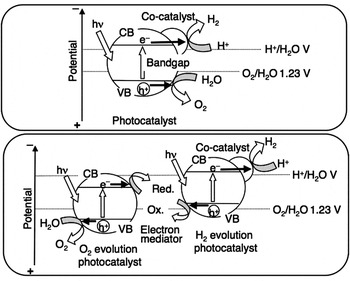
There are two types of photocatalyst systems for water splitting under visible light irradiation, as shown in Figure 1. A single-particulate photocatalyst system is one example. Important points in the single-particulate semiconductor photocatalyst system are the width of the bandgap and levels of the conduction and valence bands. The bottom level of the conduction band has to be more negative than the redox potential of H+/H2 (0 V versus NHE [normal hydrogen electrode]), while the top level of the valence band needs to be more positive than the redox potential of O2/H2O (1.23 V). The bandgap of a visible-light-driven photocatalyst should be narrower than 3.0 eV (λ > 415 nm). Therefore, suitable band engineering is necessary for tuning the band positions of photocatalyst materials for water splitting under visible light irradiation. Some oxynitride photocatalysts such as GaN-ZnO and ZnGeN2-ZnO solid solutions are active for water splitting as a single-particulate photocatalyst.Reference Maeda, Teramura, Lu, Takata, Saito, Inoue and Domen12, Reference Lee, Terashita, Shimodaira, Teramura, Hara, Kobayashi, Domen and Yashima13 See the Maeda and Domen article in this issue.
Single- and two-particulate photocatalyst systems for water splitting into H2 and O2. CB, conduction band; VB, valence band; h, Planck’s constant; ν, frequency.

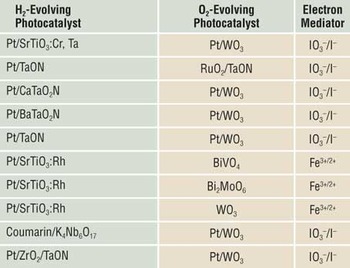
Two-photon systems, as seen in photosynthesis by green plants (z-scheme), are another way to achieve overall water splitting. The z-scheme is composed of a H2-evolving photocatalyst, an O2-evolving photocatalyst, and an electron mediator, as shown in Figure 1. Photocatalysts that are active only for half reactions of water splitting (sacrificial H2 and O2 evolution reactions) can be employed for the construction of the z-scheme: that is the merit of the z-scheme. There are many reports about visible-light-driven photocatalysts that show the activities for H2 and O2 evolution from water containing sacrificial reagents (electron donor and acceptor reagents), for example, WO3,Reference Darwent and Mills14 BiVO4,Reference Kudo, Omori and Kato15 Cr and Sb co-doped TiO2 (TiO2:Cr,Sb),Reference Kato and Kudo16 AgNbO3,Reference Kato, Kobayashi and Kudo17 Cr and Ta co-doped SrTiO3 (SrTiO3:Cr,Ta),Reference Ishii, Kato and Kudo18 Rh-doped SrTiO3 (SrTiO3:Rh),Reference Konta, Ishii, Kato and Kudo19 SnNb2O6,Reference Hosogi, Tanabe, Kato, Kobayashi and Kudo20 Cr-doped PbMoO4 (PbMoO4:Cr),Reference Shimodaira, Kato, Kobayashi and Kudo21 Rh and Sb co-doped TiO2 (TiO2:Rh,Sb),Reference Niishiro, Konta, Kato, Chun, Asakura and Kudo22 Sm2Ti2S2O5,Reference Ishikawa, Takata, Kondo, Hara, Kobayashi and Domen23 Ta3N5,Reference Maeda and Domen8 and TaON.Reference Yamashita, Takata, Hara, Kondo and Domen24 These photocatalysts are inactive for overall water splitting into H2 and O2 in the absence of sacrificial reagents. However, overall water splitting has been attained by constructing a z-scheme photocatalysis system composed of H2- and O2-photocatalysts and a suitable electron mediator.Reference Sayama, Mukasa, Abe, Abe and Arakawa25–Reference Maeda, Higashi, Lu, Abe and Domen33Table I summarizes reported z-scheme photocatalyst systems that work for water splitting under visible light irradiation. Combined systems of Pt co-catalyst loaded SrTiO3 co-doped with Cr and Ta (Pt/SrTiO3:Cr,Ta) for the H2-evolving photocatalyst with Pt/WO3 for the O2-evolving photocatalyst can split water into H2 and O2 in stoichiometric amounts under visible light irradiation in the presence of an IO3–/I– redox couple. Oxynitride photocatalysts TaON, CaTa2O2N, and BaTa2O2N can be used as H2-evolving photocatalysts with a Pt/WO3 of an O2-evolving photocatalyst. These photocatalyst systems respond to about 450 nm of light, which is limited by the bandgap of WO3. The system of Pt/TaON with RuO2/TaON is a unique combination and is active up to 500 nm. Coumarin dye adsorbed on a K4Nb6O17 photocatalyst with a wide bandgap works as an H2-evolving photocatalyst through a dye sensitization process. ZrO2 modification of TaON on an H2-evolving photocatalyst improves the activity. The z-scheme system consisting of Pt/SrTiO3:Rh and BiVO4 or Bi2MoO6 or WO3 is also active in the presence of a Fe3+/Fe2+ redox couple. The system of Pt/SrTiO3:Rh and BiVO4 responds to 520-nm light, which corresponds to the bandgaps of SrTiO3:Rh and BiVO4. The system of SrTiO3:Rh and BiVO4 corresponds to the longest light wavelength with relatively high activity among z-scheme systems, shown in Table I. It also shows activity for solar water splitting. Moreover, this z-scheme system works without an electron mediator only when SrTiO3:Rh is employed as a H2-evolving photocatalyst.
Z-scheme-type photocatalysts for water splitting under visible light irradiation.

In this article, the z-scheme systems consisting of SrTiO3:Rh of an H2-evolving photocatalyst and O2-evolving photocatalysts with and without electron mediators are reviewed and discussed in detail.
Construction of a z-scheme system composed SrTiO3:Rh and O2-evolving photocatalysts
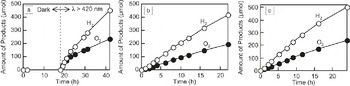
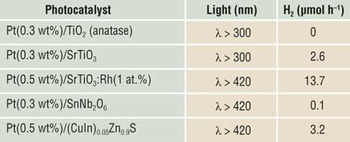
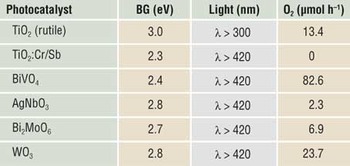
The photocatalytic activities for half reactions of water splitting are listed in Tables II and III. Table II shows the H2 evolution from an aqueous solution containing Fe2+ ions as an electron donor on various photocatalysts. This reaction is based on sacrificial H2 evolution. The Pt/TiO2-anatase did not produce H2, while Pt/SrTiO3 produced H2 under UV light irradiation. On the other hand, the H2 evolution proceeded on Pt-loaded SrTiO3:Rh, which was a highly active photocatalyst for the H2 evolution from an aqueous methanol solution under visible light irradiation.Reference Konta, Ishii, Kato and Kudo19Table III shows the O2 evolution from an aqueous solution containing Fe3+ ions as an electron acceptor on various photocatalysts. This reaction is based on sacrificial O2 evolution. TiO2-rutile, BiVO4, Bi2MoO6, and WO3 showed reasonable photocatalytic activities. These results of sacrificial H2 and O2 evolution reactions led to the construction of the z-scheme photocatalysis systems consisting of the Pt/SrTiO3:Rh photocatalyst, the O2-photocatalyst (BiVO4, Bi2MoO6, and WO3), and the Fe3+/Fe2+ redox couple as an electron relay, as shown in Figure 1.Reference Kato, Hori, Konta, Shimodaira and Kudo26 In this scheme, Fe3+ is reduced by electrons photogenerated in the conduction band of BiVO4, while Fe2+ is oxidized by holes photogenerated in the electron donor levels formed by doped Rh in SrTiO3:Rh. The result is that iron ions are not consumed, but instead are cycled during the photocatalytic water splitting. All systems produced H2 and O2 in the ratio of 2:1 from an aqueous FeCl3 solution under visible light irradiation, as shown in Figure 2. The solution contained Fe3+ and Fe2+ in a suitable ratio under steady state.
Photocatalytic overall water splitting on (a) (Pt/SrTiO3:Rh)-(BiVO4), (b) (Pt/SrTiO3:Rh)-(Bi2MoO6), and (c) (Pt/SrTiO3:Rh)-(WO3) systems.Reference Kato, Hori, Konta, Shimodaira and Kudo26 Photocatalytic water splitting into H2 and O2 in stoichiometric amounts under visible light irradiation was accomplished by constructing z-schemes. Catalyst: 0.1 g for each component, reactant solution: 2 mmol L–1 of an aqueous FeCl3 solution, 120 mL, pH 2.4, lamp: 300 W Xe-arc lamp (wavelength, λ > 420 nm) cell: top-irradiation cell with a Pyrex window. The notation of (Pt/SrTiO3:Rh)-(BiVO4) indicates the mixture of Pt/SrTiO3:Rh and BiVO4 powders.

H2 evolution over visible-light-driven photocatalysts using Fe2+ as an electron donor.

Catalyst: 0.1 g, reactant solution: 120 mL, pH: 2.4, top-window reaction cell, 300-W Xe-arc lamp.
O2 evolution over visible-light-driven photocatalysts using Fe3+ as an electron acceptor.

Catalyst: 0.1 g, reactant solution: 120 mL, pH: 2.4, top-window reaction cell, 300-W Xe-arc lamp.
Factors affecting activity of z-scheme photocatalyst systems
Photocatalytic activities of water splitting using z-scheme systems are affected by pH, co-catalysts, and electron mediators.Reference Kudo and Miseki10 These factors are discussed in the following sections.
Effect of pH on the photocatalytic activity for water splitting
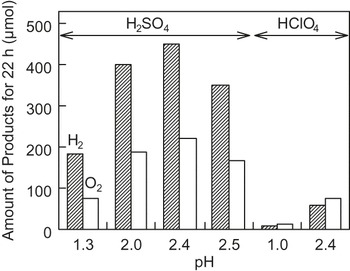
Each reaction step in a z-scheme, shown in Figure 1, is affected by pH. For example, reactivity and the nature of an electron mediator strongly depend on the pH.Reference Sayama, Mukasa, Abe, Abe and Arakawa25, Reference Kato, Sasaki, Iwase and Kudo28Figure 3 shows the effect of pH on photocatalytic water splitting using the (Pt/SrTiO3:Rh)-(WO3)-(FeCl3) system.Reference Kato, Sasaki, Iwase and Kudo28 Here, the pH was adjusted using sulfuric acid, perchloric acid, or hydrochloric acid. The photocatalytic activity of the present z-scheme system was sensitive to pH and the kind of an acid used for pH control. When sulfuric acid was used for the pH adjustment, the z-scheme system showed activity in the pH range 1.3 ≤ pH ≤ 2.5, although the activity depended on the pH. The optimum pH was 2.4. On the other hand, when the pH was adjusted with perchloric acid, the z-scheme system showed activity at pH 2.4, although the activity was only one sixth of that when sulfuric acid was used. A similar activity to pH-2.4-FeCl3-HClO4 was obtained when the pH was adjusted with hydrochloric acid. The highest activity was obtained in the aqueous FeCl3-H2SO4 solution with pH 2.4. The low pH is indispensable for suppression of hydrolysis of Fe3+ to form hydroxide precipitation. The sulfate ions create [Fe(H2O)5(SO4)]+ species around pH 2.4. This iron complex or cluster covers the surface of a Pt co-catalyst to suppress back-reactions to form H2O from evolved H2 and O2 because the back-reactions easily proceed to form water from evolved H2 and O2 for water splitting of the uphill reaction, as mentioned in the next section.
Dependence of photocatalytic activity of the (0.5 wt%Pt/SrTiO3:1 at%Rh)-(WO3) system on pH under visible light irradiation.Reference Kato, Sasaki, Iwase and Kudo28 Photocatalytic activity for water splitting using a z-scheme system employing iron ions as an electron mediator strongly depends on pH and acids, suggesting that the [Fe(H2O)5(SO4)]+ species suppress a back-reaction to form H2O from evolved H2 and O2 on a Pt co-catalyst. Catalyst: 0.1 g for each component, reactant solution: 2 mmol L–1 of FeCl3, 120 mL, light source: 300 W Xe-arc lamp with a cutoff filter (wavelength, λ > 420 nm) cell: top-irradiation cell with a Pyrex window.

Effect of co-catalysts on the photocatalytic activity for water splitting
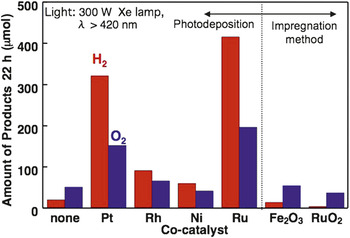
A co-catalyst plays an important role in providing reaction sites for H2 formation on the surface of a photocatalyst (Figure 1). Oxide photocatalysts that show reasonable activities for H2 evolution under visible light irradiation are only SrTiO3:Cr,TaReference Ishii, Kato and Kudo18 and SrTiO3:Rh.Reference Konta, Ishii, Kato and Kudo19 These materials are indispensable for construction of z-scheme systems using only oxide materials. So, SrTiO3:Rh is implied as a H2-evolving photocatalyst. The activities of z-scheme photocatalysis systems consisting of SrTiO3:Rh loaded with various co-catalysts and WO3 for overall water splitting are shown in Figure 4.Reference Sasaki, Iwase, Kato and Kudo31 These co-catalysts were loaded by photodeposition and impregnation methods. In the photodeposition method, metal ions are reduced by electrons photogenerated in a photocatalyst to form metallic particles on the surface. In the impregnation method, after the SrTiO3:Rh powder is added to an aqueous solution containing metal species, the water is evaporated, resulting in metal salts loading onto the surface of the SrTiO3:Rh powder. The metal salts decompose with calcination in air at suitable temperatures to produce a co-catalyst-loaded SrTiO3:Rh photocatalyst. When Ni, Ru, Rh, and Pt co-catalysts were loaded on SrTiO3:Rh, water splitting was enhanced in comparison with a non-loaded system, which was due to the enhancement of H2 production. Au co-catalysts are also effectve.Reference Sasaki, Iwase, Kato and Kudo31 The system employing a photodeposited Ru co-catalyst showed high photocatalytic performance as well as the system employing a Pt co-catalyst. The ratios of evolved H2 to O2 deviated from stoichiometry when H2 production was poor. It was due to the dominance of O2 production on the WO3 photocatalyst at the initial stage of the reaction using an aqueous FeCl3 solution.Reference Kato, Sasaki, Iwase and Kudo28
Effect of co-catalysts loaded on SrTiO3:Rh of a H2-evolving photocatalyst on water splitting by using a z-scheme combined with WO3 of an O2-evolving photocatalyst.Reference Sasaki, Iwase, Kato and Kudo31 A photodeposited Ru co-catalyst is effective for SrTiO3:Rh of a H2-evolving photocatalyst z-scheme system. Catalyst: 0.05 g for each component, reactant solution: 2 mmol L–1 of FeCl3, 120 mL, light source: 300 W Xe-arc lamp with a cutoff filter (wavelength, λ > 420 nm) cell: top-irradiation cell with a Pyrex window.

The RuO2 co-catalyst has often been used for overall water splitting.Reference Inoue11, Reference Ogura, Kohno, Saito and Inoue34–Reference Sakata, Hashimoto and Kawai36 The Ru co-catalyst formed after photodeposition was effective, whereas that loaded by an impregnation method was not effective in the present z-scheme system. The effect of the RuO2 co-catalyst strongly depended on the condition of RuO2. X-ray photoelectron spectroscopy and scanning electron microscopy analyses indicated that the surface of the photodeposited Ru co-catalyst was oxidized by air or water. This is the reason why the Ru co-catalyst is superior to Pt, as mentioned in the next section.
Comparison of a Ru co-catalyst with a Pt co-catalyst as a H2-evolution site
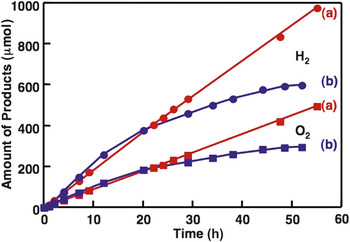
Figure 5 shows time courses of photocatalytic overall water splitting on the (Pt/SrTiO3:Rh)-(BiVO4) and (Ru/SrTiO3:Rh)-(BiVO4) systems using an Fe3+/Fe2+ electron mediator.Reference Kato, Sasaki, Iwase and Kudo28, Reference Sasaki, Iwase, Kato and Kudo31 Because this reaction was carried out in a gas-closed circulation system, the evolved H2 and O2 accumulated in the system. In the early stage, the activity of the system employing the Pt co-catalyst was slightly higher than that employing the Ru co-catalyst. However, the activity of the system employing the Pt co-catalyst gradually decreased after 10 hours, and eventually the reaction almost stopped after 50 hours. In contrast, the reaction steadily proceeded for a long time in the system employing the Ru co-catalyst even under relatively high pressures of evolved H2 and O2, indicating that back-reactions barely proceeded on the Ru co-catalyst during the photocatalytic water-splitting process. There was a significant advantage for the system employing the Ru co-catalyst.
Photocatalytic overall water splitting on (a) the (0.7 wt%Ru/SrTiO3:Rh)-(BiVO4) system and (b) the (0.1 wt%Pt/SrTiO3:Rh)-(BiVO4) system.Reference Sasaki, Iwase, Kato and Kudo31 A Ru co-catalyst for a SrTiO3:Rh H2-evolving photocatalyst has stable activity for water splitting compared to a Pt co-catalyst. Catalyst: 50 mg each, reactant solution: 2 mmol L–1 of aqueous FeCl3 solution, 120 mL, pH 2.4, light source: 300 W Xe-arc lamp (wavelength, λ > 420 nm), cell: top-irradiation cell with a Pyrex glass window.

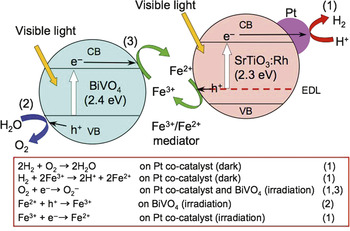
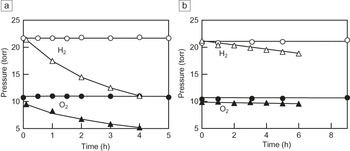
The difference in deactivation between Ru and Pt co-catalysts is due to back-reactions that were caused by the increase in the pressures of evolved H2 and O2. The back-reactions are suppressed in the system employing the Ru co-catalyst in comparison with the system employing the Pt co-catalyst. Possible back-reactions are illustrated in Figure 6. Back-reactions (1) in Figure 6 were examined with the suspension of the (Pt/SrTiO3:Rh)-(BiVO4) and (Ru/SrTiO3:Rh)-(BiVO4) systems in the dark, as shown in Figure 7. Twenty torrs of H2 and 10 torrs of O2 were introduced into the system with the catalyst suspension. The decreases in pressures of the gases were monitored. Remarkable decreases in pressure of H2 and O2 due to water formation were observed in the Pt co-catalyst system when Fe3+ ions were absent (triangles in Figure 7a). In the presence of Fe3+ ions, the decreases in pressure of the gases in the system employing the Pt co-catalyst were remarkably suppressed at pH 2.4, because [Fe(H2O)5(SO4)]+ and [Fe(H2O)5(OH)]2+ ions cover the Pt surface, although the gas consumption was still observed slightly (triangles in Figure 7b).Reference Kato and Kudo16 The ratio of H2 consumption to O2 was more than two, indicating that a reduction of Fe3+ ions by H2 proceeds. In contrast, H2 and O2 were not consumed in the system employing the Ru co-catalyst in the absence and presence of Fe3+ ions (circles in Figure 7a and 7b).
Undesirable back-reactions for water splitting using a z-scheme photocatalyst system. “Dark” and “irradiation” in the figure indicate that the reactions proceed under dark and irradiation conditions, respectively. CB, conduction band; VB, valence band; EDL, electron donor level formed by Rh3+.

Consumption of H2 and O2 due to back-reactions (a) without Fe3+ ions and (b) with 2 mmol L–1 aqueous FeCl3 solution on the (0.3 wt% Pt/SrTiO3:Rh)-(BiVO4) (triangles) and (0.7 wt% Ru/SrTiO3:Rh)-(BiVO4) (circles) systems in the dark.Reference Sasaki, Iwase, Kato and Kudo31 A back-reaction to form H2O from H2 and O2 barely proceeds on a Ru co-catalyst, showing that the Ru co-catalyst is effective for photocatalytic water splitting under the specified experimental conditions. Open symbols: H2, closed symbols: O2. Catalyst: 50 mg each, reactant solution: 120 mL, pH = 2.4 adjusted by H2SO4.

Z-scheme systems without electron mediators for solar water splitting
An electron mediator plays an important role in electron transfer from an O2-evolving photocatalysts to a H2-evolving photocatalyst, as shown in Figure 1. However, the electron mediator also produces negative effects, as shown in Figure 6. Moreover, if an electron mediator has color, part of the visible light is absorbed by the electron mediator. A suitable combination between photocatalysts and the electron mediator is required, as shown in Table I. So, a z-scheme system without an electron mediator has attracted our attention in eliminating this limitation.
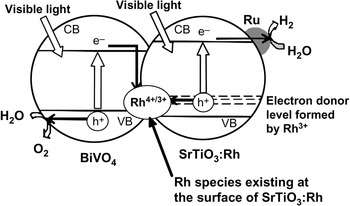
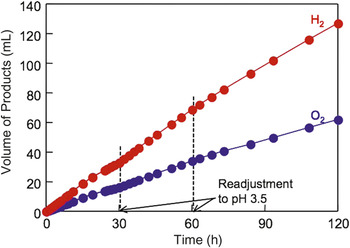
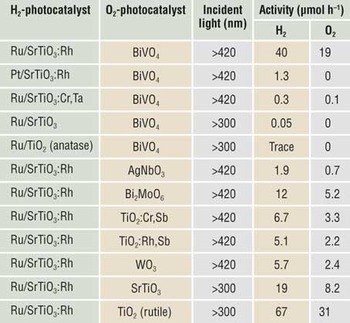
The present z-schemes consisting of Rh-doped SrTiO3 loaded with Ru co-catalyst and O2-evolving photocatalysts work for overall water splitting into H2 and O2 in a stoichiometric ratio under visible light irradiation without any electron mediators, according to the scheme as shown in Figure 8 and in Table IV.Reference Sasaki, Nemoto, Saito and Kudo37 In this process, the contact between the H2-photocatalyst of Ru/SrTiO3:Rh and various O2-photocatalysts is indispensable. The best contact was achieved at pH 3.5 with aggregation of these particles. It was reasonable judging from the zeta potentials of those particles at which the surface charges were neutral. The surface charge of the SrTiO3:Rh powder is positive at pH 3.5, while that of BiVO4 is negative, resulting in the aggregation of these powders by an electrostatic force. Thus, various combinations of z-scheme systems have been developed for water splitting, as shown in Table IV. Among them, the combination of Ru/SrTiO3:Rh and BiVO4 gave the highest activity under visible light irradiation. The overall water splitting preceded steadily over 120 h even using a solar simulator AM-1.5 as a light source, as shown in Figure 9. When the Pt co-catalyst was loaded on the SrTiO3:Rh photocatalyst, overall water splitting did not proceed because of the enhanced backward reaction of water formation from evolved H2 and O2 or their intermediates. An electron mediator of Fe3+/Fe2+ was indispensable for the z-scheme photocatalysis system employing the Pt-loaded SrTiO3:Rh photocatalyst, as mentioned previously.Reference Kato, Hori, Konta, Shimodaira and Kudo26, Reference Kato, Sasaki, Iwase and Kudo28 Moreover, other H2-photocatalysts, except Ru/SrTiO3:Rh, could not function for overall water splitting, indicating that doped Rh significantly participated in not only the formation of the impurity level in the forbidden band for visible light response but also the electron transfer between photocatalyst particles.
Mechanism of water splitting using the z-scheme photocatalysis system driven by electron transfer between Ru/SrTiO3:Rh and BiVO4 photocatalysts.Reference Sasaki, Nemoto, Saito and Kudo37 Z-scheme-type water splitting proceeds with interparticle electron transfer from BiVO4 to SrTiO3:Rh through the Rh species on the surface. CB, conduction band; VB, valence band.

Solar water splitting into H2 and O2 using the z-scheme (Ru/SrTiO3:Rh)-(BiVO4) system.Reference Sasaki, Nemoto, Saito and Kudo37 Solar water splitting for over 120 h was achieved with the z-scheme system without an electron mediator. Catalyst: 0.1 g each. Reactant solution: aqueous H2SO4 solution, pH 3.5, 180 mL. Light source: a solar simulator with an AM-1.5 filter (100 mW cm–1). Irradiated area: 33 cm2

Overall water splitting using z-scheme photocatalysis systems composed of various powdered H2- and O2-photocatalysts without electron mediators.

Reaction conditions: reactant solution; aqueous H2SO4 solution, pH 3.5, 120 mL, light source; 300-W Xe-arc lamp, cell; top-irradiation cell with a Pyrex glass window.
Summary
Research of photocatalytic water splitting has progressed, with an increased understanding of materials phenomena. Highly efficient photocatalyst materials for water splitting under UV irradiation have been developed. Moreover, water splitting under visible light irradiation has been achieved with several photocatalyst materials. Water splitting using powdered photocatalysts is the simplest way for sunlight energy conversion to chemical energy, which requires water, sunlight, and powder. Z-scheme photocatalysts are promising systems for solar water splitting. Although the efficiency is low at the present stage, z-scheme photocatalyst systems can work using sun light. The z-scheme system can employ a variety of photocatalysts that are active for either H2 or O2 evolution. The efficiency can be improved by finding stable oxide photocatalysts with narrow bandgaps, especially for H2 evolution. Moreover, H2 can be obtained separately from O2 using a z-scheme system consisting of a powder-suspension system because a H2-evolving photocatalyst is different from an O2-evolving photocatalyst. Thus, the z-scheme system is different from a one-particle system, as shown in Figure 1, and its capability is a significant property of the z-scheme photocatalyst system. Alternatively, photoelectrochemical cells for solar water splitting can be constructed using the materials employed for the z-scheme photocatalyst systems. The achievement of photocatalytic water splitting for practical use will contribute to an ultimate solution for energy and environmental issues.